IU Southeast Writing Contest Winners, 2014

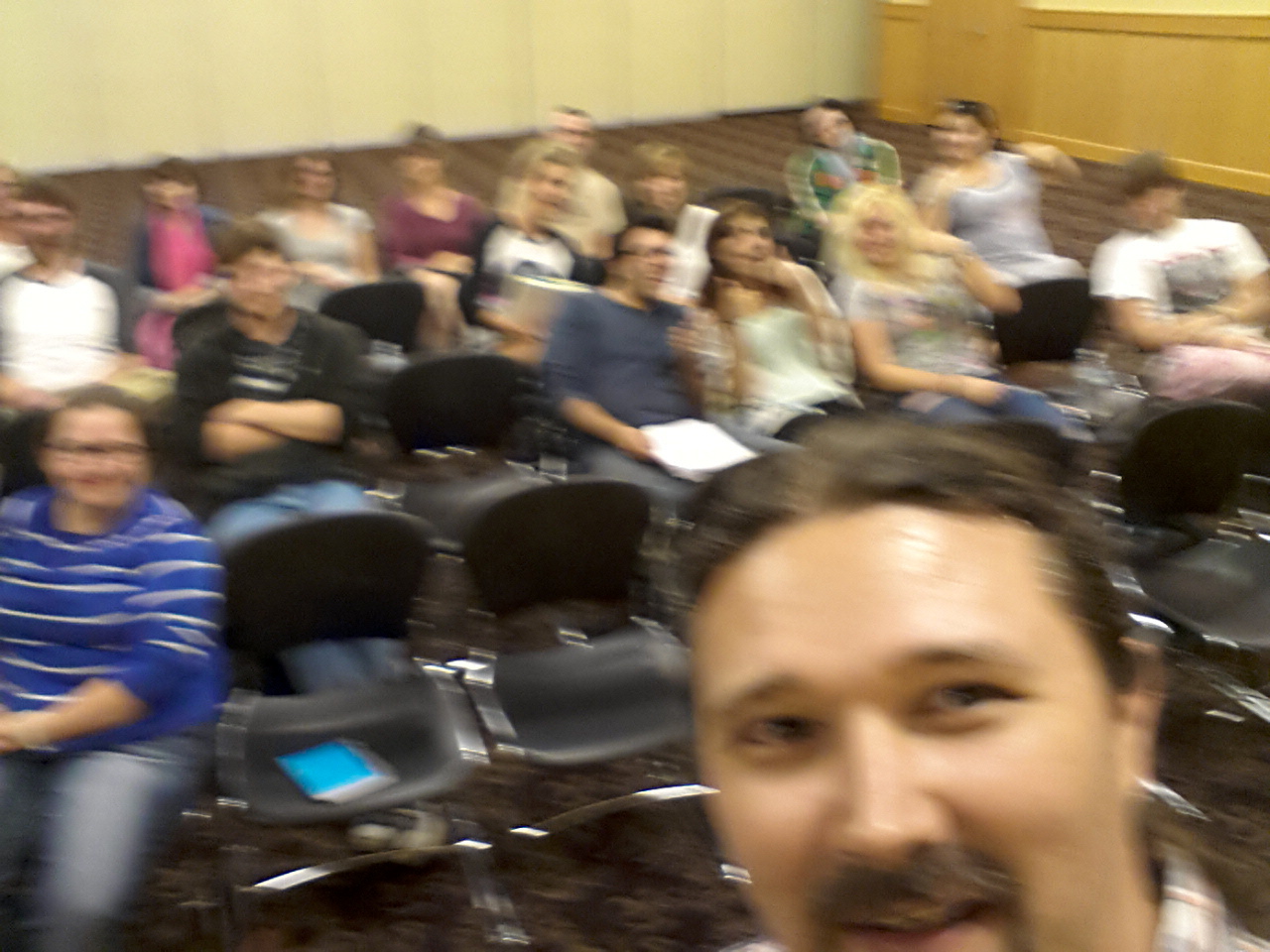
Screen shot 2013-11-21 at 7.09.25 PMLast year, I had the honor of judging the fiction section of the Indiana University Southeast Writing Contest. It was a wonderful experience reading such talented writers, and I was doubly honored this year when those students invited me to campus to read from Hagridden and give a talk on fiction writing.

Anyone remember this fun evening?


But then the university went further still and invited me to once again judge the writing competition, this time in the flash fiction category.

The IU Southeast has now announced the winners and held their awards gala (I’m told my friend Steve Bowman, who teaches at IUS, made kind mention of me, too — thanks, Steve!).

I offer my congratulations to all the writers who submitted their wonderful flash fiction, and extra applause to the winners: Tanya Le (1st place for “Crying While Laughing”), Josh Medlock (2nd place for “The Last Valentine’s Day”), Deanna Babcock, (3rd place for “Neighbors”), and Katelyn Hamilton (Honorable Mention for “Gone”). It’s worth pointing out, too, that Deanna Babcock and Katelyn Hamilton also place in other categories — clearly, the writers at IUS are multitalented!

Best of luck to all the writers as they keep at the craft! Send your work out into the world, gang, and here’s to many future publications!

Buy Hagridden and support military families

I have two dedications in my Civil War novel, Hagridden: the first is to my wife, the second is to “every civilian who ever lived through a war or is living through one now.”

In public appearances, I tend to tell people that my novel is about the people that war leaves behind.

Both of which are to say that, having written this novel about the desperate circumstances of a mother and her daughter-in-law left alone when their son/husband goes off to war —  and as a brother-in-law to a man who has served in our own wars today, the nephew of an Air Force colonel, and the grandson of men who served in WWII — I have a special place in my heart for military families.

Screen shot 2014-12-08 at 7.11.53 PMSo this holiday season, I’ve decided to donate a portion of all my Hagridden sales to the National Military Family Association. Founded in 1969 by military spouses, it has become an impressive organization whose mission is to help provide “comprehensive child care, accessible health care, spouse employment options, great schools, caring communities, a secure retirement, and support for widows and widowers” in American military families.

As a pacifist, I abhor war itself, but I have always honored the service that military life represents, and I think that too often we forget the sacrifice of those that military service leaves at home. And I figure this season of compassion and generosity is the perfect time to help families who face hardship because of their service and sacrifice, and the mission of this organization fits perfectly with the themes of my novel.

So every time you buy a copy of Hagridden — for yourself or as a gift, or both — I’ll donate a portion of that sale to military families.

This will carry on the whole month of December, so if you’ve already bought copies of Hagridden this month, you’ve already helped military families; and if you are still doing your holiday book-buying, you can still help military families.

And if you’d like to donate directly, you can do so at the National Military Families Association website, where you can also find information about other ways to get involved.

Our own worst nightmares: wrestling with violence in (my) fiction

One Tuesday this past June, I was planning to run a few errands, do a little grading, and then settle in for a long afternoon of proofreading my Civil War novel, Hagridden. At the time, it was still a couple months from publication, and I was going through the last edits in the proof copy. But before I got to work, I turned on the morning news and heard that there had been a shooting at a high school in Troutdale, Oregon.

This high school is just 30 minutes from my house in Portland; it’s just a few blocks from the house I lived in as a toddler in Troutdale, and just a few blocks from the college where my wife works now. She had just driven past the high school minutes before the shooting occurred.

I spent the whole morning and part of my afternoon watching, reading, and listening to the reports. One student killed. Another student, the shooter, dead as well. A teacher wounded. A community wounded, in shock and grieving.

But then the news took a break, and I still had errands to run, so I left the house. I dropped off the dry cleaning and some library dvds, I deposited some checks at the bank, and I stopped at a café for a beer. I took out my novel and a pencil, figured I might as well get to work.

In chapter one, my two main characters murder three men and dump their bodies in an abandoned well. And I realized I might as well have never turned away from the news.

We’ve been wrestling with violence in literature — in art in general — for about as long as art has existed, though historically that violence has been either an expression of nature (beasts emerging from an unknowable darkness to devour us, storms ravaging the relative calm we’ve grown accustomed to) or an expression of the abnormal in an otherwise ordinary world (monsters in hidden dwellings, the occasional brutality of warfare or self-defense).

Hagridden, rooted in a frightening past, addresses all these things: there are the women desperate to survive by any means necessary, their neighbor haunted by his wartime experience, a lieutenant driven mad by combat, the swampland legends of the wolf-like rougarou, the desolation of the bayou and the devastation of a hurricane . . . .

But I have always maintained that, like science fiction, historical fiction is never as much about the time it depicts as it is about the time it was written, and I’m very much aware that Hagridden is a modern novel. And this issue of violence in fiction has been a particular thorn in our modern side, especially for Southern fiction. In the general sense, this is perhaps because, in our modern era, we’re more aware of ourselves, and so we’re more aware of the dark reality that we each are the authors of our own worst nightmares, that we are the monsters we fear the most.

The past couple of months, I’ve been working on a new novel. This is also set in the South, it also deals with a violent historical period, just after the Civil War, when divided sentiments and racial tensions and deep mistrust of government authority manifested in localized and deeply personal wars.

And on the news, I hear about the deaths of John Crawford and Mike Brown and Eric Garner and Tamir Rice; I read about divided communities, racial tensions, and a deep mistrust of the police and a legal system that allows them to kill unarmed civilians without consequence.

People have taken to the streets in furious protest all across the country. As I write this, huge crowds are marching downtown in my own city of Portland. And I love those people and I support them with all my heart. But personally, I don’t know how else to respond to the violence in my world except to write it. Because in writing about violent characters and characters who are the victims of violence, I have to put myself in their places and imagine their lives.

In a world so full of violence and so compelled to report on it and consume it, what can a writer do but explore that phenomenon on the page, to try to understand it?

There are happier things to write about, like love and friendship and community support, and when they work in a story I want to use them, to celebrate them. But these are the things that heal the conflicts in our lives, not the conflict itself, and whatever resolution a story might find in the end, all fiction is driven by conflict.

And so I write a war on the page.

Some people have called my novel Hagridden “dark.” It’s a word I know from my youth, when my mother sometimes worried over my Stephen King novels and my grotesque attempts at writing horror: “Everything you write is so dark,” she would tell me.

But when we write about violence, when we confront it on the page, it isn’t about the darkness of it — it’s about bringing that all-too-human horror into the light where we can see it. Where we can know it for what it is.

We write it in order to expose that darkness and in the clean light of print on page, challenge it. I think that violence in fiction is just the manifestation of human beings wrestling with ourselves.

And so I wrestle on.

Book shopping for the holidays: the 2014 edition!

Earlier today, I spotted the NY Times list of “100 Notable Books of 2014,” which a friend referred to as her shopping list this holiday season. And I thought that was a great idea, so I went to check out the list. And there are a lot of fascinating-looking books on the list, many of which I’m interested in reading. But it turns out that out of those 100 books, none of them are by people I personally know. And you know what? People I know have put out loads of great books this year, too, including a bunch of books I’ve bought.

So here’s an addendum list. These are all writers I know, and these are also all books I’ve picked up in the past year (or plan to for Christmas), because I bought them or received them as a gift or (in the case of Revenge of the Scammed and Hagridden) I’m an author. So consider this a recommendation list — these books have found space on my shelves, and they deserve to be on yours or your friends’ this holiday season!

Fiction


Poetry


Nonfiction

Positive words

So, as promised, I ran the exercise by my basic writing class.

In my research class, I took a different track and explained that while the Ferguson situation isn’t exactly within the purview of our class, and they really ought to be addressing this in a sociology class or a criminology class, we are in a research course based around popular culture studies and this is a hugely important cultural moment that they need to be reading up on. So I provided the students with two links to troves of information, with instructions to read for themselves:

But in my basic writing course, we talked about words. Because today is the day before Thanksgiving, a lot of students were absent and I had less than half the class, so I’m sorry the rest of them missed out on this experience. But (most of) the ones who were there got it, and they appreciated the exercise.

These are the words my students shared:

Most powerful word(s):

  • disgrace
  • colorful
  • live
  • God/money
  • “This is Sparta!”
  • can’t
  • love
  • hate

Most dangerous word(s):

  • fire
  • kill
  • knowledge
  • “I never want to see you ever again”
  • no
  • yes
  • can’t
  • cut off

Most positive word(s):

  • can
  • Aubrey
  • smile
  • good job
  • dawn
  • yes
  • good luck
  • grateful/silver
  • “My chiseled abs”

And yes, I did tell my students they could do whatever they wanted with the other words, but I wanted them to carry the positive words with them.

And may you carry your most positive words with you into tomorrow as we in the States celebrate gratitude.

Happy Thanksgiving, folks.

I don’t know what else to do but write

I have so much to say on the Ferguson situation right now.

I almost typed “the Mike Brown situation,” and we shouldn’t forget how this started. We shouldn’t forget who lost his life, or his family, or his friends.

I then almost typed “the grand jury decision,” but this is so much bigger than them or their decisions.

This is about the entire community of Ferguson, Missouri.

Really, this is about all of us, which is why I’m here typing now, so I could just call it “our situation.” But here I sit in my warm home, typing on my Macbook, so safe and comfortable and privileged. It is my situation, too, because I am a human being and I choose to make it my situation, but I don’t want to pretend that I’m feeling what the people of Ferguson are feeling today. Their rage, their terror, their sorrow. I understand it — I cry as I type this — but I cannot pretend to feel it with the same intensity.

I have so much to say, but it feels like so little.


Almost 15 years ago, I was in grad school for the first time and, as a side job, I was tutoring college students who’d come from immigrant families, for whom English was their second or third or fourth language, for whom their college experience was a first for anyone they’d grown up with.

I had a lot of fascinating conversations with those students, and they might not have known it then, but I learned far more from them than they ever learned from me.

I remember one day a student came in to practice short essay writing and I could barely get him to put his name on a piece of paper. He kept fidgeting in his chair, tapping his heels and clenching his fists. He broke a pencil and when he got up to sharpen another on the old-fashion wall sharpener, he ground it halfway down before he let go of the crank.

I asked him what was wrong, and he began to rant at me about roommate problems, about teacher problems, about all the assholes who just didn’t understand. I stopped him. I pointed to the paper and I said, “Write it down.”

He said that’s not what we were supposed to be doing, but I told him we weren’t doing what we were supposed to be doing anyway, and he clearly had things to say about this. “So write it down.”

As he wrote, the letters got bigger, wilder on the page, the graphite strokes got thicker. He broke the tip of the pencil but I handed him a pen. He wrote so hard that he tore the paper. I told him to ignore it and keep writing.

He wrote and wrote. The sound of the nib scraping across the desktop, line after line, filled the empty classroom where we sat.

When he finished, he threw the pen on the table — it skittered away — and sat back with his arms crossed, and he growled, “So now what?”

I told him to wad up the paper. He looked at me. I said, “Take it in your fist, crumple it up. Make it as tight as you can make it.”

He squeezed that paper two-fisted, pressing his palms together so hard his shoulders trembled. He turned and kneaded and squashed that ball until it was the size of quarter. The size of a nickel. He tucked it away in one fist and kept squeezing, and he said again, “Now what?”

I told him to throw it away.

He got up, stomped to the trash can, raised his arm, and he didn’t so much throw the paper away as he did punch it into the trash can. It hit so hard it bounced out and he picked it up and punched it in again, and it stayed. He came seething back to the desk. He sat down.

He said, “Now what?”

I asked him how he felt.

He spread his hands forward and out across the table. Flexed his shoulders. Exhaled. He said, “Better, actually.” He sounded surprised.

I said, “Good. Whatever you came in here with, it’s over there in the trash can now. You can pick it up and take it with you when you leave, if you want, but for now, it’s garbage. Now let’s get to work.”

Doing that didn’t solve his problems, by the way. His roommate was still an asshole; he still fought with his teachers. We still had trouble in tutoring. Nobody understood. What I asked him to do, it wasn’t some magic exercise in throwing away his pain. It wasn’t some Zen “letting go” moment. I didn’t even know what I was doing with the kid. I was as lost as he was.

I just didn’t know what else to do but write.

So we wrote.


Tomorrow, I’m going to go into my classrooms and teach. And I can’t not teach this moment in our history. I can’t wad it into a ball and throw it away and move on.

But I don’t know how else to address it but through writing.

So in both my writing classes, I’m going to talk about words, about their power. I’m going to ask my students to write down the most powerful word they know. I’m going to ask them to write down the most dangerous word they know.

I’m going to ask them to write down the most positive word they know.

I’m going to tell them they can do whatever they want with the first two words. But I’m going to ask them to carry the third word with them when they leave the classroom.

And here, in the comments, you’re welcome to play along and leave your three words. Or at least your most positive one.

I could really use your positive words right now, friends.

Reading at Salon Skid Row

Earlier this week, I joined a group of fun writers and poets at a bar in downtown Portland for a little drinking, a little laughter, and a lot of literature, because we were all reading as part of the Salon Skid Row series.

Hosted by Josh Lubin at The Corner Bar, the series is old school in the best way: an open mic, a little ad-lib humor between readers, a lot of casual fun. And then there were the featured writers: Douglas Spangle, Pecos B. Jett, Alexis Orgera, and me.

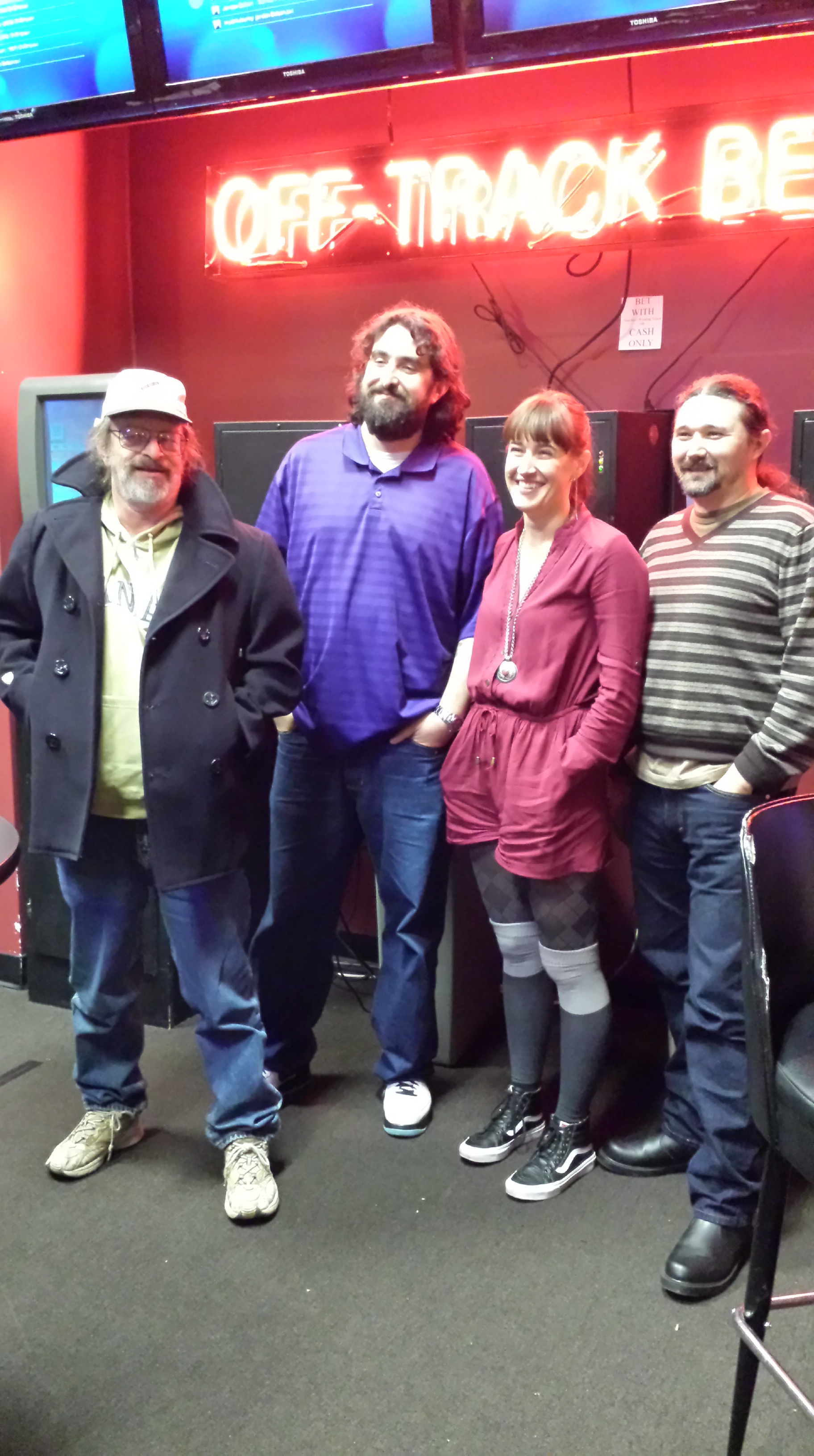
Douglas Spangle, Pecos B. Jett, Alexis Orgera, and me

Yes, that sign says “Off-Track Betting.” The Corner Bar has a sideline as a gambling joint: during the day, folks hunker down to yell over their beers at tv screens showing horse and dog races, and even in the evening, the digital slots are running behind a curtained wall (more than once, our fiction and poetry was good enough to draw gasps and laughter from gamblers playing the machines in the corner).

The audience was just as much fun, too, most everyone in their cups and all us readers taking the cue to read something lively. I read a bit from Hagridden (the introduction of Whelan), and then I decided, for the anniversary of Box Cutters, to read my bar story out of the chapbook. People got the creeps from Whelan and told me afterward that they were eager to hear more from the novel, but everyone really loved LoAnn and her ventriloquist dummy!

It was a great night in a fun venue, and I loved the bar-reading/open-mic vibe of the whole thing. I’ll be back for future events as an audience member!

NaNo(Re)WriMo: the first big rewrite

Well, I’ve done it at last.

A while ago, I mentioned that I was feeling revolutionary, that I wanted to throw away everything I’ve written on this novel and start again, that I wanted to make such drastic and dramatic changes to the book as to change the narrative structure, the POV, the purpose. I tried last week and it didn’t work, so I tried something else, and something else.

Then, at the very end of last week, I found it. My way in to the new draft, my voice.

And I have indeed chucked the old text, all 40,000 words of it, and started again with a new POV. And it just feels so RIGHT, gang! This, at last, is the book I’ve been trying to write for a year now. And (as with the first full draft of Hagridden), I can see the whole thing stretching out before me, just waiting to get written.

Which is why, for the first time in this year’s sort-of-NaNoWriMo posts, I’m going to share with you an excerpt.

Bear in mind, this is still a rough draft. Lord knows what changes are in store in revision. But this is the gist, folks, the general idea of the beginning of the book:

The sun hung low in the sky over the East Texas field and the cricketsong had just begun when of a sudden it ceased, and a crowd of grackles scattered from the widespread cedar elm at the edge of the shallow gully embanking the creek. No one outdoors to witness it when, through dry, unmown ryegrass and in the vast shadow of the elm, JW Coe highstepped slow and cautious down into the creek, stooped under the weight of a wide stone slab.

He was both thinner and fatter than in decades previous, with narrow shoulders and a hollow chest but with a taut paunch pushing against his shirt and vest, his wool coat unbuttoned because the buttons would no longer meet. But he wore the same brown hat he’d always worn, gone loose with age and stuffed with rolled newspaper to keep it snug over his thinning hair, long as usual but faded from the ashy blond of his youth to just ash. His heavy mustaches and long goatee still stained yellow with tobacco. If the occupants of the yonder house were still those he’d known three decades ago, they would doubtless recognize him, though for all he knew that family had long moved on and another family come to replace them, no part of the world empty for long.

He stopped every few paces to check his distance from the house up the slope and then behind him to Fulton, his old carthorse, uncarted and drop-hitched and chewing the rye. He wanted to know how active were the occupants of the farmhouse and how far he’d have to run if it came to that, but he saw no movement and he’d left Fulton the horse obscured enough. So on he labored, hauling the stone on his back.

[. . .]

Then with his eyes on his feet he paced out a length of land down into the gully, into a thicket of brush where the day’s last light had already died. Nearly every step he paused and set the stone down, held its top in one hand as with his other he lifted brambles and dry, fallen limbs as silently as he could manage, the journey only a dozen paces but taking him the better part of thirty minutes. With each cracked branch or small rock slipped down toward the vanished creek, he stopped and straightened and watched the house, though soon he was deep enough in shadow he was certain no one would see him.

The sun was long behind the house and nearing the earth when Coe reached the patch of earth he knew to be a grave.

[. . .]

He rammed the stone into the earth. The dull thud was soft enough but he turned toward the house anyway. He could not see it. He reached beneath his coat and drew a hunting knife and dug at the ground with it, careful not to scrape the stone for the sound it would make, and he gouged a grove into which sank the heavy slab. He worked for some minutes. Finally, he lifted one hand and then, slowly, the other, and when he saw the stone was fixed in the earth he kicked the loose dirt into the groove and packed it with his boot. Then he stepped away and beheld the stone.

[. . .]

A sound arrested him save his head, which he jerked toward the house. Wood clapped on wood, the sound of a door shutting, then boots on planks. Coe reached his hand to his knifehilt but left it there, the knife sheathed so the blade would catch no light. These habits so long unused but still there in his old muscles, in his hot blood. He studied his breath, let it come slow and even so it would make no sound. The boots at the house walked on, then disappeared though no sound of a door followed them. Coe waited. After several seconds he heard a fainter, more distant clap of wood and he stood, slowly, to peer up the creekbank. He could see nothing, not even the house, but he heard a distant, muffled song, the lyrics indecipherable but interrupted by grunts and what he recognized as happy curses. A man in the jakes on the other side of the house, away from the creek.

Frozen in the shadowy gully, the first stars pricking through the blue skin of the sky, he imagined what would happen, what had always happened. The man returning from the shithouse, the man spying the drifts of visible breath in the cold air like smoke wafting up through the liveoaks. The man realizing the presence of an intruder on his land, the man descended from the men Coe knew, a man who would know where Coe was and why. He would consider calling into the house for reinforcements, for arms, but he would not want to be called a fool. So the man would step down from the porch into the cold, damp earth, his boots soft in the grass. He would look in the last of the light, and Coe would have to answer, quiet and with a high-pitched voice, an imitation of a boy or, better, a calf if he could manage it. Something to draw the man in, and in the man would come, lured by the voice of something he could handle alone, something he could tell a story of later. And when he was close enough, Coe, even in his elder years, would rush unannounced from the trees, up the rise and out of the shadow, the knife out of the sheath and into the man’s neck in the same movement. The blood hot on Coe’s wrist and forearm, the man’s breath hot on his neck as he leaned in close to die in silence.

It all felt so familiar. It all felt so keen, so clear. Coe caught himself almost wishing for it to happen.

That first night I blazed through a thousand words in about half an hour and wanted to write on but it was late and I had work the next morning. Since then, my pace has been slower, partly because each time I sit down to the book, I’m revising the text before I carry on with the story, and (the past couple of days) partly because I’m sending characters into situations I need to check the details of against history. (Always researching, me.) Still, I’ve put together another 3,000 words this week, for a 4,200-word draft so far, and most of those words are pretty good, I think.

Not the frenzied drafting of a traditional NaNoWriMo, but this is it, gang. This is the beginning of my next novel. And, as a reader, I can’t wait to see how it turns out!


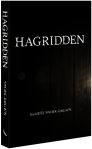
hagridden_book_coverMy first-ever attempt at NaNoWriMo resulted in the first draft of Hagridden, out this year from Columbus Press. You can order your copy from several online venues, or enter the Goodreads giveaway for a free, signed copy!

NaNo(Re)WriMo: the next several days

Last week was a busy one — I got sick, put out Jersey Devil Press, finished judging the flash fiction for the creative writing contest at Indiana University Southeast, raked leaves, did a lot of reading — so re-starting my current novel proved slower going than I’d hoped.

Then, at the end of last week, I attended a literary reading here in Portland and the writers — Trevor Dodge, Lance Olsen, and Lidia Yuknavitch — were all so inspiring in their fiction that they got me rethinking things about my novel. I started imaging a new way to approach the telling of this story. In fact, I started having just plain revolutionary thoughts.

In ordinary circumstances, this would be exhilarating. I love shaking things up in my fiction, and usually, the more radical the idea, the better the results, because anything that shakes me out of preconceptions or old habits is usually good for my creativity.

But the thing is, I’m not supposed to be rethinking things right now. I’m not supposed to be thinking much at all. I’m supposed to just be powering through a draft, whatever shit that might produce, and then I can clean it up and rework it in revision.

Except this is a sort of revision, and I’m not formally participating in NaNoWriMo this year anyway, so I get to adhere to whatever rules I want.

It’s all very confusing. So much so that I don’t even want to explain here what this revolutionary idea is. But the short, vague version is this: I have my story and my characters and all that, but the narrative perspective continues to needle at me, so I’m thinking — without bothering yet to rewrite anything I’d already written — that I need to just completely change the perspective here. Which is what tried this week, just to shake things up and keep things moving.

It didn’t work very well.

Also, last night I attended another literary event — this time, it was my friend Bill Roorbach in town promoting his new novel, The Remedy for Love — and he spent a lot of time talking about titles. So of course, I started rethinking my own title, which is the last thing I ought to be worrying about right now (I have story to write!), but sure enough, I scribbled a few alternate titles in my notebook during Bill’s reading. I haven’t fallen in love yet, but then, I was never really in love with my current working title, so I’m pretty sure it’s going to change before I’m through.

So, with all that overthinking, I’m only up about 2,000 words since my last post, or 4,200 words since last year. Even without formally participating in NaNoWriMo, this is an unacceptable pace. I’m hoping to hit the work hard this weekend and should post more impressive numbers next week.

I just have to remember to spend my time writing instead of beating myself up for not writing.

It’s funny, all these years and all those many grueling drafts later, how easy Hagridden seems to have been in hindsight.

I’m looking forward to the day when I can look back on this novel and call it easy as well.


hagridden_book_coverMy first-ever attempt at NaNoWriMo resulted in the first draft of Hagridden, out this year from Columbus Press. You can order your copy from several online venues, or enter the Goodreads giveaway for a free, signed copy!

The Hagridden character quiz!

You guys! This is TOO COOL!

Shenice, a staff member at Columbus Press, has gone onto the quiz site PlayBuzz and made a character quiz for Hagridden!

Screen shot 2014-11-07 at 9.02.02 PM

You know the drill: Which house from Harry Potter do you belong in? Which of the Avengers are you? What Game of Thrones woman are you? (Gryffindor, Thor, and Daenerys Targaryen, FYI.)

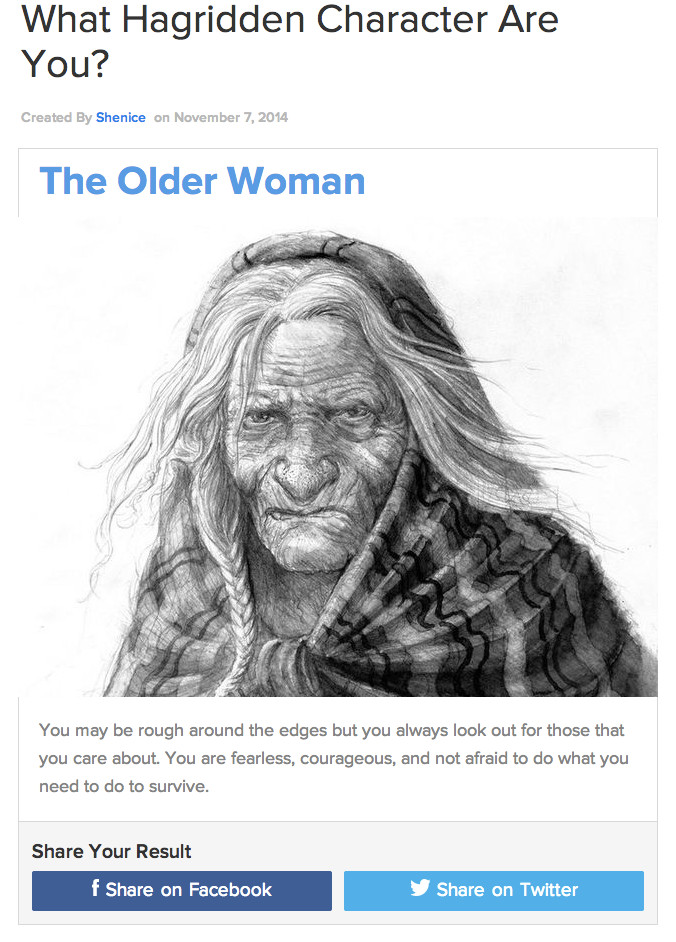
And now you can take a quiz to find out which character from Hagridden you are! Your options are the Older Woman, the Young Girl, Buford, Lt. Whelan, or (I love this!) Clovis.

I’ve taken the quiz every which way just to see what the results look like, and gang, it’s pretty awesome. But my first try, when I was answering honestly for myself, I got the Older Woman.

hagridden quiz old woman


She’s a popular result, as the first few people on Facebook to take the quiz got her as well. But it wasn’t too long before a couple of Lt. Whelans showed up, and this evening I saw the first Clovis.

My wife took the quiz, too, and — unsurprisingly — she got the Young Girl. Of course my wife is the hot young love interest! But seriously, the description Shenice wrote for the Young Girl fits my wife to a T:

You are young at heart and are not afraid to fight for what you want. You are strong, brave, and courageous. You are strong willed and always look out for those you love.

Perfect!

So, which character are you? Take the quiz and share your results on Facebook or Twitter. And share them here in the comments, too!