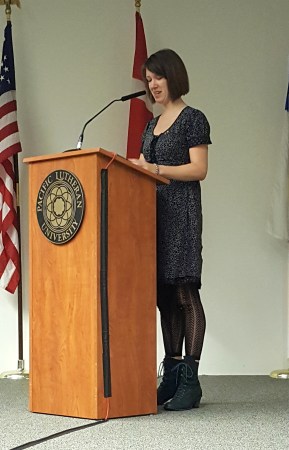
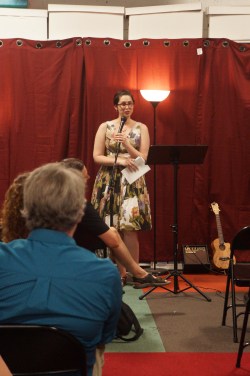
Yesterday morning, I shared the news that I had a new story, “An Understanding,” at Tacoma’s literary site, Creative Colloquy. Last night, I was one of the four featured readers at Creative Colloquy’s monthly reading series.
Reading from Where There Is Ruin — yes, that’s my proof copy of the chapbook!
Thanks to my wife, Jennifer, for snapping these pics of me.
And thanks to Creative Colloquy director Jackie Fender for this pic.
Dianne Bunnell read from her fictional memoir The Protest, Alec Clayton read a charming story about a ’70s roadtrip from the Deep South to New York City, and Kristine M. Smith read from her memoir about befriending DeForest Kelley (yes, really, THE DeForest Kelley!).
Dianne Brunnell
Alec Clayton
Kristine M. Smith
During the “intermission” (alas, singer-songwriter Maddy Dullum couldn’t make it last night), I swapped Alec Clayton a copy of Hagridden for his novel, Tupelo, and then I had an espresso — the venue, B Sharp Coffee House in Tacoma’s Opera Alley, is a delightful place with seriously decent coffee (I’m an espresso snob) and fantastic decor.
My espresso tray (and my tweed hat from Krems an der Donau, Autsria)
This is seriously the mural and furniture in the back passage leading to B Sharp’s restrooms!
Opera Alley in Tacoma, WA
The South Puget Sound area has a fun and supportive and talented community of writers, so the open-mic was rich with other great readers — some of whom had been featured readers in the past and some of whom made the journey to Tacoma from Olympia to share poetry and prose with us. Some pieces were beautifully emotional, some humorous, and several powerful pieces got into politics and our response to these harrowing times. Writers like Christina Butcher and Shae Savoy and Emilie Rommel Shimkus and DL Fowler and Leah Mueller . . . . while the reading series is officially divided into featured readers and open-mic, both times I’ve been the evening has felt more like two halves of one big celebration of literature and literary voices. And I was thrilled to be part of it last night.
Congrats to all the readers, and thanks for such a lovely evening!
Wow, it’s been a while since I last used “New publication” as the title of a post!
But I am thrilled to tell you all that I have a new short story out today, this one in my local Tacoma literary publication Creative Colloquy. It’s called “An Understanding,” and you can find it here.
I began my 2016 NaNoWriMo on fire: thanks to a midnight start, I cranked out more than 9,000 words on the first day. By Day 4, I’d launched up to 15,000 words. As of Monday, November 7, I had written 17,643 words — I was WAY ahead of schedule, so I decided to take November 8, Election Day, off from the novel and just focus on the election.
The novel I’ve been writing this NaNoWriMo is about a gang of gunslinging, angry, white men trying to burn down the world they live in. I’ve been trying to write this novel for a long time, and for a long time, the world we live in has made that book difficult to work on.
This afternoon, though, I remembered the realization that allowed me back into that novel this year: I’m not actually writing about those angry white men at all. I’m actually writing about the one man among them who regrets every horrible, violent thing he’s done, and the actions he takes to try to right his years of wrong.
That’s the novel I’m going to keep writing.
Only I didn’t.
I researched, scribbled notes, sat in my chair by the fireplace and thought and thought . . . but I didn’t write anything until November 15. A week after the election, I needed the release of art. Plus, my very excellent librarian/genealogist mother-in-law had sent me a trove of amazing historical information about the region and time period I was then writing about, so I had pent up a backlog of ideas and, on November 15, I burst onto the page with almost 6,000 words, bringing my total up to 23,243.
Among the items my mother-in-law sent me: this huge map of downtown Sulphur Springs, TX, from 1898. (The image on my laptop is a contemporary Google Street View of one of the buildings on the map.) And by the way? My mother-in-law is a badass.
But then I stopped writing again.
I am still taking notes, scribbling short scenes or character sketches, so in truth, I have been writing and racking up a higher word count. But it has never been sustained or cohesive work, and I haven’t bothered to tally up the words I’ve committed to page or screen in a week now.
Seriously: if you love literature and want to support women and gender-nonconforming writers in print, help support this anthology.
I think in some respects I’ve been attending to the mind and the heart these past two weeks, concentrating on my family and my literary community. I’ve also been in shock. And I’ve been checking in with friends, reading essays and poetry and think-pieces, trying to figure out how to help people. In my house, we’re planning donations to activist organizations; I’ve donated to the Kickstarter to publish the first-ever Unchaste Readers print anthology of work by women and gender-nonconforming writers; I’ve signed petitions and called or written my government representatives.
But it is also time, now, to get back to my work.
I was inspired today, in particular, by writer Evelyn Sharenov, who wrote on Facebook, “I feel like I’m finally awake. It didn’t occur to me than an election could throw me so far off course, that it could make me lose my focus, make me weep, overwhelm me with anger. But I am now awake.” She described a story she’s been struggling to write for a long time, and the breakthrough she had last night that has allowed her back into the piece. But I was most taken with those first lines, the nightmare she describes and that sudden, enlightening line: “But I am now awake.”
Something about that line woke me from the stupor of the past couple of weeks, and I am seeing clearly now the path forward, both for myself and for this novel. I don’t think I’ll be blazing through the words the way I did that first week of November — what’s coming requires a more deliberate pace, a more thoughtful approach to the narrative — but I know not only where I’m headed but also why I’m writing this book.
And that is empowering.
So this afternoon, I put on my Texas “home” t-shirt (another gift from my mother-in-law, and the company donates part of their profits to multiple sclerosis research, so here’s to doing a little more good in the world), and I picked up my Texas research and my laptop, and this evening, I’m getting back to work.
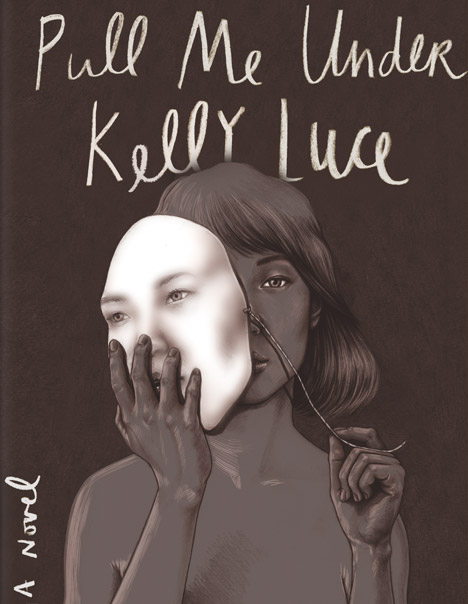
Last night I went to Pacific Lutheran University in Tacoma to see my friend Kelly Luce read from her new novel, Pull Me Under. Kelly was in my workshop group at the Sewanee Writers’ Conference in summer 2015; another fellow Sewanee alum, Jason Skipper, teaches at PLU and had organized Kelly’s visit to the campus. I was eager for the chance to see my friends and hear their words.
I was seeking the solace of their art.
It’s been a rough week since the election. Emotions everyone have been running high, and I’ve mostly wanted to just focus on home and family. I did notice that a lot of my writer friends, though, were throwing themselves into their art, or at least announcing on social media that they intended to. I couldn’t. I set aside my NaNoWriMo project and hadn’t written anything beyond a Wordstock recap since last Tuesday. Until yesterday, when I finally settled back into my own novel, returning to the outlet of fiction.
Kelly’s appearance here in Tacoma, then, was well timed, because now that I was writing again, the pull of literature drew me to my friends and an evening of art and creativity and intelligent discussion.
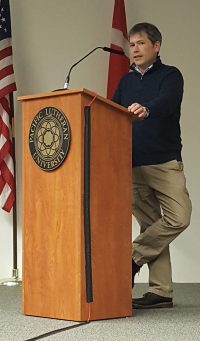
Jason Skipper introduces the reading series.
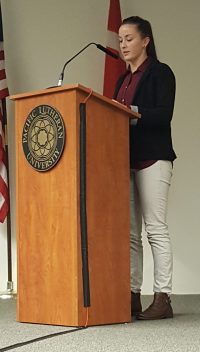
The reading event itself was excellent. There was a good turnout in the audience, a mix of students and faculty and community members like me. I also got to meet another PLU faculty member, author Wendy Call (No Word for Welcome: the Mexican Village Faces the Global Economy). After Jason Skipper introduced the evening, a PLU student, Annalise Campbell, read an excerpt from an award-winning story she’d written. (It was a great piece — left me wanted to finish the story! — and she read it well.) Then Annalise Campbell introduced Kelly, giving a thoughtful (and thorough!) review of Kelly’s debut collection, Three Scenarios in Which Hana Sasaki Grows a Tail, as well as her new novel, Pull Me Under, and tied it all to an analysis of Kelly’s importance as a writer. Brought Kelly to tears; her first words at the mic were to ask if anyone had a tissue!
Annalise Campbell reads from her award-winning short story.
Kelly’s reading was perfect: an interesting background for the novel in general, a handful of short selections rather than one long chunk of text, great transition banter and mini-intros between the selections. Her Q&A, too, was terrific, with audience questions about cultural sensitivity, differing perspectives on American and Japanese society, language choices, international education, and literary influences. I took a lot of notes — now that I’m back into my own novel, a lot of the things Kelly and the audience discussed inspired ideas for things to work on.
Kelly Luce reads from her new novel, Pull Me Under.
Afterward, I was chatting with Kelly about her book tour, and how rough a week it’s been, and she commented on how many people she knew who were giving themselves over to art and literature, how many were attending readings and book launches and gallery openings and theatre showings more than usual in the past week. We talked about how artists seek each other out in difficult times, how much we need each other even when our impulses are to hide inside the page. And Kelly mentioned how much she’s appreciated the people who have come out to see her read. How grateful she is for them.
I was grateful, too. For the literary community, for the communion of art and ideas . . . for friends.
If you want to head out to see Kelly Luce read, she’ll be in LaGrange, IL, this evening (November 16), then she’s back on the West Coast for readings in Santa Cruz (November 17) and San Francisco (November 18). If you’re in New York, she’ll be at the KGB Bar on December 4. Check out her Appearances page on her website.
It’s been a week now since Lit Crawl and Wordstock. And what a week it’s been. I haven’t written much at all since Tuesday night, but this post has been brewing since last weekend, and it’s been a welcome change to take some time and look back on last Saturday with so much love and friendship.
I wrote last year about how amazing my first Wordstock was, but I also wrote about some of the bugs in the system during Literary Arts’ first outing as festival organizers and reported on some of the suggestions folks had to make it better. And it definitely seems that Literary Arts was listening to everyone, because they answered a LOT of those concerns!
This year was still technically one day, but the festival proper was preceded by an amazing array of readings and other literary events during Portland’s annual Lit Crawl, which afforded people a lot more opportunities to get out and see a whole bunch of authors.
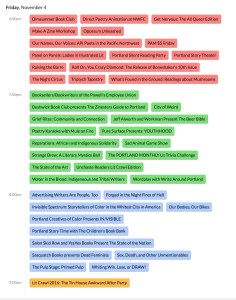
And that’s where I started. I took the train down from Tacoma (I love Amtrak) and arrived just in time for the first of the Lit Crawl events at 6 pm. I had many to choose from, but I was eager to get to the collection of readings about mushrooms. Yes, mushrooms — literary mushrooms. I had recently read Alexis M. Smith’s gorgeous eco-mystery novel, Marrow Island, and because wild mushrooms play an important role in the book, she was on the panel. Also on that panel: Gina Ochsner, whom I’d never met before last Friday but who received an Oregon Literary Fellowship in fiction the same year I got mine, so I was eager to say hello and offer a belated congratulations.
And yes, it is surprising how fascinating mushrooms can be and how important a role they can play in narrative. Of course, I’m a geek that way — I love learning about just about anything — but seriously: a few years ago, I read Bill Roorbach’s Life Among Giants, and folks, there’s a mushroom on the cover of that novel for a reason. Or, consider the role mushrooms play in the second episode of the tv mystery series Midsomer Murders. So yeah, gang: readings about mushrooms. It was a fascinating way to kick of Lit Crawl.
After that, I dashed around the corner to the Literary Arts headquarters for a special edition of Melissa Dodson and Marialicia Gonzalez’s Grief Rights Reading Series. I’ve been a fan of this series for a long time, and I joined the series as a reader back in February. On Lit Crawl night, though, I was an eager spectator (and I helped staff the book sales table for Amber J. Keyser and Oregon Book Award and Lambda Award winner Kate Carroll de Gutes). It was a beautiful reading, full of compassion and ceremony, including a blessing of the space and the ritual of each reader handing a rose to the reader that followed them. The work read that night was all amazing — meditations on loss and memory and love and self-care; I especially loved Kate Carrol de Gutes, Adam Strong, and finale poet DeAngelo Gillespie.
Me staffing the book sales table.
Marialicia Gonzalez blesses the reading space
Melissa Dodson photographing Amber J. Keyser
Pauls Toutonghi passes a rose to Adam Strong
DeAngelo Gillespie closing out the Grief Rites set
From Grief Rites, I hurried back across the street to the joint reading event hosted by the Salon Skid Row Reading Series and Portland-based publisher YesYes Books. I was excited for this reading because Salon Skid Row organizer Josh Lubin always runs a great reading, complete with a kind of media-accompaniment in the form of video montages projected on a side wall (that night’s was, brilliantly but, in retrospect, hauntingly, a bunch of old television campaign ads from Nixon and Reagan). Also, Robert Lashley was on the roster, and that man is one of my all-time favorite poets and live readers. The first time I saw him, he gave a rousing, angry rendition of his poem “Thirteen Ways of Looking at a Motherfucker at the Club”; on this night, he brought me to tears with his emotional final poem. For real, gang: you need to buy his book The Homeboy Songs.
But I was also eager to see the offerings from co-host YesYes Books, whose authors and poets I love, and those folks delivered! I especially loved Jonterri Gadson (I later bought her book Blues Triumphant) and YesYes publisher KMA Sullivan.
Jennifer Jackson Berry reads under Eisenhower campaign ads
KMA Sullivan reads
Robert Lashley reads
Overwhelmed by all that beautiful art and exhausted by a day of travel and running around downtown Portland, I was ready to pack it in, but as I left the final reading, I ran into Mark Russell and Amy Temple Harper, two of my favorite Portland writers, and we all decided to hit the Tin House Awkward After Party together. There, I ran into Mo Daviau, who is always fabulous, and chatted in the beer line with a woman name Beth about her sister’s sci-fi writing. Alas, I never did get to see Carrie Brownstein, because the party became quickly crowded and warm, and I realized just how tired I was, so I made my way to the bus and headed back to my friends’ house where I was staying for the weekend.
Besides, I had an early day ahead of me as I made my way back downtown in the morning for my volunteer duties at Wordstock.
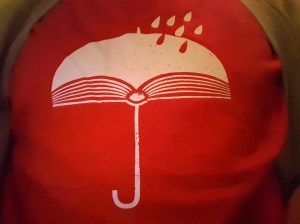
My volunteer t-shirt from Wordstock
Because my bus ran late and I missed the beginning of the first round of panels, I began my Wordstock day by briefly hitting the bookfair before checking in at my volunteer assignment. Then I hoofed it over to the First Congregational United Church of Christ, where I’d been posted.
Another thing that Literary Arts did in the past year to address the problem of crowds: they vastly expanded their venues from one to eight around Portland’s South Park Blocks, plus a slew of smaller pop-up venues in the area. The expansion of venues also reduced overcrowding in events, so it seemed to me that fewer people got turned away because a venue had reached capacity. And Literary Arts also made a much more conscious effort to address accessibility and mobility issues, so more people were able to get into the venues they wanted to.
Consequently, from what I could tell, everyone attending was even happier and more excited by Wordstock than last year, and I can say that not only as an attentive attendee but also as a volunteer.
My building, the First Congregational United Church of Christ, was a gorgeous old church with pointed arches and stained glass and huge studded-leather doors and wood pews for seating. My initial assignment was to serve as door monitor, which meant I got to count heads as attendees entered (so we wouldn’t surpass capacity), check wristbands, answer any questions, and generally just be a cheerful face as people came and went. I did that for a while, but the first event — a discussion between Vailey Oehlke (director of Multnomah County Libraries) and author Alice Hoffman, who is probably most famous for her book Practical Magic(yes, THAT Practical Magic) but whose new book is Faithful — included a Q&A, and the organizers needed someone to carry the mic around the audience. They tapped me, so I got to hang out up front during the discussion and then use my teacher skills to scan the raised hands and make sure I brought to mic to a variety of audience questioners.
The second panel, with educators Michael Copperman and Nicholson Baker, made me cry with the hope and drive those two spoke about in education. They were especially insistent on greater diversity in our teaching and our teachers, and on reaching students where they exist rather than stuffing everyone into some artificial standardization. Also, the panel moderator was Oregon Public Broadcasting’s Dave Miller, so for the second Wordstock in a row, I had a public-radio geek-out moment and rushed onstage ahead of the event to fanboy over an OPB celeb. (Last year was April Baer.)
As last year, I didn’t get to all the panels I had intended to, but as a volunteer I was able to sit in on two panels, and in the evening I attended a third, a youth lit panel with the amazing Kate Ristau (author of Shadowgirl and the newly released Clockbreakers) and Bart King (author of The Drake Equation). The authors were amazing, but the real stars of that final panel were the kids in the audience. They asked a whole range of insightful, writerly questions, and when the panel asked how many of the kids were writers themselves, several raised their hands. (One young girl, I later found out, is a published writer, and I bought her book in the bookfair. Turns out, Bart King had blurbed it!)
Bart King leading a cool collaborative reading with Kate Ristau
Kate Ristau signing my copy of Clockbreakers
Watching those young writers and readers ask such intelligent questions and get so fired up about literature was the perfect way to wind up my Wordstock experience. Except I wasn’t quite done yet!
Amid everything else going on, I managed to make the rounds in the bookfair a few times, and after that last panel, I sneaked in one more trip. Over the course of the day, I came away with quite a haul!
I also got to see and hug and hang out with a whole bunch of my fellow writers and publishers, including —
Me with writer pals (clockwise from bottom left) Kate Ristau, Jenny Forrester, Cynthia Dix, John Carr Walker, and Tina Connolly
In other words, Wordstock was just as great as last year, and then it was better. And next year? I imagine Literary Arts is going to continue to improve on Wordstock — and I intend to be there to find out!
I’m taking a short break from NaNoWriMo this weekend to catch a train to Portland, OR and attend Lit Crawl and Wordstock, two of the year’s biggest literary events in one of my favorite literary cities!
I wrote about Wordstock last year, but this year I’ll be volunteering (I’ll be a door monitor), so in addition to helping out at one of my favorite literary events, I’m also hoping to get a kind of behind-the-scenes perspective. But when I’m not assisting Wordstock attendees, I’ll definitely be hitting panels and browsing the bookfair and just generally geeking out over the whole glorious literary extravaganza; expect photos and a post next week!
And the night before (tomorrow night), I’ll also be attending Portland’s annual Lit Crawl! There are SO MANY readings and events that I want to attend, and of course I can’t get to all of them, so I’m wringing my hands over all the amazing things I’m going to miss. But I’m also giddy at all the amazing writers I’m going to see and hear — in fact, I’m so excited I’m even planning to attend the Tin House Awkward After Party (“A post-Lit-Crawl party featuring literary people standing around awkwardly until the music takes hold of their bodies” — this is definitely an event for writers! I, for one, excel at standing around awkwardly at parties).
I am still working on my NaNoWriMo project, but I have some breathing room (on Day 3, my current word count, believe it or not, is 10,492, and I haven’t updated that to include today’s count yet), so while I will probably write some on the train to Portland and on the train back to Tacoma, I expect I’ll take Saturday off and just baste myself in all the literary fabulosity that is Wordstock!
Except, as I’ve done a time or two in the past, I’m kinda-sorta cheating this year, because instead of starting a new project, I’m actually returning to a book I’ve already written — in fact, it’s the NaNoWriMo book I attempted back in 2013 — and returned to 2014.
I’m not really cheating, to be honest. In 2014, I was cheating, because I simply continued to work on an existing project rather than starting something from scratch. But this year, I am starting from scratch, because I’m throwing out the entirety of my 2013 and 2014 drafts (and, dear readers, my 2015 draft as well — because yes, I did rework that same book a third time and I’m still not happy with it).
I am keeping some of the elements of the project: most of the main characters, most of the settings, the general thrust of the story . . . .
But I have tossed all the text and most of the individual scenes I’d written, and I’ve spent the last month drafting an entirely new outline for the story. I’ve also finally wrapped my head around the narrative style I want for this, which is been the biggest hangup for me with this book. The first draft was all first-person, which was great for scenes and a few whole chapters, but I quickly realized that I just couldn’t sustain a first-person voice that consistently felt as authentically late-19th-century as I needed it to. The second draft, I tried some third-person voices and multiple perspectives, which let me shift narrative voices and keep the pieces of first-person narration that I thought worked, but in the end, the draft was just a patchwork quilt of vignettes and the stitching wasn’t strong enough to hold the whole thing together. So for the third draft, I scrapped all of that and went back to the distant, third-person limited narrative voice I used in Hagridden, because hey, it worked once, so why not use it again? And for a while it was working wonderfully, and (ironically) it allowed me to drill into the characters more and let their worlds unfold in a more natural way. But eventually, I got so mired in the details of their lives that I lost sight of the plot and had no idea how to get the book back on track.
So, here I am, once more with a blank page and this same story I have yet to finish telling. And I do want to tell it — it’s still a story that lives in my head, and it wants out.
I’m hesitant to reveal too much here about why I feel like this year merits another attempt, but I can tell you these things, gang: This past year, I’ve been following some long-running national and international news stories that, while fascinating in their own right, kept reminding me of elements of my own novel. Also this past year, I’ve read a few books that triggered ideas for me, including Andrew Malan Milward’s stunning story collection I Was a Revolutionary and (currently) Herman Melville’s Moby-Dick, as well as a few history books relevant to my story.
But I’ve been here before. So why revisit this old book for NaNoWriMo rather than simply start a new project? I’ve been thinking about this the past month, and I think it boils down to two reasons:
I don’t have a new project, and it’s hard for me to imagine a new one until I get through the projects already in my head. This is the older of two books I’ve been trying to get out of my head for years, and I’ll take any excuse to make new progress on it.
It’s been a crazy six months — I’ve wrapped up a life in one state and begun a new life (new home, new town, new job) in a new state — so I haven’t been doing the writing I’ve been wanting to. Even with my new study and all this dedicated writing time, I’m still playing catch-up on other, smaller writing projects while also juggling a series of non-writing projects. But NaNoWriMo, both as a frenzied writing deadline and as a supportive community of fellow Wrimos, has always been a good motivator and a wonderful excuse to set everything else aside and crank out the words. Which is what this book needs right now.
So, starting tomorrow (or, I’ll be honest, maybe tonight at midnight, because that’s how NaNoWriMo usually works), I’ll be off and running.
I can’t say how regularly I’ll be blogging about my efforts, because I still have a lot of other things going on (including Wordstock this coming weekend) and it’ll be a struggle just to keep up with my daily word count. But I hope to check in from time to time, so hang in there with me, gang.
And if you’re participating in NaNoWriMo, leave a comment and let me know what you’re working on!
Last Wednesday, I ventured into the heart of Tacoma’s Stadium District to experience as much of my new hometown’s creative and literary scenes as I could in a single night.
The event was the second annual Creative Colloquy Crawl, a kind of literary and creative “pub crawl” through businesses in one of Tacoma’s coolest and most creative neighborhoods.
Not every event was at a pub, of course, and not every event was strictly “literary” in the sense of the printed word. In addition to storytelling and poetry readings, the crawl included interactive horoscopes, a teen writing workshop, music and theatre performances, graphic narrative and street art . . . even selections from banned books read by burlesque dancers!
The downside to any literary “crawl” event, of course, is that for everything you attend, you miss a handful of other amazing events. In my first outing, I’m sad to say I only made it to two events (I suffered a mild asthma attack at the end of the evening and had to miss the burlesque dancers). But those two readings were stunning displays of the talent in Tacoma!
My first event was Candlelit Stories, an hour of ghost stories and eerie tales hosted in the “library” room of the amazing Sanford and Son antique shops. (Yes, I had the theme song for the old tv show in my head the rest of the evening, which was great because I loved that show!)
Kimberly Derting, author of The Body Finder YA series
Mark Henry, author of Happy Hour of the Damned
Lish McBride, author of Necromancer
Elizabeth Beck, editor with Creative Colloquy’s online magazine
Sarah Comer, a professional storyteller and musician
The show featured readings by YA author Kimberly Derting, urban fantasy author Mark Henry, urban fantasy author Lish McBride (Necromancer), Creative Colloquy editor Elizabeth Beck (who did a very cool performance piece with her story!) and professional storyteller (and all-around badass) Sarah Comer.
The first three readers were terrific — a nice blend of spooky and humorous — but the party really got rolling with Elizabeth Beck’s performance piece, a dinner scene with unseen guests, and then Sarah Comer (who also served as emcee) killed it with two stunning and expertly delivered classic campfire ghost stories, including one set right there in Sanford and Son!
I had plenty to chose from for my next hour, but I wanted a beer, so I headed to Odd Otter Brewery for Poetry & Pints, where I enjoyed some powerful poems by Emilie Rommel Shimkus, Paul Nelson, and Peter Munro.
Emcee Christina Butcher
Emilie Rommel Shimkus
Paul Nelson
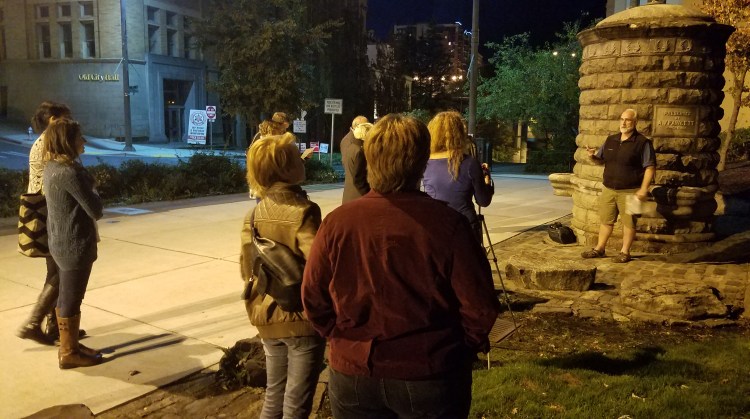
Peter Munro and the audience out in Fireman’s Park
The Crawl had a bit of overlap with Odd Otter’s regular pub trivia night, but emcee (and host of the podcast Literally Tacoma) Christina Butcher did a fantastic job of segueing into the poetry readings. Emilie Rommel Shimkus was fierce in her reading, and she worked that noisy bar like the pro she is (she’s also an actress); and Paul Nelson had a fantastic blend of wry humor and punchy, poignant observations. But for the last performance, we realized the night was lovely and we decided to give way to the second half of the bar’s trivia contest as the lit folks drifted across the street to Fireman’s Park, where Peter Munro unleashed on us an epic narrative sea poem, all waves and rhythms and harbor pilots and commercial fishermen. It was a fabulous piece and a perfect way for me to conclude my evening, as I climbed Tacoma’s Spanish Steps and paused to look out over the nighttime Port of Tacoma, the black water nestling long, yellow-lighted cargo vessels.
Overall, I had a wonderful time, and I’ve heard this past week that others at other events had just as much fun, heard equally wonderful work. But more importantly, for me, I got a deep view inside the creative heart of Tacoma, and gang, Creative Colloquy does things right.
Last Friday, my first novel, Hagridden, turned two years old.
And I turned 40.
About six weeks before that, I moved away from Portland, that beautiful city full of beautiful writers and publishers that I have called home and family, respectively, for the past five years. So for my 40th birthday, I decided to drive the two hours back down to Portland and throw myself a combination birthday-and-farewell party, and the only way I knew how to say goodbye to my Portland literary community was with a literary party.
So I turned it into a reading.
My wife got to organizing the food and drinks and decor (she’s amazing, y’all!), and she also helped name the event: Sam’s “Vintage Dude” 40th Birthday Party & Literary Reading Extravaganza. I decided to hold it at Portland’s Independent Publishing Resource Center, a cherished Portland institution where I’d also held my Hagridden release party two years ago, in part because the IPRC is suffering the rapid-development pinch that so many artists and creative types in Portland are experiencing — their rent had tripled overnight, and they needed to raise money to find a new, more affordable home — and I thought hosting my party there might help them raise some money. (I’m happy to report that the day before my party, the IPRC met their funding goal! But their Kickstarter is still going, and they will need more help down the road, so if you can chip in a little, there’s still time to help out.)
From there, I just needed to find a roster of folks to read.
If I could have invited every writer within driving distance of Portland to read, I would have, and I would gladly have sat in a chair for the months it would have taken to hear everyone I know and love share their words at a mic. But I couldn’t invite everyone, so I had to make some tough choices. And what I chose was to have a mix: some fiction writers, some poets, some essayists, some long-time Oregonians with celebrated books that I absolutely love, some transplants like me with books I have long been eager to see in print, some former students-turned-emerging writers . . . .
The final reading roster for the evening was, in order:
Renée Muzquiz, my good friend from Texas, who opened the evening with a few of her beautiful songs;
My wife, Jennifer (billed as “Surprise mystery reader #1!”), whose poetry I have always loved since we first met in college — she read a few of my favorites and wowed the crowd!;
Aubrey Jarvis, a former student of mine who is now one hell of an essayist and who is going to make a fierce publisher or editor or agent someday;
Mark Russell, a dear, wonderful human being who has been fantastically supportive of my work over the years even though he’s also busy being a brilliant satirist and the writer for DC Comics’ Prez series and the current and already-celebrated Flintstones series;
Bright and Shiny, a Portland band I love to pieces and which includes two of my favorite writers in Portland, Jessica Ann and Jonathan Oak — they played our “intermission” while we did cake from Tacoma’s Corina Bakery and whiskey toasts with bourbon from Portland’s Eastside Distilling;
Monica Drake, an icon of Portland literature and a good friend and colleague, who, like Mark, has been profoundly supportive these past few years and whose books, especially her recent story collection The Folly of Loving Life, are effectively the raw essence of Portland distilled into prose;
Yousef Allouzi, another former student of mine who is a profoundly thoughtful, attentive prose craftsman — know his name, because you’re going to be buying his books someday;
The “Surprise mystery reader #2!” — actually, me, because much as I wanted to just sit back and enjoy the work of others all evening, my wife convinced me to join in the fun, and I’m glad she did;
and Jenny Forrester, the founder of Portland’s renowned Unchaste Readers series and the author of the memoir I think I’ve been anticipating more than any other for the past few years — it’s called Narrow River, Wide Sky, and you can buy it from Hawthorne Books starting March 1, 2017!
(My good friend and Portland poet Dena Rash Guzman was also on the lineup, but she fell ill the day of the party — but I want you to know you can buy her first book, Life Cycle, now, and look for her next book of “Joseph” poems by the end of the year!)
Of course, it wasn’t all authors and musicians performing at the party — a great many of my friends were there, like me, to listen and laugh and enjoy each other’s company! Among them was Laura Standfill, the founder of Forest Avenue Press, who is always ready with her camera, and she took a ton of photos throughout the evening. Amazingly, so did my wife, even though she was also setting up book and beverage tables and serving cake and organizing toasts and reading poetry at the mic.
My wife found this party set online . . .
. . . and a theme was born! (both photos by Jennifer Snoek-Brown)
Introducing Renée Muzquiz (photo by Laura Stanfill)
Renée Muzquiz opening the party (photo by Laura Stanfill)
Jennifer getting the words going with her lovely poetry (photo by LS)
We had a wonderful crowd! (photo by JSB)
Aubrey Jarvis reading an excellent essay on the writing life (photo by LS)
Mark Russell throwing down a sick beat and rapping his way through some apocryphal texts (photo by LS)
Me loving Mark Russell’s work! (photo by LS)
We had cake from Tacoma’s Corina Bakery (photo by JSB) . . .
. . . and bourbon from Portland’s Eastside Distilling (photo by JSB)
We used the whiskey shots for the birthday toasts (photo by LS)
Everyone sang happy birthday to me (photo by LS) . . .
(photo by LS)
. . . and then folks offered generous toasts, like this one from my good friend, author Sally K. Lehman (photo by LS)
No one actually roasted me, but some of the toasts were funny! (photo by LS)
The cakes, I’m happy to say, were a hit!
(both photos by JSB)
Monica Drake showed us all how a classy Portland author works a crowd! She even replaced a character name in Clown Girl with “Dr. Sam,” an epithet the whole crowd picked up from my students! (photo by LS)
Yousef Allouzi had the audience rapt with his 9/11 essay . . . (photo by LS)
. . . while Portland author Todd McNamee had us nearly in tears with his opening from the novel Drifting (photo by LS)
I read too. Because it’s my party and I’ll read if I want to. (photo by LS)
I read a funny funeral scene from a long story in my on-the-market story collection. (photo by LS)
And then Jenny Forrester wrapped up the evening with a beautiful excerpt from her forthcoming memoir. (photo by LS)
One of my favorite things about the whole evening was the book table, where, on one side, all the readers set up their books and albums for sale and, on the other side, my wife arranged a very cool “creativity corner” where my friends could write messages on a typewriter “guestbook” and use stickers and markers to craft little zines and microbooks for me!
The partygoers buy each other’s books and cds (photo by LS)
Monica Drake signs a book for my friends Jacquline and John
Mark Russell’s books and comics front-and-center while Jenny Forrester plays in the “creativity corner” (all photos by LS)
Birthday messages in the “creativity corner” (photo by JSB)
Birthday messages and microbooks in the “creativity corner” (photo by JSB)
The “creativity corner” (photo by LS)
Looking though my zines and microbooks after the party (photo by JSB)
Looking though my zines and microbooks after the party (photo by JSB)
Looking though my zines and microbooks after the party (photo by JSB)
But my favorite part of the whole evening was introducing friends to each other, helping my fellow writers make new connections — and, most of all, hugging all my friends, all my literary family, and realizing that actually, I’m not going to miss them at all! Because they are family, and we’ll stay in touch, and I’m only a couple hours away so I’ll be back to help them celebrate all their milestones, too — their books and their birthdays — and if this long and lovely literary evening showed me anything, it showed me that we really are here for each other. We truly are family. And I couldn’t be happier about that.
Laura Standfill with my friend and former student Aubrey Jarvis (photo courtesy LS)
Congratulating my friend and former student Aubrey Jarvis on her excellent reading (photo by LS)
Me with my friend and grief mentor Melissa Dodson (photo by LS)
Two years ago, I had the best birthday I could have imagined with the release party for my first novel in my old hometown in Texas. Last year, I had one hell of a birthday in San Francisco while reading with good literary friends and celebrating the first anniversary of Hagridden. And now this outpouring of love and fun I experienced in Portland as I turned 40, and to everyone I’ve named here in this post and a whole bunch of unnamed people at my party and a LOT more who couldn’t make it but sent me their love, and to the IRPC who let us take up their space for an evening, and especially — far and away mostly — to my wife who made the whole evening possible: I will love you (and owe you favors) forever! I wasn’t really that hung up on the whole 40-years-old thing and I honestly just wanted to have a little fun for my birthday and say a brief goodbye to a wonderful city and some dear friends, but everyone who came and everyone in Portland, you made last weekend (and the past five years) a transformative event that I will never (even in my doddering old age), never, ever forget. And I love you all, more than even this writer’s words can express.
In my series of blog posts (and, this past spring, my series of writing workshops) on researching for historical fiction, I’ve discussed “going to the source,” by which I usually mean interviewing live people, getting expert opinions or local insights or eyewitness accounts. But as I explained in my workshop a few months back, sometimes the best “live person” source is long since dead and gone, so you have to rely on the next-best thing: contemporary accounts. Letters, legal documents, newspaper reports.
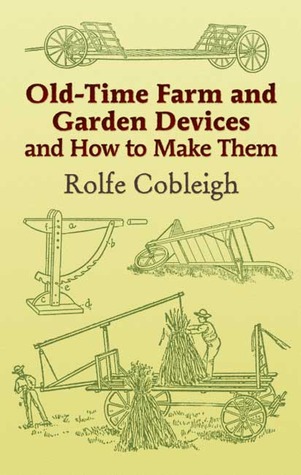
One of my current book projects is a novel set on an Oklahoma farm in the mid-1920s. It’s (very) loosely based on members of my family and events that happened to them, so I’ve been relying on a lot of those old print-source documents — my grandmother’s stories, her parents’ and aunts’ and uncles’ letters, her grandparents’ land deeds, and so on. But when my parents visited us here in Tacoma recently and we all toured the Fort Nisqually living history museum, my mother bought me an early birthday gift from the museum’s gift shop: a practical guide to farm life, written in 1909, called Old-Time Farm and Garden Devices and How to Make Them, by Rolfe Cobleigh.
Actually, what she bought me was a verbatim reprint published almost 100 years later, but the text is exactly as it appeared back in 1909. And folks, this book is an absolute TROVE! Already I’ve learned about hand-built grindstones, improvised “coolers” made of barrels buried in the earth or metal bins dropped into water wells, the difference between stanchions and stalls for keeping milk cows (“The only point in favor of stanchions is that they take up less room than stalls, but the increase in milk is a reward for allowing more space and convenience to each cow”), the best method for butchering hogs and where to build a slaughterhouse for that purpose . . . . All of which is informing my characters and their lives as I develop my novel.
Along the way, I’ve also picked up tips on how to craft a bread-slicer for evenly sliced homemade bread, how to power a washing machine with a bicycle, how to fashion a simple fire alarm from weighted string and a bell . . . . and I’m not even halfway through the book!
Most of this is simply fodder for my book, even the odd trivia like the bike-powered washing machine. I don’t know if I’ll actually use that contraption in the novel, but this book is so full of weird little innovations and improvisations that I could certainly use it to “shop the catalogue,” so to speak.
And I’ve skimmed ahead a bit, out of curiosity, and discovered a whole series of floorplans and instructions for hand-building farmhouses and barns, which is going to prove invaluable for defining the spaces my characters live and work in. (Knowing the layout of your characters’ homes can often be just as important as checking the map!)
But much of the material in this book is also good, practical advice for life today. In our new home, I have a garage with space for a workshop, and I’ve been thinking about building my own workbench out there; this book tells me how to build it as well as what tools I should keep there! In that garage, the people who sold us our house left an old glass display cabinet that I’ve been thinking about turning into a piece of dining-room furniture; I kid you not, this book has instructions for how to do just that! Later in the book (the back copy promises), I’ll learn the best form of trellis for roses, something I’ve actually been wondering now that I have rosebushes in my yard!
I’m also spotting future sections in the book about staining and preserving wood (I have a fence I need to work on), crafting a homemade gate latch (I’m not happy with the gate latch I have, and this book’s version looks cheap, easy to make myself, and exactly the solution I was imagining), and keeping hawks away from your chickens (okay, I’m not actually going to start raising chickens, but I find all this stuff fascinating).
To be honest, a lot of the material in this book feels like stuff I should have known already. If my mother’s father — who came from a family of farmers and took over his family farm at the age of 12 — had lived longer, or if I’d thought to ask him these sorts of questions when I was younger, he could have taught me a lot of this himself. I still have pieces of furniture he built, and you can see the kind of simple craftsmanship this book describes in my grandfather’s work. Often, while reading the book, I can remember the smell of his workbench in his garage, that distinctive blend of sawdust and machine oil with faint undertones of rust and stale cigarette smoke leftover from before he quit smoking. I remember his strawberry beds and sunflower stalks in his backyard, and the terrifying goose named Daisy who thought she was a dog and liked to chase me around the yard, barking and biting me, when I was just a toddler. He was an oilman by then, but I think there was always something of the farmer in him, and I remember his stories about working by lantern-light, using the outhouse, hitching up the horses and riding in the “buggy” to church on Sundays.
Reading this book feels a bit like reconnecting with him.
In short: this is one of the most valuable books I’ve ever put on my shelf, and it’s going to have a permanent home in my writing study. So thanks, Mom, for that early birthday gift!
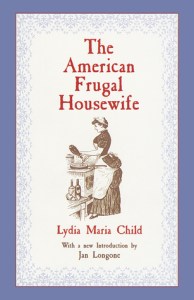
PS: my wife’s early birthday gift from my mother, also from that museum gift shop at Fort Nisqually? The American Frugal Housewife, by Lydia Maria Francis Child! Originally published in 1832, the book is full of not only advice on frugality but also loads of other practical information, like “simply written recipes for roasting a pig, preparing a calf’s head and buffalo tongue, as well as fixing corned beef, hasty pudding, carrot pie, apple water, cranberry pudding, and scores of other tasty and filling dishes. [Child’s] advice for non-culinary matters included suggestions for removing grease spots; cleaning pearls and white kid gloves; relieving chilblains, dysentery, and the night sweats; educating one’s daughters; and dozens of other domestic concerns.” This is all advice from the early 1800s, a bit earlier than any of my books or book ideas are set, but you know I’ll be borrowing this book from my wife frequently just for ideas. Also, the author? The back copy describes her as a “newspaperwoman, novelist, and ardent advocate of women’s rights.” Hurray for early feminism and independent women, and happy 19th-Amendment Day, y’all!
* The title of this post is, of course, Shakespeare, but I first heard it in my freshman year of college: my first literature professor, Dr. Kathleen Hudson, said this FREQUENTLY and burned it into my brain. That and “Make your own myth” have stayed with me all these years and still inform a lot of what I do. Thanks, Doc! 🙂



 And that’s where I started. I took the train down from Tacoma (I love Amtrak) and arrived just in time for the first of the Lit Crawl events at 6 pm. I had many to choose from, but I was eager to get to the collection of










 Samuel Snoek-Brown