Gray-and-white cat lumped atop his felted, misshapen cat hut, like a little boulder in the moss.
 I’m participating in the River of Stones project in January. Look for a new post each day. Click the badge at left for more details.

Gray-and-white cat lumped atop his felted, misshapen cat hut, like a little boulder in the moss.
I’m participating in the River of Stones project in January. Look for a new post each day. Click the badge at left for more details.

I don’t know what sparked the recent surge in interest over the spacing rules between sentences, but there it is: we are asking ourselves once again which is correct, one space or two?
I am weirdly old-fashioned in some ways regarding my approach to these things. I remember that when scholarly organizations first started switching to the “one space” rule several years ago, I rebelled. At the time, their explanation (which I first heard from MLA but which was echoed by Chicago, APA, etc.) was that the single space saved printing costs by cutting down on the number of pages. Fewer spaces meant shorter articles, yes? Except I did some tests on my own work and it made very little difference in my page counts. (For fun, I just now switched over to a 34-page short story I happen to have open on my desktop and did a find/replace to swap single spaces for double spaces. The document, which uses the standard Times New Roman 12pt, is 34 pages either way — there’s NO difference.) So I dismissed the absurd idea that the double-space rule wasted paper, and I clung to the old typewriter argument that using two spaces after a period distinguishes the ends of sentences from abbreviations (in American English) like “Dr.” and “Ms.”
Except I’m wrong.
My wife came home just the other day to inform me that the two-space rule is deservedly dead. A lot of the old “purists” will talk about how the rule is rooted in the typewriter days, and they’re right, but what I didn’t know was why: In the early days of the typewriter, the keys could only move to stamp their letters if the keys were all the same width, so the fonts on those typewriter keys were designed with a uniform width in mind. The m, for instance, was the same width as the n, despite the extra hump. (Courier still mimics this on the computer.) And because all those letters used the same space on the page — even the period — an extra space between sentences became essential for reading ease.
But our word processors today aren’t based on typewriters, they’re based on printing presses, and even from the days of Gutenberg, typeset printing used fonts with variable-width letters . . . and spaces. The variable widths of the letters (think “em dash” and “en dash,” for example) made for easier reading, but more importantly, the custom width of the spacers meant that the typesetter only needed to use one “sentence-ending” die for the space between sentences, as opposed to two of the smaller dies that marked spaces between characters.

Our word processors’ digital fonts follow the typesetting rules, so the spaces our computer uses will (in theory) vary. It’s not perfect, of course, because our computers aren’t yet as smart as we are. Try typing “the Nov. elections” into MS Word and watch Word automatically capitalize “elections” like the beginning of a sentence. Our software doesn’t recognize the difference between abbreviations and periods, which means it doesn’t necessarily use a wider space between sentences, and to be honest, I still sometimes feel irked when I see a poorly written sentence with a lot of abbreviations in awkward places because I can’t always tell where one sentence ends and another begins. “Dr. Sam is a cranky old codger. Ms. Jennifer is very patient to put up with Dr. Sam’s curmudgeonly ways.” But in long texts with a wisely selected font and good sentence structure, I really can’t tell much difference.
Look back at the test I ran while writing this, the one in which I swapped spacing on a 34-page story. I said there was no difference in length. As recently as a few days ago, I would have argued that this was evidence that the single-space rule doesn’t waste paper. But now I realize the other truth: two spaces doesn’t really increase the gap between sentences, either. If it did, that document (which contains something like 460 sentences) would become significantly longer with two spaces than with one. It doesn’t change at all. That means the computer is compensating somehow, adjusting my spacing according to logic that is based on variable-width typesetting rules.
Back when I was teaching technical communication, I tried very hard to drill underlining out of my students’ habits. There are good document-design reasons for doing this (the underline creates a distraction for the eye so the eye follows it instead of the word, and we risk losing meaning), but the thing that often did the trick was when I started explaining how underlining entered our bag of tricks in the first place. Again, it’s related to typesetting and typewriters. Back in the early typesetting days, when manuscripts were still handwritten but printing was done by machine, authors discovered the option of using italic type but had no way to indicate it in their handwriting. Go ahead — try to handwrite a sentence in script and then handwrite the same sentence in italics. Maybe it’s a little slantier, but could you keep up the distinction over a whole manuscript? Could a typesetter tell the difference? To make this distinction clearer, authors took to underlining the words they wanted italicized. When typewriters came along, their work looked like “printed” text, but the limitations of cramming all those keys into a desktop machine meant no typewriter could include a completely separate set of italicized keys. It could, however, house the single-key underline stroke, and so what was a handwriting convention carried over to typewriting. But the function remained the same: typewritten underlined words still indicated to publishers that the author wanted italicized text.
Enter the word processor, which — as a “desktop publisher” — allows us to set our own type. We can skip the unnecessary middleman that is underlining and enter our own italics. The underline, then, has become obsolete.

And for those same reasons, I would argue, the double space between sentences is obsolete, too. So I’m letting it go, kissing it good-bye (or is that goodbye? oh, I feel another post looming . . .). I enjoyed you while I used you, double-space-between-sentences, but it’s time we went our separate ways.
(Full disclosure: when typing this, I’ve had to go back and delete all my double spaces between sentences. Old habits die hard.)

The wide, wet clouds far overhead like the surface of the sea from the ocean floor.
I’m participating in the River of Stones project in January. Look for a new post each day. Click the badge at left for more details.

Design crisis over. Everything on the blog should now look fine in both Firefox and Explorer. (Still don’t know about Chrome. Anyone care to check and leave a comment?)
Now that I’ve been going through this design tweaking, though, I realize that the first anniversary of this website is coming up this weekend, so I’m toying with the idea of revamping the whole site with an entirely new theme. Any suggestions?

This past weekend, I switched to a wider sidebar to de-clutter the info there, but apparently that’s causing problems in Explorer. (I use Firefox, in which the window displays just fine. Thanks to my dad for bringing the Explorer problem to my attention!) I’m going to tinker with my options over the next day or so and try to fix this issue, but in the meantime, bear with me, gang!
For good measure, I’m posting this text twice here, the second time in a lighter color that will show up on the new (and wrong!) dark background. So no, you’re not seeing double. Unless you are, in which case, put down the drink and take a cold shower.
UPDATE: Apparently, Chrome is experiencing the same problem. Still looking into it–I hope to have a solution later today.
This past weekend, I switched to a wider sidebar to de-clutter the info there, but apparently that’s causing problems in Explorer. (I use Firefox, in which the window displays just fine. Thanks to my dad for bringing the Explorer problem to my attention!) I’m going to tinker with my options over the next day or so and try to fix this issue, but in the meantime, bear with me, gang!
For good measure, I’m posting this text twice here, the second time in a lighter color that will show up on the new (and wrong!) dark background. So no, you’re not seeing double. Unless you are, in which case, put down the drink and take a cold shower.
UPDATE: Apparently, Chrome is experiencing the same problem. Still looking into it–I hope to have a solution later today.
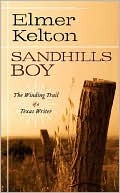 A short while ago I mentioned that I plan to read new types of books this year — eleven new categories of books, in fact — and so far, I’ve read a lot of graphic novels. Which isn’t really new for me, and which certainly isn’t on my list of eleven categories.
But I just sneaked in a memoir, Western author Elmer Kelton‘s Sandhills Boy: The Winding Trail of a Texas Writer, which my father recommended to me so strongly he mailed me a copy from almost 8,000 miles away.
The book is indeed a “winding trail,” wandering almost at random from one topic to the next. Most of the time this meandering follows a kind of logic that feels appropriate to the writer and his upbringing, because the pattern seems very much like the kinds of tales I’d expect old cowboys from my grandfathers’ generation to tell. Lots of anecdotes and asides and short character sketches and narrative jokes: that’s mostly what got me through the first half of the book.
The problem with such a narrative style is that all those detours and pit stops on the “winding trail” can get tiresome. I sometimes felt like a kid in the backseat of a long road trip. “Are we there yet?” Only a reader enthusiastic for the minutia of historical and cultural trivia would be able to stick it out through the first half. Fortunately, I am such a reader, and I found that just when I was feeling bored and ready to skip ahead, Kelton would throw in some odd but rich detail of life on a West Texas ranch that grabbed my attention and pulled me through the next few pages, and by then the narrative was rolling along nicely again.
I finished the second half of the book in one sitting. All through those first 150 pages or so, I kept thinking, Where is the writing? I was fascinated by ranch life, but I wanted to read about a writer, and in the book as in life, it took a long time for Kelton to focus on that. But about halfway through, he goes to college to study writing, and I thought, Okay, I’ll just get through the college bit. Except halfway through school he joins up to serve in World War II, and I thought, Well that should be exciting! He packs most of that experience into a single, long chapter, so the pages flew by, but before he let me put the book down and go to sleep, Kelton introduces a love story, the tale of how he met and wooed his Austrian bride while stationed in the Alps. The love story is so honest and tender I couldn’t stop reading it, and then there was the saga of bringing her to live with him in Texas, and by the time everything was settled and I could rest easy, I had fewer than a hundred pages to go and figured I might as well press on.

At which point, finally, he gets to his life as a writer, and it’s fascinating reading from there on out.
All in all, I’m not sure what to make of the book. It’s not brilliant prose, but it’s honest, folksy writing that has a quiet appeal to it. It’s not as tightly focused as I’d have expected from a memoir — it’s often more akin to an autobiography, and I know a few creative nonfiction writers who’d probably tell me it is autobiography, whatever it sells itself as — yet, like an old storyteller who indulges the occasional digression, Kelton always brings the attention back to how he got where he got as a writer, even from those long, slow chapters on ranch life.
Best of all, though Kelton makes his big break into novel publishing sound easy (he tries hard to convince us otherwise, but the long, grueling development from struggling journalist to steadily publishing novelist covers all of maybe three pages in the book), he is quick to express how lucky he was to get into writing when and how he did (he was among the last of the pulp magazine generation), and he acknowledges how much harder the business has gotten since. That’s about as fair a treatment of the life as I could ask from any successful author, and in true cowboy fashion, he conveys an almost Zen-like combination of honesty and humility that is not only appealing but encouraging. I’m glad I read this memoir, and I still plan to make a Kelton novel among the first Westerns I read this year. Thanks, Dad, for sending me the book! 🙂
Already I’m diving back into my category list, this time with an Australian novel, so look for a review of that before the end of the month. I won’t promise to review every book I read from the category list, but I’ll try to work in a sampling from each category over the course of this year. And as always, if you have any books you want to recommend, send me the titles or leave a comment here!
For more about my 11-11 project, check out my initial post on the challenge or all the posts in my 11-11 category.
For more on what I’m currently reading, check out my Bookshelf.
The ocher glow just above the treeline belies the desert sand in the air and the lighted city beneath it.
I’m participating in the River of Stones project in January. Look for a new post each day. Click the badge at left for more details.
In the background drone of my air conditioning, I almost failed to realize that the neighborhood children have stopped playing soccer in the street.
I’m participating in the River of Stones project in January. Look for a new post each day. Click the badge at left for more details.
Wind whistles, birds cry.
(found “stone”: these were the last words on screen as part of the closed-captioning of the first episode of the BBC series Wallander)
I’m participating in the River of Stones project in January. Look for a new post each day. Click the badge at left for more details.
This taxi smells of sandalwood and upholstery dust, an undertone of engine grease and sweat. The vinyl dashboard is shades of beige and taupe, and a cassette protrudes from the tape deck. All this so like my own string of tired cars on our long commutes to school back in my undergrad years.
I’m participating in the River of Stones project in January. Look for a new post each day. Click the badge at left for more details.

 Samuel Snoek-Brown