Since I mentioned Benzaiten (and suggested a possible connection with haiku) in my last patrons post, I’ve had haiku on the brain. I am not a poet — or, certainly not an accomplished one — but I have always felt comfortable with the haiku. For me, haiku represents the best of what poetry can offer: deeply spiritual yet deeply personal content, extreme compression and so extreme precision in the language, and a high attention to form without letting that form dictate the content or the expression. That isn’t to say I’m a master of haiku, not by any stretch, but it’s a form I can both read and write over and over with great pleasure, and without any of my usual fears that I’m somehow missing something.
So I decided to write some haiku this week.
This reads like a series, but that’s because I am playing with an exercise that calls for it, which I explain and link to below.
March palms
Workmen talk through open
car windows
March palms
The sun white
on the dusty asphalt
March palms
The rumble of construction
and trucks
March palms
Our neighborhood mosque gleaming
white, gold dome like a sun
March palms
Squat villa in the sand, old
white-washed door peeling
March palms
Pigeon pecking among the palm
hulls and the trash
March palms
Sky the faded blue of work clothes,
so much light
March palms
Soda-can pull tab caught in the gap
between sidewalk paving bricks
March palms
Sand swept from the street to gather
at the curb like an urban shoreline
March palms
My coffee hot, the bricks warm against my back, the minarets
bright and serene in the breezy spring sky.
March palms in blue sky,
wood door peeling in the sand —
work trucks rumble past
The exercise comes from haiku poet Timothy Russell. His exercise is actually lengthier than the one I did, extending over several days, and for the sheer practice of it, I might return to this exercise and complete it in a future post. But the short version is this: Start with a line about the month and an attribute of the day, and then go outside and write down ten random observations. Then, using the first line as the initial line of each haiku, write ten haiku using the observations (each broken into two lines). Hence, my ten haiku above.
Actually, I added an eleventh, because while English-language haiku (outside of grade school) have long ignored the traditional 5-7-5 syllabic rule for haiku, I’m a bit of a purist, and I love the new expressions that kind of attention to language can force you into. So I culled the details of the ten and tried an eleventh haiku adhering strictly to the syllable rules.
None of these is particularly good, but I see a lot of potential in some of them, so I might also return to these and post them as revised, better haiku later.
Want to try some of your own haiku? Feel free to share them in a comment! I love reading others’ haiku.
*I can’t write a post about haiku without thanking my dear teacher Dr. Qui-Phiet Tran, who was my first proper teacher in haiku as well as in Taoism and Buddhism.
For everyone who has ever done document layout, web design, or just procrastinatory formatting on their story that’s getting nowhere: We love fonts. Even if it’s bolditalic.
As an expression of female creative energy in Hinduism, she carries a lot of power, said to act as the goddess of music and poetry, the visual arts, literature, and knowledge. All knowledge. There are varying accounts of her origins — some say she was the daughter of Brahma and Durga, the pure embodiment of feminine creativity; other accounts claim that, like Athena from the forehead of Zeus, Saraswati emerged as a natural product of Brahma’s own creative force. Either way, Saraswati exists not only to drive creativity but also to control it through education and wisdom — because, as we all know, raw creativity unleashed in our lives is sometimes a chaotic force!
A multi-talented goddess, Saraswati influences intelligence, consciousness, education, and enlightenment as well as creativity, music, and the arts. She also oversees power in general (because she knew before Francis Bacon did that scientia potentia est). And those who worship her understand that she controls not only secular knowledge but also the more esoteric knowledge of divinity, necessary to achieve moksha, or liberation from the cycle of death and rebirth.
That’s quite a résumé.
Benzaiten, the Goddess of Music and Good Fortune, by Ogawa Haritsu (1663-1747)
And because all that isn’t enough for one woman, Saraswati also is the goddess of water. Her name, in Sanskrit, translates as “flowing water,” and she shares her name with a river in northern India and parts of Pakistan. It is this association that carries over to her worship in Japan, where she is known as Benzaiten. As Saraswati worship traveled through China to Japan, her attributes of fluidity picked up the Chinese and Japanese associations with eloquence (which is what her Japanese name refers to), and so the water goddess’s connection with music, literature and knowledge translated perfectly for the Japanese. Thus she is known as the Shinto goddess and the Buddhist bodhisattva of words — spoken, written, and sung — wisdom, music, and, of course, rivers.* She is also considered one of the Seven Gods of Fortune, which seems to relate, although not intentionally, to the Muses in Greece, who started our Women’s History month of patronage. And, as a bonus for my own views on teaching, she is also sometimes associated with Kannon (known in China as Kwan Yin and in Tibet as Tara), the female bodhisattva of compassion. And why not? Love, too, flows.
In Japan, Benzaiten is also associated with snakes and dragons, since both creatures are, in East and South Asia, considered water creatures. Snakes, tradition has it, serve as her messengers, and — because she is, after all, an embodiment of control and power — she is said to have married a dragon after first subduing him.
That sounds great to me. In the Chinese astrological horoscope, I was born in a Year of the Dragon, and believe me, I could do with subduing sometimes. So here’s to Saraswati and Benzaiten, who not only inspire us to write but also help us find discipline in our creativity and, like pushing our thumbs over the nozzle of the waterhose, help us direct our creative energies into their most powerful form.
*An interesting connection that I haven’t yet seen others make: Tradition has it that Zen practitioners, when composing haiku, would sit in a hut by a stream in which floated bottles of sake. If they could manage to compose a poem by the time a bottle floated past, they would take the bottle and drink, then get back to writing. Each poem meant another sip of sake. Seems like something my college students in the States would love to try, but (in theory, anyway), the idea for these serious meditators and poets was to compose beautiful poetry, not to get drunk. Either way, I wonder if there is some connection between the haiku stream and Benzaiten….
Raba’i Madhoun (Palestinian), for The Lady from Tel Aviv
Jamal Naji (Jordanian), for When the Wolves Grow Old
Last year I picked up a small anthology of excerpts from each of the shortlisted novels; the excerpts were the first translations into English for each book, but full-length translations are in the works. I read the excerpts and found them fantastic, and I look forward to picking up the books when they become available. I have not yet found a similar collection of excerpts for this year’s shortlist, but I’ll keep my eyes open. Even if it’s not available, the translations are forthcoming, so if you don’t read Arabic, look for the translations soon.
I thought I’d try my hand at some non-fiction this week, though I confess this is not my forte. For the reason I’ve engaged this genre–and, as always, for the exercise itself–see below.
I come from a line of seamen. My father, and my father’s father, and my father’s father’s father-in-law, all were captains of the sea, and so my life has always been associated with the sea. When I acquired my Master’s License, I became the fourth consecutive Master Mariner in the family, but I had known the sea long before then.
My father, who encouraged us all to call him Papa, came to America because of sea. When a boy of only twelve, he had been wrestling with his younger sister Jannetje, and Jannetje got too close to the fire. Her hair kindled in the coals and burned half off. My grandfather, Gerrit, was as much a captain at home as at sea, and he was a hard Master. Once, as a boy, Papa had reached for a biscuit at dinner without asking them to be passed, and my grandfather Gerrit reared forth and jabbed the tines of his fork into the back of Papa’s hand, told his son to remember his table manners. This time, with his sister scarred and half-bald and screaming on the floor, Papa feared what his father might do but he knew it would be terrifying. So Papa left home, fled to the docks, boarded a ship, crawled down into the hold and fell asleep. The ship sailed before morning. The next day a crew member discovered Papa and brought him before the captain, who made my father his cabin boy on the spot. So began my father’s career.
By the time I was born, my Papa had risen to the rank of Master and served as captain of the barkentine SS Modena. He was asea the year I was born, carrying a cargo of lumber between Texas and Rio De Janeiro, and according to his ship’s log he was off the coast of Uruguay when I came into this world. This was June 15, 1920, at three-thirty in the afternoon.
When the Modena arrived in Rio De Janeiro, my Papa disembarked and sought the offices of his company’s representatives in Brazil. There he learned that the company that owned the ship had gone bankrupt. Stranded, he took it upon himself to unload the ship of its cargo and deliver it as promised, then he sold the ship and used the money to pay the crew their wages and a passage home. But his good heart and honorable nature bore no reward, because the local attorney who brokered the sale kept the cash for himself and fled the city. Unwilling to leave his crew stranded, my Papa found a bank with connections to his accounts in Texas, emptied his own savings, and paid the crew himself. We estimate my Papa doled out fully ten thousand dollars to help his men, but he viewed it as his duty. When it was done and his men were safely on their way home, he found himself alone and broke in South America.
He found a local company, hired on well below his rank, and began to work his way home. He had left Texas on November 19, 1919. He did not arrive back home—still broke—until July, 1921. In that time his second son, my older brother Norman Garrett, died from a relapse of pneumonia after suffering from whooping cough. He was twenty months and five days old when he died, and I was still but nine months old. When my father left, he had a son barely a year old; when he returned, that son had died and he had a new son, also barely a year old, whom he’d never seen before.
Recently, my great-uncle Ed “Snake” Guidry* died. Because I live overseas I missed the funeral, but my great-aunt Janette (my paternal grandfather’s sister and Uncle Ed’s wife) sent me a short bio of his life so I could better remember him. The events contained therein are astounding as to defy belief, and they reminded me of Bill Roorbach‘s frequent comment that everyone believes our fiction to be true stories and our nonfiction has been entirely made up. Reading over the event’s of Uncle Ed’s life, all I kept thinking was how it was only believable because no one is creative enough to make this stuff up!
A barkentine, like the SS Modena my great-grandfather sailed to Brazil. My grandfather has a similar model ship he built not from a kit but by hand. He keeps it in his study.
Which put me in mind of my own grandfather, Capt. Ted Snoek, who this summer will turn 90. My grandpa is a wonderful storyteller–and Bill Roorbach would be pleased to know that people often think my grandpa makes up half his stories, too–and has lived such a rich and eventful life that for years now I’ve been asking him to write down his stories and send them to me. For all his storytelling prowess, though, he claims not to be a writer, and so we have agreed between us that we will write his story together: He will record the events and the memories in text, and I will work with that text to make a story.
This is how I might begin one version of that story.
The exercise itself, if you’re looking for one, is fairly standard: Simply interview someone–in this case, a member of your family–and tell their story. Most of us did a version of this in grade school, and because I continue to assign the interview in my composition courses, many of my college students have returned to this exercise with great success. If you’re looking for a written set of instructions for how to do this, you might try this one, or try chapter 4 in Tell it Slant, by Brenda Miller and Suzanne Paola.
*My uncle Ed had a lot of nicknames, but the coolest by far was “Snake.” Among the many hobbies he became an expert in, Uncle Ed was an amateur herpetologist, and he wrote several articles on herpetology and has been cited in books on Texas snakes, including this one (see page 359). He picked up the nickname after identifying a unique species of snake in southeast Texas, which was subsequently named the Guidrii.
Cover of The Progress of Love, by Alice Munro, which contains her story "Fits"
If I ever have a chance to teach a freshman seminar course — to explain to students in their first several weeks what it’s going to take to succeed in college and what the value of their education might be — this would be my entire syllabus:
Peg took courses, a different course each winter, choosing what was offered at the local high school. She took a course on the History of Art, one on Great Civilizations of the East, one on Discoveries and Explorations Through the Ages. She went to class one night a week, even if she was very tired or had a cold. She wrote tests and prepared papers. Sometimes Robert would find a page covered with her small neat handwriting on top of the refrigerator or the dresser in their room.
Therefore we see that the importance of Prince Henry the Navigator was in the inspiration and encouragement of other explorers for Portugal, even though he did not go on voyages himself.
He was moved by her earnest statements, her painfully careful small handwriting, and angry that she never got more than a B-plus for these papers she worked so hard at.
“I don’t do it for the marks,” Peg said. Her cheekbones reddened under the freckles, as if she was making some kind of personal confession. “I do it for the enjoyment.”
from “Fits,” by Alice Munro
If I added anything to it, it would be simply the Aristotelian suggestion (from Rhetoric) that learning comes most easily when it is learning done with pleasure. But Alice Munro illustrates that so beautifully already.
An "I ❤ Literature" t-shirt featuring the Irish flag, available on Cafe Press--click the image to go to the store if you're interested.
Irish lit scholars, please don’t curse me for this.
Because today is St. Paddy’s day, I thought I’d list — in no particular order and with deepest respect for anyone I’ve left off (and there will be a lot of those) — a few writers I have read and enjoyed who hail from the Emerald Isle:
Bram Stoker
Sheridan Le Fanu
Oscar Wilde*
Frank McCourt (I shook his hand once! Rest in peace, our old friend!)
Seamus Heaney
Iris Murdoch
Samuel Beckett
George Bernard Shaw
James Joyce
William Butler Yeats
C. S. Lewis
Cormac McCarthy (who is as American as they get but who identifies strongly with his Irish roots, and I respect that; also, I’ll take any excuse I can get to put Cormac McCarthy on a list)
Incidentally, I find my list deplorably short of women! Is Iris Murdoch all I can come up with? I had Maria Edgeworth here but then I remembered that while she wrote extensively about the Irish, she was part of the Anglo-Irish gentry herself, and was born in England. Does she count? I’m not sure. Okay, Irish lit scholars, you can weigh in after all — help me out here!
* The quote that is the title of this post? It’s Oscar Wilde. Who else?
I wrote two weeks ago about the earthquake in Chile and how we should donate to help Chileans, and I promised to post updates about charitable organizations as I had for Haiti. I have not written about Chile since. Why? Updates never became available. I checked, almost every day, for news about Chile and relief efforts, but I never found anything I hadn’t written already, so I never had anything new to write.
Today I read an article on MSNBC.com explaining that charitable donations to Chile are vastly lower than those for Haiti, about $100,000 from Americans, compared to the 4.3 million dollars Americans have donated to Haiti. That’s some shocking math. For every dollar we gave to Chile, we gave 43 dollars to Haiti. Put this another way: If we had taken it upon ourselves to feed the earthquake victims by heading to our local fast food joint, we would have grabbed a single item off the dollar value menu for Chile, but for Haiti, we fed a whole neighborhood.
The article explains this gross disparity by pointing to the disparity in damage caused by the two earthquakes. In Haiti, the earthquake killed an estimated 230,000 people and destroyed the homes of at least 1.2 million. In Chile, about 500 people have died and roughly half a million homes are damaged or destroyed. I think many charity-minded people see it the same way, that less destruction calls for less aid. And there may be something to that. But I also think that many charity-minded people think that for each person who has lost a loved one or a home, the grief is the same no matter how many fellow grievers stand beside you.
And in terms of pure math, the physical destruction in Chile is about 40% of the destruction in Haiti, yet our donations to Chile amount to a mere 2% of our donations to Haiti. This is unconscionable.
But I believe this disparity has less to do with the difference in damage than with the difference in media coverage. With Haiti, we experienced the expected–and necessary–blitz of news items and opinion pieces for weeks, and hardly any articles or op-ed pieces dared go to press without an addendum reminding us how to donate. For Chile, we got a fair amount of coverage but rarely did I see any mention of charity organizations or relief efforts–and believe me, I’ve been looking. Even the US government is guilty: With Haiti, the White House set up a relief hotline of sorts and provided a convenient web badge (which I have on my home page) to direct people to various reputable donation sites. For Chile, the White House has made no such effort.
When Haiti’s earthquake hit, my friend Lori Ann Bloomfield elegantly wrote about the importance of writing with compassion and of using our writing to benefit others. I think we writers have failed Chile in that respect. Let me attempt to make up for it here: The MSNBC article I mentioned above, and which I’ll link to again here, lists at the end a series of numbers by which you can make text donations. There is also a link to an older donation list, which you can find here. The Huffington Post, which was an early reporter of donation possibilities, still has its list online; I linked to it in my earlier post, and I’ll link to it again here. And since no one I can find is offering a handy web badge for donations to Chile, I’m making one myself. Look for it on the home page soon, and feel free to use it yourself.
Found photo, shot in Overton Park, Memphis, TN. Click the photo for the developer
This exercise calls for writing from a photograph. This is the photo I used (click on the photo to go directly to the photo series that includes this pic):
For a description of the exercise, see below. But first, what I wrote….
It was sunny but cool that Sunday afternoon when we drove out to the park. Francine wore a wool coat to match her church skirt; I kept my suit jacket buttoned. The ground was still soft with spring, the brown river swift in the center current though the reeds by the bank hardly stirred. There was a breeze in the air that caught Franny’s curls like the sails of a toy boat, and she kept turning her head into and out of the breeze to keep her hair as neat as she could. We laughed as we walked along the grassy river bank, talking about what she might cook for supper–I said I wanted steak and she told me not to hold my breath, that if steak was what I wanted I’d need to get a raise first, and she was planning on a roast chicken with butter beans and mashed potatoes. Which sounded just fine to me.
We’ve been coming to this park almost since the day we met at the church picnic a couple of years ago. She was just out of high school and though I was a several years beyond her we weren’t out of each other’s reach. We chatted a bit at the picnic but didn’t think much of the event—she seemed shy and I remembered without her saying so that her mother had died a few years back in an auto accident and her father was still sick with grief. She’d been coming alone to church for a year or so by then. I didn’t bring it up because I didn’t want to upset her, and when we’d run out of pleasantries about the weather or the sermon, I thought it best to drift away.
The Lion’s Club was hosting ice cream out at the park that same afternoon, and I drove over for a bite, thinking if I managed to eat a full desert after the church’s picnic I might be able to skip supper and save on my groceries. The crowd was small that afternoon and the organizer, my friend Bruce who ran a dairy farm out in the hills, allowed me a second bowl. But I’d not yet dipped into it when I recognized her, standing along over by a low rock wall, leaning against it as though she was posing for a photograph. I offered her my seconds and we spent the whole afternoon right there on that wall, just sitting and shooting the breeze.
All these afternoons running together. The same park, the same wall, the same tree, the same river.
It’s why we started going out to that park every Sunday that the weather allowed, even in the gray winter, the both of us huddled in heavy coats. Some people might think a habit like that would get awfully repetitive, and they’d be right, but that was the point: For us the park held not a series of similar moments but the same moment, revisited again and again, and in that moment we were eternally fresh, forever falling in love.
That’s what we’d tell folks. And I think it was the truth.
That day, when I took along my second-hand ArgoFlex to try a few snaps, something was different. Maybe it was the camera, the fact that I was documenting a single moment, freezing it alone of all the Sunday afternoons we’d shared out there. Pulling it loose from the one eternal moment, like pulling a card from a house of cards. It could be that because I photographed it I remember it better than all the other days, the way you remember a detail better when you write it down.
For a long while we just sat on the rock wall, same as we always did when the weather was warm enough, neither of us saying much. We liked these moments, the sound of the breeze through the trees, the whisper of the river. I watched the play of light through the treetops and set up a snap of the little wood shed where the caretakers keep their rakes. The way the sun hit it, with the fat cedar bush grown up against one corner of the building, the shadow of the shed looked like a mitten. As I fiddled with the lenses I glanced at Franny to point out the mitten, and she wasn’t looking at me or at anything, her eyes cast down toward the post at the end of the rock wall. She was running her hands over her new stockings, her palms smoothing down the nylon in long strokes. I thought she might be sad and I ducked my head to catch her eye but she smiled when she saw me.
“You okay?” I said.
“Just thinking,” she said.
Later, I posed her against a big pecan tree, the trunk twice as wide as she was and fluted with a deep curve so it seemed to hug her. She leaned into it that way, the way she’d lean into me sometimes at home, in the kitchen, and while I fiddled with the lenses I directed her pose. Purse in front, hands over it. Don’t cross your legs. Square your shoulders. Tilt your head. The boxy ArgoFlex wasn’t anything special but I felt like a professional. I told her to smile, and she did, her eyes bright in the sun. A light gust blew through and flipped out the fold in her coat, parted it a little so her skirt showed through. I snapped the photo to catch the shape of her clothes and her hair in the breeze but in that same moment she looked down, same expression she’d had the wall, her smile no longer posed but thoughtful.
“What’s going on in that head of yours today,” I said. I was laughing, because the picture wasn’t what I’d set up but I thought it might turn out anyway and I was just experimenting anyway.
“Just thinking,” she said, and I had no idea then what she was thinking, just as she had no idea then how I’d react when she did let on, or how different it turned out we were after all.
This exercise comes from my friend Ryan Werner’s Suite101 site. In the exercise, he suggests using family photos as inspiration because, “like home videos, family photos come from different psychological positions and have different outcomes.” But, he adds, “nothing says that a writer has to use her own family when doing this exercise.” Which reminded me of my poet friend Michael Levan, who tipped me off to a fantastic online collection of found photos, total strangers whose images on film never got developed by the people who took them, the stories behind the photos lost forever. The possibilities in such anonymous images are almost by definition boundless. (The guy who develops these photos has done a great job of adding a few period details, like explanations of window stickers and comments on the clothing, and his site would be an excellent resource for people writing historical fiction.)
I chose this particular photo simply because the girl’s face was so interesting. Since this photo comes from an era where photos weren’t cheap and every shot had to count, it seems odd that she’s not looking directly at the camera.
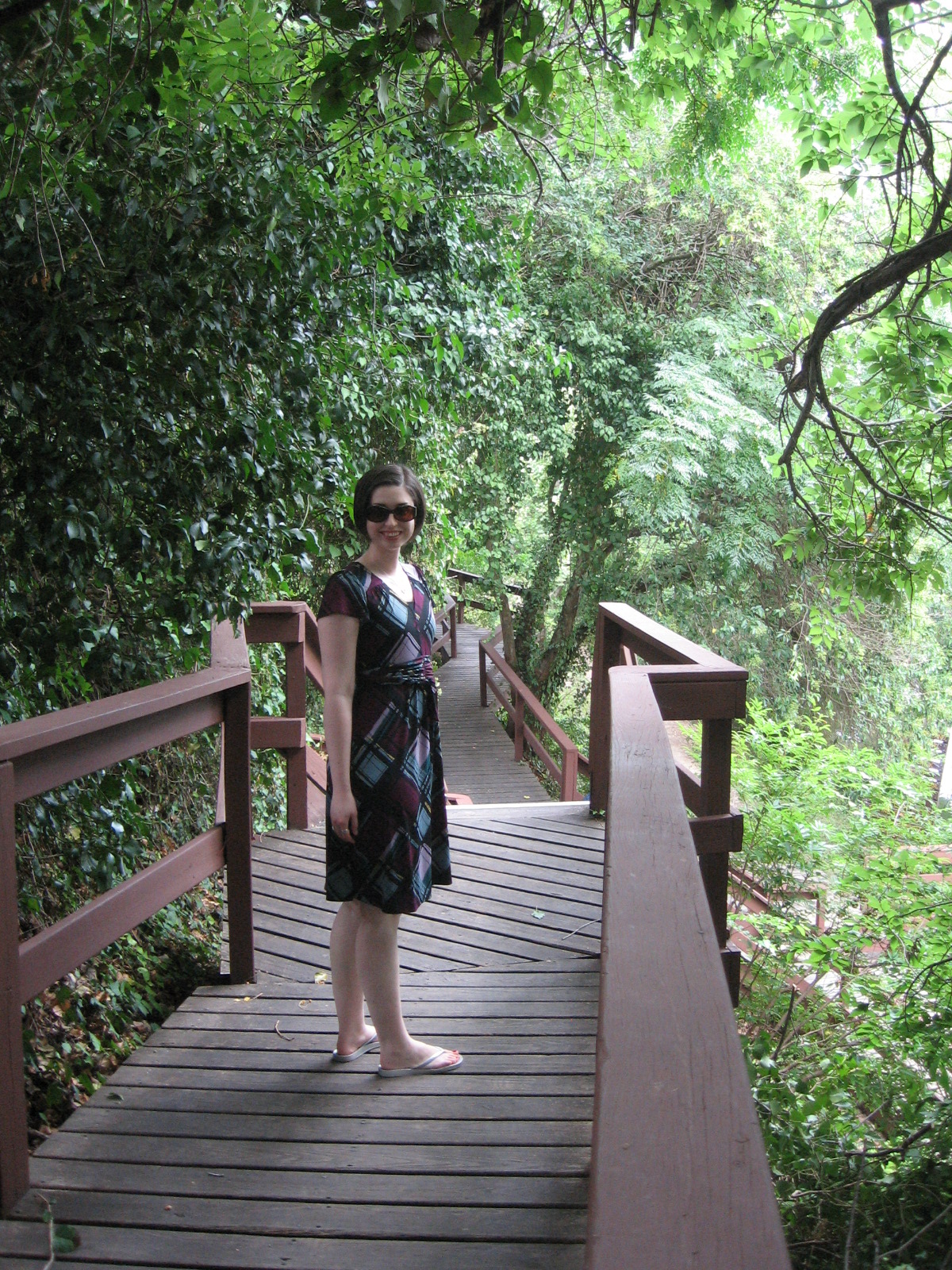
But the main reason I chose it was because it reminded me of trips I’ve taken with my wife, especially our afternoon jaunt last summer in Schreiner Park in Kerrville, TX.
My wife, Jennifer Snoek-Brown, at Schreiner Park, summer 2009.


 FYI: I have a new story in the current issue of



 Samuel Snoek-Brown