Many of you probably know this, but in case you didn’t, May is National Short Story Month. And every May, Flash Fiction Chronicles puts together a list of the best short stories available online. It’s not a competitive list — anyone can suggest one — but it is a list composed by writers and regular readers, so in some respects, being on the list is an even greater honor than winning a place on it through some contest. These are the stories our colleagues and our audience care about.
I participated last year and this, contributing stories from the excellent Matthew Burnside, Ally Malinenko, Mihaela Nicolescu, and Ryan Werner, from magazines I love — Eunoia Review, Bartleby Snopes, and my own Jersey Devil Press. (I could have listed more, but I didn’t want to dominate the list.)
But there was a surprise this year: one of my stories got added to the list, too!
I’m not going to tell you which one, because I’d rather you go visit the list and check out ALL the great fiction there. But that’s a hell of an honor, gang, and I’m thrilled to be among this amazing group of stories.
Yes, I’ve been lax about the blog, gang. What can I say — things have been busy all over. And not just for me: I have been kept dizzy trying to keep tabs on all the books that have descended on us all or are soon to bloom in the world. What follows is a long list with too little about each book, but I’m hoping you’ll get more to come, as I might actually get around to reviewing some of these (and some of these I’ve definitely promised to review):
This is the debut chapbook from Passenger Side Books, and it’s pretty damned amazing. I’m two stories from finishing this, but it takes me a bit of time because, like all the best flash fiction, Daughtery’s stories have a tendency to uppercut me to the gut and I need a few minutes to catch my breath between stories. So I’ll have to let you know how it is as a whole in a future post. Or you could just buy a copy for yourself. You know you want one.
I’m nearing the finish line on this one, too. It’s a fascinating concept, this second novel from one of Portland’s favorite writers: a whole handful of distinct perspectives on reproduction, parenthood, and environmentalism (hipster and scientific alike) all against the backdrops of the Oregon Zoo, academia, and good old weird Portland. Fun stuff.
I just finished this. I wrote a review of it on Goodreads. I’m a Nicole Georges fan from her Invincible Summer zine, but this memoir is another beast altogether, full of familial lies and awkward romance and mysterious father figures and homophobic mothers and punk rock vegans and a backyard full of chickens. You heard me. Chickens. It’s pretty stunning.
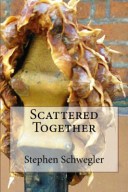
The Founding Father — complete with powdered wig — of Jersey Devil Press and the author of the Exponential Apocalypse books has a book of flash fiction out. Just the quick sample on the webpage for the book has me gasping. We all need this book, gang.
One of the twin queens of Unshod Quills has her debut book of poetry coming soon, and if you’re like the rest of us, you’ve been waiting for a while to see it. Her publisher posted a photo of the first copy off the presses just the other day, so soon, folks. Soon!
My pal from Scotland. Her new book of poems is out now, and it’s intriguing indeed! I’d assumed from the title this might be some kind of refutation of Vardaman’s famous declaration about his mother in As I Lay Dying, but that’s not remotely the case. Instead, it’s a kind of verse narrative full of oddball characters, like something out of a contemporary Chaucer or Castle Waiting. I was lucky enough to receive an early version of the manuscript, and though I’ve only browsed it so far, I’m utterly captivated by the concept. I can’t wait to read the whole thing.
Hosho’s back! I can’t say enough nice things about this killer author and poet, and if you don’t pick up a copy of everything he’s done, including this rerelease of Something Random & Tragic To Set The Guts Aflame… as well as the new And Turns Still The Sun at Dusk Blood-Red… and the forthcoming A Deep & Gorgeous Thirst, then you’re a fool.
Okay, you’re not a fool. But I promise, you’ll regret not checking Hosho out. He’s amazing.
Todd McNamee, Drifting
My buddy Todd’s first novel. I don’t have a release date on it yet, but I do have a review copy I’m reading soon, and I already like the first few pages, so keep an eye out for it!
Ethel Rohan is one of my favorite writers publishing today. She doesn’t just stick the knife in — she twists it. Her prose is obsidian-sharp, but her characters and situations are deeply, painfully moving. I just finished Hard to Say and loved it as much as her first book, Cut Through the Bone. Then I found out she’s got another coming out soon, and I can’t wait to get my hands on Goodnight Nobody.
The other godfather of Jersey Devil Press has a new book, too, and any book that includes “an all-out absurdist dystopian future about robot lubrication” deserves a place on my shelf. How about yours?
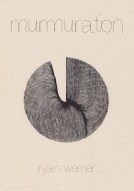
Ryan Werner, Murmuration
You all know Ryan, right? I bring him up a lot here on the blog, because he basically is my writing group — we’ve been bouncing ideas off each other for years. And if you loved the bleak Midwestern ennui of his debut book, Shake Away These Constant Days, you’re going to need to tight little chapbook, too. Because, damn. Seriously.
Oh, and then there’s me.
Samuel Snoek-Brown, Box Cutters
That’s right: I hinted a while back that I had a chapbook coming out soon. We’re still working on final edits and a release date, but Sunnyoutside is publishing a chapbook of my flash fiction. So keep an eye on the website, gang — I’ll be hitting you with details and release dates as soon as I know them!
This article in Pacific Standard, “We Aren’t the World,” by Ethan Watters, is absolutely fascinating. And I’m grateful for the way Watters boils down the VERY complicated science that Joe Henrich, Steven Heine, and Ara Norenzayan are engaged in, because their arguments are such powerful challenges to the foundations of cultural psychology that we peons outside the field would be hard-pressed to follow along without some help.
The article is long, but stick with it, because it’s a good read. But I’m sharing it here because of one passage in particular:
That we in the West develop brains that are wired to see ourselves as separate from others may also be connected to differences in how we reason, Heine argues. Unlike the vast majority of the world, Westerners (and Americans in particular) tend to reason analytically as opposed to holistically. That is, the American mind strives to figure out the world by taking it apart and examining its pieces. Show a Japanese and an American the same cartoon of an aquarium, and the American will remember details mostly about the moving fish while the Japanese observer will likely later be able to describe the seaweed, the bubbles, and other objects in the background.
This coming fall, I’m teaching a first-year college composition course. I’ve been teaching this course for, oh, a dozen years or so now, but for that last ten years I’ve been teaching it as a kind of cultural course: I ask students to write a whole series of essays about a community of their choosing (and they get to define the very idea of “community” as one of their first essays). This class, combined with my second-semester research course focusing on popular culture studies, provides students with an opportunity, through the practice of writing, to examine themselves and their relationships with the world they live in.
But in both these classes, I — like probably just about all of my colleagues — place a heavy emphasis on analytical reasoning. I teach my students how to unpack the pieces of a thing, whether it’s an essay we’re reading or a group they’re writing about or a phenomenon they’re researching.
And I still believe in that approach, but this example of the fish tank fascinates me, because I realize that I want my students to see so much more than the fish. I want my students to see the “the seaweed, the bubbles, and other objects in the background.” And I’m wondering if, in all my efforts to get students to focus, to refine, to break down and to analyze, I might be interfering with their ability to see the bigger picture, too.
In other words, in asking students to consider their relationship with the world around them but emphasizing analytical thinking over holistic thinking, am I really just providing them with tools to more closely look at themselves, rather than at the world around them?
Both are important, I think. We need to see the forest AND the trees. Fortunately, I have the summer to play with the concepts outlined in “We Aren’t the World,” to dig into the research of Henrich, Heine, and Norenzayan more directly (at least as far as my untrained brain can manage), and to consider how I might adjust my syllabus to better reflect holistic reasoning alongside analytical reasoning.
And I’m really looking forward to bringing that into the classroom!
* The all-caps “WEIRD” in the title is actually an acronym that Henrich, Heine, and Norenzayan devised to describe the distinctive American mindset: “Western, Educated, Industrialized, Rich, and Democratic,” as well as a descriptor for how distinctive — or weird — we Americans are when compared with the rest of the world and even with the Western industrialized world.
This past week, I read a fascinating article by Corinna Meier over at Best Colleges Online. It was well timed, as the two colleges where I work are engaged in next-year-planning discussion of all sorts of issues: pedagogy, organization, online education, new programs on offer.* So the business of teaching has been on the brain lately, and along comes this piece about innovations in education.
The article, “Teachers Pay Teachers…in Higher Ed?,” is about a curriculum-swap website where teachers can post lesson plans, reading materials, and other teaching-related materials they’ve produced, and other teachers can pay to download the materials. The idea, as I understand it, is to provide overworked teachers without the time to develop curricular materials of their own a place to find useful lessons or readings or whatnot and save themselves some precious time, while also providing the teachers to do produce curriculum (often in their own “free” time, off the clock) with some much-needed — and much deserved — compensation. Hence, the name “Teachers Pay Teachers.”
Meier’s article, which is well written and fairly even-handed, explores the evolution of the website from a resource for K-12 teachers to a forum for higher education, where it hopes to compete with the higher-ed trend of so-called free online education, known in the biz as “massive open online courses,” or MOOCs. The idea, apparently, is that college professors who might agree with the idea of freely shared information but don’t really want to starve can sell their course materials via Teachers Pay Teachers, disseminating information in the kind of collegial curriculum-swapping most college teachers already engage in but now earning money for doing so.
Which sounds just peachy.
Except the whole enterprise, from K-12 to higher education, suffers from a pretty absurd failure of logic. Or just basic math.
In Meier’s article, we learn about a University of Georgia adjunct named Josh Boldt. Boldt seems to buy into the idea of freely sharing teaching information online, particularly in ways the help protect the rights and the work of teachers. Last year, Boldt created a spreadsheet in Google Drive that logged the pay and working conditions of adjuncts, and then he opened it up to the public so adjuncts around the country could contribute. The idea is that having free access to this kind of information would help adjuncts protect their rights and normalize their salaries. It was such a hit that it has since developed into the website The Adjunct Project. So he seems like a prime candidate for contributing to a site like Teachers Pay Teachers. Except, he isn’t.“I don’t like the idea that we could make knowledge proprietary,” Boldt told Meier. “I’d much rather create an open environment where teachers share with each other for free.”
And that’s the catch. Because Teachers Pay Teachers seems to be a literal a name: it’s not really “extra compensation” for teachers — it’s an added expense for the teachers who buy the curriculum. It seems to be simply moving money from the left hand to the right. Or, to borrow the old phrase, it’s robbing Peter to pay Paul.
MIT professor Stuart Madnick seems to think this is how it’s always been. “Madnick said [. . .] there is a long history of professors writing and selling textbooks, and others buying them to use in their classes,” Meier writes. But Madnick’s analogy isn’t really accurate, at least at the college level, because professors are provided with free desk copies of course books. Sure, someone has to pay for those books, but typically either the college pays for them, or, more often, the publishers give the books to teachers gratis. The textbook writers make money, as they would on Teachers Pay Teachers, but the teachers who adopt those textbooks don’t have to pay that money — it comes out of the pockets of the provider or the institution.
Which raises, for me, the most important question about the whole enterprise: What’s in it for Teachers Pay Teachers? In the case of textbook publishers providing free books, they know they’ll recoup the costs many, many times over, because if a teacher requires a text, dozens, sometimes hundreds, even thousands of students will have to buy that book. And that’s where the publishers make their money. But in the case of Teachers Pay Teachers, what’s their pay-off? It’s unlikely to be a free dissemination system, like Josh Boldt’s Adjunct Project — otherwise, why charge money at all? Why not just post the teaching materials in a Google Drive-like database?
More likely, the website takes a cut of the sale, something akin to Amazon profiting from user-generated content by taking a (small but significant) percentage of each sale. I can’t say that for certain, because the Teachers Pay Teachers website doesn’t clarify this anywhere that I can find. It might come up when you sign up to participate, but I haven’t done so, because I already share teaching materials with colleagues — for free. So if I did want to engage in a larger community of sharing, I’d be more likely to look for or start a free file-sharing service, because, much as I’d love more money, I tend to agree with Boldt about feeling leery of monetizing information.
All that aside, I should point out that teachers do have the option of providing their materials for free, and the site boasts of having more than 90,000 such materials available for free, so maybe it’s still worth signing up and checking out. If I do dive into it this summer, I’ll keep you posted.
Overall, I’m glad to have found Meier’s article, and I recommend that anyone interested in this new trend in teaching go check it out.
* Speaking of new programs: Have I mentioned that Pacific Northwest College of Art, where I teach writing and literature, is rolling out a new BFA in Writing this coming Fall? It’s an amazing program that will treat writing as a studio art, and I’m proud to be a part of it! You can find out more about it here: http://www.pnca.edu/programs/bfa/c/writing
A couple of years ago — almost exactly — I got invited to visit a classroom of Emirti women who were studying young adult lit in Abu Dhabi. They were working on writing a children’s story, and the teacher wanted me to talk to them about creative writing and to walk them through some exercises. But I also found out they were reading Naomi Shihab Nye’s novel Habibi, and on a whim, I contacted the author. (She lives in San Antonio, near where I grew up. I liked to think we shared something.) To my great delight, she replied, and we swapped a few emails about writing and what the Emirati women were working on. I found Nye beautifully generous and encouraging.
You should read this poem, “A Well Traveled Woman,” that is going viral. You can see her generosity, and her beauty.
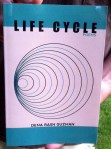
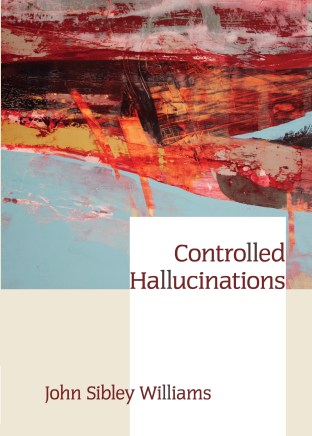
I know John, and we’ve talked about his poetry before. He’s a bit of a classicist, not in any formal sense but in the sense that he eschews “raw” and “edgy” in favor of intimacy and reflection. Or, as the press release from FutureCycle Press puts it: his poetry “weaves universal themes and images with the basic human reality of touch, word, and what is lost in their translation.”
Take these lines from poem IV:
There’s no pattern to our astonishment.
Birds don’t know the weight placed on them. They look down and see us looking up.
That is all it takes when there is no gravity but flight and falling.
It’s a beautiful first book from a terrific poet, and you should order a copy.
Twice in my teaching life, I have sat in rooms with students and tried to find the words to convey tragedy. The first time was twelve years ago, in my first year — my first month — of teaching outside of grad school. When I learned of the attacks on September 11, 2001, I was on a long commute through the Texas backcountry and I had a good hour or so to process the events and plan what to say when I met my students on campus. When I did finally arrive at school, I’d decided to simply dismiss class so students could call loved ones or meet with friends and process, but I also left the classroom open in case students wanted to talk as a group. I told them that there are few better places to talk about these sorts of things than a college classroom. And almost all the students did stay, and we talked. I realized later that the resulting discussion was as important for me — maybe more important for me — as it was for them.
When I learned of the attacks on April 15, 2013, I was already in the classroom, down in McMinnville, Oregon, between classes. I had maybe 20 minutes to read online as much as I could about what had happened, and no time at all to plan what to say. My plan for the next class was to conduct a group-building exercise designed to promote audience awareness, language building, and camaraderie in my students’ small workshop groups. We were playing the game Taboo. As students came into the room, I could see that none of them had heard the news — or if any had, they weren’t talking about it — and so I decided, in the space of about five minutes as students arrived for class, that I couldn’t derail that exercise. The communication — and the fun — were too important. So we played the game Taboo. We laughed, and we celebrated correct guesses and earned points, and we had a fun couple of hours. When class was over, one student stayed behind. Last week, this same student had lingered and talked with me about how hard it was for him to make friends, and one reason he’d come to college in the first place was just to meet new people and try to make new friends, and he was having a very hard time doing that. Yesterday, he lingered with a huge grin on his face, and he told me my class was the coolest class he’d ever had. He said I made learning fun. I wondered how differently he might have felt if I’d abandoned the game and discussed the news instead, and I was glad we’d played the game. I also realized that I had needed to laugh, too.
My last class, though, was my creative writing workshop, a small class of bright, thoughtful second-year students, some of whom I’ve taught before. One of the essays we were discussing in class was Susan Straight’s “Travels with My Ex,” an essay partly about racial prejudice and the knee-jerk assumptions we make about people. Just before class, a friend of mine — a scholar in postcolonial Arab literature and culture and an Arab-American herself — posted on Facebook a link to a Washington Post piece: “‘Please don’t be a Muslim’: Boston marathon blasts draw condemnation and dread in Muslim world.” She added to the post the comment, “What it’s like in my head today. *sigh*”
I put that Post editorial up on the projection screen and shared (with her permission) some of my friend’s other comments with my students, and we talked about the essay in the book and the article on the screen and the events in Boston. We didn’t talk a lot about Boston, but we made a space for it. And it was enough.
I value my students so much for that. There’s something special — something that, for me, feels important, even necessary — about knowing that when I approach these subjects in my classroom, I am responsible for so much more than my students’ education: I am a curator of their experience of these events. I am an editor to their stories, working with them to shape their comments and process their experiences. I am a quilter stitching together from their discussion a warm, safe place in which to lie down and cry.
And they are all these things for me.
And I am so grateful for that.
Just one month ago, many of the writers and editors and publishers I know were in Boston. They weren’t there to run — they were there for the annual conference of the Association of Writers and Writing Programs. I didn’t get to attend, but I enjoyed all the updates and photos on Facebook and blogs, because they reminded me of the only time I’ve been to Boston, back in April 2006, for the annual joint conference of the Popular Culture Association/American Culture Association. When I was in Boston, I spent a whole afternoon visiting the Boston Public Library — the first public library in America and a model of public libraries around the world even today — and many of my friends in Boston last month made the same literary pilgrimage.
The explosions yesterday happened just across the street from the library’s north side.
I have no idea what it feels like to run that stretch of Boylston Street, let alone to run it in the Boston Marathon. I have no claim to any special connection with the events of yesterday, other than that the trauma was experienced by human beings like me, and the people who raced in to help were human beings I want to be like. But I know what that area of Boston looks like, what it feels like to walk it in the springtime.
I understand how important it is to preserve that. I understand why people will return to that street, spring after spring. I understand why they will never be scared away.
Here are some other things I’ve been reading today. Not news. Commentary. Reflection. Calls to action. Love.
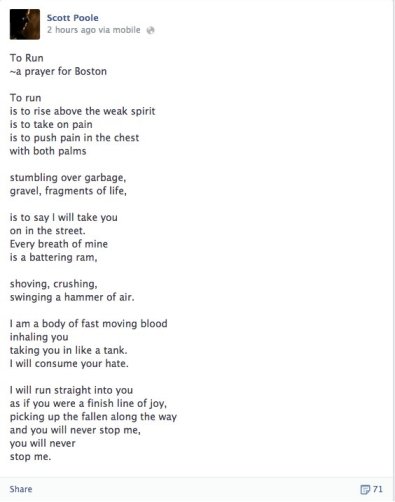
“To Run ~ A Prayer for Boston,” a poem by Scott Poole (this one got shared on Facebook, which is where I first saw it, but you can follow to link to find it on Live Wire Radio’s website)
1 excellent display on the aquatic ecology of the Louisiana wetlands
2 public libraries and 1 university library
3 colleagues (2 writers/professors, 1 writer)
4 experts in folklife and/or architecture and 1 wildlife scholar
1 coffeehouse, 1 bar/restaurant, 1 Golden Corral and 1 Waffle House
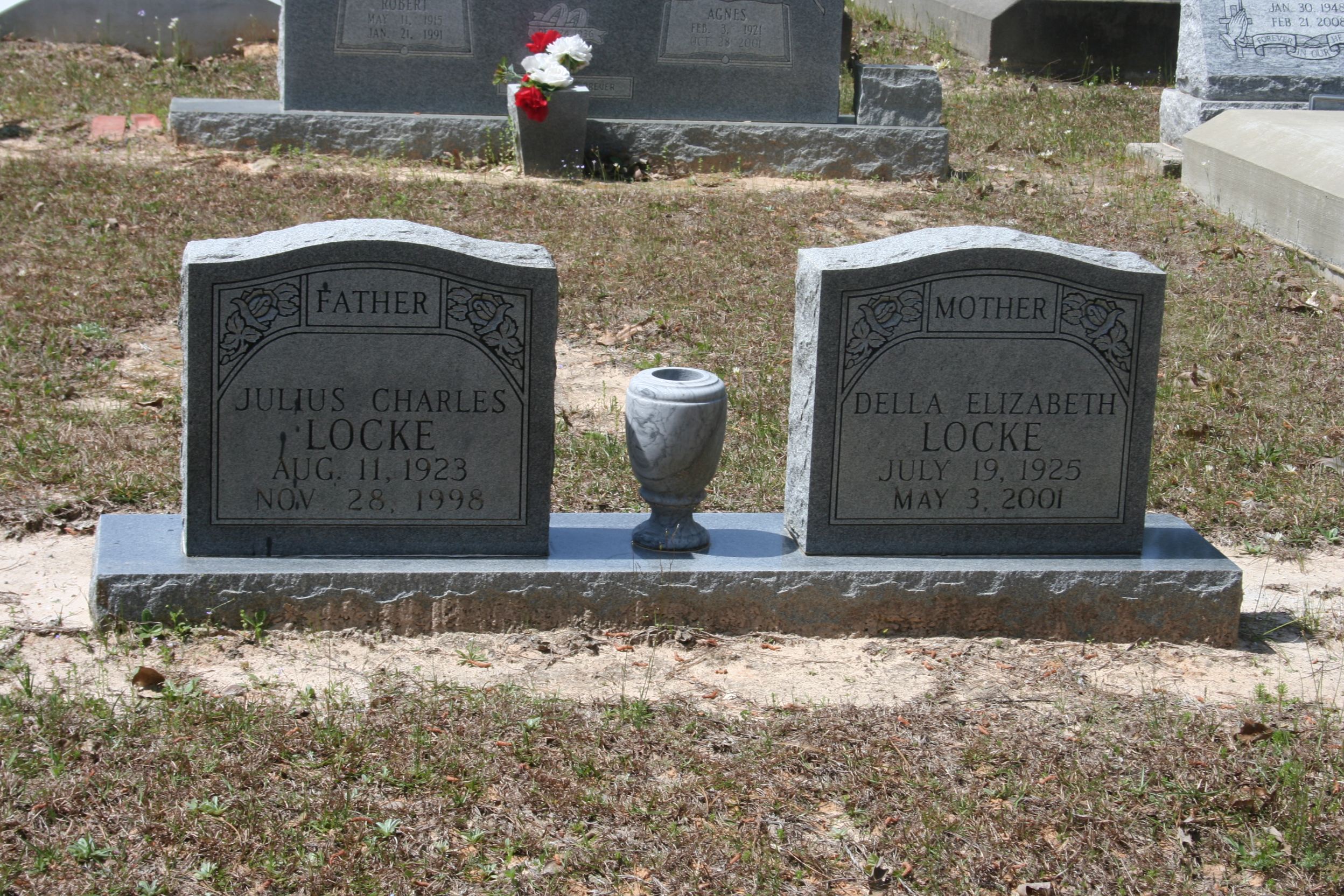
3 uncles and 2 aunts, 1 great-aunt, 2 cousins, both parents, and the graves of my grandparents and great-grandmother
5 cemeteries
2 battlefields
4 churches
the Family Dollar in Cameron 4 times
the Cameron Ferry 6 times (that’s 6 times heading west, and 6 times heading back east)
2 beaches (Holly Beach and Cameron’s Jetty Pier Park)
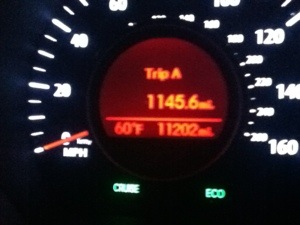
In all, I drove almost 1,150 miles.
At the libraries, I spent more than 16 hours reading from 19 books, and I wrote almost 4,000 words of notes.
I took more than 1,000 photographs.
I saw more than 30 alligators in 5 different locations, including 1 in the wild while I was all alone.
I also saw 2 marsh rabbits, 3 different kinds of snakes, a flock of coots, countless ducks, gulls, pelicans, and herons, dozens and dozens of turtles, and a nutria (just before it raced into the brush and disappeared).
I saw 2 people ahorseback in the roadside marsh.
I saw 2 airboats out in the bayou.
I had at least 6 moments of euphoric epiphany about my book.
I had comments of support and enthusiasm from countless friends and family, and a couple dozen requests for copies of the book when it gets published.
In Louisiana, I had the terrific good fortune to meet with some wonderful people. The librarians and staff at the Cameron Parish Library and the Calcasieu Parish Public Library, in particular, deserve more praise than I can offer for their patience and help during my trip. I also am tremendously grateful for the volunteers at the Vermillionville historical village — the experts in history and culture were fantastically helpful and informative, and the re-enactors gave me an excellent sense of the Cajun people who lived in the area, complete with accents, expressions, and personal stories. Also, the woman working the register in the gift shop was exceptionally friendly and helpful (or, maybe not “exceptionally” — friendly and helpful tends to be the rule in the South): she talked to me about the area and the food, and she eventually directed me to the Acadian Village, complete with discount on admission there.
The staff in the Southwest Louisiana Lake Charles Convention and Visitors Bureau also were terrifically helpful, and they directed me not only to some important historical sites around Lake Charles but also out to Vermillionville and the Acadian Village, as well as the Cajun Village in Sorrento (though I couldn’t get out quite that far this trip, I regret it, as I’ve recently discovered the excellent blog of the Cajun Village’s marketing director, Justin Newhart — you should check it out).
I also want to thank Gay M. Gomez, a researcher on Louisiana wetlands. I met her at the Cameron Prairie National Wildlife Refuge, where she volunteers in the Visitor Center, and she provided a lot of helpful information not only about the plantlife but also about the history of the area. And she, too, was delightfully friendly — she even wrote down my name and promised to keep an eye out for my book when I get it published.
But it wasn’t just the academic experts I appreciated. The locals, the experts on living in the area, were fascinating and helpful as well.
In Cameron, the only store is Family Dollar, but it was right next to the Cameron Motel, so I was in there almost daily the first half of my trip. I wound up in a kind of piecemeal conversation with the main cashier, bits of dialogue spread over several visits. The first time I was wearing my backpack, and she asked if I was just passing through, as though I were some romantic itinerant breezing into town. I told her I was in town to do some research for a book (I was on my way to library, actually). On another trip to the store, she told me how her mother had come from Maryland, where her parents had kicked her out of the house for getting pregnant. Which is how they came to Cameron, Louisiana. She said most folks had come there from somewhere else. Another trip, she asked me what sort of books I wrote, so I told her I was currently working on a historical novel set in the area. She looked at me askance and said “You won’t find much history around here. It’s all gone, from the storms or just people leaving.”
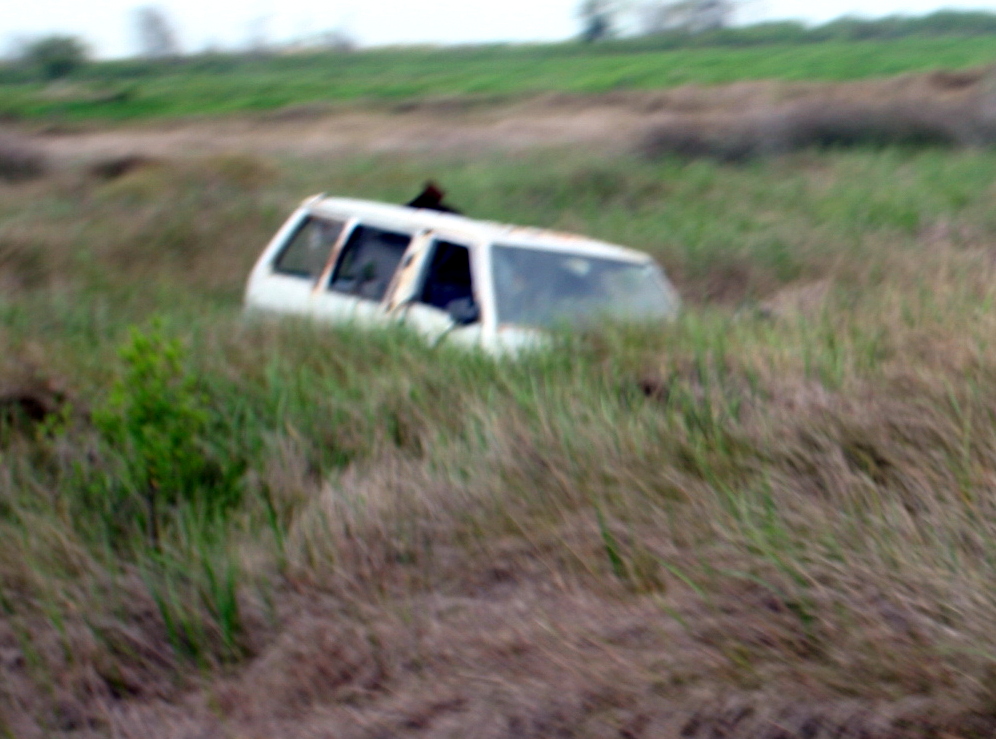
Just outside of town there are still twisted hulks of cars, the glass gone and the trim rusting, slumped in the ditches and the marsh. Tossed or washed there by Hurricanes Rita and Ike. They’re still sitting there, after all these years. No one’s ever bothered to move them. It’s eerie — it’s like the hurricane just blew through a few months ago. It was also a stark reminder that my aunt Jeanette and uncle Brad had been driven out of the bayou by the hurricanes.
My aunt and uncle laughed when I told them where I was staying. “There ain’t nothing out there,” my aunt joked. Of course, having lived out in that area for decades, she then began to direct me to a couple of good restaurants in the town of Creole, a bit farther north and less affected by the hurricanes.
Another uncle, Bill, also laughed about my staying in Cameron. I told him, “I know I’m in the middle of nowhere, but I’m also in the middle of everywhere I need to be this trip.” He joked, “You’re in the middle of two gators, maybe!”
Back at Brad and Jeanette’s, Brad asked what my book was about. I told him it was about two women trying to survive alone in the bayou.
My aunt Jeanette and uncle Brad.
He said, “Shoot, that is hard. You can’t do it. You can’t live alone out there in the bayou.” (In his thick accent, he pronounces bayou as “buy” with just a hint of an aspiration, like “uh,” at the end.)
Then Brad told me a story about “two old boys” who had taken a girl into the bayou on a boat, just to ride around, but they’d gone out there in the wrong time of year, when the water was still cold but the mosquitos were in full force. “The skeeters is terrible out there, and they started getting eat up by all them skeeters, couldn’t get away from them. So those boys jumped out the boat, jumped into the bayou to try and get away from the skeeters, but they got caught in the mud. That girl stayed in the boat, but them boys got stuck in the mud and couldn’t get out the bayou and they died there from hypothermia. The bayou is dangerous. It’ll kill you.”
Of course, my aunt and uncle survived the bayou just fine. They’re the kind of rugged, determined people who know the land, understand it. It took three floods and two direct hits from hurricanes to finally drive them out of the bayou, but my uncle Brad, especially, still waxes nostalgic, remembering his four horses and his hutch of rabbits, his duck blind and deer blind, his land. You can hear the weight of what he’s lost — and what he still carries around with him — in his voice when he talks about home.
I’d like to think that my aunt and uncle are the emotional heart of the novel I’ve written. Not just the rough and rugged romance of Buford and the girl, but also the connection to the land that Buford and the old woman feel, and the yearning for it even in the face of hardship.
And despite all the scoffing and joking about how empty Cameron Parish is these days, there are still plenty of people happily sticking in the area and preserving old traditions. Driving along highways 27 and 82, I kept seeing cars parked on roadsides and young couples, some in their teens or early twenties, mucking around in the ditches and canals with nets and traps, crawfishing. These are the dates they go on. Or I would see families at bayou-side “recreation areas,” the only recreation to do being fishing, kids with poles and parents dipping nets into the water while gray pelicans glided in military formation out over the water. At the Jetty Pier Park in Cameron, middle-aged couples fished with long poles out in the Gulf while whole caravans of families lined up in massive RVs and sat in folding chairs, barbecuing and blasting zydeco on stereos.
I found a lot of excellent historical facts and botanical details on my trip to Louisiana, immensely helpful information, but these people were the main reason I’d come to Louisiana. I wanted to meet my own characters. I wanted to know that I had been careful with the culture and the dialect. I’m sure I still get things wrong here and there, but I respect these people — some of whom are my own family — and I want to do right by them in the novel. I want to know that I’ve conveyed their strength as well as my characters’ quirks, their humanity as well as my characters’ occasional inhumanity, and how their determination expressed in my characters help my characters survive their desperate circumstances.
I need to thank some other people as well: Sarah Loghin and Max Hooper, both from Cajun blood, for their feedback, ideas, and strong encouragement as I posted updates about the trip on Facebook; my writer friend Erin Entrada Kelly, who turned me on to the research of Kelby Ouchley and later directed me to excellent food and beer in Lake Charles (her hometown) — you should keep an eye out for her upcoming novel set in the region (see her website); all my friends and family who expressed such enthusiasm for my updates on the trip and for the book in general; and especially to my family: my parents for driving all the way out there from the middle of Texas to see me, my aunts and uncles — Brad and Jeanette, Bill and Sherri, Jay — and my great-aunt Lydia and my cousins Jo Anne and Ted for feeding me good homegrown vegetables and taking us all out to visit the graves of my grandparents. And to my Grandma, whose letters about growing up in Louisiana and stories about our family helped me understand so much about so many things; and to my Papa (it’s pronounced “paw paw”), whose quiet strength and fearlessness will always inspire me (and whose excellent gumbo I will never forget). I miss them both, and I am so grateful to have been able to visit their graves this trip.
People who’ve been reading this blog for years will know the score. Way, WAY back in 2009 (that’s, like, two generations ago in blog years), I started the first draft of my Civil War-era novel set down in Louisiana. And even though the story itself isn’t true, there were so many historical facts and regional details I didn’t want to mess up that I took some time out to do some research, and I got so involved in it that I wrote a whole series of blog posts on how to research for fiction.
But then I knocked out the draft and I set aside the research. Hurray for me!
Except that wasn’t nearly the end of things. Because I knew all along that when I finished that first draft, I would still need to do two things: one, I’d have to revise the hell of out it. And two, I’d need to visit Louisiana and walk around in the bayou and refresh my childhood memories of the place. And both endeavors would involve more research, just to cover my bases.
I tinkered with the book off and on over the years, but last summer, in 2012, I finally got around to revising the novel wholesale, and while I worked on it, I sat down to stacks and stacks of books. For my first draft, I was overseas, where the libraries didn’t have much on the American Civil War (why would they?), so I relied heavily on internet research and emails to librarians and other experts. But this time, I was in the States, and I finally had access to those holy tomes, the dusty old books in the stacks. And boy, did I read.
That research fleshed out what was missing in the novel, and the revision that resulted was more or less perfect. There were still a handful of what I considered minor details that I’d want to check against the actual region, and I wanted to hit the public library in Cameron, Louisiana to pick up any local material my own nearby libraries wouldn’t have. But that was about it — I mostly wanted to make my trip to Louisiana so I could walk in the world of my novel and make sure it all felt real.
And I did. And it was amazing. (I’ll write about that later this week.)
But in the library, I also wound up reading another dozen books or so, and I was finding such great material that I drove up to Lake Charles and hit the library there as well. In all, I made my way through 20 more books on local history, culture, language, folklore, weather, and so on.
(I showed the list to my students, who are writing research papers right now, because I wanted them to know I was down in the trenches with them, doing research of my own. They collectively gasped. One said, “Are you kidding me with that?” I said, “Nope. This is what you all should be doing. This is what your research should look like.”)
So, here, all compiled into one epic list, are the sources I looked at while writing, revising, and double-checking my novel, including both print and web resources. Looking back, these 70 or so sources seem like a hell of a lot of reading, and it was, but bear in mind that I started this three and a half years ago. Also bear in mind that when I was in high school, I was planning to get a history degree before I switched to English in college, and I still love reading this stuff. I know a lot of writers who hate doing research, and I get why, but no kidding, this is fun for me.
Anyway, here’s the giant list of stuff I read for the novel:
Block, W. T. “The Great Storm of 1886: A Day of Agony and Death at Sabine Pass, Texas.” Beaumont Enterprise (Beaumont, TX), January 9, 1977. http://www.wtblock.com/wtblockjr/great1.htm.
Block, W. T. “October 12, 1886: The Night That Johnson’s Bayou, Louisiana Died.” Beaumont Enterprise (Beaumont, TX), October 10, 1979. http://www.wtblock.com/wtblockjr/johnsons.htm.
Brasseaux, Carl A., and Philip Gould. Acadiana: Louisiana’s Historic Cajun Country. Louisiana State University Press, 2011.
Ross, Nola Mae. The Devastation of Hurricane Rita: A Pictorial Log of Hurricane Rita’s Path of Destruction Through Cameron and Calcasieu Parishes. N.M. Ross, 2006.
Ross, Nola Mae Wittler. Hurricane Audrey. Wise Publications, 1996.
Ross, Nola Mae Wittler. Louisiana’s Acadian Homes and Their History. N.M. Ross, 1999.
Saxon, Lyle, Edward Dreyer, and Robert Tallant. Gumbo Ya-Ya: A Collection of Louisiana Folk Tales. Pelican, 1987.
Schmidt, Jim. Civil War Medicine (and Writing): A Blog on Civil War-Era Medicine and My Own Research and Writing.http://civilwarmed.blogspot.com.
Sears, Stephen W. The Civil War: The Second Year Told By Those Who Lived It (Library of America #221). Library of America, 2012.
Simpson, Brooks D., Stephen W. Sears, and Aaron Sheehan-Dean. The Civil War: The First Year Told by Those Who Lived It (Library of America #212). Library of America, 2011.
Sullivan, Walter. The War The Women Lived: Female Voices From The Confederate South. J. S. Sanders, 1995.
Taylor, Joe Gray. Louisiana, a History. Norton, 1984.
Thibodeaux, Ron. Hell or High Water: How Cajun Fortitude Withstood Hurricanes Rita and Ike. University of Louisiana, 2012.
* I haven’t actually read Gay Gomez’s two books yet, though I browsed one of them in the Cameron Prairie National Wildlife Refuge’s visitor center. But I met Gomez at that visitor center, where she was volunteering, and we talked about her books and the region for a while. They’re on this list because it’s a working bibliography, because I do plan to read them soon, and because I got to meet the author, who was generous and friendly.

 Many of you probably know this, but in case you didn’t, May is National Short Story Month. And every May, Flash Fiction Chronicles puts together a list of the best short stories available online. It’s not a competitive list — anyone can suggest one — but it is a list composed by writers and regular readers, so in some respects, being on the list is an even greater honor than winning a place on it through some contest. These are the stories our colleagues and our audience care about.




 Todd McNamee, Drifting






 Samuel Snoek-Brown