About eight months ago, my paternal grandfather died. I’ve written about him on the blog before; just look for any posts about Capt. Ted Snoek. He was 95 years old when he moved on, and his memorial service drew a wonderful crowd. My family invited me to speak at the service. I wrote a piece about my grandfather’s shoes. I told my wife that it was the most important — and the hardest — thing I’d written to date. People seemed to like it, though I’m amazed anyone could understand me — I wept through the whole thing.
Last week, my parents came up the Pacific Northwest for a visit, and they brought me some of my grandfather’s effects: a file box; a plaque his Seaman Center had given him; a small, intricately carved side table he’d purchased 70 years ago in India . . .
. . . and a pair of his shoes.
I’ve memorialized a few people on this blog over the years, writers and teachers I’ve long admired. So it seems fitting, now that I’m crying over these shoes in my hands, to share the memorial I wrote for my beloved grandfather, Capt. Ted Snoek.
This is what I said:
Stop me if you’ve heard this one before.
And since this is a story about Ted Snoek, chances are, you have heard it before.
Something like 25 years ago, when I was in my early teens and hitting my first growth spurt, my Grandpa genes kicked in and my feet outgrew the rest of me. I was still in middle school when I hit size 11; by high school I was wearing what were then size 12. My family went to visit my grandparents, and one day Grandpa pulled me aside, led me down the hall to his room in the back of the house, where he kept his huge desk and two twin beds for grandkids and his church suits in a small closet. He opened the closet and started pulling out shoes for me to inspect.
He was offering me his shoes.
You know Grandpa. You know his shoes. He wore size 14 D. For decades, he had to special-order them. Each one seemed longer than my arm. And these were lovely, classic dress shoes, brown Oxfords, beautiful shoes that I could barely hold in two hands. He asked if I wanted to try them on. I laughed and said, “Grandpa, I’ll never be able to fit into these!”
He said, “Well, not now. But you never know.”
This sounds like a metaphor, and it is, but by now, I do know. Both figuratively and literally, I’ll never be able to fill that man’s shoes.
Actually, there’s no reason any of you would have heard that story before, but I bet you’ve heard one like it, or experienced it yourselves. Because this is who Ted Snoek was: generous, always thinking of others, always trying to give things to people. Food, furniture, files—boxes and boxes of old receipts and genealogy records. Once, my grandfather gave me an old plank full of rusting nails half-driven into the wood. They were his nail collection. He wanted to pass it on to me.
But the thing he and my grandmother gave the most was of themselves. Everyone who wanted to could count Ted Snoek as their family. My mother never called him her father-in-law, she always called him “Dad”; to others, she referred to him as her second father. My good friend Apryl—and Roy will probably tell you more of this story in a bit—she was for most of my childhood a cousin of mine, until I got old enough to realize that she wasn’t related to me at all—she’d simply adopted Ted as her own grandfather, and he gladly adopted her right back. My friends and my sister’s friends and my brother’s friends, some of whom are here today, all knew Ted Snoek simply as Grandpa. Even a teacher friend of my mother’s, Debbie, referred to him not as “Mr. Snoek” or “Ted” but as “Grandpa.” Last week, I received a message from Ellie Cole, a member of Ted and Effie’s old church in Groves. She told me that my grandparents were about the same age as her own parents, and that Ted and Effie—and this is a quote—“were like parents to us too. When I had problems, I would seek them out and they would feed me and comfort me.”
In my Buddhist community back in Portland, we have a tradition around Christmas called Bodhisattva Night. We gather and tell stories about people we consider bodhisattvas, which are sort of like saints of compassion, people who give everything of themselves for the benefit of others. This year, I told a story about how, just a handful of years ago, my grandfather had taken in a troubled young boy. He gave him a room, food, work around the house. The boy stole from my grandparents and used drugs in the house, so Grandpa had to uninvite him. I asked what would happen if the boy ever came around again. Grandpa was cautious, mindful of the risk involved, but he told me, “Jesus said, knock, and the door shall be opened, so if the boy knocks, I suppose I’ll open the door.”
When I finished the story, one of the community members said, “He sounds like a remarkable man. He must have been a bodhisattva to you!”
Without hesitation, I said, “Oh, he was. My whole life.”
My whole life.
That’s something I realized last week, thinking about Ted Snoek’s remarkable 95 years on this earth. There isn’t a person in this room who is older than Ted Snoek was; every person in our family and among his friends drew our first breath in a world that already included Ted Snoek. He has been here our whole lives. And in that time, look at all he’s given us. Each of us, whether we’re his youngest great-grandchild or his eldest sibling, we each have 95 years worth of Ted Snoek to carry around with us.
I plan to carry mine in my shoes, like paper pushed into the toes to help the fit. Perhaps, with his help, with the example of his life, I can try to finally fill his shoes someday.
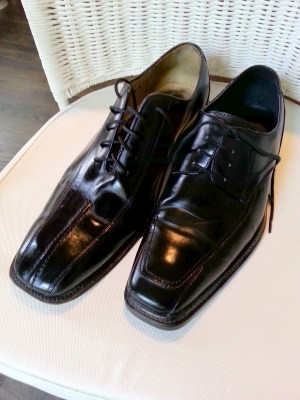
These are my grandfather’s shoes:
I wasn’t kidding about never being able to fill his shoes. Here is my grandfather’s right shoe — the left shoe is mine from a similarly styled pair:
Today, I have a study that feels, to me, a bit like my grandfather’s old room in the back of his house. It has a closet where I keep not suits but winter coats. And now, that closet will hold my grandfather’s shoes, the same as his study closet once held them.
The past week, I’ve been stopping in a few of Tacoma’s comics shops trying to find my new comics “home” (so far, the two I like best, Destiny City Comics and Stargazer Comics, have different qualities to recommend them, and I might wind up shopping at both), but the other day, I dropped into Stargazer Comics and struck up a conversation with the dude behind the counter about how much we both love Mark Russell‘s new Flintstonescomic from DC. And it got me thinking about what I’m collecting these days, and why, so I thought I’d write about it.
Let’s start with Thor, who is the reason I resumed collecting single-issue comics in the first place. (I used to be a die-hard in the early ’90s and still have most of that collection.) When news broke that the original Thor was losing his hammer and a woman would be taking up not only Mjolnir but also the mantle and even the name of Thor, I was intrigued. So I picked up the first issue, and from the beginning, I was hooked. The gender issues at work, in the original eight-issue Thor run and the current The Mighty Thor, are impressive — and necessary — and while they sometimes feel a bit heavy-handed (as they do in, say, Thor #5, where lightweight villain Crusher Creel actually utters the sentence, “Damn feminists are ruining everything!” and Thor, as she knocks the jerk out with a fist to the jaw, thinks internally, “That’s for saying ‘feminist’ like it’s a four-letter word, creep”), they are generally brilliantly handled and tremendously refreshing in the male-dominated realm of superheroes. One of my favorite moments so far is when the old Thor, who now goes by Odinson, acknowledges that this new Thor has wholly earned not just the hammer but also the name and in utter respect, he relinquishes the name to her. Later, another villain refers to her as “She-Thor” or “Lady Thor” and — with a hammer to the face — Thor quickly asserts her right to the name without any modifiers: she is simply and utterly THOR.
I actually own this comic.
So it has gone with the Thor and The Mighty Thor series, and while there have been the occasional hiccups (that Thor interlude with Crusher Creel was one; the “time-out” issues of The Mighty Thor where Loki narrates old stories was another), the series has since delved into some fascinating territory, addressing identity (gender and otherwise), friendship and family relationships, and — most recently and best of all — the concept of strength in the face of terminal illness. It’s been a stunning run so far, and while I seem to always have gravitated toward “alternate Thors” (yes, I did once collect Thunderstrike), I hope this new iteration of Thor sticks around for a good long while. She makes for damn good storytelling.
Shortly after starting on Thor, I started collecting a rash of other new series, including several by Portland writers: Chuck Palahniuk’s Fight Club 2 (now finished and out in a collected volume), Kelly Sue DeConnick and Valentine De Landro’s subversively genius Bitch Planet, and the brilliant Prez, by my friend Mark Russell. DC has recently put the latter on hiatus, much to my displeasure (I want the rest of that story!), but fortunately, they’ve handed Mark The Flintstones, a satirical contemporary reboot of the classic Hanna-Barbera cartoon.
I got the first issue of that from Mark himself, at a signing at Portland’s Cosmic Monkey; ever the satirist, he signed it, “This is where it all began to suck.” He means the dawn of civilization’s farce — the comic itself is amazing. He pulls exactly the right nostalgia-triggering images and references from the old cartoon while inserting wicked, sharp references to contemporary culture and politics (people doing paleolithic versions of selfies, soldiers suffering PTSD over the eradication of indigenous populations, hipsters sneering at popular art). And the framing device for the whole issue starts out hilarious and ends with the kind of laughter-echoing-into-somber-realization that is only possible in the best satire. I’m eager for what’s to come in this run, but better still, Mark says the long-term plan is to do a bunch of mini-arcs focused on different characters (like a Pebbles-centric storyline, a Barney-centric storyline, and so on), and he’s hinted in online comments that we might even see a visit from the Great Gazoo sometime down the line. I was already a fan of the Flintstones and of Mark Russell, but even setting those aside, gang, I am all in on this one.
But Cain has recently picked up her own comics title, this one a superhero comic: Marvel’s Mockingbird. And it is fascinating! Back in the ’90s, I never did follow the Avengers or S.H.I.E.L.D. comics with the same devotion as I did the X-Men universe, so I’m playing catch-up on Barbara “Bobbi” Morse, but Cain has rebooted the character so well that I feel I don’t need much backstory — what gaps exist or references I need, Cain helpfully drops into the storyline with expert deftness. And backstory really works better with linear narrative, which this story is NOT. In fact, in a couple of excellent fourth-wall breaks in the title pages or frame narratives, Mockingbird (and sometimes even Cain herself) explains that the opening issues are part of an elaborate “puzzlebox” narrative, slipping in and out of episodes to drop clues about an underlying throughline narrative that will all get tied together somewhere down the road. I recently finished issue #5 and the drawstrings are only just beginning to pull tight. In the meantime, Cain treats us to an exquisite levity and freshness in superhero comics, with a lot of clever in-jokes, sight gags, and allusions, as well as some spot-on gender commentary, peppered into the story or the backgrounds. In an early issue, we see Howard the Duck (of all characters!) hanging out in a S.H.I.E.L.D. clinic waiting room, and the duck makes a more active appearance in the most recent issue; in another issue, Mockingbird rescues a male colleague and plays delightfully fast with all sorts of wry innuendo about his skimpy swimsuit as she fights her way through baddies to save the guy; in the most recent issue, we catch a glimpse of the Hulk sitting on a toilet, his shredded shorts around his ankles, which I’m sure is just a grabbed opportunity but then, I thought the same thing about Howard the Duck in the waiting room, and that cameo paid off later, so who knows. (I hope the Hulk isn’t suffering any digestive problems!)
But for all the fun Cain is having with these characters, the underlying narrative is as serious and human as you can get, and the quieter moments of the storyline are beautifully handled. I mostly picked up this series out of loyalty to the Portland writing scene and my friends who are in Cain’s writing group, but I have become a fast convert: this is a terrific series, and I’m eager to see where it goes.
I also picked up the new Black Panther series mostly out of loyalty to the author and curiosity about the new direction. To be honest, I haven’t read much by Ta-Nehisi Coates except a handful of short pieces here and there, but I did catch an interview with him on the radio shortly before the release of the new Black Panther, and I loved the things he was saying about comics, culture, literature, American society, responsibility, fear, identity . . . so I resolved then and there to pick up the first issue and see what happened.
The first issue was slow, vague, a bit too broad-stroke. But it had vision and hinted at direction, so I stuck with it. The third issue was, no kidding, one of the best and most inventive, more human stories I’ve ever seen in a mainstream superhero comic, up there with the best of the Logan (not Wolverine) stories, up there with best Batman stories, and in many ways up there in its own category of comics narratives. The fourth issue is carrying that forward, and the series is doing some astounding things with issues of authority, heredity, gender, religion, and politics. It’s one of the most adult, more literary comics I’ve seen, and the fact that it’s a mainstream Marvel superhero comic is amazing.
Best of all, I recently read the announcement that Marvel is going to be branching out from Black Panther and running an offshoot series on Wakandan history and culture, and who has Coates tapped to write that series? The one and only Roxane Gay, who not only is a literary badass and the PERFECT person to pen this new series (which will focus on new characters Ayo and Aneka, lovers and rebellious ex-members of Wakanda’s all-female security force, the Dora Milaje — and they are my favorite people in this new run of Black Panther), Gay also is the first (the first!?!?) black woman to head up a major comic title. And that’s huge news, and I am definitely keen to see that first issue when it hits shelves.
No author has ever struck a better superhero pose. (Photograph: Jennifer Silverberg for the Guardian)
Speaking of women in comics: I am surprised to find myself a new devotee of Spider-Gwen. I can’t remember why I first picked up the series — I think I’d read an article about Marvel’s monkeying around with reboots, alternate worlds, and variations within the Spiderverse — but wherever I heard about it, I found the first issue of Spider-Gwen last year and decided to give it a whirl. And it was uneven at first, though I did appreciate that the writer (Jason Latour — seriously, we need more women writing women in comics!) just jumped into the story without too much explanation and quickly built an alternate universe with a history and language all its own. But there were a few false starts, some loose ends from previous series and other alternate Spiderverses to tie off, and a couple of awkward, throw-away issues. But for some reason, the character of Gwen has remained appealing to me — she is every bit the same kind of Spider-hero that I loved in the old Peter Parker stories: the teen angst, the hero anxiety, and the trepidation, all matched weirdly and beautifully with the innate duty of heroism and the delightful cockiness of youth. If Peter Parker had never existed and this was the only Spider-hero the world had ever known, I’d still love Gwen Stacy the same way, and for the same reasons, as I loved Peter Parker.
Yet Latour is smart to play with all sorts of clever references to and twists on the existing Spider-narrative, so at every turn, we keep getting familiar touchpoints that are just offset enough to make us curious what will happen next. The death of Peter Parker instead of Gwen Stacy, the recurring neighborly advice from Ben Parker, the adversary of an unhinged and vengeful but still-badged cop Frank Castle, a vapid and fame-obsessed Mary Jane (oh, MJ, what have they done to you?), and, most recently, the appearance of Kraven the Hunter . . . . It all feels so strange and yet so right. Even in its off moments, I’m loving the overarching story, and Gwen Stacy is a more fascinating character than I would ever have guessed. I don’t know where Marvel plans to go with her, but for the time being, I’m glad she’s here, and I’ll keep reading her.
Yes, it’s written by another guy, Brian K. Vaughan. And while yes, Vaughan did some brilliant work with gender issues and feminism in his seminal Y: The Last Man (still among my all-time favorite series), he’s still a guy, and I still wonder why we aren’t paying women to tell these stories. (And I say that as a man whose own first novel focuses on two women and the struggles they face. I’m proud of my book; I still want to read those same stories told by women.)
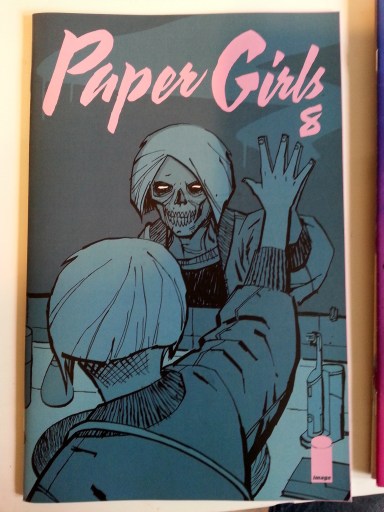
But setting aside Vaughan’s gender, Paper Girls is a tremendous story. Maybe I say that because Cliff Chiang’s artwork and Matt Wilson’s colors are so stark and emotionally evocative. Or maybe I say that because the story — a time-travel adventure that begins in the mid-80s with girls who are the same age I was then, which means their adult selves in the 2016-set narrative threads are the same age I am now — appeals to my love of nostalgia. Or maybe it’s just because Vaughan is a genius for narrative arcs, character development, end-of-issue cliffhangers, deep-seated emotions, innuendo . . . .
Folks, I’m not exaggerating when I say that this might be one of the best comics series ever written.
I might be wrong about that. Who knows where this weird and convoluted emotional trip down memory lane into the ’80s is actually headed; who knows if Vaughan will actually be able to satisfactorily tie up all the threads he’s spun off into the wings of this story. But more than any comic book I’ve read in single-issue series, in the ’90s or now in the 20-teens, this is the story that sends me racing to the comic shop each month, asking, “Is it out yet? Is the new issue here?” And I’m convinced it will also reward rereading, once the run is finished and I can go back through every issue in a binge, piecing together the clues and the characters all at once.
It’s the kind of comic I wish I had written, and it’s the kind of comic I don’t think I could ever write. It is a stunning piece of work, and I love it to bits.
Available online from Out of Print (or try your public library's Friends of the Library store).
Last night I dreamed that I was having coffee at a window bar in a coffee shop when a person approached me hesitatingly and asked if I was a writer. I was wearing my Plot tshirt (an orange triangle representing Freytag’s Pyramid and the word “Plot”), and the person (who was genderless in my dream) said they were trying to be a writer too but weren’t sure about plot structure — they pointed to my shirt.
I invited them to sit on the stool next to me and I grabbed a napkin and started talking about how that pyramid isn’t the only way to tell a story. I drew a line on the napkin and talked about plot points and act structure from my old screenwriting class in grad school. I talked about Vonnegut’s shapes and the crayon-outline Vonnegut describes in the first chapter of Slaughterhouse-Five and how important it is to know where your characters are at any given point in the story. Then I looked up and realized several other people had gathered around. A long-haired teen who reminded me of myself just out of high school but sounded a bit like Lidia Yuknavitch said, “Isn’t all this just a load of crap, though? I thought we’d moved beyond plot. Lines and structure are for hacks and old-timers, man. To hell with all that! Just do your art!”
I had a weird moment of crisis in which I worried I’d become too rigid and formulaic in my work, and I stared at my napkin with all its shapes and intersecting lines. I turned it over to the clean side and stared at that. I started talking about organicism (that’s the word I used in my dream) and letting stories happen like life, about the importance of embracing the unpredictable.
But then I thought about the reading experience and how unsettling and irritating it sometimes feels to read stream-of-consciousness, about all the work involved in trying to keep up with a writer’s brain as words just spill onto the page. I made new lines amd shapes on the napkin, talked about how we ought to know as much as we can about our characters and our world and the broad-stroke events in our narratives so even when our stories surprise us, the surprises still make sense; I talked about how the best stories make the scripted feel unscripted and the organic feel organized. Then I woke up.
And now I want to get to work on my novels: now I want to get to know my characters and see where they take me; now I want to arrange my world so I can knock it all down and find the natural patterns in the disarray.
From time to time, I assign my students an essay about their writing spaces. I share other essays about other spaces, some fairly spot-on (like an older one by my friend Alexis M. Smith) and some a little more out there (like this one on silence and sacred spaces by Pico Iyer). And then I have them find their own writing space, wherever that is, and describe it.
I love these essays. Sometimes students go the traditional route and describe a desk in their bedroom or a corner of their kitchen table; sometimes they wander outdoors and describe a tree they like to sit under or a coffeeshop they frequent. Often, though, they confess that they had never really set aside a space for homework, let alone writing, and that they tend to just do the work wherever they have a little (relatively) free time and a (relatively) clear space.
And these are the some of my favorite essays, because in my workaday life, that is usually how I operate, too. Even when I have a designated desk, like my basement computer in our old duplex in Wisconsin or my little corner desk in our flat in Abu Dhabi, or even a whole study, as I did in our Portland townhome, I often found myself writing from the dining table or the living room couch, and most of the time I wasn’t even home — I would frequently write in my downtime at work or by dictation on my commute.
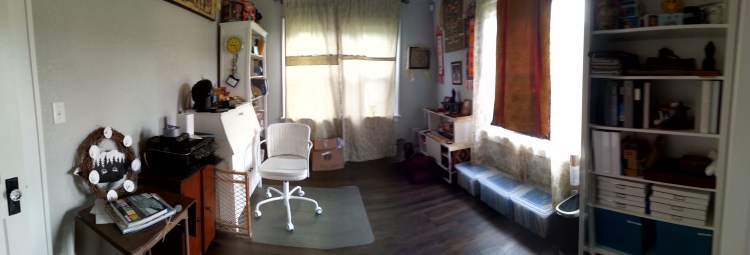
But now we have this new home, and I have a new study at the same time I have this new time to devote to writing — just writing — and I find myself consciously establishing a writing space in my new study, a place devoted to my new job of a working fiction writer.
The room has three bookshelves: One contains my writing and teaching texts, immediate story ideas and resources, writing magazines, and my bookselling bag with copies of Box Cutters, Hagridden, and the microfiction anthology I’m in.
Teaching and writing texts.
My cast with the autographs of Nick Hornby and Scott McCloud.
My notebooks and journals, writing magazines, and a box of literary keepsakes.
Writing magazines and a trove of family letters and documents that are currently fueling my stories and novels.
My bookselling bag (a repurposed camera bag).
Another contains all my religion and philosophy texts. The third contains some file boxes, binders full of more story ideas, and some decor like my father’s pipes, my grandfather’s ship captain’s bag, and my coffee mug from Sewanee.
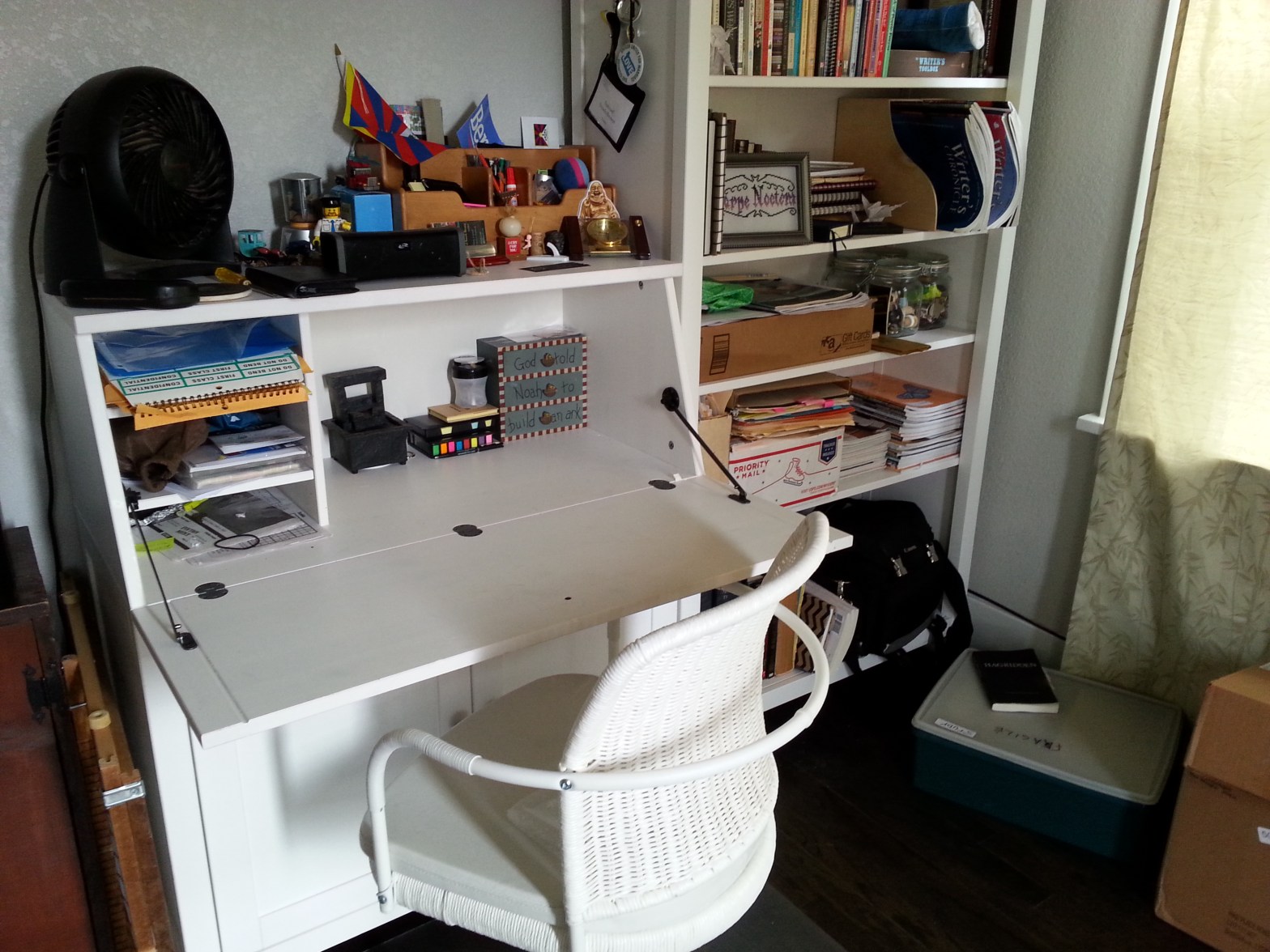
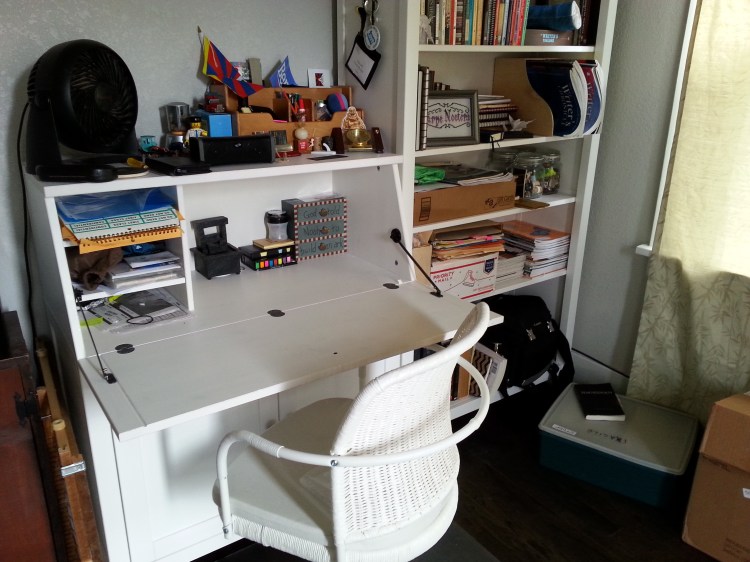
In one corner, I’ve set up my meditation space, borrowing from the “time in the chair/time on the cushion” habit my friend Todd McNamee described when I interviewed him a few years ago. But in terms of my writing, the main action happens at my desk, which is between my printer and my bookshelf of writing texts and story ideas.
Because my desk is a secretary, I had a bad habit of stuffing things in it and just closing the lid on the clutter, but now that I’m working full-time from home, I’m determined to keep it at least clear enough to write regularly at the desk. But I’ve also never really bought into the “clean, well-lighted place” theory of writing; I’ve always been more fascinated by Ray Bradbury’s approach of keeping a menagerie of odds and ends on hand as inspiration for stories, and so I keep a collection of things on the hutch portion of my desk: a set of old die-cast cars and a small “I cry for you” onion trophy from my grad-school professor Dr. Russ Sparling, a giant Lego minifig ship captain (that is also a pen) my brother gave me, a talking Buddha that tells bad Buddhist jokes from friends of my parents, a small Optimus Prime figure, a writing Winnie-the-Pooh statue from my wife, a Lego minifig version of me and my custom minifig of the Rougarou from Hagridden . . . . Next to these are my smiley face clock and my Sewanee name badge, and on the bookshelf nearby is a cross-stitched “Carpe Noctem” my mother made me.
I have other ideas for ambience, too. The big one is my collection of author portraits: the same year I completed my master’s degree, my American short-story professor Dr. Russ Sparling was retiring, and in addition to the cars and onion trophy I mentioned above, he also bequeathed to me his collection of author portraits that he had clipped from magazines over the years and framed. They include a lot of classic heavy-hitters like Carson McCullers, Anton Chekhov, Ernest Hemingway, and William Faulkner, and they had long hung in Dr. Sparling’s office, where I had long admired them. I was shocked — and honored — when he offered them to me, but I have never really had the right space to hang them up myself. I finally have that space, and I am eager to get them onto the walls!
I also hope to add a few portraits to these, favorites like Jane Austen and Cormac McCarthy, framed to match Dr. Sparling’s set. But we’ll see how much wall space I have.
I also have my framed “Rougarou” art print from a Portland artist and the Hagridden-themed photo collage my sister made me, and recently my uncle Brad gifted me a replica Civil War officer’s sword as a tribute to my novel. I’d like to hang those on the walls as well. Of course, I’m already running out of space, and I’ll have other memorabilia from other books I’ll be writing in the coming year, so I’ll have to be judicious in my decor — and besides, I’ll be in there writing, not decorating, so all that might have to wait anyway.
In the meantime, I have my writing space at last — a dedicated study, a comfortable chair and relatively clear desk surrounded my inspiration — and I am ready to sit down and get to work!
It’s been quiet here on the blog for a while, and there’s a reason for that: we’ve been moving. My wife has an amazing new faculty librarian job in Tacoma, Washington, so we’ve been spending the past couple of months transporting our lives and our minds a few hours north from our beloved Portland to this charming little city on the Puget Sound.
It also means that I’ll be taking a year off from the classroom to write full-time from our new home. It’s something I’ve done once before, back in 2010-2011, the period when I drafted Hagridden, finalized and/or published many of the stories that became Box Cutters, and put together the book-length story collection I’m shopping around now. So I’m looking forward to a similar period of creative output, with a forthcoming novella I need to finish revising, two novels trying to pushing through front of my skull and onto the page, and a few other projects rattling around behind them.
All of which means that, when we meet new neighbors or my wife’s new colleagues and they ask what I do for a living, I say, “I’m a writer.”
And that feels strange. But then, it’s felt strange for a long time.
See, I have a thing about labels. It took me years to feel comfortable claiming to be a vegetarian, so I kept explaining to people what I would or wouldn’t eat instead of just using the label. It took me years to feel comfortable telling people that I was a Buddhist, until the day I told Burmese Theraveda teacher Thynn Thynn that “I like to study Buddhism, but I’m not really a student of Buddhism,” and she matter-of-factly replied, “If you study, you are a student.”
And I waited a LONG time before daring to call myself a writer in public, and even now, when I tell people I’m a writer, I often have to fight the urge to look around for the “real writer” who might out me as a fraud.
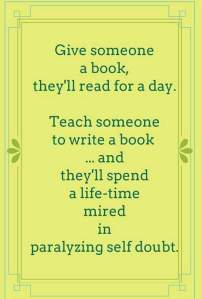
I revisit this “I’m a writer” thing from time to time, but I’ve been thinking about it especially for the past couple of months because right around the time this whole journey to a new town began and I realized I would be writing full-time again, I read an article in Poets & Writers called “Poet, Writer, Imposter: Learning to Believe in Myself,” by Leigh Stein.
Stein opens her article by expressing, in question form, a litany of self-doubts and, after the list, she explains that everyone who identifies with those doubts “may be suffering from imposter phenomenon, which is the name for those sneaky feelings of inadequacy, despite actual evidence of professional success.”
Later, she describes a commission she received to write an essay in response to an artist’s work, and while Stein initially agreed, she fell into a crippling pit of self-doubt as soon as she saw that the other two people the artist had approached were lit-famous:
I read their names and credentials [of those two other famous writers] over and over until I put myself into a sort of trancelike state of paralysis. I somehow forgot my identity as Published Poet and could only think of myself as Managing Editor of There Must Have Been Some Mistake.
That’s the label thing that I keep turning over in my head. Is it okay for me to claim to be a writer? Even after two books, even with two more books on the way and two novels waiting to get written, I’m not This Famous Author or That Prestigious Literato — so am I, in fact, a writer? Surely “There Must Have Been Some Mistake.”
Stein continues her article with a lengthy, excruciating, all-too-familiar narrative of procrastination and avoidance as she wrestles with whether or not she’s worthy of the assignment she’s been given, and this is where I fell completely into the article, because this is a habit I engage in far too regularly. Of course, I’ve always been a procrastinator in general, so maybe I simply use this kind of self-doubt and these feelings of inadequacy as excuses to procrastinate. But the emotions Stein writes about, and her strategies for nurturing those fears and doing more work than necessary both to avoid the real work of writing and to feel like she has earned the label of Writer, feel terribly familiar to me.
Later, the “Writer” label comes up again as Stein explains a four-stage model for how people perceive their own competence:
Stage one: unconscious incompetence, like writing poems effortlessly at thirteen because you read one book by Sylvia Plath and have no idea that there are any other books in the world. Stage two: conscious incompetence, that feeling of whoa when you’re learning to actually write and becoming aware of exactly how many other books there are in the world. Stage three: conscious competence, or the boldness to answer, “I’m a writer,” when anyone at a party asks, “So what do you do, exactly?” The final stage is unconscious competence, or the ability to easily perform a skill, without thinking as you’re doing it, perhaps even at the same time you’re working on another task.
Stein claims she would like to be at stage three but often exists at stage two. I actually have experienced stage four, but only when I’ve been working alone for protracted periods, like my “sabbatical” several years ago or the one I’m about to embark on: if I sit down and do the work long enough and, most importantly, I do the work out of the sight of others, I can fall into the writing and forget to be afraid of what others might think about it. (This is also one way that I use my procrastination to my advantage: if a deadline looms and I have too little time to worry about what others might think of the work, I break past the fear and just get the writing done.)
But it took me a long time to reach stage three, “the boldness to answer, ‘I’m a writer.'”
That’s where I am now, as I meet new people around our new home and have all these new opportunities to say aloud that I am a writer. Each time, it still takes me a moment to muster myself, to push past my longtime response of “I’m a teacher” and confess — yes, confess, because it feels like I’m getting away with something whenever I say it — that I spend my days at home, in my study, dreaming up stories.
At least now, when someone inevitably asks if I’ve published anything, I can point them to Box Cutters and Hagridden, and announce the forthcoming chapbook and the coming novella; when they ask what I’m working on, I can tell them about my two new novels. But when my study door is closed and I’m facing that blank screen, I still wonder if I’m using the right tense in my nominative — if I am in fact, a “Writer” instead of a “Have Written.”
Because sometimes I think I exist somewhere outside that four-stage competence scale, in some unnamed fifth stage where I know that I have written well, but I fear that I might never be able to write well again. Like somehow I just got lucky a few times, and any day now, the whole thing will come falling in on me.
I think in some respects this is related to the classic myth of writer’s block: as a novice, back in “stage two,” I might have stared at the blank page for ages worrying I’d never find the right words to fill it. But now, having written and published enough work to know that every new writing project is its own creature and you have to relearn all over again how to write each new work, I stare at that old blank page and worry I might have already found all the good words — that I have nothing left to say.
This is a stupid, self-indulgent sort of procrastination. I know it. But there it is anyway, waiting for me in my study whenever I sit down to a project.
I usually deal with this self-doubt by embracing it, by remembering Natalie Goldberg’s idea of the “beginner’s mind” (the original name of this blog, by the way). There’s also a cultural concept I read once about the Japanese, and I don’t know how true this is but it’s a good story: when, in middle age, Japanese people awaken in the middle of the night and can’t fall back asleep, they don’t lie there fretting and worrying over the sleep they’re losing, the work they aren’t getting done, the problems that woke them up in the first place. Instead, they realize that in their hectic workaday lives, they never get this kind of quiet, contemplative time, so they simply lie awake in the darkness and enjoy the gift of a little silent reflection. It’s a habit I’ve tried to embrace, and in some ways, I do the same with my fears of inadequacy as a writer: sometimes, when I have the luxury of time to slow down and do this, I will accept the idea that I do still have a lot to learn, and I start over at my “beginner’s mind” and learn anew how to do the thing I love doing.
In other words, while often I slip into this unnamed fifth stage, I try to trick myself into hopping back to stage two and enjoying the wonder and the “whoa” of learning new ways to write.
But enjoying stage two is easier when I could still claim to be a student, when I hadn’t tricked myself into thinking even for a little while that I’m a professional who ought to know better by now. And that’s what keeps me from embracing stage three — that’s why it feels so strange when I admit to people that I’m a writer.
This was where Stein’s article really drove home something for me, because toward the end, she sits down and talks with an expert in this stuff:
“We look to others to define who we are, [licensed clinical social worker and author Sherry] Amatenstein says. It’s reactive. [. . .] The whole process of writing is so fraught because unfortunately it is so much about what other people think.” For writers, professional value is so tied up in publication: If no one wants to publish that novel or poem you thought was so good when you wrote it, of course you feel stricken. “Artists are always waiting for the next rejection, or the next person to like them.”
I suppose when I tell people now that my day job is writing, it feels like some kind of oral “submission” and I am by habit expecting them to like me for what I do or reject the value my work. I never have this anxiety when I tell people that I am a teacher; I know the value of education and my role in fostering it. But storytelling still feels like something done around a campfire rather than for a living, and because the work itself can so often happen in isolation, without the immediate feedback from — and responsibility to — students or colleagues, it sometimes feels like no work at all.
But I am happy to say that the past few weeks, as I’ve been making this transition from the end of my previous term of teaching to the beginning of my new year of writing, I have been getting wonderful reactions. I met a woman at my dharma center a couple of weeks ago and told her I was a writer, and she cheerfully replied, “Oh, so am I!” and then we chatted about our craft for a while. (Turns out I had just met human rights activist and narrative nonfiction author Lisa J. Shannon. Cue my Stein-like panic in the presence of a terrific writer!) The other night, I met my Tacoma realtor’s husband and told him I am a writer; we wound up talking about Phillip K. Dick and graphic novels all night, and he left with a copy of Hagridden. Our new neighbors helped us unload our truck as we were moving into our new house, and when they asked what I do, I caught myself hedging my bets and declaring, “Well, right now I’m a writer,” as though this was just some temporary gig until I can get back to the “real” work of teaching. And in fact, it is temporary — I love the classroom and will be eager to return to it next year — but there I was, undermining my own self-worth as an artist. But one of my neighbors started talking about his background in theatre, his previous work as a producer and his desire to get back into stagework, and through him, I discovered a bit about the arts community in my new town.
In other words, I am learning all over again — with my newfound “beginner’s mind” — the tremendous value in my work as a writer, not just its personal value to me or its reciprocal value within the arts community but also its social value, its worth as art and entertainment. Sure, I am still defining that worth through the reactions of others, per Sherry Amatenstein in the Stein article. But I have become comfortable again with declaring myself a writer, and I am eager once more to go sit in the chair eight hours a day and do the work of writing — because I am, after all, a writer.
Whenever tragedy strikes America, mostly in the form of mass shootings, I have taken time out of my curriculum to foster a class discussion of the events. I have done this so regularly now that friends have started coming to me for advice about or to share their experiences with fostering such discussions in their own classes. Today, someone told me about a class conversation on this weekend’s Orlando shooting; my friend explained how the students were (as usual, and understandably) reluctant to speak out about how that tragedy made them feel, but then my friend made them write about their feelings, and the results were profound.
It reminded me that I had once done something similar with writing about a different mass shooting, and I had blogged about it. So I went to look up my old blog post and reread it.
And I noticed the date: February, 2008.
More than eight years ago.
And even then, my students and I were talking about how frightening it was that these things were happening with such increasing regularity, and how frighteningly blasé we were becoming about the horror we visit upon ourselves.
Eight years ago. And we’re still having — or refusing to have — EXACTLY the same conversation.
This is our complicity. This is our fault. This is our blood, in our streets and on our hands.
It is long, LONG past time for saying “Enough!” It has been enough for years and years. And we’ve known it, all this time.
I’m not going anywhere with this. I offer no insights, no calls to action. You know the insights. You know the actions. We have spoken out, we have demanded action, we have acted ourselves, and we will continue to do so.
But in the meantime, look at us. Look at who we are. Look at who we’ve become comfortable being.
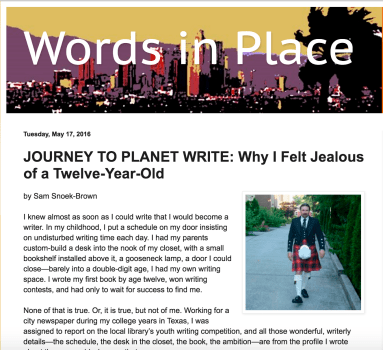
Author Gay Degani is running a series on her Words in Place website called “Journey to Planet Write,” where writers describe their path toward their literary careers.
A while back, Gay invited me to participate, which was thrilling! But as I began drafting my literary origins, I kept coming back to the stories I told myself about how I should have become a writer, how I kept imagining the path I wanted to be on and the milestones I was supposed to reach. And how in college I met a twelve-year-old with a better “origin story” than I had.
So I started there, with my literary fantasies and failures, and wrote about how I finally let go of those ideals, and how I’m still in the process of becoming of writer.
Head over to Words in Place and check out my essay, “Why I Felt Jealous of a Twelve-Year-Old,” and then hit the archives for more writers’ journeys and origin stories!
Things are picking up again, gang, so if you haven’t been keeping tabs on my Events page or my Facebook or Twitter accounts, you might like to know about a couple of upcoming events in my calendar:
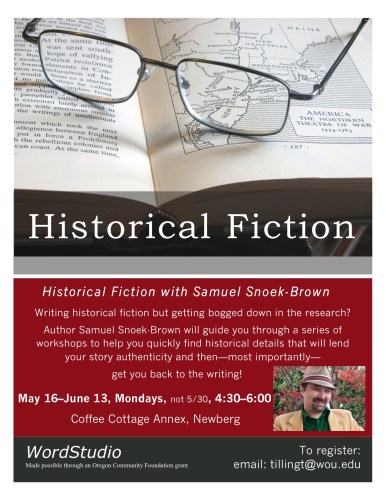
The other big deal is my four-week writing workshop on historical fiction through WordStudio. Based on my on-going series of tips for research for creative writing, and my experience writing historical fiction like Hagridden, we’ll be working on developing story through research for a whole month! The workshops will be early evenings each Monday (note that we’ll have Memorial Day off in the middle) at the Coffee Cottage in Newberg, OR.
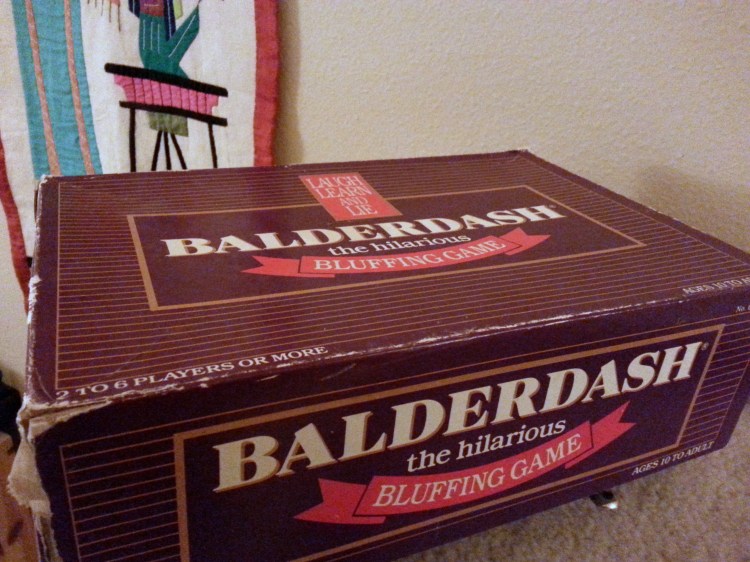
Because we’re playing in groups — or teams — I play a variation of the rules: we use no board, the teams collaborate on their definitions and voting, and I control the word cards throughout. This year, though, I added a new element: because of the logistics of this particular class, I wound up with three larger groups, which meant we’d only have four definitions to choose from, so I added a definition of my own this term, which was a lot of fun.
I needn’t have bothered, though. I did pick up some “points” by getting the class to vote for mine, but the students chose each other’s definitions just as often because, in their workshop groups, the whole class was in top form on writing convincing definitions! And, as it happened, that same class period, one of the students asked if I ever blogged about my classes, so I decided to share some of their definitions (and some of my own!) with you here on the blog.
(A note: the “true” definitions are those provided by the game, and while they’re generally pretty accurate, I have noticed that sometimes the game authors play with vagaries and short-cut half definitions in the interest of fitting things onto the cards, so any word nerds out there, if you have quibbles with the definitions, blame the game.)
Poonac: “residue left after pressing oil from a coconut”
My definition: a tree nut native to Canada
Definitions from the class:
nesting ground for birds in the Middle East
the inability for someone to perform a task
a coffee bean that is ingested by large cats — the acid from digestion alters it and, after extraction, it is gathered and processed for human consumption (those students were thinking of kopi luwak, and kudos to them for playing off my well-known obsession with coffee)
Dorado: “a fish resembling a dolphin”
My definition: a species of jackrabbit common in the Southwestern United States
a fallen angel replevied from Heaven (during class, I had revealed how much I love the word “replevied,” so that group was after brownie points!)
Noddlethatcher (my favorite word of the whole class!): “a maker of hats and wigs”
My definition : an Italian bird that builds its nests entirely from dried pasta (at this point, I began getting increasingly silly in my fake definitions)
Definitions from the class:
a type of knot commonly used by deep-sea fishers
the practice of repairing leather work
a farming tool used for irrigation
Pinchem: “the cry of the wild titmouse” (I can’t tell you how much I love this definition!)
My definition: Appalachian slang for a baby with chubby cheeks
Definitions form the class:
a woodwind instrument from the medieval era
the process of cross-breeding plants in an industrial greenhouse
treated, debarked wood
Jillick: “to skip a stone across the water”
My definition: like a cowlick, but in women’s hair
Definitions from the class:
a tool used to sharpen blades on industrial machines
a type of folk music from Scandinavian origins
a nomadic farming society that herds sheep on the northern coast of Scotland
Carfindo: “a ship’s carpenter (from the word carf, meaning a notch in the wood)”
My definition: a smartphone app showing nearby vehicles worth stealing
Definitions from the class:
a fish that is only found in the Mediterranean Sea
a music note that demonstrates a slow tempo
an Italian wine connoisseur
And that was all we had time for, but honestly this was one of the best classes for fake-definition writing I’ve ever had! It reminded a bit of the chapter in Frank McCourt’s Teacher Man where he has his class write excuse notes instead of essays and is immensely impressed by the creativity and intelligence of his students at faking people out!
That we were playing this game as a group-building exercise and an audience-analysis exercise, and that my class is currently working on writing definition essays? Well, hopefully I Miyagi’d them into learning something while they all were laughing and having fun. 😉
Anyway, congratulations, any of my students reading this. You’ve done me proud.
The deadline to apply for the Sewanee Writers’ Conference is coming up fast, gang. April 15! And it’s FREE to apply, so you should definitely put in for it.
Why?
I’ve written a lot here on the blog about falling in love with the family I found at Sewanee last summer:
But as this year’s application deadline approaches, I thought it would be cool to ask some of my workshop colleagues what they thought of our experience. So here are just a few of the amazing writers I got to work with and what they had to say about their Sewanee.
Caleb Ludwick is a writer living in the mountains outside of Chattanooga, TN. He is the author of the novel The First Time She Fell.
Stacey Swann is currently working on a novel, an excerpt of which you can read here at A Strange Object.
What did you think of our workshop experience?
Shane Collins
I had a fantastic time. Allen Wier and Adrianne Harun were great mentors with teaching styles that complimented each other. Both were personable, approachable, and generous with their time. The same could be said for all of the Sewanee professors. I also really liked our workshop cohort. There was a huge range of stories/excerpts and probably the only commonality was the quality. It was so beneficial — if not a little humbling — to get feedback on my work from so many wonderful writers.
Caleb Ludwick
It was only my second workshop and it cut deep, in all the best ways. I came to Sewanee with a novel 75% finished and realized through reading everyone’s work, and having everyone else read mine, that not only was it nowhere near finished, it wasn’t even a novel. Allen’s close reading and willingness to talk through what I’d written lit a fire for the next 6 months of chopping and reconfiguring, pushing me to write better than I have before, without question.
Stacey Swann
It had been quite a while since I was a student in a workshop, and I loved the feeling of entering each day knowing I would leave with new things to chew over that I hadn’t considered before. Having two workshop leaders was a new experience too, and one that I can’t say enough positive things about. I loved the way Allen Wier and Adrianne Harun came at the stories from different angles and taught in different ways.
What was your favorite reading? Your favorite craft lecture?
Shane Collins
My favorite reading was definitely Tim O’Brien’s. I’m biased because O’Brien has been one of my most influential writing heroes but it was so surreal to hear him read one of my favorite stories. I think my favorite craft lecture was Jill McCorkle’s. She had this wonderful extended metaphor comparing a short story to a haunted house that has stuck with me.
Caleb Ludwick
Reading was Tim O’Brien’s, simply because he read the very line that I read in junior high, and realized that it was possible to create worlds with words in a more powerful way than I had thought before: “Curt Lemon steps from the shade into bright sunlight, his face brown and shining, and then he soars into a tree.”
Craft lecture was Alice McDermott’s. So many insights, shaped into something whole and holy.
Stacey Swann
My favorites were the Fellows readings — always a one, two, three punch of amazing. My favorite craft lecture? Alice McDermott’s.
What was your favorite memory from Sewanee?
Shane Collins
Obviously my favorite memory would be the time I spent stalking Tim O’Brien. But another great memory was having Jesse Goolsby as a fellow in our class. I began reading his novel before I knew he would be in my workshop, before I even knew he’d be at Sewanee. It was just a pleasant surprise.
Caleb Ludwick
Long walk alone from the interstate back toward campus, deciding to hitchhike instead and getting picked up by an ex-Sewanee security guard with amazing stories. Having him drop me at the reservoir, jumping in to cool off. Back in time for readings. Perfect.
What would you tell someone thinking of applying this year?
Shane Collins
No matter how you get into Sewanee, whether as an auditor, contributor, scholar, or fellow, I guarantee you will have a positive and worthwhile experience. Workshop was wonderful but I also learned so much by attending panels, readings, and craft lectures, not to mention the connections I made at the numerous social events.
Caleb Ludwick
Bring work that you know isn’t perfect, but aren’t sure why. Also, some advice Rebecca Makkai gave me — make friends. You’ll keep them.
Stacey Swann
The rumors of the amazing Sewanee community are not overstated. I was blown away by the kindness, intelligence, and talent of everyone I met — attendee, faculty, and staff alike.
I also heard from Sewanee Writers’ Conference faculty (and my mentor last year), Allen Wier!
I thought our workshop experience was inspiriting. Not only did the group include a rich variety of literary approaches, talented and inquisitive writers, but, also, we had a lovely sense of community almost immediately. I would certainly encourage any writer seeking an intense two weeks with like minded readers and writers to apply.


 Let’s start with Thor, who is the reason I resumed collecting single-issue comics in the first place. (I used to be a die-hard in the early ’90s and still have most of that collection.) When news broke that the original Thor was losing his hammer and a woman would be taking up not only Mjolnir but also the mantle and even the name of Thor, I was intrigued. So I picked up the first issue, and from the beginning, I was hooked. The gender issues at work, in the original eight-issue Thor run and the current The Mighty Thor, are impressive — and necessary — and while they sometimes feel a bit heavy-handed (as they do in, say, Thor #5, where lightweight villain Crusher Creel actually utters the sentence, “Damn feminists are ruining everything!” and Thor, as she knocks the jerk out with a fist to the jaw, thinks internally, “That’s for saying ‘feminist’ like it’s a four-letter word, creep”), they are generally brilliantly handled and tremendously refreshing in the male-dominated realm of superheroes. One of my favorite moments so far is when the old Thor, who now goes by Odinson, acknowledges that this new Thor has wholly earned not just the hammer but also the name and in utter respect, he relinquishes the name to her. Later, another villain refers to her as “She-Thor” or “Lady Thor” and — with a hammer to the face — Thor quickly asserts her right to the name without any modifiers: she is simply and utterly THOR.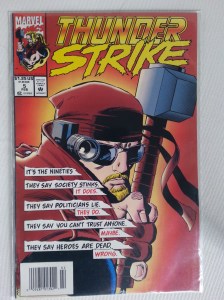
 I got the first issue of that from Mark himself, at a signing at Portland’s
  But Cain has recently picked up her own comics title, this one a superhero comic: Marvel’s
  I also picked up the new Black Panther series mostly out of loyalty to the author and curiosity about the new direction. To be honest, I haven’t read much by Ta-Nehisi Coates except a handful of short pieces here and there, but I did catch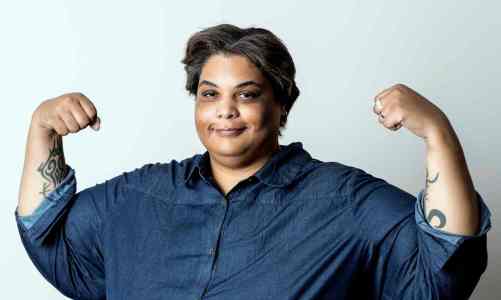
 Yet Latour is smart to play with all sorts of clever references to and twists on the existing Spider-narrative, so at every turn, we keep getting familiar touchpoints that are just offset enough to make us curious what will happen next. The death of Peter Parker instead of Gwen Stacy, the recurring neighborly advice from Ben Parker, the adversary of an unhinged and vengeful but still-badged cop Frank Castle, a vapid and fame-obsessed Mary Jane (oh, MJ, what have they done to you?), and, most recently, the appearance of Kraven the Hunter . . . . It all feels so strange and yet so right. Even in its off moments, I’m loving the overarching story, and Gwen Stacy is a more fascinating character than I would ever have guessed. I don’t know where Marvel plans to go with her, but for the time being, I’m glad she’s here, and I’ll keep reading her.
 But setting aside Vaughan’s gender, Paper Girls is a tremendous story. Maybe I say that because Cliff Chiang’s artwork and Matt Wilson’s colors are so stark and emotionally evocative. Or maybe I say that because the story — a time-travel adventure that begins in the mid-80s with girls who are the same age I was then, which means their adult selves in the 2016-set narrative threads are the same age I am now — appeals to my love of nostalgia. Or maybe it’s just because Vaughan is a genius for narrative arcs, character development, end-of-issue cliffhangers, deep-seated emotions, innuendo . . . .





 The other big deal is my four-week writing workshop on historical fiction through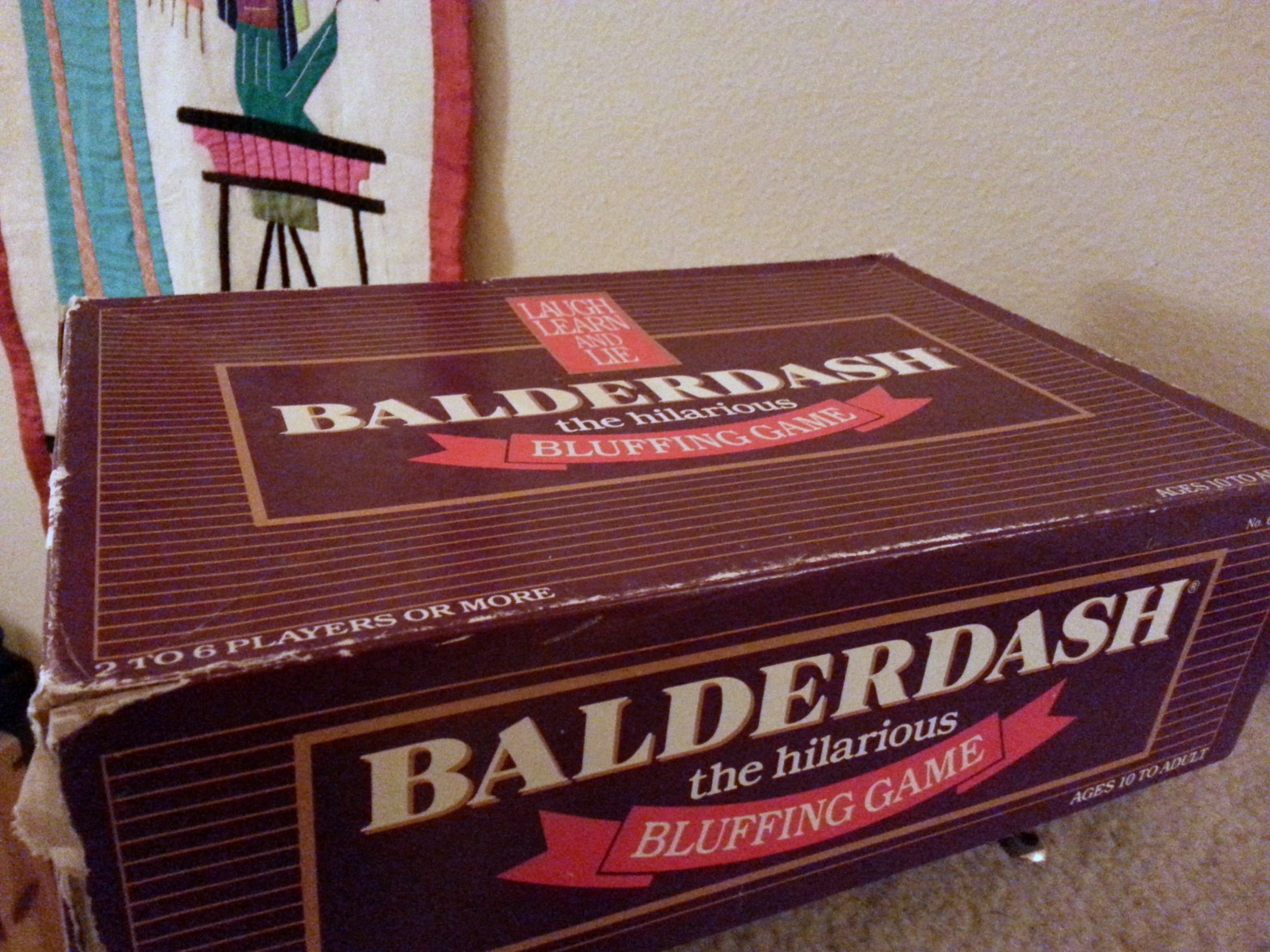

 Samuel Snoek-Brown