Coffee, coffee, and then more coffee

Benno Mélange, Viennese specialty coffee from Cafe Benno, Vienna, Austria. From my smiley face blog (click the pic to go there).

Just a quick post full of links, because apparently, this week I haven’t been the only one with coffee on the brain (and in my cup).

The first one I noticed came through one of my subscriptions here in WordPress, over at author Heather Wright’s The Wright Words blog. Nothing in depth or earth-shaking, but in “Coffee Writing,” Wright does comment on the joy of writing while sipping a cuppa joe. Which I love, because back in undergrad, when my addiction to love affair with coffee began, a professor once told me that caffeine stimulates the creative centers in the brain, which is why so many poets and painters have been hanging out in coffeehouses since the Turks invented the establishment more than 1000 years ago. I’ve since read a lot of back-and-forth on the exact impact (or lack of) coffee has on mental and creative abilities, but anecdotally and personally, I’ve seen nothing that disproves that little factoid and I live by it as a truism.

Which is why I also love the other post — or, rather, series of posts — I found at a blog I’ve newly subscribed to, Gin & Lemonade. The blogger, LKD, is apparently running a photo series on her “magic coffee,” a cool sort of “magic eye” Rorschach test in coffee foam, but I only found out about it because of her recent post “All Good Stories Start With Coffee,” which, as Heather Wright and I have agreed, is damn good advice.

And finally, I’m paying attention to a new group I learned about this weekend, Coffee for a Cause, a Portland-based organization aiming to use coffee and/or coffeehouses to benefit local non-profits. The website doesn’t seem to have been updated since March, so I’m not sure if they’re still active, but I certainly hope so because I’d love to support them.

Got any other cool coffee links, coffee posts, or coffee groups to share? Leave me a comment!

A Writer’s Notebook: Bill Roorbach’s bad advice

Yes, I missed last week’s Notebook. Skipped, more like, but my wife was newly arrived from two months overseas, so I forgive myself and I trust you will too.

Besides, this week (as I’d intended to do last week), I’m using an exercise from Bill Roorbach’s newly-minted “Bad Advice” series over at the blog he shares with Dave Gessner, Bill and Dave’s Cocktail Hour. But more on that below. First, the exercise:

The ash on Ryan’s cigarette was getting long and when he asked the bartender for an ashtray — again, as he had when he’d first sat down but the guy ignored him — the bartender pointed to the stubby tumbler on Ryan’s table and said, “You’re about to knock the ashtray off with your elbow, man.” When Ryan turned back to the table he damn near did knock it off, a self-fulfilled prophecy and a hell of a mean trick on the bartender’s part. The glass was stained and smokey, but it looked clean enough and he’d assumed it was either serving as a votive candle holder or else was just how they served drinks down here. He tapped the cigarette over the glass but the ash tumbled, hit the rim and exploded half in the glass and half over his wrist and cuff. The bartender sneered as Ryan brushed his sleeve, then his shirt, then the stained wood table. Ash in his lap. He stood and brushed his pants leg. “You sure I can’t pour you a lager, buddy?” Ryan sat in the next chair over, his back to the bar, but had to move again because his back was to the stairs as well and he wanted to see Doris when she descended.

He didn’t know why he’d agreed to meet her here. Doris. This was her sort of bar, not his. Ryan liked clean, well-lit places above ground, where you could see where you’d parked your car out some plate glass window maybe, where you could find the toilet without needing to also find stairs. This place, the White Silo, the least aptly named place in all of Dubuque, was an underground bar, not in the sense that it was hip and known only to the hipsters but in the sense that it was a goddamn basement, and smelled like one too. The only people who came down here were nobody poets and beer snobs, who hung out in the dark of the bar’s red walls and wood-paneled ceiling, its thin carpet stained with snow-mud and spilled porters. In the corner, a heavy wood bar that looked like it once belonged in a saloon but had more recently served as an ice cream counter before being dumped in this basement and forgotten. The bar was the reason this place existed underground instead of the easier-to-reach ground floor: the damn thing was too heavy to carry back up the stairs. Bathrooms just toilets wedged into two utility closets and papered in old posters and flyers, the drains in the floors corroded by old chemicals more than by urine. A sound system no fancier than a cheap home theater because the whole space wasn’t much bigger than Ryan’s first apartment in the basement of the house next door to his parents. But at least he had moved out.

I’m going to let Bill Roorbach explain this exercise over at his blog, because he does a better job of it (and works a better exercise from it), so do yourself a favor and check out the post “Wednesday is Bad Advice Day: Getting Started (Fiction Edition).” But the short version is this (quoted from Bill’s post):

It’s rare anymore for me not to know what I want to write, but it’s still true that I seldom know how to start. What I do know is that the best thing to do is simply go. Almost anything will do, but I do have my tricks. The most basic (and this makes a good exercise for your students, if you’re teaching any kind of writing, but especially fiction), is to put a person in a time and a place with an object, and then proceed [. . .].

For the setting, I turned to my wife and said, “Tell me a place.” She said, “North Dakota.” I said, “Tell me a place I might actually be able to write about.” She said, “Dubuque,” and so it was.

I asked her for a man’s name and she said Ryan. I said, “What made you say ‘Ryan’?” and she said, “I was thinking of Air Force One.” Okay, good enough for me.

I’m a fan of the focus-on-an-object approach, a tip I learned from Italo Calvino’s chapter on “Quickness” in his brilliant book Six Memos for the Next Millennium. (Haven’t read it? Go buy a copy. Now.) But while Bill Roorbach suggests that “objects have a way of turning up on their own” — and he’s right — I can’t help but want to start with them, and in cases where I don’t have an object in mind already, I turn to a favorite anecdote of mine, which I first read in Francine Prose’s Reading Like a Writer (and have quoted elsewhere):

“Once, when someone asked him his method of composition, Chekhov picked up an ashtray. ‘This is my method of composition,’ he said. ‘Tomorrow I will write a story called “The Ashtray.”‘”

So I tried to start with an ashtray. But clearly I got hung up on the bar, which seems a more interesting set piece, so perhaps I’ll ditch the whole opening thing with the cigarette and the glass and get right into the weird history of this place. Or who knows, maybe the toilets will wind up being more important. You never know.

Which is half the fun, really.

Photo blog 56

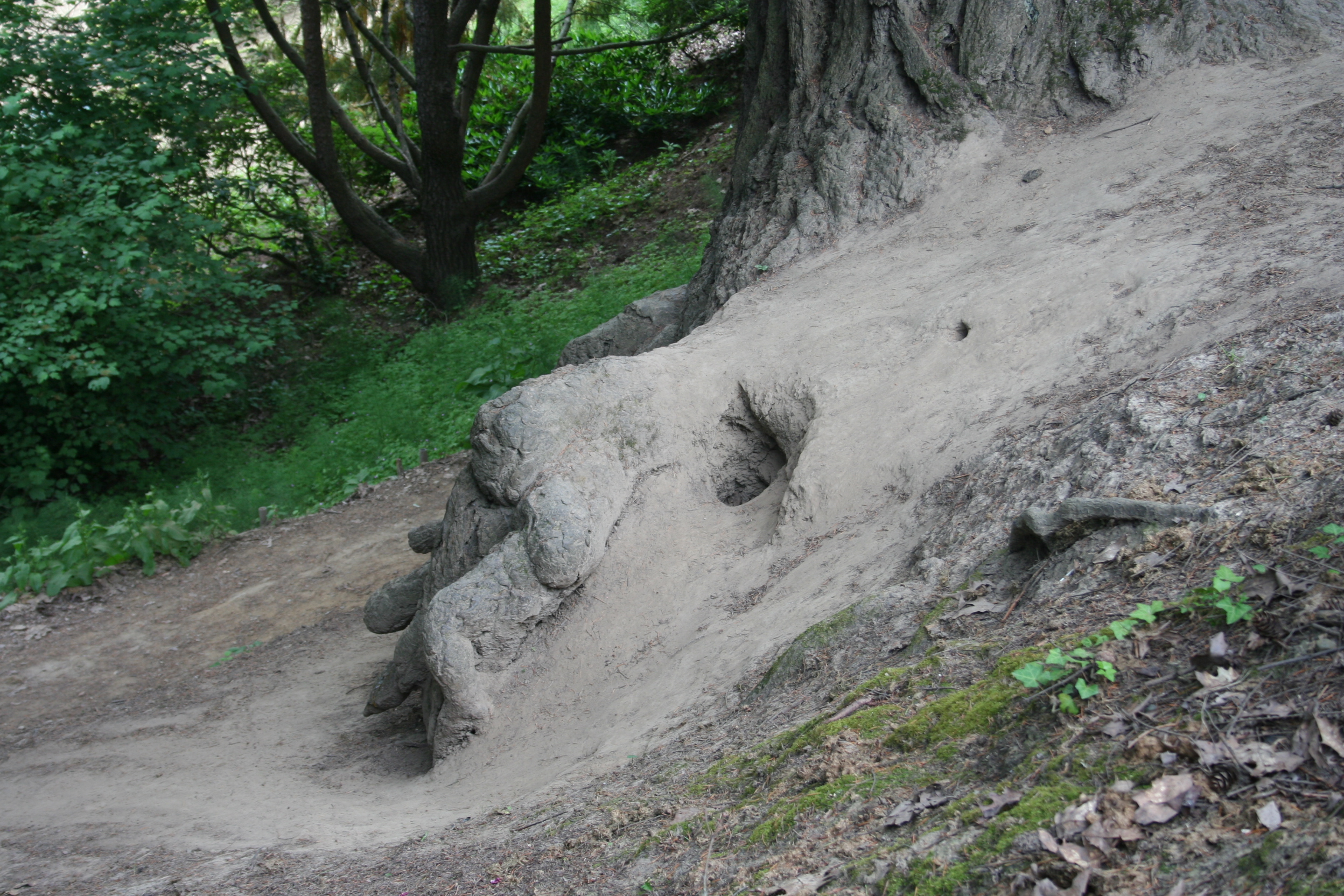
"Old woman sleeping." Roots and earth outside the Rose Garden, Portland, OR, 27 June 2011.

Small stone, Vol. 2, #19

Wind in the pines, the earthy scent of someone’s organic wheat bread overlaying the wash of rose petals and loose soil. Children giggling, a Korean woman translating a botanical label for her elderly mother, two French women remarking on the moss climbing the trunks and the sift of light through the branches, a tourist laughing at a Shakespeare quote over a stone bench. The dry brush of paperback pages like the old wood of the bench I share with my wife, her head on my shoulder as we each read our books in the watery light of the afternoon.

No better day than this.

New(ish) publication

Soft Corners, a poetry and fiction anthology from MLM Publications.

A month ago (almost exactly — how weird is that?) I mentioned that my story “A Few May Remember” had finally turned up in the April edition of Midwest Literary Magazine. Now MLM has compiled their last handful of issues into a bound anthology, called Soft Corners. My story’s in there, too.

By all means, read my story online for free. But if you have some cash to spare and (like me) enjoy the look of book spines on shelves, head over to MLM and grab a copy of the anthology. Because there are almost certainly better writers than me in there.

Small stone, Vol 2, #18

Picnic table – View from Flodigarry, Isle of S...
Image via Wikipedia

In the park, at a picnic table, dusk settling in, corduroy blazer on, laptop open, chin on fist. I feel like such a writer, and such a poseur.


A Writer’s Notebook: Work details

There’s this story I’ve been aching to finish for a long, long time now, but the details just aren’t coming. Or, weren’t until this week. But thanks to Tom Franklin, things seem to be rolling again.

More on that in a minute. First, some writing:

Val dropped the ramps and unchained the big yellow Walker mower from the rail, then he hopped into the trailer and backed the mower down where Randal waited with the sled.  His other employee Jesús was sorting the lines and checking the gas and oil levels in the weedeaters.  Behind them the lawn stretched wide and green, only the frayed tips of the Augustine going brown in the summer sun, and Val surveyed the slopes and shallows as he always did though he knew by heart the route he would take.  The huge house skinned in white Austin stone sat atop a small hill like a magistrate, watching them.  Val stared at it a moment.

He let Randal hitch the sled to the back of the Walker as he lifted out the little Snapper push mower, checked the gas and oil in it.  The three men gathered at the rear of the trailer, Jesús with the big Troy-Bilt slung over one narrow shoulder.

“Hace calor,” Jesús said to neither man, but more between them.

Randal nodded without looking at him and said “Si,” then to Val he said, “So, boss, I can take a look at those flower beds if you want.  Ain’t done much to them since the summer started.”

Val glanced up toward the house where the little shrubs and a narrow strip of wilting marigolds and zinnias flashed in the morning light.  “Sure,” he said.  “But get them edges first, out along the fence, you and Jesús both.  Entiende, Jesús?  Los bordes?”  Jesús nodded.  “Then let Jesús take the little mower up behind the house while you check the beds.”

The men broke, Randal and Jesús walking apart like duelists in opposite directions to trim the fringe along the fence until they met behind the house.  Val watched them a moment then slipped on his heavy headphones over his ball cap and stepped into the sled, adjusted his feet, then switched on the key and set the choke and fired the big mower.  It lurched and tugged at his grip but he rode behind it easily, the little wheels of his sled bouncing lightly through the grass and the engine growling before him as he glided out to the edge of the property.  He clenched one handle and released the other, spun a tight arc while with his free hand he slapped the blades into gear and then he was lost to the world, rolling over the sprawling lawn and thinking about anything but work.  The sandwiches his wife had made him, the orange Gatorade drum full of water lashed to the truck, the crazy preacher he’d met the other day, the crazy girl he’d met those many years ago.  At the end of the lawn he spun a half circle and rode back the opposite direction, all his lawns cut in ordered stripes to follow the contours of the land instead of awkward spirals like the kids would do.  Like he would have done back then.

He dipped and rose along the rolls of the vast lawn, his knees bending and unbending with the motion like a sailor aboard a rocking vessel, which is how he often felt out here alone in the bright sun, like a captain on some great green sea that he alone knew how to navigate.  His feet floating above the grass as though above the water.  And he coasted on, the mower snarling but steady in his grip.

When he’d striped the lawn and cut a few tight circles around the trees up near the house, he raised the blades and rumbled back over to the truck.  Jesús and Randal stood there waiting, a cup of water each, and when he killed the engine and stepped down from the sled they handed him a cup as well.  He looked into the water and watched it shiver, the vibrations of the mower grips still trembling in his hands.  He downed it and poured himself another and they all took out their paper sacks of lunches and stood leaning against the bed of the truck as they ate.  They compared sandwiches like schoolboys: Randal had baloney, Jesús some unidentified loosemeat that they could not translate from his description, Val a thick chicken salad on light wheat bread with the lettuce still dripping dew from when his wife had washed it.  The other men shook their heads.

Randal said as he always said, “Man, your wife needs to teach my wife how to make a sandwich.  I’d prefer a good chopped barbecue myself, but shit, what you got always looks better than what I got.”

Val only nodded and ate in silence.

“Hey Jesús, I never ask you, do I.  Your woman make good sandwiches?  You like them there she gives you?”

“No estoy casado.”

“I don’t know what that means, amigo.”

“Sin esposa,” Jesús said.

“I think he’s saying he ain’t married,” Val said.

“Well maybe that’s a good thing, hey, Jesús?”

So, the other day, Tom Franklin was in Portland to promote the paperback of his bestselling, award-nominated novel Crooked Letter, Crooked Letter, and I attended the reading. Afterward, we hung out for a bit, had some dinner, debated Cormac McCarthy (Franklin is the one who turned me onto McCarthy), and talked shop. And during that evening, I remembered what is probably the most important lesson I picked up from Franklin while writing my masters thesis on him ten years ago: the story is in the details.

During the Q&A after Franklin’s reading, he explained this same lesson to the audience, telling his story of the Sears Catalogue that I related in my post series on historical research. Someone had asked about his novel Smonk and the appearance there of a gatling gun, and Franklin explained that it wasn’t really a gatling gun, it was “1908 Model Hiram Maxim water-cooled machine gun” (this is quoted from the book, but Franklin rattled it off from memory). “Those are the sorts of details that make a story,” she said.

So Franklin’s fiction is riddled with concrete, specific details: Not a soda, but a Coke. Not beer, but Budweiser. Not a rifle, but a Winchester 45-70 over and under. In his latest novel, the bulk of the first chapter is dedicated to a farmer/mechanic’s daily routine, which sounds strangely mundane for the opening of a novel but which Franklin brings to vivid and poetic life with the rich professional details of the work — what kind of tractor, what mix of feed, how his shop doors open.

So I revisit the grossly unfinished draft of my story in progress, and I add to it as much detail as I can manage. My character owns a small lawn mowing business, so I get to describe not just the routine of cutting lawns but the equipment, by name and by procedure.

The tricky part about details like this is knowing with it’s right, though. In many cases, you can add too much, thinking to over-explain a process. In other cases, you can skimp, tossing in just enough to refresh your own memory but not enough to give a vivid idea to your readers. For that, you need access to a reader. Share the work with people who are familiar with the details and people who aren’t, and see who gets what.

I did mow lawns professionally, though only briefly and a very long time ago; still, I paid attention and remember a lot of what I learned, so I add those details here. Whether I used too much or too little, though, is unclear to me. So if you’ve ever mowed a lawn professionally, or if you’ve never mowed a lawn at all, I’d love your feedback. How much of this is working? And how much isn’t?

New fiction from Amos Magliocco

Amos Magliocco

I love promoting the work of people I know, but here in the summer months most of my short-fiction friends suffer a dry spell of publications. Such is the nature of what we do: many of the venues that publish us are tied to academic institutions and therefore are tied to the academic calendar. So it’s always nice when someone manages to land a publication that appears during the summer, because it helps us keep literature out there in the world year round.

I just found out that my friend Amos Magliocco will have a story in the new issue of Redivider, which is holding a release party in Boston tonight. So if you happen to be in the Boston area this evening, go check out the release party. And if you want to read some cool fiction, pick up the latest issue of the journal.

Seriously, Amos is a supremely cool guy. In addition to teaching creative writing at the University of North Texas, Amos is a recognized (and badass) stormchaser. He’s also a damn fine writer — his essay “Put on the Pretty” was anthologized in 2010 in Pushcart’s Best of the Small Presses. Pushcart, people! That’s awesome.

New fiction: the OBCBYL project, story #5

Day 214 - White Noise
Image by FadderUri via Flickr

I am finished. My run at Our Band Could Be Your Lit is, today, officially over. My last story is online now.

I had a blast doing it, and many thanks to Ryan Werner for making me sound cooler than I am (with only one exception, all those titles were his, and like any good editor, he tweaked a few of the stories to cut out the fat I’m so fond of in early drafts).

Of course, now I have to return the favor. I’ve been so focused on writing these stories the past several weeks that I’ve let pile up quite a backlog of fiction I’ve promised to read and respond to for others, including Ryan.

So, back to the desk, put on the glasses, crack my knuckles, pour my coffee. And listen to what words may come….

A Writer’s Notebook: Packing my bags at OBCBYL

And just like that, my tenure at Our Band Could Be Your Lit is coming to an end: this week, I’m writing my last story for this project. And it couldn’t come at a better time, because Ryan Werner has decided to start throwing simply idiotic songs at me. Seriously — his words: “For your last three, here some of the most ridiculous songs I could find.”

I’ve been mulling my choices over for days now, and I still don’t know what I’m going to do for this last story, but here’s the song I picked, for better or worse.

And that’ll be that. Next week, I’ll move on to other writing exercises and new ideas. But it’s been great fun these past several weeks, and it’s been good for my writing, I think — I’ve actually quite liked the fiction I’ve written for OBCBYL; even last week’s story, which I wasn’t sure about even when I submitted it, has grown on me.

Here’s hoping this last story turns out as well. Tune in early next week to find out!