I will try to post any information on relief efforts and aid organizations, as I did for the earthquakes in Haiti and Chile, but most of my attention right now is focused on getting out of Amsterdam and back home to the UAE, so it might be some time before I can compile a list. In the meantime, if you know of any organizations I should mention, please, post it in a comment.
The RC Windom was relocated to Galveston, Texas, which is where Papa met my mother, Florabell Freeman. Papa and Momma were married in June 1911—which is a story she liked to tell and did often, and will tell herself in a future chapter.
Momma also loved to tell us stories of the Papa’s generosity. While they were strolling down streets near their home, they would observe a family being evicted for failing to pay their rent. So Papa would pay their rent for a couple months, letting the family move back in until they fell on better times. This occurred more than once.
My own parents had just bought a house when the RC Windom was dispatched on a long trip. At the time, Momma was pregnant with my oldest sister, Henrietta. Momma’s mother, Sophie, had gone to take care of an elderly man in Lampasas, Texas and, not wanting to be alone during the birth of her first child, Momma went to stay with her mother. So Henrietta was born in Lampasas rather than Galveston, and my father was away at sea.
Must have been when the Windom returned to Galveston, if it did, that Papa paid off from his tour in the Revenue Cutter Service and started a new venture in his life. For a while he was a stevedore loading bales of cotton (my brother Karl ended up with his bailing hook). Then he ran a launch used to board ships and to ferry people across Galveston Bay. He was employed aboard tug boats, and was captain of most of those he worked. He chartered a tug and barge in 1914 and was towing a barge loaded with rice where the Trinity and Brazos Rivers meet when he saw thirty-eight people stranded by the flood. He emptied his cargo and took all of the people aboard the barge to ferry them back to Galveston. This was during the Christmas season. On the way, a baby was born on board, and the lad was named William in honor of Papa. They were still some ways from Galveston, but when the water subsided to a point he could wade through for two hundred feet, he took a message ahead that the people were safe.
Another time he spotted a ship aground and sent a towing cable to tug it loose. The strain on the cable was too much. though, and it snapped, swung around and amputed both legs of one of the seamen. Papa caught the man in his arms, applied tourniquets to both bleeding thighs, but it was in vain.
Before the 1915 storm that struck Galveston, Papa owned a tug a and three barges. He carried cargo from port to port and also chartered out his barges. After that devastating storm he was moving bales of cotton and found bodies under the bales he was moving. This caused him to have terrible nightmares so he sold his tug and barges to the International Shipbuilding Company, incorporated in Orange, Texas, and hired on with them as a Vessel Superintendant. Sailing ships were being built in Orange and Papa was a sailing ship seaman, a sailing master. After the ships were built and launched, he took them on trial shakedown runs.
During World War I on a tugboat trip to Mexico, Papa’s Chief Mate reported a light that he thought was Galveston. Papa said it was in the wrong direction, ordered the tug full speed ahead, and had the crew don their life jackets. What the Chief Mate had stopped was not Galveston but a German submarine lurking in the Gulf of Mexico. It was a narrow escape, but Papa’s tug managed to out run the submarine, and once he’d got them clear, Papa headed the tug for the nearest port to report it.
In 1916 the family moved to Beaumont, Texas. In 1919 Papa signed aboard the Modena, a five-masted barkatine with an auxillary engine, making it a motor vessel. This was the ship my Papa was aboard when I was born, the ship he had to sell in Rio.
This is it for my great-grandfather’s story, but I have plenty more story to tell. The next time I take this up, I’ll be moving on to my grandfather, Capt. Ted Snoek, and explaining why he’s mathematically Chinese. So look for that story later this spring.
UPDATE: Our flight out of Amsterdam was scheduled to leave late Thursday night, putting us back in Abu Dhabi on Friday morning. That didn’t happen. Instead, a volcano erupted in Iceland, and the resulting ash cloud shut down almost all air traffic throughout Western Europe. So we’re stranded. As I write this, at 4 pm local time in Amsterdam on Friday afternoon, we are back in our downtown B&B and waiting to board a flight that won’t take off till Sunday.
The good news is that despite all the headaches and chaos at the airport, and the exhaustion of heading from B&B to airport to airport hotel back to airport then back to B&B, we are at least downtown again and have a full day to squeeze in some last-minute relaxation (and recover from the hectic travel mess and re-prepare to fly out). There are certainly thousands of passengers in worse situations.
So, since we effectively have an extension to our vacation, I am continuing my travel journal and will document all the frustrations and kindnesses we’ve experienced the past day or so. It’ll take me a few extra days to post the travel journal here in the blog, but I’ll include everything, so look for it next week.
Because we’re in the Netherlands, land of my ancestors, I thought I’d continue the story of my great-grandfather William Karel Snoek, Sr., who left his home in Hoorn, Holland at the age of 12 and took to a life at sea. There is no new exercise this week, though–I’m still working from the basic interview-storytelling exercise I mentioned in the previous “Capt. Snoek” entry.
When my Papa signed on as cabin boy of his first ship, where he’d been found a stowaway, he did so with seriousness and purpose. He worked that ship and others, worked hard and worked smart until he became a captain. While working his way up, Papa learned to speak seven languages, sailed around the world three times, and was heavyweight champion fighter of the Australian Navy, where he lived before emigrating to America. Papa was also an artist. He did macramé with beads, painted in oil on canvas, made belts out of twine for us lads and purses out of twine for the girls. Carpentry, playing the spoons and making saws sound like sad violins, collecting postage stamps and foreign coins—Papa was a poor man’s Renaissance man.
After leaving Australia, Papa emigrated to America from England on the SS United States, arriving at Ellis Island in New York. Somewhere along the way he heard that the Revenue Cutter Service (the forerunner of the Coast Guard) was hiring. He signed on and, with his experience and quick mind, immediately started working his way up, first to an ordinary seaman, then a coxswain and a petty officer, then a boatswain and finally to warrant officer, and it was as a warrant officer that he became captain of the RC Windom stationed out of Norfolk, Virginia.
While in Norfolk one balmy day in 1909 or 1910, as Papa ventured onto Granby Street (which later would become the Hub of Norfolk), the street being muddy from recent rains, he spotted a runaway horse and wagon coming in his direction with a small child onboard. He dashed through the mud, grabbed the reins as the horse attempted to pass him by, quieted the horse and rescued the young girl, who was the sister of a man named Bruce Shaffer. Afterward, Papa and Bruce became close friends, and it was in his honor that I received my middle name.
On one of my trips to Norfolk, I looked up, phoned, and met Mr. Bruce Shaffer at a coffee shop. I explained to him that I was his namesake. It turned out that by that time Bruce had become a millionaire, and he explained to me he’d made his fortune in real estate. He would scout out an town that was growing into a city, and he would buy up all the outlaying land cheap, then as the city expanded he’d resell it at a profit. Bruce Shaffer also was the author of the Veterans Bonus Bill and spent a quarter of a million dollars lobbying for the in Congress. He spent days speaking as many as twelve hours at a time before Congress and was aided by Senator Huey P. Long, of Louisiana.
After Papa ran away from home, he never returned, even though there were opportunities to do so, but he and his mother did communicate and though his parents never came to America, they were kept informed about us children. Wooden shoes of different sizes arrived for each of the children; Henrietta’s and Karl’s were large, Flora Belle’s was child size and mine a baby’s size.
I’ll post part 2 of my great-grandfather’s story next Friday. Stay tuned!
UPDATE: I had written this post early and scheduled it, since I hadn’t planned to write in this blog while on vacation. But I have to note that on this very day, I was in The Hague, visiting the Central Bureau of Genealogy to research my family history. Sure enough, I not only found tons of fascinating new information on my ancestors, but I also discovered a letter the Bureau wrote my grandfather in 1982, responding to his own requests for family records! It was a thrilling moment, and I love that I was able to find my family roots on the same day that I’d scheduled this post to appear.
I mentioned the other day that I would be on vacation for part of April. We’re headed to the Netherlands to revel in the land of my ancestors (my great-grandfather came from Hoorn). I will have Internet access in Amsterdam and elsewhere, but I don’t plan to spend my vacation posting blog updates–I’m supposed to be getting away from it all! So, as I did with Vienna last fall, I’ll keep a written journal while I’m there but I’ll wait until I return to transcribe it here.
However, I’d like to keep the blog up to date as much as possible, so I’ll be pre-writing a couple of my Writer’s Notebook entries and scheduling them to post while I’m away. Keep an eye out for those, and any impromptu posts I might toss out from Amsterdam. And look for the week-long account of our travels in the Netherlands when we return!
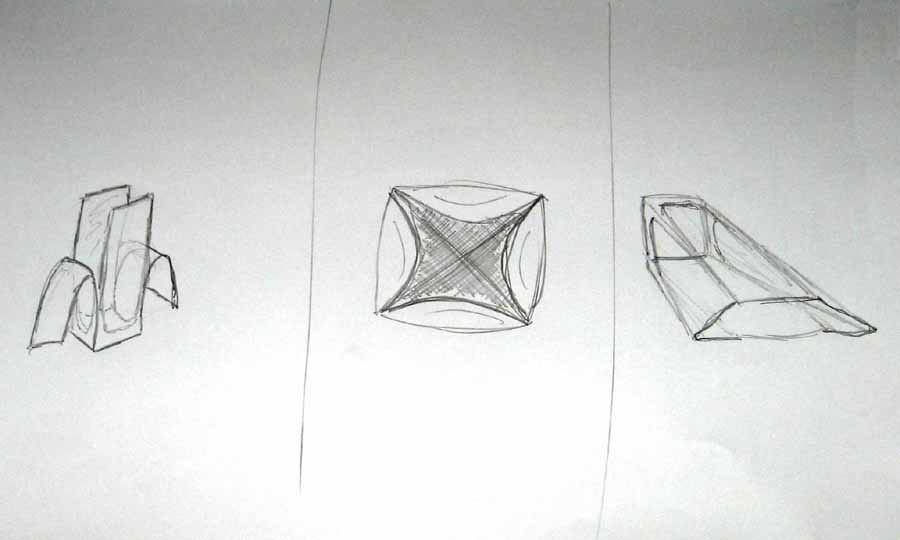
I have several friends who are visual artists, some of whom also write. In comments on previous blog posts and via several e-mails, I’ve been chatting about the relationship between art and writing with my friends Lori Ann Bloomfield and Crystal Elerson, and I thought it might be fun to try a sketching exercise as a lead-in to a writing exercise. The results (with my deepest apologies to artists everywhere, especially my friends who know what they’re doing) follow, but for the explanation of what I did, and for the exercise Crystal Elerson recommended for me, see below. The top two images, by the way, are photos of the object I drew and the “sketches” I did in PhotoShop, because I love playing in that program. The bottom two are my sad little drawings.
Tiger Lily chuffed and flattened her palm over her breast when she saw him. She turned toward Ilene. “Oh lordy, it’s him, that man. You know that man, that Ford?” Ilene opened her thin mouth like a bird expecting food but Tiger Lily continued without her. “No, you don’t remember poop. I remember.” They watched the man together as he crossed the wide floor of the former gymnasium and scanned the outer walls of the senior center. He put a hand in one jeans pocket and posed, his bearded face pivoting on his thick neck.
“What was that girl’s name?” Tiger Lily said. “The young one. It was something foreign, Chinese maybe. Only girl like that in town. You’d think I’d remember.”
Ford looked over at them and Tiger Lily ducked her head and fiddled with her fingers as though she was arranging flowers in her lap. Ilene’s eyes went wide and bright and she opened her little mouth to call out to him, but he’d already looked on, searching for something else. He saw Martha poke her head from her small cubicle office in the corner by the kitchen and he walked away from the old ladies, toward the office. He went inside.
“That man is sick.” Tiger Lily put a hand on Ilene’s arm.
***
Ford walked in the door and leaned against the formica counter and rang the bell but it died away among the dissonance of yapping dogs. He waited, listened with his open palm above the bell’s small button. The yapping rose and fell like the noise of passing traffic. He discerned some kind of pattern in it. When he heard a lull in the racket he slapped the bell. He waited and listened, slapped it again.
At length a man appeared, balding and brownskinned with a heavy shadow of stubble along his jaw. The plastic badge on his shirt pocket said Sergio. He wiped his brow and asked what Ford wanted, peering at him the while.
“I come to see about my dog,” Ford said.
“We ain’t got your dog.”
“If you find him could you let me know? My name’s Ford and I—”
“Buddy, I know who you are. I saw the flyers.”
Ford stood from the counter and sighed. Sergio shook his head and pressed his palms firm into the countertop, the muscles in his forearms taut.
“Let me tell you something, friend, we don’t owe you any favors. You being here in this town is favor enough. I see your dog or any dog you ever choose to get, I’ll round it up and keep it here to give to someone else or just kill it if it’s here long enough.”
“Look,” Ford said, but Sergio held up his palms. Ford went on anyway. “I just wanted some company.”
“You got all the company you ever deserved when you took that little girl.”
“It wasn’t like that.” Ford shook his head and turned and shouldered his way out the door.
As he left, Sergio shouted after him, “There ain’t nothing for you anywheres.”
***
Sharon stood still in the foyer of the HEB, the air conditioning washing over her from the long box over the sliding doors. Her hair kept whisking into her mouth. The bunched straps of her plastic shopping bags dug into the crooks of her fingers but she lingered to read. She’d not known Ford Kemp, had in fact moved here long after the crime he’d gone to jail for, but she feared his return and could not explain why.
***
When he got back to town, goddamn, it was like a miracle and a nightmare at once. I mean, I know what he’s supposed to have done, but I’ve seen this boy play. I had hopes for this boy. Just a few years back, there was that Gary Maltsberger who went and played defensive end for UT, he was damn good and did our town proud. But old Ford, he would have been better, and it’s a damn shame what happened with that girl. Of course, there’s the other side to that story that nobody talks about. He always said it was consensual, and I for one believe him. Who wouldn’t have wanted to be with Ford Randall Kemp? Hell, I would have dated the boy. If I was a girl.
My friend Crystal Elerson gave me this (and several other) exercises to try. For the drawing, she says to “divide your page into three columns. In each column draw the same still life (a vase? A potted plant? An apple?) from three different perspectives. On another sheet do the same thing except instead of changing perspectives, change techniques. In this way, you can see how things relate to each other spatially, and from there you may have insights about how story parts relate spatially.”
Crystal goes on to explain that a suggestion she’d made on my dissertation novel (that I should try breaking up my opening sections into dispersed chunks separated by varying lengths of white space) “was, in part, born out of this type of exercise.” She was right, too–that technique helped me organize the opening bits and really nail down the disorientation of the character. Because it’s all about perspective, about seeing things from new angles or in new lights.
For the writing portion of my exercise this week, I adapted Crystal’s exercise to come at a character from multiple perspectives. This is a guy–and a story–I’d long struggled with, and I’d decided a while ago to try writing it from some perspective other than his own. This exercise gives me a chance to come at it from many perspectives at once, to develop an almost Cubist sense of three-dimensionality. It’s similar to an exercise Robert Flynn uses in his writing workshops (I took one of his summer workshops at West Texas A&M), and which led to my dual-perspective story “The Simple Things,” though you can find versions of the exercise in most writing guides: Write a story (or read an item in a newspaper), then pick someone who seems a minor character and tell the story from that perspective.
M.C. Escher, Plane-filling Motif with Birds (1949), wood engraving
This particular exercise is also related to the use of negative space in drawing–defining something by what’s it’s not, shaping it out of what isn’t there–in that I’m trying to describe this character without ever getting into his head, but instead by looking at how others see him. This, too, is a fairly common writing exercise: describing things in terms of what they aren’t.
I don’t expect anything like the success I had with NaNoWriMo, partly because I’ll be on vacation for 10 out of April’s 30 days, but I plan to participate in Script Frenzy this year. I’ve long wanted to adapt my dissertation novel as a graphic novel, and I’ve taken a few tentative stabs at it already with mixed success, but I keep getting hung up on the fact that I have no artistic talent whatsoever (witness my ridiculous sketches in this week’s Writer’s Notebook, which will appear on Friday). But I figure if I keep letting that get in my way, I’ll never get around to finishing the adaptation, so I’m going to use April to kick-start the scriptwriting process, even if I don’t finish by the end of the month.
I’ve also talked my brother, artist and animator Jon Snoek, into diving in–he’s working on a film script, I think–so I’ll have at least one person driving me on. My friend Kevin Phillips is playing along as well, and I think Crystal Elerson (who gave me this week’s Writer’s Notebook exercise) is considering it as well. Just don’t expect updates from me until the second half of the month–I’ll be writing on other adventures.
In the meantime, to find my Script Frenzy profile and (eventually) monitor my progress, go here.
Look upon the world as a bubble, regard it as a mirage; who thus perceives the world, him Mara, the king of death, does not see.
~ Dhammapada, Canto XIII, verse 170
A depiction of the afterlife as perceived by Tina Sweeney, of Laval, Quebec. Image from The Big Book of Near-Death Experiences, by P.M.H. Atwater. (Excerpted in a photoessay on Newsweek's website--click the image to see more)
I’ve become a student of many aspects of many religions, but one of the areas I pay most attention to is death and the afterlife. The novel I wrote for my dissertation is set entirely in the afterlife and deals with questions of permanence and identity after death. As a Buddhist, one of my primary focuses in mediation is on impermanence and the death of the ego, the independent self. And as a student of compassion, I take very seriously our role of consolers in times of great distress and grief. So I read a lot about death, dying, and the afterlife.
“Oh,” Tarah says. She’s stopped playing, the last notes resonating inside the piano. She turns to face me, her hands in her lap. “I see now. You haven’t accepted that you’re dead.”
If I could feel cold I would. For a moment I almost believe her—I can’t feel my heart, which I’d expect to be slamming into my breastbone right now. I’m not even breathing. I’m just standing here, staring at Tarah. I’m not blinking. She’s staring back like she’s waiting for me to pitch over stiff and confirm that I’m a corpse. But then I hitch in a breath, and I lick my lips.
“What did you say to me?”
“Dead, Nessie,” Hadi says. He takes my hand but I jerk it away. He sighs, the poor kid.
“Nessie,” Tarah says, “you have died. This is what comes next. You need to accept that.”
***
It’s too late, breathing or not I have come disconnected, no sensation anywhere but moving everywhere. I dish across the surface of myself like an oil slick, without shape, a translucence in all colors. There’s no earthly way of knowing which direction I am going. I’ve said this before, read it aloud from somewhere. I’ve done this all before, and before, and it all just keeps sliding backward forever, no start to any of it. I feel infantile, I’m in my own womb, and I’m terrified.
***
I am the ocean. I ebb and flood. I rise, I sink–recede. I am not asleep. But this is not a wakefulness. I think the children might have been right.
***
And just as sudden it’s over. And I am over. I pry open my eyes to the thin light, press my hand between my breasts. I feel nothing.
It’s been a long time coming. When I first heard Cormac McCarthy‘s brilliant novel The Road was being developed as a film, I noted the release date on my mental calendar and held my breath. That was back in early 2008. When the movie finally did get released more than a year and a half later, we had already moved overseas and I had to wait longer still. This week, finally, The Road has arrived in Abu Dhabi, and today I went to see it.
I’ll not comment further, because the praise has all been said by now, and many have said it better than I ever could (I’m talking to you, Michael Levan!). I’ll say only this, for myself: I had a great deal of both anticipation and trepidation going into this, because McCarthy is perhaps my favorite author and The Road is among my favorite novels by any author, and I wanted badly to see the film done right but worried such a task was impossible. It wasn’t. They did the novel justice, and I am much pleased.
When I was studying Franklin’s debut story collection, Poachers, for my masters thesis, I paid close attention to his regional descriptions of southern Alabama, where all the stories are set. One story in particular, “Triathlon,” stood out, mostly because it is structurally one of the most perfect stories I’ve ever read, but also partly because it describes a road trip in such perfect detail it reads almost like a map. One day, on a whim, I decided to get a map of Alabama and try to follow the directions in “Triathlon”; I wanted to see if I, like the characters in the story, would wind up in a dark patch of woods at a deep, hidden lake.
I did. Not at the hidden lake in the story, maybe, but using only the directions in the story, I found on the map a wide forested area with small bodies of water hidden among the green, including one tiny lake that a small side road led partway to but never quite reached — much like the lake in the story.
In the film version of The Road, the Man and the Boy follow an old road map on their way to the ocean, and I could never quite make out the place names on that map. So when I got home from the theater, I did a little searching online to see if I could discover anything about the setting. And sure enough, someone has done for The Road what I once did with Franklin’s “Triathlon.”
Shipyard #11, Qili Port, Zhejiang Province, 2005. Photograph by Edward Burtynsky
I’m preparing one of my novels for submission, and I’m writing a synopsis. I hate synopses. Like all prejudice, it’s an irrational loathing–I always feel like I’m crushing the story, stripping away the beauty and leaving just a skeleton, and I can’t help but think that if people want to know what a book is about they should just read the book.
But this is only true for my book; I quite enjoy reading a good dust-jacket description and have a hard time buying a book that doesn’t give me some hint at what lies within. And I’ve seen many an exposed framework in other media that looks just as beautiful as the finished product. A house, for instance; the ribbing of a ship in the shipyards; a sketch for a painting. If a story is good, you should be able to strip away the finish and still see the wonderful potential in the bones.
Still, accepting the value of a finished synopsis is a far cry from being able to write one, and my instinct as a storyteller is to start telling a story, and I always have difficulty distilling my fiction to this essential, bare-bones extent. So I started poking around for some straight-forward advice on how to do one, because when all else fails, I still go back to exercises.
There are some great examples of synopses online and in books, but without the novel itself to compare with, it’s hard to see how the author stripped it down. Sometimes even when I know the novel, I keep thinking, But they left out this part, and this character, and this scene…. I discovered, eventually, that as much as I like to overwrite and then edit down a story, stripping away this much is simply too hard, and I needed to come at my synopsis from the other end, starting from scratch and building up.
But what to include? What speaks loudest, what is most essential? Worse: What am I forgetting? I stared at my blank screen for a long, long time, feeling very much like a brand-new writer, utterly unsure of what to do next. My beginner’s mind is not always a comfortable place to be.
Then I found this exercise, by H. L Dyer, which is somehow the best of both approaches. The description is a bit convoluted, but the short version is this: Go through a book chapter by chapter, and for each chapter, look for only three things–the beginning, the middle, and the end. Talk about going back to basics! Actually, Dyer suggests looking for the set-up, the conflict, and the resolution, which casts the beginning, middle and end in their more functional lights. Then, with one sentence for each aspect, three sentences per chapter, you’ll roll through a synopsis in no time. Or at least, not much more time than it takes to read your own book.
Going through my own novel this way, I realize I was doing this in grade school when we had to write book reports. We called them summaries back then, but the idea is the same, and the process is the same, too. And writing this synopsis–this summary–of my own book, remembering all those grade-school book reports, is allowing me to read my novel as a reader. That’s a pretty exhilarating experience.
I remember an interview with Tom Franklin in Southern Literary Review, in which he was discussing his novel Smonk. He explains that his editor resisted the novel, kept telling him it was the wrong book to work on at that time. And the interviewer asked why he kept writing it anyway, why he insisted it was the right book. Franklin says, “I knew I was writing the novel that I most wanted to read.”
Going back over my novel now, reading it like a reader and distilling it into a synopsis as though for a book report, I feel the same way. Giddy. Delighted. This is the book I want to read, and it sometimes surprises me that I’m the one who wrote it.
*The title is from a birthday card I have long kept attached to my writing desk: It shows Winnie-the-Pooh scratching his head with a pencil, and underneath are the words, “‘The hardest thing about writing,’ though Pooh, ‘is finding the right words.”







 Samuel Snoek-Brown