Social media is a hyper-emotional space, fraught with extreme opinions, extreme sensitivities, extreme expressions conveyed in extreme compression which leads to extreme misunderstanding.
This is true on Facebook, on blogs, on Instagram, on Reddit, and perhaps especially on Twitter, where the limitation of 140 characters demands an extreme attention to and care with language but where the speed at which Twitter operates often allows time for neither attention nor care.
Such was the case yesterday with Anne Lamott, who, as a hero to writers and a champion of wordsmithing, ought to have known better.
I won’t bother repeating her words more than I already have on Facebook and Twitter, but the gist is this: yesterday, for reasons we may never know, Lamott issued a bizarre pair of tweets about Caitlyn Jenner’s recent transition, openly refusing to use Jenner’s correct feminine pronoun and fixating on her genitalia in weirdly infantile language.
As her son later took to Twitter to explain, Lamott is from a certain region, culture, and generation, and she seems not to understand or easily accept some of the social progresses we’ve been making these past few months/years/decades. And that’s fair — I completely understand the difficulty many people have in shifting our societal habits and assumptions, and I have certainly advocated for giving people the benefit of that particular doubt and letting them come around.
But what was especially surprising — and what added further insult to the injury Lamott caused (intentionally or unintentionally) yesterday, was her eventual response to the outcry from her fans. Rather than address the controversy, she initially refused to delete her hurtful tweets, and she dismissed hers fans’ criticism as “inaccurate, vicious hysteria.”
To be fair, all this unfolded at Twitter speed. The gap between Lamott’s initial tweets and her later snide dismissal of the controversy lasted more than a dozen hours and, in Twitter, felt interminable and utterly heartless. But in real life, hearts and minds can often take lifetimes to change, so the fact that Lamott came into Twitter this afternoon, barely more than 28 hours after her initial tweets, and finally apologized — and, eventually, deleted the most harmful of her two initial tweets — is progress indeed.
Some good friends and great writers I know have said it seems too little too late, that the apology seems disingenuous, and I can’t argue with them. But I’m grateful to see it anyway.
None of this is why I’m here writing all this on the blog.
Here’s what I want to write — and this is directly to you, my friends, my family, my fans:
It is important to speak out when we see these things occur.
Even when they’re innocent. Even when the author of such things never intended any such offense.
A lot of people love Anne Lamott so much they were bending over backward trying to excuse the tweets, inventing all sorts of background scenarios or pointing to obscure rules of Twitter syntax to shift the guilt for the offense away from Lamott. And I don’t blame them — though I was one of the tweeters who called Lamott out for the offenses, I certainly didn’t want the offenses to be hers, because I’ve long been a fan of Lamott, not only as a writer but also as a human being. I, too, was looking for any excuse I could find to let her off the hook.
But ultimately, I realized that wasn’t the point. Because it wasn’t Lamott who was on the proverbial hook — it was all the transpeople, all the trans allies and all the friends and family of transpeople, who were on a hook, tormented by the tweets on Lamott’s page. And whoever was responsible for that pain (some suggested Lamott had been hacked; some suggested Lamott was simply quoting a friend), Lamott ultimately was responsible for the tweets on her account. And she eventually took responsibility and apologized.
And I want to say here, now, that I expect you all to do the same for me. Hold me accountable for the things I say here, or on Twitter, or on Facebook. I try hard to remain relatively inoffensive, especially in my public face, but we’re all human beings, and human beings are deeply, inevitably fallible creatures.
So if you ever see anything offensive here, or on Twitter, or on Facebook, or in any of my other social media presences, please call me on it.
I’d like to say that whatever offended you wasn’t me — that I got hacked, or that I was unclearly quoting someone else and failed to make my point — but I still want to know that what you saw was offensive. I want the chance to explain it, or to delete it, or to apologize for it. Even if I wasn’t responsible for it in the first place, I never want to ignore it.
Because when others speak out against inhumane offenses, we help each other see what hurts us. And if we’re willing to listen to that, we can begin to develop compassion, we can begin to heal.
I’m not going to say whether Anne Lamott is off the hook she set herself — I’m glad to see any kind of apology and I’m willing to accept it on face value, but I’m also a white straight cisgender male, so I wasn’t the one she (accidentally?) attacked in the first place, and others have rightly written about the pain of those attacks, here, here, here, here, and elsewhere — but I want to join her son, whose tweets in this time have been a model of patience and compassion, in taking that apology as an invitation to further dialogue, to further awareness. To further healing.
When I was a boy living in Texas, I loved The Dukes of Hazzard. I watch their TV show constantly, I had the General Lee in both Hot Wheels size and the large action-figure size because I also had the action figures of Bo and Luke Duke. I often had them mingle with my action figures of the Lone Ranger and Silver. At one point, I even had the General Lee as a remote-controlled car, one of the cheap ones that was still attached by a cord to the controller, but its headlights lit up and you could press a button to hear the sound of the horn playing Dixie.
God I miss this show.
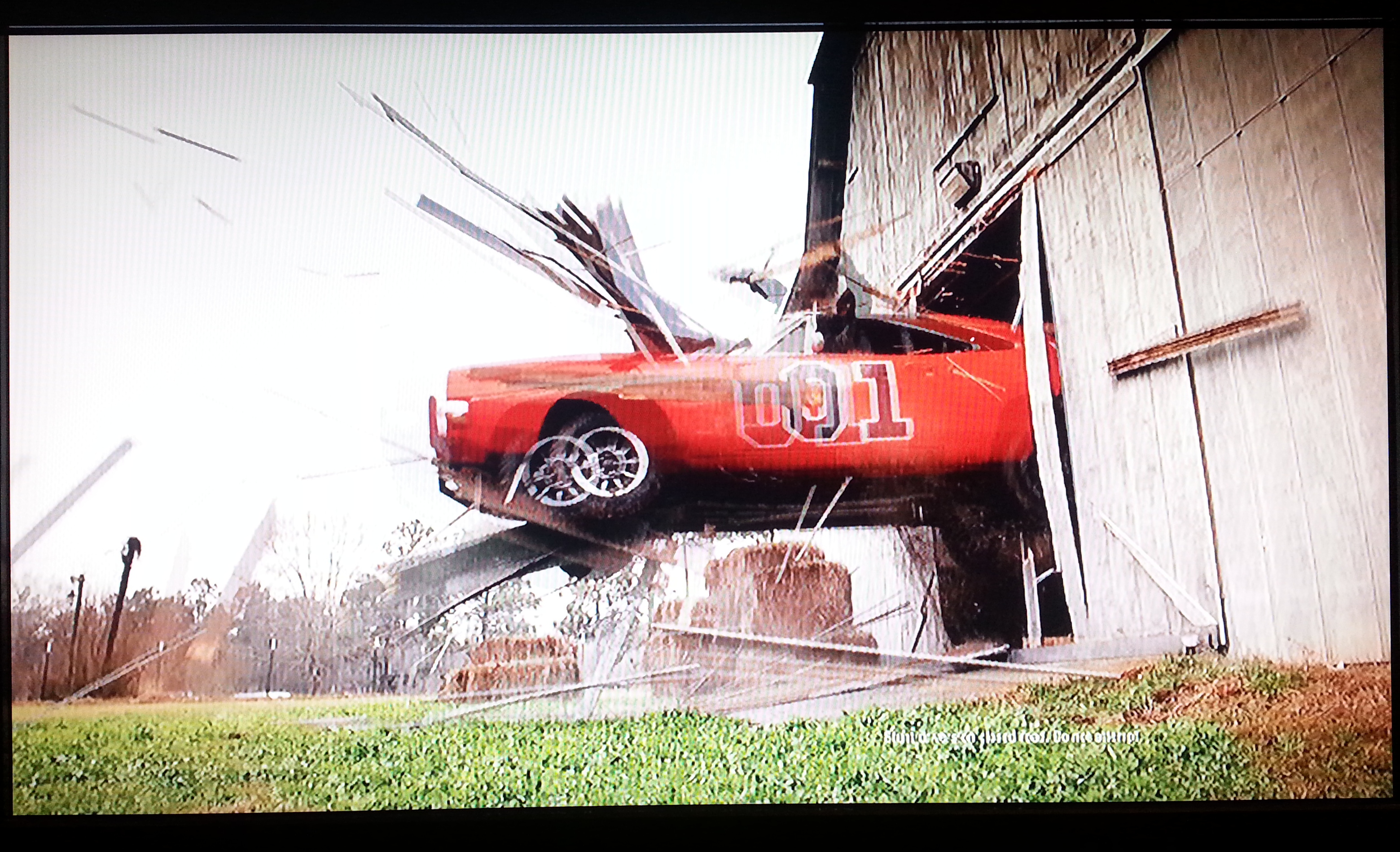
So it was with some delight that, when I finally got around to watching episode 4 of Texas Rising on my DVR, the recording opened with a commercial featuring the older versions of Bo and Luke Duke driving the General Lee through a barn wall as they run from the country cops. It’s ridiculous commercial that I’ve seen before, but, knowing what I was about to get myself into with this TV show, it was nice to start on something that, while still absurdly stereotypical of the American South, was at least fun.
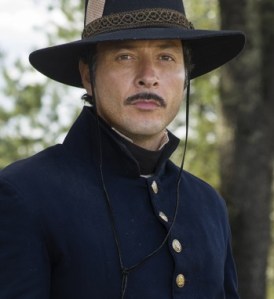
But on to Texas Rising itself. And for once, something genuinely interesting has happened in the first ten minutes. Actually, in the first five. We see and interact with, on screen, a man we previously have mostly known through reference or dialogue addressed toward: Captain Juan Seguin.
Juan Seguin, a genuine Tejano badass (photo from the Texas Rising cast page)
This man is significant for a whole range of reasons, beginning with the fact that, as a Mexican, he bridges the conflict being portrayed in this series. He is Latino by ethnicity and Mexican by nationality but has chosen for political and national reasons to fight with the Texian army against Santa Anna. And they address that role in this scene very early in the fourth episode, as Sam Houston is outlining his plan of attack for the famous Battle of San Jacinto and “Colonel” Seguin is pointing out his place in that battle. Houston rightly suggests that Seguin and his Tejano troops visibly distinguish themselves in some way on the battlefield, because “there is such a deep-rooted hatred toward Mexicans that I fear your men will have to duck more than Santa Anna’s bullets.” (Actually, I listened to this line several times, and every time I heard “Sandinista bullets,” which can’t possibly be correct. Anyone have a transcript of this?)
But, for me, there is more to this man than the TV series has been willing to portray. Seguin, it turns out, was present at the Alamo. According to history, he was one of the men selected to carry the famous message that Texans will “never surrender or retreat” across Santa Anna’s enemy lines in pursuit of reinforcements. And, against all odds, he succeeded and rallied troops to reinforce the Alamo, but he was unable to return before the Alamo had fallen to Santa Anna.
We see a version of this at the very beginning of episode 1, when Seguin is one of three men urging Houston to support the Alamo, but his role is downplayed and the scene is brief. Yet Seguin is a key figure in the story of the Alamo, even though he was not at the final battle of the Alamo, and because Texas Rising chose to begin not with that battle but after it, showing only the ruins and the executions that followed, Seguin is robbed of his heroism and his story. (Full disclosure: I grew up not far from the Texas town that bears Seguin’s name.) He has been in the series all along, and has been referred to a number of times since that brief first scene, and has been standing in the background in a few scenes, but it is taken until now, the fourth episode of a five-episode series, to finally acknowledge this Tejano hero. And that’s a shame.
Still, it’s nice to see him finally get his due on screen, and it’s nice to see some reference to the Mexican nationals who served in the Texian army fighting for Texan independence: it’s nice to see all these Mexican-Americans get their due on screen. And this Seguin scene pays off later when Seguin is in the midst of the Battle of San Jacinto and meets a Mexican soldier who declares in surprise, “But you’re one of us.” Seguin defeats the soldier and spits at him, “I am a Tejano!”
“But you are one of us!”
Seriously, Seguin is a badass.
“I am a TEJANO!”
It is odd that Houston keeps referring to Seguin in this scene as “Colonel” rather than “Captain,” considering that Seguin was not promoted to even Lieutenant Colonel until after the Battle of San Jacinto, but I suppose Texas Rising has realized they’ve been ignoring this hero too long and felt he deserved an early promotion.
This fourth episode is also playing with the old geographic problems I had with the first episode: There are scenes early on that illustrate the conflict at Vince’s Bridge, a key wooden bridge in a bayou near San Jacinto. In the film, it’s played as a stone bridge, and while there is water nearby, every character’s every movement kicks up billows of dry yellow dust that is utterly out of place in any location that would ever be considered a bayou.
Either Ephraim Knowles makes Peanuts’ Pigpen look spit-shined, or this area is WAY too dusty for a bayou
I’ll grant you, the bayous surrounding Houston, Texas, where the Battle of San Jacinto took place, are slightly different than the saltmarsh of Louisiana where I set my own novel, but I have lived in Southeast Texas and wrote a book about the bayou, and I know bayous. Whatever they’re showing you on screen is not Vince Bridge over any bayou. This is, again, a symptom of this whole series being filmed (again, ironically) in Mexico. But it still seems weird for a series purporting to portray Texas history. This is not Texas, and it’s barely history.
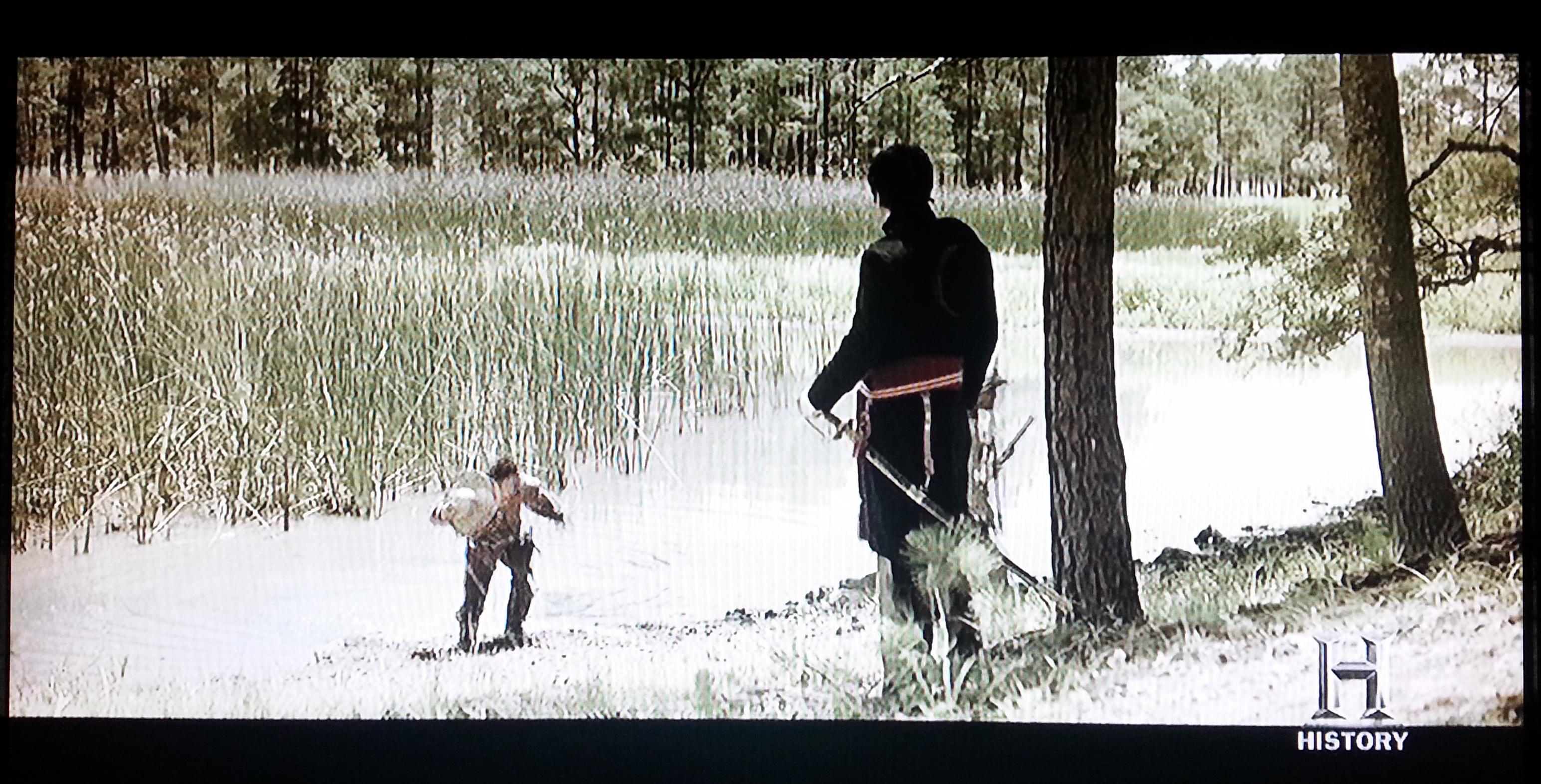
To be fair, this at least looks plausible as a Texas bayou, even if it isn’t.
Immediately following this, we see another scene where Manuel Flores, the Texian army’s Mexican spy, returns to camp with news for Sam Houston. He reports on Santa Anna’s troops and their movements, and Houston asks about Emily West. Flores reports that West has confirmed that Houston was right to wait for his attack (did you get all that?) but that now is the right time to attack. And Houston concurs.
I have to say, as an author who loves strong women characters and has written them myself, I love putting the agency for launching the decisive attack in the Texas Revolution into the voice and command of a woman. I wish this had been the case; I wish there were a historical record that would support such a story.
I also like that, of all the ridiculous creative licenses this TV series has taken with Texas history, this creative license empowers a woman as part of the revolutionary effort. If this series has been empowering women all along — had, in fact, been empowering real heroines, had not mitigated the true heroism of Susannah Dickinson in favor of Emily West, this quasi-invented character that they have fictionally fleshed out, then I would be celebrating louder than anyone else on the Internet.
But, sadly, the historical record is the historical record, and there is no direct evidence that Emily West played any role in the Battle of San Jacinto. There is only the rumor that she might have distracted Santa Anna with her “feminine wiles” by seducing him out of his pants before the attack was launched.
I have a hard time criticizing this moment in the series, frankly. As a writer, I genuinely love that the people composing the series looked at the historical record and the rumor alike and extrapolated from them that if Emily West had indeed intentionally distracted Santa Anna moments before Sam Houston’s attack, then she must have been collaborating with Houston in some way and was therefore an integral part of Texas Independence.
But my god, in a series that has made so many errors and so many leaps and so many narrative fabrications just to tell this ten-hour story, I can’t help but view this moment as yet another unnecessary invention.
And they’re not done abusing the story: as the battle erupts and Santa Anna dresses to join it, he also manages to catch Emily West monologuing.
“Antonio! I’ve waited to see the look of defeat in your eyes. You killed my brother at the Alamo! You killed [something muttered that I couldn’t make out]?”
Props to Cynthia Addai-Robinson: she does look fierce.
But, alas, she never killed Santa Anna in real life, and so in the film we have Santa Anna’s loyal manservant lumbering literally out of nowhere to take the bullet, leaving West dumbfounded that someone caught her monologuing.
Look at how little Santa Anna cares that his manservant gets shot. He must be evil.
Weirdly, despite this carefully scripted interlude where Santa Anna is caught in flagrante delicto during the battle, he still manages to have time to don his usual uniform, ride into the battle itself, and rally his troops. This is so far at odds with at least the Texas version of these events, where Santa Anna was, at best, caught dressed as a common enlisted man cowering in submission, pretending he was not who he was, that I am baffled by the portrayal. This series has gone out of its way to mythologize and aggrandize the Texas Revolution, yet now, when they have the excuse of literally catching the bad guy with his pants down, they choose to ignore every record we actually have, even the questionable ones, and go with a new version where Santa Anna acts with some semblance of bravery and leadership.
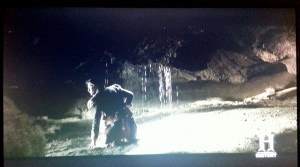
Later, we do see Santa Anna leaving the battle like the coward the Texas legend reports him to be. Sadly, the episode shows him dropping into a subterranean cavern to hide. First, I have never read a version that mentions him hiding in a cave. (Most stories have him discovered either hiding under a tree or in tall bayou grasses.) And second, please tell me where, in any bayou anywhere, let alone near San Jacinto, are there subterranean caverns underneath the marsh land?
Why this series has chosen to return to its first and most egregious error, geography, with such a ridiculous invention in this fourth episode, I do not understand.
And, of course, it is in this cavern that Santa Anna meets the lowly enlisted Mexican soldier with whom he is destined to swap uniforms.
This is not the story I grew up with when I lived in Texas.
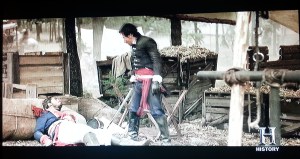
I accidentally captured this fade transition and got both characters onscreen together. Santa Anna is at first glad to find one of his men — he breaks down in tears later.
To be fair, when the Mexican soldier dies of his own wounds while Santa Anna attempts to care for him, and the Mexican General/Presidente breaks down in tears over this final defeat, we are invited to feel sorry for him. We are invited to empathize with his utter downfall and his emotional breakdown in the face of it. And it’s a nice emotional moment.
And yet.
Even though we never see it on film — it’s as though the filmmakers are going out of their way to portray Santa Anna as sympathetic, even though they fail — this version of the story has Santa Anna robbing the corpse of a wounded soldier in a cave so that he can escape unrecognized.
He robs a corpse.
I might be misremembering the stories I heard in my childhood, but even Texans never painted Santa Anna in this villainous and lowly a light. And, to add to his fictional (as opposed to his real) humiliation, when he is caught in this stolen get up, it is by a boy, that young character introduced in the previous episode during a humorous interlude with Sam Houston solely so that we would know who this boy was when he captured the Mexican general.
Sure enough, though, from the first cannonshot fired to the men reassuring Houston that the Texians have won, the film time of the battle is indeed a tidy 20 minutes — incredibly, including commercials — which is almost exactly the real time of the Battle of San Jacinto. Well done, Texas Rising, on getting at least one thing right. Unfortunately, that means that the rest of this episode was indeed setup and aftermath, dragged out forever.
Some of this is okay, like the beautiful scene with Deaf Smith I’ll get to in a moment. But a lot of this padding is, as usual, problematic. Take the middle of the episode: just a little past the halfway mark, something really interesting happens in this episode, but, unlike the great midway moment last episode, this time it’s interesting only because it’s such a tremendous disappointment:
Finally, when Santa Anna is captured and exposed for who he is, held prisoner by the Texian Army, Lorca arrives in camp, demanding revenge.
It’s a wonderfully tense moment, perhaps the moment this whole series has been building toward since Lorca’s first fictional revelation crawling out of the ashes of the Alamo in episode 1. All his bluster, all his sadism and brutality in his pursuit of revenge, all the atrocities he has committed against “every brown person” — they have all led to this moment. And indeed, surrounded by the Texian army and facing Sam Houston himself, Lorca will not be denied his revenge, and he draws his pistol. The whole of the Texian army draws their arms against him. Sam Houston says, “Shoot me first,” and Lorca replies, “You don’t think I will?” Then Lorca reveals his very nature — literally, as scripted, his only reason for being in this entire series: “Fine by me! We end it now! It’s my only reason for living!”
Oh, would that it were so.
Because what happens in the next 60 seconds of climactic tension is that a crazed, vengeance-driven madman suffering from the most traumatic of post-traumatic stress is facing off against a weary but victorious Texian army with every gun aimed at him, a man who has no reason to live but to kill Santa Anna and so has no reason not to pull the trigger in this very moment and go out in a blaze of glory, instead lowers his pistol and rides away.
Would that the History Channel had more fully embraced the other fictions that they have been crafting in this series so far and let Lorca shoot Santa Anna, or at least try to. “Fine by me. We end this now.” But no: we have three more hours yet to watch.
What does Lorca do instead? He rides into the countryside with his band of loyalists and attacks an innocent family of Tejanos just going about their lives. If Lorca is a symbol, he has turned into a vicious, corrupted symbol. He started out as symbolic of the horrors of war, symbolic of the trauma suffered by those who have witnessed atrocities in battle. He was every soldier living with survivor’s guilt. It was, for a (very brief) time, beautiful and haunting and tragic to behold. But sometime in the middle of last episode, he turned into something else, a man hellbent merely on vengeance against all “Mescins,” and by the time we get to this moment in the second half of episode 4, he is representative of a violent racism.
The two redeeming aspects of this scene are that his men recognize his madness and finally stand up to him, rescuing a young boy and telling him at gunpoint that they are done killing women and children; and that when Lorca lets them go, with little choice left him, he stands distraught amid the bodies until a Mexican woman, in the background, rises from her wounded collapse with a rifle and shoots Lorca in the back.
The episode’s title this week is “Vengeance,” and I like to think that this is the moment it refers to.
Granted, this is not the last we see of Lorca, and by the episode’s end, he does attain some semblance of redemption. But I’m not sure he’s earned it, and I know for certain the series hasn’t.
Fortunately, between these Lorca scenes, we get a quiet, isolated moment among the dead on the battlefield, with this series’s best character and best actor, Deaf, played by Jeffrey Dean Morgan, awakening among the corpses and finding his wounded horse. “Come on,” he says. “Come on save me.” And when he discovers how wounded his horse is — how wounded his comrade is, for indeed that’s who this horse is to him — he cries, “Oh, why did you have to go and do that?” And then he lays the horse down in the tall grass, runs a hand over the horse’s neck to comfort it, and, weeping, begging the horse to wait for him, he shoots it.
It is, without question, the most touching moment in the whole series so far. It is the kind of scene this series should have been doing all along: calmly focusing on individual characters, quiet moments of courage and despair, of camaraderie and grief, of duty and honor. No grand speeches, no side narrative to pad the story. Just these moments, Texans being human beings as they fight for everything they hold dear, however they define that. And Mexicans and Natives doing the same. If this series had been that, it would’ve been amazing. If this series had wanted to turn the brief six weeks of the Texas Revolution between the Alamo and San Jacinto into a full ten-hour miniseries, this is how they could have done it, without any extra characters, without any narrative padding. Just focusing on the key figures and showing them as human beings.
If only they had done that.
Strangely, though the episode is not without its fabrications and exaggerations and digressions, it managed to last almost the whole two hours before committing one of this series’s classic anachronisms, and once again, it is an anachronism that connects the Texas Revolution to the US Civil War: With only ten minutes left in the episode, we have a scene with Santa Anna in a Texian army prison camp, and he complains to a fellow prisoner: “If I owned both hell and Texas, I would rent out Texas and live in hell.”
My ears perked up immediately. I recognized this quote without even having to look it up, because, having written a whole novel about the Civil War and having grown up being a Civil War fanatic as a child, I knew immediately that these were not Santa Anna’s words. These are the words made famous –– famous, mind you — by US General Philip Sheridan during the Civil War.
How on earth could the History Channel not only get this wrong but think they could pass that by even the most casual of their viewers? It is a shocking anachronism, a shocking inaccuracy in what is already a ridiculously inaccurate series.
I have been complaining about the problems in this series from episode one. By the time I arrived at this moment, I had been complaining about this series for almost eight full hours of television. And yet here, finally, I feel pressed upon to say to the History Channel: Shame on you.
This moment, above all the others in the episode, is absolutely inexcusable.
As for the padding in this episode: we see a bit of unnecessary but expected romance (such as it is) and an initial payoff of the bank robbery setup in the form of an attempt to loot the defeated Mexican army. And the Lorca scenes.
But there are two particularly problematic final efforts to fill out the last half hour of this episode: A fake predicament of Emily West — her capture, attempted trade in ransom for Santa Anna, her planned rescue. And a fake few scenes — just moments, really, and wholly unconnected to anything else in this episode — involving that “frontier justice” town of Victoria and the corrupt Empresario Buckley. Seriously, these few Victoria scenes last a whopping three and a half minutes, altogether, and those in only the last 20 minutes of the show.
It was nice, I confess, to witness the moment when Hays and Wallace request volunteers to defend the town and all the women in the room grab rifles and march into the streets while the Empresario stays indoors with his whiskey. The show could have made more of this moment, could have oversold the heroism of these fierce frontier women, but it played it cool and let the scene speak for itself (for once), and so, once again, the events surrounding Hays and Wallace exhibit some depth and interest, and even though nothing about them is factual, these things at least feel true. (Or so says the guy who wrote a novel about fierce women who take up arms to survive in wartime.)
So what will the series do with its final episode? Will it be, as I suspected, a padded political bore and/or a rushed connection to the US Civil War? Maybe. It’s hard to tell. The tease references the politics surrounding Sam Houston — as I’ve said, this is framed as his series — and a single scene with Santa Anna and US President Andrew Jackson. The rest of the story is tying up loose ends of invented narratives, all that padding the series has already forced into the story that are now left dangling. That aspect is indicative of just how unnecessary all that padding was — the war is over and we still have two hours left to watch — and I’m certain without even watching the last episode that this whole series could have been done effectively, with LOTS of extra character development, in (at most) six hours. But no, we’re pushing for ten, and we have two hours to go.
As a fictional Santa Anna might have said, if I owned ten hours of silly Dukes of Hazzard commercials and this ten-hour miniseries, I would gladly rent out this series and watch the Duke boys instead.
So, before I get into the third episode of Texas Rising, I would like to start with the show’s own disclaimer: “The following program is a dramatic interpretation of Texas’ fight for independence. Viewer discretion is advised.”
I suppose the “viewer discretion” they advise is to focus on the “interpretation” part and not take any of this too seriously.
Which is just as well, because on my cable guide, the write up for this episode claims that Sam Houston is going to push his army south to force a final standoff with Santa Anna, and indeed, the episode opens on April 13, 1836. There are only eight days left before the final defeat of Santa Anna, and we get all but the last of them in this episode, which ends on April 20, one day before the Battle of San Jacinto and the capture of Santa Anna.
For readers not raised in Texas and already branded and tattooed with the state’s history, I’ll go ahead and spoil that final battle for you: it lasts 18 minutes. And, incredibly, the teaser for next week’s episode seems to suggest that its entire two hours will focus on that 18-minute battle. Granted, there’s going to be some run-up to the battle, and we’ll probably see its immediate aftermath with Santa Anna (famously captured while disguised as a lowly enlisted soldier) dragged into the Texas camp. But even assuming they show the 18-minute battle from multiple angles and so double its screen time, we’re still looking at almost 90 minutes of . . . what, exactly?
This whole series has such a plodding, tedious pace. And we see that in just the first ten minutes of episode three: how does Texas Rising plan to fill out all this extra time it’s scheduled for itself? By inserting a bank robbery, because what Western would be complete without one? As though the heroism and the politics of the Texas Revolution aren’t interesting enough all on their own. Seriously: episode three includes a subplot in which the lone (and invented) Louisiana Cajun in the Texian army plots a Galveston bank robbery while they’re on the march (presumably to play out in a future episode).
Most of this middle episode is full of those sorts of foolish filler scenes, though there are a few bits that are at least interesting. I will confess, for just the few brief scenes he’s in, it was fun watching Ray Liotta’s Lorca, especially his early moment dumping a basketfuls of snakes on passing Mexican soldiers. His character, while purely symbolic and mostly unnecessary, is actually one of the most interesting things on the show. Even watching him sharpen swords is more interesting than most of what else happens in this series.
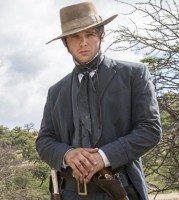
Jack Hays (Max Thieriot), as he appears on Texas Rising
Also, following the blue-blood John Coffee “Jack” Hays and the lumbering William “Bigfoot” Wallace as they track down stolen goods is an obnoxious waste of screen time in terms of telling a story about the Texas Revolution, but the characters are actually fun. I enjoy watching these two types play off each other, and, in this episode, when they chase down a roving band of thieves, the resulting saloon fight is fairly well done, especially the climactic, gut-clenching stab in the stomach for one of the bad guys.
Still, their adventures are a needless digression from the history: both men are historical figures and were famous for their service in the early Texas Rangers, but most of their exploits occurred after the Revolution. (Hays did see action at Laredo during the Revolution, but it’s not what he was famous for.) They’ve been included here simply to work in their names and pad out the story.
Capt. John Coffee “Jack” Hays of the Texas Rangers (Photo credit: Wikipedia)
This is even more evident when the two men get wrapped up in the corrupt local dictatorship of “Empresario Buckley” and his regime in Victoria, as well as his role in selling off bad homesteads.
There is a lot to complain about in this storyline, actually. I’m first troubled by the insistence of including a white homesteader getting attacked and slaughtered by a gang of Comanches. In the episode, the scene was well filmed and for the most part well acted — at least by anyone who wasn’t a Native American, whose characters, sadly, remain gross stock figures whose only job is to whoop and shoot arrows.
I’m not saying that such attacks never happened in Texas, because of course they did. It’s worth noting (and the series only hints at this but at least it hints) that these white settlers were in fact interlopers on Mexican and, in this case, Native land. So of course these attacks occurred. But we already know that. We know that from history, and we know that from the countless television shows and movies for as long as there have been such things, and from the countless books and stories that preceded them, that the “scary savage Indian” always attacks the “simple salt-of-the-earth” pioneer. These are bad clichés, and so I’m not sure how they serve this narrative about the Texas Revolution.
I would much rather have seen the ways in which the Comanches supported the Mexicans in the war (which they did), and I would have liked to have seen portrayals of the roles other Native peoples played in the Revolution. (It’s worth noting that, for all the screen time they give these ham-fisted scenes with the Comanches and that brief fight sequence with the Karankawa in episode 1, the cast page of the series website does not include a single Native character.) I would also like to have seen a more honest portrayal of the kind of invasion that white settlers represented in this part of the world, rather than the occasional dialogue hints that are seeded into the episode. As it is, this “Indian attack” scene, while broadly effective, also feels exploitative and cheap.
Empresario Buckley (Robert Knepper), whose boots are even more “evil” than his mustache
This event eventually gets connected to the man who sold this attack-prone land to the white homesteaders in the first place, the cruel and almost surely invented Empresario Buckley of Victoria, Texas. We get a long sequence of scenes of him arresting Hays and Wallace, of him explaining his sense of “frontier justice” to them as they ride into Victoria, and then of his mustache-twirlingly villainous attempts to torture them into confessing to crimes they never committed. This is all just more cheap padding based on Western tropes and stereotypes, whose only purpose is to drag out what should be a four-hour miniseries to ten hours.
And then, of course, the sole survivors of the homesteading family arrive in town, the white woman and her loyal savior slave, and Buckley invites his captives to hunt down the Comanches for him. Killing Comanches is, in fact, why both Hays and Wallace became famous (or infamous, depending on your view of history), but again, they earned that reputation after the Revolution, not during it. Here, it’s just filler.
Speaking of creative license, there is another instance of the show placing music too early in history, but this time, they use it to interesting effect: There’s a story that the song “The Yellow Rose of Texas” is about Emily West, the character who has been plotting to assassinate Santa Anna and the woman with whom Santa Anna was allegedly having sex when the Battle of San Jacinto began. This is conjecture, based on a second-hand story in a British man’s diary years after the battle, but it is a common legend in Texas.
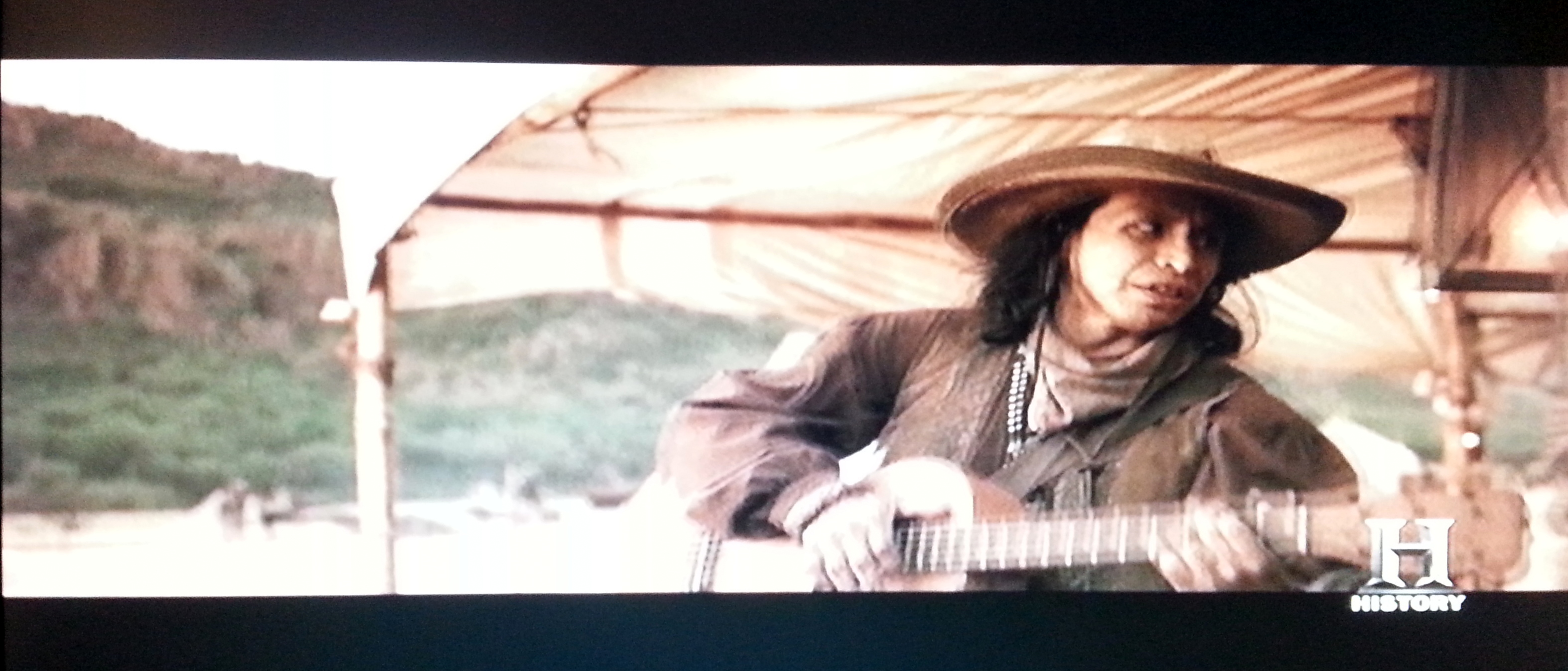
In this third episode, not quite halfway in, Emily West finally resolves herself, Hamlet-like, to kill Santa Anna — and of course, as in history, she fails. But then, several minutes later and exactly halfway through the episode, we are at the Texas camp, where the Army is preparing to march to battle the next day, and there’s the sound of a guitar and men stamping feet and clapping. For those not in the know, the tune being played in the scene is “The Yellow Rose of Texas.”
Manuel Flores (Gerardo Taracena) playing “The Yellow Rose of Texas”
What makes this interesting is that, while we have no record of the song before it turned up in travelling minstrel shows in the 1850s, the film places the song in the Texas camp, marking it as an explicitly Texan song, and the man playing the song is Manual Flores, the Mexican spy who works for the Texian army. He mumbles some vague sounds that aren’t quite words, and certainly aren’t lyrics, but the song is clearly “The Yellow Rose of Texas.”
It is an interesting way of honoring the historical record but also fabricating legend without laying any particular claims to the historicity of this moment. When History Channel productions work, this is how they work: they take licenses not to distort or flat-out change history, but to represent it dramatically. Finally, in this moment, halfway through the third episode or, to look at the larger picture, exactly halfway through the entire series, we have a moment that feels worthy of a History Channel production.
Still, I feel nervous about the next two episodes. Apart from the apparent decision to drag out the final battle over the whole of episode 4, I remain suspicious that they’re going to use episode 5 to link the Revolution to Texas’s involvement in the Civil War.
In some respects this makes sense, because, despite all the digressions, this is being framed as Sam Houston’s story, and Sam Houston is notable not only as the hero of the Texas Revolution or as the only governor of a US state to also serve as president of a sovereign country, but he is also notable as the only governor in the South to oppose secession — and, thanks to him, Texas was the only state in the Confederacy to vote on secession by popular referendum.
There’s a part of me that wouldn’t mind seeing that on film, but that really has nothing to do with the Texas Revolution except for Sam Houston. But I suspect that’s the connection they’re going to make because there was a moment, right at the 90-minute mark (30 minutes before the end of this episode), where Sam Houston rallies his troops at a fork in the road, literally offering them the choice to march toward battle or away from it. Of course, they enthusiastically vote for war, and when one of his advisors questions why Houston even bothered with the vote, Houston responds that men will always fight harder if they think they have a choice in the matter. So this is almost obviously a set up for the vote to join the Confederacy.
And that’s my problem: If I’m right, the fourth episode is going to drag on interminably and then the final episode is going to sweep through 25 years of Texas history, losing all political and historical nuance in the process. Of course, this series hasn’t bothered with much nuance so far anyway. Still, it’s going to drive me mad watching that, and if that’s not where they’re headed, I don’t know why they’re pushing Civil War themes so hard, nor do I have any idea what the final two hours will have in store for us.
But whatever those final hours are, I strongly suspect that the next episode — the two-hour reenactment of an 18-minute battle — is going to be about as exciting as watching adobe dry.
I’ve been a huge fan of Eunoia Review for a long while now, and I’ve been honored to be among their contributors three times now, and they’ve been home to some of my favorite stories. Today, I’m happy to say that Eunoia has published a fourth story of mine, and, depending on how you measure these things, it’s my oldest story.
There’s a part of this story that, when I was in college way back in 1994, I wrote the first draft of. I was proud of that story at the time but over the years, as I sent it out and the rejections poured in, I came to realize what a ridiculous mess it was. Still I kept at it, revising and tinkering and starting over.
Then, in grad school about a decade ago, I was in a medieval hagiography course and I had an idea for a modern adaptation of one of the hagiographies I was studying, and in the process of drafting it, I realized that what I was really working on was a new, drastic revision of that old story from 1994.
Slowly, slowly — it took years — the two drafts came together, and and then slowly I revised their offspring, this new story, until now, finally, the story of Val and his wife and Jeremy the crazed street preacher and Cecily, the woman who once slept with an angel of God and couldn’t quite let him go, it’s all here for you to read in “The Penitent Go to Texas.”
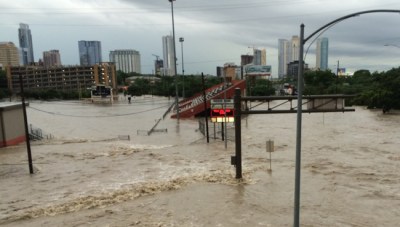
Yesterday, I posted a review of the History Channel miniseries Texas Rising, and I plan to post more reviews as the series continues the next few Mondays. But I wanted to save this news for its own, separate post: all of the areas depicted in that series, from the Alamo and San Antonio de Béxar to Goliad to Gonzales to the forthcoming sites of San Jacinto and Washington-on-the-Brazos, are suffering from catastrophic flooding.
It’s easy to forget that while watching the miniseries, because the whole thing is shot in the deserts of Mexico. But here are some images of what Texas actually looked like while the miniseries was first airing on Memorial Day:
An intersection is flooded in San Marcos. REUTERS/Don Anders/Anders Photography/Handout (retreived via Yahoo News)Photo of the Houston area, submitted by local news viewers (retrieved from abc7news.com)Texas Stadium underwater in Austin (retrieved from kxan.com)
By some accounts, Texas received upwards of eight million acre feet of water over the holiday weekend, enough to turn the entire state of Rhode Island into a lake ten feet deep.
The good news is, Texas is already getting a lot of state and federal aid, and Texas’s reputation as “the Friendly State” is well deserved, so lots of neighbors are helping each other out. (There was one particularly heartwarming story of Austinites lining up in droves to take in foster pets when Austin animal shelters flooded.) But there’s a lot left to do, especially in the face of further flooding and other dangerous weather. So here are some lists of ways to help, either financially or with labor, as well as some information about storm shelters and relief organizations in the affected areas (each link has a fairly lengthy list of resources).
I grew up in Texas, where the hagiography of early Texans and the aggrandizing of our heritage (or, at least, our Anglo heritage) was mandatory.
People think I’m participating in the tradition of tall tales when I say a thing like that, but it’s true: in Texas schools, you learn Texas history before you learn American history, and there are no Benedict Arnolds — every Texan is a hero.
But even in Texas, where everything is bigger, some heroes are bigger than others, some events more epic than most. And no story is more important in Texas history than the Texas Revolution, no heroes more celebrated than Sam Houston, Stephen F. Austin, William Travis (he of the “line in the sand” fame, or so went the stories I grew up learning), Davy Crockett, Jim Bowie.
I won’t mess with Texas, but I’m about to mess with Texas Rising.
These events have been the subject of dozens of films over the years, but recently, they’ve begun airing as Texas Rising, a miniseries on the History Channel, and, as I did a few years ago with Hatfields & McCoys, I’m tuning in.
When I watched Hatfields & McCoys, I was in the middle of the first major revision on my first published novel, Hagridden, and though the story in that miniseries took place a few decades after the events of my novel, the miniseries was useful just for the mood it set. Now, I’m drafting a new novel, this one set mostly in Texas a few decades after the events in Texas Rising, but once again, the mood seemed like it might prove helpful. In fact, a few of the characters in my novel behave the ways they do because their fathers fought or failed to fight in the Texas Revolution and later the Mexican-American War, and this fierce Texas rebellious independence still haunts the people in my story.
But I have to say, I hadn’t made it ten minutes into this miniseries before I had my doubts. After an opening scene exhibiting the cruelty of Mexican general Santa Anna, the action shifts to a “Texan Army Camp — Gonzales,” the camera panning up and away to reveal a dusty cliff overlooking a dry valley far below. It’s a scene out of every classic Western you can name — and a landscape utterly unlike Gonzales, Texas, where the land is low and flat, ribboned with the San Marcos and Guadalupe Rivers and even in drought a fairly green place.
The cliffside Texas army camp as portrayed in Texas Rising
The panning shot from the top of a tall mesa
The real Gonzales today, fairly near the historical Texas camp (photo by orlando-ska via Panoramio)
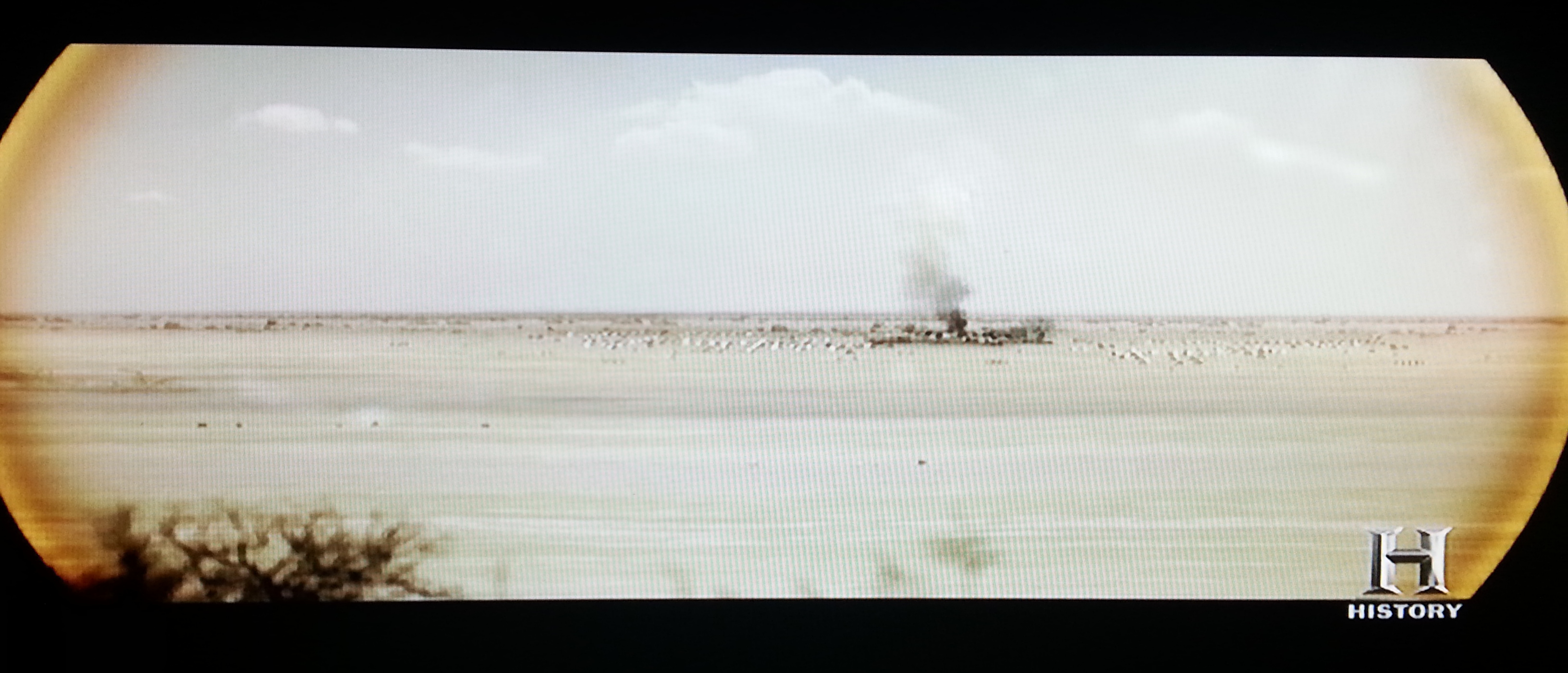
They make the same mistake only a few minutes later, locating the smoking remains of the Alamo and a subsequent running battle nearby in a flat desert landscape utterly unlike the Béxar area. (The whole series was filmed, ironically, in Mexico.)
The burning Alamo and the surrounding flat desert, as seen through a telescope in Texas Rising“The Fall of the Alamo,” by Theodore Gentilz (1844). Notice the rolling hills in the background and the small forest on the left.
These seem striking and blundering geographic mistakes so early in what is supposed to be a film for the History Channel.
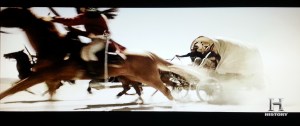
The scene with Sam Houston is hackneyed, full of cliché and overly “purposeful” dialogue, using characters’ speeches in the service of exposition, and even then it resorts to the emotional shortcut of swelling music to sell Sam Houston’s case, and never mind Bill Paxton’s (actually quite effective) acting skills. And the later scene of the running battle — a dramatized (and invented) attack by Karankawas on the wagon of Susanna Dickinson as she left the ashes of the Alamo — is likewise steeped in cliché, a “cowboys-and-indians” affair lifted without any sense of irony from ’50s-era TV Westerns.
“Indians” attack the wagon . . .
A wide shot of running “Indians” across a desert landscape . . .
“Cowboys” to the rescue . . .
This scene seems even more egregious considering the invented character of Billy Anderson: the usually-fun Brendan Fraser as a white man raised among Natives and serving the nascent Texas Rangers as a scout. He’s supposed to be a kind of Texan Natty Bumbpo, I suppose, and I understand his role as “a man torn between two cultures,” but his deep-throated “wise Indian” voice and his cliché braids and preference for the bow and arrow feel too much like redface here, and combined with the stereotypical portrayals of practically every Native in the series, it’s a hard act to swallow.
This is not the Susanna Dickinson history remembers.
This “cowboys and indians” scene is also problematic for how it treats the real-life Susanna Dickinson, who, following the massacre at the Alamo, had the strength and presence of mind to personally stand up to Santa Anna and refuse his offer of special treatment. It’s a record that seems far removed from the weeping, terrified portrayal in this scene. Instead, the filmmakers gave Dickinson’s strength — and her role in relating the events at the Alamo to Houston — to Emily West, a woman (improbably) rumored to be the inspiration for “The Yellow Rose of Texas” but who was never at the Alamo.
There are some interesting moments early in the first episode when the series tries to explore the tenuous racial relationship between white settlers-turned-Texians and the Mexican nationals then in command of Texas, with alliances as well as racial slurs, but here, too, the series flubs its history, tossing around slurs like “bean-eater” that would not come into fashion for at least another 75 years.
To be fair, in the second episode, there is a clever scene in which a Mexican soldier derides a Texian soldier as an illegal immigrant, (rightly) turning current Texas prejudice on its head. It’s a smart move that is mostly rooted in historical fact, though again, I have a problem with the language: the Mexican, accusing the Texian of illegally crossing the Sabine River into then-Mexican territory, calls the Texian a “wetback,” which is a clever usurping of the slur, but alas, the word is nearly a hundred years too early.
Texas Rising also places Emily West — inaccurately — in the Alamo on the excuse that she’s there to free her brother from slavery, an odd narrative device considering that American settlers were flooding into Texas in part because they wanted to prime it for entry into the Union as a slave state and, despite the nominal Mexican ban on slavery in Texas, slavery was widespread in the territory. There was at least one slave at the Alamo, but he wasn’t Emily West’s brother, he was Joe, the slave owned by garrison commander William Travis, and he was allowed to leave the Alamo but he wasn’t freed.
In other words, the production here seems muddled in its inaccuracies: on the one hand, it resorts to old-fashioned and sometimes racist clichés regarding its treatment of the Native and Mexican populations in the area and their roles in the Texas revolution; on the other hand, it plays politics with the Mexican-Texian relationships and engages in strange and unnecessary revisionism regarding Texas’s history with black Texans and slavery. This latter is even more surprising given the film’s insistence on linking the Texas uprising to the later Civil War: about halfway into the first episode, a man takes up a guitar to rouse a demoralized and retreating Texas army and begins playing “Dixie,” the unofficial anthem of the Confederacy. “Dixie” has a disputed origin, but it wasn’t popularized until the 1850s and we have no record of it at all until — at the absolute earliest — the mid 1840s, at least half a dozen years after the events of the Texas Revolution. So clearly its only purpose in this miniseries is to link the Revolution to the Civil War.
I’m all for a little narrative license in historical fiction — sometimes you have to bend the truth to tell a good story. But in historical fiction rooted in factual events and figures, you have to begin with some version of the truth in order to bend it, and Texas Rising seems more interested in beginning with mythology and legend and only peppering in small “truths” when it’s convenient. Perhaps I’m expecting too much of a channel that airs shows like Ancient Aliens, but History also is home to the solid Vikings series and gave us the mostly excellent Hatfields & McCoys, so while I wasn’t expecting textbook historical precision in Texas Rising, I had some hopes for at least a pretense of honoring some historical truth.
There’s also the problem of pacing. Because the series opens after the fall of the Alamo — which, as every Texan knows, occurred on March 6, 1836 — and will presumably end with (spoiler alert?) the humiliating fall of Santa Anna on April 21 of that same year, the whole ten-hour miniseries covers only six weeks worth of history. Sure, one might assume you’d need ten hours spread out over a month of Mondays to cover that span of time, but the events in the six-hour Hatfields & McCoys spanned more than a generation and even it felt slow at times. To cover so brief a period as six weeks in so long a series at Texas Rising requires glacial pacing, something highlighted in the second episode, which focuses largely on how slow Houston is to engage Santa Anna’s army. That, at least, is a clever bit of historical accuracy, but it doesn’t make for very engaging television, and I actually was working on this post even while the second episode was playing — that’s how little it held my interest.
Not everything in the series is problematic. There are some good performances here. Bill Paxton, despite the beef-fisted jingoistic dialogue he has to work with, manages a fairly solid performance, and though Emily West doesn’t belong in this part of the story, Cynthia Addai-Robinson does a good job of conveying both the strength and the human fragility of her character. The real scene-stealer, though, is Jeffrey Dean Morgan. His Erastus “Deaf” Smith could be another of the series’ lame clichés — he’s written as the “strong, silent cowboy” type — but his confident delivery and emotional facial expressions lend his portrayal a wonderful gravitas, and he’s a pleasure to watch.
I’m also fascinated by Ray Liota, who, like Tom Beringer in Hatfields & McCoys, so completely disappears into his character that I didn’t recognize him. Unfortunately, he didn’t have much to do in the first episode and in the second his only real moment of focus was a ranting speech in which he espoused well-written but ultimately overblown pseudo-religious and blatantly racist anti-Mexican rhetoric. He gets away with that because his character is more a symbol than a person, and of course, like so much of Texas Rising, his character is a total fabrication — there were no combat survivors at the Alamo, “left for dead” or otherwise (Santa Anna executed any combatants left after the battle, and he burned the bodies just to be sure) — so I’m not yet sure what role Liota’s Lorca is going to serve in this story. But he’s making the most of what little he has to do, and I’ll be interested to see what else he gets up to, however much it departs from the reality of the Texas Revolution.
Bill Paxton as Sam Houston
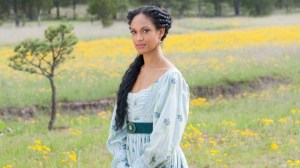
Cynthia Addai-Robinson as Emily West
Jeffrey Dean Morgan as Erastus “Deaf” Smith
Ray Liota as Lorca
all actor images courtesy the Texas Rising pages at History.com
Still, I’m pretty disappointed in the series so far. I suppose that if Texas is known for anything, it’s for proud tall tales and patriotic self-aggrandizing (and politicized and inaccurate textbooks), so in that respect, I suppose Texas Rising is perfect. But as someone who grew up in Texas — and as someone writing a novel about Texas rebels and vigilantes — I wish this miniseries had avoided at least some of the stereotypes about Texas and presented us with a more honest, nuanced, human story, one worthy of the real Texas history this series purports to convey.
But as it stands, what I really I wish is that I didn’t have another six hours of this to sit through.
Every few weeks or so, the community college where I teach selects a couple of faculty members to highlight by posting a photo of them in the hallway alongside a kind of Q&A about their personal life. It’s a fun way for the students to get to know their teachers and for us faculty to get to know each other. I’ve certainly enjoyed standing in the hallway and catching up on my colleagues.
Well, this week, I got featured on the board, and I thought it would be fun to share my Q&A responses with y’all. 🙂
I let my wife pick the photo.
Instructor’s Name & Subject: Samuel “Dr. Sam” Snoek-Brown, Writing.
Educational Background: PhD in English (creative writing), University of North Texas (2007); MA in English, West Texas A&M University (2001); BA in English, Schreiner University (1999).
Short bio: I was born in Oklahoma and raised in Texas but I got to Oregon as fast as I could. In between, I’ve lived in Wisconsin and the United Arab Emirates, and my wife and I have traveled to Canada and Europe and Asia. When I’m not teaching or traveling, I write fiction: I’ve published a chapbook of short stories and a novel called Hagridden.
Hobbies & Interests: Writing (no, seriously! it’s not just my job!), hiking, coin-collecting, travel.
Favorite food: “Mexican macaroni” (my own recipe!).
Favorite Sport: I’m so lazy that I don’t even watch sports.
Favorite Pet: Our two cats, Ibsen and Brontë (yes, they’re named after writers).
Favorite Movie: Book of Kings (a short film by Chris Terrio), Amelie, Kundun, American Beauty, 12 Angry Men.
Favorite Music: I have varied taste, but lately I’ve been fixated on Summer Camp. But I’m also a recovering metal-head.
Favorite Book: Cormac McCarthy’s The Road, Beth Ann Fennelly’s Tender Hooks, Shantideva’s Guide to the Bodhisattva Way of Life, Chris Ware’s Building Stories.
Favorite Person in History: Guilty pleasure: Vlad III of Wallachia. But really it’s Tenzin Gyatso, His Holiness the 14th Dalai Lama.
Favorite Moment in my Life: The day I met my wife.
Nickname: I don’t really have one, but I once earned the epithet “Alamo” after a rousing game of paintball.
Favorite Place I’ve been: Oregon! But for travel, it’s probably a tie between Scotland and the Netherlands, both the homelands of my great-grandparents.
Favorite Teacher and why? Billie C. Hoffmann, my 7th-grade English teacher and 8th-grade yearbook teacher. She treated me like a fellow scholar and a colleague even though I was just a kid; she made me feel like my personal writing and my interests were important, that they were as much a part of my education as anything I learned in a classroom. I carry that with me today and strive to share that with my own students.
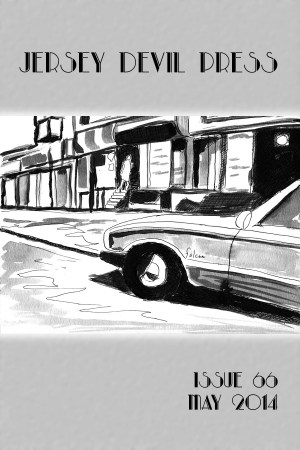
The May issue of Jersey Devil Press is out, and it’s full of the usual shenanigans: stunning prose poems, otherworldly obelisks invoking transcendence, blessed/cursed warriors, anthropomorphic animals in the workplace, and, of course, the apocalypse at the end of it all.
But don’t worry, dear readers: “the end” (as in the apocalypse) is an ongoing thing, especially at JDP, and we’ll be back in June with more amazing for you to read!
Back from Minneapolis less than 24 hours and I was in my classroom, rearranging the tables and spreading out all my books, magazines, brochures, business cards, submission flyers, notebooks, pens, fake tattoos, noisemakers, and buttons, creating my own miniature bookfair for my students. And yes, I let them take a lot of what I brought back (but not my books!), and afterward, I went through a rundown of the panels I attended and answered questions.
But none of this was much of a surprise to my students, because they’d been following my blog the whole time I was away, and I’d required them to write responses to my AWP adventures. A lot of those responses included some interesting comments and questions, so I asked their permission to share some of those here on the blog. Only a few gave that permission, which I understand — it’s hard putting your words out there! But even this small sampling should give you an idea of how engaged my students were, and their emails and response posts were a big part of what kept me going that last day of the conference!
From my composition course:
It was [great] that, seeing that we all are writing about our communities that we are involved in, we get a digital view of the wider version of the community you are involved in, which is awesome. The layout gives me a blueprint to a degree of how to layout my community papers that I’m actually eager to write about.
~ Salim Hakeem
My comp class this term is writing a series of essays about a community; each student selects her or his own community, and their first essay is primarily a definition essay explaining what that community is and how it functions. I get some terrific topics from my students — this term, I’ve got churches and make-up salespeople and music groups and a waste treatment plant — but it was nice the turn the tables and show them a bit of one community I belong to. This was really just a happy accident, a result of timing more than design, but I’m glad it happened and gladder still that Salim pointed it out to me!
I bet it was really exciting being surrounded by authors like yourself. Did you also autograph your books for people? It sounded like fun, meeting for dinner and drinks with all your friends. Did you have to wear a tux at all?
What is your old mentor like? Your old professor David Breeden? That’d be so cool to see the one that’s responsible for you becoming what you were meant to become, or what you wanted to be.
Also, what is a full novella manuscript?
~ Ruby Ritter
A lot of students sent me question-heavy responses, which I loved. So I thought I’d use this post as a way to answer a few of them:
As a matter of fact, I did sell or trade all but one of my books, and yes, I did autograph a few of them! I also got a ton of autographs — practically every book I brought back has a signature. I love the stories those handwritten names and inscriptions tell when I read and reread the books later.
I never did wear a tux, but I did nearly pack my kilt for the conference. My wife and I have been binging on the Outlander tv series (and my wife is reading the first novel now), so I’ve been in a particularly Scottish mood lately. And I’ll take any excuse I can get to wear the kilt! But my wife, wise and practical woman that she is, reminded me that I was packing carry-on only and the kilt weighs half a ton, and even my casual cargo kilt is no light garment. So, alas, I left them at home. No fancy dress for dinner. 😦
The novella manuscript question stems from some news I got at AWP — that a publisher was interested in my novella and had requested the full manuscript. To address the latter part of that: I had submitted a query (which is a bit like a sales pitch, a description of a writing project to gauge a publisher’s interest) and a few sample pages from my manuscript. If a publisher is interested, they’ll ask to read the whole book. It’s a bit like sending in an application and cover letter and then later getting called in for the interview; they’re deciding if they want to “hire” my book.
In class, though, Ruby also asked what a novella itself is and how it’s distinct from, say, a novel. Which is a more complicated answer. I gave the class the run-down, but if you’re looking for that explanation in print, here’s my old blog post about novellas.
From my creative nonfiction course:
I mostly envy the community you seem to have found among writers. How do you meet these people? How do you know everyone? Absolutely phenomenal.
~ Aubrey Jarvis
I spent a lot of time talking to people at the conference about how much I love this community aspect of AWP, this sense that however solitary our normal writing routine and however small and localized our little writing groups are, we are still part of this huge literary world, and AWP helps us remember that once a year. It’s as exhilarating as it is overwhelming, as invigorating as it is exhausting, but it is, to quote Aubrey, “absolutely phenomenal.”
And even in a world where I meet writers every day on social media (the most common greeting at AWP is “I know you on Facebook!”), I still wind up meeting whole gaggles of new writers at AWP. That’s a large part of what AWP is for: discovering new voices, if not in person then at least on the page.
This year, for example, I met for the first time a handful of publishers, several new writers, and the editorial staff of several literary journals. I also connected with new undergraduate students at the University of Wisconsin-Platteville, where I used to teach, and with new graduate students in the creative writing program at the University of North Texas, where I earned my PhD. Many of these new writing colleagues, of course, I have since friended on Facebook or followed on Twitter. I also swapped books with some of these writers and publishers, so we’ll get to know each other through the written word and (so the intent goes) help promote each other online if we like what we read.
And how amazing it must have been to give your mentor books in which he is acknowledged. That is a dream of mine to do someday.
I also liked that you got to see Bill Roorbach. (I say hi too.) The more I read Writing Life Stories, the more I feel like I have a story in me that has meaning to more people than just me, and the more I feel prepared and confident to do the work, put in the time, and become a great author. I already know I will be using the book for more than just this class, and it is something I will most likely refer to repeatedly over my life and (hopefully) career.
~ Daniel Holsonback
One of my favorite things about engaging with the writing community — at a huge conference like AWP or at a local event like the Terroir Creative Writing Festival (which happens this weekend and, yes, I’m running a session there) or even at a single author’s booksigning — is that you get to meet these people you admire and aspire to become. They serve as role models, sure, but by and large, they also serve as occasional mentors, ushering you into your own writing life even if only a few minutes at a time. (Bill Roorbach is especially good at that; if you haven’t met him in person, you can always follow the writing blog he shares with Dave Gessner — they’re currently celebrating the fifth anniversary of that blog.)
And if things pan out and you do wind up publishing some work down the road, yeah, it’s not just good etiquette but also a thrilling experience to have the opportunity to thank those folks who helped you get there. Writing my acknoledgements was one of my favorite parts of my whole publishing experience. And I still have a lot of people left to thank, so I hope to publish many more books where I can acknowledge them. 🙂
And finally, rather than end on my own response, I’m going to let a student have the last word, because I love Kianna Johnson’s response to the whole experience of AWP:
I loved the photo on Day 1.2 of the side of the building — covered in all those music notes. I thought I was just trying to distract myself from reading, or writing (music does that to me) but then as I thought about the concept of music and literature it all made a lot more sense. You have to have rhythm when you write and you have to have enough creativity that your words can sing to your reader. My theory (no pun intended) continued to remain relevant as you talked of standing and singing “I” — “We are that ‘I’ song.” Our lives are a reflection of who we are, and if we’re lucky, they’re songs — and it’s incredibly beautiful.
It was great to see you having so much FUN throughout all this “research,” “work,” and “development.” You, hanging out with a bunch of writers across the country but interacting with people just like you — people who understand writing and how to get it out in the world. I feel that we idolize the greats (why wouldn’t we, they’re awesome), but I think it’s important for us to not hold them too far above us. What makes them more capable than we are? With proper guidance, hard work, dedication and positive influence, couldn’t we be great writers too? The answer is yes.
So, I mentioned yesterday that Blue Skirt Productions was one of my favorite tables at AWP. One of the reasons was that they ran a contest for their literary magazine, Microfiction Monday: they provided these 4×4 sticky note and asked folks to submit microfiction that fit on it. Ideally, one hundred words or fewer. And it was a contest, too! The winners would be published in a special APW edition of the online magazine.
Also at the conference, I met Grant Faulkner, founder of the magazine 100 Word Story (and executive director of NaNoWriMo!) and author of a book of 100 100-word stories, Fissures, which I bought. While I was chatting with him, I told him how much I admired the 100-word story and that my shortest story (“Consuela Throws Her TV Away”) was 380 words.
But I figured Microfiction Monday‘s sticky-note challenge was a good excuse to try a 100-word story, so I thought about it for a couple of days and then on the last day of AWP, I slapped my sticky note on the table.
That’s my gray sticky note in the middle!
And gang, I got selected, and today the story, called “The Storm,” is live! And special note for Hagridden fans: eagle-eyed readers might spot how it’s related to my novel! (Another special note: my first attempt at NaNoWriMo was Hagridden. Everything’s connected!)





















 Samuel Snoek-Brown