Yet another travelogue: Vancouver, BC, Day 4

26 March 2014

We intended to make our last full day in Vancouver a rather lazy day, with a couple of leisurely strolls through relatively nearby neighborhoods and a bit of casual souvenir shopping. And that’s pretty much how it started, with a morning walk through Yaletown, which feels very much like Portland’s Pearl District, where I teach at PNCA. In fact, Yaletown has almost exactly the same history as the Pearl: a former industrial warehouse district upcycled to a trendy (and fairly spendy) commercial and arts district. But the restaurants and boutiques in Yaletown are at least 50% more expensive (slash-pretentious) than Portland’s Pearl — at one home décor shop, we found a lovely little silk-shaded chandelier that was on sale for $4,000! — so we didn’t end up buying anything in Yaletown.

We did stop at Goorin Bros. Hat Shop, which was excellent and actually one of the few shops in the right price range — the hats were all on the expensive side, but they’re excellently made and worth the price. I nearly bought a cowboy hat (people who know me, don’t scoff — my Papa always wore a fine, low-crown “gambler” style cowboy hat, a style that actually looks okay on me, and I figure it would make for a good camping hat), but the fit was a half-size too small and the crown a half-inch too tall. I had fun trying on all the other hats, but I have a limited range, really: I can’t pull off newsboys, fisherman’s hats, flat caps, military “scout” caps, berets, or, I discovered today, bowlers. All the rest of the hats that might look decent on me, I already own in a variety of colors and patterns and fabrics. So, no dice on the hats, which was a shame, but the shopping experience was still fun — Jennifer had a ball trying on cloches and pillboxes and slouch hats, and the sound system was playing old Motown and Stax soul the whole time, including a run of Sam and Dave.

With shopping a bust in Yaletown, we moved on to Granville Island. We’ve been walking practically everywhere in Vancouver because it’s an exceptionally walkable city, and looking at the map, we figured we’d simply walk along Granville over False Creek to the island. It looks easy enough on paper. But the map is deceptive: actually, the Granville Bridge extends up and over the entire island, depositing cars and pedestrians on the south side, so we got gorgeous views of the city and False Creek and even Granville Island itself as we passed above it, but we also had a l-o-n-g hike that basically doubled our travel time. (Pro-tip: take the ferry. At ten bucks a ticket, they’re rather spendy for such a short hop across a narrow channel of water, which is why we stupidly skipped them and walked it, but the ticket is good for the whole day and the convenience is worth it. Our feet are pretty pissed off at us right now.)

When you consider what Granville Island is — arts and crafts shops and public markets — you’d be forgiven for assuming it would be just some flea market-cum-tourist trap full of overpriced craft souvenirs and wannabe artists with a weekend gig selling their hobbies. But it’s not that way at all. For one thing, you’re not even allowed to set up shop on the island unless you’re a working artist or craftsperson, and by working, I mean that most of the storefronts we saw were at the front end of — or even inside of — the artists’ functioning workshops or studios. We saw several artists painting and had a lovely chat with a woodworker carving beautiful wooden birds, and in a quirky kiddie décor shop, the saleswoman entertained us by telling us details about every artist of every piece in the store. So when you walk into a place, you know these people aren’t mere hobbyists; these are working artists. For another thing, the work is good, no matter how silly it can sometimes get (we saw plenty of silliness, including a fun little postcard shop of locally printed sketches and engravings and a huge kids market with toys and games and puppets galore). For another thing, you actually get to talk with the people making the work, and that makes a big difference. In fact, one of the most interesting places on the island, which we hadn’t even known to look for, was the Emily Carr University, an art and design college on the island where students also have gallery space. (We stopped at the library, of course, where I was pleased to find the writing center right up front, tutors on duty right there in the main lobby.) In short, Granville Island is the real deal.

Best of all, the “crafts” on the island include wineries, craft breweries, and even a local British Columbia sake maker. That latter was our midday respite, with a three-round tasting flight of sake made right there on the island by a Japanese sake maker, using rice he grows in British Columbia’s Fraser Valley — allegedly the northernmost rice paddies in the world. I’ve had sake in Japanese restaurants before, both warm and cold, but I’m not at all versed in sake tasting, so getting a flight at the sake-maker’s own place was a treat. We even bought a bottle to bring home (it will make for great summer sipping!).

We had lunch inside the huge Granville Island Public Market, a covered market space with as many fruit stands and corner cafés as craft shops. We were tempted by the huge pot pies at a pie shop, but the lines were long and our stomachs small, so we went for burgers — Jennifer loved her teriyaki burger; my Cajun veggie burger was good, but it’s hard to sell me on veggie burgers anymore after yesterday’s fabulous meal at Naam.

We wound up our island trip with a bit more shopping and a three-round craft beer tasting in the Granville Island Taproom (the Island Lager was my favorite; Jennifer preferred the Honey Lager), and then we braced ourselves for the l-o-n-g walk back over the bridge. Bracing ourselves didn’t help: it was fairly torturous despite the beautiful views, and by the time we made it into downtown, we opted to just head back to the apartment, where we ate take-away pizza from a corner dive in the ground floor of our building ($5.50 for two slices and a soda, and the pizza was actually really good). Then we played a few more hands of gin, planned our early morning trip to the train station, and it was off to bed for (literally) a handful of hours of sleep before our train leaves in the morning.

Tomorrow: final thoughts, photos, and some comments on the delightful train ride aboard Amtrak!

Yet another travelogue: Vancouver, BC, Day 3

25 March 2014

I’ve written about this before, but my paternal grandfather was a merchant ship captain — technically still is, since he remains a master mariner, though he’s in his 90s and has been retired for decades now. His father was also a master mariner, as was his father before him. And so on, for generations.

So, whenever I have the excuse to do so, I like to hit maritime museums, and Vancouver has one, out in the Kitsilano area. The museum sits across False Creek from downtown and faces English Bay; we saw its distinctive A-frame building from the English Bay Beach yesterday.

I was eager to visit it regardless, because it’s a maritime museum and because, in our limited experience, Canada seems to do its history museums right — we were impressed by all the ones we visited in Prince Edward Island years ago, and the Vancouver Maritime Museum today was no different. But I was especially excited because that A-frame building also houses the RCMP vessel St. Roch. I don’t mean a model of the ship (though the museum holds dozens of gorgeous model ships); I don’t mean a replica of the ship. I mean that the actual artic sea vessel, bow to stern, keel to crow’s nest, sits inside the building.

And I love boarding historic ships.

I love standing at the helm, hand on old-fashioned wheel, and I love exploring below decks, poking my head into the sleeping quarters and the mess. But I didn’t realize going in just exactly what made this ship so special. Turns out, this is the ship that finally made it across the fabled Northwest Passage. Actually, another ship had made the arduous and often fatal voyage before, so the St. Roch was the second to sail east to west through the artic, but it was the first to make the journey coming the other direction, west to east. So, standing aboard that humble but sturdy and well-preserved vessel, you are literally standing aboard history.

The rest of the museum is equally amazing (there is an exceptional exhibit on the immigration of Punjabi Sikhs to Canada, including a starkly honest appraisal of Canada’s racist past — and present — in language that American pride and politics would rarely allow, and it was both astounding and refreshing to behold; the museum’s sections on the Inuit peoples was equally honest and applause-worthy), and while we arrived concurrent with a field trip of what looked like kindergarteners, the museum staff and the school’s chaperons did an excellent job of maintaining order, and we thoroughly enjoyed the whole visit.

Afterward, we headed down to trendy 4th St. to window-shop and find some food. (The Kitsilano neighborhood came highly recommended, not only by our guidebook but also by our chiropractor, whose husband is Canadian.) The shops were fun but not tempting enough to part us from our cash, but then we found lunch at a little restaurant called Naam, and just like that, I fell in love.

Naam has been around since the 70s, when Kitsilano was Vancouver’s hippie-central and 4th St. was called Rainbow Road, and the vibe of the place remains true to that heritage, complete with old wooden tables and mismatched chairs, the brick accent walls and the dark wood trim, a little wood-burning stove for heat and a carved-wood banquette for teas and coffee, prayer flags and paintings of trees and photos of buddhas. The overhead lamps had shades of handmade paper. The sound system played the first CAKE album in its entirety. Even the people seemed part of the décor: from the street, I saw pairs of middle-aged white women eating sandwiches and pairs of young Asian women eating ramen; as we entered, I spotted an elderly Sikh man waiting for his bill and a young hipster in a punk tshirt under his long lotus-bead mala and black linen jacket talking politics with a friend; we were greeted by a kid who looked like a young Matthew Broderick, a self-declared nerd who asked about the buttons on my bag (the Autobot symbol, the Thundercats logo, a cartoon Superman, a Bayou magazine button, a Reading Frenzy button, and a button that reads “writer”); we were served water by a girl in a hand-knit TMNT sweater; one of the waitresses wore a black smiley-face tshirt and kept her long dreds under a backward ball cap; our waiter wore an argyle-print shirt under a plain, unbuttoned dress shirt. In short, this was the kind of local place where literally everyone feels welcome and at ease, a kind of neighborhood living room. It was the sort of relaxed, hip atmosphere we were expecting at the Melriches coffeehouse yesterday — Naam got that vibe right, and then some.

Also, it boasts a hell of a menu: Mexican, Asian-fusion, burgers and dogs, chili and soups, and it’s all vegetarian — no meat allowed — and it included loads of vegan and gluten-free options as well. Jennifer had the chili with a giant salad, hearty home-baked bread, and a local honey brown lager; I had a Sam’s Five-Star Burger (that’s actually the name of the burger patty, handmade at Naam, and it’s hands-down the best veggie burger I’ve ever had, anywhere, ever) with sesame fries (actually thick potato wedges with sesame seeds clinging to them, served with a miso gravy instead of ketchup), a giant salad, and a local IPA.

I’m carrying on like this about a lunch because it was simply that fantastic. The whole experience. It was easily the highlight of my day — I even bought a tshirt advertising the place! If you’re ever in Vancouver, this is where you want to have lunch and/or dinner. Hell, if you’re not in Vancouver, come visit this town just so you can have a meal at Naam. Seriously. It’s that good.

Eventually, though, we had to move on, so we kept strolling down 4th St. and window-shopping. Despite how full we were from lunch, we even stopped in at Sophie’s Cosmic Café for one of their famous milkshakes (strawberry, and it was delicious) while taking in the kitschy diner décor and enjoying the classic Johnny Cash playing over the sound system. Finally, though, we caught a bus back downtown to the Vancouver Art Museum, which opens up Tuesday evenings for “by donation” entries, which is cheaper than regular admission.

As excellent as Canada’s history museums have proven to be, the country apparently needs to work on its art museums. The Vancouver Art Museum is touted as one of the best and largest art museums in the country, and it’s a fine museum and a beautiful building, but if this is one of the largest, the rest must be pitifully small. Also, the whole first floor is currently devoted to Lawren Harris in part because he is recognized (in this museum, anyway) as one of the most important figures in defining and supporting Canadian art, but the glowing and insistent language the exhibit uses implies that Canada hasn’t actually had a strong history of support for the arts, or at least for visual arts.

(Actually, where the Vancouver Maritime Museum today and the Stanley Park totem poles yesterday did an excellent job promoting the value and importance of First Nations art and culture in Canada, the Vancouver Art Museum seems to have an almost exclusively white, European/North American bias in its collection and presentation, which I thought odd. It might be true that Harris promoted and preserved the Canadian art scene, but only because no one was — or is, in this museum — including Native arts in that scene. Apparently, they’re still “other.”)

While I’m not generally a fan of the kind of modernist abstract art that Harris eventually settled on in his later career, I found his early transitional work quite exciting, especially his bold use of texture and stylized line in his expressionist landscapes. And it made for an excellent companion to the third-floor exhibit of Edward Burtynsky photographs, a powerful, moving artistic statement about our place in the natural world and our role in the planet’s transformation (one might say destruction).

I only wish we hadn’t had to pass through the oddly out-of-place exhibit of Myfawny MacLeod’s ultra-modern art, which consists mostly of found objects and middle-fingers (sometimes literally) to establishment attitudes. If the exhibit had been a student show, displaying pieces in which a young artist is exploring her artistic world and figuring out how she wants to express herself, I would have found the art interesting, some of it even exciting. But given MacLeod’s existing career and alleged standing in the local Vancouver art community, the whole thing came off as weirdly unrealized, immature even. Even then, it might not have seemed so disappointing had it not served as an out-of-place buffer between the Harris and the Burtynsky, which made such great companion exhibits I wish they’d been presented back-to-back, without the intervention of MacLeod.

Anyway, by the time we’d finished with the museum, we were ready for some dinner, so we headed to La Bodega, a little tapas place downtown that Jennifer found. The décor here might seem corny at first — plastered walls with wrought-iron gates and amber lamps, inexpensive poster-prints of lesser Picassos, the Gypsy Kings playing over the stereo — but it’s actually so over the top “Spanish” that it’s kind of charming. I figure if a place is going to go faux-authentic, they might as well go all in, and La Bodego freaking commits. Also, the food is good (fairly excellent, considering how relatively inexpensive it is), and the half-pitcher of fresh-made sangria, full of orange slices and apple wedges, that Jennifer and I shared was the perfect refreshing end-of-day complement to our meal.

In fact, it was a perfect way to end our day overall, as Jennifer and I sipped sangria and discussed art and food and history and culture. It was the kind of evening that makes me love travelling with my wife — these long, reflective discussions we have, they feel like a kind of recurring fifteenth date, where we’re perfectly comfortable with each other but we’re still discovering things about each other, still surprising each other, still finding new things to say. I don’t know if travelling simply provides us with new topics to discuss or if it’s something subtler, like the journey changes the context of our usual conversations and we find new ways to say old things. But I always delight in these moments, even after seventeen years together. And despite my gushing about lunch earlier, if Jennifer asks, this is actually my favorite thing today, and most days.

Yet another travelogue: Vancouver, BC, Day 2

24 March 2014

We woke early this morning because the weather was supposed to be wonderful again and we wanted to beat the crowds to Stanley Park. We needn’t have worried — the weather was wonderful but still a bit cool and overcast, and it’s a Monday, so the park wasn’t crowded at all. Still, it was nice to give ourselves the extra time to explore, because Stanley Park is enormous, not quite as large and nowhere near as lose-yourself secluded as Portland’s Forest Park but huge and impressive nonetheless. We spent most of our time strolling along the lengthy walk around the seawall, enjoying gorgeous vistas of the downtown city skyline and the snow-dusted mountains beyond North Vancouver (and dodging cyclists who insisted on riding in the walking lanes). Near Brockton Point, we took a detour to see the totem poles, recent replicas of older replicas of much older originals, preserved here to honor the native First Nations peoples who used to live in what is now the park. The totem poles were fascinating and beautiful and very informatively presented — we learned a lot in our short visit here!

After a tempting turn through the gift shop, we returned to the seawall to find the Brockton Point lighthouse (we have a thing for lighthouses, developed on our trips to Prince Edward Island, but this one was fairly unimpressive) and the various quirky statues along the walk. Once we’d rounded the point, we made our way back into the park to find the miniature train (a disappointment, actually) and then to the Warren G. (the G stands for Gamaliel!) Harding memorial, which was a bizarre but ultimately pleasant (or at least informative) surprise. It was erected not only to honor Harding’s visit to Canada in 1923, the first by a sitting US President (it took that long!?!?) but also in memory of Harding, who died in San Francisco a week after his visit to Vancouver. Plus — I feel the need to repeat this — Harding’s middle name was Gamaliel! As Jennifer said, who knew we’d have to come to Canada to learn so much about a US President?

Frankly, Brockton Point is just a tiny thumb in the whole great fist that is Stanley Park, and I would love to revisit it someday for some serious hiking, but we had a lot of walking yet to do today, so we took the bus back out to West End, where we had excellent miso and ramen at Motomachi Shokudo, followed by a long walk through the West End — stately homes nestled among mid-century apartment complexes and towering, Soviet-looking concrete apartment towers. Eventually we found ourselves at the quaint little Barclay Heritage Square and the Roedde House Museum; the latter was closed, but it was nice to see nonetheless, and Jennifer in particular enjoyed the whole area. Then it was northwest through the gay community along Davie St., where we were looking for a guidebook-recommended coffeehouse called Melriches (“This is the kind of place where Morrisey would hang out on a wet Monday afternoon to check his emails”). It was fine, but crowded and hot and with a bored/rude barista, so not really what we were hoping for. Oh well.

We ended up at English Bay Beach, which was perfect for relaxing in the emerging sunshine and the cool sand while leaning against huge logs to watch a flotilla of cargo ships collected in the bay.

Nearby, we discovered a bizarre collection of bronze statues, huge grinning behemoths making exaggerated gestures of laughter and glee. The sculptures, by Chinese artist Yue Minjun, were erected to “inspire laughter, playfulness and joy in all who experience it,” and sure enough, we both found ourselves cracking up as we imitated the statues for photos, and for me, it turned out to be the highlight of the day!

Still smiling, we headed back across West End along Denman to take the bus down Georgia into downtown, where we indulged in a little window-shopping along Granville before walking back toward home. Along the way, we stopped for dinner at Japadog, a weird but hugely popular little dive (they also have food carts scattered everywhere in the city) where they serve hotdogs prepared with Japanese toppings and seasonings — I had a veggie dog with seaweed, fried onions, Japanese mayo, and teriyaki sauce, and it was delicious; Jennifer’s, a pork brat with grated radish and cabbage, was also good but a bit much in flavor. We also had fries cooked in butter that were amazing.

Tired (and overwhelmed by the Japadog flavors), we retreated to the apartment for a bit of gin rummy before venturing out for coffee and donuts (and free wifi) at Tim Horton’s, then it was back to the apartment for a stint in the sauna and hot tub. Another round of gin rummy (Jennifer won both games) and we were more than ready for bed. Fortunately, tomorrow is a bit less dependent on time, so we’ll get to sleep in a bit, something I’m very much looking forward to!

Yet another travelogue: Vancouver, BC, Day 1

Jennifer and I are on Spring Break, and we’ve decided to blow town for Vancouver, BC. We actually have a history of heading north for Spring Break, rather than south like so many of our friends and colleagues. What can I say: Having grown up in Texas and lived almost three years in the Middle East, we’ve decided we much prefer cooler weather.

Another reason we decided to head to Vancouver (which I’ve come to think of as our beloved Portland’s Canadian cousin) is the train trip I took to Seattle last month, when I fell completely in love with Amtrak. I enjoyed that trip so much that not only did I gush about it here on the blog, but I also decided to take trains as often as possible when we go on long-distance trips, and with Spring Break right around the corner and Vancouver right up the coast, this seemed like an ideal time to introduce Jennifer to Amtrak.

Since I’ve already blogged about my love of the train, though, I’ll skip our eight-hour trip (I’ll probably roll it into a post about our return journey) and get straight to our first full day in Vancouver, which is what follows.

Two things to note:

  1. Our AirBnB apartment has wifi but it’s public and therefore so slow as to be useless. So we’re relying on free wifi elsewhere. Fortunately, we’re near the gorgeous and iconic Vancouver Public Library, as well as loads of cafes with free wifi. But we’re on vacation, and while I’m writing about the trip every day, I’m not that concerned about staying connected, so I’ll update the blog when I get to it. If you don’t hear from me tomorrow, assume we’re relaxing and exploring the city. (Don’t worry — I’m still thinking of you, gang!)
  2. Also, because of the infrequent wifi access, I’m going to wait and upload photos to a final recap post later. That’s okay. My travel posts don’t usually include photos until the end anyway.

That said, here’s what we got up to yesterday.


23 March 2014

On the way to Tim Horton’s for donuts and coffee this morning, I found a huge crowd of doctors, paramedics, and police officers milling around outside the Vancouver Public Library. Across the street, an EMS ambulance; parked along Robson, a pair of police cruisers. I might have assumed it was an emergency, but the collection of white-coated doctors made me think it might be some kind of convention. Then I saw a pair of doctors and an EMT petting a dog while another group of paramedics milled around sipping coffee with a few cops, and I shrugged the whole scene off.

On the way back from Tim Horton’s, I walked straight through a film crew and I realized the gang of emergency personnel might actually be extras on a shoot, and sure enough, later in the afternoon Jennifer and I stopped by the library together and they were filming there. We even got shooed out of the shot twice.

[UPDATE: I’ve since done a little investigating, and we’ve learned that the film is called Proof, a tv-movie/pilot for a possible series starring Jennifer Beals. All due credit to my wife, by the way: even under the shadow of a ballcap and in the bustle of the filming and bystanders, Jennifer (my wife) correctly identified the actress as Jennifer (Beals) and I’ve only just confirmed that she was right!]

The scene we watched involved a jogger [Beals] running along the sidewalk outside the library; she stops to check her phone, pulls her earbuds out, and gives a kind of frustrated or worried shake of her arms, then she turns toward the library and sprints up the steps. We watched them film this scene at least three times, marveling at how we could never quite tell who among us were just bystanders watching the film crew and who were actually extras, until the direction shouted “Action!” and a handful of pedestrians (dressed better than the rest of us, we realized) sprang into choreographed “casual walking.”

Directors really do shout “Action,” by the way. We never heard “Quiet on the set!” but we were outdoors, so maybe there’s no point in quiet on the set. But the director did shout “Roll camera!” then “Action!” and finally “Cut!” All the clichés were there. (Once, after positioning himself, he also grabbed his director of photography and said, “Hold it! We have a couple of bogeys about to enter frame,” referring to clueless pedestrians or cars coming into the shot.)

In between these two movie-set encounters, my wife and I had a fantastically full day. We started by heading out to the waterfront to check out the transit situation at the Waterfront Station (there was supposed to be a tourist info desk there, but it was closed as part of the station’s renovations) and then up to the Olympic Cauldron (which, alas, was closed off to pedestrians for construction). Afterward, we circled back through downtown and east to historic Gastown, the site of Vancouver’s original settlement (which sprung up, appropriately enough, around a bar opened on the site by a man lovingly known as “Gassy Jack”). Gastown has become a kind of hipsterville, which sounds obnoxious but it’s actually a lovely stroll through some beautiful sidestreets with loads of history and character. We also stopped in at a Fluevog shoe store — it’s a fashion thing, and you can read all about it on my wife’s style blog soon.

From Gastown, we headed south and then east again into Vancouver’s Chinatown, which isn’t as crowded or as colorful as San Francisco’s but is wonderfully authentic, full of dim sum and trinket-markets and the sounds of Chinese music drifting out of shop doors. We strolled through the beautiful Dr. Sun Yat-Sen Chinese Park, which is adjacent to the classical Chinese Garden of the same name. The garden is no doubt gorgeous and is famed for its authenticity (apparently, even the pebbles were imported from China), but the park was perfectly beautiful and serene — I lost count of how many times Jennifer breathed an awed “Wow” — and the price was certainly right: it’s free. Afterward, we grabbed a hearty lunch of steamed pork buns (for Jennifer) and steamed veggie buns (for me) and then headed to the Jimi Hendrix Shrine, allegedly housed on the site of the restaurant where Hendrix’s grandmother worked and where Hendrix played as a kid — and later played guitar before he hit it big. The shrine itself is fairly unimpressive, just a row of guitars painted along the building wall and a tent erected in back with photos and murals of Hendrix — but it was certainly cool to hang out in the spot while “Purple Haze” played in my head.

On our way back toward downtown, we stopped at the Irish Heather pub in Gastown for a warming dram of single-malt (Scotch, not Irish — we’re loyalists when it comes to our whisky), and then we headed to the library, where I had a terrific time watching Jennifer marvel at this phenomenal work of architectural art. I’d visited the library on Jennifer’s behalf when I was in Vancouver for a conference back in ’05, and while I’d visited libraries in other cities before, this one always feels like the library that inspired my habit of seeking out libraries to share with Jennifer, and then our habit together of visiting libraries on vacation. (It remains my favorite library in North America, and possibly the world — for me, the only library that could compete is the Openbare Bibliotheek in Amsterdam. My wife, who actually is a librarian, agrees.)

We finished the day with a movie (The Grand Budapest Hotel, which is delightful — I highly recommend it) and then grabbed the makings of dinner from a local market; because we’re staying in an airbnb apartment, we decided to “cook at home” this evening. A dip in the apartment building’s hot tub and then a quick look at tomorrow’s itinerary, and we were ready for bed.

Jennifer has a routine of asking me my favorite thing of the day (later, on the train home, she’ll probably ask me my “five favorite things” about the whole trip), but today, it’s hard to pick one. The Chinese park — and Chinatown in general — was very impressive; the Hendrix shrine was cheesy but cool; watching a film crew in action was good fun, as was seeing Jennifer gleefully explore the amazing Vancouver library. But I suppose my favorite thing of the day was probably the fact that we walked everywhere, the whole day, and survived. All told, we probably didn’t walk more than a few miles today, but we’re so spoiled with our beloved Portland’s good transit that we rarely have to walk much at home, and it’s been a long while since we got in a good hike, so it’s been nice to stretch our legs and remember how it feels to be sore and exhausted but also in touch with the ground and our surroundings. It feels somehow . . . fulfilling. I can’t find a better word.

In fact, that’s probably a good word for this whole first day: fulfilling.

Some thoughts on a term completed

My community college is on the quarter system, and we just finished the winter term. And I always finish a composition class with an essay exam. I went through some of the reasons a couple of years ago, but here’s the short version: I value reflection in writing, and I like to see my students experience that.

This year, one of my community college students turned in his exam essay and, as he leaned across my desk, he grinned wryly at me and challenged me to write an essay of my own, this one about my students.

I accepted the challenge. I even shook on it.

Which is a pleasure, really, because my community college students this winter have been outstanding. This term, I saw students open up to themselves. I saw students realize that they are writers. Even if the writing is hard or uncomfortable — or maybe especially if it’s hard and uncomfortable — they have come to think of themselves as creatures capable of stringing together sentences, painting images with words, conveying ideas in paragraphs. This isn’t just me observing their writing during the term; these are their own revelations, written down in practice exams and the final essay. Many of my students wrote about going through drafts and discovering a knack for descriptive detail they hadn’t realized they possessed, or trying to solve a problem raised in workshop by adding whole paragraphs they hadn’t realized were missing.

Speaking of workshops, those were probably the most commented-on aspect of the course this term. In exam after exam, students remarked how much they came to value or rely on their small workshop groups. Some of these students expressed their esteem for their group or their love of the process in fairly profound language. “I used to think I was a horrible writer,” one student wrote in an exam essay, “but after this term I’ve realized I just need another set of eyes to help point out what I can’t see.” Another student wrote, “My drafts are a finished product until my workshop group gets a hold of it.” These are such beautiful expressions of how communal writing is, of how important workshopping is to the writing process! I want to put that latter phrase on a tshirt or a coffee mug. But I can’t, because it belongs to the student who wrote it. Which, honestly, is all the more wonderful.

Another thing I loved seeing this term was how rapidly some of my students progressed in their writing. Some came into the class struggling terribly. Learning disabilities and years-long gaps between their last writing classroom (in high school) and this one . . . these difficulties made many of my students feel lost coming into the class, worried from the outset that they were starting out in last place and they would never be able to catch up. But I don’t run a competitive classroom — the only race you need to win in my class is against yourself — and the speed and determination with which these students advanced in their writing was astounding. And they themselves were aware of this; at least half the class wrote in their exam essays of their increased confidence or of their surprise that they not only could write but that they even enjoyed writing. My favorite of these comments went like this:

After taking this class I definitely feel more comfortable in my ability to write a better essay. I learned techniques and thought processes to guide me I learned where my weaknesses are and what to look out for. All in all I am able to take away from this class a bit of confidence in myself that I feel will go a long way.

It’s not the most poetic expression of this newfound confidence, but it’s the most thorough, and that last line in particular — “I am able to take away from this class a bit of confidence in myself that I feel will go a long way” — gets at the heart of everything I try to do in this early composition classes: I don’t expect every student to be outstanding, for every essay to be an award-winner. I’m not teaching perfect writing. I’m teaching disciplined writing; I’m teaching the process, and — most importantly — I’m teaching that the process goes with you. It’s not confined to the classroom or the college; it’s not some hoop you jump through on your way to a degree. It’s a practice, it’s a skill and a craft, and it will serve you in myriad ways throughout your life, if only you’re willing to pick it up and carry it with you.

Early in the term, one of my students wrote about a trip she’d taken to Austria and how it rekindled her childhood love of The Sound of Music. I’ve had that soundtrack in my head all term, but because of these students, I haven’t been thinking of the old standards, “Do Re Me” or “Edelweiss” or even my favorite, “The Lonely Goatherd.” Rather, I’ve had Maria’s song about confidence running in the background all term: “With each step I am more certain / Everything will turn out fine / I have confidence the world can all be mine / They’ll have to agree I have confidence in me.”

A little bird told me to tweet

I’m not a Luddite. But I am ridiculously slow to adopt new tech things. Before I bought my first smartphone last August, I was still using an old prepaid flip phone — in 2013. The only two game consoles in my house are a PS1 (yes, that’s a 1) and a SuperNES (yes, that’s a SuperNES). We still have movies on VHS, and we still have a functioning VCR to watch them on.

And yesterday, I joined Twitter.

Finally.

I’ve added a Twitter feed in the sidebar on the right; you can follow me @SnoekBrown.

And now I’m all caught up, right? I’m hip, and in with the cool crowd?

Wait — what’s “Snapchat”?

Enhanced by Zemanta

I’m reading at Smallpressapalooza #7

Another reading in Portland, Oregon, so apologies to any readers not lucky enough to live in the vicinity of my beautiful city. But this one’s a big one, so if you’re anywhere within driving (or, hell, flying) distance, it’ll be worth the trip.

I’m talking about the seventh annual Smallpressapalooza, hosted by Powell’s City of Books and Kevin Sampsell.

I don't know why there's a cat in a box, except that it's the Internet, and the Internet demands cats in boxes. Also, it's the official photo for the Facebook event page.
I don’t know why there’s a cat in a box, except that it’s the Internet, and the Internet demands cats in boxes. Also, it’s the official photo for the Facebook event page.

While it’ll be worth your time to come early and stick around through the whole marathon of literature, you’re more than welcome to slip in late and/or leave a bit early (this is, after all, not only St. Paddy’s Day but also the evening of the Oregon Book Awards). Still, if you do pop in and out, you’ll be missing out on parts of a stellar line-up, so do plan to come for the whole shebang.

Either way, here’s the schedule, complete with little breaks every hour:

6:00 Ross Robbins
6:15 Walidah Imarisha
6:30 Jeff Alessandrelli

7:00 Samuel Snoek-Brown
7:15 Lisa Ciccarello
7:30 Kyle Minor

8:00 Matty Byloos
8:15 Dena Rash Guzman
8:30 Emily Kendal Frey

9:00 Cameron Pierce
9:15 Melody Owen
9:30 Virginia Paine

Come hang out, listen to cool words from great writers (and me), and I hope to see loads of people there! Also, happy St. Paddy’s Day!


Enhanced by Zemanta

Joy Harjo at Pacific Northwest College of Art

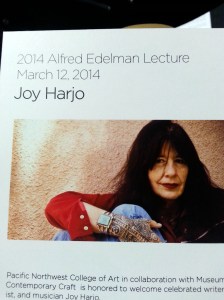
My program from Harjo's lecture.
My program from Harjo’s lecture.

Last night, Joy Harjo was at Pacific Northwest College of Art, where I teach literature and composition. She was giving the 2014 Edelman Lecture, though she said she dislikes the idea of a “lecture” and, in fact, drifted in and out of “lecture” mode, mixing in storytelling, poetry, advice on making art, and an original song on her flute. Because that’s how Joy Harjo gives a “lecture.”

I was fortunate enough to have met Joy Harjo before, almost 20 years ago, when I was just a first (or was it second?) year student in college myself. She was at Schreiner College (now Schreiner University), and in addition to her lecture/reading/storytelling, she also met with students, went to lunch with faculty, and afterward, signed books. Hers was one of my first author events, ever, and I was already starstruck before I even met her, but then I got to join the crew who went to lunch with her (I was on an end and still too shy to try and join any conversation), and her personality was electric. Later, at the lecture, that aura and charisma got bigger, swelled and crackled to fill the auditorium where she spoke, and the force of her blew my hair back. She was a revelation to my young self. Afterward, though I was a broke college kid and had no idea what her work was like on the printed page, I lined up to buy one of her books (I picked up The Woman Who Fell From the Sky) and have her sign it. Back then, I had never had an author sign a book, so I had no idea what to expect; I assumed we would just file past, assembly-line style, and she would put her name in the book and maybe smile and nod and then I’d be on my way. Instead, she looked into the face of each person she met, said their name like she’d known them all along, and thanked each person. Individually. A different conversation every time. I told her how much I loved her lecture at my college, and she thanked me. Asked if I wrote poetry. I told her I dabbled. (I still only dabble — I am no poet.) In my book, she not only signed it, she also drew a cascade of stars and added the message, “For Sam — for your journey, glad to meet you here.”

I was bowled over by the whole experience. I was never the same again.

I’ve met plenty of writers since then and I’ve become an author myself, so I know this is the drill. This is how book signings work. Especially when they follow a lecture at a small private college where the students are like a big messed-up family, the writer sitting in our living room and getting friendly with us as a matter of proximity as much as politeness. Still, Harjo has a kind of magic about her, and even if she hadn’t been my first signed book and my first big writer, she still would stand out in my memory. She would resonate the way her presence resonates, the way her voice can fill a room.

So it was a thrill not only to see her again all these years later, but also to be able to stand before my students, the way my own professor, Kathleen Hudson, had stood before me 20 years ago, and tell them how amazing was this woman visiting out campus, what a fantastic opportunity this was, how urgently I wanted them to attend the lecture.

I don’t know yet if any of my students took me up on my offer — the room was crowded and it was hard to see exactly who was there, other than “everyone” — but when I was sitting out there in the audience, I was transported back to my own college days. There’s an exhilaration in that, not in remembering my days as a student but in reconnecting with the idea of being a student. It invigorated my desire to connect with my own students, to invite them into the same kinds of mind-transforming experiences I had when I was a student. To pass along the awe and the energy, the inspiration, the yearning to better connect with this vast creative world out there.

(If any of my PNCA students are reading this, be ready to talk about this in class next week.)

It’s easy to kept swept up in a Joy Harjo appearance, so I didn’t take many notes, but there were several moments during the address in which she tossed out bits of advice on the artistic life, notes she’s been making toward a longer piece, and I managed to scribble down several of those inspirational one-liners:

On planning out her writing or her music:

One thing I’ve learned about art is that it’s usually way ahead of me.

Also:

I don’t usually know what I’m doing, and if I do, I know I’m going in the wrong direction.

On learning to write poetry:

The spirit of poetry came to me and said, “You need to learn how to listen. You need to learn grace. And you need to learn how to speak.”

On how to balance her art with her work as an activist:

My art is my activism.

On acknowledging the traditions and creative communities you come from:

Know your traditions, and practice your traditions. Also, know your language — and maybe learn another language.

Also:

Know that your visions do not belong to you.

On being part of a creative community and sharing what you’ve learned:

If you have knowledge, share it. Of course, it’s important that you share it with someone you know will take care of it.

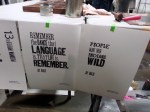
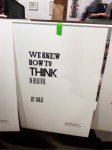
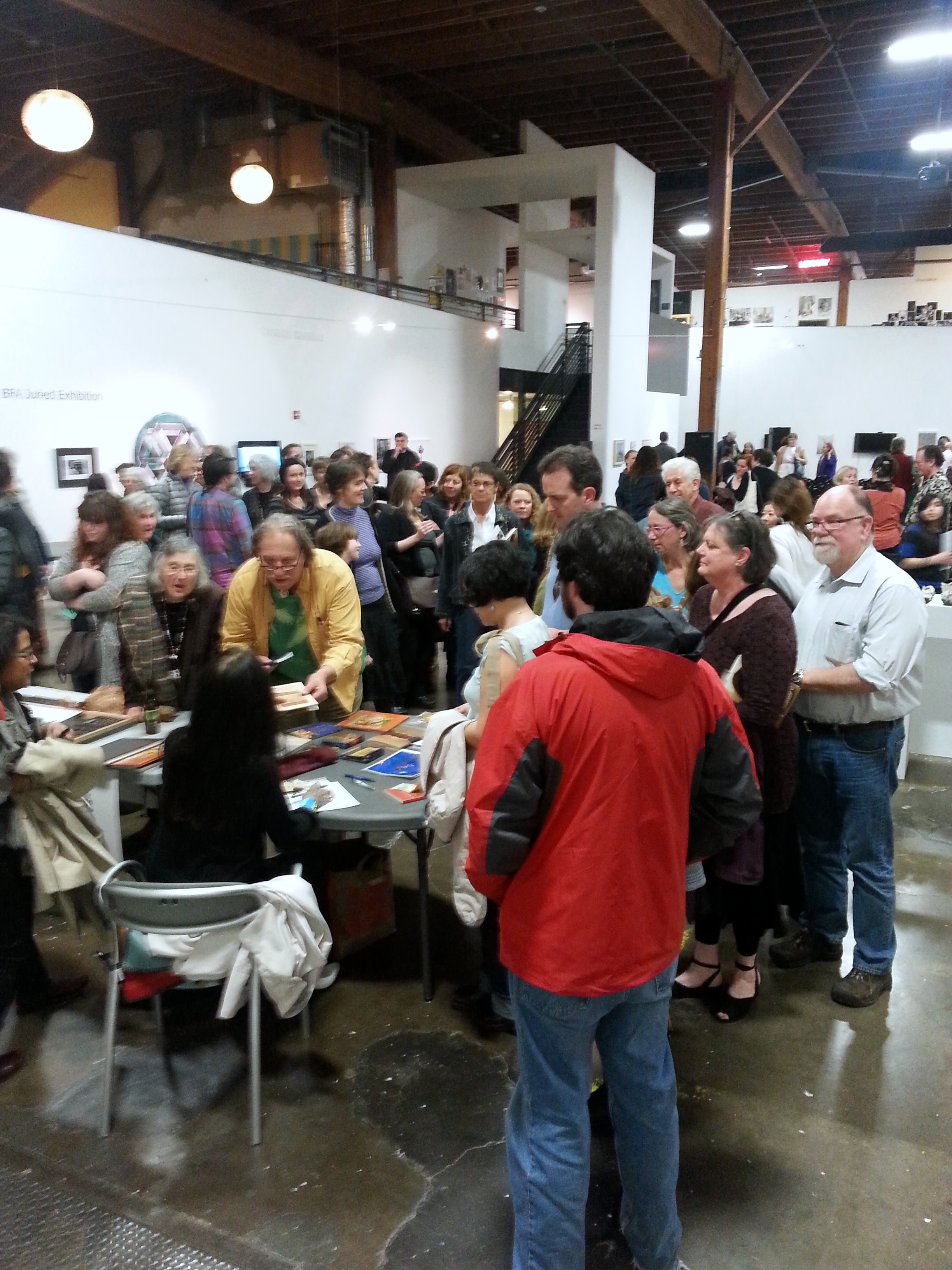
I wasn’t the only one taking notes. There was also a press on hand, with a couple making one-the-fly broadsides of Harjo’s comments.

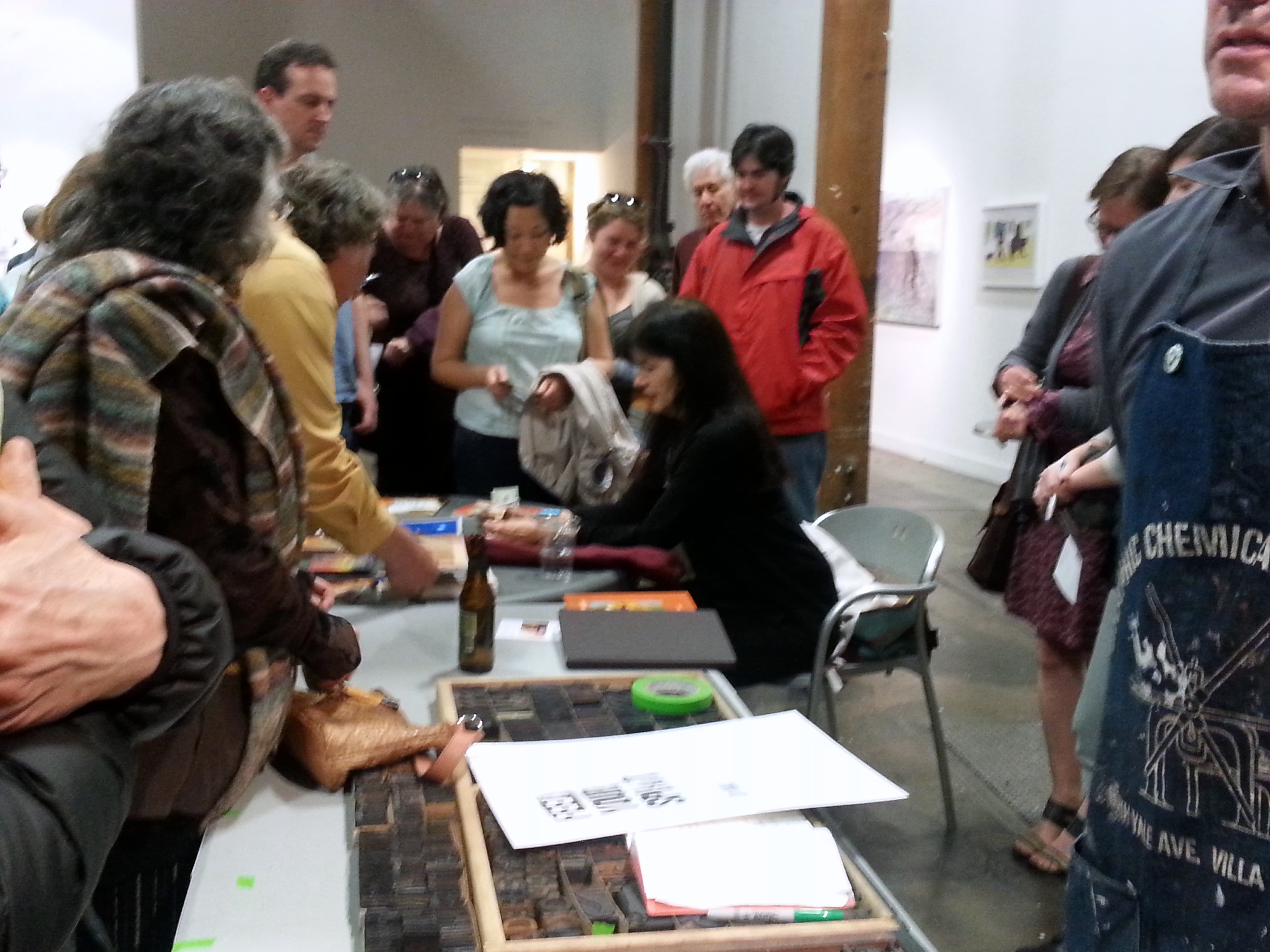
Afterward, Harjo sat in the back of the room and signed autographs, just as she had done when I was a college student.

20140312_200802

To say that people lined up to meet her is an understatement. The whole bloody room crowded up to the table.

20140312_200828

It was an invigorating night, and a fascinating opportunity to relive one of the seminal moments of my own education. I hope my students, if they went, got as much out of last night as I did.


Enhanced by Zemanta

New review of Box Cutters

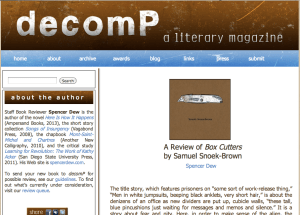
Screen shot 2014-03-09 at 10.35.22 PMI just learned that Spencer Dew has written a new review of Box Cutters; it appears in the March issue of decomP magazine.

Dew’s comments are humbling:

This opening story shows Snoek-Brown at the height of power, mastering the sort of casual, interior ramble that puts us, as readers, inside the skull and soul of someone that sounds like flesh and blood and warts and dimples.

And also:

This warped use of the known, the everyday recurs in the stories collected within this chapbook—ingenious curlicues of thought

Thanks so much to Spencer Dew, and to decomP magazine.

Want to buy Box Cutters? Check sunnyoutside press, Powells.com, or Amazon. (And if you live in the Portland area, you can find it at Reading Frenzy on Mississippi.)

Ink Noise in Portland, March 7

1507172_566777243414464_171395702_nJust a short reminder that if you’re in Portland, OR, tomorrow night (March 7) around 8 pm, you should head over to the Jade Lounge in the southeast for the Ink Noise Review reading series. I’ll be joining a bunch of poets, including my friend John Sibley Williams, for an evening of beer and literature.

Hope to see you all there!