Meg Tuite’s “Exquisite Quartet” fiction column in Used Furniture Review. This month’s story is “Scenes from an Open Marriage,” a story I wrote part of.
I have a new story online today — sort of. Actually, I have part of a story: The excellent Meg Tuite runs a fiction column called “Exquisite Quartet” over at Used Furniture Review. The idea is that she gathers three other writers she knows and trusts, and together the four of them collaboratively craft a single story. Meg and I shared space in the fourth issue of Unshod Quills, where she was the featured fiction writer, and this month she invited me to play in the Quartet, along with Julie Innis and Jordan Blum.
This particular collaboration turned out to be a bit segmented — there were four main characters, and we each wound up taking one and writing bits of the story from our character’s perspective. I love when stories do that (my own story “The Edge of Seventeen” does something similar), and since the story is all about “Scenes from an Open Marriage,” I think the excuse to explore different perspectives separately from each other fits really well with the general themes of the story.
And if anyone’s curious, there’s a character named Sam but I didn’t write him; my section is “Sonja.”
I belong to a super-secret writing group online (for real — don’t bother looking, you won’t find us), and lately I’ve been working on little exercises with them. These are some of the things I’ve done.
She was shopping for her own engagement ring in a mall kiosk. I told her I wouldn’t make her buy her own wedding, and she smiled at me. Those witch-hazel eyes reflecting all the tiny diamond-points of white from the tracklighting, her teeth disarmingly unbraced. Her lips were pink like the blush on a peach. I doubt her fiance would bother to describe her lip gloss. I was picturing her on my living room couch, my arm around her shoulder and popcorn between our laps like an old Blockbuster add, before I even asked her name. When she told me, I started pairing it with the names of our children. I offered to buy her a coffee, talk over her ring options. “I don’t know,” she said. “I just don’t know.” I offered to talk her out of this marriage; I explained that I was serious about never making her buy her own ring, that I would take her anywhere, give her anything. Already I felt this way. Already I loved her. But already she was gone, before I could even process her response — I still don’t remember what she said as she left — and I was alone at the glass cabinet, looking down into the Tahitian pearls and the tennis bracelets. The upside-down reflection of a groomed salesman, grinning into the glass. “May I help you, sir?” I don’t know. I just don’t know.
The glove never came off because I never put it on. My fist would not unclench. There is no room for fingers. This is how you wanted it, and for the first time I understood the older people who would sigh with their heads down and claim that whatever they did to me, it was hurting them more than they hurt me. I didn’t believe them; I believe them now. I look at you and ache. You challenged me, and when I slap you, it will be with my bare hand.
This online writing group likes to work in prompts or themes (which seem to be all the rage these days — Housefire, In Between Altered States, Unshod Quills, Whole Beast Rag, and of course the aptly named Prompt, just to list a few), and the vaguer the better. I don’t always write for everything, but the two that prompted these short pieces were related to falling out of love and gauntlets, respectively. (And yes, there’s a typo in the first one, which someone in my writing group already called me on, but hey, it’s about the exercise, not the perfection of prose, so I left the typo in for you, dear reader).
I’m kind of fascinated by the idea of letting these two pieces stand as they are. They need work, of course — both are awfully rough. What I mean is, I think I’d like to leave them this short. I love working in flash fiction, but the shortest one I’ve ever felt worked was in the 350-word range, and most of my flash lives closer to 1,000 words. I don’t often play with forms so short I might as well call them prose poems. But both of these seem to want to stay this length, whatever their final text, so I think I’ll see what happens if I just edit and don’t try for a wholesale revision.
Unless you talk me out of it. What say you, readers? Expand? Contract? Leave the way they are? I’m all ears. Or eyes — this is the Internet. 🙂
This slim novel simply swept me away. I had the good fortune to pick it up at a reading Jemc gave in Portland, in the last of the famed Smalldoggies Press series, but I actually bought it before Jemc read. I am a man utterly devoted to my wife, so the title alone caught my eye; I am also a man happily married to my wife, so the short write-up on the inside flap — “Ten years ago the narrator unlocked the door of a wrecked apartment, empty of any trace of his wife. As stunning as her disappearance is his response. He freezes on the facts of her, haunting his recollections….” — piqued my interest. When Jemc read that night (from chapter 32), the prose caught my breath and wouldn’t release it until I’d started reading the book.
The story is odd: there is almost no plot here, just a series of vignettes that build on each other in the minutest increments. The characters are difficult to like: the wife is fascinating and the husband’s near-worship of her understandable, but she also is disturbingly selfish and he is sometimes infuriatingly blind to her power over him — or, rather, willfully ignorant of it, because when he does have moments of insight, he lets them go quickly, desperately.
But the prose in this book! Oh, the prose…. The way Jemc writes is simple, occasionally even simplistic, but it is nearly always perfect, nearly always the right words in the right rhythms. Her prose is lyrical: while some of the short chapters read almost like flash fiction, others are practically prose poems. Her imagery is precise, her little forays into monologued stories-within-the-story are exacting and breathtaking, her pace is spot-on, and her symbolism layered and wonderfully understated. Even the ending, which you will think you know but won’t, is fantastic — for such a simple concept of a novel, which she seems to give away in the flap text, she still manages to pull a surprise in the ending, and it’s wonderful.
I don’t necessarily like the people in this book, but I understand these people and I love this book. And absolute pleasure to read, and I will cherish it on my bookshelf. I don’t often reread novels, but this is definitely one I’ll return to again and again.
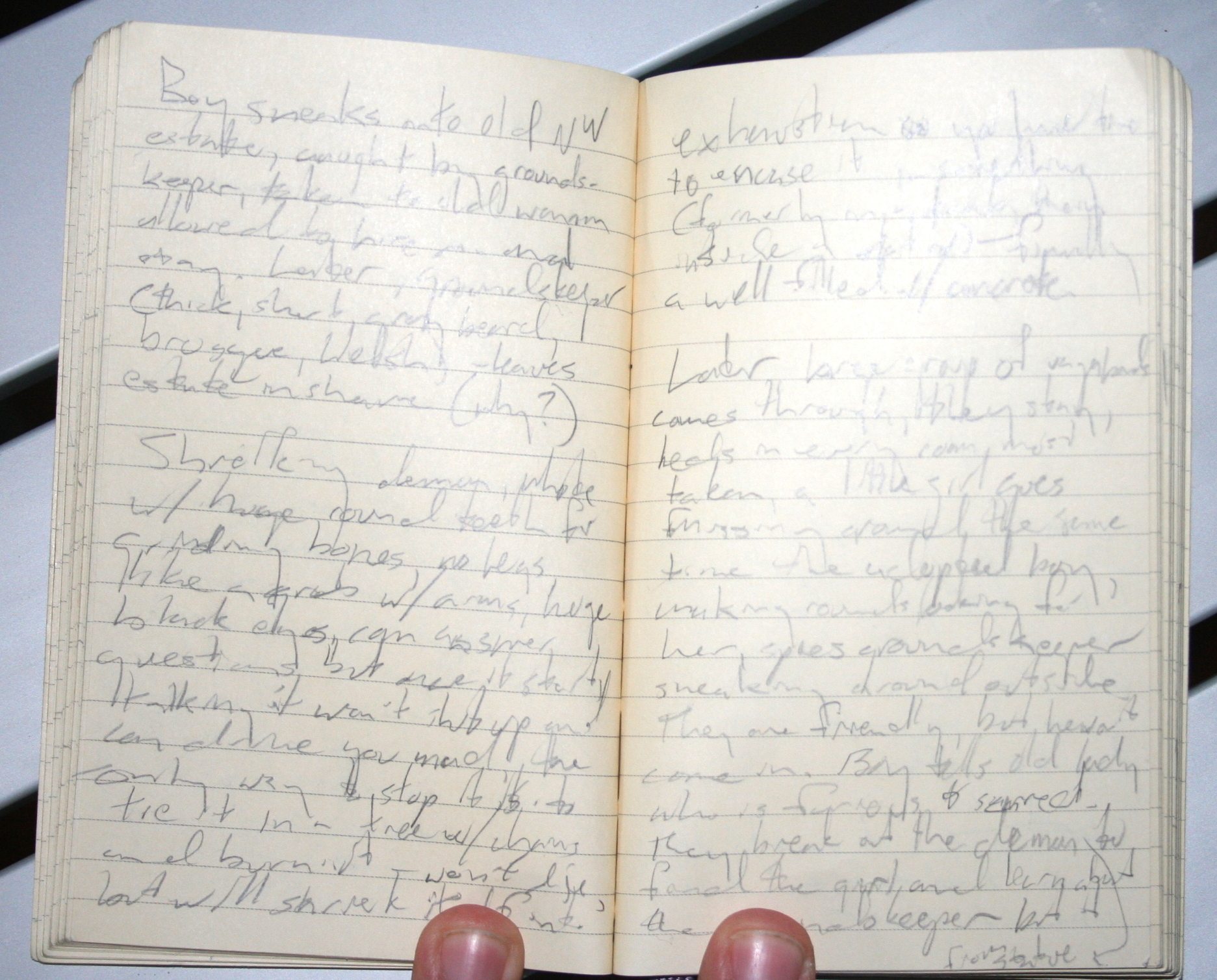
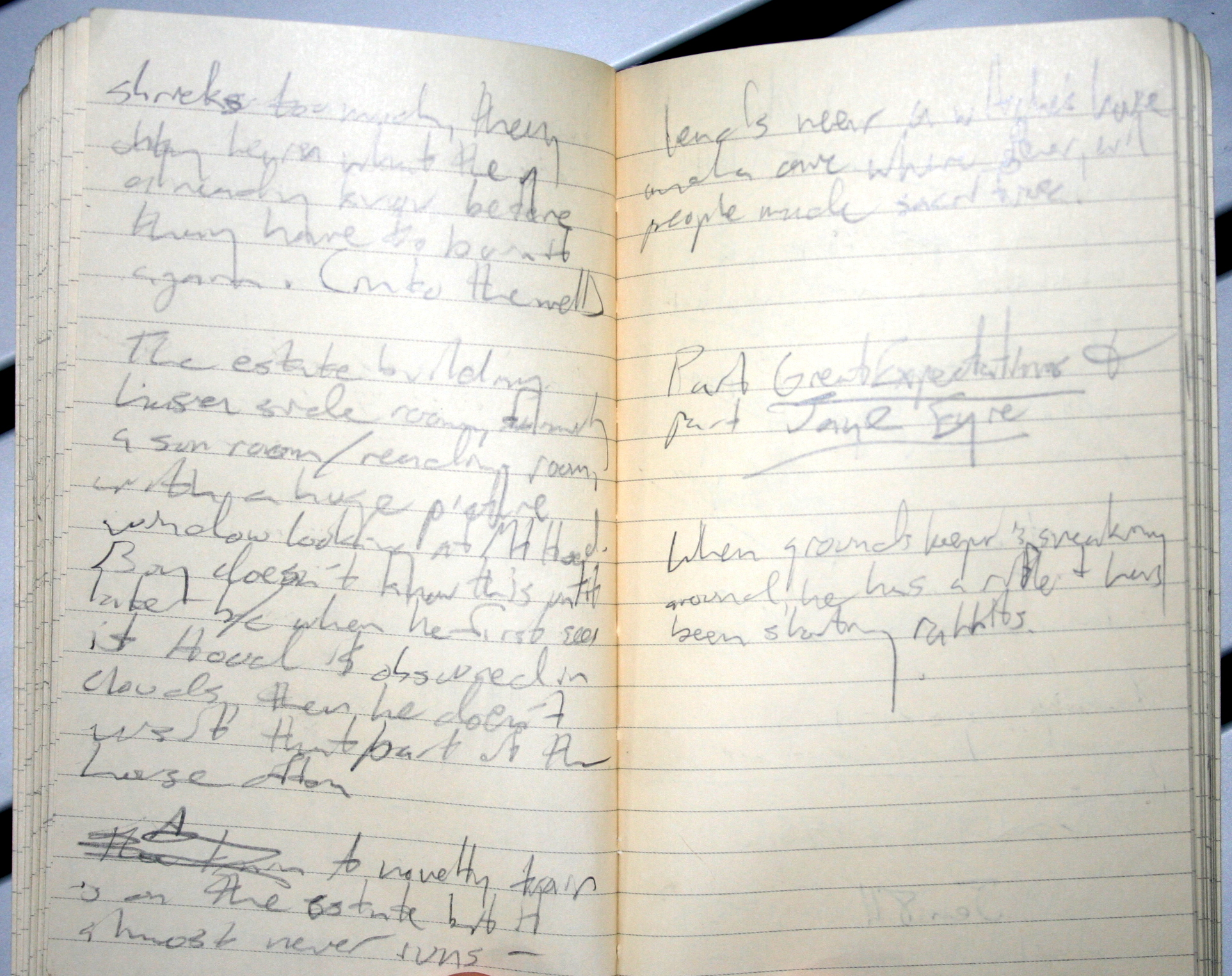
This has been a heavy writing week for me, and it’s about to get heavier: in addition to final novel revisions, synopses, queries, and excerpt submissions — which have taken up the bulk of my week — I am today beginning work on a collaborative piece a friend of mine solicited me for. So I’m taking a bit of a short-cut this week and returning to my “retro” excerpts from old hand-written notebooks.
Boy sneaks onto old NW estate, caught by groundskeeper, taken to old woman, allowed to hire on and stay. Later, groundskeeper (thick, short, gray beard, brusque, Welsh) leaves estate in shame (why?)
Shrieking demon, white w/ huge round teeth for grinding bones, no legs, like a crab with arms, huge black eyes, can answer questions but once it starts talking it won’t shut up and can drive you mad, the only way to stop it is to tie it in a tree w/ chains and burn it — won’t die, but will shriek itself into exhaustion so you have time to encase it in something (formerly in a tomb, then inside a statue) — finally, a well filled with concrete.
Later, large group of vagabonds comes through, they stay, beds in every room, most taken, a little girl goes missing around the same time the adopted boy, making rounds looking for her, spies groundskeeper sneaking around outside. They are friendly, but he won’t come in. Boy tells old lady, who is furious and scared. They break out the demon from the statue to find the girl and learn about the groundskeeper but it shrieks too much, they only learn what they already know before they have to burn it again. (into the well)
The estate building has a side room, formerly a sun room/reading room, with a huge picture window looking at Mt. Hood. Boy doesn’t know this until later b/c when he first sees it, Hood is obscured in clouds, then he doesn’t visit that part of the house often.
A novelty train in on the estate but it almost never runs — leads near a witch’s house and a cave where other, evil people made sacrifice.
Part Great Expectations & part Jane Eyre.
When groundskeeper is sneaking around, he has a rifle and has been shooting rabbits.
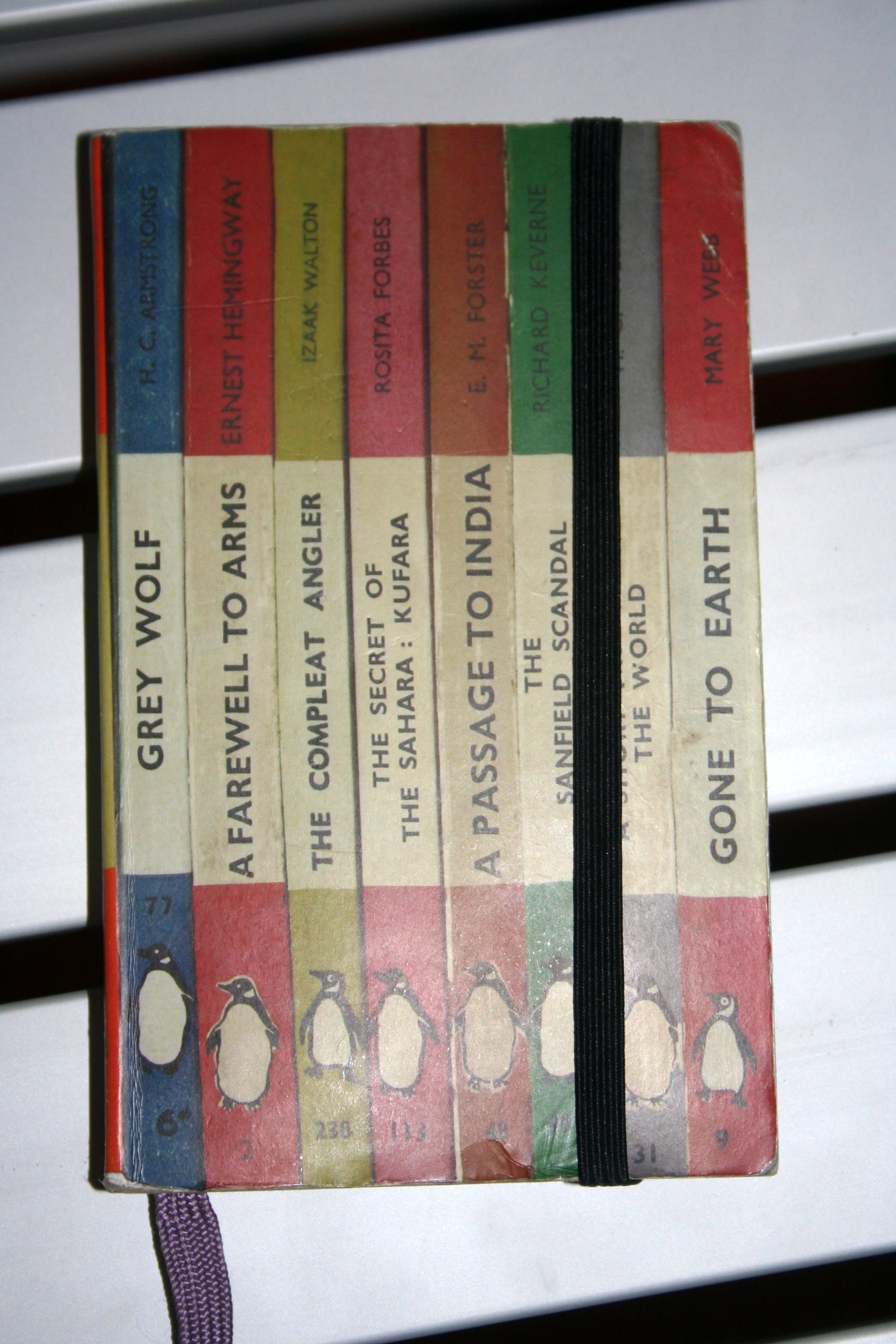
This is actually not from an “old” notebook — it’s from my current notebook. My wife got it for me at a Magrudy’s when we lived in Abu Dhabi. Which means I’ve had it for a while — a year and a half, maybe two years now. So obviously I’ve been slow to fill it up, though it’s nearly finished now.
Anyway, what happened with all that wild text up above is that I dreamed it. All of it. The scribbles in my notebook were what I managed to get on paper immediately after I woke up. So I’m not embellishing anything here — this is exactly as I dreamed it.
Which isn’t to say it’s exactly how it would turn out if I ever wrote this as a novel (which is what I’m picturing it as, though it feels tight and self-contained enough that it might work better as a novella). I mean, witches? Shrieking demons? I love the hell out of good old-fashioned Gothic horror stories, but I’m not sure I’d actually want to get that outlandish with it.
Or maybe I would. 🙂
Anyway, this isn’t the first time a dream has turned into fiction for me. My story “It Was the Only Way” was, almost verbatim, a dream I had. The “prologue” chapter of my novella also was a dream, as was the idea for the novel that became my dissertation. But this thing? I’m still not entirely sure what I’m going to do with it.
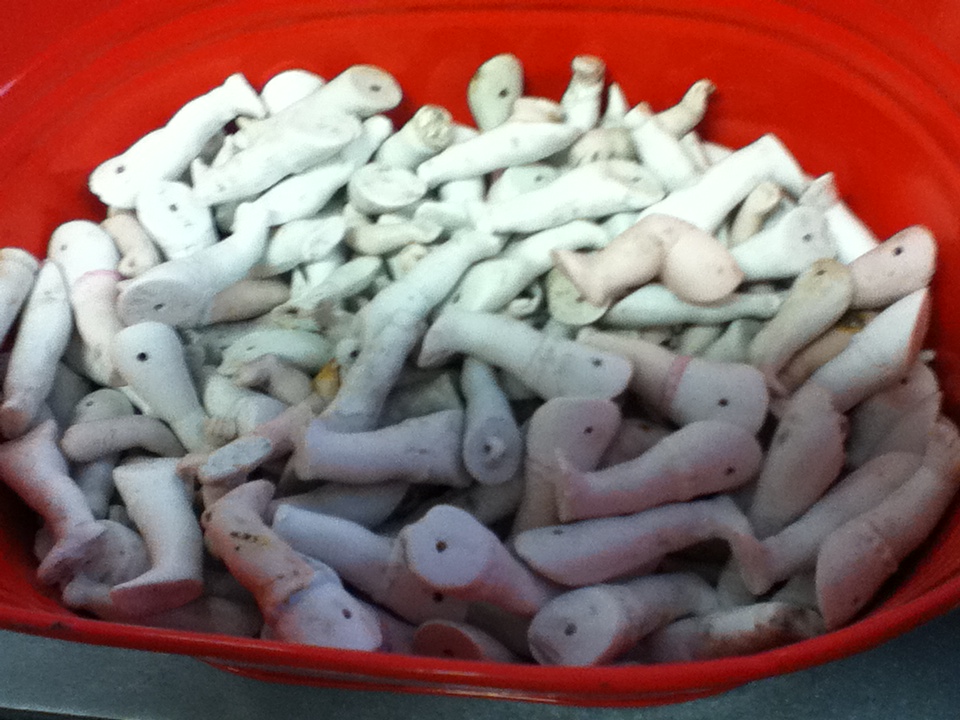
Yet another entry in my “abandoned dolls” series, this time a two-fer:
“An arm and a leg.” Discarded doll limbs at Collage, Portland, OR, 24 June 2012.“Broken Charlottes.” Damaged “Frozen Charlotte” dolls at Collage, Portland, OR, 24 June 2012.
The arms and legs were for sale, $3 each, at Collage, a Portland crafts store where our upstairs neighbor works (hi, Sonya!). When our neighbor spotted me waxing enthusiastic over the body parts, she pointed out how some of the limbs seemed to be burned, and we started speculating on what sort of twisted ritual the dolls’ previous owners must have been conducting. Then Sonya rushed me around to another counter to show me the German broken “Frozen Charlotte” dolls, which she said someone had dug up and shipped to Portland. I was fascinated that only one of the Frozen Charlottes had a head!
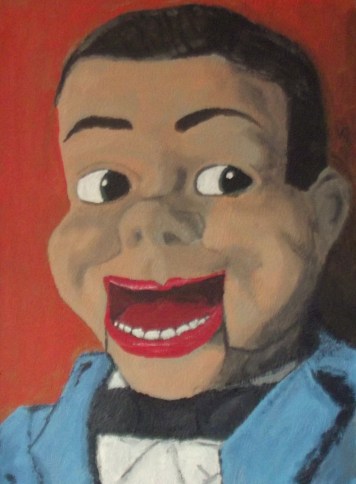
The artwork that accompanies my story is by my brother, Jon Snoek, who is awesome.
So, today, my story “The Voice You Throw, the Blow You Catch” got published at Fiction Circus. I’ve been really psyched about this one for a while now, gang, because I love the magazine and I’m pretty damned proud of the story.
What makes this publication so exceptionally cool, though, is that Fiction Circus goes the full nine and then some. Fiction is awesome, but words just aren’t enough for these people — they toss in some artwork (in my case, it’s by my brother, artist and filmmaker Jon Snoek), add an audio file of the text getting read (and I’m the one reading it, so now everyone knows what I sound like), and who knows what else.
So if you want to read a great story, go check out Fiction Circus. If you want to hear me read a great story, go check out Fiction Circus. If you want to see a whole bunch of other awesome literary shenanigans, go check out Fiction Circus.
I’ll include a couple of quick headings in the notes so you know what you’re reading, but I’ll write more about some of the things we talked about afterward. For now, I just want to dive into the scribbles I jotted down.
A quick brainstorm of essay ideas, specifically thinking about writing “list essays”:
(2) I want to be like my Papa
(1) The imminent death of my cat
The fake-pregnant ex-girlfriend stalker
Wetting the bed — the machine
Injuries (end with broken hearts?) [I always wanted broken bones]
Revisit “things my father said” as a list
(2) Missing both my grandparents’ burials
Students I’ve tutored
Rejections (literary) — the most painful/disappointing
(1) Animals I’ve killed
Rejections (romantic) — the most painful/disappointing
Crushes I’ve had — the most ridiculous (once I fell in love w/ a girl I saw in the mall)
Libraries I’ve visited(?)
Cemeteries I’ve visited (?) — visit some more
(1) Pets who’ve died
Scout eaten by Vietnamese?
Puppies baked in the sun
Peanut who tried to run away to die
Mom drying Kea
BS hanging himself
Rowdy shot w/ bb
Develop one idea into a list essay:
My first dog died when Vietnamese people kidnapped him to cook in their restaurant. Or so my dad told me. All I knew was that Scout had run away. I was seven and I wanted to go looking for him, begged my parents to out me in the car and drive the neighborhood streets. That’s when my dad told me that Vietnamese people patrolled the streets looking for stray dogs to kill and cook in their restaurants. I didn’t believe him. Part of me thought my dad had sold my dog to the restaurants. Mostly I just thought he didn’t want to look for Scout. Later, I believed he knew my dog had run away and been hit by a car, and he just didn’t know how to tell me. Whatever the reason, when I was seven, I wanted to blame my dad, but I couldn’t.
My second dog was killed by a sheriff driving through our neighborhood. He was stopped down the street to chat with my dad and a neighbor. My dog Punkin, like so many of our dogs, escaped our back fence and ran down the street — he wanted to chase tires. The sheriff tried to drive away, rolling in first gear just a few miles an hour, but Punkin got himself up under the wheels anyway. He yelped, ran a few yards, and collapsed. The sheriff drove away. I yelled, ran home, and collapsed into the couch, face down, tears in the cushion. Punkin died at the vet’s of internal bleeding. I couldn’t decide whether to blame the vet or the sheriff, so I blamed them both.
My third dog wasn’t even my dog. He belonged to my dad, a jumpy dachshund aptly named Rowdy, who got out of the fence all the time. The last time, I was closest to him and I chased him through the woods and backyards, calling his name and cursing him. Then I heard a pop and a yelp and Rowdy burst past me in the undergrowth. I stood over the brush and saw a neighbor pump his pellet rifle, again and again and again. We stared at each other a moment, his dark eyes, his dark beard, the rifle ready in his hands. Then I chased Rowdy back to where I found him collapsed and panting. He died in my arms. We all blamed neighbor, except for the sheriff when my dad filed his report, so then I blamed the sheriff too.
The list essay, as we were working with it in the exercise, is a repetitive structure that builds on a formula sentence opener. Kevin Sampsell also likes to call it the “riff” essay, as though you’re a musician riffing off a theme or an idea. Chloe Caldwell’s essay “My Mother Wanted to Be Betty Boop” is a list essay that riffs off the opening phrase “My mother wanted…”: “My mother wanted to be a dancer.” “My mother wanted me to be an artist….” “My mother wanted to be Betty Boop.” And so on.
That last block of text in my exercise was supposed to be a list essay, and in the sense that I start each paragraph the same way, it sort of is. I break the form pretty much right away, and I develop ideas far beyond those opening sentences so it doesn’t quite have the same rhythm as a good list essay (each of Chloe’s opening paragraphs in “My Mother…” is only a handful of lines long). But I think I’m getting away with it for now because I also end each paragraph on the same note. My first dog dies –> who gets blamed. My second dog dies –> who gets blamed. And so on. Plus — and this was an accident of the process — I moved quickly from the original list idea (“Pets who’ve died”) to the focus on dogs; and each paragraph isn’t just about my dog’s death, it’s also about my dad. Kevin and Chloe agreed that the structure works, and Kevin talked at length about how the list essay exercise is just a leaping off point, a means of generating ideas and possibly structure without necessarily tying us into a particular formula. Which is cool.
I like the piece I started and I plan to follow through on it. (I should point out, too, that I’m not entirely certain about how old I was when Scout died — I might have been six, I could have been eight — and I’m skipping over some details in all these stories in the interest of brevity. That’s something I might play with in future revisions.) Also, I love a lot of other ideas in that initial list, and I think I’ll take a crack at those later, too. (I have a couple of good ideas for how to approach the cemetery essay, for example, and I kind of like the possibilities in the injuries list.) Oh, and those numbers in the list are ideas for how I might connect some of the essays into longer pieces, or arrange them side-by-side in some sort of collection. Always thinking ahead, me. 🙂
We did some other exercises as well, and I have gobs of other notes — it was a fantastic and productive workshop — but this post is long enough already, so I’ll save them for future Writer’s Notebook posts. But seriously, huge thanks to Kevin Sampsell and Chloe Caldwell for such a great experience, and thanks to the other writers who showed up to share their work as well.
The workshop, by the way, is hosted by Crow Arts Manor. Check them out, support them, send them postcards, whatever you think is cool. Because they’re cool.
So, I’ve finished a wholesale revision and final(ish) edit on my Civil War novel, the first draft of which started me on my whole “Researching for fiction” series a couple of years ago. And in the process of working over that text, I came across another aspect of research I’ve long been aware of but had forgotten about: checking the map.
It happened a few days ago, as I thought I was nearing the end of the editing process. Late one night, I flashed awake with the realization that, in my revision, I’d created a minor plot hole and would have to go back to correct that. The problem was that one of my main characters, Buford, had been stabbed through the calf just before getting washed a couple dozen miles inland on a hurricane’s storm surge. In the first draft, he and the girl he’s with hike back in, oh, no time at all, the wound in his leg utterly forgotten. So I had to go back and deal with Buford’s wound.
A map of Louisiana’s major bayous, from Ouchley’s Bayou-Diversity. The deep, swamplike bayou I was imagining was Lacassine Bayou, even though I’d set my novel far to the west, between Sabine Lake and Calcasieu Lake (those two bean-shaped bodies of water in the extreme southwest corner along the border and the coast).
I managed to fix that error fairly easily, but in the process, I got to checking some of the regional details in a couple of excellent new resources I picked up from the library (Kelby Ouchley’s Flora and Fauna of the Civil War and Bayou-Diversity), and I discovered I’d manufactured a geographic impossibility. I had characters traipsing from saltmarsh to swampland to grassy prairie to sugarcane fields, all in the space of roughly a day. All those regions exist in southern and southwestern Louisiana, where my novel is set, and I’ve been to all of them in the span of a day — by car. Which was the problem: All my characters are on foot. So basically, I’d compressed a range of about 200 miles wide by 100 miles northward into a space roughly 1/5 that size.
I’ve written before that I’m not terribly concerned with geographic perfection. It’s a fictional story, so even set in a realistic world — even set in a real place — I give myself a lot of license with locations. But I’ve also written before about how cool it is to see regional descriptions in a story so accurate that you could treat them like a map. At the time, I was referring to Tom Franklin’s story “Triathlon” and Cormac McCarthy’s novel The Road, but it works for other fiction, too: when I went to New Orleans deep in my obsessive Anne Rice phase and followed the descriptions of the Mayfair witches’ mansion home there, the novels took me directly to Anne Rice’s Garden District home, on which she’d based the Mayfair house.
When you use real locations in your work, you need to know what you’re talking about, because people will call you on it. Not just the absurdly nitpicky folks, either — the ones who write all the “goofs” observations in IMDB are ridiculous, but normal people can be just as dickish about the details. Ordinarily, I say to heck with them, because it’s fiction. But details are important in fiction, and we can’t spend all this energy detailing teacups or firearms or shoeleather or weather or what birds are in the sky without also paying equally careful attention to the cartography of our world. Stephen King, in his memoir On Writing, writes that “locale and texture are much more important to the reader’s sense of actually being in the story than any physical description of the players.” And one of the key elements of Jesse Lee Kercheval’s revision checklist, in her text Building Fiction, is to check that “the physical setting for your story [is] so consistent and believable and the relationship between different places so clear that you can sketch the floor plan of a house, the streets of a town, or the route of a cross-country trip that is important in your story.”
And more than any other location, you don’t mess with someone’s hometown.
When I was discussing all this on Facebook the other day, I got a lot of agreement on this point. My father, who normally thinks I overthink fiction (and he’s probably right), wrote, “I pick a novel because of the geographical region of which I’m familiar then am critical of the author because I can tell they didn’t really know the area so appreciate the work an author puts into the accuracy of their story as it relates to geography.”
Author and editor Eva Hunter, of SOL: English Writing in Mexico, noted, “Yup. If you get the details wrong, you throw the readers out of the dream.” Or, perhaps a worse offense: making a mere dream out of their reality.
I remember reading many years ago an article in a writing magazine (was it Poets & Writers? The Writer? Writer’s Digest? I forget), in which the author talked about setting her mystery stories in a real city. It was somewhere in Colorado, if I remember correctly, and it was a relatively small town. No big deal. And so, because it was no big deal, she took a lot of license with the geography: she used some street names but didn’t bother much with their layout. She moved some buildings around. She changed some of the city’s history (or something) — whatever she needed to do to get the story told. And the book passed her agent, her editor(s), the publisher’s fact-checkers. . . . And then she gave a read in Colorado. Not even in that town, but a bigger city nearby. And when it came to Q&A time, that’s all anyone wanted to talk about. Not just that she’d mixed up street names, but that she’d had car chases going the wrong way down a one-way street, that she’d had a stop sign where there was really a stoplight, that the drugstore used to be the candy store but she’d forgotten to mention that fact. I mean, these people were flat-out asinine.
And we might be tempted to leave it at that — because we can expect the locals to feel protective of their geography — but somehow it got picked up in a newspaper, started getting mentioned in reviews, and before you know it, the author was roundly panned as a hack who didn’t know enough to do her research.
Because she forgot the check the map.
From “Lloyd’s new military map of the Border & Southern states Drawn by Edward S. Hall. Waters & Son, engravers. Battlefields are marked by red lines and strategic places by red dots. New York, H. H. Lloyd & Co., 1862.” From Library of Congress. (I found this map through the Louisiana Digital Map Library. Click the image to visit the site.)
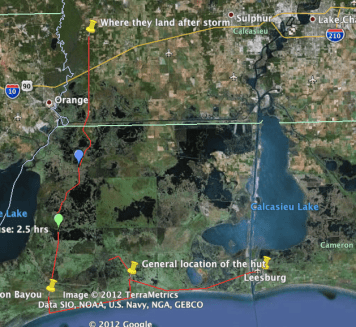
So I’ve been checking my maps, including modern maps of Civil War battles in Louisiana (there were quite a few minor skirmishes but few battles important enough to show up on a map) as well as contemporary military maps of the region. They’ve proved invaluable. I also hit up Google maps and plotted the walking distance between a few key locations, and I used Google Earth to draw a bunch of place-markers and paths on the planet. Using those tools, I shrank down the size of my region (thanks to those books by Ouchley, I was able to find easy botanical substitutes for the plants and trees I needed that do exist within the walking distance I’m describing), and I tweaked some details and changed some of the story, and it’s turned out not only more accurate but also better.
Which isn’t to say I’m slavish about any of this. As my friend Ryan Werner reminded me on Facebook, “Shoot the bullet, dude.” And I do still take a lot of license with my descriptions. For example, when the women in my novel visit the nearby town of Leesburg, I didn’t bother looking up any city plans for street names or buildings, even though Leesburg is a real town. Or was — it was abandoned and all but erased from history, the only remnant of it the current town of Cameron, which sits in roughly the same place as Leesburg once did. But they’re not the same town, so I’m not terribly worried that the locals are going to call me on my descriptions because there are no “local” Leesburgians.
Also, since there weren’t really any settlements out there in the marsh except a loose community in Johnson Bayou (which I mention in the book), and no roads to speak of except an old shell road along the chenier roughly where today’s Gulf Beach Highway is (I mention the shell road, too), I can get away with some really broad depictions of where the women and Buford live out in the marsh. The flora and fauna are more important than a roadmap, because there was no roadmap.
Except the map I made in Google Earth.
I get away with this sort of ambiguity (I hope) because I’m more interested in what the region represents than in how it functions as a roadmap. Janet Burroway, in her text Writing Fiction, admonishes that the cartographical realism of a setting is only a small part of its function: “But realistic settings constructed from memory or research are only part of the challenge, for an intensely created fantasy world makes new boundaries for the mind. [. . .] Your fiction must have an atmosphere because without it your characters will be unable to breathe.”
And Stephen King reminds us, in On Writing, that “[t]his isn’t the Taj Majal we’re visiting, after all, and I don’t want to sell you the place. It’s also important to remember it’s not about setting, anyway — it’s about the story, and it’s always about the story.”
So check your map — always, always remember to check your map — but that’s just to get your bearings and keep your back-seat readers from trying to tell you where to drive, and don’t be afraid to drive off into the thickets and make new roads. As long as you know where you’re going, your story will probably be the better for it.











 Samuel Snoek-Brown