Booklist 2015, and the power of my students’ writing

This is long delayed, but finally, I’m sharing my annual reading list. Not that it’s anything spectacular; continuing a trend, 2015 was an even lighter reading year than 2014 was — even when I count collected runs of comics issues as “books,” I’m down from 60 books to 42. This was partly because I set aside all reading in November to focus on drafting a new novel, and partly because my teaching load in the fall was extra heavy, and partly because preparing for and attending Sewanee Writers’ Conference this summer took a lot of my attention.

But I think it’s also because I’m beginning to let go of the race for higher numbers and re-embracing my usual, slow, savor-the-words approach to reading. And I’m not alone in that. See this editorial in The Guardian this past summer, for example; or this blog post at HuffPo from a couple months ago; or this piece in the Chicago Tribune from just last month.

Quality, as they say, can trump quantity, which in my case isn’t so much about the quality of the books — though I loved the books I read last year — as it is about the quality of my reading experience. I prefer to take my time, to chew on the words, to — when the moment calls for it — to set down the book and stare at the ceiling and think about the passage, the sentence, the line, the phrase I’ve just read.

So I’m okay with fewer books this past year, even if it means taking longer to get through my ever-towering to-read stack.

And now, here’s the whole, short list of books I read last year, followed (as usual) by a sort of break-down:

  • Alexis Orgera, Dust Jacket
  • Alexis Orgera, How Like Foreign Objects
  • Bartee Haile, Murder Most Texan
  • Beth Swain, Silenced
  • Carson Ellis, Home
  • Charles Frazier, Cold Mountain
  • Christian Kiefer, The Animals
  • Chuck Palahniuk and Cameron Stewart, Fight Club 2 #1-8
  • Daniel E. Sutherland (ed), Guerrillas, Unionists, and Violence on the Confederate Home Front
  • Ellen Urbani, Landfall
  • Gay Degani, Rattle of Want
  • George P. Garrett and Paul Ruffin (eds), That’s What I Like (About the South), and Other New Southern Stories for the Nineties
  • Grant Faulkner, Fissures
  • Gwen Beatty, Kill Us On the Way Home
  • Ian V. Hogg, Weapons of the Civil War
  • Jane Austen, Emma
  • Jane Austen, Sanditon
  • Jason Aaron and Chris Sprouse, Thors #1-4
  • Jason Aaron and Russell Dauterman, Thor #4-8
  • Jason Aaron and Russell Dauterman, Mighty Thor #1-3
  • Jason Latour and Robbi Rodriguez, Spider-Gwen #1-5
  • Jason Latour and Robbi Rodriguez, Radioactive Spider-Gwen #0-4
  • Jenny Drai, The New Sorrow Is Less Than the Old Sorrow
  • Kelly Sue DeConnick and Valentine De Landro, Bitch Planet, Vol 1: Extraordinary Machine
  • Laura Garrison, Skeleton Keys
  • Lidia Yuknavitch, The Small Backs of Children
  • Linda Medley, Castle Waiting, Vol. II
  • Lynda Barry, Syllabus: Notes from an Accidental Professor
  • Mark Millar and Dave Gibbons, The Secret Service
  • Mark Russell and Ben Caldwell, Prez #1-6
  • Matt Love, Of Walking in Rain
  • Michael Gerhard Martin, Easiest If I Had a Gun
  • O. Walsh, My Sunshine Away
  • Neil Kagan and Stephen G. Hyslop, Atlas of the Civil War: A Comprehensive Guide to the Tactics and Terrain of Battle
  • Richard McGuire, Here
  • Ringu Tulku Rinpoche, Daring Steps: Traversing the Path of the Buddha
  • Sally K. Lehmann (ed), Bear the Pall: Stories and Poems about the Loss of a Parent
  • Scott McCloud, The Sculptor
  • Shawnte Orion, The Existentialist Cookbook
  • Steven E. Woodworth and Kenneth J. Winkle, Atlas of the Civil War
  • Tim Gautreaux, The Clearing
  • William C. Davis and Ray Bonds, Illustrated Directory of the Civil War

Of these, seven are nonfiction (as usual, mostly research for my own fiction, though there is a Buddhist text in there); only one book was creative nonfiction — a memoir. Unless you count Lynda Barry’s Syllabus (which I used in one of my writing classes) as nonfiction and/or memoir, but I include that with the graphic novels and comic book series, of which I read thirteen.

Only fourteen were fiction: five collections and nine novels. But two of those were books I read before the general public got them: Ellen Urbani’s novel Landfall and Gay Degani’s collection Rattle of Want. I got those in advance because I was asked to blurb them, which was a wonderful honor. I did the same for the multi-genre anthology I read this year, the Sally Lehman-edited anthology of loss and love, Bear the Pall.

Five were poetry collections, which I love reading and need to read more of. One was a children’s book, Carson Ellis’s charming Home.

And, as every year, I’ve also read hundred and hundreds of pages of student writing, almost all of it essays, and my students still manage to floor me with their words. Maybe some of that is down to my assignments, or to my instruction, but I know a lot of it is just about the circumstances and the dedication of these beginning writers, and I feel so fortunate that I get to read such informative, sometimes inspiring student work. Young scholars finding their way in the intellectual world, retirees embarking on a late-life second career, drug addicts looking for a chance to redefine themselves, health-care workers and aspiring police officers writing about how they want to serve their communities, military veterans exploring the sacrifices they’ve made in service of their country, parents raging against the injustices of a world blind to autism, young adults bravely combatting learning disabilities or mental disorders . . . .

These are things I can’t assign in any classroom; these are lives, spilled onto the page and shared with such trepidation, with such hope. I have read some damn fine words this past year — Matt Love’s beautiful mediation on rain, Christian Kiefer’s emotional but brutal rumination on nature and human nature, Lidia Yuknavitch’s gut-twisting manifesto on art and violence, Ellen Urbani’s thoughtful dramatizing of a national nightmare — but the work my students produce was — and remains — among the best work I’ve ever read. And I’d trade that for 100 books every year.

Rattling language; wanting to write: Gay Degani on fiction collections and the writing life

It’s funny how writers find each other. Sometimes we meet at readings or conferences. Sometimes we’re fans of each other’s works. Sometimes we have mutual acquaintances and become friends online. With author Gay Degani, it’s been all three: I met Gay in a Facebook group for writers at almost the same time that I discovered her work with Every Day Fiction and Flash Fiction Chronicles. Then I picked up her suspense novel, What Came Before, and I became a fan — and then I met her in real life at AWP and I became a friend.

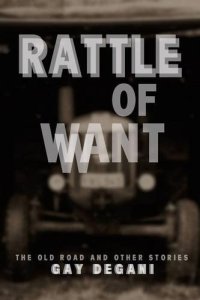
41CvkV0qP-LMore recently, I got my hands on an early copy of Degani’s newest book, the story collection Rattle of Want, and loved it so much I blurbed it:

The stories in this book are a masterclass in narrative craftsmanship. From the brief sparks of her microfiction to the meditations of her long stories to the tapestry of her novella-in-flash, Degani displays a mastery for calling forth human characters and conjuring whole lives out of meticulously wrought images and moments. Rattle of Want is a beautiful, smart collection.

So now that Gay Degani is on her “blog tour” in support of that most recent book, I feel grateful for the chance to talk to my friend about her work:

Rattle of Want is unusually thick for a collection containing so much flash fiction — we get almost 50 stories in this book! What was it like organizing and editing so many distinct pieces into one collection?

Pulling together a collection took me well over two years. I wanted it to be just that, a “collection” of the best work I’d done to date, a volume with a nice fat spine. Also I wanted to focus on the more literary of my pieces, drawing from stories written from 2007 on.

The first task was one of elimination. I’ve written several stories that are sci-fi, humor, western, and mystery in feeling, and I needed to figure out if any of those could make the transition from genre to literary. Almost none did. Once I decided on what were the strongest pieces, I began to rewrite them, keeping in mind that the theme of the collection would be focused on what we as humans “want.”

The thickness of this volume is primarily due to the inclusion of “The Old Road,” written in flash chapters. At around 100 pages, the novella made a substantial contribution to the collection.

What inspired that flash-cycle novella, “The Old Road”? It’s a beautiful and fascinating novella, but that seems like a difficult form to work in. What made you decide to tackle the story that way?

The novella was a result of a project at Pure Slush, brainchild of Matt Potter, called 2014. He asked 31 writers to write one story a month, linking each month to the next, and to do this over the course of a year. It felt like an easy commitment to me, but I worried about the editor. It meant reading, editing, and publishing 365 stories. But he did it.

His instruction was that we would each chose one day of every month—I chose the 19th—and write a 1500-word piece in present tense that took place on that exact date. He then pulled together all the stories from all the authors each month and published them together in a print volume. It was a real challenge, but I loved my characters and I wanted to create “chapters” that could stand on their own as well as be a contributing part of the whole.

Once the year was over, I asked Matt if I could fill in the inevitable gaps in the whole and publish it with my other stories and he agreed.

Many of the stories in Rattle of Want are flash, but several are longer stories of a more “traditional” length, and the book ends with that amazing flash-cycle novella. How do those varying lengths play together on the page — what was their relationship for you?

Since my goal was to put together a collection of my best work, it meant I had to gather all the stories I’d written that I felt had something to say about me and about life as I see it. I’ve always written longer stories so they were part of what I had at hand even though in recent years I’ve focused on flash.

I love trying to capture that moment of realization we as humans have when something shifts in our awareness. That’s what flash does best, but I’m also interested in recording the build and interplay of relationships, and that often dictates more story. The longer stories live in my brain for a long time before I’m willing to commit them to paper and they have many false starts, but I feel as a writer, I need to write until I say what it is I want to say.

This is your third book, two story collections and a novel in between them. How does writing a novel, for you, compare with writing short stories? With putting together a collection?

The work is always hard because there are secrets inside the secrets of anything we learn to do. There is no way to anticipate what you will have to figure out to become good at something.

Ironically the novel, What Came Before, had been in the works for six years when I pulled together Pomegranate, which is actually a chapbook of eight stories. I’d written six screenplays and another novel, and felt I had nothing to show for it. It was Gay Degani making a statement to myself that yes, I am a writer.

Everything for me—learning to write a novel, screenplay, short story, flash fiction—has been part of my learning curve. At each stage, I kept thinking once I do this or that, I’ll know what I’m doing. I’m still doing that, but at least now I feel I’ve proven to myself I can follow through and do this work. I just wish I’d figured it all out when I was a little younger!

Your bio reveals that you placed second in a national writing contest in high school and then set aside writing for 25 years. What was it that brought you back to the page?

I never abandoned writing. What I abandoned was trying to publish what I wrote. It’s hard to work in isolation and I had little time for classes, but I did take them when I could, and would be optimistic for awhile, snail mailing to one journal at a time (no simultaneous subs) like Zzyzzyva or Boulevard only to be told no, but “Onward.” I tried to keep at it, but often threw my hands up and said, “I’m not a writer.”

How has your work as an editor at Every Day Fiction and Flash Fiction Chronicles and SmokeLong Quarterly informed your writing?

Anything a person does that relates to his or her field of endeavor enriches that experience. Reading slush at Every Day Fiction taught me how important it is to dig past first thoughts to find something new and fresh. So many writers forget that if they think of some angle quickly, so will hundreds of others. At Flash Fiction Chronicles, I often had to write content and by doing so, I researched topics, broke down different processes in order to explain them, and this deepened my ability to understand the elements of good fiction. At SmokeLong, I’ve had the opportunity to read and interview many top-notch writers and to ask the most vital of questions, “How did you DO that?”

Where can people buy your books? Where can people see you read?

You can purchase at Amazon: Everything on one page here.

You can also purchase at Lulu: Pomegranate in paperback or Rattle of Want in paperback or Rattle of Want in ebook format.

Oh and one caveat about Pomegranate, three of the eight stories are also in Rattle of Want. Edited and deepened. “Spring Melt” was nominated for a Pushcart prize and “Monsoon” was a Glimmer Train finalist. I felt I had to include them. The third, “Pomegranate,” was written for the chapbook and never published elsewhere and I felt it deserved a broader audience.


IMG_4578Thanks to Gay for chatting with me! She makes me want to put together another collection of fiction. 🙂

You can find out more about Gay and her work at her blog/website, Words in Place, and again, you can buy all her books online from the bookstore of your choice, or you can buy them all online.

The art of punctuation

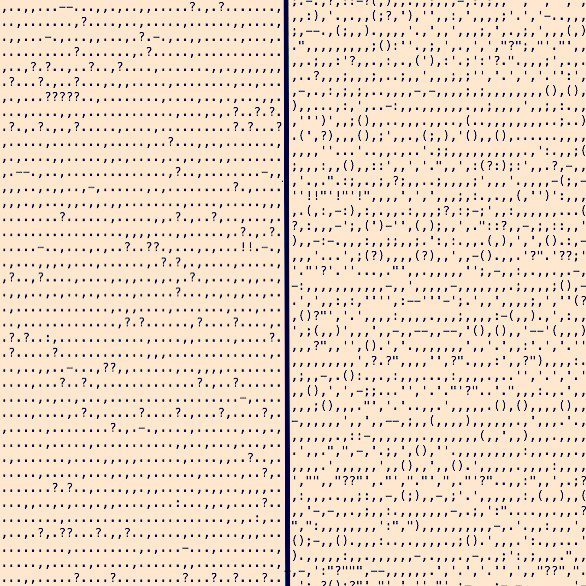
Scrolling through my Facebook newsfeed this morning, I spotted an interesting piece at Medium.com about punctuation in novels — and only the punctuation. In the piece, Adam J. Calhoun talks about writing a computer code (available online for free) that reduces text to its punctuation — and nothing else. The image at the lead of his piece is a side-by-side comparison of two of his favorite books, McCarthy’s Blood Meridian and Faulkner’s Absalom, Absalom!

1q9fyo1sifevktb7a26wbew
Punctuation in Blood Meridian by Cormac McCarthy (left) and in Absalom, Absalom! by William Faulkner (right). Image by Adam J. Calhoun

(Full disclosure: Blood Meridian is also one of my favorite novels, but, though I love Faulkner in general, I couldn’t stand Absalom, Absalom! the first time I read it. It felt like the worst of Faulkner’s self-indulgences. I should probably give it a second chance, but this image of the punctuation, as indicative of what I remember hating about that novel, isn’t encouraging me!)

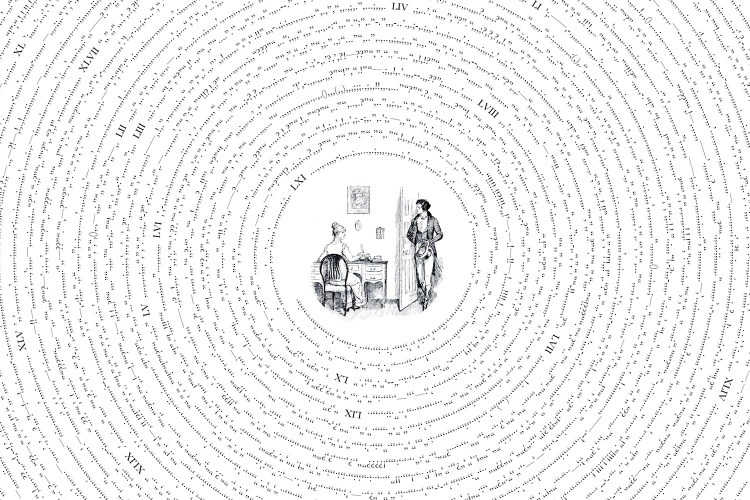
Others have done this, too, and have taken the punctuation-imaging process a beautiful step further by turning the punctuation into graphic art; you can find Nicholas Rougeux’s Between the Words posters for Pride and Prejudice, Moby Dick, Ulysses, and other classics online.

Here’s a close-up on Rougeux’s poster for Pride and Prejudice:

pride-and-prejudice-closeup-large

But Adam J. Calhoun isn’t just interested in the visuals. In his article, he uses the punctuation in novels to talk about the shape and rhythm of the prose. “This morse code is both meaningless and yet so meaningful,” he writes. “We can look and say: brief sentence; description; shorter description; action; action; action. [. . .] Blood Meridian is short sentences. A question or two? Maybe, but then more sentences. And yet Absalom, Absalom! is wild; moreover, one might say, it is statements, within statements, within statements: who doesn’t love that?”

He also looks back at the text and discusses the lengths of sentences, which seems like a slightly different exercise until you think about punctuation’s role in organizing those words and shaping those sentences: “Punctuation does more than simply carve out a space for words. It separates them. Clearly, some authors are more okay with long rambling sentences than others. William Faulkner looks at your short sentences and says nothing less than fuck you.”

And of course, all this made me think about my own work — especially Hagridden, which has generated some discussion among readers and reviewers about its punctuation, particularly the absence of quotation marks. (The novel does contain one pair of quotation marks, in chapter 20, around the title of the song “Hush-a-by baby.”) Whenever people ask me why I left out the quotation marks in my dialogue, I usually quip that I wrote the first draft so fast that punctuation just slowed me down. And that’s true, but this is also true: when I tried adding the quotation marks back in, they got in the way — they seemed to clutter the page and interfere with the kind of storytelling I was trying to do in that book.

Calhoun addresses that in his own analysis of punctuation in books: “The difference between a Hemingway and a McCarthy is the dispensation of quotation marks. When the warm, curling hands of the quotation is gone the reader is left with a broader sense of space.”

I like that, but I find the opposite can be true, too: in the case of Hagridden, I feel that by eliminating the quotation marks and running dialogue into the storytelling, making everything — even the conversations — part of one cohesive narrative, the prose becomes denser, like a thick bayou ground-growth that you have to carefully navigate.

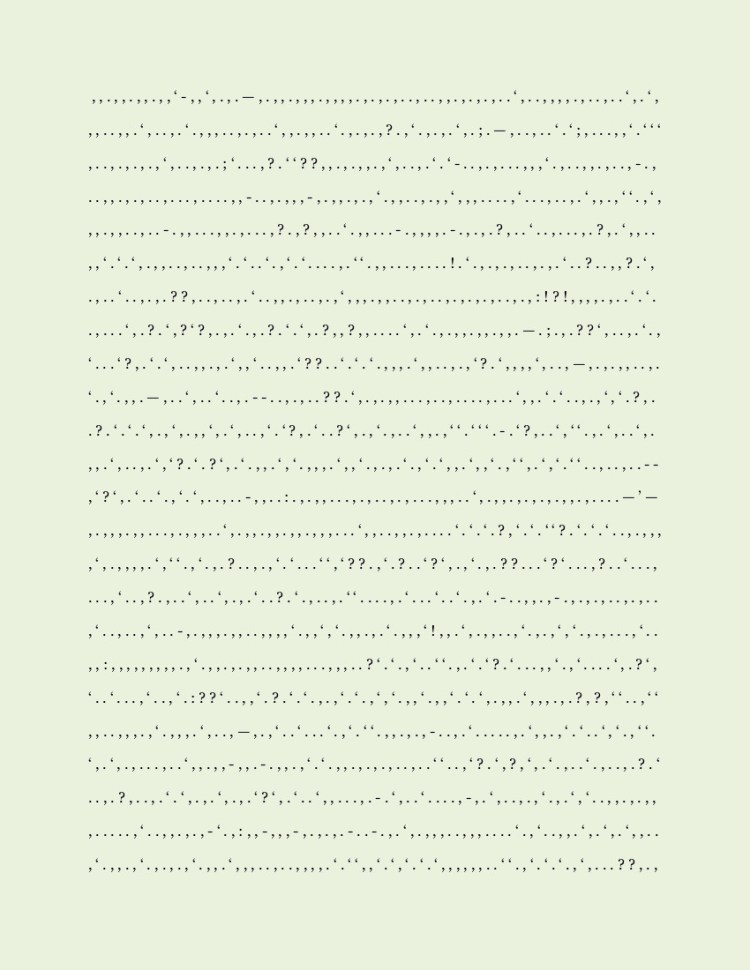
But Calhoun’s work also made me wonder how the other punctuation in my novel helps a reader navigate that text, so I went back to my file and cut out all the words. The results are interesting. In manuscript form, the book is roughly 230 double-space pages (in print, it’s about the same length); cutting out all the words reduces the whole book to five and a half pages.

Here’s the first page of the punctuation-only Hagridden:

Hagridden punctuation

That’s a lot of periods, more question marks than I realized, and fewer em dashes that I was expecting. I’m kind of pleased to see so few exclamation points, though — I once took a summer writing workshop with Texas writer Robert Flynn, who insisted that every writer is allowed one exclamation point per year, so we’d better use it wisely. I knew not to take that literally, but I did take it to heart, and I try as much as possible to convey excitement, surprise, and horror through the language I use, rather than the cheat of the exclamation point. In the 230-some manuscript pages of Hagridden, it turns out I used only 32 exclamation points — about one for every seven pages. Compare that with all the questions people have in this tumultuous period in history: the novel contains 276 question marks, more than one per page.

Calhoun also calls attention to the decline of the semicolon, illustrating in his article a marked drop in semicolons from 19th-century prose to 20th-century prose. I, for one, rather enjoy the semicolon, to the extent that I sometimes think I overuse it — but it turns out Calhoun is right, because Hagridden contains only 13 semicolons. I swore I used more than that, but there you have it. Same goes for the em dash, which I also feel like I overuse; in Hagridden, I used just 27 of them.

Compare those figures with the 3,535 commas and the 3,883 periods in the book.

Most interestingly, Hagridden does not contain even a single pair of parentheses; there are no asides in that book! And I used just one ellipses in the whole book, a single moment in dialogue where a character lets her thoughts trail off, literally afraid to finish her sentence. (It appears in the penultimate chapter, if you’re looking for it.)

So thanks to Adam J. Calhoun for giving me the excuse to revisit my work and look at how I punctuate my words. Of course, the trick now is to forget I ever saw that article and get back to the writing without obsessing over the punctuation; I have a terrible habit of trying to let craft drive the drafting rather than saving it to inform the revisions. Still, good food for thought, and I’ll look forward to paying a different kind of attention to my punctuation in the future.

Quite So: David S. Atkinson talks writing, reading, and his new story collection

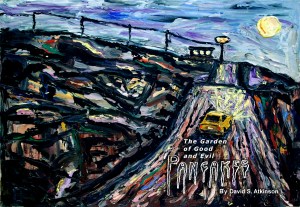
IFLast year at AWP, I bunked up with David S. Atkinson. We guzzled coffee by the gallon and talked books for three days. Of course, I was already a fan: I loved David’s first book, Bones Buried in Dirt, and he and I were both guests on an online reading series at the (now sadly closed) Lit Demon website — David read from his second book, The Garden of Good and Evil Pancakes.

So when I heard he has a new book coming out this year, Not Quite So Stories, I was eager to chat with him about his new work.

David is the author of three books now: Bones Buried in the Dirt (2014 Next Generation Indie Book Awards finalist, First Novel), The Garden of Good and Evil Pancakes (2015 national indie excellence awards finalist in humor), and now Not Quite so Stories (out this March from Literary Wanderlust). He also publishes short fiction widely in print and online. A native of Nebraska, he now lives in Denver where, when he isn’t writing fiction or reading hundreds of books a year, he works as a patent attorney.

Which is where I began our conversation:

Writing is not your day job, but it is a hell of a lot of work — the writing part, for sure, but also sharing it, promoting it. Especially for those of us who work with indie presses and have to do most of the promotion ourselves. What kinds of things do you do to get the word out there about your publications?

Actually, writing is kind of my day job. Working as a patent attorney on the prosecution side of things is a lot like being a high-priced tech writer. It’s definitely not the same as my writing-writing, but it’s still primarily writing.

To get to the actual question though, I do everything I can. I’ve been getting involved with more local readings to get more people familiar with my writing, querying various places that do reviews and interviews, doing book reviews of other books myself, participating in as many social media based writing group interactions as I can, putting out a book trailer, posting updates regularly on various social media pages, and anything else I manage to think of. I think the more one can be involved in any aspect of the writing community, the more people out there are going to hear about you and get curious about your writing.

I also don’t forget to publicly thank people who help in various ways too. Not only do they deserve it, but they tend to want to spread the word when they’ve had a hand in it — like John Domini, Karolyn Sherwood, and Joseph Michael Owens, who helped me work on stories like “G-Men” at a Dzanc workshop day a few years back.

Where do you do your writing?

Anywhere I can. I write sitting in bed a lot, but also plenty of other places. The desk in my office, the bathtub (my story “An Endless Series of Meaningless Miracles” was certainly thought of there), the living room in front of the TV, the bus, the train, riding in cars, my office at work if I get a minute, hotel rooms, Village Inn and other restaurants, anywhere. As busy as life gets, you’ve got to snatch available writing time any place you can.

Bones-Buried-copy

Your first book, Bones Buried in Dirt, is a beautiful testament to early adolescence, a nostalgic journey through a particular kind of American boyhood —

Thank you! I’m not sure there’s a question here, but I’ll take compliments anywhere I can get them.

And your second book, The Garden of Good and Evil Pancakes, “explores the fictions we tell ourselves, and the fictions we tell ourselves about the fictions we tell ourselves.” But this new book seems to address the meaninglessness of mythologies, as though the stories we tell ourselves don’t actually make any difference. Is this new book sort of a progression from the second one? What’s the relationship there?

coverActually, I began Not Quite so Stories before The Garden of Good and Evil Pancakes. I just didn’t finish it until after that book was out. This one was a much longer process. I don’t see this one as necessarily a progression, though I can see a certain unintended relationship. But, I don’t think Not Quite so Stories posits mythologies as meaningless. The core idea was definitely that life is inherently inexplicable, absurd, and that myth as a metaphoric way to explain life is a pointless exercise. We just have to figure out how we’re going to go on in the face of the absurdity of life, and mythologies are one way to deal with that. It’s as valid as most other approaches — whatever helps a person. A private mythology certainly helps Christien in my story “Changes for the Château.” Just the idea that we can ultimately make sense of things is what this book scoffs at. I think The Garden of Good and Evil Pancakes actually takes a pretty similar position, though in a very different way.

NotQuiteSo-72In the write up for Not Quite So Stories, you point out that the title is a play on Rudyard Kipling’s Just So Stories, arguably a children’s book. And I noticed that the book’s trailer opens with storytelling to children. I can’t help but feel like in some ways this is a return to some of the childhood themes you were addressing in your first book. Anything to that?

Definitely. The book’s refutation of the idea that we’re going to be able to explain and make sense of life is advocacy of a return to viewing life with the sense of wonder most of us had in childhood before we got conned by routine into thinking that life was not magical. I don’t think that’s something we should give up in life, and we should struggle to reclaim it when we can, like the character Nan, in my story “The Onion She Carried,” who tries to make life magical again by making her day “an onion day.”

The titles of your last two books are plays on titles of other works. And if I remember right, I think you said that The Garden of Good and Evil Pancakes actually started with that title and the book developed from there. Is that how you tend to work? How do you feel your titles relate to your work?

I like to say that I have no tendencies, no process, but that isn’t really accurate. Each project I begin seems to have a certain set of inherent rules and procedures for how it needs to be pursued. I feel my way around until I get how a project needs to be worked and then go with it.

That being said, I don’t tend to start with a title. It can come at various points along the way and help shape things, certainly in development stages and revision stages. My story “The Boys of Volunteer Fire Two-Twenty-Two-Point-Five (and a Half),” for example, started as a humorous concept. Then I needed a title that reflected that humor. Once that was in place, then I just needed to actually write it, was well into the flow.

The Garden of Good and Evil Pancakes was actually the other way around from what you mentioned above. It started with a misunderstanding of what Donald Antrim’s The Verificationist was going to be about, which I told Joseph Michael Owens about and he told me to go ahead and write that. I decided not to write a title until the very end, and a breakfast play on The Garden of Good and Evil popped into my head, which I hadn’t read at the time (I did later). The title of this new one came fairly early on though. I’d written a few of the stories in various forms by that point, but when the idea of the collection came up, the title Not Quite so Stories pretty much went along with it.

You’ve blogged before about the quantity of books you read, and I remember a recent interview of you with Jen Knox where you said you read literally hundreds of books in the past year. I know a lot of those are shorter works like chapbooks, but that’s still a hell of a lot of reading. I tend to be a slow reader anyway, but I have found that lately, it’s harder and harder to squeeze in quality reading time. How do you manage to read so many books?

Yeah, I read books of a variety of different lengths. Some of them are as short as chapbooks, but most tend to be around two hundred pages or so. Two to three hundred books a year tends to be about 50,000-80,000 pages a year, according to the tracker on Goodreads. Most of how I get so much reading time is that’s most of what I do when I’m not writing or working, and I’m pretty much writing or working when I’m not reading. My wife and I went to a resort in Mexico recently and when we sat on the beach, I read on the beach. I carried a book pretty much everywhere on that vacation. In fact, I probably read to the expense of writing sometimes. I really should write a little more and read a little less.

This reminds me of articles I’ve been seeing around lately about the difference between fast reading and slow reading. Are there books you read faster than others? I know in my case — and these are all books I love — I took forever to get through Dostoyevsky’s House of the Dead and Danielewski’s House of Leaves. Austen’s Sense and Sensibility took me three months to finish (it really drags in the middle!). What’s the book that took you the longest to read, respective to its length?

House of Leaves took me about three days to read. The thing that took the longest was turning the book around to be able to keep reading, and occasionally having to go to a mirror and things like that. Sense and Sensibility took me about five days (I agree it drags in the middle). Of course, the only reason I know this is the Goodreads tracker. I wouldn’t remember otherwise, which means I’m not sure what book would have taken me the longest with respect to its length. Some books definitely take more time than their pages suggest (like Tibor Fischer’s Under the Frog), and some the reverse (like Adam Levin’s The Instructions). I know War and Peace and In Search of Lost Time both took me years to complete because I kept starting them and then stopped. However, War and Peace only took about a week and In Search of Lost Time about a month and a half (for all seven books) once I got into the run on each where I finally read each straight through.

What’s the relationship, for you, between your reading and your writing?

I think there’s an interactive relationship between almost everything in my life and my writing. My story “Context Driven” was influenced by a laugh my wife had at me when I mistakenly tried to use my key to unlock a Camry that was the same year and color as my Corolla. “Domestic Ties” goes back to a Saturday Night Live sketch from the ‘70s. Reading is certainly no exception. I read because I like reading and enjoy it, but I’m always absorbing. I’d written a few stories in this collection, but wasn’t sure what I was doing or what I’d end up doing with them. Then I happened across books like The Nimrod Flipout, Museum of the Weird, The Elephant Vanishes, and The Girl in the Flammable Skirt. The origins of the book concept started to grow from there.

You’ve read prose at poetry events before. I keep getting invited to do that, too, which is cool — I might be one of the world’s worst poets, but for some reason, I’ve been allowed to slip past the velvet ropes and hang with poets. How does that play for you? What’s your relationship with poetry?

Most of the poetry events I’ve read prose at have been very welcoming. The poets there have tended to be some pretty cool people, so maybe it’s that. I tend to go with my flash pieces there, which are usually received well. Flash seems to have a certain kinship with prose poems though, so maybe it’s just close enough. I’ve written a poem or two before, or tried, but I simply haven’t devoted the kind of study and time that I have to my prose. I’m more of an amateur at poetry than I am at skydiving (which I did once, tandem). Still, I read at least a few books of poetry a year. Maybe ten to twenty on average. I like to listen to poetry as well, I’ve got a few poetry reading CDs in my music library, and I interact with a number of poets on a regular basis. There’s so much prose people can pick up from poets, so it’s a good use of time even beyond simply being enjoyable.

I feel like I ought to ask you some kind of clever wrap-up question, but really, I just want to plug the book! When’s the release date, and where can people grab a copy? Also, any events coming up where folks can catch you live?

Thanks! The release date is March 1, 2016. So far, it’ll be available at Amazon (though a few third party sellers insist it is available now, it isn’t and they’ll just cancel any orders once they realize that) and at Smashwords.

I’m planning on trying to read at the open mic portions of some of the upcoming Fbomb Flash Fiction Reading Series at the Mercury Café in Denver (February 16th, March 15th, April 19th, May 17th, and June 21st) and I’ll be a featured reader at the one on July 19th (The 2nd Annual Flash Fiction Festival). I’ll also be reading at an event Stephen Dunn is putting on at Still Cellars in Longmont, CO (readers include Dana Green, Angela Buck, Steven Dunn, me, Khadijah Queen, and Katie Jean Shinkle).


david

Many thanks to David for the cool conversation! You can find out more about him and his writing at his website, and again, you can buy all his books online from the bookstore of your choice, or you can click the links on his website’s publications page.

Happy reading, gang!

Writing news

It’s been a busy several weeks, gang, which is why I’ve been relatively quiet lately. But a few cool things have happened since I last updated, and there are some more cool things coming soon:

We’ve had not one but TWO issues of Jersey Devil Press go live: the special Sherlock Holmes issue (the cover of which I made myself) and the February issue, which boasts a beautiful Buzz Siler painting on the cover.


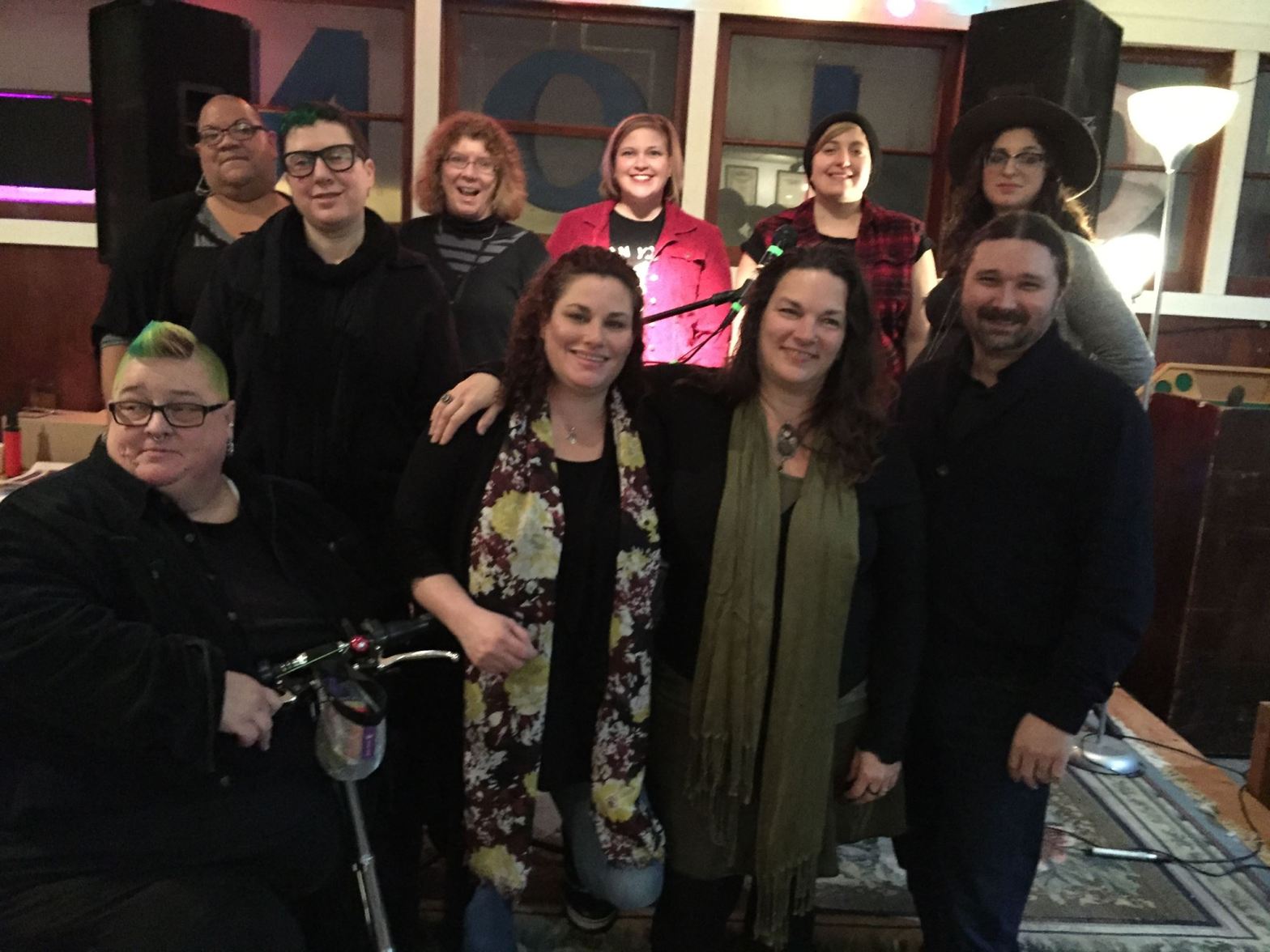
Earlier this month, I read as part of the excellent line-up for the Grief Rites series here in Portland. The theme for the February reading was “Love Letters,” so of course I read the love letter in Hagridden. (Thanks to event organizer Melissa Dodson for inviting me, and to author Corie Skolnick for snapping these photos.)


I’ve booked a room and a flight to LA for this year’s AWP. I’ll be participating in at least one reading and am looking into putting together another, but if you know of any readings I should attend or get invited to, leave a comment! Also, look for me in the bookfair — I’ll have copies of Hagridden and Box Cutters if you’re looking for my books.

Also check out Blue Skirt Productions at bookfair table 675, because their books are totally awesome — they even have adult coloring books!


Speaking of Blue Skirt: I am thrilled to announce that they will be publishing my novella later this year! I’m still in the editing phase (which is another reason I’ve been away from the blog lately), but stay tuned over the next several months for news on that new book.

But wait, there’s more! As I announced a while ago here on the blog, I also have a new chapbook coming out later this year from Red Bird Chapbooks. They’ve recently posted their whole 2016 line-up, and there are some exciting titles and authors on that list, including three with connections to my old grad program at the University of North Texas: a first book of a poetry by my classmate and friend Bethany Lee; a fiction collection by Kelly Magee, whose earlier book, Body Language, I helped select for the Katherine Anne Porter Prize in Short Fiction back when I was in grad school; and a nonfiction book by new friend Gwendolyn Edward, who is a recent alum of UNT’s creative writing program. There’s clearly a lot of great work associated with UNT, gang!


And I’m not the only one with books coming out. Earlier this month, my friend Michelle Modesto released her first book, Revenge and the Wild, from HarperCollins imprint Balzer + Bray. And earlier this week, my friend Mo Daviau released her debut novel, Every Anxious Wave, from St. Martins.

And first thing next month, novelist and friend Monica Drake will release her first story collection, The Folly of Loving Life, from FutureTense Books — but you don’t have to wait til March! You can pre-order a copy at a (for now) discounted price! Go here for details.


And they’re still not the only people with books I’m excited about!

My friend David S. Atkinson has a new book out next month, too — Not Quite So Stories — and I’ll be interviewing him about it here on the blog.

And Gay Degani, whose new book Rattle of Want I was thrilled to blurb, is on the blog tour circuit at the moment, and I’ll be interviewing her as well.

You might already know David and Gay, by the way — about 18 months ago, they each interviewed me about Hagridden — you can find my old chat with David here, and my old chat with Gay is here. And then stay tuned for my new conversations with them about their work!


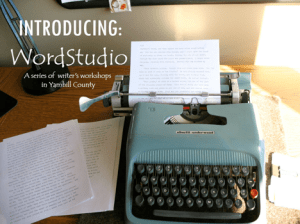
And finally, I’ve updated my events page to include a couple of upcoming readings and workshops. That’s right — I said workshops! In April, I’ll be conducting a short seminar/workshop at the Terroir Creative Writing Festival; you can register for the festival here.

Screen Shot 2016-02-12 at 3.32.14 PM

wordstudioAnd then for four weeks in May and June, I’ll be leading an intensive workshop on historical fiction as part of Terroir’s new WordStudio workshop series. The ongoing series of inexpensive workshops will include classes in poetry, nonfiction, fiction — the first one is about blogging! Check out the Terroir WordStudio site for more information and cost and registration.

2015 is a year of kickass women

I’ve been cleaning up my study this week, shelving stacks of books and bagging issues of comics, and as I’ve been working, I’ve noticed something:

This year has given us a lot of amazing women in art to celebrate. Films, comics, books, television — women are kicking ass.

furiosa-madmax-650-1Two of my hands-down favorite films this year were Mad Max: Fury Road and Star Wars: The Force Awakens. Each included an absolute badass woman lead, an action heroine who was also a fully rounded human being and the center of the film she helmed. Charlize Theron so dominated her film — and it was Furiosa’s film through and through — that I usually refuse to refer to it as anything but Fury Road, dropping Max from the title altogether.

And (no spoilers here, really), Rey is such a force to reckon with in the new Star Wars movie that the old guard from the original trilogy are basically supporting characters, circling this new, amazing young woman. Daisy Ridley puts in a hell of a performance and absolutely owns the scenes she’s in, but more importantly, her character is skilled, intelligent, and fierce but also has a full range of emotions and a believable character arc. (Yes, there’s some discussion of her being a “Mary Sue,” a term I’ve only just learned this week, but I won’t brook any such complaints here. See the recent io9 article on the subject if you want it put to rest.)

migxn7dlaywfhnohl1gl

And women aren’t just kicking ass on film. I’ve recently started collecting serial comics again, and three of my favorite comic book series this year are all woman-centric, and all three are woman reboots of traditionally male characters.

prez-1I’ve been loving Mark Russell’s Prez, and while the wit and and satire throughout the series have been spot-on (and sometimes eerily prescient), Beth Ross, a teenaged girl at the helm of the nation, is the smartest, savviest, and most humane character in the whole series. That comes as no surprise since it’s her series, but it’s breathtaking to see on the page — and it’s worth noting that in the original Prez series from the ’70s, the character was a boy. None of that patriarchy in the Year of Women!

I’ve also become hooked on Spider-Gwen, which I picked up as a curiosity but have been totally charmed by. There’s a lot of gimmickry in the series, with its multiverse in-jokes about the fates of long-established characters in this alternate reality, and personally, I’m not thrilled with the way they’ve turned MJ into a vapid fame-hungry narcissist. But the character of Gwen is beautifully rendered, a believable image of a young woman thrust into heroism before she was ready for it, with some of the same problems that Peter Parker faced when he first became Spider-Man but also with a whole range of new issues that feel unique to Gwen and her competing roles in her new life. It’s an interesting book that seems to be successfully outliving its function as just another experiment in the Spiderverse, and I’m enjoying the story direction.

Thor issue 5 from Marvel ComicsAnd then there is the big powerhouse herself, the Goddess of Thunder, Thor. She caused quite an uproar both in our world and in hers, in our newspapers and within her own Asgardian world, when a woman took up Thor’s hammer and became Thor herself. One of my favorite moments in the whole series was when the old Thor, who has renamed himself Odinson, conceded that she was now Thor, because whoever wields the hammer wields the name. The new Thor is powerful yet conveys some wonderfully human doubts, and, as drawn, she is feminine without being sexualized, and her appearance expresses enormous strength without resorting to an overmuscled, “masculinized” form. There are also some fabulous feminist assertions in the series on behalf of several characters, and it’s as strong a female heroine as I’ve ever seen in a comic book.

I also bought the first collected volume of Bitch Planet, which looks and sounds an awful lot like sexploitation but is in fact brilliantly subversive in its feminism. “Think Margaret Atwood meets Inglourious Basterds,” the website says, and that’s about as awesome a line of praise as I could imagine. And, most importantly, the series is written by a woman. It’s an important series, I think, and one I’ll be keeping an eye on!

Speaking of women writers: several of my favorite books this year have also been by women, including Portland’s own Margaret Malone (People Like You) and Lydia Yuknavitch (The Small Backs of Children). Both women have written books primarily about women and womanhood, and the results are powerful, assertive, sometimes funny and sometimes brutally violent, yet also beautiful, illuminating.

In fact, as in years past, my reading list this year has been dominated by brilliant women writers, including Ellen Urbani (Landfall), Sally K. Lehman (In the Fat), Gwen Beatty (Kill Us On the Way Home), Gay Degani (Rattle of Want), Linda Barry (Syllabus), and the ever-present Jane Austen (this year, I read Emma and reread Sanditon — and speaking of Jane, I’m genuinely interested in seeing the film version of the fun but silly novel Pride and Prejudice and Zombies, because that’s how relevant Jane manages to remain).

agent-carter-768On television, my wife and I both became immediate fans of Agent Carter (we eagerly await her return next year!), and our favorite characters on The Librarians are the two women, one of them a genius and the other a kickass soldier. I also let myself get sucked into Supergirl in spite of myself. It’s ridiculously silly, all comic book colors and camp, but it tries (not always successfully) to present a feminist message, and the lead actress is utterly charming. She also does a great job of conveying uncertainty in her own power but also “Super” ferocity in defense of her city, her friends, and herself. (I’ve not seen Jessica Jones because I don’t have Netflix, but I hear it is amazing and the perfect example of the superheroine we all need. Supergirl’s got some womanning-up to do!)

outlander-the-story-continues-key-artMy wife and I also became immediate fans of the tv series Outlander. (My wife is reading the novels now; I hope to pick them up soon.) The series, like the books, is ostensibly a period romance, but it’s brilliantly subversive within its genre, not only bending the genre with elements of time travel but also upending many romance tropes, especially in the bedroom, where Claire is an experienced and commanding lover, and on the battlefield, where Claire — a former wartime nurse — is equally commanding and competent but also suffers from the same PTSD as her male comrades-in-arms. The complexity of the roles throughout the series is admirable, but it’s especially thrilling to see such a strong, complex woman at the center of the show.

Of course, we’ve always had these women in our arts. Notice I titled this post “a year of kickass women” — one among many. But for some reason, the importance and blockbuster appeal of strong, intelligent, complex women is feeling more prominent this year, and with some eagerly awaited books, films, and comics on the horizon, it looks like we’ve got some momentum for more equal — and more exciting — representation in our popular arts. And that’s thrilling.

Your 2015 holiday shopping list: books, books, and books!

It’s been a great year for books, y’all. And now that the crunch is on for gift-giving season, I wanted to share some books published in the past year by friends of mine! There is a LOT to love here — poetry, prose, anthologies, even a few adult coloring books! So I’ve included some blurbs or endorsements so you know what you’re getting into, and I’ve sorted the whole list by something like genre, as well as a couple of sections for particularly prolific publishers I love.

Click the links to zip down to the kinds of books you’re looking for, or just scroll through and buy one or two of everything.

I’ve even included a few books scheduled for publication early next year — they’re on pre-order now, so get in early and snap those up, too!

Poetry  |  Anthologies & hybrid collections | Novels & collections  |  Memoir  |  Young Adult

Blue Skirt Press  |  sunnyoutside press

Coming in 2016!


Poetry

How To Be An American, by Ally Malinenko

The poems in How to Be an American strike the chords of conversations we should be having, should have already had and resolved, or conversations that should be irrelevant. In this generation’s remake of democracy, Malinenko’s book is an incendiary device.

— Jason Baldinger, author of The Lower Forty-Eight

Confluence, Sandy Marchetti

Marchetti’s debut collection, Confluence, delivers taut, emotionally-charged poems that never cease to surprise. These poems are unified and purposeful, but are also dynamic and nuanced. Marchetti knows just when to shift gears, to spring a surprise on her readers, so that reading Confluence becomes an enthralling, epic journey, while also musing about the merging between large and small, real and imaginary, nature and urban, lover and beloved.

— review by Michelle Donahue in The Rumpus

Hive, by Christina Stoddard

Hive is a remarkable debut collection of poems about brutality, exaltation, rebellion, and allegiance. Written in the voice of a teenage Mormon girl, these poems chronicle an inheritance of daily violence and closely guarded secrets. A conflicting cast of recurring characters — best friends, sisters, serial killers, and the ominous Elders — move through these poems as the speaker begins to struggle with the widening gulf between her impulse toward faith and her growing doubts about the people who claim to know God’s will. Ultimately she must confront what it means to believe and what it costs to save ourselves.

Last to Leave, by Christie Grimes

In Last to Leave, Christie Grimes two-steps through the heat and seasoning of Texas and embraces rural northern New York in poems that sweat and chuckle, question and speak of resolve. These poems are familiar with salsa and barrooms, classrooms, and warm kitchens. These are rites of passage painted in language lush with flavor and craft.

— Georgia A. Popoff, author of Psalter: The Agnostic’s Book of Common Curiosities

The Existentialist Cookbook, by Shawnte Orion

In his debut collection, The Existentialist Cookbook, Shawnte Orion sifts through the absurdity of modern living for scraps of philosophy, religion, and mathematics to blend into recipes for elegies and celebrations. From Kurosawa films to “Project Runway,” writers to rock stars, influences are embraced and wrestled as Orion magnifies mortality through the prism of chronology and humor.


Anthologies & hybrid collections

The Part Time Shaman Handbook: An Introduction for Beginners, by Michael Gillan Maxwell

Part-Time Shaman Handbook blasts us back to childhood with peyote force of recognition, strips us of stagnant, uniform blinders that have “adulated” us. Don’t leave home without it!

— Meg Tuite, Bound By Blue

Bear the Pall, edited by Sally K. Lehman

How to sing a song of remembrance when our voice is gone in grief? What is the weight of a life when that life is gone — and how do we bear that weight? In love and sorrow and joy, in celebration and confusion and contemplation, the authors and poets in this slim but beautiful book have crafted a touching tribute to parenthood, a eulogy for fathers and mothers everywhere.

— Samuel Snoek-Brown, author Hagridden (that’s right — I blurbed this book!)


Novels & Story collections

America’s Most Eligible, by Corie Skolnick

America’s Most Eligible is a hilarious romp about an ambitious young woman who has come of age in the pretentious world of Southern California. With great humor, Corie Skolnick satirizes “the bad tweed set” of literary academia along with the self-important characters of Hollywood, journalism, self-help Psychology, politics, and especially traditional commercial publishing even as the latter languishes in the throes of death at its own hands.

Find more of Corie’s work at Broadway Books in Portland or online.

Spirits, by Todd McNamee

Spirits is a compelling novel about a man with psychic abilities that have been enhanced by the government. Over time Sean’s gift has become a curse due to a combination of the constant barrage of telepathically hearing the multitude of people around him every day and the horrific things his government requests of him. The novel begins with Sean’s profound struggle with alcoholism and regrets for the things he has done. He is contacted by a group who inform him that they need his help to fight a coming evil, a rogue agent with his same powers who is not afraid to use them to create his own army of mind slaves. Sean acquires other allies along the way, including a ghost and a coven of witches. But it all depends on whether he can hold it together long enough to save the world.

Find more of Todd’s work at foxflame.net.

Your Little Red Book, EJ Runyon

Two voices.  Alexis in the unconscious second person style scribbles, sketches, and keeps notes; like she’s tracing out someone else’s story. Maureen, just doing the best being honest with herself about the women in her life.  Alexis, a broke young artist with problems reading and writing, keeps her little red book close at all times. It holds her life. She wants to be sure she’s gotten it all down as it comes. She narrates to herself in illegible script, unaware of her unique style of recording her own world. Here we have one half of a She said/She said scenario. Maureen, a successful owner of a small chain of Art Supply stores, catches Alexis in her store with a pocket full of stolen tubes of paint. And she’s smitten from first glance. Knowing all too well the pitfalls ahead, Mo wants only to help. Only for a while. Only in any way she can. No one told her she’d have to fight nearly every step of the way. And therein lays the other half of said scenario.

You can find more of E.J’s books at her website

Rattle of Want, by Gay Degani

The stories in this book are a masterclass in narrative craftsmanship. From the brief sparks of her microfiction to the meditations of her long stories to the tapestry of her novella-in-flash, Degani displays a mastery for calling forth human characters and conjuring whole lives out of meticulously wrought images and moments. Rattle of Want is a beautiful, smart collection.

— Samuel Snoek-Brown, author of Box Cutters and Hagridden (I blurbed Gay’s book, too!)

Killer &VictimChristopher JH Lambert

Alexander, the first crowd-sourced city, has come to rival NYC as the premier metropolis in America. It’s known as The Paradise City, the first step of a new era. But tonight: A haunting art performance. A killer’s quest for redemption. And a photo shoot in a field set aflame. These plant in Alexander seeds of chaos that, when they blossom, will see paradise tearing itself apart.

Landfall, Ellen Urbani

Ellen Urbani’s story of Katrina and its aftermath is an important part of America’s modern mythology, a chronicle of one of our greatest national trials. But Urbani’s characters reach beyond mythology: two rich and complex young women, two troubled and heartbreaking older women, whose separate journeys and literal collision are unique yet timeless. Landfall is a mirror in the floodwaters, showing us our own distorted faces in the murk and mayhem of our recent past.

— Samuel Snoek-Brown, author of Hagridden (yep — I blurbed Ellen’s book, too)

The Small Backs of Children, Lidia Yuknavitch

A fierce, provocative, and deeply affecting novel of both ideas and action that blends the tight construction of Julian Barnes’s The Sense of an Ending with the emotional power of Anthony Marra’s A Constellation of Vital Phenomena, Lidia Yuknavitch’s The Small Backs of Children is a major step forward from one of our most avidly watched writers.

In the Fat, by Sally K. Lehman

The voice of In the Fat‘s narrator, Sky, feels sometimes adult and sometimes childlike and is the perfect rendition of a young woman in transition — a forced transition — from girlhood to womanhood. This novel is a hard, honest look at mothers and daughters, sexuality and psychology, fear and friendship. Lehman has written a powerful book about a whole range of difficult subjects filtered through the mind and voice of a strong young character.

— Samuel Snoek-Brown, author of Hagridden (I blurbed this book, too!)

The Animals, Christian Kiefer

Bill Reed manages a wildlife sanctuary in rural Idaho, caring for injured animals — raptors, a wolf, and his beloved bear, Majer, among them — that are unable to survive in the wild. Seemingly rid of his troubled past, Bill hopes to marry the local veterinarian and live a quiet life together, the promise of which is threatened when a childhood friend is released from prison. Suddenly forced to confront the secrets of his criminal youth, Bill battles fiercely to preserve the shelter that protects these wounded animals and to keep hidden his turbulent, even dangerous, history. Alternating between past and present, Christian Kiefer contrasts the wreckage of Bill’s crime-ridden years in Reno, Nevada, with the elusive promise of a peaceful future. In finely sculpted prose imaginatively at odds with the harsh, volatile world Kiefer evokes, The Animals builds powerfully toward the revelation of Bill’s defining betrayal — and the drastic lengths Bill goes to in order to escape the consequences.

The Pulse Between Dimensions and the Desert, Rios de la Luz

Rios de la Luz’s writing blows minds and breaks hearts. A sort of new and bizarre Tomás Rivera, Rios is able to blend the familiar of the domestic with all the wilderness of the universe. Her stories will grab you in places you didn’t know you had, take you by those places to where you’ve always wanted to go — though you never knew how to get there. Buy this book and enjoy that journey.”

— Brian Allen Carr

People Like You, by Margaret Malone

Malone’s writing could be seen as a close cousin to the work of Tom Drury, Mary Robison, or Denis Johnson — stories that casually draw you in and leave you wanting more. People Like You feels like being let in on a secret that won’t stay secret for long.

— Joshua James Amberson, The Portland Mercury

Kill Us On the Way Home, by Gwen Beatty

Six short stories of where and how life moves ever forward, with or without the person living it. Birds and amputees and hot dog vendors go in circles. The cars all still run but can’t seem to leave town. Beatty pulls gum from under the park bench and you chew for what seems like forever before finally swallowing, the thing stuck between your ribs like your mother always warned you it would.

The Sorrow Proper, by Lindsey Drager

The Sorrow Proper is a novel-length investigation of the anxiety that accompanies change. A group of aging librarians must decide whether to fight or flee from the end of print and the rise of electronic publications, while the parents of the young girl who died in front of the library struggle with their role in her loss. Anchored by the transposed stories of a photographer and his deaf mathematician lover each mourning the other’s death, The Sorrow Proper attempts to illustrate how humans of all relations — lovers, parents, colleagues — cope with and challenge social “progress,” a mechanism that requires we ignore, and ultimately forget, the residual in order to make room for the new, to tell a story that resists “The End.”

I’d Walk With My Friends If I Could Find Them, by Jesse Goolsby

Wintric Ellis joins the army as soon as he graduates from high school, saying goodbye to his girlfriend, Kristen, and to the backwoods California town whose borders have always been the limits of his horizon. Deployed in Afghanistan two years into a directionless war, he struggles to find his bearings in a place where allies could at any second turn out to be foes. Two career soldiers, Dax and Torres, take Wintric under their wing. Together, these three men face an impossible choice: risk death or commit a harrowing act of war. The aftershocks echo long after each returns home to a transfigured world, where his own children may fear to touch him and his nightmares still hold sway.

Jesse Goolsby casts backward and forward in time to track these unforgettable characters from childhood to parenthood, from redwood forests to open desert roads to the streets of Kabul. Hailed by Robert Olen Butler as a “major literary event,” I’d Walk with My Friends If I Could Find Them is a work of disarming eloquence and heart-wrenching wisdom, and a debut novel from a writer to watch.

The O’Henry Prize Stories 2015 (includes “The History of Happiness” by Brenda Peynado)


Memoir

My Unsentimental Education, by Debra Monroe

A misfit in Spooner, Wisconsin with its farms, bars, and strip joints, Debra Monroe leaves to earn a degree, then another, another, and builds a career — if only because her plans to be a Midwestern housewife continually get scuttled. Fearless but naive, she vaults over class barriers, but never quite leaves her past behind. When it comes to men, she’s still blue-collar. Negotiating the world of dating, Monroe pays careful attention to what love and sex mean to a woman ambivalent about her newfound status as “liberated.”

An Unsuitable Princess, by Jane Rosenberg LaForge

In An Unsuitable Princess, Jane Rosenberg LaForge, a Los Angeles native, combines imaginative narrative and personal memoir to show how her own coming-of-age was warped by her hometown’s peculiarities, particularly the constant, confusing mashup of glittering fantasy with the complex urban reality that, ironically, provides the fantasy with vital context and support.

review by Diane Josefowicz in Necessary Fiction


Young adult

Silverwood, by Betsy Streeter

A story of finding where you belong, even if it involves time travel, shape shifting, and hacking. Helen Silverwood, fourteen, is sick of life on the run with her mom and her younger brother. Nothing makes sense. She doesn’t understand why she has recurring dreams of shape-shifting creatures, why her mother is always disappearing, and how her brother can draw things that haven’t happened yet. Most of all, Helen longs to know what happened to her dad is he imprisoned, a fugitive, or gone forever? When someone blows up the apartment where Helen lives, the stories of the ancient Silverwood clan and her role in it begin to unravel. All Helen wants is to feel like there is someplace she belongs but getting there will prove very, very complicated.

When Stars Die: The Stars Trilogy, by Amber Skye Forbes

Amelia Gareth’s brother is a witch and the only way to save her family from the taint in his blood is to become a professed nun at Cathedral Reims in the snowy city of Malva. [. . .] Now Amelia must decide what to do: should she continue on her path to profession knowing there is no redemption, or should she give up on her dream and turn away from Cathedral Reims in order to stop the shadows who plan to destroy everything she loves?

Shadowgirl, Kate Ristau

Shadowgirl tells the story of fairy teen Aine, who is haunted by a fiery dream, where her mother loses her mind and her father makes a devastating choice. Áine escapes into the Shadowlands to discover the secrets of her family and her past. But the moment her foot crosses the threshold, Áine is thrust into a war that has been raging for centuries. Guardians, fire fey, and a rising darkness threaten the light, and Áine must learn to fight in the shadows — or die in the flames.


Blue Skirt Press (currently offering special deals, including a coloring book package!)

Women: Heart & Whimsy, by MaryElizabeth Mono

Explores the feminine with an uplifting sensuality that invites the observer to look deeper. This book contains 20 original images to color.

Nightmarish Dreams, by Chris Bonney

This book contains 21 original 8 by 10 images to color. Chris Bonney’s artwork has been described as a cross between Tim Burton and Dr. Seuss.

Broken Parts, by Gayle Towell

Jake Smith, a book smart loner hiding in a dead-end welding job, is thrown for a loop when his fifteen-year-old brother Ben shows up on his doorstep after outing their father for molestation. During Dad’s trial it comes to light that not only was Jake also abused, but he turned a blind eye for years as it happened to his brother. But with Dad in jail and Mom insistent that Ben is lying, Ben is forced to rely on Jake even if he can’t forgive him, and Jake is forced to step up and care for his brother despite struggling with his own trauma and brutal flashbacks.

The Shepherd’s Journals, by Drew Andrews

Constantly seeking God in both the everyday and the esoteric, an obsessive and conflicted prophet known only as the Shepherd lives out his salvation under streetlights, in grand visions, and in the arms of others. These journals chronicle his experience as he struggles with divine calling and human need. The Shepherd’s Journals is part poetic love letter, part prayer, and part feral howl against modern living. Its musical rhythm pulls readers in and guides them through an uneasy, spring-tension urban landscape.

The Butch/Femme Photo Project, by Wendi Kali

There are many identities within the LGBTQI community. Among these are butch and femme. Both of these identities date back to the beginning of the 20th century and are a part of the lesbian and bisexual subculture. Both have taken on many definitions. In this collection of photographs, people from across the United States and Canada who claim these identities today share their own definitions and describe how they express themselves uniquely.


sunnyoutside press

Songs & Yes, by MRB Chelko (poetry)

Scattered Trees Grow in Some Tundra, by Cheryl Quimba (poetry)

Lot Boy, by Greg Shemkovitz (novel)


Coming in 2016!

Revenge and the Wild, by Michelle Modesto (YA)

The two-bit town of Rogue City is a lawless place, full of dark magic and saloon brawls, monsters and six-shooters. But it’s just perfect for seventeen-year-old Westie, the notorious adopted daughter of local inventor Nigel Butler.

Westie was only a child when she lost her arm and her family to cannibals on the wagon trail. Seven years later, Westie may seem fearsome with her foul-mouthed tough exterior and the powerful mechanical arm built for her by Nigel, but the memory of her past still haunts her. She’s determined to make the killers pay for their crimes—and there’s nothing to stop her except her own reckless ways.

Every Anxious Wave, by Mo Daviau

A high-spirited and engaging novel, Every Anxious Wave plays ball with the big questions of where we would go and who we would become if we could rewrite our pasts, as well as how to hold on to love across time.

The Folly of Loving Life, by Monica Drake

Following her acclaimed novels Clown Girl and The Stud Book, Monica Drake presents her long-awaited first collection of stories. The Folly of Loving Life features linked stories examining an array of characters at their most vulnerable and human, often escaping to somewhere or trying to find stability in their own place. These stories display the best of what we love about Monica’s writing — the sly laugh-out-loud humor, the sharp observations, the flawed but strong characters, and the shadowy Van Sant-ish Portland settings.

My mother, my teacher

Julie-Snoek-150
Julie Snoek

I just learned that my mother, a retired teacher with a 35-year career in elementary and middle-school classrooms, was a guest on Episode 14 of The Teaching Experience Podcast!


In the interview, my mom talks about her lifelong love of teaching and learning, her devotion to teaching each student according to the context of that student’s life and abilities, her near-burnout under the strain of political rather than pedagogical demands placed on teachers but also her reinvigoration through empowering her students in the classroom.

I grew up in the midst of all of this, helping my mom prepare her classrooms each year and helping her mimeograph (remember those?) assignments and using her teaching materials to play “school” with my stuffed animals and my siblings, and later visiting my mom’s classroom as a guest and watching her work with her students. I’ve learned my teaching styles from a long succession of my own former teachers, but I learned first and most from my mother, and, most crucially, she taught me how to learn about teaching by observing teachers.

Today, I teach college, not elementary school, and I’ve only been at it half as long as my mother was. But a lot of my attitudes and practices in the classroom come from her: my enthusiasm for the profession even in the face of sometimes overwhelming extracurricular demands, my desire to listen and to reach each student on that student’s terms, my insistence on empowering students to take command of their own learning, my love of learning about learning and my love of sharing the whole educational experience with students.

I have always been proud to follow in my mother’s footsteps. But whenever I see my mother getting long-deserved recognition for her career, I fill to bursting.

Thanks, Mom.

And thanks, too — as we wrap up the fall and head into our long winter naps — to all the teachers everywhere for the hard, hard work you do and for the inspiration you provide.


Setting aside Chekhov’s gun

I love Anton Chekhov. His sense of story rooted in character and culture has long held me spellbound, and I hold him as an unreachable ideal for what the best of short fiction can look like. He also had some terrific writing advice, probably the most famous of which was in favor of necessity in the details:

“Remove everything that has no relevance to the story,” Chekhov said in a whole range of ways in letters, essays, and interviews. It’s good advice, but on its face, it’s not very sexy, which is why it’s more well known for the example he gives:

“If you say in the first chapter that there is a rifle hanging on the wall, in the second or third chapter it absolutely must go off.”

We call that rule “Chekhov’s Gun.”

But a lot of the time, when we see it, we stop right there. When we encounter a beginning writer who’s never heard the rule, we feed them the line about the rifle. A forcefulness and a conspiratorial giddiness enters our voice, and we tend to emphasize the action that follows: “It must go off.” We are grateful for the permission, and we can’t wait for that gun to go off.

We invite violence into our fiction.

We have good reasons for doing so. As I’ve written before, good fiction depends on conflict, and violence is conflict made manifest in the loudest, most unsettling ways. Violence is a part of the world we write and it is a necessary and important part of great fiction. It’s also an easy and useful means by which to arrest our readers’ attention.

But it’s not the only way, and when we succumb to the temptation of easy violence in fiction, we are ignoring the rest of Chekhov’s advice:

“If [the rifle is] not going to be fired, it shouldn’t be hanging there.”

These past couple of years, I had been drafting a violent novel absolutely chock full of guns. I name the guns; I describe their actions, their ammunition, their weight and smell. Some of the characters practically fetishize the guns. That obsession with firearms and violence is necessary, because the story is set during the Reconstruction, that turbulent and bloody aftermath to the US Civil War. And the violence isn’t invented for the sake of a good story — much of the surface narrative of that novel is rooted in various historical events that occurred in the borderlands between Texas, Arkansas, and what was then Indian Territory.

I’ve written before about how I drafted most of the novel and then threw it out because the voice wasn’t right. Last year, I started over and made fast progress, up to a point; over the summer, I took that novel to the Sewanee Writers’ Conference and found my direction in the book, and when I came back to my home desk, I made more progress on the book.

And then I stopped.

I was wrestling with how to write a novel about men who glorify and revel in warfare and gunplay without seeming to glorify and revel in that violence myself, and I was beginning, too, to wonder what my book might have to say about a long-ago war when we are beset by war today. I think there are plenty of things to say — it’s why I wrote Hagridden — but I wasn’t sure anymore what this book was saying.

Eventually, I got out of my head found my way back to the story, but before I could start writing again, a sick man went on a self-righteous shooting rampage in my own state of Oregon. I grieved with my students, I shared words at candlelight vigils, and by the time I returned to my novel, I found I no longer had the same interest in writing about self-righteous men exacting their vision for the future through gunfire and terror.

This is, frankly, exactly the reason I should be writing that book. Some of my best work has come from trying to express in fiction the issues I am most interested in and most afraid of in the real world. But I was reaching a saturation point, and I decided I needed to get some distance from the real violence before I could keep writing fictional violence.

And I have since realized that I will not get that distance. I will not enjoy a few months’ reprieve; we cannot even go a few days without mass gun violence and ideological terror being enacted somewhere in our world. As of two days ago, we could not even go a single news-cycle without not one but two mass shootings in America.

As a nation, we said in our earliest chapters that we should have a rifle hanging on our national wall. Lately, we seem to have decided that it absolutely must go off, on practically every page.

And I am exhausted by it.

So I am heeding — and reverse-engineering — the latter part of Chekhov’s advice: I don’t want to write a novel in which a gun goes off, so I am writing a novel now in which I never introduce the gun in the first place.

The book I’m working on still involves a shooting — a single gunshot, a stray bullet, a dead child. Last month, during my NaNoWriMo drafting, I spent a lot of time figuring out who had fired the shot, and why, and how that character felt about it afterward. But yesterday, I decided to cut that character and those pages out of the novel.

The gunshot still happens; the child still dies. But I’m not going to reveal who did it or why. I’m not going to spend any pages wringing hands over motives or prevention. Instead, I am going to follow the grief of the people left in the wake of that moment of gun violence.

I used to write violence in my fiction because we live in a violent world. And I still will write that fiction, because our world is still violent.

But I don’t want the attention to be on the violence. I don’t want to hang a gun on the wall of my writing just for the excuse of firing it. Instead, I’m locking the fictional gun away and writing about that other terrible reality: we are a world of victims, a community of grievers.

NaNoWriMo 2015: the end is the beginning

NaNo-2015-Winner-Badge-Large-SquareWell, I have crossed the finish line and then some. As of today, my word count stands a little more than 57,500. Of course, as I said in my previous NaNoWriMo post, a lot of those words I’ll wind up throwing out, and I also know a lot of those words might stay but become drastically different words. There’s a lot of work left to do on this book. But something interesting has happened with this one: I’m looking forward to that work.

When I finished Hagridden, I was aware of the work still to come but was so elated to have finished the draft (and also so eager to head off for vacation) that it was pretty easy to set the book aside for a few months. But with this new book, I don’t want to set the work aside. I’m still fired up about this story — the characters, the structure, the arc the story takes. I still see clearly the work I have left to do, and I’m eager to keep doing it. Fortunately, I only have a couple of weeks left of school and then I’m on winter break, which I very much intend to use writing and rewriting this novel.

I’m also learning a lot from this book. I’m fond of the adage that with each new story, a writer has to learn all over again how to write. That can feel daunting sometimes, because it’s so much easier to go into a familiar routine, to think we have it all figured out; it’s comforting to think that writing is a skill that you can practice and perfect. But outside a handful of strictly formulaic genres, writing rarely works that way. Each story, each book, is its own entity with its own process, and each time you sit down to write something, you learn something from that act.

One interesting thing I have discovered in the writing of this book is the permission to change my writing style. The prose on this book is a bit sparer, the sentences a bit shorter, than I usually like to write. I had thought this was simply a product of rushing through a draft, but the more I think about it, the more I realize it’s a stylistically appropriate move. With Hagridden, the landscape was so lush and sometimes impenetrable that a florid, dense language, focused on landscape, felt appropriate. And in my previous in-progress book, the language had been tied to the dense woods and marshy bottomlands of Northeast Texas, and I was riding on the coattails of Hagridden, so the style felt not only right but also familiar.

But this book is set in flat, dry Oklahoma in the spare years leading up to the Depression and the Dust Bowl. So — I realized recently — of course the language would settle down, of course the sentences would flatten out. That realization is one of the things that keeps me coming back to the page even after NaNoWriMo is finished.

Another discovery is the emotional heart of this story. The book I set aside so I could draft this one was much more action-driven, much more concerned with plot and structure. There’s a strong sense of structure in this Oklahoma novel, too, but this story is driven by emotion rather than action, which makes it a pleasure to sit with and ruminate on instead of worrying over every turn in the story or every plot point on a graph.

That’s something else I have learned writing this book: I spend too much time obsessing over the details of plot and structure. Yes, I do need those things, and knowing them up front can help me organize such a lengthy, complex project as a novel. But one thing this year’s NaNoWriMo experience has reminded me of is the importance of getting out of my head and just putting words on the page.

One problem I’d been having with my previous novel is that I gave myself permission to slow down and think my way through that story, and all that extra time allowed me to second-guess every turn, every motivation, every outcome. I not only talked myself out of whole chapters, I even threw out the entire first draft.

On my current novel, because I haven’t given myself time to second-guess the direction of things or the ending I have in mind, I’ve been much more successful at plowing ahead with the book.  But because I had at least an organizing principle to guide the story if I ever got lost, I was able to keep writing no matter how many side paths I took in my meandering, fast-paced drafting.

Maybe it won’t always work this way for me. But I’m seeing now how necessary this particular process, this balance or plan and structure with heart and organicism, has been for my writing. When people claim that you can’t teach creative writing, I think this is what they mean: not that you can’t teach skill sets, or that you can’t share experiences, because you can and I do. It’s why I teach the classes I do, and it’s why I’m writing this now, to share. But I think there are certainly some lessons about one’s own writing and one’s own process that one can only learn through the practice of it. If even then.

And this is the main thing I’ve learned in these past thirty days: that for a first draft to work, I somehow have to know where I’m going and then no worry about how I get there; that I have to keep a momentum going so I stay out of my head and stay inside the story; and that, most importantly, sometimes the stories just come to you. I’ve forced my way through six NaNoWriMos now; only one other year has been as successful as this one. I couldn’t have predicted that. It just happened. But if I hadn’t continued showing up — if I hadn’t pounded out tens of thousands of words, if I hadn’t failed or nearly failed at four other books — maybe I wouldn’t have found this one. So I keep coming back to the page, week after week, year after year, and once in a while, something amazing happens.

How fun that, twice now, it’s happened in a November. And now the real work begins.

Happy revising, y’all!