The Jersey Devil loves a freak show

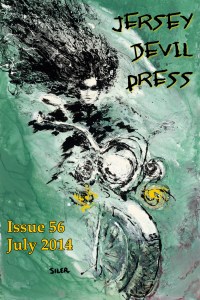
JDP cover July 14We have a brand-new issue of Jersey Devil Press, and it’s just in time for you to get your freak on for 4th of July!

We have people wearing animal flesh, bloody murder for the throne of a back alley mob, haunted madmen on murder sprees, moth men, upside-down houses . . . And a rad woman on raging motorcycle for our cover art, courtesy of painter Buzz Siler!

Fire up the roman candles, gang, and celebrate the Fourth Jersey Devil-style.

Oh, and BONUS NEWS!

Jersey Devil Press is now open to poetry submissions, too!

If you’re a fan of the magazine, you know our aesthetic. If you’re a new reader, here’s a little tip about the kind of poetry we might dig: this issue, though all fiction, has stories about people wearing animal flesh, bloody murder for the throne of a back alley mob, haunted madmen on murder sprees, moth men, upside-down houses . . .

I think you get the gist.

For more details, check out the submissions page for the new guidelines.

New review of Box Cutters

Folks, there’s a new review of my chapbook, Box Cutters! This one’s by Elise Matthews, in American Microreviews and Interviews, and maybe I’m biased, but I think it’s a fascinating read. A lot of reviewers have paid a lot of attention to the “between the lines” stuff going on behind the stories, but Matthews goes the extra step and digs in deep between actual lines: she spends maybe half the review on just three sentences from the first story! I love close readings like that!

It gets dark and heavy so fast, from eating with his wife/girlfriend to accidentally-but-intentionally punching her. The narrator isn’t afraid of his failings, nor does he shy away from acknowledging responsibility for his actions.

This winds up being the gist of the whole review, focusing less on the bruises that most people find so interesting and more on the issues of shame and atonement:

The rest of the collection has similar pacing and depth, similar honesty from the characters. None of them seem ashamed of who they are—even when it feels like they maybe should be, like Lemuel in “Distance” or the narrator in “Dream With Enough Conviction.” These are characters who act a bit shamefully but don’t apologize for it.

I love reviews like this not because they’re so generous with my work (but they are so generous, and I’m so grateful!) but for their ability to show me my own work in new light. They show me new ways of seeing. It’s a gift, these reviews, and I can’t thank reviewers like Elise Matthews enough for them.

Ooh! And bonus review! Poet Michael Levan reviews the collection Leaving Clean from poet Natalie Giarratano! These are both grad school pals of mine, and I admire their poetry more than I can express, so it’s extra cool to see the one review the other, and even better to see that review alongside one of my book! Wins, all around!

Every Kiss A War

“These are real men and women who live in the real world made up of cowboy boots, red lipstick, and wine in mason jars. The details are so thick and vivid, that each story makes me feel like I’m standing inside a bright, colorful painting and I could reach out and touch the brushstrokes. Reading these stories is a visceral experience.”

My friend, poet Brianna Pike, reviews Leesa Cross-Smith’s Every Kiss a War, one of my favorite fiction collections this year — maybe ever. This whole post is made of win.

bripike's avatarBrianna Pike

When you’re a poet sending out work into the universe, it can seem like the literary world is very, very large. But then something happens that reminds you that indeed it is a small world. A small world full of generous, talented writers.

A few weeks ago I was online researching some places to send my poems and I came across Mojave River Press & Review. I was impressed with their site and decided to send some poems. Around the same time I discovered Mojave online, my friend and author, Sam Snoek-Brown put a post up on Facebook about a collection of short stories called Every Kiss A War by Leesa Cross-Smith. Who published Every Kiss A War? Mojave River Press. About two days later, I’m back online and I notice some people I follow on Twitter talking about Whiskey Paper. Whiskey Paper is an online publication that publishes…

View original post 620 more words

Little Surprises Around Every Corner But Nothing Dangerous, or We’ve Got a Delay

In which amazing writer Ally Malinenko writes of many awesome literary things. And also of me. (Thanks, Ally!)

More literary news than you can read in a week

Man oh man. I’m looking at my web browser now and I have half a dozen tabs open just to stories about writing and publishing. And in my history, I’ve got almost a dozen more links I’ve visited in the past week or so. It’s been a busy time for literary news, is what I’m saying. So I thought I’d share some of what I’ve been reading about:


Writing news:

I think the most interesting thing I’ve read this week was Carl Zimmer’s “This Is Your Brain on Writing,” from the NY Times. The study it describes is, frankly, too limited to say anything definitive about creativity and the brain, but Zimmer is careful to acknowledge that, and the study here is an interesting piece of a large and fascinating area of research.

I’ve also been on a bit of an i09.com kick lately. I tend to follow them fairly regularly, but it’s mostly for their movie and science news. Every now and then, though, they publish something really interesting on writing, including this “One Weird Trick For Cutting Down Your Novel” (which I fully plan to use as I work on my new novel this summer) and these “31 Essential Science Fiction Terms And Where They Came From” (because I am a huge language geek).


Publishing news (awards):

Most of what I’ve been looking at lately is in the area of publishing, beginning a few weeks ago with the 26th Annual Lambda Literary Awards. I’m especially proud of my fellow Portland writer, Nicole J. Georges, for her graphic novel win for Calling Dr. Laura (a fantastic book, by the way!).

More recently, I saw news of the 2014 Independent Publisher Book Awards. I don’t know any names on the list — authors or publishers — but I recognize a lot of them, and as an author with two books with indie presses, sunnyoutside press and Columbus Press, I’m very glad to see what else is happening in the world I inhabit!


Publishing news (submissions):

There is also a slew of new openings for submissions — to magazines, to presses, to award . . . . I can’t even list them all here, but the short version would include the launch of Boaat — both the press and the magazine — and its chapbook contest; Augury Books, which is looking for full-length book manuscripts in prose and poetry; Bookfish Books, which is looking for YA novels and novellas; the newly revamped and very slick Writing Disorder website (they published a piece of mine last spring, before the redesign); and, very helpfully, a whole list of other open submissions from the amazing new lit magazine Entropy.


Publishing news (Amazon):

And finally — always — there’s Amazon. Gang, I have mixed feelings about Amazon. On the one hand, I have no qualms with people who shop there, and my chapbook is available through Amazon and my novel will be, and if that’s where you choose to buy my books, more power to you — please do so! On the other hand, that company is killing us. All of us — the writers, the publishers, the readers. All of us.

We’ll start small, with this charming story about an artist who created an “E-Book Backup” of a novel by photocopying, page by page, a Kindle version of 1984 and then binding it in book form. Sounds like clever art, but there’s a deeper meaning here: “‘E-Book Backup’ was inspired by a disturbing action that Amazon made in the summer of 2009,” the artist explains. “One day, Kindle owners who had purchased a certain e-book offered for sale on the Kindle marketplace found that it had been removed from their device by Amazon, who explained that the independent publishers who sold the e-book did not have the rights to offer it for sale. It was George Orwell’s 1984. I couldn’t have asked for a better example of the fragility of this media environment.”

Then there’s the new David Sedaris book tour, which is taking place in small brick-and-mortar stores around the country. To be fair, his tour isn’t explicitly connected to the much-covered public legal battle between Amazon and publisher Hachette. But that hasn’t stopped Publishers Weekly from framing it in those terms, and honestly, these days, anything that happens in a brick-and-mortar bookshop seems a direct challenge to the corporate monster that is Amazon.

Which is why Esquire magazine recently ran a whole advice article on “How to Quit Amazon and Shop in an Actual Bookstore (and why you damn well should).” And I have to be honest, folks, I loved the piece. In fact, I posted it to my author page in Facebook and asked for fans’ favorite local bookshops, and I’m building a fun list! (I’m going to share it on the blog soon.)

The rest of the news is focused on the legal fight between Amazon and Hachette, with news about how the battle is impacting JK Rowling’s new book, how Hachette is fighting back by turning into a corporate behemoth in its own right, and why all of this is spelling out a future of “‘assisted suicide’ for book industry.”

Frankly, it’s grim news. The situation isn’t desperate — the brilliant thing about small, independent presses is that they’re small and independent, so they’re mostly unconcerned about all this corporate warfare; literature isn’t just a big pond, it’s a big ocean, and the small presses will keep printing great work no matter what the Big Fish do. But for anyone who loves books and bookstores, this battle is worth watching, and the outcomes of it are something we all should be bracing for.

5 character facts: the “special features” part of Hagridden

There’s this writerly meme going around. The rules: to share five facts about the main character from my current work-in-progress.

I got tapped for this on Facebook, by the amazing Ally Malinenko, author of one of my favorite stories ever in Jersey Devil Press. Ally has a book coming out (very!) soon, the beautiful-sounding This Is Sarah, and in a couple of weeks I’m going to run an interview with her here on the blog. So I wanted to respond to the meme here as well, as a kind of heads-up about the interview.

And I’m going to cheat. The meme is supposed to address a WIP, but the book that I’m going to be working on this summer, I’m not actually working on yet. I’m still setting it up, getting to know the characters. (I might return to this later and do it again, just as a character-building exercise.)

So instead I’m going to do Hagridden, because, 1) it’s not out until August 19, so it’s still “in progress” (right? wink wink), and 2) I’m actually working this week on a series of stories related to the book, with some minor characters in the novel becoming main characters in the stories. So it counts.

For this, though, I’m going to stick to the novel, and I’m going to give you five details about the main characters — yes, plural: the woman and the girl (the woman’s daughter-in-law). And I’m going to give you details that are mentioned in the novel, but they’re the kinds of character-background details that I know a lot more about than gets revealed in the book. So consider this the special-features section if the novel were a dvd. 🙂

  1. The woman is a closet alcoholic. She’d never admit it, and everyone thinks she’s a teetotaler because she never let her husband Alphonse keep liquor in the house. But actually, she wouldn’t let him keep it around because she knew she’d be in the bottle if he did. (In the novel, she does find a bottle Alphonse hid from her, and after he dies it becomes her most treasured possession.)
  2. Unlike practically everyone else in the novel, the girl isn’t local to the bayou. Most of the white folks are Cajuns or Anglo-Cajuns (the woman is Cajun with Native American ancestry), and there’s a free black Creole, but the girl comes from the Carolinas. That’s how she puts it, never specifying which Carolina she’s from, because what’s left of her family — brothers, mostly — lives in both North Carolina and South Carolina. But between you and me, she’s from North.
  3. The girl wound up in Louisiana, and married to her now-dead husband Remy, by accident. She and her parents were on a ship headed for Texas when they got caught in a storm and shipwrecked off the coast of Louisiana. (This is loosely based on a real shipwreck, though that one occurred about 30 years later and 35 miles west, near the Texas border.) This is never explicitly stated in the novel, but the girl was only 16 at the time of the wreck; she was 17 when her parents died and she married Remy.
  4. The woman, as I mentioned earlier, is part Native. Her background is actually Chitimacha, a tribe from a bit farther east in Louisiana. The tribe was known for its strong, independent women, which is where the woman gets her fierce will and her survivalist fortitude. It’s also why, when her house fell down in a storm in the first years of the war, she was able to build a reed hut from scratch — the structure, called a palmetto house, is traditional to the Chitimacha people (though the woman’s house isn’t as complex or as sturdy, since she was working from childhood memories of stories told by her grandmother).
  5. The woman and the girl have names but I never give them and I never will. When I first considered doing this meme, I nearly chose to write it about the “main character” of the bayou itself, because it’s that region that dominates the novel and directs most of the characters’ lives. These women are a part of that, not quite forces of nature in their own right but certainly agents of nature. Which is why I never name them.

Hagridden comes out August 19 from Columbus Press! Check the website for updates!

Oh, and I’m supposed to tag more writers to play along, so here we go: I’m calling out Hannah Pass (who, rumor has it, is working on a novel right now), Alexis M. Smith (who better be working on something new because I LOVED her novel Glaciers), and Luke B. Goebel (whom I just met, but his forthcoming book, Fourteen Stories, None of Them Are Yours, sounds amazing!). None of them are obligated to participate, but I’d sure love to hear more from them about their work.


New publication — it’s an article!

I talk a lot about place in fiction: setting, a sense of home, checking your maps…. Mostly in my classrooms, bit also online here is the blog, in writers forums, or in casual Facebook chats.

Now I’ve written an article about the interplay of place and character in fiction. It’s part craft, part Francine Prose-like close reading (if you’re a fan of Jonis Agee and/or Raymond Carver, you’ll enjoy my article).

image

It’s at Flash Fiction Chronicles. I hope you get something out of it. More importantly, I hope it sparks a conversation! If you have comments, please do start a discussion at Flash Fiction Chronicles!

A sneak preview of Hagridden

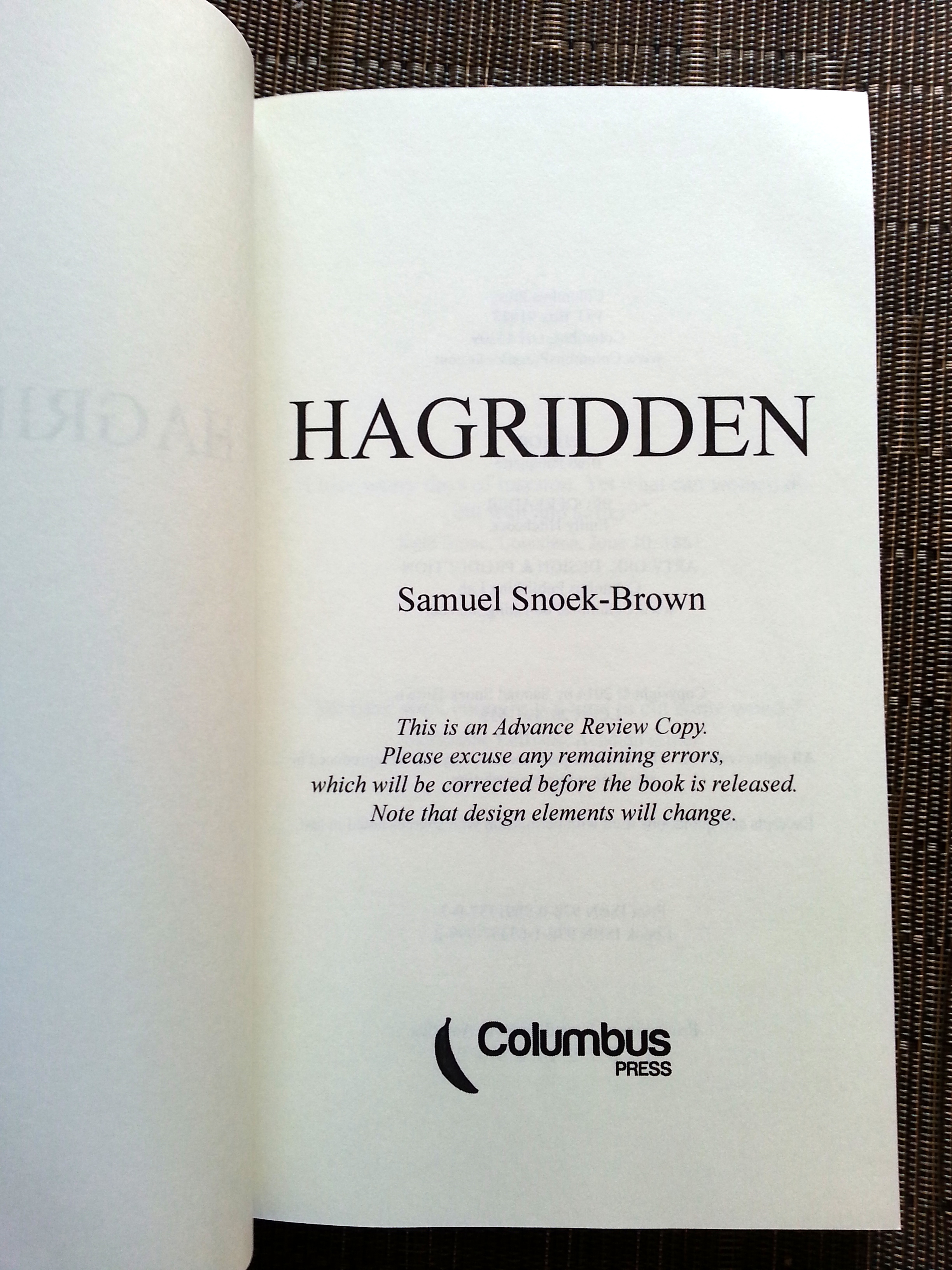
Apologies to people following me on Twitter or on my Facebook page, for whom this is repeated news. But my advance review copies of Hagridden came in the mail today.

20140606_171900

Please excuse me while I do a happy dance.

cart dancing

It’s still the rough copy — it doesn’t yet have cover art, the blurbs are all still forthcoming, and there are still a handful of typos here and there. I’m actually going through one of these print copies to catch any remaining errors.

But you guys! I’m going through a print copy! This is my novel, and it looks like a novel!

I have to tell you, I am completely geeked out over this. I mean, as I go through this book making last-minute corrections, I’ll be reading my own novel. In book form. In my hands. With that new-paper-and-glue smell!

I get to smell my own book!

You should all just brace yourselves now. This is how excited I am over the review copies. When the final, official print edition comes out in August, you’ll probably be able to hear me shouting about it. Wherever you are. Seriously — just open your windows and listen. =D

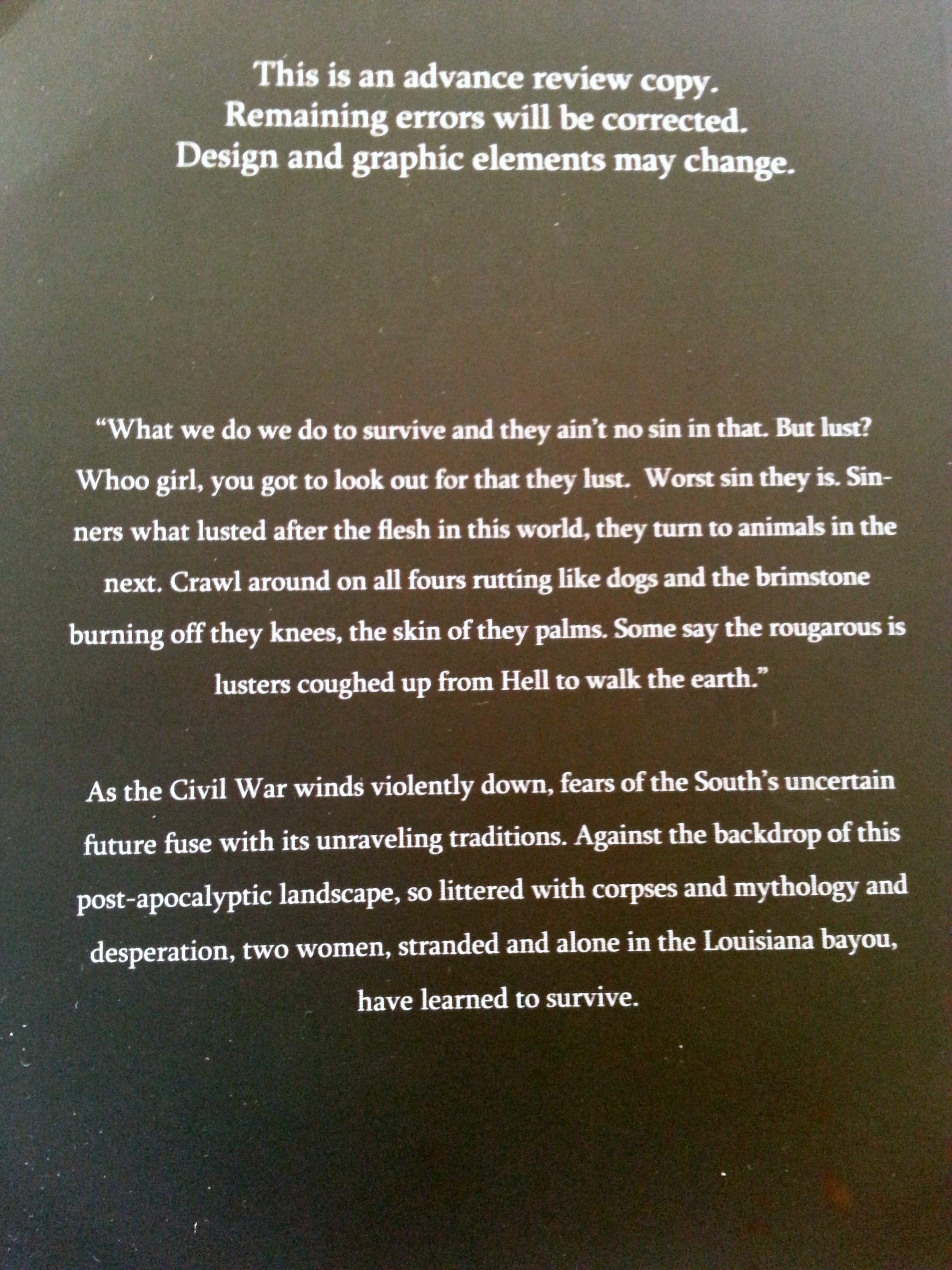
In the meantime, here’s one last tease: the promo text on the back cover:

20140606_173029

People die around the Jersey Devil — but at least there’s an afterlife

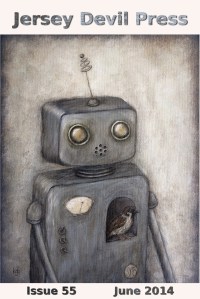
JDP cover June 14The June issue of Jersey Devil Press is live. And full of death.

Seriously. Everything from sweet old ladies in hospice care to suicides and, ultimately, nuclear destruction. For our own good, of course.

But don’t worry! You can still get cell phone reception in Heaven.

Okay, so the news out of JDP looks a little scary this month. Which is why we’re so happy to have the bird-hearted “Rupert,” care of artist Kris G. Brownlee, on our cover. Because gang, this robot is freaking adorable. When we all die and the digital hive-mind takes over the world, I hope the planet gets populated with Brownlee’s robots.

On making a book trailer

I wanted a book trailer for Hagridden. I don’t know what good they do, really, and I might not have really worried about it at all, but just about the time my publisher and I were going over the initial proof of my novel, I saw the trailer for Leesa Cross-Smith’s Every Kiss a War. And holy shit, that’s a good trailer!

So of course the wheels started spinning and I decided a book trailer for Hagridden could be pretty cool.

It’s a risky move, frankly. A lot of people don’t use them, and with good reason: they don’t seem to do much in terms of selling books. I knew that from my research, and my publisher said pretty much the same thing. It’s not that trailers aren’t cool; it’s just that, in terms of return-on-investment, they’re not really worth the money.

But I kept watching that EKAW clip, and it’s just so damned good! So I was itching to take a crack at this thing, and I decided to start shopping around for media firms who make trailers, figuring I’d pay for it out of my own pocket.

But gang, trailers are expensive.

I looked at maybe two dozen places, and for a one-minute trailer, the prices I saw ranged from $300 for a static image and some generic music (n0t even a voice-over) to almost $3,000 for a slick, professional video tantamount to a short film. (I don’t know what Cross-Smith’s trailer cost, but it must have been on the upper end, because it’s better than most of the samples I saw on the pros’ websites.)

I spent a few weeks balancing price against quality, trying to find the best value, but eventually I realized that anything I could afford was going to look like I could afford it — meaning, not that great. And the kind of trailer I really wanted would almost certainly never pay for itself — it was (barely) doable, but not at all cost-effective.

But before I gave up on the trailer, I decided to scribble down my ideas just to see what they looked like on paper, in thumbnail sketches, and the more I tinkered, the more I wanted to see some version of this on a screen. And that’s when I remembered: I have iMovie on my Mac.

So I figured, what the hell. Since the book trailer was going to be an outside shot anyway and I was really only doing it because I wanted to see one, I decided I might as well just make one myself. Just to see those thumbnail sketches made real.

So I made one.

(I also posted the trailer to Vimeo.)

I think it’s pretty obvious this is my own work, and not the work of a pro, but honestly, I could have spent a few hundred bucks and wound up with something about this good. Granted, it doesn’t hold a candle — or even a match — to the Every Kiss a War trailer, or to some of the really fine professional trailers I saw on the upper ends of the price range. But mine was free. (Well, free minus the hours and hours and hours I spent working on it the past couple of weeks. But basically free.) Which means that if it convinces just one person to buy the book, it’s a heck of a return on my investment! And if it doesn’t do anything at all, it was still cool to make.

So, short version: Book trailers really don’t seem to be worth it, at least for most authors, but damn it, I love them anyway, and sometimes they are worth it, and mine was worth making just for the experience of making it.

(And I hope it makes you curious enough to buy my book in August.)