National (I don’t have time for) Novel Writing Month

2013-Participant-Vertical-BannerI can’t believe I’m about to do this, but here it is: I’ll be participating in NaNoWriMo again this year.

My trepidation is not for lack of interest — I love NaNoWriMo. My first outing resulted in the first draft of my novel Hagridden, which in turn led to my Oregon Literary Fellowship and a research trip to Louisiana. My third attempt has turned into a handful of pretty damn fine stories in a strong story cycle, which I worked on again this summer while on a writing retreat. And last year’s effort gave me the beginnings of several really interesting short pieces I ought to be working on now.

Except I haven’t had the time for writing I’d like to have had. I’m teaching five classes on three different campuses; on one of those campuses, I serve as faculty advisor for a film club. I edit two different lit magazines, and this past month I served as fiction judge for a university creative writing competition. I have a chapbook coming out in a few weeks, and I’ve been prepping for a reading to coincide with its release.

And on and on.

So why am I giving up what little free time I have left to pound at the keyboard in a furious attempt to knock out 50,000 words in 30 — though, given my schedule, FAR fewer than 30 — days?

Well, aside from the fact that I should be doing this anyway (I’m a writer, damn it! Writers write!), I also have a story to tell. A couple of months ago, my mother-in-law, who is a librarian and also works for her local genealogical society, came across a book about a psychopath cowboy waging a one-man rebellion in northeast Texas just after the Civil War. Thinking about my own Civil War novel set down in Louisiana, she thought I might be interested in this true story about a crazed gunslinger in Texas, and she sent me the book.

The story is about Cullen M. Baker, and while his life has been accounted for — and fictionalized — many times before, including the Louis L’Amour novel The First Fast Draw, the book my mother-in-law sent me is more of a cursory overview of Baker’s life. It’s a tight little account of the weirdest (and probably embellished) episodes in the life of a man some consider the first outlaw gunslinger of the Wild West, a legendary figure who served as a real-life model for other famous figures like Billy the Kid and Jesse James. And it is the nature of this telling of Baker’s story — brief, episodic, unconfirmed — that got my brain turning. I realized how many details I wanted to change, what information I would have added to the story, which characters I was most interested in. And the more I read, the more I began to see someone completely different from Cullen Baker, a set of characters and a connected narrative that might be based on stories about the man but which has taken on a life of its own.

I began to see my next novel.

And there’s no better excuse to start that draft than this coming month.

I don’t know if I’ll actually have the time to “win” NaNoWriMo this year (I fell short last year), but the story’s in my head now, the characters developing before I’ve even put words on paper, so I figure as long as I’m writing something, I might as well write this, and I might as well write it now.

So pull on your boots, clean your sidearm, and saddle your horse, gang. We’ve got a story to tell!

New publication

My story, "Please Know Our Loving Thoughts Embrace You," in Eunoia Review, 24 October 2013.
My story, “Please Know Our Loving Thoughts Embrace You,” in Eunoia Review, 24 October 2013.

I have a new story online today, gang. It’s called “Please Know Our Loving Thoughts Embrace You,” and it’s a love story, a classic romantic tale of boy-meets-corpse.

No, seriously.

And before you all start frothing at the mouth in Walking Dead glee, no, it’s not a zombie story. And no, you more twisted horror fans, it’s not a necrophilia story, except maybe in the strictest translation of that word. It’s just a love story. With flowers and everything.

If I haven’t turned you off by now, can I just take a moment to tell you how much I love Eunoia Review? I stumbled across this magazine the new old-fashioned way — trawling Duotrope — but I latched onto them and started submitting for all the old old-fashioned reasons: I read the work they were already publishing and loved it, and I wanted to be a part of that. It is humbling to me that I’ve been invited into these digital pages three times now — humbling because I’m still a fan, still a reader, and I love the writers I’ve been allowed to share space with at Eunoia, including, as word has spread about how great Eunoia is, some good friends of mine.

But I think the best thing about Eunoia isn’t just the quality of the writing, it’s also editor Ian Chung’s willingness to take risks on the work he publishes. My first story at Eunoia, “Summerplace,” is unusually long for an online magazine — at just under 10,000 words, it’s unusually long for most print magazines! — but Ian took a chance on it. My second story, “Curl Up and Burn,” was even longer, and it plays with a kind of fictional journalism, both of which were risky for any publication,  yet it’s become one of my most popular stories. And now today, a story about a man who finds a murdered woman in the woods and then finds love.

Huge, HUGE thanks, Ian Chung, for supporting my work. But you know what? Even bigger thanks for supporting ALL the work Eunoia publishes — it’s an amazing magazine, and reading it every day these last couple of years, it’s become an important part of my literary life.

Words everywhere

What a week in literature!

This past Tuesday, my wife and I went to see Salman Rushdie speak as the inaugural writer in this year’s Portland Arts & Lectures series. I’ve heard him on the radio several times and I’ve enjoyed his appearances on The Daily Show, so I knew the guy was not only brilliant but also funny. But live, in person? The man was hilarious! Whether it was his impression of New York police and his demonstration of the difference between how American cops and armed British cops carry their sidearms (“American police shoot innocent people, while British police shoot themselves in their own asses” — it’s a long story, but it was a riot), or his detailed lambasting of Fifty Shades of Gray and The DaVinci Code (“Jesus didn’t speak French!”), or his description of word games he likes to play with other writers (only an audience of lit nerds would laugh hysterically at changing Salinger’s title to “The Pitcher in the Rye”) — by the end of the evening, the crowd was in stitches.

Afterward, we stopped by the afterparty to see what was what, and while I didn’t manage to find my writer friends Kerry Cohen and James Bernard Frost (who were there, eating cheese) or Literary Arts program coordinator Mel Wells or director of programs and events Susan Denning, I did get a chance to shake Rushdie’s hand.

I just want to say that again: I shook Salman Rushdie’s hand!

I had been threatening all night that if I got to meet the man, I would tell him how much I loved him in Bridget Jones’s Diary, just to see if he would laugh at that. But when it came down to it, I succumbed to fanboy awe and chickened out. Instead, I giddily said, “I just wanted to thank you for coming here! It’s such an honor!” I expected him to nod and thank me and move on to the next fan pushing closer to him — the room was packed and Rushdie was the gravitational center of all movement — but instead, he switched his glass of wine to his left hand so he could shake my right, and he said, “Oh, thank you for having me. It’s been a pleasure, simply a marvelous trip.” I told him I’d missed his radio interview earlier in the day, and he said how much he’d liked doing that, but his favorite experience was meeting with students at a local high school. I said, “Oh, good! You know, that is such a great program — I’m so glad Literary Arts does that, gives these students access to a writer like you.” Rushdie said it was actually the other way around: “I found the students invigorating. They inspire me.”

Salman Rushdie visited Madison High and was given a thank-you gift of student writing by Librarian Nancy Sullivan. (Click the image for the source.)

Wow.


A mere two days later, I woke up and checked the Internet (stupidest thing you can do, getting online before you’ve even gotten out of bed, except for yesterday) and I leapt out of the blankets and stood shouting in the bedroom: “Oh my god! Oh my god! Alice Munro!”

Because one of my favorite writers of all time had just won the Nobel Prize in Literature.

But that’s not all! Alice Munro is the first Canadian to win (yeah yeah, Saul Bellow was born in Canada, but he was raised in the US). And in 112 years, Munro is only the thirteenth woman to win the prize, which is a pitiful ratio but she’s helped move women one prize closer to literary equality. And, most exciting for a writer like me, she’s won the Nobel based solely — solely — on a career writing short fiction. (I know, some people like to pretend that Lives of Girls and Women is a novel, but they’re wrong. It’s a story cycle. Trust me: I’m teaching that form in a college course right now, and Munro’s book in on the syllabus; we start it in a few weeks.)

As far as I know, no other Nobel laureate has ever won solely for short fiction. Plenty of prose winners have written short fiction, but in explaining their reasons for the award, the Nobel committee always cites the strength of the writers’ novels. Munro has never written a novel. So this is a HUGE validation for short fiction as a form. Especially considering the so-called “decline” the past couple of decades of the short story — or rather, of story collections, which, if you’ve ever so much as glanced at the publishing and literary agents markets, you’ll know are often denigrated as “unsellable.” So as a guy who still considers short fiction my most comfortable form of writing and who is currently working to publish a collection of short fiction, this is very, very exciting news!


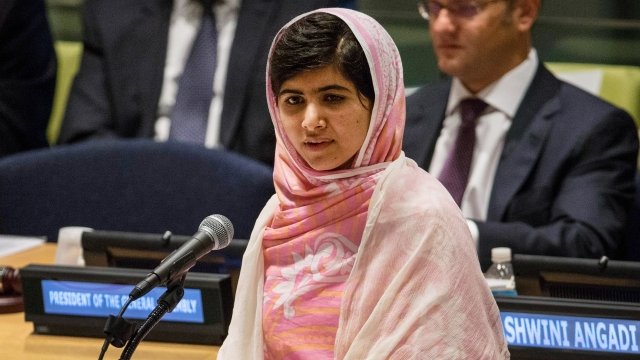
I also want to give a shout-out to Malala Yousafzai. She’s not a writer in the same way that Rushdie or Munro are, but she is an inspiring advocate for education and has written a book. I mention her, though, because while she was overlooked — unfairly, in my estimation — for the Nobel Peace Prize today, she’s still an extraordinary human being whose words are worth celebrating.


Finally, a plug for my friend Hosho McCreesh, who has had not one but three books out this year, the most recent of which, A Deep & Gorgeous Thirst, is officially out as of this week. And even though the release party happened on Sunday down in Albuquerque, you can pretend you were there by listening to a reading from the release:

Jersey Devil Press turns four

jpdcoveroct2013It’s that time again, gang: Jersey Devil Press’s latest issue is out! And it’s our fourth anniversary!

Whether it’s two best friends slowly poisoning themselves to death, or a blind painter taking instructions from an imaginary dragon, or a stranded cyclist drinking water with a coffin-dweller and jamming to interstellar music, or a family haunted (literally) by a fatal mistake, we’ve got everything you could ever want.

We even have giant kewpie dolls dissected and exposed, organs and bones and all, courtesy of our cover artist, toymaker and genius sculptor Jason Freeny.

The one thing we don’t have is Mike Sweeney: our content editor is stepping down after an epic two years at the helm. Seriously, look over the work he’s curated during his stint at JDP — he’s more than earned his retirement. I’m speaking seriously and personally here — Mike’s been a hell of guy to work with. We’re all going to miss him something fierce.

But hey, we have good news, too, because our hard-working colleague, Laura Garrison, is stepping up to fill Mike’s shoes! They’re big shoes, but we already know Laura will wear them well — she was the editor behind our celebrated first-ever poetry issue a couple of months back.

In the meantime, check out Mike’s last issue, and let’s all send him our love. No, strike that — let’s all lift his shirt and give him raspberries. This is Jersey Devil Press, after all!

Look ma! I’m on TV!

That’s right, folks: earlier this summer — on June 18, to be precise — I was on the local TV program Arts Alive, based in McMinnville, Oregon. Host Lynda Phillippi invited me on to talk about my Civil War novel Hagridden and the research trip I took to Louisiana. It was a great conversation, during which we talked about fiction, samurais, Southern regionalism, teaching research, and dead snakes in the road.

No kidding.

Big thanks to Lynda for having me on the show!

And I hope you, happy readers, enjoy the conversation as much as I did. 🙂

I’m notable!

Several weeks ago, I announced here on the blog that Nathaniel Tower and the other excellent folks at Bartleby Snopes had nominated my story, “Lightning My Pilot,” for the storySouth Million Writers Award. (Actually, the story got nominated twice — my wife got there first, with a reader nomination.)

Today I got an email from the fine folks at a different magazine, WhiskeyPaper (where another of my stories appeared last year) congratulating me on making it to the next round of the Million Writers Award — which was news to me, but sure enough, “Lightning My Pilot” has been shortlisted to the “Notable Stories” list!

So far, the announcement is on storySouth co-founder and Million Writers judge Jason Sanford‘s website, but sometime soon, the storySouth website itself will get updated with the shortlist. After that happens, a panel of judges will narrow the shortlist down to ten finalists, and then you — yes, you, happy readers — will get to vote on the winner. So stay tuned, gang! Here’s hoping you get a chance to vote for my story!

Also, while I have your attention: shoutout to my writing compatriots, Ryan W. Bradley and Tim Horvath, who also got shortlisted this year. Go read their stories, y’all — read all the stories on the list!

New publication

rusty nail cocktail
rusty nail cocktail (Photo credit: Wikipedia)

I’m an ingredient in a drink, y’all!

As of today, my story “Have Love, Will Hurt” appears in the August/September print issue of The Rusty Nail, which is both my father’s favorite cocktail and a kick-ass literary magazine.

This story is one of the fun ones, too. Not because of the content (a guy falls in love with a knife, people), but because it’s one of those stories where I indulge my obsession with intertextual connections. Anyone who liked Miguel in “No Milk Would Come,” or Bobby in “Kicking to Stay On,” or Neal in “Kamikaze,” well, here’s your chance to see them all in one story!

Huge thanks to Craig Hart for picking up the piece, and I hope you like it.

BER-nee, Texas

Several years ago, my wife and I were on our first trip to Prince Edward Island, in the Canadian Maritimes. One evening, we decided to attend a “murder mystery” dinner theater, just for fun, and got to chatting with one of the actors. This guy was playing (or maybe was in real life) an over-the-top loudmouth, and his pre-show job was to meet all the audience members and collect their points of origin. “Where are you from? Where are you from?” Because we were in Canada and no one really knew Texas geography, we didn’t tell anyone we lived in Denton — we said we were from Dallas. Later, during the show, this loudmouth actor would refer to audience members by their locations, not their names, and when it came our turn, he pointed to us and shouted “Dall-ASS! Tex-ASS!”

I’m very happy I didn’t mention the Hill Country town I mostly grew up in: Boerne.

But Boerne, Texas, turned up in my Facebook newsfeed, today, in the form of a Buzzfeed article on places we’re all mispronouncing. It’s #4, and while they get the phonemes right, they get the emphasis wrong: it’s not ber-nee, it’s ber-nee.

Still, it put me in mind of all the stories I’ve set in my old stomping grounds, and I thought I’d list them here:

Curl Up and Burn

This is my most overtly “Boerne” story, complete with a (mostly factual) history of the town and the surrounding area. It’s kind of my bittersweet love note to the place I grew up in and promptly moved away from, only to keep returning to in fiction. It even mentions Boerne in the opening lines:

Every building and every landmark in Boerne, Texas is built from the chalky limestone native to the region. Other than a few wood accents, little cedar posts or oak accent walls, and the water tower gleaming white in the hot Texas sun, everything else is stone. This is how Ford Randall Kempe prefers it. “It’s more durable,” he says.

No Milk Would Come

This one is almost purely fictional, but I used to work in a restaurant similar to the one in this story (the line about the “dysfunctional family” — I stole that from one of the waiters at the restaurant). That place doesn’t exist anymore, but that’s one reason I keep coming back to my hometown — I get to preserve the parts of the town I loved. Also, this is another story that name-drops Boerne in the first line:

The other night I stopped for orange juice at the Pico station on the north side of Boerne, and I picked up this men’s magazine just to browse it, and then I wound up buying it because of this article about sex dolls so realistic you could dress them up and no one would know the difference.

Kicking to Stay On

This one doesn’t mention Boerne by name, but that’s where it’s set. People who grew up there will know it because of the bar: “Later, the gloves stripped away but the chem­i­cal smell still hang­ing on their raw hands and in their scrubbed shirt-sleeves, Bobby and Mikey drank beers at the Rac­coon Saloon.” The ‘Coon (that’s what all the Boerne residents know it as) doesn’t exist anymore, either, but in my fictional Boerne, it’s a mainstay.

Barefoot in the Guadalupe

This is another of my “love note” stories, though the narrator is no real fan of the town or even the state of Texas. His best friend, though, adores it: “Tommy had only lived in the Hill Country for a year when I met him.  He loved the place: the cedar brush here in Boerne, the dusty meadows surrounding the San Antonio suburbs, the fake concrete Stonehenge out in a field off FM 1340.”

Horror Vacui

This story — about an accountant-turned-sword-swallower who has some issues with his bowels — isn’t really about Boerne, but it does, at one point, give the address of the protagonist, and, you guessed it, it’s in Boerne. (Actually, though the address is totally made-up, the house I describe in it is only a few streets up the hill from my parents’ house.)

There are other stories less explicitly Boerne-esque — no references to the town, direct or indirect — but I know they’re set there, and people who grew up in the area might recognize some of the landmarks. There are even a few stories (“Bathe in the Doggone Sin”; “A Few May Remember”; and the related stories “Air Enough At Last,” “Potato,” “A Smooth, Clean Cut,” and “Dream with Enough Conviction“) that are set in my own neighborhood.

I could write a much, MUCH longer blog post about why I keep returning, in fiction, to this part of my world. I could probably write a book about it, or at least several chapters in a book, and maybe some day I will. But in a way, I already have written a book about it — you just have to read all my fiction.

Which I hope you will.

Reel librarian giveaway!

Anyone interested in a Lego librarian? My wife wants to give you one for free. Go to the Reel Librarians !website and check out the giveaway!

Jennifer's avatarREEL LIBRARIANS

My, how time flies! This week, we celebrate the second anniversary of Reel Librarians. 😀

Reel Librarians second anniversary graphic

And even though we turn two, there have been a lot of firsts and milestones this year, including:

And there’s another first in store, to help celebrate — the first Reel Librarians giveaway! Remember this past summer, when my husband and I scored our very own Lego Librarian? We also were able to score ANOTHER Lego Librarian, and I had the idea of saving it for a celebratory giveaway. Now that time has come! 😀

Lego Librarian with balloons
The Lego…

View original post 311 more words

There’s nothing but time here

image

This afternoon I heard the familiar knock and rattle of our mailbox and stepped onto the porch to collect the mail. We had a flier from The Container Store and a tightly bundled parcel of coffee beans from an old friend down in Austin. But what caught my attention was the quiet rain shower misting over the street and the fresh smell in the air. And I decided I needed to take a break from work and sit on the porch for a bit.

I put the mail in the mail bin and the coffee beans in the kitchen, which is when I realized a cup of fresh coffee would go perfectly with the rain. So I brewed a quick cup of pour-over.

While I watched the coffee grounds bloom, I decided I didn’t want to just sit outside and smell the rain. As long as I was taking a break, I might as well enjoy some reading, not the critical works I was assigning my students or the news I’d been avoiding all day — something that would feel right during a short break on the front porch, something that would go well with coffee and rain. So, poetry, of course.

image

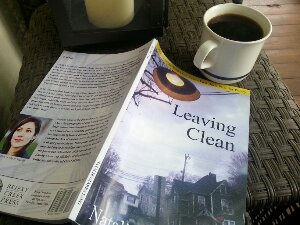
So I picked up Leaving Clean, the debut collection by my friend and grad school classmate Natalie Giarratano, which had arrived in the mail a few days ago but which I’d only got a couple of poems into.

The first two poems are beautifully lyrical and ornamented with these hard little images from everyday life — shoes on a telephone line, screaming kids and trampolines. But by the third poem, I was beginning to see past the line breaks and stanza structures to the narrative, almost essay-like purpose underlying the poems. This is something I’ve always loved about Natalie’s poetry: her ability to make a point not by beating you over the head with it but by feeding you lines that bring her point blooming forth from inside you.

I sat a few moments, sipping coffee and marveling at her subtlety and her compression, and I remembered that I’m spending more time this year focusing on compression and precision in my first-year composition classes. I usually spend a lot of my time in those classes trying to get students to expand their ideas and hone their topics, and then we deal with the language once it’s on the page, in a full draft. But I want to spend more time up front this year thinking about the pieces, about individual words and sentences.

And I’m reading Natalie’s poetry and thinking about my good friend and mentor David Breeden, who used to turn all his novels into screenplays just to tighten them up. And I’m wondering if I couldn’t do the same with essays and poems. If I couldn’t ask my students to turn their first drafts into poems in order to focus on the language and squeeze out all the excess.

It’s just a thought, but if I try it, I’ll write here how it went.

In the meantime, my break is long since over, considering my quiet few minutes reading poetry on my porch has turned into lesson planning….

PS: The title of this post is a line from the first poem in Natalie’s book. You can find the whole poem, “Self-Portrait as a Pair of Shoes Hanging from a Power Line,” on her website, but the two stanzas that this line begins (you need two for the context) go like this:

There’s nothing but time here,
so wait: we could love you;
though, you should know,

we’ve seen the way you devote
yourself to pavement and always
appear to be rushing, leaving,