This isn’t about writing or teaching, but it is about Texas, where I grew up and where a lot of my writing still gets set. And the fiery death of Big Tex means something. It’s about the loss of a symbol, the old-fashioned heart of the modern Texas cowboy. Big Tex was, after all, more than just a statue: he was a giant automaton, a huge mechanical marionette, whose Howdy Doody mouth would boom friendly greetings to everyone visiting the Texas State Fair. He was, for many, a protector of the state and its warm-hearted, manly image. His rugged blue jeans and crisp Western work shirt, his huge white hat and equally huge metal belt buckle, his clean cowboy boots — these were not the clothes of a ranch hand but the costume of the modern Texan, still tied to his cattle-drive history but looking out over the modern corporate metropolis of Dallas at the future. His hat tipped casually back on his head, one hand perpetually raised in a friendly howdy and the other arm extended in a welcome: “Come on in, folks.”
The fire seems to have started in his boots and the first signs of smoke came billowing from his hat. (Where else, on both counts?) But Big Tex was clothed in genuine fabric, and it didn’t take long for the whole of him to become consumed. It caught people by surprise, and while we’ve all been trained these days to whip out our phones and our cameras to record every tragedy we come across, people in the foreground of the resulting videos seem stunned. No one is screaming; no one is applauding or shouting “Awesome!” They only stand and point. No one seemed quite sure what to say. In the audio of the emergency radio chatter that plays over some of the YouTube footage of his death, you can hear the dispatcher declare, “777 is out at Big Tex. You got a rather tall cowboy, all his clothes burned off.”
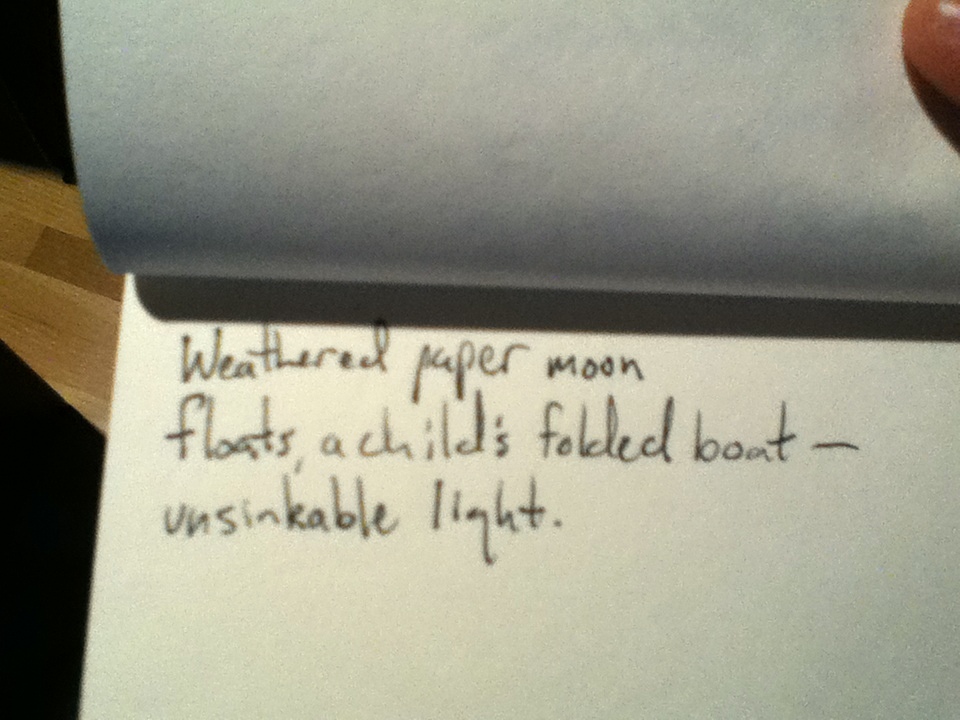
A few weeks ago, I attended the O-Tsukimi moonviewing festival at the Portland Japanese Garden. Among the various activities at the festival, the organizers had laid out small handmade notebooks and pens for us to write haiku about the moon.
These are my haiku.
Weathered paper moon
floats, a child’s folded boat —
unsinkable light.
yellow moon arises
earth lifts up her snowy hood
old friends reaching
EJ Runyon and I had a LONG and very interesting conversation about my story “Lightning My Pilot.” We get into areas of general craft, but it’ll help to read the story (if you haven’t already) to understand some of what we talk about. Otherwise, dive into the first part of the interview!
Any comments? Feel free to leave some here, but definitely leave questions or comments at EJ’s blog: join our conversation! 🙂
Oh, and PS: I’ve added a new “Interviews” page to my blog, under the “Writing” menu, where you can find interviews I do with other writers and interviews people have done with me. I’m planning to expand the interviews I’ve done with others soon (including an exciting interview I hope to post early next month), so stay tuned. And if you want to interview me, just drop me a line — I’m fun to talk to. 🙂
I read an online story by my guest, Samuel Snoek-Brown recently. And it touched me so much, I re-blogged it on my site here.
Here’s a link to it: Lightning My Pilot. I really thought so highly of it that, as a ramp up to National Novel Writing Month, I’ve invited the author to engage in a three-part talk about the how’s and why’s that went into creating this small gem. Here’s the first blog, the next ones will show up in the 21th & 28th of October.
So first, take a look at his short story.Then see our talk here, I really didn’t expect us to have that much to discuss, but you know writers… especially deadly serious ones. Here we go.
Blog one of three
EJR: I think there’s something cool in looking at what the first thing your characters say on the page. Either because you…
So, as I promised last week, I’m attempting a draft of something based on notes I took at a literary reading here in PDX last week. And, thanks to a conversation in the comments with EJ Runyon, I decided to try the story about rearranging furniture.
She opened the door but it stopped on its chain. Her one eye blinked in the crack and she stammered through something about forgetting she’d latched it. The door closed, the chain danced against the wood, and then the door flew open so it blew back her silk robe. She was still dressed for work, ill-fitted tweed slacks and flowery blouse like a sack, but her mussed hair sprung from her head in strange limbs and shelves, and I could tell she’d taken her bra off, and she’d slipped this fluttering dragon-printed robe over her clothes as though this, somehow, constituted unwinding. Or maybe it was just a part of her, because when she waved me inside, the loose, fabricky flutter of her forearm-wrist-hand-fingers looked like it was part of the wind from the door, like the silky sleeve was dragging her thin arm with it.
“Come in can I get you some tea?” she said, all one sentence, and she was already through to the kitchen before I’d crossed the threshold. I told her no, that I was fine, and she came out of the kitchen, all one motion, like she’d just gone in to run a quick lap on her way to the living room. “Oh, good,” she said. “I’m not actually sure I have any tea.”
The long, narrow entryway had two balls of light, one a few paces past the kitchen and the other off at the end of the hall, both from small desk lamps dropped on the floor, their black cords snaking against the baseboards like a cat rubbing your leg. In that far ball of light on the floor, I could just make out the twin squares of empty doorways, both of which sifted into blackness as they rose, like the whole end of the hallway was filled with smoke that was trying hard to penetrate that little circle of light on the floor.
But Hope had already disappeared into the watery gray of a huge living room on the left, and I followed her.
The floor was tile but it might as well have been cement, the unpolished marble a grayish pink that sucked up all the thin yellow light slipping in through the narrow windows from the building across the street. The plaster walls were a muted yellow the reminded me of a sick dog’s urine. Our footsteps echoed. I felt like I was back in the warehouse; I half expected to find a forklift parked along the back wall next to the leather couch and the cardboard boxes.
“So, this is it,” she said. “I just bought the couch, but I’ve had the side tables for years.” She pointed to boxy wooden chests, one with an unlit lamp on it and the other piled with loose file folders and a paperback novel. “I still need to buy a coffee table. What size should I get? I have my eye on this great brass-and-glass thing, but I worry about breaking it and it doesn’t have much storage. And I don’t know if it’ll match my other stuff in here. What do you think?”
“Ma’am, I don’t know. I’m no decorator.”
“Not that everything has to match, of course. I’m not a slave to style. Form over function, right? No, wait, I have that backward, don’t I?”
“I wouldn’t know.”
“Well, anyway, I need a coffee table. What kind do you think I should get? What size would work best in here?”
Just about any damned size she wanted, really. She could have sawed the legs off a formal dining table and dropped it in front of the couch and the room still would have felt cavernous.
“I guess a bigger one would work,” I said. “Unless you wanted to use parts of this room for something else — you got plenty of space.”
“Oh, that’s a great idea! I could use part of it for an office. Not a real office, because I’m using one of the bedrooms for that, but I could set up a little laptop desk over here” — she ran away into a shadowy corner of the room, her phone hollow against the walls so it came to me like a long-distance phone call — “and a lamp, like a floor lamp, and a bookshelf. Oh, I’m so glad I asked you here! You have such good ideas!”
I nodded, for some reason, and I looked around the space, but I couldn’t even see her anymore in the dark.
I spent a long time thinking about this piece. I knew where the ideas were coming from, but I had no idea how to enter the story. Then I remembered that I didn’t have to enter the story — not from the beginning, anyway. I just needed to start getting words on paper. So I started with the one thing I knew, an experience I once had helping a relative stranger move her furniture, and just started writing.
Still, I hit a wall, and I knew it was because even while I was writing, my mind was leaping to other ideas, still thinking of other influences, still trying to figure out who these two people are and where they’re coming from and why they’re here.
I could have resorted to my mindfulness practice and tried to let go of all those competing voices, and ordinarily, that’s what I would do. But that practice can sometimes take a while, and I needed to get words on paper — for this post you’re reading now — on a deadline. So instead, I decided to use the excess mental energy and actually try to chase down all those competing thoughts in one space.
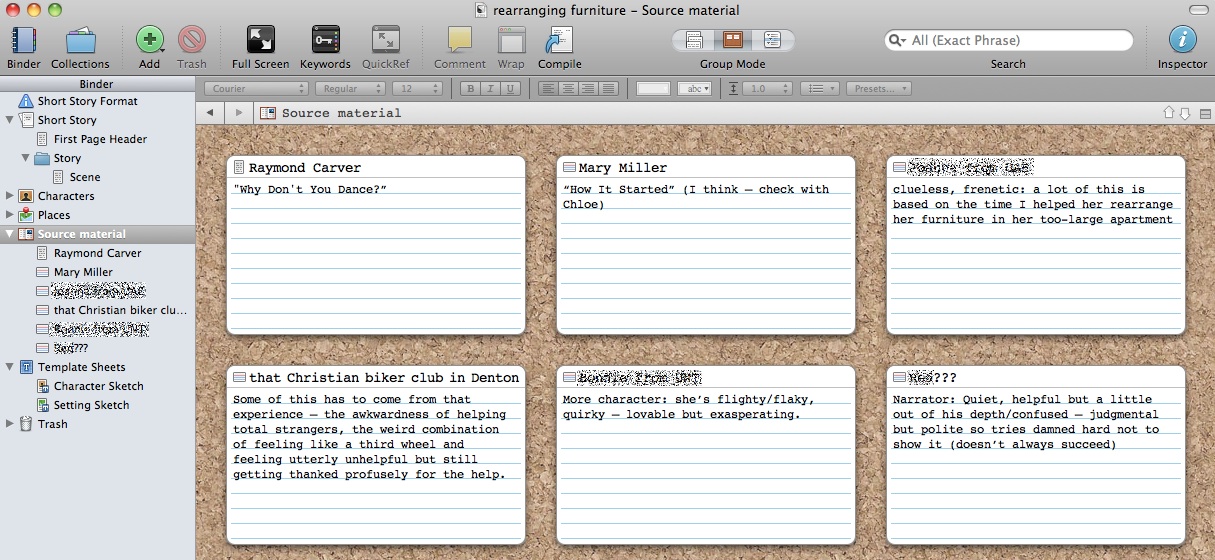
Which is where notecards come in handy. Or, because I love working on a computer: Scrivener.
I pixelated the names of some real-life inspirations.
This way, I can write little “notecards” about character backgrounds, inspirations, and ideas, and I can work on the text of the story itself, all in the same place. And later, when I need to collate these people and scenes and ideas into something like a coherent draft, I can pull them together, export them to a Word file, and keep writing and revising from there.
But I’m still a long way from coherence, let alone revision. I don’t even have any story here — it’s just this scene, and it’s all description and characterization, and I’ll probably throw most of this away. But I still think there’s a story in here somewhere. So, I write on!
Some of you might recognize the title: it originally appeared in the excellent Orchid: A Literary Review. But, sadly, Orchid is now defunct and the story was only ever in print, so a lot of you haven’t had a chance to read it. It’s one of my soft-spot favorites, and I’m thrilled that Fiction Southeast is giving it a new home so you can check it out.
Also, some of you might remember my story “It Was the Only Way,” which was in SOL: English Writing in Mexico, back in March 2012. If you do, you might recognize the name Consuela. Is this Consuela the same as the boarding-house matron in “It Was the Only Way”? Well, “Consuela” takes place in Laredo, TX, and “IWtOW” takes place in Piedras Negras, Mexico, just across the border from Eagle Pass. So, these two Consuelas are not in the same sister-cities. But that doesn’t mean they’re not the same woman. Read both, and you tell me. 😉
Yesterday, Ryan Werner name-dropped me in his interview with the University of Wisconsin-Platteville’s creative writing blog. So they contacted me, and today, my interview is online, too. Among the things we talk about: writers in Wisconsin, dreams, snow and Dairy Days and strawberry shortcake in Wisconsin, Sarah Rose Etter and Jac Jemc, fall on the beaches of Thailand, and advice for aspiring writers.
Go check it out, and then, while you’re there, read the other interviews they’ve done, especially my pals Russ Brickey and Mike Lambert.
And stay tuned here, too: in a few days, I’ll have another interview up at EJ Runyon’s blog!
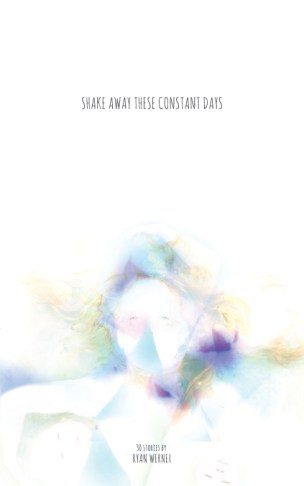
Shake Away These Constant Days. By Ryan Werner. From Jersey Devil Press.
A lot of people have asked about digital versions of Ryan Werner’s killer collection of flash fiction, Shake Away These Constant Days. And the great and terrible Jersey Devil has heard your prayers:
When I go to literary readings, I always take my notebook. Before I got my iPod, I took my notebook everywhere, but now that I can rely on the much slimmer iPod for emergency idea-jotting, I sometimes leave the thicker notebook at home. But at readings? I have to have paper and pencil to scribble the ideas that come up during those events.
Last night, I attended a Literary Mixtape reading here in Portland, at which Chloe Caldwell, Peyton Marshall, and Michael Heald read the works of other writers. Here are some notes I took at that reading, with some explanations of the notes. Next week, I’ll tackle of of these ideas and post that as my Notebook entry.
Before the readers on the list got rolling, a fourth reader (or, technically, a first reader), whose name I didn’t catch because I’d arrived five minutes late, stepped up and read Donald Barthelme’s “The Party.” In it, there’s this line about a brutish guy at the party: “Yes, it was King Kong, back in action, and all of the guests uttered loud exclamations of fatigue and disgust, examining the situation in the light of their own needs and emotions, hoping that the ape was real or papier-mache according to their temperments, or wondering whether other excitements were possible out in the crisp, white night.” It’s a weird line, especially in light of the fact that “Kong” seems to be a metaphor, though Barthelme treats him as both figurative AND real, so it’s hard to know what the hell to think.
Which is what sparked this idea to insert a mythic, monstrous character into an otherwise serious story. In retrospect, I think Bigfoot won’t work — it’ll read too much like one of those Slim Jim commercials — and choosing an alternate will be hard without it coming off like a Hotel Transylvania reference, but I’m still curious about the possibilities.
The “turtle story” is a reference to a story I started about ten months ago and drafted parts of right here in the Notebook. The draft has changed drastically since then, and I’m planning to do one more big revision on it — according to this and one other note I’ve made elsewhere — soon. The idea to send the narrator to the coast came while listening to Michael Heald read Rick Bass’s “Redfish.”
The words in quotes are the title of a memoir by Ray Johnson, which Peyton Marshall read from. (It’s fascinating, which is why I wrote down the title — I want to read this book!)
The rest of the notes I scribbled while Chloe Caldwell was reading. I missed the names of the two books she read from, but the final piece was “How It Started,” an unpublished story by Texas writer Mary Miller.
For next week, I can’t decide if I want to try a draft of the monster-at-the-party story, the rearranging furniture story, or the stoned road-trip essay. Thoughts, readers? Feel free to weigh in and tell me what to write!










 Samuel Snoek-Brown