I keep thinking about recapping the last of my AWP experience, but I realized that everything I forgot to say the last few posts — events I witnessed, readings I attended, sites I saw — I can also show you through the pix I took:
Los Angeles
If you’ve been following the last week’s posts, you know I walked myself raw: I wore a pair of socks on day one that I didn’t realize had worn thin in the heels, so I wound up with fairly massive blisters right from the start. (They’re fine now, by the way.) That meant I didn’t get out and explore as much as I usually do during conferences — but I did snap a few photos as I walked to and from the conference site.
Flying in over LA
Spotted on my way to the Convention Center
Spotted on my way back to my hotel
LA’s Central Library
Yes, let’s!
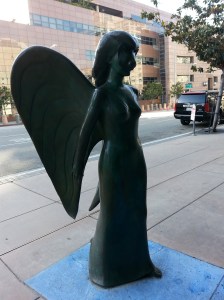
Catfaced angel
Catfaced angel
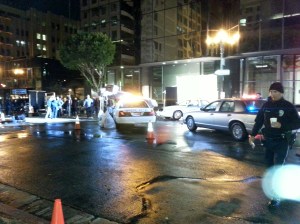
Walking through film sets
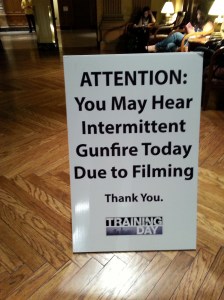
Coming back from the conference one evening, I noticed the roads were wet from rain, though I hadn’t noticed any rain that day. Police blocking the road and lights everywhere. Then I spotted a crane parked in the middle of a road suspending a huge, dripping bar overhead — it was a rain machine. The next morning, I walked through another film set immediately outside my hotel, and later that day, I finally saw a sign in my hotel lobby explaining what was going on.
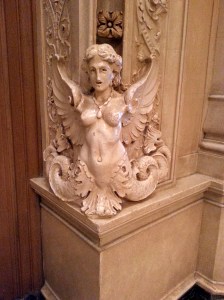
The Biltmore
Speaking of my hotel: I waited too late to book my conference hotel and wound up grabbing the first room I found in the last overflow hotel available. That happened to be the Biltmore, but I didn’t realize its significance until I was there in the building: the Biltmore is where the Academy Awards and the Oscar statue were invented, and the hotel hosted the awards for several years back in the early days. Which is important in our household because my wife — whose side-project research area is on librarians in film — is a HUGE Oscars nerd. So while I couldn’t get into the famed Crystal Ballroom where the Oscars used to happen, I did snap up as many photos as I could to share with her (and I hit the gift shop to buy her a small “Oscar” statuette labelled “World’s Greatest Wife,” because she is).
Panels
I only attended a handful of panels, most of which I’ve already written about, but I have to say that, in retrospect, I’d like to attend more panels next AWP. The panel load I used to stack up was, honestly, too much, so this year’s much-lighter load was a nice change. But I enjoyed these panels so much that I’d like to have squeezed in a few more.
Something else I’m noticing, now that I’m looking at these photos again: Women writers rock! All but one of these panels included men, and on the first panel I attended (on chapbooks), I didn’t know anyone presenting so I didn’t snap photos. But on every panel, pictured or not, the stand-out awesome folks were the women writers. They were the smartest, the funniest, the fiercest, the most insightful, the most memorable.
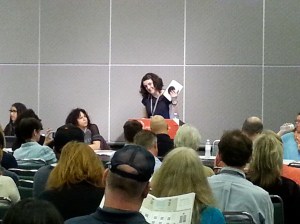
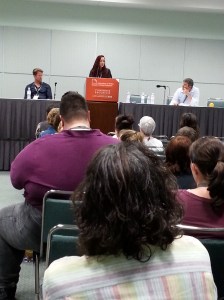
Mo Daviau heading a panel on writers debuting after 35
Mo being fab, as always
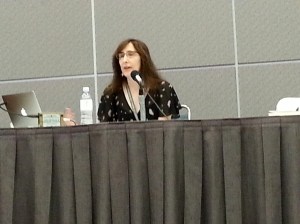
Jane Rosenberg LaForge talking about how California shaped her memoir
Joani Reese talking about writing as a “woman of a certain age”
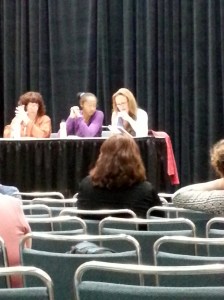
Beth Ann Fennelly being brilliant and glorious about moving from poetry to memoir
Tom Franklin (the longhair in the foreground) watching his wife be brilliant
Readings
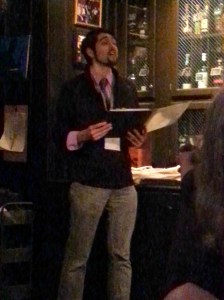
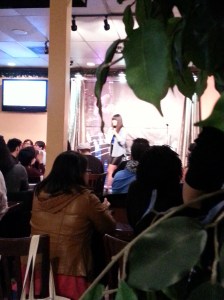
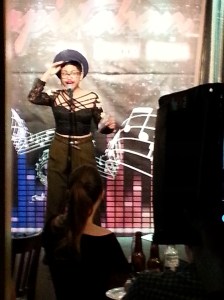
I backed off panels in year in part to make room for more readings, which was wonderful. I only snapped photos of two of the readings, and my phone is notoriously poor in low light, but no photo would have done these readings justice anyway. From the brusk but charmingly hipsterish bandana-ed doorman guarding the reading in the whiskey library so no one would interfere with someone’s poem, to the epic “literaoke” reading/karaoke mashup in a Filipino restaurant, this year provided some of the most colorful readings I’ve ever attended!
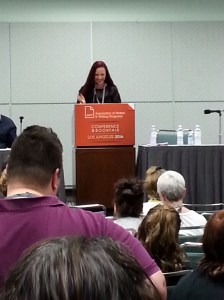
Derek Mong
Rebecca Foust
Jenny Yang
Angela Peñarendondo
Bookfair
Most of my AWP this year was in the bookfair. In recent years, I lamented having too little time to see the whole exhibitor list or hang out at particular tables, but this year I committed to walking the whole floor, table to table, row by row.
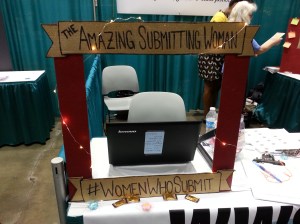
For some reason, this year looks a little less wacky than years past in the photos I took — fewer costumed writers shilling for their publications, fewer loud displays, and (for reasons of Convention Center policies) far fewer exhibitors pouring shots. But it was still plenty fun, with a lot of interactive displays and, most interestingly, a lot more exhibitors that weren’t writers or publishers or programs but creative businesses related to writing and publishing: digital typewriters, audio narratives that look like payphones, even a perfume company selling scents crafted after dead writers (the “Death in the Afternoon” Hemingway scent smelled like raw musk sprayed over a sweaty bull, which was alarming but perfect; I bought my own Lizzie Bennett of a wife the “Pemberly” scent).
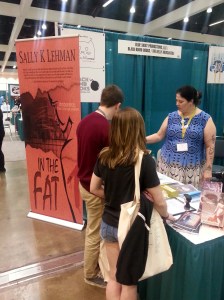
Sally K. Lehman chatting up her novel
The best “last day” sign I saw in the bookfair!
Blue Skirt Press’s Microfiction Monday Contest
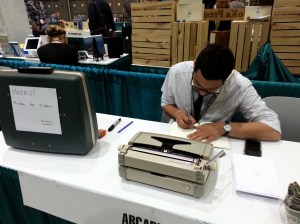
Chad Abushanab writing a haiku for me
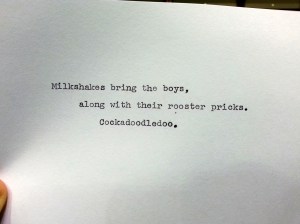
I gave Chad “milkshake” and “rooster prick” from the movie Before Sunrise
Chad Abushanab’s haiku for me
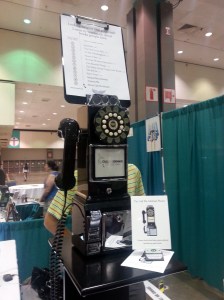
The “Call Me Ishmael” story phone
At the Lulu Fund table
Me listening to someone describe the first time they read Harry Potter
Me supporting Literary Arts by staffing their booth
Literary Arts put together this list of Oregon publishers and publications
PBS filming in the bookfair
So what did I pick up while walking the bookfair this year? Not as much as I wanted to — I took a lot of cards and bookmarks so I can continue shopping later, but when I left for AWP my luggage was full of books to sell, so I only had room to buy as much as I sold. Which I happily did, and I’m eager to start reading these new books and journals!
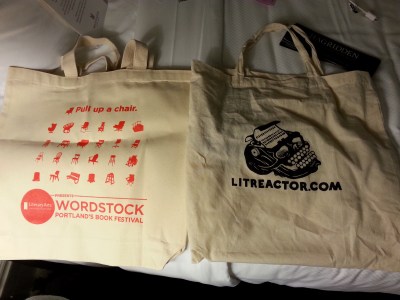
And, of course, I snagged a couple of awesome tote bags in the bookfair, too.
And then I packed all that up and headed home, eager for the next chance to hang out with writers and talk about craft and publishing and community — which is actually right around the corner, at the Terroir Creative Writing Festival in McMinnville, OR, where I’ll be talking about building stories from ephemera and trash! If you’re in the area, come join us!
It is late Saturday night. I am exhausted. I have blisters the size of my thumbs from the daily 2.5-mile walk from my hotel to the conference and back (not to mention all the walking in between, in search of books and in search of presses and in search of panels and in search of food and in search of drinks and in search of friends . . .). I have accumulated and laid out the swag I picked up in the book fair — a relatively light haul this year but plenty of amazing stuff for me to look at it later. I have taken stock of the books I brought and accounted for the ones I sold or gave to friends. I have downloaded all the photos I’ve taken and typed up all the notes I wrote during panels — craft notes and story ideas and observations.
I’ve said more than once in these posts that this year’s AWP was different from any other AWP I’ve been to. Today, I realized it was in many ways the reverse of most AWPs, at least in the sense that I started the conference exhausted and burned out and crabby, and I ended on an exhilarated high from all the connections I made, ideas I gleaned, hugs I gave and received . . . .
In fact, today was so full and productive and pleasant that I imagine this will be the longest of my posts, because I have to account for the experiences I had and the memories I created and notes I took. I also attended as many panels today as I attended in the previous two days combined, so there’s a lot to report on. And of course there are other photos, though I’ll probably save those for tomorrow. (If you’ve been following me on Twitter or Facebook, you’ve probably seen many of the photos already, anyway.)
I would like to begin today out on the streets, where, mercifully, I did not awake to construction for a change. Instead, I walked through a shootout in the streets — and a director yelling into a megaphone as the cameras rolled. Seems CBS is launching a tv show based on the film Training Day, and I walked through their set this morning. But television is small potatoes compared with the literary world of AWP! So, as I shared on other social media, instead I have to tell you the story of the woman I met in the elevator this morning.
Yesterday, I stopped by The Writer’s Hotel table in the bookfair and, after a conversation with the representatives, went ahead and signed up for a 30-minute manuscript consultation with an editor. Every little bit helps, after all! (More on that experience in a bit.) So this morning, I was going down to my hotel’s business center to print several pages from a novel manuscript so I could take it to the editor today. I wasn’t leaving the hotel, I wasn’t going to the conference yet, so I didn’t have my usual AWP paraphernalia with me: no tote bag, no name badge. And yet, when I got on the elevator and found a woman, similarly unidentified, riding down to the lobby, I was surprised when she glanced at me and asked immediately, “AWP?” I said yes and asked who she was with, and she told me she was representing Juxtaprose. Then the elevator dinged and we got off and went our separate ways, but I kept wondering how she knew I was part of the conference. Then I caught myself in the mirror and realized I was wearing my Portland Review tshirt, which I had brought on purpose to advertise the magazine and Oregon writing in general — but I had forgotten its relationship or, more accurately, its abnormality outside the writing world. Of course she knew I was a writer; of course she knew I was with AWP.
I told this story on social media this morning because it amused me, but this evening, I also discovered that Juxtaprose had reblogged my first post from AWP, so it turns out we had more connection that I realized in the elevator. I wish I had asked her name. I will definitely be paying more attention to the magazine.
I’ve been saying all along that this year’s AWP is different from years past, but I realized today that I’ve had a bit of a backward AWP: I started the conference cranky and sleep-deprived and ended it boisterous and eager to meet everyone.
And boy, did I meet everyone!
The theme of my conference this year, I think, has been no-win choices: it seems like everything I went to this year meant I missed something else equally amazing. Last night, for example, I was attending one event at the expense of another that I had been eagerly looking forward to for months. But it was one of those situations where, if I bailed on one thing, I would’ve been heartbroken to have missed the other. So I had a wonderful evening last night, and also was heartbroken to have missed a bunch of other wonderful people. The good thing was, today I managed to run into most of the people I missed last night, and many hugs were shared and many selfies were taken. So I suppose the takeaway is that, if you fully commit to AWP,even when you think you’ve missed the people you need to see, you will eventually see the people you need to see. Or at least that’s the way it played out this year.
One thing I think everyone needs to know about AWP is that Saturday is the free-for-all. AWP typically opens the bookfair to the public on Saturday; and also, because it’s the last day of the conference, exhibitors and vendors are eager to distribute their stock at whatever cost rather than have to ship all those books and journals home. So it’s a day of steep discounts, and seasoned AWP goers know this, so they frequently wait until Saturday before loading up their tote bags.
This was more obvious this year than I’ve ever seen it, and while there was a lot of interest in both my novel and my chapbook, I only sold one copy of each on the first and second days. Total. Both of them on the first day. Today, however I blew through two thirds of my stock, and I gave away a lot of bookmarks and business cards as well!
I also staffed the Literary Arts table during the lunch hour, and we distributed a lot of scout books and tote bags then as well. This is, in fact, good business practice, because people do eagerly take these items and often follow up on them. But it’s also a convenience for people like me whose luggage is already over stuffed with the things they picked up from other people’s tables. I was worried I wouldn’t be able to fit all of my stuff in my luggage — a common problem in each year — but today I sold a lot of books and made room for the books I bought, so I’m doubly happy.
Most gratifyingly, I’m told that while I was sitting at the Literary Arts booth, a pair of men were so interested in the last copy of Hagridden at the Blue Skirt table that they were nearly ready to armwrestle over who got the book. Apparently, they settled the dispute more amicably, and shortly afterward I brought in more stock from my backpack. But it thrills me to think that any two people were interested enough in my fiction that they were ready to wrestle for it. I wish I could’ve witnessed that.
When I signed up for my editorial consultation today, I wasn’t quite sure what manuscript I would bring, because I hadn’t intended to consult on my work in the first place. It was a spur-of-the-moment thing, an “impulse purchase” even though it was free. And the consultation was actually more an advertisement for The Writer’s Hotel Master Class, a kind of mini conference/workshop/retreat, but I listened to the pitch because I was genuinely curious, and when I saw that my friend Bill Roorbach was on the faculty, I knew it would be something special. So I went ahead and checked out the consultation.
My appointment was with Scott Wolven, and, on a whim, I decided to print out a chapter from my novel in progress. This is the same novel I took to Sewanee last summer, where I workshopped the first couple of chapters with Allen Wier. Again, I have waxed rhapsodic about Sewanee before and will do so again soon, but I need to say here that Allen’s insight to my book was deeply helpful, because he showed me the process that I could follow to develop the story and also, more importantly, he showed me the heart of my book and the humanity of my characters. In other words, he showed me my novel; he showed me myself as a writer.
Which is why, not under Allen’s advice but because I knew it was the right thing to do, I tossed a lot of the draft I had written beyond what I took to Sewanee, and last fall I started over with a new framing narrative to reconnect with the people in my book. The short chapter that I brought to Scott Wolven this morning was the first of that new material, because I wanted to see if I was on the right track based on Allen’s advice.
What wound up happening, in my brief 30-minute conversation, was fascinating to witness. I handed Wolven my pages, and he asked me for a bit of information about the book so he would have a context in which to read the pages, so I explained to him the plot as well as the thematic grounding of the book. And then he read a few sentences and out came the pen, and while I sat there watching, he started scratching at and scribbling all over my words, line by line, slash mark by slash mark, tearing the piece to shreds. And yet I could tell that he wasn’t simply digging into it for the sake of making my time worthwhile; he had found something immediately and was using that as a guideline by which to read the rest of the work, something I sometimes do when grading papers but haven’t witnessed from the other side like this before. Even when I was a student (well, more formally a student — in truth I will always be a student), all the response to my work happened “off stage,” so to speak. So it was harrowing to witness today as a writer, but it also was instructive to watch as a teacher, which made the second half of his reading all the more gratifying: eventually, he sat back in his chair and just read, nodding in places, getting my work and following my story and what I was trying to do because he was seeing it as a reader.
When he finally put the pen down and begin speaking to me again, explaining the notes he was writing on the first several pages, he showed me my own worst faults. He revealed to me the language things that I suspected I was doing and worried might be problems, but he didn’t simply point them out and tell me to stop doing them. He explained to me what they were doing in the text, how they affected the reading of the work. He became my audience, and then he spoke up.
So I knew the problems that he was telling me about, even before I showed him the text, but they were the kinds of problems that I allow myself to ignore because I’m still drafting, or because they’re stylistic choices, or because “that’s just how I write and other people need to get used to it.” And what Wolven explained to me today is that while other people might be able to “get used to it,” agents and editors and publishers don’t have time to get used to it and this is exactly the kind of thing that I need to be cautious with in my work if I want to share my work with a wider readership.
And he was exactly correct. And I knew it.
Some of his tips I’ll be sharing with my own students when I return to the classroom next week, or will file away in my brain to recycle on individual essays when I begin grading again myself. But mostly, it was a thrill to sit there as a writer and watch a reader — an intelligent, insightful, careful reader, exactly the kind of reader I want to write for — react to my work with mindfulness and constructive criticism. It’s been a long time since I’ve seen that in action. It wasn’t the kind of feedback that would help me develop a whole book; it wasn’t the kind of feedback that would allow me to tell this story in the first place. But it is the kind of feedback that will help me sell the story once I’ve told it. So while today’s consultation was free, it also was invaluable.
I think later, when I post photos, I will try to take inventory of all the people I met whose work I love so much. Tonight, let me focus instead on the panels I attended.
The details might also have to wait for a future post because I took so many notes and I felt like I had so many epiphanies today that I can’t cram them all into this tonight. If you’ve been following me on Twitter throughout the conference, you’ve probably seen some of the things I felt most noteworthy, but trust me when I say they were but a few drops in many buckets, so I have a lot more to share.
I will say this: I think it is perhaps not coincidental (as though the universe is my writing program) that I began today with a panel about memoir in which my friend Jane Rosenberg LaForge discussed her own book, a mashup of sorts, a blurring or even an ignoring of lines between fiction and fact, between memoir and fantasy; and I ended my day on a panel about poets transitioning into the memoir, in which the brilliant Beth Ann Fennelly insisted on maintaining the lines between genres if only to understand how to write one thing rather than another.
Jane’s book, An Unsuitable Princess (Jaded Ibis Press), is described by her and her press as both a “true fantasy” and a “fantastical memoir,” because it is in many ways both autobiography and fiction; or, more properly, it is an autobiography about the fantasy life she lived as a girl, so that we get to juxtapose the life that existed in the “real” world with the life that existed in her child’s mind. The concept, at least superficially, reminds me a bit of the “Expectations/Reality” split-screen sequence in (500) Days of Summer (also an LA story!).
It’s an idea I love, and I began my day thinking that there is no such thing as genre anymore — in fact, I caught myself telling that to more than one person in the bookfair this afternoon.
But then Beth Ann Fennelly, in the last panel of the last day, talked so eloquently about the distinctions between poetry and memoir, between fiction and memoir, between one mode or medium and another, that I remembered how important some of those boundries can be. I have long described Beth Ann as my favorite living poet, but I also have long extolled the beauty of her first nonfiction book, Great With Child, and I adore the novel that she cowrote with her husband Tom Franklin, The Tilted World, and, at least based on her work, I absolutely believe her when she says that poems and memoirs can never really be the same form. They are discrete forms, with different paces and different meanings.
It feels weird to write this, because years ago I attended an AWP panel in which Beth Ann talked about the similarities and relationships between prose poetry and flash fiction, and here, today, she was arguing something like the opposite. But what actually happened is that I am seeing that earlier talk in a new light, and she is so intelligent and so thoughtful and so precise in her definitions of how words and sentences and lines and narrative pacing function that I find myself agreeing with her whatever she says.
This all sounds contradictory, because I’ve been following her work for a long time and have a long, nuanced perspective on her evolution as an artist. But I’m telling you, her discussion today was brilliant and convincing, and I’m happy to report that she brought hardcopies of her prepared comments, like a President delivering her State of the Union to the press before she delivers it to Congress, so I can quote her verbatim in a future post and I intend to. Let me tell you now: you are going to thank me for this.
I often tell people that Tom Franklin is the writer I want to be when I grow up, but that’s partly because I don’t know how to be Beth Ann Fennelly. They are, collectively, the two people I most admire in the writing world, and even the little bit that I know them, the ability to send them an email once in a while or sneak up behind them at a conference and get a hug or sit in the room and hear them speak, has been such a privilege in my writing life.
That is probably the thing I have been thinking about the most this final day of AWP: the privilege of knowing these people, of working among them. I think this every year at AWP, as I make my way through the bookfair or the readings or the panels, as I hug writers I know and buy their books and beg them to sign their books for me. But I was thinking about it today in particular as I staffed the Literary Arts booth in the book fair. People would come up and ask what Literary Arts was, and as I began my spiel — they are a nonprofit in support of the literary arts in Oregon, they organize the Oregon Book Awards and Wordstock and the Portland Arts & Lectures series, they support Writers in the Schools, they are a host for or promoter of other reading series and other writers — I found myself each time, with each new person to the table, flush with a sense of gratitude. Not just for Literary Arts (though of course for them, because they made my first novel possible), but also because of what they represent. Obviously, they are a facet of the multitudinous, interconnected, beautifully mutually supportive writing community in Oregon, but they also are emblematic of the community that existed already. Literary Arts is possible because the writers are already there, they are already supportive of each other, they already make so much possible for each other. And that’s not just the case in Oregon but throughout the US, throughout the world. And AWP, for a few mad, exhausting days each year, represents that massive community. That flood of support and love. That depth of genius in craft and artistry. That I can even for a short while tap into even a small corner of that has been a tremendous privilege, and it has opened up so many doors creatively, professionally, emotionally. It seems strange to consider people that I see once a year and I know otherwise only online as genuine friends, as family, and yet that’s exactly what they are. We are family, related not by blood but by ink.
I didn’t use to be a hugger. I used to be fairly reserved, happy to shake a hand but always wary of too much intimacy. I am extroverted professionally, as a teacher, but my preference is for introversion, for solitude and quiet. Give me a choice between a party and a night home with my wife and cats, and I will choose my wife and cats every time. I like smallness and quietude and simplicity. Conferences like this, where tens of thousands of people congregate, many of them with an agenda —it can overwhelm a person like me. And yet, for these few days, it feels so necessary because it is, actually, not an opportunity for networking or salesmanship but a reunion. For a bringing together of the vast diaspora family I’ve found in art. I love these people.
I was not a hugger, but I became a hugger in the presence of so much love.
I only hit one panel today. The rest of my time I spent in the bookfair, meeting folks — most of them from the Sewanee Writers’ Conference. Which has been lovely!
I started the morning (after the construction woke me at 6 am) with breakfast at the celebrated Original Pantry Café. Remember my plane-mate from yesterday, J. Andy Kane? He messaged me about meeting up, so we made plans for this morning and chatted about teaching and conference panels and our experiences of AWP so far. While I was at the ALR reading last night, he attended the Claudia Rankine keynote address, which I’ve heard was intense. I wish I’d gone, though I’m glad I hit ALR and then got the rest I did.
Back at the conference today, I devoted much of my time to walking the bookfair, visiting tables and chatting with folks. I’ve surprised myself by not collecting as much freebie swag as I usually do at AWP (something my wife is doubtless glad of! I have a habit of cluttering the house with this stuff), but I did pick up a few books today, including some from Jellyfish Highway Press, run by my friend Justin Lawrence Daugherty — they just put out a chapbook coauthored by Kelly Magee, whose work I’ve admired since I helped pick her story collection Body Language for the Katherine Ann Porter Prize back in 2006.
I also got a poetry chapbook signed by Joe Wilkins, who teaches at Linfield College down the road from my community college in McMinnville, OR. (Joe also gave me a beer, which I needed by that time!) And I hung around the Literary Arts booth for a while, and spent some time shilling at the Blue Skirt Productions table off and on (how those folks do that all day I don’t know — they’re amazing!).
The rest of my day was mostly (finally!) reuniting with my friends from Sewanee Writers’ Conference. Tonight is the Sewanee Alumni Reception, so I wore my Sewanee tshirt to help advertise the conference (soon I’ll go change into slightly dressier attire for the reception), and the shirt helped draw a lot of attention to the conference but also helped my friends recognize me.
It’s been a wonderful, if for now piecemeal, reunion, and I’m struck by how these people, many of whom I only knew for a couple of weeks last summer, feel so much like family. It is genuinely exciting to reconnect with each of them, and everyone is quick to rush in and hug me.
Others have asked whether they ought to apply to Sewanee, and I tell all of them yes, immediately and enthusiastically. “How was it?” they ask. Transformative, I tell them. Transcendant. Profound. The greatest, most important two weeks of my professional life, I tell them. And sometimes I worry even that is underselling it.
It’s hard to explain to people, really, just how much Sewanee meant to me as a writer. I tried in a post from shortly after the conference, and I will try again in a week or so as I post some comments from some of my Sewanee colleagues. But let me say quickly, here, that the deadline to apply this year is April 15, and if you’re a writer, I cannot urge you strongly enough to put in your application.
One other Sewanee connection, and the best thing to happen in the bookfair today: this afternoon, I found my friends Tom Franklin and Beth Ann Fennelly (both Sewanee alumni). For folks new to the blog, you should know that I love these two people. Tommy is the writer I want to be when I grow up, and Beth Ann is my favorite living poet by a long shot. (Though, interestingly, she’s moving into memoir now, and you guys, if you haven’t read her book Great With Child: Letters to a Young Mother, stop reading this and go order a copy right now. It’s stunning.)
Tommy and Beth Ann were chatting with someone, so I just hung back until I could say a quick hello. Tommy spotted me first, and after I hugged him and Beth Ann, they introduced me to the guy they’d been chatting with — and it was Dennis Lehane! You know, the guy who wrote Shutter Island, Gone Baby Gone, Mystic River . . . .
I’d heard Lehane on the radio awhile back, doing an interview on public radio about craft and fiction, and I found him profoundly interesting. And here I was shaking his hand! Then Tommy (who blurbed my novel Hagridden) told Lehane about my book, and Lehane leaned in with his phone and snapped a photo of my business card so he could look up my book later.
It’s like everyone’s dream version of AWP, and here is was happening to me!
I had goosebumps for half an hour.
At one point midmorning I slipped away to attend a panel headed by my friend Mo Daviau. The panel had the excellent title of “We Got Here As Fast As We Could: Debut Authors Over 35,” and I went partly because I love Mo and her work, and partly because I am a debut author over 35 — my chapbook came out when I was 37 and my first novel arrived on my 38th birthday.
It was a great panel, full of humor and insight and some hard truths, and it did what great panels do best for me: it made me think. Better still, it made me write. Seating was scarce so I stood in the back, leaning against a trashcan, and not five minutes into the panel I heard something that made me whip out my notebook and use the trashcan as a desk.
This (more or less) is what I wrote:
I’m struck by how layered writers’ lives are. One of the panelists said she was baker — that baking took up the bulk of her time not spent writing. She said how much she valued the physicality of baking, that she couldn’t imagine a life in which her job mostly sitting down and working on a computer eight hours a day and then coming home to sit down and write on a computer.
And I caught myself in a kneejerk reaction: Oh, so you’re a baker who writers — you’re not a writer.
Which is a stupid, snobbish reaction.
I think many writers work so long and so hard — we invest so much time and money and energy and love in our work — that we feel anyone who does anything other than writing is just a dabbler, an unserious interloper into the profession. And it’s true that my job — teaching writing — allows me to pretend that I don’t segregate my life, that my writing is teaching and my teaching is writing, so I am a “real” writer.
It’s an attitude many people share, even non-writers. Another woman on the panel talked about telling people she wanted to write and how people would respond with, “Oh, then you want to be a teacher!”
But the real truth is that we all fill so many roles in our lives. I am a writer and a teacher. A friend of mine is a writer and a bookseller and a publisher. Another friend is a writer and a librarian. Another friend is a writer and a manager of a college’s student union. Another friend is a writer and a casting agent. Another friend is a writer and a patent attorney. Another friend is a writer and a cabbie. Another friend is a writer and a musician and a school lunchroom worker.
We could have another conversation about compensation for writers — for artists of all kinds. There are certainly plenty of us who would love to make all our living from our words. And just as certainly, the industry we work in and the society than supports literature afford too few of us that choice.
But I think there are plenty of us who would choose to teach, or bake, or work on patent law, or work as a casting agent, or drive cabs, even if they could just quit everything and write for a living.
Because we can be more than one thing. We can have more than one identity. We can do anything we are attracted to doing or anything we have to do to pay the bills, and we will still be writers.
If AWP teaches us nothing else, it is how huge — how expansive, how inclusive — the world of writing and writers is. It’s academics and publishers and full-time writers, yes, but it’s also everyone else. Anyone who wants to put the best of themselves, the worst of themselves, the purest form of themselves into words and to share those words with others.
I’m writing this post in two parts. I began it in the morning, wearily sipping coffee at the desk in my hotel room, but I will finish it late tonight.
This morning I’m writing about my journey here last night and my exhaustion (already!?) this morning; later, I’ll recap the day.
The trip here, really, was fairly uneventful. I taught class yesterday (hi, WR 115 students!), so I had to catch a late flight, but I had already planned and packed so I didn’t have to rush for the airport.
And I had a charming taxi driver. We talked languages — he’s Kenyan but after he had a brief phone conversation with his roommate, he explained to me that he had been speaking Somali on the phone. He was trying to explain that he wasn’t speaking Arabic, but I told him I already knew that: I only know enough Arabic to give directions to a taxi driver, but I knew whatever the tonal similarities in modern Somali, it wasn’t Arabic.
He chuckled at my “Arabic for taxi drivers” line and told me he didn’t speak any Arabic at all. “I really only speak two languages,” he said. “Somali, even though I’m Kenyan, and English.” And he explained he was still struggling with English. I told him I understood — I had a little French from high school, but I’d mostly forgotten it.
“Yes!” he said. “It was like this too, for us. We learned Arabic, they tried to teach it to us, you know, in the schools. In the high school. I did okay I guess, but I forget most of it now. I’m learning English.”
While we were talking, an obnoxious, repetitive, oversimplisitic pop song was playing on the radio, and during the chorus the driver started laughing at it.
“Music today!” he said. “Makes it hard to learn English, yeah? That’s bad English, yeah? But it’s how we learn!”
I laughed along with him and he switched off the station, but he pointed at the silent radio. “It’s hard, though. Learning English. I try, but all the new words! English takes so many words, so many. All the time, new words coming in, yeah? We can’t catch up!”
I told him he wasn’t alone there — I could barely keep up myself!
On the plane, I noticed that a woman in my row was writing in a notebook. I knew immediately that she was headed to AWP, same as me — same as most of the plane, I suspect. I even tweeted about it (though in the dark in my hurry to tweet before shutting off the phone, I misspelled “I love writers!”).
Woman in my row writing in a notebook, because #AWP16. Literally: "BRAINSTORM" in a lightning cloud at the top of her page. I live writers!
Turns out the guy seated between her and me was also a writer, also headed to AWP. I didn’t catch the woman’s name because it’s always awkward talking around other people, but the guy I sat next to was J. Andy Kane, a fiction writer like me. (The woman at the end of the row was also a fiction writer — we enjoyed the fact that we were on Prose Row in the airplane.) Andy and I struck up a conversation because he was curious about the novella I was editing, and when we landed, we split a cab downtown and talked about Cormac McCarthy, because really, you get two white male writers of a certain age together long enough, sooner or later they start talking about McCarthy. Especially if I’m one of those writers.
So, all in all, a pleasant trip down, even though I didn’t get settled into my hotel room until 1 am.
And then the construction began.
Seriously: after just a few hours of sleep — before the sun was even up — I awoke to raucous construction sounds: machinery, crashing rubble, jackhammers, shouting men, that beeping alarm of a big truck backing up. Sometime around 5 am!
I’m up on the 8th floor in my hotel, and I can’t even see the construction out my window — I think it’s down the block somewhere — but I might as well be standing on the sidewalk watching it. The way sound carries in these urban canyons is amazing.
I’m usually not this tired until day three of AWP, day two at the earliest, but man, I’m starting this conference off exhausted already, so who knows how long I’ll manage to keep up with all my busy, hard-partying friends. The second half of this post might be awfully short.
But I have a full day ahead, and I’m eager to get to meeting folks, so I’m off until tonight.
Well, it’s currently 8 pm. I should be at a pool party right now. But it turns out that I’m nearly 40 years old, and my knee hurts, and I slept too little, and whatever other excuses I can pile on here. And even though those are all just excuses, I’ll add one more — the most important – and tell you that I’m making good progress on the novella revisions I owe Blue Skirt Productions, and I’m perfectly happy for any excuse to call it an early night so I can sit in my (now relatively quiet) hotel room and write.
Not that it hasn’t been a full day.
But, as I hinted in earlier posts, it’s been a different kind of full, one in which I get to do my own things according to my own agenda, and much as I love having students assign me homework (tit for tat, y’all!), I am liking this new, arguably purer way of experiencing AWP.
So, things I’ve gotten up to today while I’ve been my own boss:
By the time I’d walked the 1.2 miles from my hotel to the conference, found the line for registration, navigated my way through the meandering ropes in order to register, and then found my way to the post-line line to pick up my tote bag and a lanyard, I had not only missed my 9 am panel, I was nearly running late for the 10:30 panel.
Still, I made it to a solid panel — right there in the bookfair itself — on chapbook publishing. I can’t say that I learned anything I didn’t already know (I’ve written about chapbooks here in this blog before, and I’ve published one already and I’m publishing another later this year), but it was a good panel, full of quips and one-line advice, some of which I tweeted during the discussion.
"A #chapbook doesn't want to be a 'real book' when it grows up." Kate Asche at #AWP16
More interestingly, though, one of the panelists is an editor at a press where I’ve recently submitted a chapbook (fingers crossed!), and even better, when I laughed at a panelist’s line disparaging a certain Hollywood celebrity who thinks he’s a writer, a friend of mine recognized my laughter (apparently, I have an immediately recognizable laugh) and snapped a photo of me during the panel. Thanks, Jane!
Photo courtesy Jane Rosenberg LaForge.
Afterward, with no other panels on my agenda, I headed to the Blue Skirt Productions table to help staff it for a while.
I love helping friends sell books that I believe in, and sure, Blue Skirt is publishing a novella of mine later this year and is including me in their microfiction anthology that comes out in May, but anyone who followed my AWP posts last year knows that I’ve been a fan of their books for a long while. So it’s no trouble for me to hawk Blue Skirt‘s not-really-YA child abuse series by Gayle Towel, or their haunting psychopathic-prophet novella, or their veterans’ War Stories anthology, or their Butch/Femme photo anthology, or their adult coloring books. Also, they’re sharing a booth with Sally K. Lehman, who has two books that I have blurbed before, her parental grief anthology Bear the Pall and her powerful novel In the Fat, so it was no trouble to help sell those books either.
What I found interesting today was how quiet I become and how strong my impulse is to slink into a shadowy corner and disappear whenever anyone at that table celebrated my work. Blue Skirt and Sally were kind enough to let me set out copies of my chapbook Box Cuttersand my novel Hagriddenfor sale, and they sold books for me. But to hear anyone describe my novel, for example, as one of their favorite novels ever, to hear people compare it to books like Slaughterhouse-five or The Red Badge of Courage — I honestly don’t know what to do with praise like that. It’s one of the things that makes me such a terrible salesman of my own work. I believe in the stories that I write, and I believe that they are worth sharing with other people. But I don’t know how to celebrate them in the same way that I celebrate the works of others.
So that was an interesting experience today.
Eventually, my poet friend Brianna Pike found me and we went to a late lunch, where we talked about fitting our writing into our busy lives, and teaching at community colleges and the pleasure we take from that — the essential importance of that level of work — and how fortunate we feel to have spouses who support our creative endeavors.
She is also a dear friend, and she is one hell of a poet. One of my all time favorites. And over lunch we talked about her own manuscript, which is coming together, and which I am so eager to see in print.
Bri and I had a lot to catch up on, so our lunch ran long, and afterward I stopped in at the bookfair only long enough to sell a copy of one of Blue Skirt’s coloring books before I had to grab my bags and head off to another panel.
I chose a panel on teaching students who want to write about social justice, mostly because last term, in my introduction to composition class, I had a student write about her experiences as an immigrant to America, and another student write about her experiences as a woman in a male-dominated profession, and another student write about his experiences as a mixed-race child in an impoverished, single-parent family. Each of them touched on so many deeply important issues that I, as a cis white male from a moderately impoverished but relatively privileged to background, could never write about myself. So I wanted to learn some techniques for how to guide students through writing about experiences that I don’t share.
The panel was good, though mostly the panelists adopted a formal, “academic conference” approach and simply read from papers, so while I learned some things, it wasn’t as engaging as I wished it had been. Still, I took note of their names so I could look up their work elsewhere and continue to learn from them, because they had some good ideas.
And then it was off to a reading hosted by the American Literary Review, the magazine I used to work for when I was in my doctoral program at the University of North Texas. I’ve always had an affinity for that magazine, and I have become fiercely defensive of it in recent years as the university has cut its budget and taken it from a renowned print magazine to an online-only magazine. (I love online mags and ALR is still a hell of a publication; it’s not the medium but the budget issues that bother me).
And UNT continues to draw strong writers as students, so I always enjoy meeting the new cohorts in my old program. Last year, in fact, I met the former managing editor Caitlin Pryor, who impressed me tremendously at the time. Later that same summer, we reconnected at Sewanee Writers’ Conference, where she was studying with the poets, and we became good friends. Tonight, I reconnected with Caitline and some of the other ALR alumni from last year, and I also met another fellow fiction writer and another poet, as well as the new production editor (my old job at ALR), and every one of them made me miss my old grad-school days!
This year’s reading was at a whisk(e)y library, a dangerous place for me because I am such a fan of whisk(e)ys. The back room that the magazine reserved was small and a bit crowded, but it was a perfect location for a literary reading, and the work people read was beautiful. Most interestingly, from a personal perspective, was that one of the poets is a newly transplanted Portlander (I got a lot of laughter when I woo-hooed a shout-out to Portland during his bio) and another was, to my surprise, a fellow Sewanee alum from this past year. So it was a fantastic way to end my evening.
Not that the evening itself has ended. Most of the people at the ALR reading — and a few other friends who messaged me later — tried to convince me to join them for a dance party later this evening. Because sometimes I think this is the real purpose of AWP: to bring writers together not to share their work or sell their work or even to talk about their work, but simply to enjoy each other’s company, in party after party.
And there was a time I would’ve joined them, even though I look terrible in a bathing suit and I can’t dance for anything. But the truth is, I am now middle-aged, and I feel it. Particularly after such a rough morning, after so little sleep, with so much work ahead of me.
#AWP16 folks are all: Bar party! Pool party! Dance party! I'm all: I just want to work on my book. #AmOld#NotSorry
I found, walking away from the bar tonight, that I was looking forward to my hotel room, where I could pull out my writing and get back to the work of revision. Because really, whatever else we’re here for, isn’t that the point?
Every year, writers and publishers put out all manner of guides to AWP: panel guides, readings guides, bookfair guides, etiquette guides, bar guides, survival guides . . . .
I’m not going to chime in much, because there are plenty of other guides for you to choose from. But I will share a few things on my online radar as I head into next week.
The first is Entropy’s perennial guide, though it’s really just a list of panels, offsite events, and bookfair happenings they think are going to be cool. I’m a fan of Entropy, and I generally agree with their sensibilities — the events on their list are going to be cool — so check out their post here.
Of course, I’m using AWP’s app to keep track of my own schedule, so I could pull an Entropy myself and share my list with you here. But it’s a L O N G list, with a lot of double- or triple- or even quadruple-booked time slots (Saturday at 9 a.m. I have four different panels I absolutely have to be at, so either I’m going to master Hermione’s time-turner by this weekend or I’m going to have to make some tough choices!), so there’s not much use in sharing my mess of a schedule. And besides, a lot of my schedule duplicates Entropy’s anyway, so feel free to check theirs instead.
And you’ll want some help narrowing down your own list, because seriously, the conference is massive this year. Today in class, I told my students there were hundreds of events at this thing; I just checked the schedule, and I actually underestimated! I’m seeing roughly 640 panels, 155 offsite readings (plus another five that are technically before the conference begins and yet another five after conference ends!), and more than 700 book signings in the bookfair. (I’m glad I counted, too, because I spotted a couple of authors signing books I’d missed my first run-through of the list!)
There’s also a slew of events listed on Facebook, some of them unofficial and therefore not on anyone’s schedule. I have two series of book signings I’m eying: the string of book signings at the Press 53 table, and the booth-hopping Joe Wilkins (who works just down the road from my community college in McMinnville, OR — he teaches at Linfield College); Joe is going to be signing at four different tables on Friday, April 1:
1:00-2:00 pm: University of Arkansas Press, table #1033 (When We Were Birds)
2:00-3:00 pm: Story Catcher Writing Workshop & Festival, table #1945 (all his books, presumably including his Red Bird Chapbooks poetry collection — we’re going to be pressmates! — and his Iron Horse chapbook)
And just a reminder: I’ll be at the Blue Skirt Productions table (#657) and the Literary Arts booth (#1639) from time to time, which are good places to find my books (and yes, I’ll have a Square reader for folks who aren’t carrying cash). Portland author Kate Ristau also has invited me to hang out with some of the Willamette Writers crowd at the Timberline Review table (#106), which I was going to do anyway because they’re sharing space with Portland’s Future Tense Books (have I told you lately about their new book by Monica Drake?), so expect to find me there, too!
All of which is to say, I can’t really offer you much of a “guide” to AWP because we’re spoiled for choice this year, and you’re bound to have a great time whatever you do. So really, my only other suggestion is this:
Stay hydrated, and get some rest. Seriously — I know the panels and readings and signings and events can carry on from breakfast til long after midnight, and practically everything involves drinking of some sort, but you don’t have to do (or drink) everything, and you’ll enjoy what you do get to a lot more if you’re actually awake for it. So be kind to yourself.
So, it’s that time of year again: the annual orgy of drinking and books that is the Association of Writers and Writing Programs conference and bookfair, where writers emerge from our writing spaces and squint in the light as we greet each other with, “Oh, I know you on Facebook!”
This year is going to be a bit different for me, though. Usually, I introduce the conference to my writing students and have them select panels and readings to send me to. But this year, I am going to have exactly one class period — the first of the term — before hopping a plane to Los Angeles, and I’ll be doing good to introduce my course, let alone the conference. So, for the first time since I started attending AWP back in 2005, I am my own man.
That means a (slightly) more relaxed conference for me, in which I can focus on panels related to my teaching (and panels my friends are on), and it also means more time for offsite events and bookfair browsing.
That latter part — the bookfair — is going to be different for me this year, because while I’m affiliated with four different publishers now, only one of my publishers is going to be at AWP. When I first started attending, I was working for American Literary Review and spent a lot of my bookfair time hawking the magazine. And a few years ago, when I first returned to AWP after a few years overseas, I spent a lot of my bookfair time at the sunnyoutside press table, promoting my then-new chapbook, Box Cutters. But this year, sunnyoutside is missing the conference, and Columbus Press (publisher of my novel, Hagridden) isn’t going to be there either. Later this year, I’ll have a new chapbook coming out from Red Bird Chapbooks, but they’re not on the bookfair list this year, either.
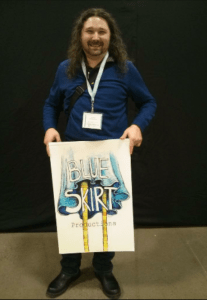
Me “wearing” the Blue Skirt sign at last year’s AWP.
That leaves Blue Skirt Productions, where I spent a lot of time last year because they’re awesome and where I plan to spend a lot of time this year because they’re publishing my novella. But that book won’t be out til later this year, either — I’m still working on edits — so I’ll mostly just be hanging around with their amazing writers and publishers and plugging all the other great books they put out.
So if you’re looking for me in the bookfair, try the Blue Skirt Productions table, #657:
I’ll also be helping out at the Literary Arts booth, where you can learn about the Portland Arts & Lectures Series, the Oregon Book Awards and the Oregon Literary Fellowships (I was a recipient in 2013), Writers in the Schools, and the Portland writing scene in general.
The Literary Arts booth (#1639) is also a good place to pick up copies of my two books: I’ll have them with me. After all, Hagridden was the book whose early drafts helped me earn an Oregon Literary Fellowship. So come see what that fellowship helped me finish!
Also, my first book, Box Cutters, is nearly sold out, so if you want a copy of that, come find me at the bookfair. The publisher has a handful left that you can order direct or pick up at bookfairs back East, but I have all the rest — a dozen copies! — and chances are, after AWP, they’ll all be gone. That’s the last of the print run. So get yours while you can!
You can probably also find my lurking around the Sewanee Writers’ Conference table (#904) from time to time, because I’m eager to plug that program and would love to run into some of my new friends from last summer’s conference. (In fact, some of us are threatening to break into impromptu readings right there in the bookfair, so stop by and see if you can catch the fun!)
And I’m sure I’ll be hanging around the American Literary Review table (#416) a bit, too. And the One Storytable (#541), a favorite since my first AWP 11 years ago. And the Press 53 table (#530), home to a handful of my favorite writers (Liz Prato, Grant Faulkner, James Claffey, Bonnie ZoBell, Clifford Garstang, and on and on); I hung out there last year in support of Liz Prato and the release of her book, and I met a lot of the press’s other writers and wound up having drinks on the last night with publisher Kevin Morgan Watson.
And . . . I could practically copy the whole bookfair list here, frankly. And probably should, because I’ll certainly be making the rounds of all of it — in fact, since I am on my own schedule this year, one of my goals will be to spend a few minutes at every table. I don’t know if that will actually be possible — with more than 800 exhibitors and less than 30 hours of actual bookfair time, I could spend two minutes at each table and do literally nothing else at the conference — but I’m going to give it a shot!
So if you’re in LA at the end of March/beginning of April, you’ll know where to find me. See y’all there!
You read that title right, gang: my first book, the flash-fiction chapbook Box Cutters, has nearly sold out of its print run. I received ten of them in the mail today, and sunnyoutside press has a handful more on their end, but that’s it. Enough people fell in love with that book that it’s almost gone from the world!
These are the last of the Box Cutters!
This is one of the things I like about chapbooks, actually: when they’re done right, each book is a work of art in its own right, the design and production of it as beautiful and distinctive an artifact as the words the books contain. And I’ve heard a lot of praise for the artifact of my book — not just the words in it (though, thank you all for loving those words!) but also the design of it: the shape and size of it, the texture of the cover, the individually stamped silver box cutter on the cover, the hand-sewn binding, the font choice, the texture and color of the pages. In fact, if you have a copy, look closely at all those tiny fibers visible in the paper — they’re meant to resemble the fine cardboard dust you get from slicing open a box with a razor blade. That’s the kind of artistry and attention to detail you only get from a small press publishing small runs of chapbooks.
And like works of art, they are limited. There are only so many in the world. Collect them, and cherish them.
If you still want a copy of Box Cutters for yourself, you can order one of the last copies from sunnyoutside. Or you can find me at AWP in Los Angeles next week — I’m bringing my whole stack with me, the final dozen, and if you find me, you can get one straight from the author.
And if you already have a copy of Box Cutters, well, thank you. So. Much. It’s a small book, but it was my first, and it was beautiful, and it will always hold a special (sharp, edgy) place in my life.
I often share lists of books or lists of writers here on my blog, for a whole range of reasons — books I’ve bought in the past year, friends with work coming out, reading challenges. At least three times now, I’ve shared lists of women writers, but that list keeps growing, and it’s become something of a tradition here on the blog to share lists of women writers or books by women during Women’s History Month and in the vicinity of International Women’s Day. So, here’s some more:
For some background, you can see some lists of women writers I love from back in 2010, 2014, and 2015.
But within the past year, I have either bought new books or got round to reading older books by these amazing women:
But that’s not all! Earlier today, the Facebook page for the Willamette Writers organization here in Oregon asked for our favorite women authors, so of course I chimed in with a long list. Among the women not already on that list above, I also named Beth Ann Fennelly, my favorite living poet; Alice McDermott (her craft lecture at Sewanee Writers’ Conference this past summer was even more amazing than her novels!); Mary Shelley; Charlotte Brontë; Jonis Agee; Leesa Cross-Smith; AS Byatt; Sandra Cisneros; Alice Munro; Toni Morrison; Annie Proulx; Margaret Fuller; Marie Marshall; Alice Walker; JK Rowling, of course; LM Montgomery; Anne Rice (I stand by her early work); Francine Prose (her Reading Like a Writer is one of my most-recommended books).
And of course there is the WEALTH of amazing women writers here in Portland: in addition to some of the women above (Kelly Sue DeConnick, Monica Drake, Carson Ellis, Sally K. Lehman, Margaret Malone, Kate Ristau, Gayle Towell, Ellen Urbani, Lidia Yuknavitch, and too briefly Jenny Drai and Alexis Orgera), we also are home to Alexis M. Smith, Cari Luna, Carrie Seitzinger, Chelsea Cain, Cheryl Strayed, Dena Rash Guzman, Domi Shoemaker, Elissa Wald, Emily Kendal Frey, Heather Vogel Frederick, Jean Auel, Jenny Forrester, Jessica Standifird, Karen Karbo, Kari Luna, Kate Gray, Kerry Cohen, Kristina McMorris, Lili Ristagno, Melissa Dodson, Mo Daviau, Olivia Olivia, Rene Denfeld, Evelyn Sharenov, Natalie Serber, Nicole J. Georges, Ruth Tenzer Feldman, Suzy Vitello, Ursula K. LeGuin, Walidah Imarisha, and, of course all the AMAZING women I haven’t named from the celebrated all-women Unchaste Reading Series.
And those are just the ones I know of, just in the Portland area!
And then there are the books still arriving later this year. There’s also Bethany Lee, Kelly Magee, and Gwendolyn Edward, three friends/acquaintances of mine with chapbooks coming out from Red Bird Chapbooks later this year (I’m thrilled to be their pressmates!)
And on, and on. So many women, so many amazing books!
So today — and tomorrow, and next week, and all year; but especially today — pick up a book written by a woman and share it. And please, feel free to add names and titles in the comments!
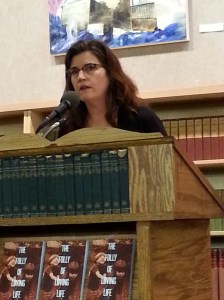
The other night (on Leap Day!) I headed to Powell’s City of Books here in Portland for the release of Monica Drake’s already-lauded new book — her first story collection — The Folly of Loving Life.
I love Monica’s work, her two novels and the wonderful essays she publishes, and she also happens to be a friend and neighbor of mine; I’m also a huge fan of the publisher, Portland’s own Future Tense Books. So I’ve been eager for this book for a long while, and I preordered my copy and picked it up at a small “soft release” party on Valentine’s Day. Between then and Leap Day, the book started getting great buzz. Writer friends like Lidia Yuknavitch and Cheryl Strayed have been praising it on social media. Willamette Week said that “reading these stories is a bit like finding a beautiful painting of a wound” and raved about the book’s tribute to a changing Portland. Portland Monthly called it an “emotionally attuned and haunting collection,” and they ran an interview with Monica full of beautiful writers-life gems:
Writing’s really hard, and I am not fast at it, so you have to be in it for the long haul. And if you’re going to be in it for the long haul, it has to be enjoyable. I’ve been doing this for 25 years now, and so how are you going to get through 25 years when you’re going to have a lot of rejection? When you’ve got really cool people you can talk to and share your work with and maybe get them to recite your lines once in a blue moon, that’s big feedback. Plus you get to see their work and see it grow and evolve. That’s just a dream. That’s the only way to do it, I think. There are some writers that just like to write in isolation, but I don’t know—you just gotta keep it fun somehow. People think of that word “fun” as trivial, but it’s really so crucial.
I shared that quote with my students this week, after a particularly good day of workshopping in class. One student emailed me to thank me for the quote. “That’s just what I need to hear after writing all night,” he told me.
Also, there was this beauty — again, connected to the community of writers in Portland:
I was writing these short, kind of cuckoo stories, and I was down at Powell’s one time and heard someone talking loudly. I realized they were reciting lines from these little immature stories I’d been generating, and it was Chuck [Palahniuk]. He was calling out to me by remembering sentences that I wrote. It was so funny and flattering and interesting, and I think it was gestures like that that made writing really fun. Those kind of things built the community and kept me personally writing, and in some ways it is just an extended conversation with those writers that I love. I’m just lucky to have the writers I love right in the room.
It’s a sentiment she repeated this past Monday at her book release, and indeed, the room was not only packed to the rafters, it also was chock full of writers, and many of them were writers Monica knew well enough to call out by name during the Q&A. Liz Prato. Lidia Yuknavitch. Domi Shoemaker. Portland literary goddess and Unchaste Readers series founder Jenny Forrester. Celebrated publisher Laura Stanfill was taking photos, and so was author Davis Slater. Poet Barbara Drake (Monica’s mother) cheered from the audience; Chuck Palahniuk sat unassumingly in a corner and applauded his old friend.
But because this is Portland, there were also so many other writers in the room that none of us could have known them all. While I was sitting quietly in my seat waiting for the event to start, I spotted Chuck Palahniuk and sneaked a photo of him to send to my brother, who is also a big Chuck Palahniuk fan. A moment after I snapped my photo, a woman sneaked over to Palahniuk and quietly apologized for disturbing him. She showed him a tattoo on her arm. They chatted for a few moments, then she returned to her seat near me. A guy behind me said, “What’s your tattoo?” She pulled back her sleeve to show him a passage of text from one of Palahniuk’s books.
“Oh, I thought that was him!” the guy behind me said.
“I thought so too,” she whispered. “I wanted to ask someone, but I didn’t want to broadcast it and make a big scene.” I noticed that tucked underneath the woman’s brand-new copy of Monica’s book was an issue of the comic book, Fight Club 2.
A few minutes later, that same woman turned to the man behind me and said, “Didn’t you have a book out recently? I think I’ve seen you read here before.”
The guy chuckled and demurred. “No, ha ha. Not me.” Then he added, “I just have the one book, and that was six years ago.”
Because of course he had a book. This is Portland.
“You?” he asked the woman.
“Well, I hope so!” she said. “I’m trying!”
Because of course — we all have books in Portland.
“I feel like everybody’s writing,” Monica told Portland Monthly in her interview, “and everybody should be writing! Portland is just lucky and thick with it.”
And that’s the thing I love most about this town. For all of Portland’s growing pains the past several years, one thing has remained, has gotten even better: our writing community here is vast, diverse, interconnected, and hugely supportive. New writers alongside established writers, unknowns chatting with the famous (and the infamous), genre writers working with literary writers.
“I think Portland has an amazing writing community too,” Monica told Portland Monthly. “Writing isn’t just the written work that we make, it’s the whole approach as a value system and a lifestyle, and I love the way the different networks of writers have gotten closer together in Portland.”
And that’s one of the things that makes Monica Drake so necessary to the Portland writing scene. She gets this city; in many ways, her writing is this city. “While [her] novels are more character studies, involutions of eccentricity,” Matthew Korfhage writes in his Willamette Week review of The Folly of Loving Life, “among the shorter narratives here it is place that feels most freshly described: the art museum, the cul-de-sac neighborhoods whose roads are all named the same. [. . .] Time was, you’d give a newcomer Palahniuk’s book Fugitives and Refugees to show them what living in this city is like. Maybe from now on you’ll give them this one [. . .].”
You can pick up The Folly of Loving Life through your local bookstore (ask them to stock it!) or online from Powell’s or directly from Future Tense Books. (Yes, it’s on Amazon, too.)
“I have talked to other crime writers that have been urged by various professional people in their life to put the word girl in their title,” says [crime novelist Megan] Abbott. “It’s not necessarily an issue with the content of the book itself, but there’s this sort of shorthand that if it has ‘girl’ in the title, then I know what to expect.”
That calculus seems to be at work with a book that arrived recently at NPR’s offices: Girl in the Dark, by Marion Pauw, described by its publisher as “in the vein of blockbuster thrillers such as The Girl on the Train and The Good Girl,” by Mary Kubica.
Of course, this got me thinking about titles in general. Stieg Larsson’s entire Lisbeth Salander series, beginning with The Girl with the Dragon Tattoo and continuing posthumously with the The Girl in the Spider’s Web, written on commission by David Lagercrantz. Simon Mawer’s The Girl Who Fell From the Sky. The new Brian K. Vaughan comic book series I’ve fallen in love with, Paper Girls. The recent Girl In The Dark by Marion Pauw, and the forthcoming Girls on Fire by Robin Wasserman. (Those last two, the former out last week and the latter coming in May, are from the same publisher, HarperCollins.)
This reminds me of the discussion about cover designs, how the major presses follow (and pretend to predict but really create) trends in what kinds of images will appear on covers; Monica Drake has spoken before about her fight to keep pink, lipstick-style fonts off her hardback cover for The Stud Book (the publishers wanted to market it as “women’s fiction,” whatever that is), and Dan Chaon once told students in my old grad program that the empty birdcage on the cover of his Among the Missing was just a stock image, that the publishers told him simply, “Bird cages are in this year.”
Apparently, “Girl” books are “in,” and have been for at least a few years now.
I’m not much of a marketer — I just write the books; my interest is in how readers engage with the story once it’s in their hands, not how to get it into their hands in the first place — but this has made me wonder if I ought to have retitled Hagridden as “The Girl in the Bayou,” especially considering that neither of the two women in my book have names, so the younger of them is always referred to simply as “the girl.” (Or, by her lovers, as the bayou term of endearment “sha.”)
Of course, there is discussion of how “girl” can demean the women at the hearts of some of these novels — Gone Girl‘s Amy Dunne is hardly some young, innocent child, and the titular “girl” on the train is a divorced — and very much adult — alcoholic. Sometimes, as a long-ago Guardian article noted about Lisbeth Salander, the title is calling attention to the disparity between attitude and reality and the demeaning ways in which other (mostly male) characters treat the women of these novels. But in other cases, it seems the capital-G “Girl” in the titles is just an easy marketing ploy.
In Hagridden, the girl is called the girl for two reasons, in this order: to distinguish her from her older mother-in-law; and to aid in the idea in that she and the nameless “old woman” are not less than people but greater than people, that they have faded into the marsh and become part of the land and the war itself, mythic agents of violence operating outside the mundane world of men. And most readers and many reviewers seem to get that.
But just for fun, I think whenever I have to give some new and curious reader the “elevator pitch” of my book, I’ll start telling them, “It’s kind of a thriller. Think of it as ‘The Girl in the Bayou,'” and I’ll see how they react. 😉













 This year’s reading was at a whisk(e)y library, a dangerous place for me because I am such a fan of whisk(e)ys. The back room that the magazine reserved was small and a bit crowded, but it was a perfect location for a literary reading, and the work people read was beautiful. Most interestingly, from a personal perspective, was that one of the poets is a newly transplanted Portlander (I got a lot of laughter when I woo-hooed a shout-out to Portland during his bio) and another was, to my surprise, a fellow Sewanee alum from this past year. So it was a fantastic way to end my evening.
 I also have a few nonlisted readings I’m planning to attend, including the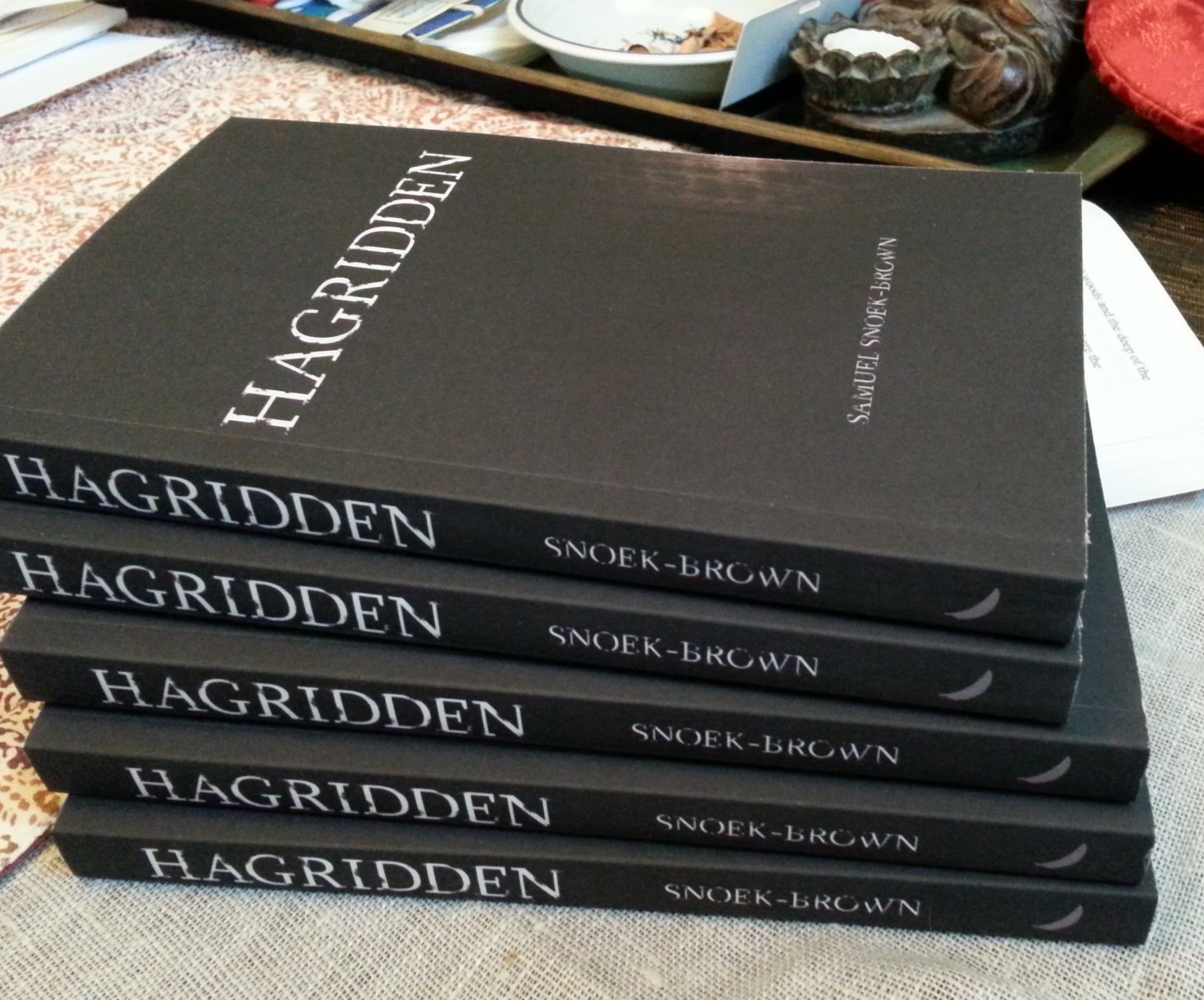


 Also, my first book, Box Cutters, is nearly sold out, so if you want a copy of that, come find me at the bookfair. The publisher has a handful left that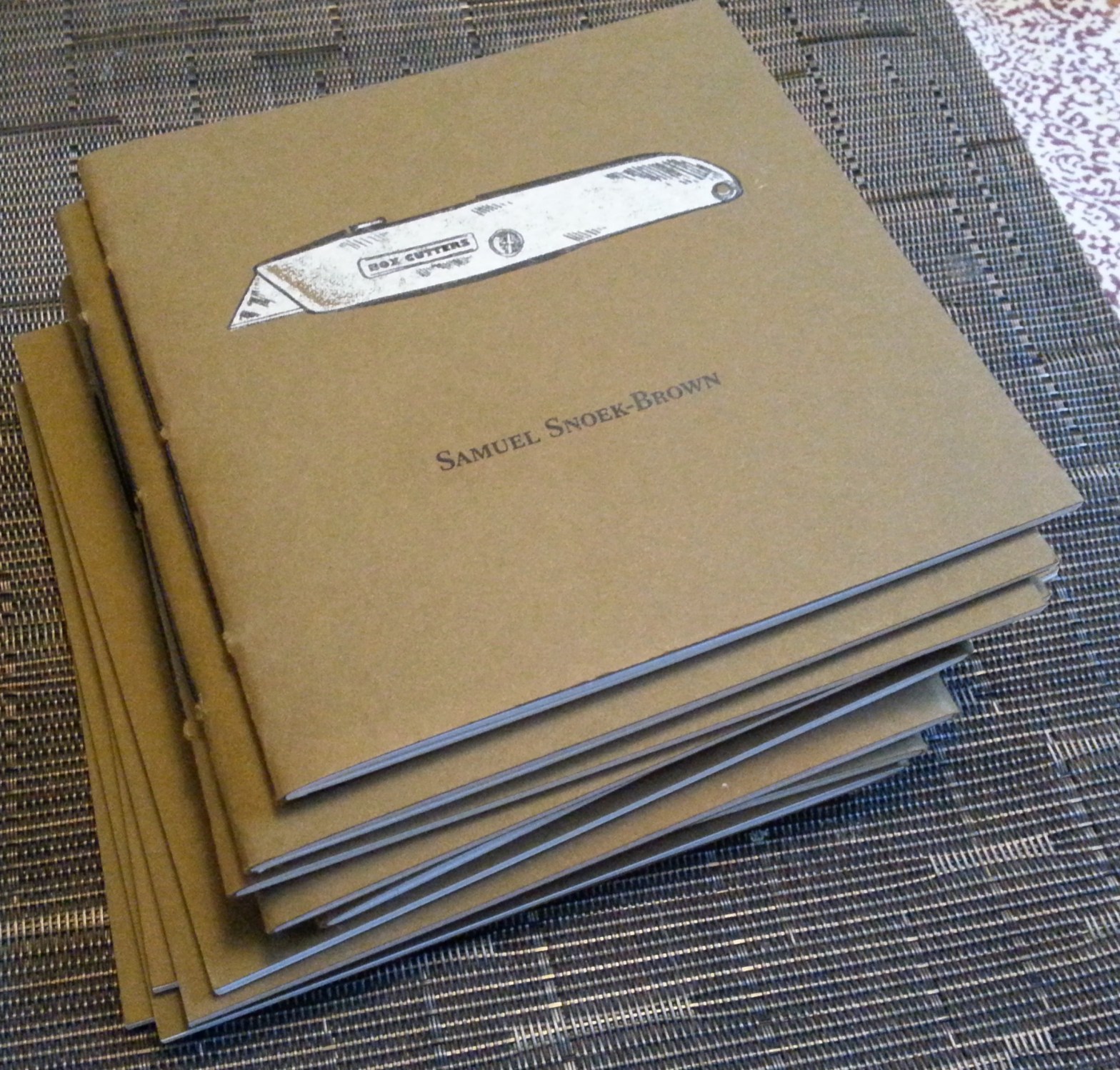



 But because this is Portland, there were also so many other writers in the room that none of us could have known them all. While I was sitting quietly in my seat waiting for the event to start, I spotted Chuck Palahniuk and sneaked a photo of him to send to my brother, who is also a big Chuck Palahniuk fan. A moment after I snapped my photo, a woman sneaked over to Palahniuk and quietly apologized for disturbing him. She showed him a tattoo on her arm. They chatted for a few moments, then she returned to her seat near me. A guy behind me said, “What’s your tattoo?” She pulled back her sleeve to show him a passage of text from one of Palahniuk’s books.
 Samuel Snoek-Brown