
I was driving a two-hour commute to teach a college class. I listened to the news on the radio. At one point I had to pull over on the side of the road just to catch my breath. Later, I passed others who had done the same. When I got to school, I spent half an hour trying to figure out how to break the news to my students, because none of them had heard yet. I canceled the day’s lessons. I told them they could leave to call family or friends if they needed to, or they could stay and talk about how they were feeling. I asked them to try and not react with anger, because it was almost certainly anger that caused the attacks in the first place. Nine years later, I am still asking people to remember that.
A Writer’s Notebook: Last lines
Today, I’ve written a story backward. I explained some of the reasons for this in yesterday’s post, but for more about how I went about the actual exercise, see below.

When they left the theater they were already arguing. Matilda gestured with her handbag and it swung like a wrecking ball; Gerhardt waved his gloved hands violently in the air; Leo jabbed his folded umbrella like a sword with each point he thought he was making. They were ridiculous, and the people they passed on the sidewalk parted around them and glared or shook their heads before closing again on the other side, but the trio argued loudly anyway, oblivious.
Matilda was insisting that when the film had ended on the shot in the woods, the camera angled upward into the trees, the director was indicating hope and happiness. “Look at all that sunlight,” she said. “Coming down in rays like that through the leaves? It was like a vision of heaven.”
“Exactly,” Gerhardt said. “That’s why it represents death. When do you see scenes like that except in graveyards?” He moved his hands over his head to indicate the leaves blowing, the sunlight falling in somber rays. He looked like a madman having a convulsive fit.
“I see it plenty,” Matilda said. “I see it now. Look over there across the street, you just look there in the park.” Her handbag swung on the end of her arm as she pointed, and she swayed with the weight of it. “See those trees? See the sunlight? Show me a graveyard.”
“I think you guys are missing the point,” Leo said. “This whole movie was about questions, about uncertainty. You think it would give all that up to end with something so definite as you’re talking about?”
“Of course!” Gerhardt said. “That’s why it’s an ending. It has to resolve things, it has to answer all those questions.”
“That’s what I’m saying,” Matilda said. “There is no answer in death, in graveyards. The sunlight in the trees has to mean hope. It has to mean certainty.”
“You show me one thing, one thing in this life more certain than death.”
“Please, you two, I swear,” Leo said.
“Okay, fine,” Gerhardt said. “What uncertainty do you find in that ending?”
“I find no ending at all, for one thing.”
“Bah, no ending. Look, movies like this, they always have to mean something, and that meaning comes in the ending, and that final meaning is always in the form of a symbol.”
“Exactly,” Matilda said. “The mirrors in All About Eve, or Rosebud in Citizen Kane.”
“God, that stupid sled,” Gerhardt said.
“Filmmakers work in images and images are symbols. Sunlight is hope.”
“Sunlight in the trees is death.”
“Okay,” Leo said, thrusting his umbrella so that Matilda caught her purse to her chest and Gerhardt stepped instinctively to the side. “Okay, you want a symbol? Why is the sunlight coming through the trees?” He jabbed upward where the sky was clouding over. “If we wanted hope, they would have shown us bright light. If we wanted death, they would have shown us shadows. Instead, they showed us both. We get both in one image. There is no answer. Or,” and here Leo stabbed toward them with his umbrella again, “or, how about this? The leaves are obscuring the light, the trees are covering up our chance at illumination. So we remain in a state of ignorance, and we get no easy answers.”
Gerhardt and Matilda looked at him a moment, then they turned to each other. They looked back at Leo. Then Gerhardt threw one arm high in the air, pointed his index finger, and waved it in a spiral like an orchestra conductor or a magician.
“A ha!” he announced, then he whirled on Matilda so she clutched her purse tighter. “There, even he agrees! The trees are blocking out the light! Death, you see! Where’s your hope and happiness now?”
Matilda studied him a moment, looked to Leo, then dropped her purse heavily at her side. “You’re the one who’s hopeless,” she said. “And I’m hungry.” They walked on, arguing more quietly now that they were also looking for a small diner or café, and after a block they’d pulled several paces ahead, their argument getting dim as the afternoon light. Leo looked up at the sky wearily as the first few drops of rain started to fall.

The last line of this story comes from Week 94 of the First Line blog. Using a first line as a last line has a lot of challenges, not the least of which is the differing natures of the two: one (sometimes) seeks to introduce a conflict, the other (sometimes) seeks to resolve it. But because both, at their best, are also intended to grab a reader’s attention and leave an impression, sometimes they can be interchangeable.
There is no one way to write a story backward, and frankly, I wouldn’t recommend doing it on purpose except as an exercise, but the basic starting point is essentially the same for any backward story: you need ask how a story might have wound up in this place, what sorts of conflicts this final line might be reflecting on or resolving, and then you need to look through the sentence for clues about how to get there.
If you’ve read and/or written enough fiction, you develop a feel for what works and what doesn’t, and ordinarily, I’d have scrolled through the first lines myself until something grabbed my attention in a way that got me thinking backward, but to make my job even harder, this time I asked my wife to look through the First Line blog and choose the sentence for me. Now, I had to not merely knock out a story that felt apparent in the “last” line — I had to find a story in the line.
This proved even more difficult because, while looking up into the rain is a great beginning for a story, it has also served as many, many endings to stories (most of them written by Hemingway). There’s a certain melancholia implied by rainy weather that works well as an emotional ending to certain kinds of fiction, and easy though it would have been to write such a story, I wanted to come up with something different.
But the word “wearily” caught my attention in this sentence, and I kept asking myself, Why is Leo weary? Or, why does he look up wearily? Is it the rain that makes him weary, and if so, why?
To get some ideas going, I turned to an old favorite, Jesse Lee Kercheval‘s Building Fiction, and reviewed her chapter on endings. There aren’t any ideas for writing a story backward, but there is a terrific scene at the end of the chapter in which Kercheval describes a couple of colleagues arguing about the ending of one of her own stories. And I thought, maybe my character, Leo, is weary because of an argument.
So, I have three characters — Leo included — arguing about something that makes Leo weary, and looking up at the fresh rain should somehow exacerbate that weariness; it should, to use a cliché, be the nail in the coffin.
But what to argue about?
And then everything just sort of clicked: Why not have them argue about the nature of endings?
The resulting story is too clever by half, I know, but it was fun to write, and this sort of deductive story building helps me prepare for those moments in my writing when I do stumble across an ending before I’ve finished a story and need to figure out how to get there.
Last lines

We writers pay a lot of attention to first lines. They’re supremely important — for the reader, they are the opening impression, the first glimpse not only at the story but also at the style of the story and even (dare I say it in this age of modern criticism) at the author. For the publisher and the bookseller, they serve as the hook to snare a reader — a buyer of fiction — and pull them into a story. For the author, they can easily become mere gimmicks, catchy one-liners tossed onto the beginning simply to snare not a reader but a publisher. Yet they remain deeply significant, particularly when done right, and we writers rightly pay them a great deal of our time. Some of my Writer’s Notebook entries, in fact–including last week‘s — have come from a blog titularly devoted to the First Line. And when we writers and readers and nerds play those literary games in which we quiz ourselves over our knowledge of the written word, one of our favorites is the recognition of famous first lines.
But recently, my wife discovered a different game, in the form of an online Entertainment Weekly article: Great last lines in literature.*
The last line is perhaps as important as the first; in terms of posterity, I might say it is more important, since the first line draws us into a story but a last line can affect the way we forever feel about a story. It is our exiting moment, our echo from the end that will carry into our everyday lives after we close the book. Last lines are hugely important. Yet we pay so little attention to them, at least in our popular or everyday conversations.
Perhaps we’re afraid of giving away an ending. Perhaps we are intimidated by them. But we need them so desperately, we writers. Endings are one of the most crucial bits in a story, because they need to do more than simply leave us with a “wow” moment, and they need to do more than simply wrap up a story: the best endings will change the way we see the story we’ve just read, they will leave us reviewing (or, ideally, even re-reading) a story again and again.
I know that in our private lives, we writers in particular take great care with our endings. Many writers even choose to begin with the ending and work the story backward. In workshops, beginning writers are often warned away from this because it can lead to stories that feel too forced, less organic, too much in the service of a cute, gimmicky last line. Our teachers and mentors are right to warn us. I remember that in many of my later, advanced workshops and one-on-one conversations with mentors, one of the most common criticisms on my fiction was that my stories didn’t quite earn their endings. I came to learn that my problem wasn’t in writing for the ending but in letting the ending exist separately from the story, so that even as I wrote toward the fantastic last line I’d conceived, I wasn’t writing a fantastic story — I was content to rest the weight on the ending and leave it at that.
Those writers who successfully begin with the ending — sometimes a last scene, sometimes the exact final sentence — have an array of techniques for using it to drive their story. Some will write backward, working out in reverse how all the elements of the story can lead to this final moment (this is especially common in mystery fiction). Others will work into a story the front way, the “organic” way, but at some point realize where the story is headed and, to give themselves an end point to work toward, will skip ahead and scribble out the ending. (I’ve used both these techniques, on both stories and novels, with mixed success.)

Occasionally, an ending will come all on its own, a part of the “organic” process itself, and we won’t even realize that this is the ending we’re working toward. Recently, I began reading the collected stories of John Cheever, and in his preface to the book, Cheever describes how he would sometimes compose those stories out loud, trying lines in his own voice or simply announcing them when they came to him, formed on their own. “It was under the canopy of a Fifty-ninth Street apartment house that I wrote, aloud, the closing of ‘Good-bye, My Brother.’ ‘Oh, what can you do with a man like that?’ I asked, and closed by saying, ‘I watched the naked women walk out of the sea.'”
What a fantastic last line! I’d not yet read the story, but already I had an idea of what sort of story it must be, and reading it later that same night was a delightful exercise in both how right and how wrong I’d been. Such is the power of a terrific last line.
So tomorrow, I think I’ll return to Lori Ann Bloomfield’s First Line blog, but instead of starting a story with one of her first lines, I’ll use it as a last line and see what sort of story might lead there.
* I should confess that I had my wife read these to me aloud, and when she mentioned a title I’ve not yet read but want to, I asked her to skip it. I am, in fact, afraid of giving away the ending. So read this article at your own risk.
Photo blog 20
Ramadan mubarak!
10 tips on writing from the Chronicle of Higher Ed

One of my professors from graduate school posted on her Facebook a link to an article, “10 Tips on How to Write Less Badly,” in the Chronicle of Higher Education. It’s a strange title, partly because the URL truncates the title to read “10-Tips-on-How-to-Write-Less,” which is precisely the opposite of this article’s purpose: The tips in this piece are designed to make us not just better writers but better-functioning writers, which is to say, writers who write more.
So I thought I’d share those tips here, but revamped a bit. The article frames these as tips for academic writers, we scholars who sometimes–okay, frequently–find it difficult to translate our passion for research and learning into a productive writing career. And as such, the tips provide some excellent advice, but I had thought to recast those tips as a means of producing better creative writers. (I’ve already done something similar by recasting Thich Nhat Hanh‘s Fourteen Mindfulness Trainings into my 14 Principles for Creative Writers.)
But one of the amazing things about this article is that it doesn’t need recasting–or, not much, anyway. Go read the tips for yourself, and if you’re a creative writer, just mentally replace any references to academic writing with “creative writing,” or references to intellectual concepts with “story concepts,” or whatever else makes sense for you. Writing is, after all, writing; for all the nuances of style and genre and form, the process is pretty much the same for everyone.
The one tip some people might need a little help converting is #6, “Pick a puzzle,” in which author Michael C. Munger suggests framing an academic article as a puzzle you need to solve. His idea is to make your argument interesting–to yourself and to readers–by making it a conundrum, something to needle at and work over mentally. It is also, Munger says, a great way to get started on an article. But unless you’re a mystery writer, this one doesn’t immediately seem very easy to translate into a creative writing tip. The key is in the last sentence of the tip: “Don’t stick too closely to those formulas, but they are helpful in presenting your work to an audience…” For we fiction writers, Munger is describing plot formulas. For the poets, he’s talking about poetic forms. Either way, his advice is sound: Use whatever tools it takes to get the writing going and keep you–and your readers–interested, but also be willing to break free of the formula when you need to.
Now go read the article. But don’t linger there too long (it’s tempting, over at the Chronicle, to just sit around and read everything), because soon enough, you’re going to need to get back to the writing!
Related Articles
- Tips on Becoming a Better Writer (writinghood.com)
- Better academic writing means better thinking (billbennett.co.nz)
- Home – The Chronicle of Higher Education (chronicle.com)
New fiction by David Maizenberg

A long time ago, I accidentally found an amazing little collection of short stories that felt unlike anything I’d read before–and in the best possible way. The book was Invitations to a Bridge Burning, by David Maizenberg, and they profoundly changed the way I think about fiction. I had by that time been through enough college literature classes and enough creative writing workshops that I’d become trained in unpacking not just the literature but also the craft behind the literature. It’s a profound feeling, being able to do that almost on instinct, and it’s highly empowering (and a little dangerous–think Sylar on early Heroes, able to see “how things work” just by looking at them, and then being able to co-opt that mechanism for his own uses; I’ve yet to see a better metaphor for what we do in creative writing pedagogy), but in some ways, being able to understand fiction on that level takes away a little of the magic in the reading experience. David Maizenberg was the first writer to give that magic back to me, because while I was able, after a while, to unpack what his stories were doing, I’ll be damned if I can figure out how he does it. Even today. The man is a wizard.
Anyway, I was so head-over-heels about this book that when I stumbled upon Maizenberg’s e-mail address one day, I wrote him. And, miracle of miracles, he wrote back. Turns out, Dave is a terrific guy, and over the years we’ve swapped more than a few e-mails about this terrifying world of writing we both live in.
Recently, I passed along to Dave the blog project a friend of mine, Ryan Werner, is working on, in which Ryan writes flash fiction based on reader-submitted songs. Dave got inspired, and instead of suggesting a song for Ryan to write a story about, Dave wrote a story himself.
And it is fantastic!
Dave’s been doing other things lately, so there’s not a lot of his fiction out there anymore, but clearly, the magic has not waned. The man is still a wizard.
You can check out his story, “A Short Illness,” at Our Band Could Be Your Lit.
A Writer’s Notebook: Prose haiku
Technically, this is just a very short short-short, the flashiest of flashes (to borrow a phrase from Rowan Atkinson in Love Actually), but I’ll explain below why I call it a “prose haiku.”
She sat on a thick window sill outside the store and tucked into tiny chicken wings, so small they looked like fried pigeon, wrapped in paper so greasy it looked waxed, even from way over here where I stood watching, across the street — it caught the light in ways no other paper would have. When she finished, she licked each of her fingers, rapidly down the left hand but slower, more ponderous, through the fingers of her right, and then she let the paper fall to the ground, and she let her head drop too. Those half dozen tiny chicken wings had been her only reason for leaving the house today, I thought, and now she was finished, not just with lunch but with everything.
I’m taking this exercise from a favorite source, Lori Ann Bloomfield’s blog First Line. About a month ago she posted a “random exercise” in which she described what she calls the “prose haiku“: basically, it’s a story in three sentences. It sounds much less rigid than traditional haiku — no syllable-counts to worry about here — but writing a story in three sentences isn’t easy. To get in some sense of story you keep wanting to write abnormally long sentences, yet even with these long sentences, I tried a few versions and kept wanting to add more. Writing a good story in only three sentences might be just shy of impossible, but I think it can be done. Even if it can’t, it’s still great practice, because it starts you thinking about what’s essential in a story — it forces you to strip a story down to its basest elements, and that practice can make even your longest fiction more concise. Besides, theoretically, any story could get told in just three sentences, because it gives you room for a beginning, a middle, and an end — an introduction, a climax, and a resolution. (I don’t know that any of those are in this story, but it’s a start–and this is just an exercise, anyway.)
If you wanted to make things complicated, you could start adding rules, like a five-word sentence, a seven-word sentence, and a five-word sentence; or a story that must revolve around the traditional Taoist theme of nature and balance. And maybe I’ll be masochistic enough to try it some day. But in the meantime, take a crack at your own three-sentence story and post it in the comments! I’d love to see your work.
(PS: My little vignette was inspired by a photo series I saw in an exhibition at the FOAM museum in Amsterdam, which I wrote about back in May. That series contained, I think, five pictures of this woman eating chicken, so it could be considered a kind of photo-haiku.)
New publication
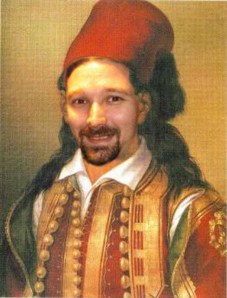
A bit of news: A short while ago–the day before my birthday, in fact–I got word from Red Fez that they wanted to publish my story “Kamikaze.” Today, the issue went online. It’s also chock full of other great stories and poems, so make sure to check out the whole issue.
For links to some of my other publications, check out my Publications page.
Photo blog 19


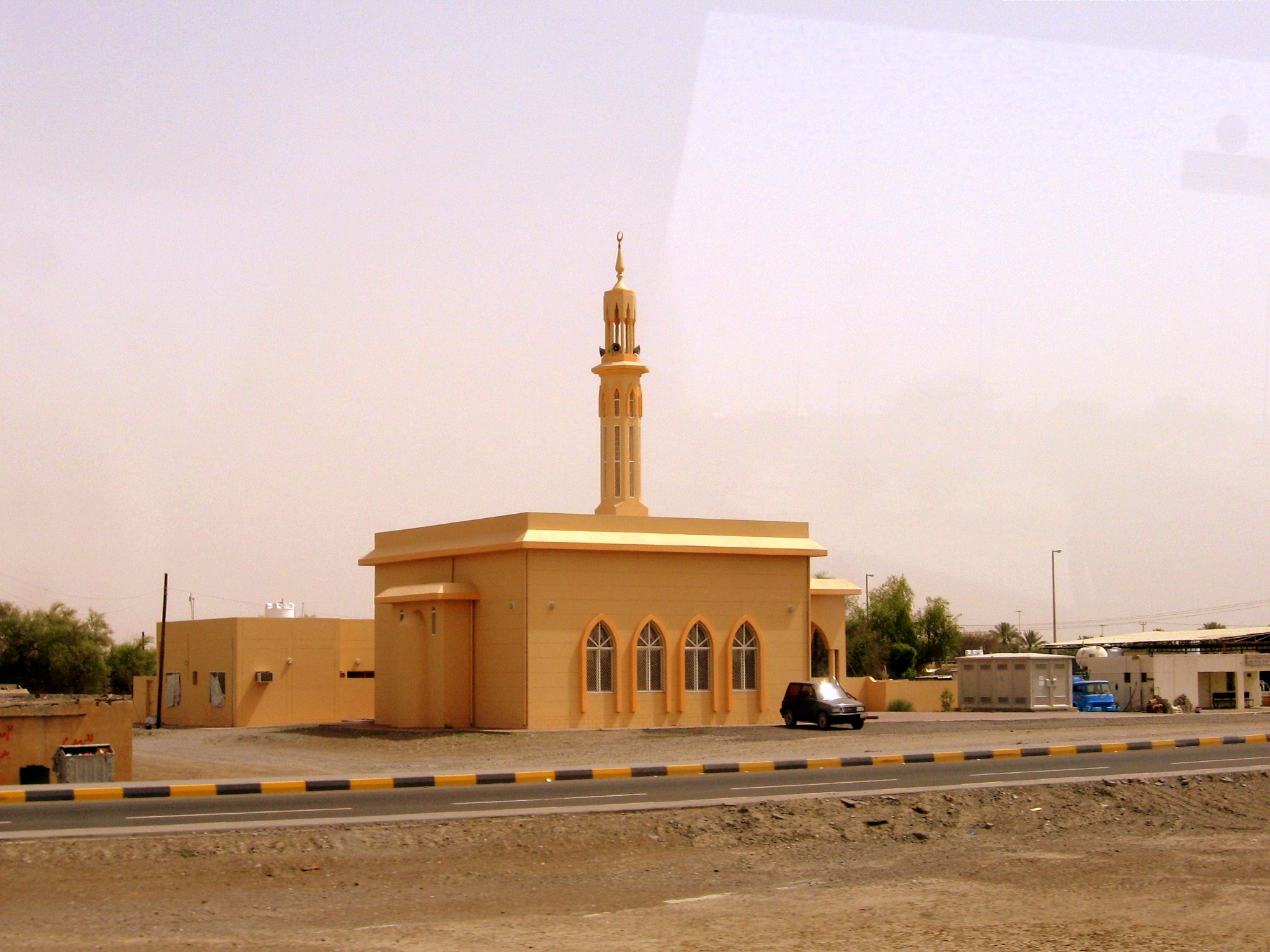
“Night and Day.” Neighborhood mosque in Hadbat al Zafaran area, Abu Dhabi, United Arab Emirates, 21 & 22 January 2009.
Ramadan mubarak!
Interview with Darin Bradley, author of Noise
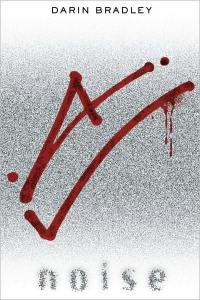
Darin Bradley‘s apocalyptic novel Noise hit bookshelves, both physical and virtual, today. So I thought I’d ask Darin a few questions about his novel, the apocalypse, and writing in general. The resulting e-mail conversation, which has spanned the past few weeks, has turned out to be very long, which is a good thing, because Darin has a lot of really fascinating ideas to share. But, to make that conversation a little easier to navigate, I’ve decided to post this interview in “pages.” I certainly encourage you to read the interview straight through, but if you want to return to the interview later and skip to a favorite comment from Darin, feel free to use the page jumps below to navigate the questions.
- Noise and the apocalypse
- Academia and the writing life
- Zombies! and other matters of literature
- Darin’s bio
I know we all hate this question, but I have to ask: where did this idea come from? Let me put it another way: what got you interested, both academically and creatively, in apocalyptic literature?
It’s all right — sleuthing ideas is, I imagine, every bibliophile’s secret hobby.
The idea itself is quite a bit older than the story as it ended up. Years ago, when I began grad school, I used to entertain a story about two young men who decide to remake the world “in their own image,” so to speak. It had a lot more in common with The Prince (in fact, that was my working title — ripoff though it was) than it did with anything apocalyptic. But, really, that’s all there was to it–an idea about remaking the world.
Later, as I started accruing student debt in the tens of thousands, and as my credit card balances climbed, I started to become predictably frustrated with the general progression of adulthood. Sure, I found my studies interesting, and I was running a number of creative projects on the side that kept my artistic inclinations in check, but the idea of graduating, getting a job, and then slowly killing time until I became old . . . well, the idea disturbed me. It was pretty straightforward, cliche, existential ennui.
So I became infatuated with everything falling apart — erasing the debt record, dissolving useless career paths, discarding fatuous social (or academic) discourse. Clearly, this was a form of escapist fantasy.
But then, after I graduated and moved away from Texas for a few years, now in the thick of the post-grad tedium I’d so feared, things really did start becoming collapse-y. What had once been a fascination with social liberation — a favorite topic I shared with some friends once a week at the pub — became an interest in the declining economy, the downsizing of American influence on world culture, and the rise of D.I.Y programs and local culture. By accident, all things came together, and my interest supplied me with the setting for the old story I’d never written. Now, on the other side of my degrees, I had a head full of cognitive theory and critical discourse — I wanted to explore how environments destabilize identity, including our feverishly held beliefs about life, the universe, and everything, to intone Adams. So, I decided that an otherwise normal person, when thrown into a social environment that no longer supports (or makes room for) the conveniences and niceties of social coexistence that we know now, would have to re-examine his or her personal mythologies to re-purpose them for a more violent environment. I mean, what good are the lessons you learned playing T-Ball when you’re concerned about people kicking in your door to steal your flour? What does it matter if you excelled at finger-painting when you spend all day hunting for desiccated potatoes in the barren earth? How could one change the meanings of these identity-building experiences so that they rationalized violent, survivalist behavior? What we know, what we think, about our selves and those around us is really just convenience. A lot of it doesn’t mean anything, even though we’d desperately like it to.
So, with this M.O. in mind, I conceived the rest of the details for the story, including the counter-cultural movement that calls itself Salvage. Salvage would be broadcasting, publishing, or otherwise communicating what I’d concluded about culture, destroying it, and successfully surviving to start anew. In order to really use Salvage to channel those old frustrations, that expired ennui, I decided I needed a handbook for how one successfully creates a post-collapse nation-state bereft of the civil luxuries we use now in our international relations — the point would be the survival of your people, even (often) at the expense of others. I was surprised at just how frightening, just how fascist, this blueprint turned out to be, and once I’d written it, I was ready to fill in the novel around it.
What do you make of the irony that you’ve created art about a future socioeconomic reality in which art is essentially pointless — an unproductive aside from, if not actually an impediment to, survival?
Or, to put it another way: Way, way, way back in human history, when we were all living in an anarchic, pre-governmental (in fact, pre-language) state, eking out a meager survival in caves, we were still making time to paint our daily observations on the stone walls. Some of this was instructive (how to hunt bison, for instance), but a great deal of it was also religious and/or decorative. So clearly, even in our most basic, most anarchic states, we still made time for art. Or, to use your analogy: Even as we were hunting for desiccated potatoes all day, finger-painting was still an important part of our lives. If so in the pre-historic past, why not in a post-apocalyptic future? (Or have I got it all wrong?)
The irony certainly isn’t lost on me. Luckily, though, I spent a fair portion of my formative reading years wrestling with authors like P.K. Dick, Alfred Bester, and Vonnegut, so I’ve long since come to terms with the idea that speculative, prognostic literature grapples with the state-of-the-world now. The “future” is the hyper-present — the future as SF’s left-handed morality play, etc. This is especially true in apocalyptic literature, when collapse is corrective and the timeline of civilization has been flattened. So, that’s to say that Noise, whenever one might read it, is about one’s world at the time and not the “future” I’ve painted. After all, the future is no more real than the past, but that’s a bit of a red herring and probably a bit further down the cognitive theory rabbit hole than we should go right now.
But I think you may be on to something, Sam: a necessarily artless world is, for us, right now, simply an artistic construction. Things might be different if the zeitgeist changes significantly, but in the socially generated, semiotic rat’s nest of self and culture that determines conscious existence today, positing non-existent things, like artless worlds, is a good shorthand definition for the “artistic endeavor” — in the whole artistic simulacrum, Baudrillard sense of the word.
Anyway, I think the cultural importance of art in pre-history as opposed to post-apocalypse is not a two-sided coin. I think they’re two different conversations. In the past, when people passed the evenings scratching stick-figure portraits of themselves onto cave walls, they were doing so when they had the time, security, and environment that would allow them to. Primarily (and I’m making sweeping generalizations here — I’m no anthropologist), the consciousnesses of our proto-folks would have been informed first by securing food, securing shelter, and presumably securing a mate. Later, after one had spent a long day in the sun bashing enemies with a stick to steal their potatoes, one could unwind with a charcoal stylus and some bare cave wall space. Today, though, the psycho-social identities of most of us in the literature-reading world often do prioritize art over existence. I mean, how concerned are we that there won’t be food at the grocery store when we make our weekly trips? Or that McDonald’s will suddenly run out of burgers? Food, shelter, and security are such low priorities for most of us, they’re such “givens,” that we “lead” ourselves, so to speak, with our religious stances, our political theories, our personal fashion styles, etc.
My assertion, going back to the idea that the Noise future is a corrective hyper-present, is that conscious existence as we know it, the art-forward consciousness, would necessarily evaporate if our social architecture collapsed on us and we were plunged into an existence-forward type of world. That’s what I mean when I talk about re-purposing experience. Taking the, “survivally speaking,” “now-useless” experiences of your past and learning how to change what they mean to your identity. Now, all that practice in T-Ball isn’t about personal athletic excellence at all (with its concomitant importances of personal performance in a social environment) — now, it taught you what you need to know about hitting a moving target with a club, so you can eat.
| (<– click here to return to the beginning) | (click here to go to the next page –>) |
 Samuel Snoek-Brown