A Writer’s Notebook: Character interview

For a short set-up, I’ll reveal only that I’m currently thinking about—but not yet working on—a story about a character who is very difficult for me to understand, for reasons which will be apparent in the exercise itself. So this week, I decided to get to know him a little better by interviewing that character, a process I’ll explain in more detail below.

Me: Ford, thank you for agreeing to meet with me—I know this must be difficult for you.

Ford Randall Kemp: Whatever. I just want to get through this, get it over with, you know?

M: I’ll try to be brief. But let’s just jump right into it, to keep things quick, okay? So, you were imprisoned ten years ago for the rape of—

FRK: It wasn’t rape.

M: For the statutory rape of a young girl.

FRK: She was fifteen. I was eighteen. I can name you two or three dozen people my age did the same damned thing. What else you supposed to do in this town but drink and screw? We was all doing it, and what went on between me and her was consensual.

M: But still you were convicted.

FRK: Her damned parents kept pushing it. And then there was that preacher.

M: The youth group leader, Ben Hager.

FRK: He’s the one. People here will do whatever a church fellow tells `em, they’ll believe whatever he says. Him and those parents, they had me lynched `fore I ever went into that courtroom.

M: There was another witness, too—a girl, a friend of Chen’s?

FRK: That’s what I heard. Don’t know who she is—she gave a statement but never testified.

M: Do you resent them still? The Hager man, the parents, that girl?

FRK: I don’t know. I mean, there’s a part of me’s still mad as hell, and I sure couldn’t stay in a room with them for longer than thirty seconds—

M: And yet you came back to Boerne. Why’d you return to this town? After all that happened?

FRK: This is where I’m from, where my family is from. It’s who I am. It’s in my blood. It’s hard, on a lot of people besides me I know, but damn it, they can’t take away my roots. I belong here same as anyone, got the same right to be here as anyone.

M: A lot of people would rather start over, I’d think. Have you found it difficult to find work? To reconnect with old friends?

FRK: It’s hard, sure. I’ve been a few places, asked around about work. They got these flyers, with my picture and my name, some stuff about what they said I done, those things are pasted all over. At the HEB and the Wal-Mart, at the library, at the schools, at the old folks home. So it’s hard. I got a job mowing lawns, for one, and I go around collecting trash, not like a garbage man but more like a salvage man, picking up things out of the trash I can sell off other places or fix up, things like that. I make ends meet.

M: And old friends? New friends? How has it been trying to fit back into your old life?

FRK: I ain’t got a old life. There’s some fellows I knew back in the day, we see each other at the bar now and then. Some has moved out and some don’t want to know me any more. There’s a couple of fellows, but that’s it. Had me a dog for a while, but he’s disappeared now. I think one of my neighbors took him.

M: Why do you think that?

FRK: I don’t know. I’d of said it was to mess with me, to, what do you call it, deprive me of happiness? But this neighbor of mine don’t seem interested in that, and he’s new around here besides, don’t have any history with what everyone else is so upset about. I don’t really like the looks of that guy, to tell you the truth.

M: Let’s get back to life here. Do you see a future in Boerne? Are you planning to stay long?

FRK: Why? You looking to run me out too?

M: I’m not looking for anything, Ford. I’m just asking what people want to know.

FRK: People can just suck it up and sit tight, cause I ain’t going anywheres.

M: What about Chen? Have you been in contact with her since you got out?

FRK: I ain’t supposed to, no. Besides, I don’t think she’s around here no more. I hear she went up north somewhere, Dallas or somewhere.

M: If you could talk to her today, what would you tell her?

FRK: I ain’t got nothing to say to her.

M: Are you angry that she turned you in?

FRK: She didn’t turn me in. I done told you, it was that Ben fellow and that friend of hers, whoever it was. Chen and me was . . . . Look, I ain’t gonna talk about her anymore.

M: There was some talk during the trial, I think about why she was never put on the stand. If it was consensual, why didn’t you call her as a witness to say so.

FRK: I said I ain’t— Look, we did, okay? Or, I did. I talked to her, and called her up and asked her to tell folks—to tell her own folks, anyway—that we was doing what she wanted us to do. She never said word one. Never answered my calls, never called me back. I saw her in the courtroom once, in the back. She just sat there. She knew what was happening to me and she just sat there quiet and hiding from it all like she was embarrassed or something, I don’t know, and that little . . . . She, she let it happen. She didn’t say nothing to stop it.

M: So you blame her, then, for what happened.

FRK: I blame this whole goddamned town, is who I blame.

M: Then why did you come back here?

FRK: To hell with all y’all, is why I come back here. And to hell with you, too.

M: I’m sorry—

FRK: You’ll see. I’m telling you now, you’ll see why I come back. And to hell with me too.

This exercise is fairly common and has a lot of variations, from the short and simple to the lengthy and elaborate, but for today’s exercise, I decided to shy away from written lists of questions and treat this as an actual interview—and then just wing it. There are some pretty complicated ways to go about the character interview, with setting descriptions, background notes, comments on mannerisms, and so on (check out Gina Candido’s Suite101 article for this sort of exercise), but I wanted more than anything to hear Ford’s voice, to let him speak, so today, I focused on that.

Very little of this will make it into the story I intend to write, but it’s actually proven invaluable, because the free nature of this exercise and the requirement that I just get out of the way and let Ford speak for himself has allowed me to discover some interesting bits of background I didn’t know about before, and it’s given me a clearer picture of Ford’s emotional state and some inkling–even though he hasn’t said so aloud–of what he was really thinking about when he moved back into this town. And now I’m looking forward to writing the story.
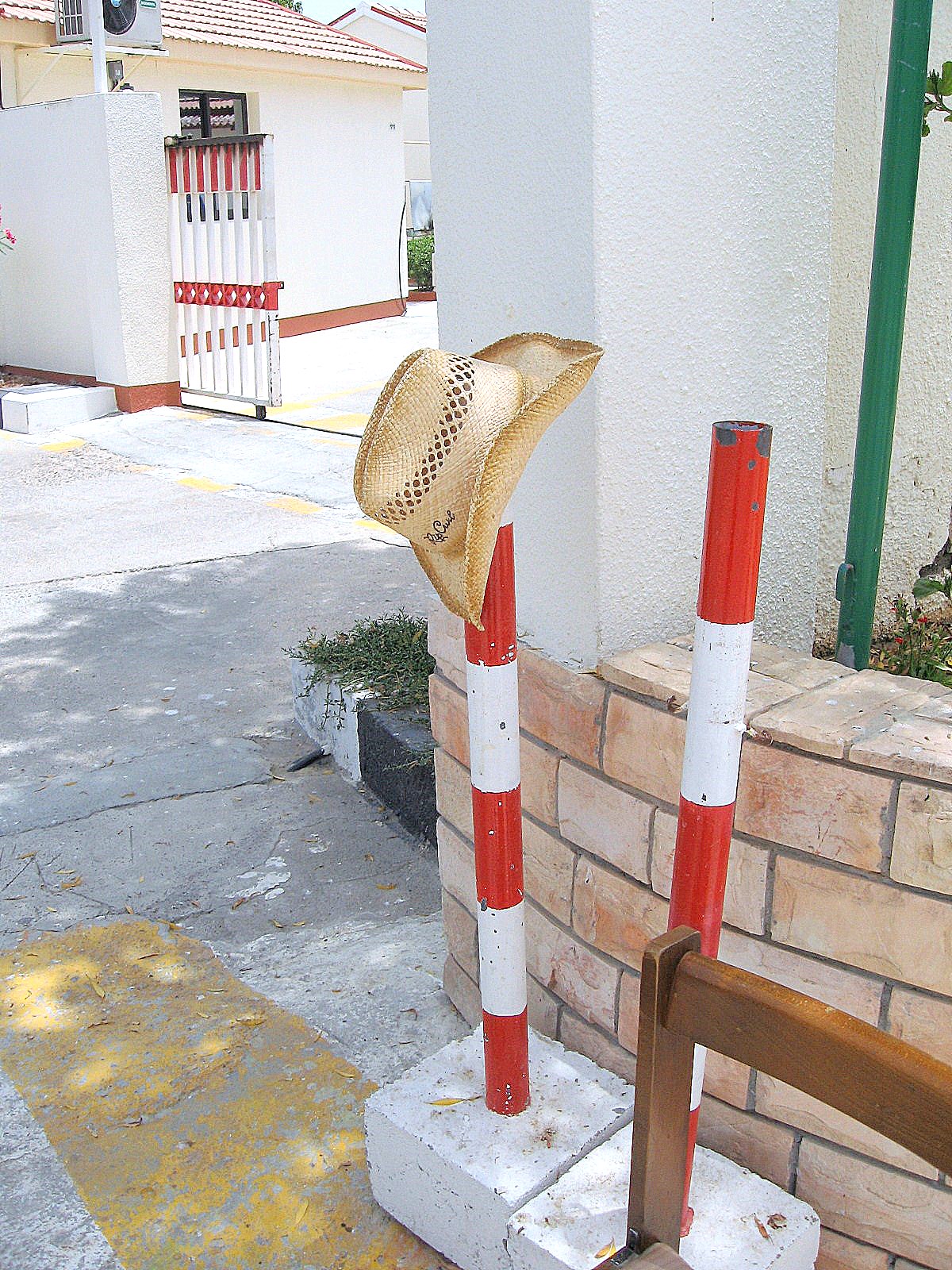
Photo blog 6

"Resting." Workman's hat at Sandy Beach Hotel & Resort in Fujairah, UAE, 8 May 2009.

How to know when the writing is done

I started writing about good writing yesterday simply because it was on my mind — I’m neck-deep in three different stories right now, with two more on the sidelines, as I try to finish a story collection. But as soon as I posted it, I started thinking of a related discussion: How to know when the writing is done.

That’s a far harder question to answer, I think, because while good or bad is a judgment call, “finished” is more absolute, and it has less to do with quality than with completion. Knowing when your story is good is a matter of taste; knowing when it’s done is a matter of process.

We all struggle with our work, drafting and revising and editing and reading and re-reading and begging friends to read . . . . For many of us, this revision process becomes an obsession, even — ironically — a means of procrastinating. Most of us are doing this with a purpose beyond putting words on paper: we feel we have something important to say, some great story the world wants to hear, and our goal, eventually, is to share that vision with everyone. Yet when it comes time to actually wrap up a story and send it out into the universe, many of us find it difficult to let go.

This is mostly tied to the question of whether our work is good, I think. A long while ago, I had exactly this conversation with Ryan Werner, who noted his own concerns with his work: “I get to draft four or five and then freeze up, because I’ve always got a vision that I don’t want to betray.” This freeze is a particularly malicious form of writers block, really, in which we don’t realize we’re blocked because we’re still doing the work. We revise, and we revise, and we tell ourselves this is what writing is all about — and it is — but then we fall into it, determined that if that revision made that sentence perfect, then this revision will help the next sentence, and when all the sentences are perfect we’ll revise to make sure they gel perfectly, and then we’ll recheck everything, and question ourselves, and change a word….

We’re not alone. F. Scott Fitzgerald never met a sentence he couldn’t revise, and he was notorious for frustrating his editors with major revisions — both substantial and substantive — at the last minute. He’d send back galleys that showed more red ink than blue. He’d tear out whole pages, rewrite chapters. It never ended.

This sort of perpetual revision, the pursuit of perfection, is absurdly common, really. I say absurd because writers have been suffering from it openly for so long you’d think we’d have found a way to prevent it by now. But we haven’t — I often suffer from the same anxiety.

It is surmountable, though. Getting over it is like getting over writers block, only backward. With writers block you have to grab on and stick with the writing, no matter how rough it gets or where it leads you. But with this perpetual revision thing, the only solution is to let go and send it out, no matter how rough it is or where it winds up. It’s a hard thing to do, because as much as rejection frustrates me, I sometimes suffer an even greater fear that my bad writing will get accepted. My story “The Simple Things,” or “Coffee, Black,” or “Counting Telephone Poles” — all were relatively well received when I published them, but I look at them now and see dozens and dozens of changes I want to make. Yet they’re in print, and sometimes I wonder if I’ve “betrayed my vision.”

Then I pick up the 1993 anthology The Gulf Coast Collection of Stories and Poems, a one-off collection published by the University of Southern Alabama. It contains Tom Franklin’s “Rise,” an early draft of a story that later appeared as “Blue Horses” in Franklin’s own collection, Poachers. The difference between those drafts is phenomenal. Franklin grew a lot as a writer in the six years between “Rise” and “Blue Horses.” Yet, there they both are, in print — published. The same thing happened between the version of Franklin’s award-winning novella, “Poachers,” that appeared in Texas Monthly and the one that appeared in the book.

And then I remember that Raymond Carver also frequently revised his published work for later collections, though to be fair, he was usually trying to undo the changes Gordon Lish had imposed, trying to revert to Carver’s own vision. Not long ago, Carver’s widow, Tess Gallagher, released an early, pre-Lish draft of Carver’s famous “What we Talk About When We Talk About Love”; the early version ran in the New Yorker, and reading it in the context of the more famous version, it is difficult to decide which draft is better — which draft is the “good” draft.

I began to realize that we are almost guaranteed to betray our vision, in some sense, because if we’re worth a damn as writers we’ll keep working on our vision, and what we expect out of our work will become more refined and of a higher quality as we progress. Which means anything we publish now is already doomed to fall below our future standards. By that account, then, it doesn’t seem to matter much if it falls even below our standards now. Sure, we want to publish the best we’re capable of, but I think we need to focus on publishing the best we’re capable of publishing, not the best we’re capable of writing and certainly not the best we can dream up in our heads. Which means, if it’s accepted for publication somewhere, then we have to say, good enough for now. But that can’t happen until we let go and send the work out into the world.

It’s an easy lesson to learn, but it’s a hard one to stick to. Believe me.

How to know when the writing is good (or good enough)

When I was in grad school working on my doctorate, I took a class on the form and theory of poetry, with poet Bruce Bond. It was a fascinating course that taught me a lot, not only about poetry but also about my own approach to fiction. Bond has a way of asking provocative questions that don’t seem provocative at first — he manages to incite self-analysis without pushing it on people. One night, for instance, during the general run of class discussion, Bond tossed us this question: “How do you know if your own work is good?” It was just as an abstract consideration — he wasn’t literally asking, really, not in the sense that he expected an answer right then and there — and we quickly moved on to other topics. But I lingered over the question, and began scribbling a response in my writing notebook.

This is a much-revised version of that response:

I don’t think it’s a question of how you know, but if you can know. And I don’t think you can know. You can have ideas about which of your works are good, or what in a work is good, and you can make arguments — good, solid arguments, sometimes — but inevitably, people will disagree with you, and some of them will be correct.

For instance, I published two stories in Amarillo Bay. The first story I thought was terrific. I had worked on it a lot, polished it, tinkered with language and sneaked in some pretty impressive imagery and even what I think are two very potent metaphors. It’s a good piece: Solid, clean, and moving. The second piece, I dashed off in an afternoon. I’ll grant you, I’d had the idea for a long time, and I’d even written two drastically different drafts of that idea (one of them unfinished, and one with a lame, happy ending). But the draft I settled on is almost just that — a draft. I sat down at my computer, frustrated that I had nothing to write even though I desperately wanted to write, and I finally decided to just knock out a character sketch. And even then, I couldn’t come up with a new character, so I simply pulled out a character from my novella and aged him roughly a decade, and then, just to get a sense of who he was, I stuck him in the situation I’d already written two other drafts on. A few hours later, I had “Distance.”

Of those two stories, only the latter has elicited comment on Amarillo Bay‘s site, and the comment was praise from a fellow writer. Later, another dear professor of mine — the inimitable Tom Preston, a wise man well versed in literature whose tastes are very like my own — approached me about both stories. He said the first — the polished, metaphorical story — felt “sentimental” and was clearly the lesser story of the two; the latter — the draft — he praised at length. And, in perhaps the best compliment any of my fiction has ever gotten, no less an author than Tom Franklin commended the impact of the story’s ending.

So much for knowing what’s “good” in my own work.

Then there’s the strange case of the backward compliment I received at an academic conference several years ago. In 2003, I’d read what I considered then to be one of my best stories, what was to become the first section of my novella, at a regional PCA/ACA conference. It was well received, and a number of friends who’d read earlier drafts of it commended the improvements I’d made. The next year, I returned to the conference to read a new story. Again, this second piece was a story I’d essentially dashed off in a night (again as a character sketch). I’d worked on it a great deal since the first draft, but the bones of the story remained intact: All I’d really done to it was tweak a word here, change a word there.

After my second reading, a writer whose work I really admire and who’d heard my first reading in 2003 approached me wide-eyed and said, “Wow, Sam, that was a great story — your writing has really matured. That was a lot more polished and engaging than the piece you read last year.”

So no, I think it’s actually impossible to know “good” in your own work. But I do think you can know if you’re satisfied with your work, which is another matter entirely. Take that last example: Clearly, I was more satisfied with the first story I read at conference than I was with the second. In some ways, I still am; though that first story has undergone significant revision in the context of the novella, it has always had what I think is a richness and a depth of meaning, which I’ve spent years honing and polishing, that simply cannot exist in the dashed-off character sketch. And as happy as I am with the sketch — it’s a good story, I think, in the generic sense of “good” as “finished, and not bad,” and frankly, the thing won the Jerry Bradley Award for graduate creative writing at that conference — I still personally prefer the richness, the depth of a more developed story. So I remain more satisfied with the first story.

But that’s just me. And it’s not a hard-fast rule, either. In the earlier two examples, the stories published on Amarillo Bay, I took to heart Tom Preston’s comment about the first story being too “sentimental,” and I went back and re-read both pieces. Turns out, he’s right: I liked the sentimentality at the time I wrote the first story, and I was also awfully impressed with myself for working in the deeper metaphors and whatnot, but the more I read those two stories, the more I came to realize that the second one feels more honest. Maybe that’s because it’s starker, or shorter, or less polished. Several years ago, Dan Chaon suggested during a Q&A session while visiting the University of North Texas that we writers need to leave a few rough edges in our stories, lest they become too polished, and I have always loved that idea. Or maybe it’s because in that shorter story I managed to connect with the character through the sketch process in a way I couldn’t connect with the loftier, more metaphorical story. Whatever the reason, I’ve since decided that I’m more satisfied with “Distance” than I am with “Coffee, Black.”

All this is just a rambling way for me to explain how one writer embraces his fiction without assuming he can ever really know anything about it. Which is not cynical or depressing at all, I think — it’s liberating. It frees me to write whatever makes me happy. I have my standards (which, I admit, are perhaps higher than anyone can really achieve, especially me, which is why I thank Dan Chaon for the permission of “rough edges”), and yes, many of those standards are based on how I want people to react to my fiction, or how I think people are going to react to my fiction. I have my standards and I write according to them, until I’m satisfied that I’ve met those standards. But I find I can accomplish this a lot faster, a lot more easily, and often a lot better if I stop worrying about whether my standards are “correct” or not, stop worrying about whether I’m getting my fiction “right,” stop worrying about whether my stuff is any good. And just write.

A Writer’s Notebook: Music and flash fiction

In the wake of last week’s Writer’s Notebook, my friend Ryan Werner sent me an e-mail with a challenge: Do it again. And this time, make it complete — in other words, write a piece of flash fiction.

The actual exercise was more complicated than that (as usual, I’ll explain it below), but it was a very interesting challenge and I decided to take him up on it. So first, a link to the song, and then a piece of flash fiction (still rough — this is an exercise, after all).

I’m using Feist’s “Honey, Honey,” from The Reminder. I’m going to link to the music video on YouTube, though I encourage you to pick up the deluxe two-disc edition of the album, which includes this video and three others, because it’s fantastic stuff.

Dream with Enough Conviction*

She often dreamed of him at night. She felt guilty when she did, because he was the man who’d killed her husband. But she’d never minded that her husband was dead, and she never blamed him for the killing. It was just one of those things. This dreaming, his face in her sleep, was another of those things, but this was her doing, and she felt something close to sorrow every time it happened. What made it worse was that she was sadder that he was in prison than that she’d dreamed of him at all.

If she could tell anyone about the man she loved, she would have told them he was a soldier, or a sailor, that he was away at sea or gone to war. She would stand in the window and watch the wind in the trees, longing for his return. She did so anyway, even when her son — her murdered husband’s son — was home in his room, his own teenage problems to deal with. She stood in the window and watched, and waited.

She visited him sometimes in prison, on his birthday, on hers. She used to take her son on holidays but it was getting harder. And she liked to visit him alone. She thought of it as shore leave. At night, alone in the dark, she imagined it anew, her the marooned lover, he the sailor back from a long journey on slow, calm seas, the two of them in throes. It always ended with her in tears. There would never be any conjugal visit—they were never in a conjugal way, and they never could be.

Sometimes, if she stood in the window long enough, she would suddenly burst into motion, the stillness too much. She would grab her keys, sometimes forget her purse, her license, and she would crash out the door and into the truck and down the road, gravel and dust spitting behind her. She would drive for hours, run the gas tank nearly dry. She never went anywhere. She just drove, eddying in the town or drifting down the highway like it was pulling her along it, an asphalt current and her powerless against it.

She was driving toward some future where he is free, where her son understands her need for this man. Or toward some alternate world where he’d never defended her from her husband, where she’d never married her husband, where she’d married this man instead. Surely, around the next curve, over the next hill, this world awaited her. If she could just drive fast enough, if she could just look hard enough. And she would close her eyes, screaming down the highway, waiting for the dream to come.

Ryan envisioned this exercise as a kind of collaboration, involving many writers, so that we would have the opportunity to write to songs we wouldn’t expect and might not have chosen ourselves. So he asked me to spread the word to some writer friends of mine and see what turned up.

The exercise as Ryan devised it is this: Each writer will submit a song to everyone, and then each of us (including the writer who submitted the song) will produce a piece of flash fiction from each song. We set a 500 word cap, and because I had this post in mind, I also imposed a personal deadline of yesterday (giving us all a little less than a week).

A lot of people expressed interest in the idea, but timing being what it is, many decided to wait until they could play along more fully. Still, among me, Ryan, and two other players, we wound up with four songs. I’ve posted my own song here, but to be fair, I’m also posting the other three stories I wrote, which you can read starting here.

Also, if you want to play along with this one yourself, Ryan has started a blog devoted entirely to this exercise. His goal: To produce a story a week for the next two years. You can check it out at Our Band Could Be Your Lit.


*UPDATE: A revision of this first story, “Dream with Enough Conviction,” has now been published by Red Fez. Click here to check it out online. (Click here to return to the rough draft above.)

Photo blog 5

“True Love.”  Platteville, Wisconsin, 3 March 2007.

Patrons of writing and teaching: Winnie-the-Pooh

“Pooh And Piglet Writing Notebook.” (Available from Pooh Corner online store.)

I haven’t done a Patron of Writing in a while now, and with all the hard writing work I have ahead of me this week, I figured it was time to bring out Pooh-Bear.

I’ve loved Winnie-the-Pooh since I was an infant (I still have my Pooh-Bear, faded and misshapen after all these years; my wife recently repaired a very old rip in his neck, much to my profound delight), and like many fans of Pooh, I’ve loved our favorite bear for more than his Disney incarnation: true frequenters of The Hundred-Acre Wood have long valued Pooh-Bear for his simple wisdom and his kindness. Nowhere is this more apparent than in the popular philosophy books The Tao of Pooh and The Te of Piglet. But in recent years, I have come to know Pooh as a writing mentor as well.

Winnie-the-Pooh. (I only have the cover of my old card–I cut the back off a long time ago–so if you know who printed this, send me a note so I can credit the copyright owner.)

It started, I think, with a birthday card I received years ago. The cover of the card shows Pooh holding a blank notebook, the pages folded back, as he furrows his brow and scratches his head with a pencil (in his left hand, the same hand I write with). Beneath that, the card reads, “The hardest thing about writing,” thought Pooh, “is finding the right words.”

I cherished the card so much I stuck it on my office door at work, and it has followed me to every office door since then. Now that I’m writing from home, I’ve stuck it onto the inside of my writing desk, where I can always remember that I’m not alone in the struggle to find the right words.

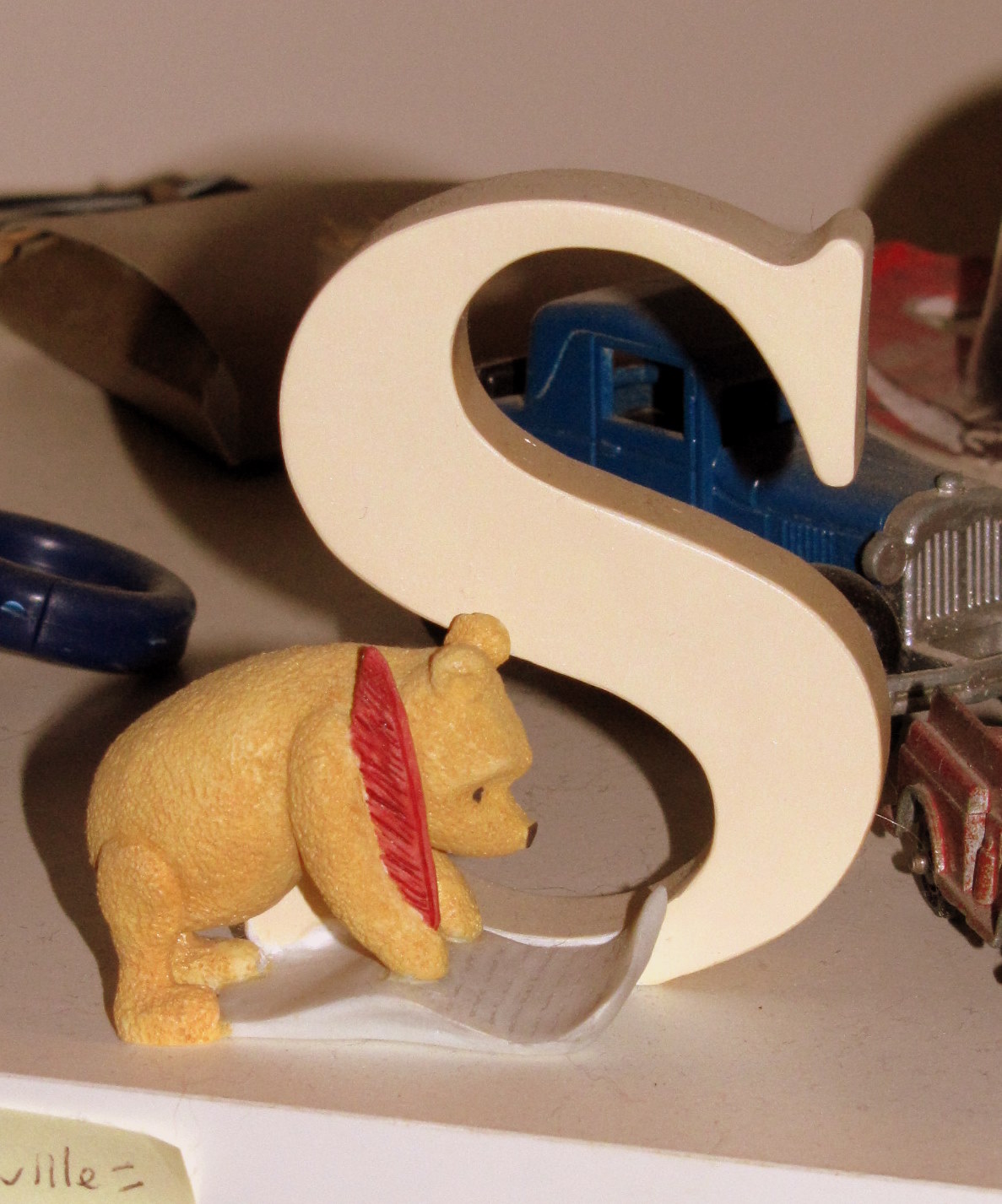
Then, just a year ago, my wife gave me a small Winnie-the-Pooh statue. It’s a simple letter, just a sweeping serif S, and it’s meant for children, something to decorate a nursery perhaps, but I adore it. For one thing, I am a child at heart and hope to always remain so. But more importantly, the statue shows Pooh kneeling at the foot of the S, bent over a waving sheet of paper, a large red quill in his hand. (This Pooh is a righty, but I’ll forgive him.) It was a perfect gift, and now it, too, adorns my writing desk.

“Pooh Writing.” Winnie-the-Pooh (c) Disney; statue design (c) 2006 Enesco Ltd.

In A. A. Milne’s brilliant classic Winnie-the-Pooh, Eeyore complains about “[t]his writing business. Pencils and what-not. Over-rated, if you ask me. Silly stuff. Nothing in it.”

But Pooh, champion of writing, has a different idea. For him, the joy of the process is what’s important, and he understands, in his simple way, that sometimes you just have to push through the “silly stuff” until you find what’s great. He is, in fact, an advocate of the writing exercise: while writing a song in Winnie-the-Pooh, he explains to Piglet, “I shall sing that first line twice, and perhaps if I sing it very quickly, I shall find myself singing the third and fourth lines before I have time to think of them, and that will be a Good Song.”

He also advocates for the writing workshop. In The House at Pooh Corner, Pooh seeks out Piglet as a reader and asks for his comments on a new poem. Piglet (apparently an experienced workshopper), begins with some general praise for the poem but then offers some specific, concrete advice on how to improve it: he likes the poem, he says, “All except the shillings […]. I don’t think they ought to be there.”

Pooh is eager for a discussion of craft, though, and he decides to explain more about his process: “They wanted to come in after the pounds,” explained Pooh, “so I let them. It is the best way to write poetry, letting things come.”

It takes a lot of patience, I know, to simply “let things come” in the writing. Especially if what come are not the right words. But the point, I think, is to stick it out, to keep coming back to the writing, and to enjoy the process. I’ve been struggling a lot with a particular story this past week, and I needed Pooh to remind me of that.

So now I’m going back to the writing. I shall write the first sentence twice, and perhaps if I write it very quickly, I shall find myself writing the third and fourth sentences, and so on. If I let them, the right words will come.

* I’m not the first person to recognize Pooh’s influence of us writers: for another cool post on Pooh, check out “The Winnie-the-Pooh method of writing” over at Thoughts From Mystery Hollow.

A Writer’s Notebook: Music and freewriting

I’ll explain the exercise more fully below, but, as I did with the “1,000 words” exercise, I need to mention this up front:  I’m writing while listening to Edvard Grieg’s “Peer Gynt, Suite No. 1, Op. 46: Aase’s Death.”  I can’t upload an audio clip of the piece without violating copyright, but you can hear a decent preview of it at Last.FM.  The version I’m listening to is performed by the Budapest Philharmonic Orchestra, from the collection Meditation: Classical Relaxation Vol. 5.

Give it a listen, and then read on.  To try this exercise yourself, see below.

The sun had not yet risen, and the predawn sky was watery , the thin clouds mauve against the amethyst sky.  Inside, the room was darker, murky, the curtains heavy over the one small window.  He thought he heard her breathing but it was only the rhythmic whir of the vaporizer.  The air tasted cold, like rubbing alcohol evaporating on the skin.  Her thick quilt was up high around her neck.  She lay on her back, propped against a mass of floral pillows ruffled with shams; her shoulders tilted askew because of the curve in her brittle spine.  A small light sifted in from the little nightlight in the hallway bathroom, and when he moved over her so his shadow fell away from her face, one milky eye glimmered yellow in the dark.  Her mouth hung open, the lips dry and drawn up like the opening of a pouch, the wrinkles from her lips fanning out.  She looked like a fish, like a desiccated eel.  He remembered the time his two goldfish had died and his mother had helped him scoop them from the bowl, the warm luster gone and their scales faded like watercolors in the rain, the gold dilute, their little mouths agape.  His grandmother was still wearing her clip-on earrings, gold filigree badges pinching each lobe.  Her hair crested and waved in steely strings, oily and thin.

The room was very still.  Even with the swirl of mist issuing from the vaporizer.  He pulls his arms around himself, but he felt even he was motionless–he could not feel his own heartbeat, he could not hear his own breath.  He inhaled deeply, his narrow chest expanding against his arms; in the back of his throat, he tasted stale flowers and expired medicine.

He bent to shake her.  The quilt was more substantial than she was, and when he pushed against her, it slid across her collarbones with a sound like paper.  The wattle of her neck moved with it, and he jumped backward, staring.  But she didn’t stir, so he eased closer and took her bony shoulder and shook her again.  Her whole body moved at once, like a cornhusk doll.  She was cold like the room.  He thought she needed warming—he thought she needed the tea she loved so much.  It was nearly morning now, and she would be asking for it soon enough.  So her left her there in the dark and went to the kitchen to find her old mug, her teabags, the kettle.  Whatever it took to wake her up.

I love writing to music.  I used do an exercise with my freshman composition students for which we listened to a piece of instrumental music and wrote whatever came into our heads based on that music (for a long time, I had fun playing them Metallica’s early instrumental “Call of Ktulu,” which none of them ever recognized, because afterward I could explain that the song was itself inspired by prose–H.P. Lovecraft’s short story “Call of Cthulu”).  In yesterday’s post, I wrote about how I use music in my own fiction, but I mentioned only briefly how much I like instrumental music, especially classical music, for setting mood or finding an emotional tone, and today I wanted to deal with that in more detail.

This week I’m working on a story in which a 12-year-old boy finds his grandmother dead in her bed, though he doesn’t at first realize it.  So I decided to work on that scene.  What appears here probably won’t make it into the story–this is primarily for my own reference, so when the boy mentions this moment to others I’ll have an idea of what he experienced; besides, the perspective here is (a little) too reflective, too adult for the kid I have in mind, though he is fairly mature for his age.  But I wanted to get these moments down anyway.

To try this on your own, simply select a piece of music that suits the mood you’re looking for.  (I selected this movement from Peer Gynt precisely because it was written to accompany a death in an Ibsen play, and because the movement of it, rising and falling like quiet ocean, felt so somber and meditative.)  Then find a place to listen to your music without distractions–not in the living room with the TV on, not on your iPod while out walking around the neighborhood.  Someplace isolated and quiet.  Listen to it once without writing.  Close your eyes if necessary.  Don’t think about the music, don’t try to start drafting in your head.  Just sit, and listen.  Focus on experiencing the music.  Then, when the song has finished playing, listen to it again, but this time do a freewriting exercise.  Let the music guide your thoughts, but don’t try to control your thoughts–just write whatever occurs to you, any thoughts that come to mind.  You can write for the duration of the song or, if the song is relatively short, you can put it on a loop and write to a set time limit–ten minutes, twenty, a half hour, whatever gets the job done.

For more on writing to music–any music at all–check out author Meg Cabot’s blog entry on her musical writing habits.

[Music] is the liquid that we’re all dissolved in*

Some writers cannot write except in silence. Some, actually, need specific kinds of silence: crickets, white noise, one of those nature-sound machines, wind in the trees. But silence all the same.

I am not one of those writers.

Sure, if I fall into a story and lose all track of my physical surroundings, I can enter silence and not even realize it. But to start out, sitting down for the first time and trying to do the work of writing — the uninspired, slavish end of the craft, which has very little to do with art — I must have sound. More specifically, I must have music. And, to work most effectively, I must have specific kinds of music — often, specific artists.

In fact, much of my fiction is directly tied to individual songs. For example, my story “Horror Vacuui,” about a man both obsessed with and terrified of his own feces, began when I mentally connected a few key lines from Tool’s “Stinkfist” with a few key lines from Tool’s “AEnima.” My story “Barefoot in the Guadalupe” involves an eccentric pianist from the Texas Hill Country, and I spent a lot of time listening to local musician C. Ridge Floyd while writing it. I have a whole series of stories based on lyrics from a single song (people who know me know the song and the project, but I’m hesitant to give it away here in the blog — sorry for the lame mystery).

Then there are my longer works, my novella and all my various novel projects, which merit not songs but whole soundtracks. The novella borrows heavily from the Butthole Surfers, Tool, Metallica, and early Ministry — which works great, since it’s about the kind of confused and angry teens that I hung out with in high school. My ever-evolving “vampire” novel includes songs by those same bands as well as stuff by NIN, White Zombie, and Type-O Negative, but it also draws on stuff by Sarah McLachlin, Tori Amos, and Evanescence. My first “finished” novel (I’m still editing it), Stew Pit, makes explicit references to Louis Armstrong, Lenny Kravitz, the Beatles, Bob Marley, even Tchaikovski.

I also use music to set tone and drive the feel of the language in my fiction. My most recent novel (still in progress), for instance, is set deep in the South, and even though this particular music isn’t period-accurate, I’ve spent a lot of time listening to gritty southern rock and new blues by bands like Drive-By Truckers, Lucero, and William Elliot Whitmore.  Music is also a strong emotional memory trigger: a long short story I’m currently working on is set in 1988, so I’ve created a playlist on my computer of nothing but albums from 1986-1988, just to send me back into that era.

But I use music for more generic purposes too, listening to playlists solely for their mood, or their lyrical content, or their effect as background noise. I think it’s because I’m so in love with music but am not a musician at all, so I’m always trying to recreate the music in prose. I’m certainly not the first to do something like this. I once had a student, who was majoring in jazz, turn in an essay on how Toni Morrison used music composition theory to construct her novel Jazz. Stephenie Meyer — for better or worse — has made much of her love for the band Muse, which served as her primary musical inspiration while writing the Twilight saga and whose music now turns up in the Twilight films.

For my dissertation novel, I combined all these reasons for musical inspiration, and even went so far as to compile a chapter-by-chapter “soundtrack” for the novel. It includes pieces for their lyrical content (Tool’s “Lateralus,” Muse’s “City of Delusion,” Slayer’s “Reign in Blood” and Tori Amos’ cover version, “Raining Blood”), pieces I value for their tone or rhythm (Godspeed You! Black Emperor’s “Hung Over As The Oven In Maida,” Ministry’s “Dream Song,” Dum Dum & the Smarties’ “Merrily,” Muse’s “Knights of Cydonia”), and long moody pieces I listen to primarily as appropriate background sounds (Om’s “At Giza,” Mussorgsky’s “Night on Bald Mountain”). Each is connected to a specific scene, or a specific character, and informed the way I went about writing the book. This might, actually, be one reason it still feels a bit disjointed, and perhaps I should revise the book in silence, in order to smooth out all the discordant rhythms and tones of the narrative. But then, discord and displacement are major themes in the book, so maybe it works just fine as it is. . . .

One of the most common pieces of writing advice is to find a writing place and not only make it yours, but also make it habitual — make it a place that reminds you to write. I still like to think I’m able to write whenever and wherever, if I have to, and the truth is, my writing place isn’t a place at all: my writing place is music.

* If you don’t recognize the title of this post, it’s a variation of a line from Modest Mouse’s song “Blame It on the Tetons.” The actual line is “Language is the liquid that we’re all dissolved in,” and it’s one of my favorite single lines in any song.

Photo blog 4

"Framework." Inside the Art Institute of Chicago, 24 May 2007.