A Writer’s Notebook: Olympic history

I’ve been writing an essay on Superman for almost a day straight, intending to post it here as an essay draft. But then I remembered that today, this evening, we will get to see hundreds and hundreds of superheroes, representing the whole planet, competing in peace and camaraderie during the Olympic Games.

Not that I needed reminding. My wife and I love the Olympics and are very much looking forward to watching every minute of them we can. I just wasn’t planning to write anything about them. Then a friend of mine posted a video from the 1996 Olympics in Atlanta, and I remembered that I already had written extensively about them. See, back in `96 and `97, I spent a full year keeping a lengthy, almost daily journal, not just jots about my daily activities but long, rambling accounts of everything running through my head. Most days, the writing was just ranting and the entries seem idiotic to me now. But in the aftermath of the Olympics, I couldn’t help but sit down to a full-blown essay on the subject.

I wound up writing more than 2,000 words on the `96 Olympics, but what follows is my just-after-the-fact account of one particular moment, the singular event that will always be first in my mind when I recall those Games.

The women’s gymnastics team was in the lead and in the position to take home the gold. It would be the first time in Olympic history that the U.S. women’s gymnastics team won a gold, and on home turf, no less. The Russians, Ukrainians and Romanians were whole tenths of a point away (a big difference in gymnastics). But things started going wrong. Dominique Dawes nearly put her foot out of bounds on floor, and ended up over-correcting and not only going out of bounds anyway, but sitting down in the process. Dominique Moceanu slipped on bars and beam (or one or the other, I don’t remember), and Shannon Miller, our top medalist in Barcelona and America’s favorite for the gold, wasn’t doing too hot in general. The Russians, Ukrainians and Romanians saw all this and suddenly got a confidence boost. Before we knew it, they were mere hundredths of a point away, and ready to take our gold and our historical moment in the spotlight away from us. Only one event left. Vault. Romanians: nailed it. Ukrainians: nailed it. Russians: nailed. Chinese: nailed. Dominique Moceanu: slipped. Shannon Miller: low scores. It came down to our last vaulter, Kerri Strug. No one knew much about Kerri. Shannon and Dominique Dawes had always over-shadowed her with their accomplishments. The audience somehow managed to sit on the edge of their seats in anticipation and sigh in resignation at the same time. If she didn’t nail these vaults and get an outstanding average score, we’d lost our shot at team gold. She sets up, takes a deep breath, and shoots down the runway. Springboard, vault, up, over, looking good, and the landing. She, too, slipped and fell. It was all but over. Unless she got a 9.7 on the next vault, it was over. And then we noticed through our moping and doom-saying: she was hurt. She’d twisted her ankle, sprained her ankle, or something even worse. The commentators were already saying that the last thing she needed to do was vault again, and we might as well kiss the gold good-bye. The audience was restless, distraught at losing the gold. Her teammates were torn between mild concern for their friend or tears at losing the gold. The tears won. Only Bela Karoli paid her much attention, shouting “You can do it! You can do it!” She took her mark. Murmurs spread through the stadium. Gymnasts gasped at what Keri was about to do. She tested her ankle and winced in pain. She was hurt, bad. “You can do it.” She looked at Karoli, she looked at her distraught, weeping teammates, and she saluted the judges. She was going to vault again. Cheers went up from the audience as the other girls looked up in shock. They knew better than anyone how badly she was hurt, and they knew she shouldn’t be doing this. With a bad ankle, how good could her score be anyway? May as well give up and save her ankle. The judges gave their recognition. She tested her ankle one more time, took a slight spring on her good foot, and started down the runway. About halfway down her face turned white. Still she ran on, faster and harder. When she hit the vault her whole body went pale. Still she went up, higher, straighter, perfect. Down she came. Everyone winced in their own vicarious pain before she even hit. And then she landed. On one foot. And stuck it. She hopped a turn to face the judges, saluted, and turned back to her team. And collapsed. Dragging herself across the mat, she burst into dry tears, shaking in pain. Her coaches, her teammates, paramedics, and even gymnasts from other nations rushed to her side. And the score went up. 9.737. She did it. With the sacrifice of her ankle and the rest of her ’96 Olympic competition, Kerri Strug had won her team the gold, and she had single-handedly made history.

I still get chills when I think about it. I wept openly when I first saw it.

Call me a sap, but I have to admit: I wept just rereading it.

Today, of course, we have YouTube. So what I was recording for posterity (oh, how the world will cherish my journals when I am gone! How absurd I was in that year before I met my wife — thanks, Jennifer, for grounding me so) now is freely available to anyone with access to a computer.

Still, these particular moments, this particular event, was special to me. My sister was a gymnast and had studied at some of Karoli’s camps; not long before these games, she had met and worked with some of the very Olympians competing in the games, including (if I remember right — Sara, correct me on this) Moceanu and Dawes. Watching those Games, in that sport, in the US, with these girls — it was like watching my own family, almost. Which is saying something, because for much of our childhood I gave my sister a very hard time about the expense of her gymnastics career — it took the `96 Olympics for me to understand fully what she’d been involved in, and how proud of her I actually was, and still am. So looking back over what I wrote back then (the journal entry is dated 30 July 1996, 12:19 am, toward the end of the Games and immediately after the gymnastics competitions ended), I enjoy reliving what I felt in those moments.

And I’m looking forward to the heroic efforts we will witness in the coming two weeks, and the new memories we will collectively make. 🙂
Best Texas Music (literary edition)


Today, the Dallas Observer is running a piece on “The Best Texas Songs of All Time,” counting down from 100. I found out about this from Denton band Slobberbone’s Facebook page, where they celebrated hitting #63 on the list with their track “Barrel Chested.”

“The huge riff is lifted straight off an AC/DC album and all the amps are set at 11,” writes contributor Darryl Smyers. “I loved each and every Slobberbone song, but with ‘Barrel Chested,’ Brent Best may have never had a finer moment.”

Why is this worth mentioning? Well, aside from the fact that Slobberbone is awesome, their “best Texas song” is on the same album as “Little Drunk Fists,” which is very close to my literary heart, because a little over a year ago Ryan Werner offered that song up as part of my stint sitting in at Our Band Could Be Your Lit. The resulting story, “The Voice You Through, the Blow You Catch,” has wound up proving very popular, so much so that it later got picked up and given the full media treatment — creepy puppet artwork, audio file of my scratchy voice reading the story aloud — at the excellent Fiction Circus. And not long ago, I got a note from an editor I’d sent a small chapbook to in which the editor singled out “TVYT,tBYC” as his favorite story in the selection I’d sent.

So, thanks for helping me make awesome fiction, Slobberbone! And congrats on making the list of Best Texas Music. It’s well deserved.


Photo blog 91

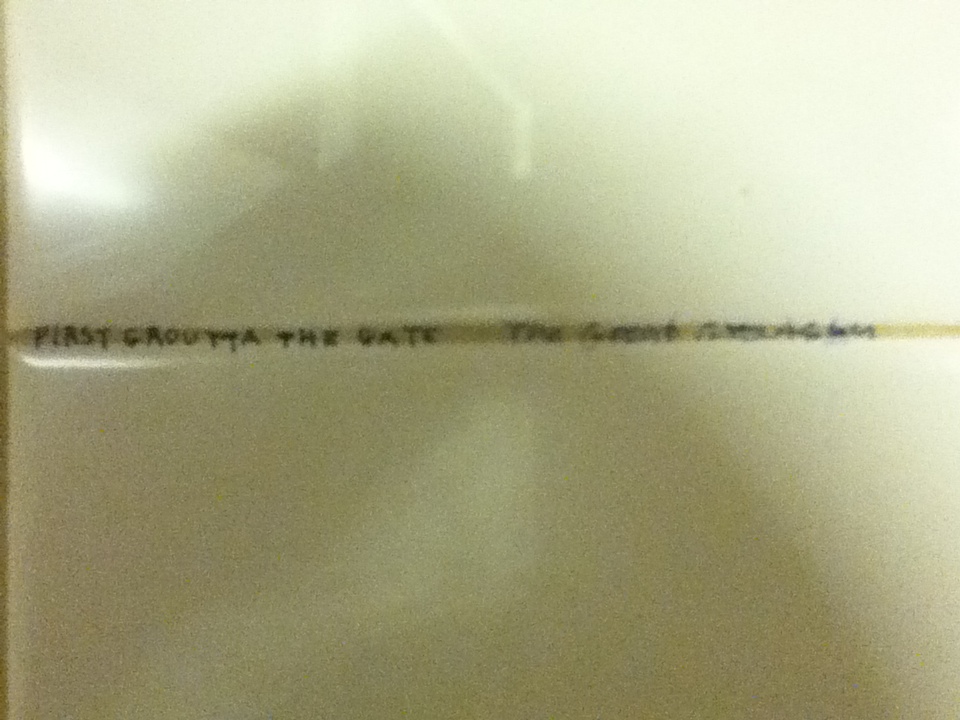
“First groutta the gate” & “The Great Groutsby”


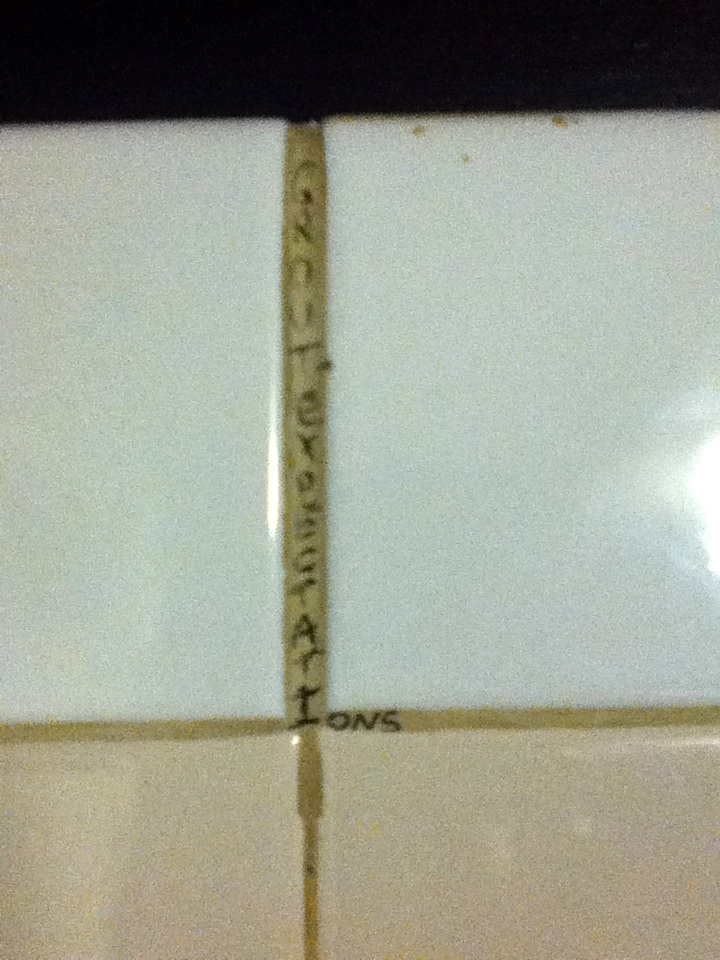
“Grout Expectations”

“Reading between the tiles.”
Literary pun graffiti in the bathroom 
during
the Unchaste Reading literary event at
the Jack London Bar, Portland, OR, 16 July 2012.

New publication

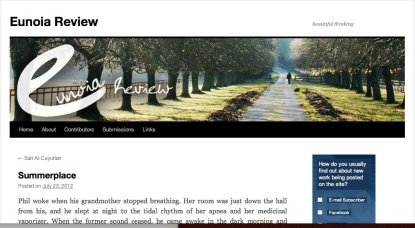
My story, “Summerplace,” in Eunoia Review, 23 July 2012.

I have a new story online today, one I’m really excited about for a number of reasons! For one thing, the story, “Summerplace,” is in Eunoia Review, a publication I’ve liked for some time now and which is getting a bit of buzz in the world of online lit magazines. (And they’ve had a solid run of really terrific poetry lately!) Also, this story is from my story cycle, Strangers Die Every Day. Not counting the lengthy novella, only two stories from that collection remain unpublished now, though both are out on the market (as is the novella and the collection as a whole).

As I mentioned the other day, the stories from Strangers Die Every Day all interconnect; “Summerplace” is a bit of an outlier in that collection in that it takes place significantly earlier than any of the other stories, but if anyone’s curious, a few of the characters from this story also show up in “A Few May Remember” and “Barefoot in the Guadalupe.” I’ll leave it to you to find them. 😉

But don’t think you need to read any of the other stories to find your way through this one. All you need is a little sea air, a flashlight, and a sense of isolation even among a crowd.

Enjoy! And huge thanks to Ian Chung and the rest of the Eunoia gang for the opportunity to appear in this awesome lit review.

Work In Progress – ChainBlogging

I’m not going to tag anyone specific, but if you’re reading this, consider yourself tapped and feel free to play along.

My pal Hobie Anthony passed this along to me, and it looks like fun, so here we go:

What is the title of your WIP?

Do I have to pick just one? I have a novel, a large story cycle, two finished chapbooks and two nearly finished chapbooks, the basis of a graphic novel (if I can ever sort it out and find an artist), and the bones of another story cycle and another novel, all floating around my computer, taunting me.

But for today, we’ll stick with the second story cycle, For All It Reminds Us Of, since it’s the next thing I’m going to be working on.

Where did the idea for the WIP come from?

Hosho McCreesh. Specifically, the poetry from his collection For All These Wretched, Beautiful, & Insignificant Things So Uselessly & Carelessly Destroyed. But I’ve written at length about this before.

What genre would your WIP fall under?

I have issues with genre labels. To me, they’re a bit like music labels these days. I mean, what makes something speculative or slipstream or postcyberpunk or femslash? And what distinguishes any of those from literary fiction? There are answers, I know — good, lengthy, complicated answers — but I keep thinking of Chris Cornell’s acceptance speech in the early `90s when Soundgarden won an award for best alternative album: “Thanks, I guess. I don’t really know what alternative is. I just thought we were playing rock ‘n’ roll.”

Anyway, in this case I actually feel pretty comfortable with the genre of this book: it’s apocalyptic fiction. But I certainly hope it’s literary, too, and maybe a whole bunch of other things as well.

Which actors would you choose to play your characters in a movie rendition?

I don’t know that I think in terms of actors anymore. I get pretty visual in my writing, I think, and I’ve written a few things I think would look pretty cool on film, but that’s not the end game when I’m working. A lot of smart people have made good points about basing character descriptions on actors you’d like to play your characters, because you never know when Hollywood might start trying to stuff your pants with money, and why not help them see your book on the big screen? But a book is not a film, and I think you hamper the writing when you try to conflate the two media.

There are exceptions, of course. Charade and No Country For Old Men both began their lives as screenplays, became novels when no one wanted the screenplays, and then got optioned as movies. Oh ho ho, the joke’s on Hollywood. But again: they started as film, not prose. If I’m sitting down to write prose, I’d rather pattern my characters on real people, not actors.

What is the one-sentence synopsis of your WIP?

When global cataclysm decimates and scatters humanity, those of us left know we can survive, whether alone or in groups; what we need to figure out is how to live. (Or something like that. It’s not an action-y or political apocalyptic book; it’s about the human struggle — not the struggle to survive but the struggle to regain, and probably redefine, some sense of human normalcy.)

Is your WIP published or represented?

Nope. It’s not even finished yet. I mean, there’s an absurdly rough draft, but it’s mostly bits and pieces, not as tied together as I’d like and nowhere close to polished.

How long did it take you to write?

I wrote it last November during NaNoWriMo, so, one month? But like I said, it’s a mess. I’ve played around with it off and on over the last several months, but I think I’m going to get serious and try to knock out a wholesale revision before this coming November.

What other WIPs within your genre would you compare it to?

Nothing. I suppose, since the book is a story cycle, it has that in common with my finished book-length collection. And a lot of my work is about disconnect between human beings and the desperate attempts to reconnect — this book just takes that literally and to an extreme.

Which authors inspired you to write this WIP?

Hosho, of course. There’s also an interesting book by Helen Phillips, And Yet They Were Happy, that sort of touches on some slightly similar themes and uses the story cycle structure. Her book is tonally and stylistically completely different, and the stories in the cycle are all multi-part flash pieces, kind of cycles-within-a-cycle. But I was reading it while I was writing my first draft, and it was influential.

Tell us anything else that might pique our interest in this project.

Every story/chapter title is a line from one of Hosho’s poems, one for each poem in his book. And it was that line-cum-title that directed the plot of each story.

Also possibly of interest: the apocalypse in my book is that a super-massive iron meteor has hit the earth, not quite on the magnitude of the extinction-event meteor that (some say) struck the Yucatan and wiped out the dinosaurs, but close. In fact, in my book, the meteor would have been that big and would have missed earth, but it hit the moon and got deflected into earth. So now the moon’s busted and continues to rain shards of itself onto us all, and the impact of the meteor itself not only triggered planet-wide tsunamis but also caused a chain-reaction plate shift so the whole planet is ravaged by earthquakes and, relatedly, volcano eruptions. And, of course, a kind of “nuclear winter” under the resulting ash cloud.

That’s not really the interesting part. This is: I spent a LOT of time reading up on natural disasters and worst-case scenarios, both globally and specific to this region, and within the limits of fiction and storytelling, the apocalypse I deal with is, strictly speaking, realistic. Not very probable, but definitely possible. So, you know, brace yourselves. 🙂

A Writer’s Notebook: story cycles

Today’s exercise is visual. And it’s a mess. But I’ll just share with you what I’ve done, and then I’ll explain how and why I did it. All you need to know up front is that these are stories, mostly in collections, and the names of characters.

I do this kind of thing all the time, and I’ve written about it before. But the other day I discovered an app for my MacBook that creates “mind maps.” You might also know them as “clustering exercises,” which is why I went ahead and downloaded the app — I love the clustering exercise, and I thought it might not only be a great way to brainstorm new story ideas on my computer but also to illustrate the exercise in my classroom: my freshman essay writers love clustering, or mind-mapping.

The app is called MindNode. I downloaded the free version, MindNode Lite, but I’m enjoying this thing so much I’ll probably pay for the pro version soon. Anyway, to test out the app without investing too much in a new project (I have revisions to work on), I decided to use it for the thing that first leapt to mind when I saw the app: creating a “map” of how my stories connect.

I connect stories all the time. In fact, I make no secret of my (ridiculous) plan to connect everything I ever write, at least one story or book to another, eventually. It’s an ongoing project, and some work is more tightly connected than other work — and there are still plenty of stories drifting alone out there — but it becomes a useful writing exercise in itself, since, if I ever get stuck on a project, I can try to imagine it in relationship to something else I’ve already written.

Still, I’ve come a long way. The images above look tangled and convoluted already, but believe me, I’m just getting started with this MindNode program. All I’ve put into the character map so far are the stories of three collections — a book-length story cycle and two chapbooks — plus a couple of free-floating stories I thought of while I was piecing it all together.

The close-up is of the first five stories from my story cycle, Strangers Die Every Day, which contain some of the densest character overlaps. “A Few May Remember” and “Summerplace,” plus an as-yet unpublished story, “Curl Up and Burn,” have some of the most points of interconnection, but that’s also because they’re the longest three stories in the book. Also, one of these stories, another unpublished piece called “Have Love, Will Hurt,” ties into a trilogy of stories to become a separate chapbook, and one of the stand-alone stories, “Bathe in the Doggone Sin,” gets a tiny, blink-and-you’ll-miss-it reference in “A Few May Remember” — the drunk neighbors in “AFMR” are the main characters in “BitDS.”

And so on, and so on.

Anything to keep the fiction interesting, even if I’m the only one who knows what’s going on…. 🙂

Photo blog 90

“Stranger in a strange land.” Brontë exploring the hall
outside our apartment. Portland, OR, 13 June 2012.

A Writer’s Notebook: a scene from a story

So, I’m working on a new short story. I’ve already finished the first draft and am working on the first read-through, so this isn’t technically a “rough” exercise in the raw here. But I won’t know if this is how the final version will look until I set the whole thing aside for a while and get some distance.

Anyway, in the meantime, here’s an early scene.

The first girl he fell in love with was Natalie, glossy brown hair and dark blue eyes, a Michael Jackson patch sewn on her backpack. Pink lipstick that she wiped off in the girl’s room before getting on the bus for home. They were in fourth grade. She sat behind him in homeroom — he kept turning around in his seat to look at her, kept getting his name written up on the chalkboard. She would roll her dark blue eyes at him but he was determined.

Once, he bought her a tin ring set in plastic garnets from the fifty-cent prize machines at the Safeway. When he gave it to her on the way from music class back to homeroom, she sighed, pushed his hand away. “I don’t want that,” she said. But he offered it again, and he told her that he loved her. “Don’t,” she said. “Please, stop it.” But he did love her, honest, for real. He didn’t like her like her, the way some other boys would. He loved her. “You don’t even know what you’re talking about,” she said. “You’re creeping me out.” That afternoon, when he got his name on the board for turning around in his seat again, he said, out loud in the classroom, that he would prove it to her. Then he stood from his seat, the teacher shouting at him now, and walked to the chalkboard. Underneath his own name, he drew a large chalk heart and got to the t in Natalie name before the teacher took the chalk away and marched him out of the room. He was in detention for a week and the principal switched him to a different homeroom.

Today is the third day since he found the woman in the forest. He can’t imagine now what he would say if he called the police. How to explain the delay. But he cannot just leave her there. On the way home from work, he stops at the Safeway for beer and a frozen pizza, and as he enters the store he pauses at the floral section. He selects a thin bouquet of lilacs and carries them with him through the store, tucking them into the crook of his arm while he collects his beer and pizza. “Aw,” the cashier says. “Must be date night.” He just smiles at her and swipes his debit card. By the automatic glass doors, he spots the gumball machines. Jawbreakers, eyeballs, fruit candies. The single prize machine is full of fake tattoos. He pushes in two quarters anyway, hopes for a heart tattoo. When he cracks open the little plastic bubble, he finds a long band of paper with a tribal coil of barbed wire.

He drops his beer and pizza off at his apartment then drives straight to the park. In the twilight, it still takes him almost two hours to find her again. He lays the lilacs beside her head. He kneels and looks at her. Small birds are whirring in the trees; flies reel over the ferns where she lies. A prop plane buzzes overhead. In the last of the light, he licks his wrist, over and over, all the way around, then he pastes the fake tattoo into the spit on his arm. He squeezes his wrist in his fist and he closes his eyes.

When he opens his eyes, the sky is darker but his vision has adjusted. He can see her looking at him. He whispers, “I wish I knew your name.”

There isn’t much of an exercise here except me following an idea. My wife and I — big murder mystery fans — sometimes joke that the deep, lush ravines in the verdant forests here in Oregon would make great places to hide a body. And then a few weeks ago, after we had spent the day in Washington Park, I turned on the news and heard that, lo and behold, just such a thing had happened: someone had found a body in the very park we’d just visited.

It creeped me out a little, I have to admit. And it got me wondering, what would I do if I found a body? How would I react?

I still don’t know the answer to that, beyond calling the police. But that immediate answer — to call the cops — made me wonder what sort of person wouldn’t call the cops. Why would someone find a body and not report it?

And then I had this idea: what if the person who found the body fell in love.

It’s a morbid thought, I know, but before you get the wrong idea, know that I’m referring to a tale about Charlemagne, related by Italo Calvino in his Six Memos for the Next Millennium. In the tale, Charlemagne become subject to a spell in which he falls in love with anyone to possess an enchanted ring. At first, this ring is worn by his wife, so no one suspects an enchantment, but when she dies and he continues to love her corpse, an archbishop discovers the cause. He removes the ring and Charlemagne falls in love with the archbishop, who throws the ring into a lake to be rid of it. The plan backfires; Charlemagne lives out his remaining days sitting by the lake, gazing adoringly at the water.

I’m fascinated by this idea of people falling in love with inanimate objects. And we don’t need magic to explain it — people fall in love with things or places or memories all the time. So now I have this man, who is lonely and a bit pathetic and unlucky with women, and he finds the body of a woman, and suddenly, he has a companion.

So this is the idea I’m playing with in the story. This, and the consequences of her eventual decomposition: this is not a relationship that will last forever….

Meanwhile, as I sit here writing… (plus, Photo blog 89, sort of)

Some observations from the past several days:

  • I just finished a story. When I started it, half of me wanted it to be a piece of flash fiction, and the other half wanted it to be a novella. The first draft wound up being 5,200 words. I met myself in the middle.
  • Having this blog, and interacting with other writers, has led me to meet a lot of really cool people. But today I got an email from a total stranger who wants me to review a poetry book. And I got the book (it’s digital). That doesn’t happen very often — it’s not like I’m a lit magazine or a professional reviewer or something. But hey, it’s pretty cool! I haven’t read the book yet, but if I can get around to it sometime soon, I’ll let you all know how it is. (And everyone, please feel free to send me stuff! I love you all and I would love to share your work! But I ain’t promising to like it, or even to have time to read it. I’m just saying.)
  • Speaking of liking or not liking work: today I got a rejection. Which I don’t take personally — it’s not an easy story to place. But I waited 208 days for a thin form rejection of a 570-word story. I know people are busy, and I’m just as guilty as the next guy about taking too long to get back to people, but man, it’s flash fiction people. It’s not that hard. So after 208 days, I might at least have expected the easy toss-on line of “Sorry for the long delay….” Manners: some people have them, other people don’t.
  • And speaking of manners: I recently met Katharine Hargreaves, one of the editors of Whole Beast Rag. Check them out, because they’re doing something few people are doing right now: they’re a literary magazine that wants criticism. Seriously: it’s a rare creature, this Whole Beast, because for the most part writers and critics are fairly suspicious  of each other and don’t often hang out in the same circles (writers who ARE critics tend be just a little bit crazy), but to be perfectly honest, that division is fostered and nurtured in many a grad school program and is must less nerve-wracking out here in the Real World. So here comes Whole Beast Rag, saying screw you to the status quo and putting Lit and Crit side by side. And, unlike many academic critical mags, they’re not all snobby about their work. They want good, sound, well-written criticism, so you’re not going to get away with sloppy work and bald amateurism, but don’t think you need a PhD to read or write for this fine publication. Give them a whirl. They’re pretty rad.

In other news:

I have been really fortunate to meet a lot of really cool writers since I moved to Portland. Not all of them live in Portland, but many of them have connections to other writers in Portland or have read here. Here is what some of them have been up to:


And finally:

This month, Unshod Quills is celebrating its first anniversary, and Dena Rash Guzman invited a bunch of past contributors and other local litsters out to UQ Headquarters for a big shindig to celebrate. Here are some photos of writers being crazy:

This slideshow requires JavaScript.

(I took all these photos. Except the two I’m in, of course. Later, there was a campfire, and the following morning coffee by sunrise, but I don’t have pics of those. Also, I’m not labeling these — it would just be too complicated — but if you’re curious, writers/editors/etc. in these pics include Chad Reynolds, Dena Rash Guzman, Hobie Anthony, Kerry Cohen, Kevin Sampsell, James Bernard Frost, Katharine Hargreaves, Laurel Hermanson, Monica Storss, and my wife, Jennifer Snoek-Brown. And a bunch of other people — I lost track after a while.)

I love the smell of freshly-printed Internet

Paris Turns Purple
Okay, I’ll be honest: I don’t actually read the Paris Review. But they didn’t have any freebie images of Glimmer Train or One Story. (Photo credit: Robert Burdock)

One of the things I love about writing and publishing is the community of writers and publishers I get to participate in. That includes the terrific magazines, reviews, and journals I’m in, because I’m a reader, too, and I publish in the places I love to read. And I am an editor — I did the usual stints on student rags in college, but I also spent a couple of years working for American Literary Review and I’m currently the production editor for Jersey Devil Press. I work for places I love to read, too.

Sometimes that means print magazines, which is excellent, because I love the printed word. It’s a cliche these days to talk about the texture of the pages or the heady smell of the binding glue, but damn it, go press your whole face into a new print literary review, really work your nose down into the gutter, and breath deep. Feel the ink and wood pulp against your cheekbones. Tell me you don’t get high off of that.

But I’m no Luddite. I like a good e-zine as much as I like a good print journal. In fact, in some ways I like them better, because while I can’t put an e-publication up on my bookshelf at home and then egotistically hope all my guests will notice and ask me about my work, e-publications are much easier to (egotistically) share with all my friends, family, and readers. All it takes is a link on Facebook, or in an email, or here in my website.

Readability on the iPad
I also don’t have an iPad. But I do have an iPod, and yes, tiny as the screen is, I do read lit journals on it. Seriously. (Photo credit: Wiertz Sébastien)

And I love reading e-publications for the same reason: I have access to them fast and easy. And they smell just fine, too, though I wouldn’t press your nose too hard up against your iPad. Plus, there are some damn fine e-zines, e-journals, and e-reviews out there. I know. Just glance at that massive list of links in the right-hand sidebar and you can see I read a lot of them.

Lately, though, I’ve noticed a bit of a trend in e-journals turning up here on the free (or relatively free) WordPress platform. That makes a lot of sense, really: even e-publishing is expensive, and don’t let anyone tell you otherwise (even if you get a free blog and take e-submissions through Gmail, you still have to invest a lot of valuable, otherwise-money-making time in producing the thing), so even if you pay for the domain upgrade, like I have, using WordPress for your design and hosting is a good way to save your money for other things, like subscribing to other literary magazines.

This trend is feeling very close to my work lately, because some of my most recent or upcoming publications are in magazines hosted on WordPress. And this is good news for many of you, because it means all you have to do to subscribe to the magazines is to follow them on WordPress!

Here are a few of the magazines I read that are hosted on WordPress:

  • Burnt Bridge, where a long-time friend of my family, Roy A. Rogers, has published (they do a terrific print edition, too)
  • Eunoia Review, where I’ll have a story later this month
  • In Between Altered States, where I get loads of inspiration from their prompts and from the killer stuff they run
  • Unshod Quills, run by the phenomenal Dena Rash Guzman and Wendy Ellis; I had a whole string of stories in their fourth issue
  • Used Furniture Review, where I just published as part of a collaborative story organized by the awesome Meg Tuite for her fiction column

Not a WordPress member? No worries! Look for the RSS subscriptions — and look for something similar on any other, non-WordPress journals you find. This also goes for magazines using the fancier, paid version of WordPress, like Jersey Devil Press, The Murky Fringe, Red Dirt Review, or Fried Chicken and Coffee, but it also goes for magazines hosted on Blogger (Our Band Could Be Your Lit) or other platforms. If you don’t see an RSS feed, look for an email sign-up, like the one at SOL: English Writing in Mexico. Still not finding a way to subscribe? Follow them on Facebook or Twitter.

Read this stuff, people! Not just once in a while but regularly. We write this stuff for ourselves — let’s face it — but we publish this stuff for you. And for the fame and glory and booze and women/men. But mostly for you.

We hope you enjoy it. 🙂