I swear this isn’t going to be an annual thing, at least not that I’m planning for. But since the anniversary of this site is here, I’m going ahead and redesigning the site again. I’ve added so much content over the last year — loads of links, the NaNoWriMo page, photos galore — that I feel the site is getting a bit full. Not cluttered, necessarily, but, shall we say, wooden and sluggish? Just in appearance. So I’ve decided to brighten things up and make things a bit cleaner in the process.
Of course, I’m also adding MORE content. The ideas, they just keep coming.
So, in three days, look for a new and (I hope) improved website, with a few new features.
The biggest change you’ll notice is the URL: I’m upgrading my WordPress account to have my own domain, so starting on January 26, you can find me at snoekbrown.com. Nice and simple.
Don’t worry — all the old links should still work, and snoekbrown.wordpress.com should still get you to snoekbrown.com. If that’s a problem on the 26th, trust that I’ll find out in a hurry and fix it before this coming weekend.
The major new feature I’m considering adding is a page of photo galleries or slideshows. To which end, I’m hoping you can help me out: take the poll below and tell me what you’d most like to see on the site. And yes, you can pick more than one thing.
Also, I’ll need your help deciding how best to present these photos to you:
Any other feedback you have about the site would be great, too. Any pages or features you could live without? Any pages or features or links you wish I’d add? Anything you like in theory but wish I’d do differently/better? Leave me a comment! I’d love to know.
Otherwise, see you at snoekbrown.com on January 26.
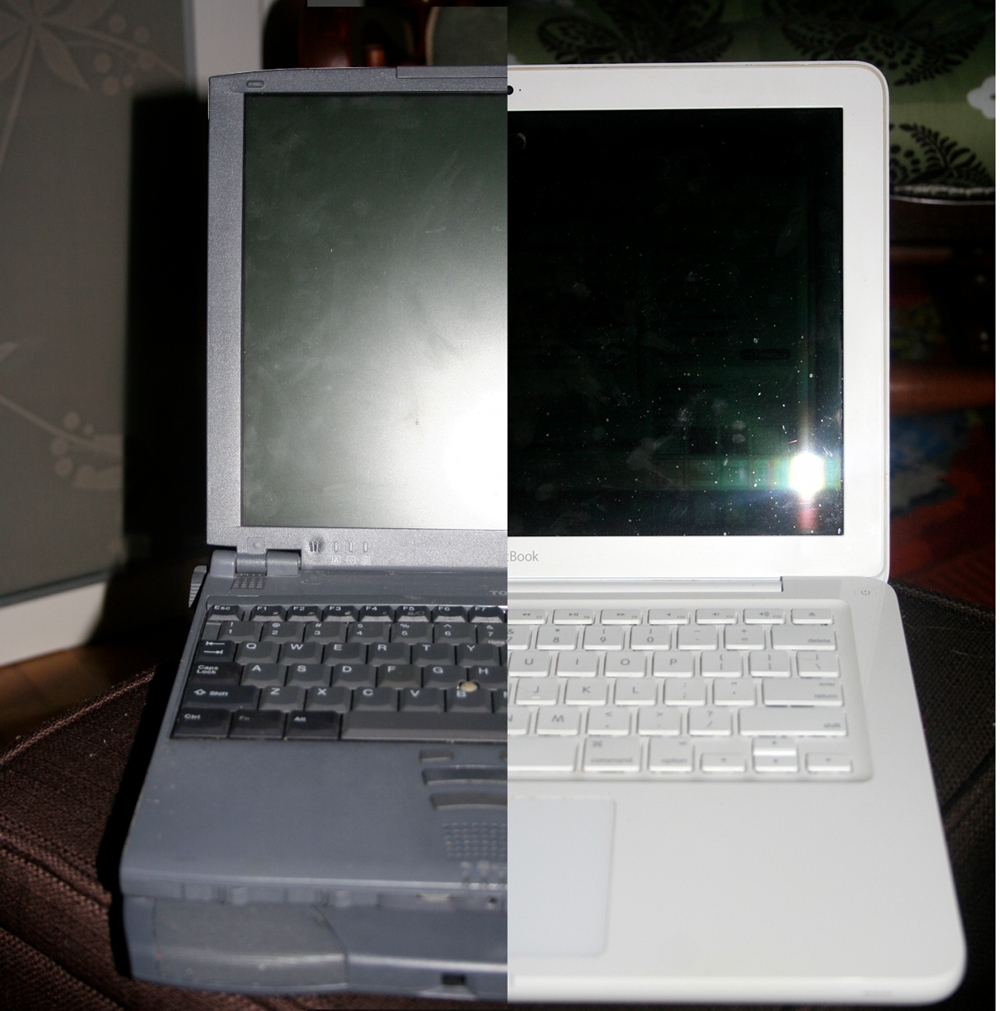
* Both these computers are mine, old and new, but I’m just kidding about the “busted” part — my old Toshiba is still kicking and when I need to write without the temptation of the Internet or video games (a growing problem lately!), I still break out the old familiar laptop. I might just do so this week, in fact.
This week I’ve been introducing the writing process to my college writing students through a multi-draft assignment based on NPR’s “This I Believe” project. In class on Wednesday, I had them begin a quick 250-word “credo” to get the ball rolling on the series of drafts, and, like a good teacher, I sat down and wrote with them. Both the drafts I started are pretty awful (which is okay — these are still a rough drafts, after all), but I’ll go ahead and share one of them anyway. And after the bad writing, I’ll explain the exercise.
I believe in the power of the smiley face. It’s such a simple icon that represents such a simple human emotion, but it’s one of the few human emotions we all share, if not in reality then always in aspiration. As the Dalai Lama likes to say, everyone wants a happy life. And, if I remember the science right, the smile is one of the few universal facial expressions, transcending culture. It might mean slightly different things in different cultures and contexts — there is a famous example Alfred Hitchcock liked to use of an old man smiling at a cute puppy and then the same man — not even a separate image, but the exact shot we’d seen previously — smiling at a teenage girl, and how much of a difference context makes in how we respond to the smile. But generally speaking, we can intuit genuine smiles as expressions of happiness, and that emotion — visually stimulated — is, in fact, contagious. Seeing others smile makes us smile, which, by extension, means that seeing others happy makes us happy. The smiley face, then, is the purest expression of basic human compassion and the universality of empathy that I can think of. It represents hope for our future, it conveys the interconnectedness of all living beings…….
Blah blah blah blah blah — this has gotten really inflated really fast, and it’s out of hand. I need to rein it in and re-focus on the simplicity of the smiley face. Or perhaps that sentiment is too simple? No — tell a story about children, my own niece or nephew, for example. Talk about the smile project to surgically repair children’s cleft palates, perhaps? Something concrete — I, too, have strayed too far from the definite and am rambling into vague or grandiose abstractions.
For those of you unfamiliar with the “This I Believe” series, check out the website: thisibelieve.org.
For this first, sloppy, short draft, I have my students write a statement of belief, something small and personal and simple, something they can knock out in 250 words during a class period. A lot of them struggle with this — a lot of them reach for grander ideas or broader topics, even when they start out small and simple. And I don’t blame them for it: obviously, I have the same problem!
Still, it’s a starting place. Speaking only for myself, if I pursue this topics I’d definitely scrap everything I’ve written and begin again, which is precisely what I assigned my students to do for their second draft. Because that’s how writing goes.
I wonder how many students see all college classrooms in grainy black-and-white? (Image via Wikipedia)
In a recent piece in Forbes (why Forbes? why not Chronicle of Higher Ed or InsideHigherEd.com, both of which the author cites after his essay) on why professors “Don’t Lie Awake At Night Thinking of Ways to Ruin Your Life,” economics professor Art Carden opens with a quote from I Corinthians: “When I was a child, I spake as a child, I understood as a child, I thought as a child: but when I became a man, I put away childish things.” It’s a strange opening quote, given that it comes from the same chapter in Corinthians that discusses love and marriage (many Christians use the passage in their wedding ceremonies). Is Carden suggesting that once we enter college we’re married to our education?
(Sure. Why not?)
But what he’s really saying, in a somewhat politer way, is that college students need to grow up. Toward the end of his editorial, he mentions, speaking directly to his students, that he “once thought as you do”: “I once carried about the same misconceptions, the same litany of cognitive biases, and the same adolescent desire to blame others for my errors.” Okay, maybe it’s a bit condescending to relate “misconceptions” and “cognitive biases” with adolescence, but the man does have a point.
At the beginning of his editorial, he explains how most students assume they begin with a perfect 100% and the professor — cruelly — “takes off” points, as though we’re all in this game to punish students. Just last term, I had two students say this same thing out loud in class. My response then was the same as Carden’s response now: Students start at zero (I prefer the phrase “start with a blank slate”) and earn points: “My assumption at the beginning of each class is that you know somewhere between nothing and very little about basic economics,” Carden writes, referring to his own field as an example, “unless you were lucky enough to have an exceptional high school economics course. Otherwise, why are you here?”
But the best part of his piece is the passage in which he explains his genuine compassion for his students:
Finally, I’m here to be a mentor and instructor. This means that our relationship differs from the relationships that you have with your friends and family. Please don’t infer from this that I don’t care about you, because I do. A lot. I want to see you make good choices. I want to see you understand basic economics because I hope it will rock your world as it continues to rock mine and because the human consequences of lousy economic policy are enormous. That said, you should never take grades personally. I don’t think you’re stupid because you tank an exam, an assignment, or even an entire course. Economics is hard. A D or an F on an economics exam does not diminish your value in God’s eyes (or in mine) or indicate that economics just isn’t for you. It probably means you need to work smarter, and I’m here to help you with that.
The two key phrases — for my own views of education — are these: “Please don’t infer from this that I don’t care about you, because I do. A lot.” And, “I’m here to help you with that.”
I might have chosen a different opening quote. Perhaps the quote, from His Holiness the 14th Dalai Lama, that I include at the bottom of my website: “Pay attention not only to the cultivation of knowledge but to the cultivation of qualities of the heart, so that at the end of education, not only will you be knowledgeable, but also you will be a warm-hearted and compassionate person.” Or perhaps a comment from Marcus Aurelius, whose Meditations I am currently reading: “You have power over your mind — not outside events. Realize this, and you will find strength.”
But however I might have opened the essay, I would probably have ended it in roughly the same way Carden does, substituting “English” or “writing” for “economics,” of course: “[Writing] is hard, but becoming a responsible member of a free society is very, very, very hard. I’m still learning to put aside childish things. I hope you will do the same. Start now. The effort is daunting, but the rewards are substantial.”
Because it is the best evaluation of self-publishing and e-publishing and traditional publishing and the future of books and everything else we all care about so much (well, you and me, anyway) that I have seen in a long time. It might even be better than Margaret Atwood’s awesome keynote address I linked to about a year ago.
This is The Way Things Are, and no bones about it.
Unless you want to pick bones. In which case, leave me a comment!
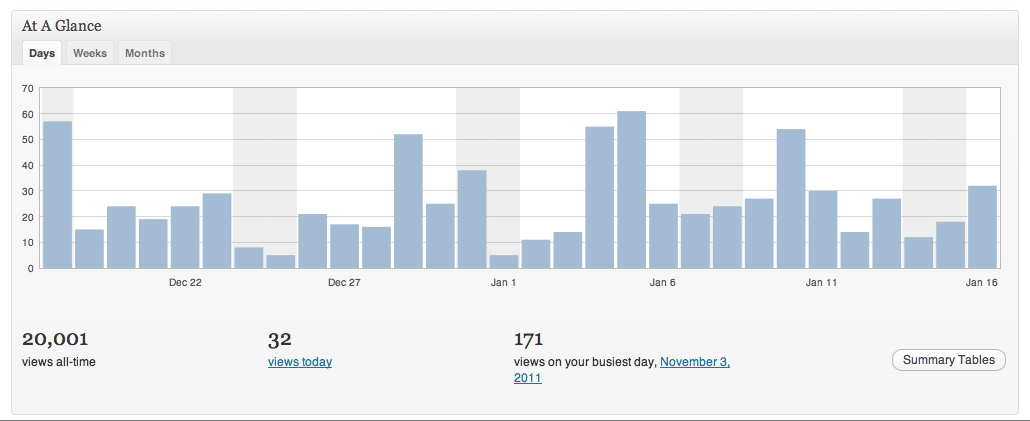
Ladies and gentleman, as of about 6:45 pm Pacific Time, I have topped 20,000 hits on this website.
This is fantastic! And well-timed, because this coming week, I will be unveiling a wholly revamped website. Most of the main pages will remain, so the menues will function as usual, but I’ll be adding a few things, like a photo gallery or two, and maybe a redesigned publications page, and some other new features. The two main differences, though, will be a change in the layout and color scheme, and a new domain name: as of January 26, the anniversary of this site, snoekbrown.wordpress.com will become snoekbrown.com!
Got any ideas for other new features you’d like to see on the site (or old features you’d like me to retire)? Send me an email or leave a comment here!
I’ve been busy this week. I just began my winter term teaching college writing, I’ve started finalizing the layout and the cover design for the February issue of Jersey Devil Press, and I’m working on a major redesign of this website. (Stay tuned for more news on that front!) So, I’m breaking out the old pen-and-paper notebooks again.
NYPL is a strange sanctuary of literature, where the librarians have chosen the protection of books over access. It is still a public library, but they have an entire room just for the catalog (today, a bank of computers), two huge reading rooms filled with desks, and between them several banks of counters like teller stations at a bank where you take your book requests so the library assistants — not you — can go and retrieve your materials.
Book rooms behind closed doors for sequestered study like a monastery.
catalog name: CATNYP
* Look into grants for library workshops?
* Look into visiting English/CW classes in the middle & high schools?
With young poets, the best advice is to get out of their way. They know that creative writing is play, and they are still young enough to know the value of play.
“No yelling.”
“Don’t say ‘boo’ even if you don’t like it.”
“You’re the boss of your poem.”
“Do your stretches.”
The reference to the New York Public Library dates these two pages to the end of January/beginning of February, 2008, when I attended the annual conference of the Association of Writers & Writing Programs. (Alas, that was the last time I was able to attend, since we moved to Abu Dhabi later that year and only returned to the US this past spring; this year, I can’t afford the trip to Chicago, where the conference is, which is killing me because AWP is one of my favorite conferences and Chicago is one of my favorite cities. But you can’t win attend `em all, I guess.)
The second page seems to contain notes I took at the AWP conference, where I remember attending at least one panel on teaching creative writing to kids and young adults. The previous summer I had launched a creative writing workshop for teens at the public library in Platteville, WI, where we lived at the time; I repeated the workshops in summer 2008, so I was getting some prep work in at AWP. (This page is followed by three or four more pages of similar notes.) I don’t know who said the comments in quotes — one of the presenters, but I don’t recall which one. By the way, those writing workshops for teens are still going strong: I handed them over to Ryan Werner when I left Platteville, and he’s still doing them every summer. 🙂
The journal this appears in was a gift from my mother. It’s one of my favorites, partly because the paper is so smooth and easy to write on but mostly for the “Joy” kanji on the magnetic flap.
This week I’m working on several things at once, and all the writing I’m doing is destined (I hope) for other publications. But true to the Notebook, all the work also is written from prompts. So I thought I’d share links to the places whose prompts I’m working with.
Housefire: A few inventive but very explicit prompts with detailed instructions; fiction and poetry.
The Prompt Literary Magazine: So many prompts in such a variety it’s almost a book of exercises. Which is cool. Fiction, poetry, essays, sketches, and pretty much anything else involving words.
Our Band Could Be Your Lit: Submissions based on prescribed songs; flash fiction. (It’s been on hiatus for a while, but send in something anyway and make editor/author Ryan Werner do some work on it!)
Unshod Quills: Fairly open as to style, genre, etc, with several general prompts to choose from. Fiction, essays, poetry, videos, photography, and so on, and so on.
I could list all the prompts here, but there are a lot, and those sites deserve some traffic, so go visit the links above!
I’m not writing material for all the prompts at all these sites, but I am working on a lot of this. If you know of any other cool publications that also are calling for submissions based on prompts, pass along the links in a comment!
Jersey Devil Press, Issue Twenty-Six, January 2012. Cover art by Patrick Breeden.
January’s issue of Jersey Devil Press marks my first public outing as their production editor, in charge of the layout and design of the pdf “print” issue and the web version of the issue. And while I’m mostly just adding personal touches to the excellent work Eirik Gumeny did setting this whole thing up, I’m still pretty damned pleased with the work!
It helps that our new content editor, Mike Sweeney, has such awesome taste in fiction, too — just this afternoon I was telling him how much better the stories look each time I read them while designing the issue.
The one thing I did want to bring to Jersey Devil Press with my first issue was some outside cover art. A lot of Eirik’s covers are fantastic, but I love meeting and talking to and working with visual artists and photographers, so I was looking forward to finding some good outside cover art for the magazine. And my first cover artist, Patrick Breeden, has contributed a simply killer abstract piece. Which is why I’m skipping my own Photo blog post today and just putting up the cover of Jersey Devil Press.
Now, go read some fiction. You can thank me later.
The WordPress.com stats helper monkeys prepared a 2011 annual report for this blog.
Here’s an excerpt:
The concert hall at the Syndey Opera House holds 2,700 people. This blog was viewed about 9,900 times in 2011. If it were a concert at Sydney Opera House, it would take about 4 sold-out performances for that many people to see it.







 Samuel Snoek-Brown