A Writer’s Notebook: newspaper/object story

This is the beginning of something, but where it goes, I don’t yet know:

When I was in college I bought pot from a guy who kept turtles in a kiddie pool on his sun porch. I forget how many altogether, but he had at least a dozen in there. All kinds, too — a handful of box turtles, a few snappers, a slider, a river cooter. Barry had only bought two of them himself; the rest he got from customers who couldn’t pay for their dime bags.

If you hung around Barry long enough, he’d take you through his house to the back yard and introduce you to Clive, his six-hundred-pound tortoise. If you were a girl, he’d let you ride Clive. Otherwise, you’d just stand around sharing a pre-sale joint, blowing smoke in Clive’s old face and feeding him heads of lettuce.

Clive was another payment, but not for any dime bags. Barry had gotten him from a distributer in Tijuana in exchange for running a truckload of grass into the States. Barry never volunteered how he’d got both the pot and the tortoise across the border, and I never asked. But I do know this was back in the early `80s, so Barry’d had Clive for more than a decade by the time I met him.

The Mexican had gotten Clive as a birthday present from his great-uncle, who in turn had found the tortoise as a boy while wandering the streets of his Mexican village. When the great-uncle had found him, Clive was as big as a man’s head; when I first met Clive, he was slightly smaller than my sofa. As near as we could figure, Clive was nearly a hundred and thirty years old.

Barry got into pot because he had stomach cancer. Last month, he died. I hadn’t heard from him in years, not since college, and I didn’t really smoke anymore unless someone else was carrying. So there was no reason I would ever know that Barry had died, except that, for some reason, I inherited Clive, who by now must be a hundred and fifty.

A couple of weeks ago my mother-in-law sent me an article on left-handedness (I’m a lefty — or, more accurately, I’m mixed-handed but have a left-handed preference). The article appeared in an October issue of the newspaper insert American Profile, and when I finished it, I skimmed the rest of the insert for any other interesting tidbits. And tidbits there were: in a brief section titled “Tidbit: Did you know? . . .” the issue contains a paragraph about a tortoise in Colorado:

Toby the tortoise, who was found in 1911 by a 10-year-old girl, marked a century in captivity in August. During his last 28 years, the reptile has been cared for by Karen Churnside, of Boulder (pop. 97,385), Toby’s third “custodian.”

Which got me thinking about Italo Calvino and my favorite of his Six Memos for the Next Millennium, his chapter on “Quickness,” in which he explains the technique of giving even the briefest story a grand scale by focusing an object rather on characters. By following an object as it passes from person to person over time, you can convey a lot in very little space. Think of the ring in Lord of the Rings, or the violin in The Red Violin. And I figured, with a tortoise’s long lifespan, why not tell a story about a tortoise passing from one generation to the next and crossing continents?

I’m not really sure yet what sort of story this might become, but it’s fun building the foundations like this.

11-11: Poetry (modern French)

I opted to pick up some French poetry mostly to brush up on my French. Turns out, I’m not quite as rusty as I thought I was, at least in terms of my reading skills, because I still retain enough of my French to not only get some of the subtle in-jokes and layered allusions in the original French but also to catch what I feel are some weak translations in this volume.


For the most part, the translation is fairly solid, a bit pedestrian perhaps but certainly serviceable. But the kind of poetry in this collection — French symbolist poetry that explores dreams, the subconscious, and surreality — isn’t really meant to be merely “serviceable,” which is one reason I feel the translations are sometimes a bit weak. In a Max Jacob prose poem early in the collection, Fowlie translates:

Yes, it fell from the nipple of my breast and I did not see it. As a boat comes out from the rock cave with the sailors without the sea quivering in the least, a new poem fell from my breast of Cybèle and I did not see it.

Yet the original lines in the middle of this piece read

Comme un bateau sort de l’antre du rocher avec les marins sans que la mer en frémisse davantage, sans que la terre sente cette aventure nouvelle, il est tombé de mon sein….

That phrase following the second “sans,” which translates as “without the earth feeling this new adventure,” is utterly absent from Fowlie’s version. And I wonder why. The line ungrounds the poem, literally, setting the sailors asea without any notice of the earth they’re leaving behind. It’s a line of freedom but also of loss, a stark prefiguring of the poet’s own failure to notice the poetry leaving his breast. Cutting the line mars the poem, I think.

In a later poem, “Prophétie” by Jules Supervielle, Fowlie rearranges the grammar of a stanza in ways that don’t exactly ruin the poem but that do, for me, upset the rhythms in the original. In the French, the poem’s final stanza reads

A la place de la forêt
Un chant d’oiseau s’élèvera
Que nul ne pourra situer,
Ni préférer, ni même entendre,
Sauf Dieu qui, lui, l’écoutera
Disant: “C’est un chardonneret.”

Fowlie translates this passage as

Where the forest was
A bird’s song will rise up
Which no one will place,
Nor prefer, nor even hear,
Except God. When He listens,
He’ll say: “It’s a goldfinch!”

This is a fine translation that gets across the gist of the stanza. But the grammar of those last two lines bothers me, because in the French, the verb tenses and the line structure are slightly different. I would translate those last two lines like this:

Except God, he will listen,
Saying: “It’s a goldfinch!”

The meaning of Fowlie’s translation is essentially the same as mine or as the original French, but swapping the present progressive and the future tenses changes the way I read the lines. In the French, God is going to listen, some day, and then — simultaneous to the listening — will be be saying “It’s a goldfinch!” Fowlie’s translation moves the action to a conditional present (“When he listens”) and then supposes a future reply (He’ll say: “It’s a goldfinch!”) In the original, we anticipate God’s response and then enjoy the immediacy of it; Fowlie moves the anticipation to the end, and thereby throws an emotional drag on the whole poem. It ends on a downbeat, rather than the upbeat I read in the original.

Fowlie does some similar things to lines breaks, too. In Jean-Cocteau’s “Plain-Chant” (“Plain Song”), Cocteau writes:

J’ai, pour tromper du temps la mal-sonnante horloge,
Chanté de vingt façons

Fowlie translates this as:

I have sung, to deceive the evil-sounding clock of time,
In twenty ways.

There is nothing particularly wrong with this translation, but I pay a lot of attention to line breaks in poetry, because I love what line breaks do to language, and while the French version breaks apart the verb phrase “I have sung,” I can’t help but wonder if it was on purpose, since it renders the second line as “Sung in twenty ways.” In the French version, the second line contains a verb, some sense of action. In Fowlie’s version, the second line is just a number, an accounting. It’s dead, flat, unconnected to the line before it.

I quite enjoyed reading the French poetry in this collection, and having Fowlie’s translations to check my understanding was tremendously useful, but ultimately, I think the translations are flawed. Still, it’s nice to know I can understand these things on my own, despite how out of practice I am with my French, because now I can consider tackling some French poetry without translations and just letting my sense of the poems unfold more naturally.


For more about my 11-11 project, check out my initial post on the challenge or all the posts in my 11-11 category.

For more on what I’m currently reading, check out my Bookshelf.

Photo blog 74

"Photographer." My father at Pittock Mansion, Portland, OR, 7 October 2011.

I got caught taking this picture. My father was amused, and since I had the camera ready, I took that picture, too. I actually like it better:

11-11: Russian fiction review (Vladimir Nabokov)

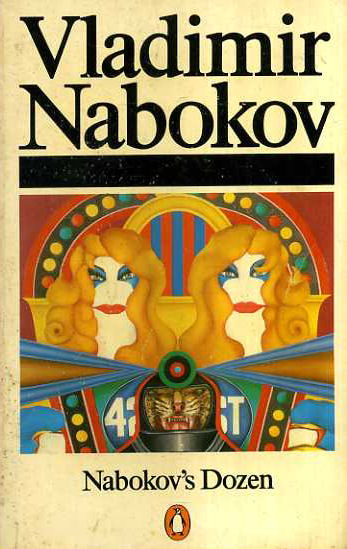
Nabokov's Dozen, by Vladimir Nabokov. (This isn't the edition I read -- I read 1969 "Books for Libraries" edition -- but this is a cool cover.)

I suppose that if one is going to read Nabokov for the first time — as I have with this book — one ought to start with Lolita. Because, well, why wouldn’t you?

But Lolita — the character, at least — has become such a part of our cultural consciousness that I fear any reading of Lolita the novel will be marred by “Lolita” the archetype. And besides, I’m always interested in the short fiction of famed novelists — I like to see what they’re capable of in that shorter, more compressed form.

Nabokov, to judge from this book, seems to be a bit hit or miss in the short form. Some of the stories in this book are quite good, products of their time that feel a bit dated and staid by today’s standards but that are clearly well written and good stories. A few are excellent, understated gems that easily survive the radical changes in taste that have convulsed the short fiction world for so long, and those stories hold up quite well even today. And a few are so weirdly flat that I’m a bit surprised they ever saw print.

It’s no surprise that my favorite stories in the book are the most stylistically inventive or contain the most bizarre content:

“Spring in Fialta” is actually fairly pedestrian, in terms of content, though its subject — the “girl who got away” turning out to be not such a great catch to begin with, and yet the sad male narrator yearns for her anyway — is a favorite subject of mine. But he chooses to tell the story in a kind of fractured narrative built almost entirely out of memories revisited at random in a present-tense rumination. The result is a narrative that jumps around in time wildly and frequently switches between present and past tense (with healthy but haphazard doses of past- and present-conditional tenses), yet the story itself never really gets confusing. Instead, Nabokov wraps you up in the narrator’s reminiscences and so you just sort of float along, a passenger in someone else’s story.

“Signs & Symbols” is also a bit fractured, but for different reasons: the story involves an older couple’s attempt to visit their son in a sanatorium, and the narrative drifts between their perspective and the observations of their mentally ill son. The passages in the son’s head, obviously, are the source of many of the “signs & symbols” of the title, but the whole story bears the marks of a writer anxious to play mind games with his reader and bury as much symbolic content in the text as possible. Which all sounds a bit pretentious, and it is, but for me it works. Plus, the plot of this story reminds me strongly of the plot in Raymond Carver‘s “The Bath” and its longer, more developed revision, “A Small, Good Thing” — in fact, I wouldn’t be surprised to learn that Carver was influenced by this story (I know Carver was a fan of Chekhov, but I don’t know what other Russians he read).

“Scenes from the Life of a Double Monster,” a story about a pair of conjoined twins that is narrated, sometimes in the first-person plural and sometimes in the singular, by only one of the twins, is a bizarre and haunting story about human connections and disconnections. I confess, I had started this story late at night and thought I might skim it a bit before skipping ahead to another I wanted to read before falling asleep, but something about the narrative voice of this story compelled me to back up and start over, and I wound up reading it all the way through. It’s a gimmicky premise and could easily have come off as a piece of hack exploitation fiction, but Nabokov handles the perspective of this one conjoined twin sensitively and beautifully, and it’s a terrific tale even if the ambiguous ending doesn’t quite satisfy the rest of the story.

But the real knock-out in this collection is daring “Conversation Piece, 1945.” The story starts out as simply a mistaken-identity story that flirts with the speculative or the surreal: a man shares his name with a notorious bigot and keeps getting mistaken for him in awkward circumstances. The “conversation” that the title alludes to is one such mistake, in which the narrator gets accidentally invited to an intellectual salon hosted by a friend of a friend (in a layered confusion, the narrator himself has mistaken the name of his friend’s friend for someone else he knows by the same name). The salon, it turns out, is hosting a “celebrated” anti-Semite, and all the party present — none of whom the narrator actually knows — are quietly, politely, viciously anti-Semitic themselves. The narrator is trapped, then, in a situation from which he cannot politely extract himself, listening to ideas he finds morally repugnant. And so the story goes. It would be a comedy of manners if not for the racially and politically charged content — set in America in 1945, the story takes place shortly after the death of Hitler but before the end of war in the Pacific Theater, and it does a fantastic job of highlighting the dangerous undercurrent of anti-Semitism among certain sects of America’s “intellectual” élite during the war years. What on the surface looks like a mere situational comedy becomes a troubling philosophical commentary. It’s a clever and risky combination, but Nabokov pulls it off brilliantly.

Vladimir Nabokov. (Image from Wikipedia.)

Some of the other stories in this collection come off as over-long and a bit dull, old-fashioned to my eyes. “The Assistant Producer” was probably the worst offender; it actually contains the line, “We are now going to witness a most weirdly monotonous series of events.” And indeed, we do. “Mademoiselle O” also suffers, because, while it is interesting as a peek into the private life of Nabokov himself — it is so blatantly autobiographical that Nabokov included a version of the same story, using the actual rather than the changed names of the characters, in his memoirs — I feel the story is too constrained by fact to make convincing fiction.

But the book on a whole is a good read, and I don’t regret at all not having picked up Lolita first. In fact, I feel I can probably more honestly read Lolita now; I feel I can treat it as fiction rather than as cultural icon.

But that’ll be for next’s year’s reading list.


For more about my 11-11 project, check out my initial post on the challenge or all the posts in my 11-11 category.

For more on what I’m currently reading, check out my Bookshelf.

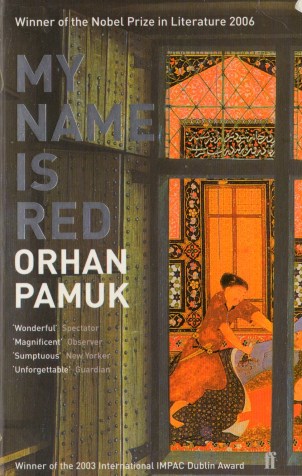
11-11: World fiction review (Orhan Pamuk)

Part murder mystery, part historical novel, part spiritual meditation, part political intrigue, part love story, part philosophical treatise, part artistic rumination, part narrative experiment. . . .

Orhan Pakmuk‘s My Name is Red, the English translation of which helped him secure a nomination for the Nobel Prize in Literature (he won in 2006), is many, many things. And in most other books, this would wind up becoming a jumbled mess, a confusing genre mash-up that would trip over itself trying to sell too many things to too many readers at once. But Pamuk handles the story brilliantly.

Brilliant. That’s a word that gets used perhaps too often, certainly by me. So let me take a breath and type it again, slowly and deliberately.

My Name is Red is a brilliant novel. 

I can’t say much about Pamuk’s translated prose because I have no idea how the novel reads in Turkish (though translator Erdağ M. Göknar‘s sentences are wonderful to read — in almost every sentence he manages to strike a perfect balance between artistic flourish and reader-friendly directness), but the structure of the story and the way Pamuk unveils his characters — their backstories, their yearnings and fears and obsessions and schemes — one chapter at a time, through their own voices, the voices of others interacting with them or thinking about them, sometimes even the voices of inanimate avatars like a coin or a drawing of a horse or the color red: it’s simply astounding.

This book is dense and complex, and it took me a bit of time to get into; I confess I might have given up on it after a few chapters if not for two very personal attractions: the novel opens with a dead narrator (my doctoral dissertation’s scholarship is on postmortal fiction), and the setting is 16th century Istanbul, so a lot of the buildings and characters and historical information reminded me of my trip to Turkey about 14 years ago. Other people might get frustrated with this novel before they have time to become absorbed in it.

Орхан Памук в Пушкинском Доме
Orhan Pamuk (Image via Wikipedia)

But read on. Read it again. Spend a long evening reading your way into the book, and then dream about it at night. It’s worth the effort. Pamuk rewards you.


For more about my 11-11 project, check out my initial post on the challenge or all the posts in my 11-11 category.

For more on what I’m currently reading, check out my Bookshelf.

A Writer’s Notebook: a blank page

I’m regifting.

Last year, the Writer’s Notebook fell on Christmas Eve, so I put on my sweatpants, poured a cup of hot cocoa, and begged off writing for the day. And I offered you, my readers, a blank page for a Notebook entry. This year, it’s the day before Christmas Eve, and I’m wearing jeans, thinking about brewing coffee, and working on designing the January issue of Jersey Devil Press (we have some awesome fiction in store for you in the New Year!). So, I’m still begging off. Because it’s the holidays — whether you celebrate Christmas, Hanukkah, Yule, Newtonmas, Festivus, or, as I did last weekend at my Buddhist center, Bodhisattva Day — and we all deserve a little time to kick back, reflect, and enjoy ourselves.

And if “enjoy ourselves” means, for you, writing, well, here’s a blank page for you to write on.

Happy holidays, readers! And best wishes for the coming year.

Last-minute holiday shopping: e-books!

Amazon Kindle
Image by Mathieu Thouvenin via Flickr

Need to do some last-minute holiday shopping? Time is short, driving hurts the planet, holiday shoppers are crazy. Even you — shopping makes us all crazy.

So go online and order an e-book!

I’m not promoting Amazon’s Kindle, by the way (I don’t own any kind of e-reader), and if you can find other e-book versions of these authors’ works, by all means, go for it. But the Kindle is king right now, so I’ll link to those. And a lot of these authors have more than one book available, so I’ll link to their author pages, which might also include some good old-fashioned books. Like, on paper. Order those, too.

Anyway, here are some people I’d like to see make a little extra money this holiday season:

There are loads more writers I could share, and I urge you to check out the list of authors in my links on the left — if I left anyone out, chances are you’ll find them over there.

Happy holidays, and happy shopping!

Photo blog 73

“The lustre of mid-day to objects below. . .” ZooLights holiday displays, Oregon Zoo, Portland, OR, 4 December 2011.

Not-really-new publication

Red Dirt Review, Vol. 2

About a month ago, I was thrilled to have my story “Barefoot in the Guadalupe” appear in Red Dirt Review. (Editor John G. Hartness was extremely kind in his comments on the story, which made the publication all the cooler.)

Now, the collected issue of Red Dirt ReviewVolume 2 — is available in print or on ereader, and my story leads the issue!

If you want the print version, go order a copy now (it’s only $7 — a great stocking stuffer!). Otherwise, keep an eye on Red Dirt Review‘s website, where an electronic version will be available soon. And you can always read my story here right now.

Speaking truth to agents

So, a few days ago over at one of my favorite blogs, Literary Rejections on Display, there was a hell of a conversation going about literary agents and how we writers should approach them. Not in the “please publish my novel” way, pitching your work and begging for acceptance; we’re talking about talking back to agents after a rejection. One of the ultimate taboos. But the writer in question, Jackson Bliss, dared to write a killer (and, in my view, respectful) response to one of literary agent Nat Sobel’s assistants.

And that’s not even the ballsy part.

When Writer, Rejected (the anonymous author of LRoD) posted Jackson Bliss’s letter (this was back in September), the criticism was immediate and multitudinous: people were appalled at pretty much everything Jackson Bliss and written and done. “I just don’t get a) why you might send anything but a positive, “Gee, I really appreciate all the consideration you’ve given my manuscript!” respons,” [sic] one reader wrote. “For all you know, that agent’s assistant might someday become an editor somewhere. Do you want to her to remember you as an overly picky picky type? and b) why you would publicize your sass on an openly accessible blog?” Another reader disliked Jackson’s comments about the Asian-American “platform” he would use to sell his novel: “Why in the hell to fiction writers need a platform to write fiction. It’s made up. [. . .] God gave me this creative brain and I create what I want with it, “platform” be damned.”

And then, a few days ago, Jackson Bliss fired back, responding to critics of his response to a rejection. And what he wrote is so thorough and fantastic is reads like a freaking manifesto.

“Personally, I’m sick of all the kowtowing that aspiring fictions are expected to do in this industry,” Jackson writes in one point of his five-point reply. “We’re supposed to shut up + just take it until we’re too famous to shut up. But I think we have important things to say BEFORE we ever become famous.”

Later, he comments on the nature of the industry itself, essentially pulling back the curtain on the Wizard of Oz that is our modern publishing industry and showing us the timid little man cowering in the booth: “Prominent agents are scared shitless about publishing fiction from debut authors. It’s a hostile landscape to art, + yet you’re criticizing me for feeling (expressing) that the industry is fucked up + that I have issues with it? That’s insane.”

And, in one of the best passages from the whole piece, he directly addresses his critics and establishes his place in the literary landscape:

For many years, I played the diplomacy game. I took each kind rejection, shut my mouth + hoped that my hard work would be enough, but now I don’t want to + that doesn’t make me dumb, or arrogant. It makes me human. I simply want to express how I feel + not censor myself just because I think it increases my chances of getting it published — I really don’t think it does, by the way. You need talent intersecting with luck intersecting with people with power. There are tens of thousands of aspiring fiction writers who will never be published EVER + it’s not because they’re not talented enough, it’s because some of them give up, some of them lose heart, some of them find other media to publish their voices + only a few actually make it. I’d rather hold on to my stubborn confidence, which has kept me in this game for awhile [sic] now, + by the way, has given me some fantastic responses from agents + some decent publications + a lot of hope for the future. If you disagree with my approach, I can respect that, but to call me arrogant, dumb + irritating because I have the gall to simply communicate anything besides “thank you ma’am” to an agent’s assistant seems very harsh + judgmental to say the least.

Overall, it’s a terrific read, and well worth perusing, both in the original post on LRoD and the follow-up post (make sure to read the comments, too!).

My favorite part of all this, though, is that it led me to Jackson Bliss’s blog, Blue Mosaic Me, which is awesome and definitely a must-read for any literary writer. In addition to his postings of rejection letters he receives (we get rejected by a lot of the same journals!), he has some very cool things to say about the writing life in general, and as in the letter he wrote to the agent and to his critics on LRoD, he doesn’t hold back on any of it.