A Writer’s Notebook: photo poem

It’s a photo exercise, but unlike previous versions, this one is a poem. And I have a reason for doing it.

But, as usual, first the photo (this time an animated gif!):

From Summer Camp's "Down" video, which is comprised entirely of animated gifs. This isolated image is from their blog (click on the image to visit it).

We stood in the street and watched the roof burn. The ridgepole
a perfect line of flames, reaching like children for candy
at a parade. And we lined the streets in the same manner, parents
waiting patiently for the end. Beer in red plastic cups – someone had saved
the keg, which sweated in the street. The roof tiles popped to rain
their tiny gravel. Inside the house the stereo bass still shook
the windows that flickered like a television with the fires now
erupting indoors, outlets exploding on the beats and the dance
tune of the fire alarm. Neighbors came to join us, someone lit
a joint, and that couple who’d been making out on the couch made out
now leaning against the sycamore next door, oblivious or unconcerned
that the flames had jumped the roof and crackled now in the tree top,
ash like snowfall on their shoulders, embers in their hair. We watched
them as much as we watched the tree, the house, everything aglow
like a snuffed candlewick. A window burst as the stereo exploded and
someone shushed us for the sirens but no one was coming. We had
only this, the silence, and our arms around each other.

This is obviously one of my favorite exercises. I’ve done it before, (the “photo story” post, the “1,000 words” exercise, the “Uninvited Guests” story), and I’ll almost certainly do it again. This time, I sort of combined it with my other favorite exercise, writing from music, because the image above comes from the video for Summer Camp’s song “Down.” (Scroll to the bottom for the video!) And while I mostly just did that for background noise, you can tell it influenced the poem.

But this isn’t just me rehashing an old exercise. As I mentioned last week, a lot of the things I’m working on right now are things I intend for publication, which makes it hard to share. One of those things was a story I wrote to submit to Housefire, which rarely takes unsolicited submissions and usually only seeks out work in response to prompts, as is the case this December.

I chose prompt #2, which invites us to select a title from a cut-up poem and use it to write fiction. But the other two prompts are just as cool: #1 offers a list of titles and asks for a poem or story written from one of the titles, but I skipped it because I just finished doing exactly that for my NaNoWriMo project.

So, this is related to prompt #3, which is a story or poem based on a photo or two people in bed with a dog.

(A quick note, by the way: these prompts are only for December, so they’ll be gone soon. If you want to tackle this challenge yourself, head to the Housefire “submissions” page quickly and get writing! Otherwise, keep an eye out for future calls for submissions.)

I thought about using that dog photo for this exercise, but if I did, I’d probably want to submit it. So I took the idea but found a different photo. (Summer Camp’s photo blog is one of my favorites!)

I decided to do a poem mostly because my fiction has been feeling a bit long these days, and while I’m not the best at writing poetry, I feel like poetry teaches me a lot about compression. I’m still a narrative guy — this poem could easily become a piece of flash fiction — but I was kind of interested in the line breaks I was discovering along the way, so I left it in this form.

But maybe I’ll make a story out of it anyway.

Thoughts?

In the meantime, listen to Summer Camp, because they’re awesome.

Photo blog 72

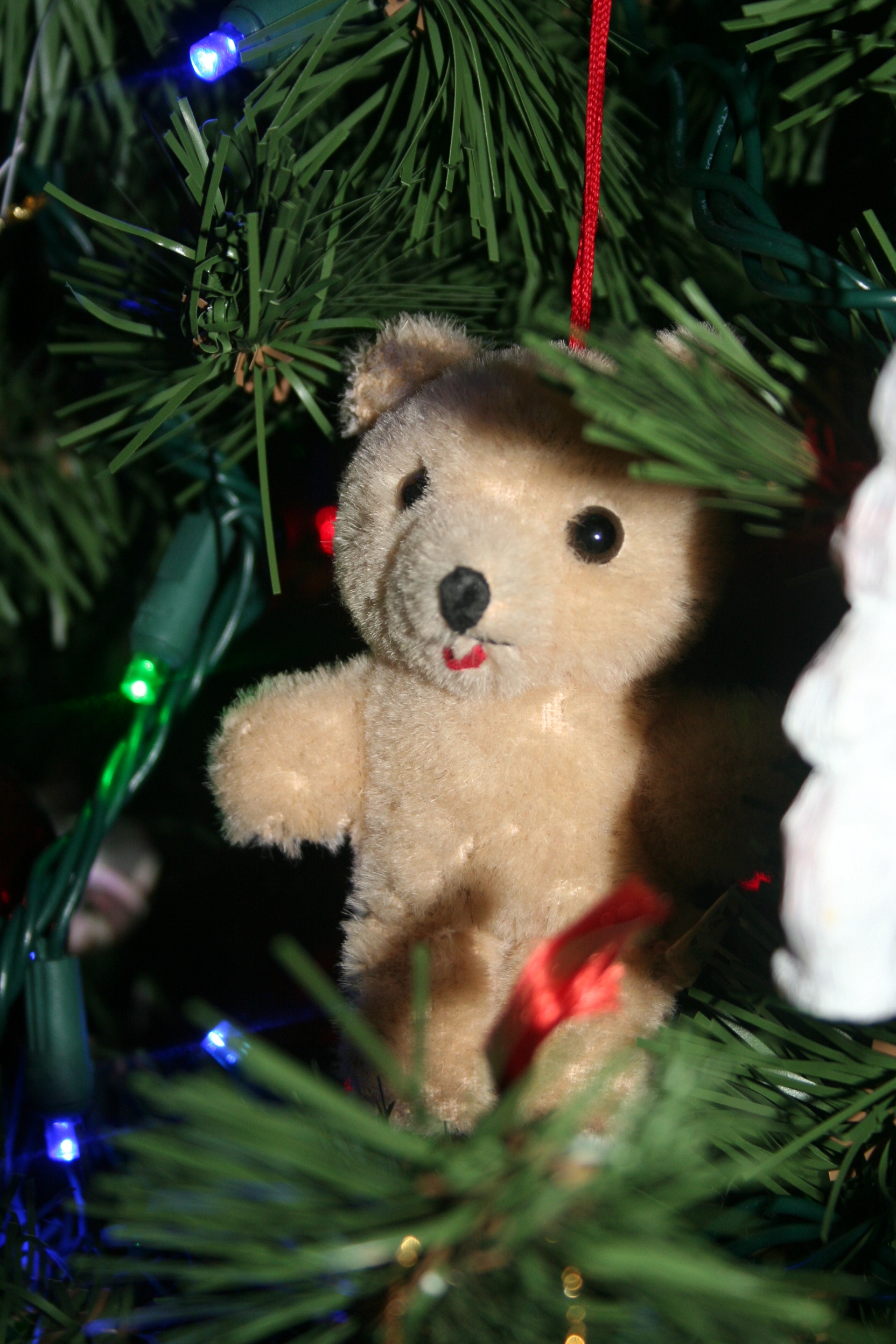
"A bear in the woods." The teddy bear ornament from my childhood, on our Christmas tree, Portland, OR, 25 November 2011.

A Writer’s Notebook: poem from an old notebook (Retro #1)

I’m in a strange place this week. Recuperating from NaNoWriMo, wrapping up a fall term of teaching and grading final exams, and warming up my design skills for my first run as Jersey Devil Press‘s new production editor. So this week, I’m digging into my huge stack of physical pen-and-paper notebooks and posting an old entry from years and years ago. A kind of retrospective Writer’s Notebook.

Which, come to think of it, might be fun to do now and then, especially since so many of the things I’m planning to write in the coming months are intended for publication elsewhere. So maybe I’ll make this an occasional thing for the Notebook, a kind of series-within-a-series. Think of it as one of those episodes of long-running sitcoms where all the characters reminisce and then show a montage of old clips from past episodes.

I wonder if I can add a laugh track to my posts. . . .

Laying down in the short back seat
knees invading the rearview,
you look up
to wonder
at the thin rock moon
cut by the black defroster wires.
Blue fire fueling a midnight
ghost ship on seas of tar and stone.

Little luna lullaby.

Tires burn beneath you with
the sound of blood in transit.
A twinkling twilight plane rolls
across the black, a dust mote
or a scratch on your retina.
Telephone wires merge w/
and cross the defroster,
silent save the occasional midnight
whisper.

The radio joins the front seat
passenger — faceless, distant now —
in slumber. Driver lives
two feet ahead of the bumper.
No breathing, no other headlights.
The world shrinks down to one
backseat, w/ a thousand tiny
blue details falling behind.

Still,
you watch the moon.

No exercise to this, at least not one that I remember. I don’t recall exactly when I wrote this, either, though it’s on the front pages of one of the earliest notebooks I hung onto, so I’m guessing late winter or early spring of 1998?

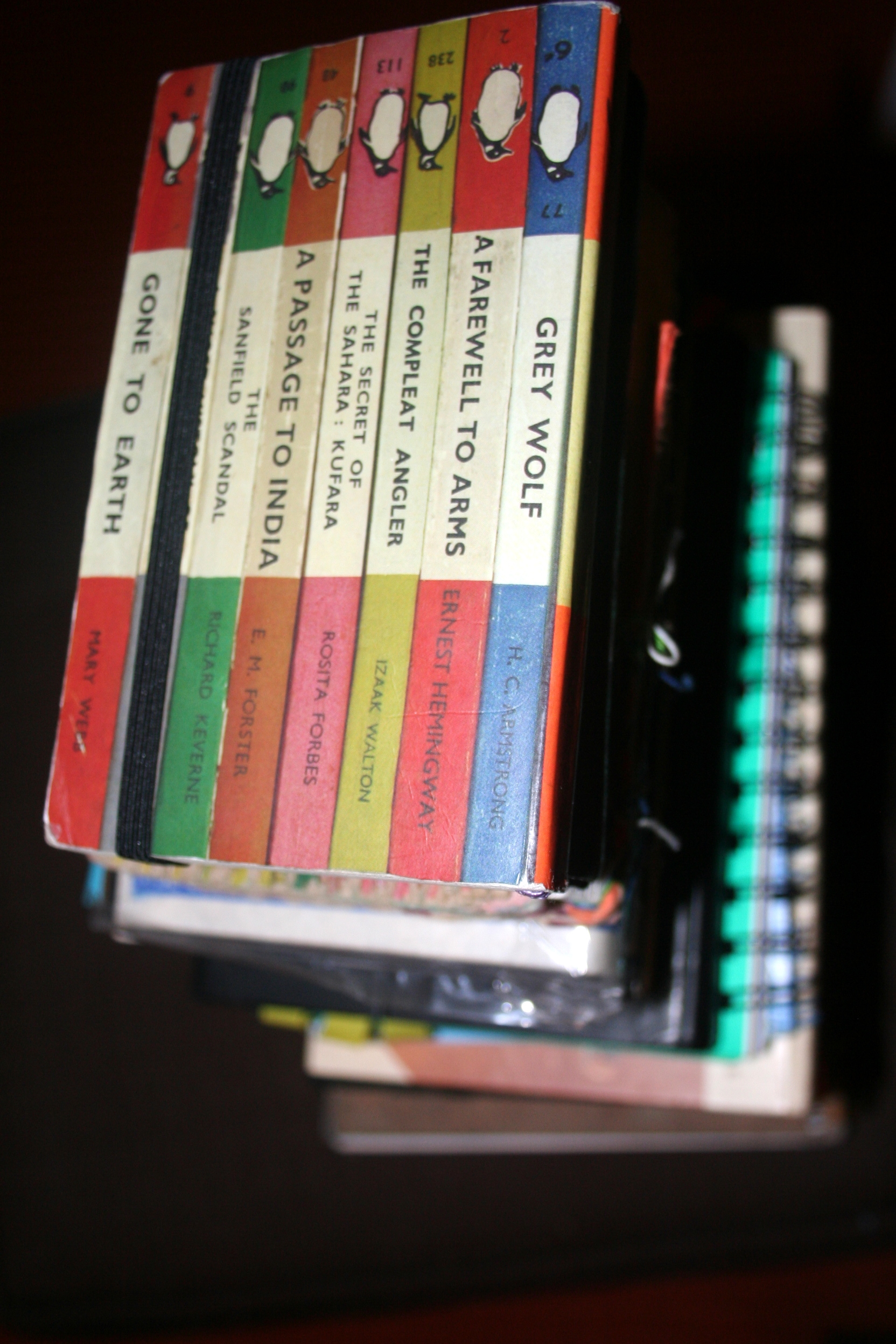
As I was looking through my old journals for something to post today, I decided to stack them up and count them, too. Sadly, I’m missing a handful — at least three of those old composition notebooks and two old spiral notebooks that I can think of off hand — but in this stack (at left), I have nineteen that I’ve kept. Not all are full, though. Some are special purpose journals: I have a journal I only write in on long trips away from my wife, a journal I only write in when we visit Canada, a journal I started my Scotland writing in and have decided to keep free for similar trips later, a journal my wife gave me for our one-year anniversary that I designated as only for sappy love poems. Two of these are my current journals, one for teaching and classroom notes and the other for my personal writing. One of these I didn’t include in the stack because it contains notes from the Buddhist teachings I’ve attended, and another is completely blank because I haven’t got round to it yet. But at least two-thirds of these notebooks are completely filled, front to back, with scribblings, sketches, maps, notes, poems, stories, funny words, cool quotes, ideas for titles, character names, and anything else I can think of. Yes, even a few packing lists for long trips.

This journal — the one I took this attempt at a poem from — was a gift from my wife; she bought it for me in San Miguel de Allende, Mexico. It was hand stitched from old notebook paper and recycled corrugated cardboard; she bought it in a little street market, and for years it smelled of jasmine incense. It’s a thick notebook that never quite fit in any of my pockets, but I carried it around everywhere for more than a year, and even now I enjoy flipping through it. It feels good in my hands. The texture of the corrugations, the flaking paint on the cover like patina on a sculpture, the thick bookmark of braided orange-and-purple threads — these things delight me, make me want to write new things in new notebooks.

I’ve become rather addicted to the idea that my best writing is my typed writing, that I have to be at a keyboard in order to keep up with my thoughts. But there’s a lot to be said for the physicality of handwriting in a hand-made notebook. I need to do that more often.

I intend to do that more often.

Big news for teen authors!

A sample cover of the new young adult literary magazine One Teen Story.

Today, One Story magazine, one of the finest, most respected voices in literary publishing, announced that they are launching an offshoot just for teen authors, One Teen Story.

I’ve been a huge fan of One Story since I first met publisher Hannah Tinti at an AWP conference some six years ago. And I’ve been a huge fan of promoting creative writing among teens since I was a teen writer myself — I started my first novel when I was in seventh grade, writing in a spiral notebook during English class with the strong encouragement of my English teacher Billie C. Hoffmann. So this combination of champions of contemporary literature and the young authors aspiring to join the literary ranks is beautiful, almost as if I’d dreamed it myself.

If you know a teenager who’s into writing fiction, or if you are a teenager into writing fiction (that goes double for you young authors I worked with in the Teen Summer Creative Writing Workshops at Platteville Public Library back when I lived in Wisconsin!), or if you’re a fan of young adult literature, or if you’re a middle school or high school teacher, or if you’re a public or school librarian, or if you’re just a fan of great writing period: go check out One Teen Story!

Choose teaching – be a teacher

English: A teacher and young pupils at The Bri...
Image via Wikipedia

I’ve had my profession on the brain lately. Students who are beginning their college education with an eye to teaching, students who want to know why I became a teacher, my college’s administrative meetings and course evaluations, colleagues around the country and overseas who are sharing their end-of-term triumphs and frustrations, even a few people who have actively attacked my role as a teacher: I’ve had a lot of opportunities in the past week or two to evaluate my profession as an educator.

Here in the States, educational funding isn’t a hot topic at this particular blip in the news cycle. We’re more concerned about the economy on a whole and the political gamesmanship surrounding it, so that when Congress rejected a recent proposal from President Obama that would have created more teaching positions across the country, the resulting news stories weren’t about the impacts on education but about the political wrangling between Democrats and Republicans in general and Congress and the President in particular.

But apparently, over in the UK, education is making the news. Or, at least educator Mike Tidd is making news out of it on his blog, miketidd.com: The role of geography in education. In his post yesterday, “Choose teaching – be a teacher,” Tidd writes about an impending reduction in teacher training positions at colleges and universities. “The Coalition wants more teachers to learn their skills on the job in schools rather than in training colleges,” he writes; but in his view (a right view, I think) “universities and teaching colleges offer fantastic teaching expertise and facilities that should be further funded.” He goes on to discuss the broad social importance and local community impact of education, quoting a fellow educator to help make his point: “I find that teaching is an ever-changing occupation that keeps you on your toes. To teach the future generation of Britain with a passionate voice can create change and can only be a benefit for the country,” according to Russell Wait, Curriculum Leader of Global Studies at Cove School in Hampshire.

For my American friends and colleagues, this quick British perspective is worth a read. It’s easy to get by turns both riled up and depressed by our own struggles to promote education and educational funding, but it’s also nice to know we’re not alone in our fight. (And for my British friends and readers: please comment! Here or on Mike Tidd’s post, either is fine with me!)

To read more, check out Mike Tidd’s “Choose teaching – be a teacher.”

11-11: Southern fiction (Christopher Cook)

The Kindle edition of Christopher Cook's novel Robbers.

I began my love affair with Southern fiction, as most of us do, with Faulkner, but I didn’t get serious about studying the genre until I started reading Tom Franklin. His then-distinctive blend of gritty blue-collar stories set in a modern but familiar American South, a style of writing Franklin likes to call “Industrial Gothic,” built on groundwork laid by Barry Hannah and Cormac McCarthy and Raymond Carver, making Southern regionalism seem universal and making the cold mechanical world of a post-agrarian South seem as uniquely Southern as Faulkner’s hot, wild Yoknapatawpha. I loved the work so much I wrote my masters thesis on Franklin.

Christopher Cook is a fan of Franklin, too. It was our mutual admiration of Franklin’s work that wound up bringing Cook and I together on Facebook, where I also learned that Cook is from Port Neches, Texas, a Gulf Coast town in deep southeast Texas where I, too, spent part of my childhood. And discovering a Texas writer with whom I share a regional past and a preference for fiction was quite a thrill for me. So obviously, I just had to read his work.

Robbers is an early novel from Cook, but it’s a delicious one, full of violence and debauchery: convenience store robberies, adultery, wanton murder, black widows, casual rape. But that’s only half the book! The other half — literally, as the chapters swap perspectives back and forth from criminals to lawmen — is an almost old-fashioned police procedural, with a swaggering Texas marshal on the hunt for the marauding bad guys. This novel has all the force of a Quentin Tarantino film wrapped in the casual hipness of an Elmore Leonard novel.

And if that was all this book was, I’d have enjoyed the hell out of it. It’s a wild ride, great for staying up late turning pages by lamplight. But actually, the book is more than that — it’s also damn beautifully written. Even a task as simple as describing common Texas locations, like the city of Austin, takes on an almost mythic language:

They rolled on southward through the commercial verge, crossed the Colorado bridge above a shimmering turquoise river. Upstream high greentreed banks flanking the course and a solitary racing shell sculling the windskipped surface, a waterborn centipede. Downstream, bridges over First Street and Congress and the snaggletoothed profile of the glassy city center.

Christopher Cook.

Also, though the characters start their journey according to type — bad guys kill, rob, and rape; good guys wear badges and white hats and steadfastly hunt the bad guys — within the first few chapters everyone takes on far greater depth than you might expect from this kind of story. The killers expose deeply personal backstories and emotional misgivings about their crimes. (There is a weirdly unnerving scene in which one of the crooks tries to rape a woman but can’t perform, “thinking he couldn’t get a hard-on cause it didn’t feel right. Knowing it wasn’t.” He even apologizes to his victim, who forgives him! We almost want to forgive him too, so tender is the villain.) The black widow who leaves a suave man dead in a hotel room is also a desperate single mother trying to make her way in the world. And the heroic cops are less than heroic, too, pursuing duty but making an awful mess of it as they go.

In all this, the various landscapes of Texas are vivid and compelling, not quite “a character itself” as we so often want to claim of regional fiction, but definitely a sharp presence in the book, an almost spiritual underscore to the whole story, as though the wide expanse of the state (so huge it’s hard to escape) was itself some hot, unforgiving deity overseeing the events but never much bothering to interfere.

Robbers delivers on all levels, really — it’s a rousing cops-and-robbers story, a harrowing tale of murder and mayhem, and a beautifully written work of fiction. And it would be quite at home on the same shelf as Tom Franklin’s Smonk or “Grit,” the opening story of Franklin’s collection Poachers.

I very much look forward to reading more of Cook’s fiction.


For more about my 11-11 project, check out my initial post on the challenge or all the posts in my 11-11 category.

For more on what I’m currently reading, check out my Bookshelf.

11-11: Contemporary poetry (Jerry Bradley)

Back in April, I had the good fortune to attend this year’s annual joint conference of the Popular Culture Association and the American Culture Association. This conference is a perennial favorite of mine, thanks in part to my association with Jerry Bradley, who chairs the creative writing area of the conference, but I hadn’t been able to attend the past few years because I was living overseas. When I moved back to the States this spring, I timed my arrival to coincide with the conference so I wouldn’t miss out.

When I attended Jerry Bradley’s poetry reading at the conference, I discovered he’d just published a new collection of poems, The Importance of Elsewhere. This was wonderful news, because I very much enjoyed his first collection, Simple Versions of Disaster. And at PCA/ACA, he read several of the new poems from this collection, many of which were excellent, so by the end of the panel I was eager to buy a copy.

It turns out that The Importance of Elsewhere is something of a mixed bag. Some of the poems feel a bit thin, and the punchline closers for each section come off as trite, maybe even childish. The title of one poem sets up a joke about “The Difference Between Real Life and TV”: the one-line poem that answers is simply “I have a tv.” Cue the soft chuckles and groans.

But that’s just one side of Jerry Bradley, the social fun-lover who just can’t help himself. It’s as though, having led us through a selection of deeply moving or philosophically challenging poems, he is afraid to leave us pondering or distressed and wants to lighten the mood in each section closer. And who can blame him? Because the rest of the book is powerful. In all, I’d say about two-thirds of these poems are really good; of those, probably half are great, and several just flat-out floored me. “I Never Think of My Father” is a brilliant opener:

I never think of my father as old either.
Dead at sixty-two, he was smileless
long before the hospital, durably stern
and disapproving as if he suspected everyone
had been pissing off the porch.

I want to hear nothing but silence,
and plenty of it, he scolded all my youth.
He has likely had his fill of it now.

The book is divided into four thematic sections, and much of this first section follows the punchy, pained brilliance of its opening poem. In fact, the whole book seems to be about pain, or cynicism, or yearning. In “What I Did Last Year,” for example, Bradley describes the delusions of tourists, both foolish and painfully nostalgic:

For them the Ohio is just a bookmark
a black nightdress, an enormous taxi
whose speeding engine conceals
that everything is farther away
than it once was

He also seems to have particular issues with religion, as so many poets are wont to have: In “The Voodoo Museum at Lent,” he writes that “All gods wear masks in wet climates.” In “Visit to a Church,” he opens with “Deaf as a stone, quartz is a kind of saint” and later asks “Which gods are honest and which ones false [. . .] What if we cannot choose?” In “Disbelief,” he cautions us about the warning signs on winding highways: “For all our stalling and despite the reassuring stripes / they stand to remind that most roads / remain dark.”

Jerry Bradley, from his author page at Ink Brush Press.

But there are quiet moments in many of the poems that belie Bradley’s inner searching, his belief in spite of himself that there are answers out there, even if he doesn’t know where to find them, or that love is possible, even if it is dark and dangerous and unexpected. This is perhaps best expressed in his poem “Calling in the Dark,” about the songs of crickets in the nighttime:

though every song is about death
even two notes may warm
a dream or burst into fire
and put things right

Ultimately, this seems to speak for the collection as a whole, as it raises so many questions and complaints yet continues to try and ignite the flame, to “put things right.”

Overall, this collection carries a lot of weight for so slim a volume, and it easily stands alongside Bradley’s excellent first collection.


For more about my 11-11 project, check out my initial post on the challenge or all the posts in my 11-11 category.

For more on what I’m currently reading, check out my Bookshelf.

A Writer’s Notebook: NaNoWriMo 2011, the recap

So, it’s finished. A final total of 51,557 words, most of them bad, most of them destined for the trash bin. But that’s what NaNoWriMo is all about: pounding out words no matter how bad they are, without attachment to what you write because you’re more likely than not to cut it all anyway.

What’s interesting is that this feels really good — I like having all this revision to do because I like having a text worth working on again!

I’v been here before, of course. My first attempt two years ago produced a strong first draft of a novel that after a lot of revision still retains much of its original shape and is now, in part, out in the world thanks for guest editor Shya Scanlon, publisher Ryan W. Bradley, and Sententia magazine. (Hagridden is a good novel, publishers — go pick up a copy of Sententia‘s issue 3 or contact me for details, if you’re interested.)

My second NaNoWriMo attempt, however, was an utter failure. I am almost certain to throw away basically all of what I wrote, but I don’t actually know that because I haven’t bothered to revisit that mess of text since I set it aside a year ago, and I’m not much interested in returning to it any time soon.

But this year, for all the bad writing I produced and the overall directionlessness (a word?) of this year’s novel, I’m still energized by the idea. In fact, now that I’ve gotten the worst of the writing out of the way, I’m actually more interested in the idea than I was when I started, and I hope to spend part of my winter break going back over the pieces and refining, rewriting, reimagining.

So, not a wasted effort at all!

Another cool thing about this year’s NaNoWriMo is that I got one of my students involved in it. It was exhilarating to watch him overcome his initial trepidation and become utterly absorbed in the process. He tried to convince me to let him count the effort as his in-class writing and give him credit for the novel; while I was tempted, I said no, and he still undertook the challenge! Which was awesome. (He did get a classroom assignment out of it, though — he wrote one of his assigned essays on his NaNoWriMo experience, and I was more than happy to give him credit for that!)

Better still, my student got so into the race to reach 50k that he began taunting me in class when his word count surpassed mine, daring me to catch up to him! And I have to say, this last week was hard work, with Thanksgiving and a huge pile of student essays coinciding with the final push to finish the novel, and I’m not entirely sure I would have made it if this student hadn’t been sitting in the classroom, smirking and saying, “So, Dr. Sam, when are you going to write as many words as I have?” So, seriously, big thanks “Fayt Holland” (his screen name) for goading me across the finish line this year, and congrats to him and all the other NaNoWriMo winners this year!

And now, because I had twenty chapters but only four weeks of Notebook posts, I’m going to offer the last of the excerpts. Next week, it’s back to other sorts of writing exercises.

from “Winter Struggles Even as the Night”

She focused on her breath, slow inhalations and long, thin exhalations, her lips slack but her throat taut from trying to silence herself. No sound. She heard the blood in her ears and worried they might hear it too. She flicked her eyes about in the dark, wondering if there was any light she hadn’t noticed that might catch in her whites and reveal her awake. She prayed the rumors were true, that already their skin had gone pale and slick like mole rats, that they walked about sleeveless or even shirtless, that they smelled so pungently of rotting leaves and burnt hair that if she didn’t see they gray, waxy skin in the broken moonlight outside, she’d be able to smell them when they entered her house.

She was thinking “when.” Not “if.” And she’d stopped breathing altogether.

from “The Marrow Seethes with All We’ve Let Them Take”

We are here, protected by the people. But it has not been easy. When the poor moon first cracked and sent her children for protection to the earth, and the the earth then shook in anger at being so imposed upon, and the sea rose up in rebellion and the fires spewed up in sickness and the storm raged and the clouds covered up all of it in shame and mourning, and the people began to die and wander confused among their friends and descendants, some of them aware of us for the first time, they came here. The living and the dead, crowded at our gates, the living seeking refuge and the dead seeking solace. And we were overwhelmed. They crowded in, the living trampling our roots, breaking our windows, muddying our rice mats and bending our branches. The dead caused unnatural winds because so many had swarmed inside and them would run, startled, every time our well-dippers tapped against rock and bamboo stopper. It was bad enough that our moon lake was gray with ash, our lanterns extinguished in the winds, our flowers shriveling in the dual onslaught of heated air and early winter. But the people were too much. So we had to take control.

from “A Cackling, Drunken Cure”

He came back to their house with the ring in his pocket. It had been easy to find and impossible to find, all the rings scattered among necklaces and collectible coins and shattered glass on the pawn shop floor, all the firearms and electronics looted but the unsurvivable riches left for the junk they’d become, but this ring, the exact one he needed, was just one among that many. He’d been gone for hours and she had gone out herself, probably just to piss in the backyard but he looked for a note anyway. There wasn’t one. It had to be the backyard, then. The door to the cabinet over the microwave, where they used to keep the whiskey, still hung crooked. It would not shut. He wished it was still stocked — he needed a drink. But he was not nervous, because when she said yes, he thought, it would all be fine. Tomorrow, he would repair the door, and secure their fence and till their yard for a small garden and scavenge for paint — paint wasn’t a survival good, was it? — and begin to paint a nursery.

He drank water from a plastic cup and put it back in the sink where he’d found it, and he went into the bedroom to arrange the sheets and fluff the pillows. Tonight, the house would be clean, the ramen would taste rich, the sex would finally happen. He patted his pocket several times while he cleaned.

He knew she’d said before that weddings and families made no sense anymore, but when she saw the house, and she saw the ring, and she saw all the things he was prepared to do, to change for her, she would see what he saw: a future, however dim, themselves the only light in a choked, blackened world.

from “Today, Tomorrow, and the Day After That”

A group of highwaymen saw the boy on the road and tracked him to my house, and they came banging on my door in the middle of the night. I kept all the chains on when I opened up but they shined the lights mounted on their guns into my eyes and backed me from the door enough to force in their pilfered Jaws of Life, so I shouted at them to stop and let me unlatch everything. No sense letting them destroy what’s left of my home. They kept their lights in my face as they interrogated me, asking who the boy was I was harboring. “Harboring? I said. “He’s just some child who got himself lost in the forest. I let him in out of pity. I know times are hard, but there is still pity in the world.” But they didn’t buy it and they help me at gunpoint while they searched his clothes. They took him into another room. It was quiet, no sounds of struggle, but still I shudder to think what might have been going on in there. Anyway, they found the letter, opened it and read it, and while they surely couldn’t have understood its importance, they were smart enough to know it must have been worth something to send out on the road like that. So they took the letter and the boy and they left my house with both.

This is as accurate an account as I can bring myself to write at the moment. Whether or not the boy lived or the letter has reached its destination, I couldn’t say. I can guess with some certainty that the highwaymen won’t continue this chain of written accounts. They have other concerns.

from “With a Doomed, Mortal Joy”

Good morning, listeners! As always, I don’t know if anyone can hear this, but welcome to day 37 of our broadcast. Today’s news, as every day’s news, is brought to you by Oregon Public Broadcasting, the former staff of which was nice enough not to loot their own offices when everyone got out of town.

The traffic is at the same standstill it’s been at for the last six weeks, with all highways impassable and all major bridges out. If you’re out there in a vehicle, stick to the city roads as usual.

The current temperature is 56 here at the studio, and if current patterns hold, the low tonight will probably be in the upper forties. As always, it’s hard to tell if we have rain in our forecast, but ashfall is light so except any showers to be a bit cleaner today.

In our studio today is local poet Harmon Jasper, and he says he’s composed some new Sunray Poems to try and brighten our days, and afterward we’ll hear from Professor Jeanine dePalma with our daily series Education in the Afternoon. But first, some music from our house band Star Resurrection, because, after all, if we didn’t have this stuff, what’s the point of getting out of bed in the morning. For those of you who have beds.

Total word count as of this post: 51,557 words. THE END! (For now.)

For more about my NaNoWriMo project, check out my NaNoWriMo page here or my profile on the NaNoWriMo website.

Enhanced by Zemanta

An animated history of the English language

A friend of mine shared this video on Facebook earlier today, and it’s just so fantastically succinct and hilarious I had to post it here. It’s “The History of English in Ten Minutes”:

My friend found it on a blog post at Milk And Cookies, but it’s pretty widely available.

What’s particularly genius about this is the way that, by distilling the history of the English language into just these ten minutes, the video calls attention to the three main driving factors in any language’s development: religion, conquest, and the arts. Pretty much in that order, though one could make a case for military conquest outpacing religious intellectualism for language growth. My own history of the English language professor was fond of telling us that a language is just a dialect with an army, which is probably why religion became less important to the development of English around the same time the Church stopped commanding armies. At least directly, anyway.

Also something to note: The whole last two minutes of the film are about major developments in the English language that have occurred since I last studied the development of the English language! That’s how fast things change, folks.

Anyway, this is a delightful run-down of linguistic history, and a fun way to blow a Saturday morning. Enjoy!

A Writer’s Notebook: NaNoWriMo 2011, week 4

I’m behind schedule, thanks to grading, editing, and Thanksgiving. And with more grading coming my way, I’m going to be hard-pressed to break 50k by the end of November 30. But I’m determined, and with a lot more ideas running around my head, I’m not terribly worried about making the deadline. The weird bit, though, is that I know I’m over-writing this book, and I expect to throw out a lot of the stuff I’ve written just to pad out the word count. When this month is over and I have time to go back and start editing this pile of text, I expect the book I’m actually writing will wind up much shorter.

But all in due time. Right now I’m just aiming to break the NaNoWriMo word count.

from “An Ugly Conversation”

Daniel caught one of the pirate buses outside Corvallis. It was a dark, filthy bus that cut out all light and smelled of chicken manure. The driver didn’t know any English and wouldn’t take Daniel’s money, useless as it was anymore, so Daniel gave him three joints and took an aisle seat in the center. The broken roads were bumpy and intolerable. Once, only twenty minutes into the ride, the bus got stopped by guerrillas, but Daniel made it out OK. As long as he kept his eyes down and his swollen bag hidden, he was safe. In the end, he gave the rest of his weed to the guerrillas, but he stayed on the bus; he stayed alive.

It took six hours to get to Portland. The bus wouldn’t go into town — something about the driver being afraid of cities. Daniel tried to explain bars and prostitutes to him as the passengers left the bus, but the driver yelled and shoved him out the door without listening.

Daniel wandered the streets for a while. It was already late in the night. Or early in the morning, depending on how you looked at it. Either way, it was dark and damp and unsettling. Daniel found an open bar and sauntered in. A whore with three missing teeth walked over to him and put her hand on his crotch, but Daniel pushed her away and asked the bartender if he knew any cheap hotels that were still open.

“How cheap, kid?” the bartender said, his voice thick with slur.

“Real cheap.”

“How much you got to pay for it?”

“I’m tapped out. I want to work for it.”

The bartender laughed loudly, and the whore, who hadn’t gone away yet, joined in while she stroked Daniel’s shoulder. “Pretty little boy like you? What you know about work?”

“I know what kind of work I’m capable of, man,” Daniel replied defiantly. Then he glanced his eyes at the whore and said, “Know what I mean?”

The bartender smiled slowly, exposing one gold tooth and one green one. He reached under the counter and pulled out a foggy beer mug. “Sure, kid. I know what you mean.” He poured himself some watery moonshine from a jar and took a lazy slug from it. He continued, “I tell you where to find your ‘work.’ But it’ll cost you. Understand?”

“Shit,” Daniel said as he looked down at the bar. The whore cackled and walked away. The bartender kept looking at Daniel evenly. “Not for free,” Daniel said at last.

“No,” the bartender said. “Not for free.” He grinned again.

“Fuck,” Daniel muttered.

“Exactly,” the bartender said.

“Fine,” Daniel said. “Where?”

The bartender pointed to a door with most of the word Gentlemen still painted on it, and Daniel shuffled his way over to it as the bartender rounded the bar.

from “The Dusty Shutters of Ourselves Thrown Open”

A soft rain drifts slowly through the thick summer air. The drops are so like they behave like fog, spiraling their way to dew the stone-littered streets.

And a black, opened umbrella bobs along the street four blocks away. It looks like a beetle, the shell of the umbrella shining in the rain.

Closer, a block and a half, a woman stands in a dark grey overcoat, perched absurdly in black heels and teetering on the scattered chunks of concrete beneath them. Her legs are too skinny, her jeans so tight. She looks like a blue heron wading the sidewalk. Before her: clusters of tall grasses that have pushed up through the fractured asphalt bend in a dance with the rain. Behind her: nothing. She waits.

[…]

An ocean leaps and licks at a stony shore sixty miles away. By car it was ninety minutes. Today it might take two days, assuming you stopped to sleep.

The wounded moon is working its way toward fullness, the spray of itself not yet visible in those rare breaks in the cloud. There’s a puddle in the new depression on the sidewalk, and the moon skips along that rippling surface to reflect off a window across the street, so it shines inside like a street lamp. Behind that window: a man. Before the man: a pad of paper and a broken antique oil lamp. He is writing. Not words, not meaning, only scratches of a brittle pencil on yellow legal paper. It seems to soothe him, that sound. I can hear it from here, monotonous as a chanting monk. In mid-sentence, pencil already shaking on to another line, he pauses and sighs.

I imagine that he’s writing a letter to God:

“I was thinking of you the other day, sitting out on the fire escape, watching the sun crash-land in the distant, boiling sea. I thought of all the good times we could have had, all the things I wish we could have done. Actually, I got rather depressed. Sipping on your blessed wine didn’t help much, of course.

“Dear God, why don’t you write?”

The letter wasn’t to God, of course. Or if it was, there is no God to read it.

from “Somewhere — an Insistent Harvest Moon”

In the small hours of this morning, I woke to the snort of a something rooting through the brush near my campsite. It sounded like a wild pig. Do we have those up here? Did they migrate here? Or maybe this is just one of those things that broke loose from the zoo and is trying to make its way out here like the rest of us.

After it left, I noticed a huge spotlight lighting my campsite and the south wall of my borrowed tent, and I wondered in my half sleep if a park ranger had come in the night and erected a giant street lamp out on the lake while I slept. Then I woke enough to realize how absurd that was, which is when I thought of the teenagers out on their deck boat. Maybe they’d seen my fire after all, or had spotted me floundering drunkenly on the shore. Maybe they had binoculars — boats like that have all sorts of gear in the hold — and they’d seen my bottle. They assumed I had more, probably buried in the woods like a pirate stash. And like pirates they were coming to pilfer it, to rape me or kill me or both, in no particular order. A boat like theirs, it was bound to have a search light.

I couldn’t hear the engine, but maybe they’d run out of fuel. Or maybe they were smart enough to cut it halfway across the lake and drift in silently.

I lay awake for maybe an hour, trying to hold my breath in intervals so I could hear better, so I could be prepared for their approach, for my own death. But the light never wavered, just rolled slowly, slowly up the wall of the tent.

Finally I sat up. Nothing changed in the light, even when I turned to study my own shadow on the opposite wall of the tent. I reached for the zipper pull and dragged it one link at a time, centimeter by centimeter, around its circular track until the flap fell inward enough that I could poke my head out.

It was the moon.

I watched it for about ten, maybe fifteen minutes, before I convinced myself that the light really was the moon and not a gang of teenagers sailing across the lake. Finally I conceded I wasn’t going back to sleep, and I crawled out of the tent to go sit by the lake in the moonlight. I kept to the shadows, in case those kids really were out there watching me, but I liked peeking through the branches up to that wounded, scattered moon. I could never figure out why the ejecta from the moon always glowed a pale electric blue. Why not white, or gray? Why not red like the sunsets?

from “A Very Good Thing”

Two days ago, Frankie spotted a twenty-eight-foot pocket trawler aground on some new island out here, something not on the charts, coughed up by the sea. I remember fishing with my uncle Bruce, how that guy would sometimes lie flat on a big table of a rock out over the river and watch the fish with his hand held out over the water, his fingers in a claw and the chords of muscle in his forearm taut, and then a fish would swim within his grasp and he’d plunge his fist into the water and snatch the fish out onto the rock. Most of the time he tossed it back. He just did that to prove he could do it. And when we saw this ship aground on this new land out in the middle of nowhere, it reminded me of my uncle Bruce, but upside down, we the fish gliding over the surface and earth below poised, ready to snatch us all at any moment just to prove we aren’t safe out here.

There were men still in the ship. They were out on deck waving and shouting, though we couldn’t hear them from where we were. We tried to hail them, too, but their equipment must have been out.

How they survived out here I still don’t know. I mean the ship and the men alike. We’ve been adrift for about three weeks now, all of us ready to put in but still unsure where it’ll be safe to do so, if it’s safe anywhere. But we’re prepared for a long period asea and have a ship big enough to ride out the tsunamis. This little trawler? It’s a miracle it ever stayed afloat long enough to run aground. It’s a miracle, too, that any of the crew held on and didn’t get swept overboard.

I was thinking about all this as we pulled closer to them. I thought that maybe they hadn’t survived out here at all, that maybe they were new to the sea. That maybe their vessel has survived in harbor, however unlikely that was — they’d have been safer out here — and had only recently put out to sea to try and bring in a catch. I can;t imagine what the food situation must be like on land.

The seabed was jagged and unpredictable, and we couldn’t get close enough to them to do much from the ship. So the Captain sent a towing cable out to them, and they hooked on and braced for the tug back into the drink. They were stuck fast, though, the fractured seabed wrapped around the hull like a cradle, and the strain on the cable was too great. Before we could change course and make some slack, the cable broke. It looked like a bad special effect, like a tentacle of that giant squid in 20,000 Leagues Under the Sea, slow and animal. But it wasn’t slow, it was just thick and wiry, and when it whipped around over the deck it caught Frankie in the thighs and amputated both his legs. One stroke, just like that. He was standing there shouting and then he was lying on his back, still shouting, and though we’d all seen the legs come off and fall the opposite direction as his body, we couldn’t process what had just happened. We all thought he’d just been knocked over. Frankie thought the same thing, kept trying to sit up and hollering at us to help him to his feet. He reached for a handhold on the deck and came up with his own left shin.

The Captain himself scooped Frankie up under his arms, sat him on the anchor well and ripped off his own belt to tourniquet a thigh. Gerry pulled off his belt, too, and the Captain tied off the other leg. The Captain was sobbing the whole time, his face so pinched with his cries I don’t know how he could see what he was doing. But it was long since too late.

Total word count as of this post: 38,178 words.

For more about my NaNoWriMo project, check out my NaNoWriMo page here or my profile on the NaNoWriMo website.