So, Portland author and generally cool guy (you should see the reception this dude gets at readings) Riley Michael Parker has released his novel, A Plague of Wolves and Women.
And seriously, that should be all you need to rush out and buy the book, because with a title like that, how could you go wrong?
But, okay, maybe some of you need a little more convincing, so check out this killer book trailer full of creepy drawings, gritty music, and rave reviews. And if you don’t rush out and buy the book after seeing it, it’ll only be because you’re cowering under your bed, scared of the novel. Which is just another reason to buy the damned thing.
My friend Darin Bradley, whom I interviewed a little more than a year ago about his (very cool!) novel Noise, has a piece of experimental fiction in the inaugural issue of Coffinmouth. It’s pretty cool — the story and the `zine. Go read it.
I know. I missed last week’s Notebook and when you scroll down in a minute, you’re going to find a blank page.
This is a good thing.
See, I’ve landed a new teaching job and a tutoring gig, I’m working on a project for my Buddhist center, and I’m reading for Jersey Devil Press. Plus some other things. So this an excellent time to take a breath, regroup, and rediscover my Beginner’s Mind.
Starting next week, I’ll be doing the Notebook entries every Friday as usual. Sometimes I’ll be writing assignments similar to the ones I’m giving my students; other times, I’ll be returning to the fiction or dabbling in poetry and nonfiction, as usual. And come November, I’ll be diving once more into the heady storm that is NaNoWriMo. So I’ll be plenty busy. But I’ll be renewed in a way that I haven’t felt in a while, and I’m looking forward to it all — the teaching, the editing, the reading, the learning….
Join me, won’t you? You can start by writing your own Notebook entry this week. And by all means, share it with me! 🙂
Wow! I haven’t posted an 11-11 reading update since March! But I have been reading from the list, gang, and I’ll be playing catch-up in my reviews every few weeks from now on.
There’s certainly something to be said for learning to appreciate an older style of writing. I labored with Dostoyevsky for example; I even had to work at loving Chekhov. But such adjusting periods usually pay off because the literature is so rich and beautiful and, for the writer, informative about the possibilities in craft.
I’ve labored long and hard with Elmer Kelton’s The Time It Never Rained, because it is an historical novel rooted firmly in a particular culture, a particular era, a particular economy. It addresses issues of race and class, of politics, of environmentalism. It is a complex novel. But my problem with it is this: it takes too damned long to get itself underway, and the labor doesn’t really pay off. Sure, the characters that start out as stolidly stereotypical do eventually develop distinct personalities, individual motives, a life outside the plot. But before Kelton can let these characters live and breathe on their own, he feels the need to utilize them toward some other Purpose, with a capital P: namely, he needs to take the time to explain to us, in textbook detail, the harsh mechanics of ranch life, the prejudices of every class of character, and — most importantly — his conservative, anti-government political slant. And he takes forever doing it.
I suppose that, given the beauty of the second half of the book, that wait might seem worth it. But here’s my problem: While Elmer Kelton takes somewhere between 120 and 150 pages to set up the socio-economic realities of his novel, Jane Austen managed the same in the very first sentence of Pride and Prejudice. And I think if Kelton had sacrificed his research and his memoirs in favor of tightly crafted storytelling the way Austen did, this would have been a much, much finer novel.
That’s not to say it is without beauty. Even early in the novel, Kelton’s descriptions of the landscape are among the most beautiful passages I’ve read: “It was a comforting sight, this country. It was an ageless land where the past was still a living thing and old voices still whispered, where the freshness of the pioneer time had not yet all faded, where a few of the old dreams were not yet dark with tarnish. It had not been so long, really, since feathered Comanches had roamed these hills a-horseback, seeking after game, or occasionally in warpaint seeking honor and booty and blood. Eighty years . . . one man’s lifetime.” (One feels the lamenting echo of this romance in the latter pages of Cormac McCarthy‘s No Country for Old Men, both set and written a generation after Kelton’s novel.)
And once he gets the dry technical-manual-like explanations of ranch life out of the way, he winds up writing gloriously punchy, concise sentences about cowboying and sheepherding: “Diego climbed over the fence, rope in his hand, and dropped down inside the corral. He shook out a horse loop, moved carefully toward the colts, swung the rope in a quick figure eight and caught the bay around the neck.” This quick, easy passage, letting necessary jargon slip in and out without any passing glance, is a far cry better than the full paragraph some 70 pages earlier in which Kelton carries on about the long historical whys and wherefores of putting a plate and glass in the kitchen sink. (I’m not exaggerating.)
Elmer Kelton (Image via Wikipedia)
Overall, though, the beautiful pastoral writing and the eventual development of the main characters — especially Charlie Flagg and his Mexican ranch hand’s son Manuel — can’t compete with the pervasive political bias of the novel, which asserts itself in long, awkward treatises and monologues or forced “arguments” between the dogged Flagg and basically everyone else in the book. I don’t mind political content in a novel, especially if it serves the story, but in the case of this book, the servitude is reversed. In an afterward to the edition I read, Tarleton State University professor Tom Pilkington remarks that “it would be a mistake, I think, to read into the novel a particular political message — that all government aid should be sternly and righteously rejected.” But that precise message comprises at least half of Charlie Flagg’s speech and thoughts in this book, and as Pilkington notes, Charlie Flagg is presented as a “a genuine hero,” so his is the voice of the whole novel. And every single character save one who accepts government assistance and offers a counterpoint to Flagg’s perspective does so in weak, circular, repetitive illogic, always resorting to either an “everyone else is doing it” or a greedy “get yours while the getting’s good” position, and every one of them, by the end of the novel, comes to ruination and in one way or another “concedes” that Flagg was right all along. The lone hold-out, the only character to offer the thinnest attempt at a serious argument against the novel’s pervasive anti-government stance, doesn’t make his stand until barely 10 pages from the end, and the best he can muster is “the system’s broken, but the idea’s still good.”
So I think it would be foolish to ignore the political message wedged into practically every page of this novel, and because the story and the characters become so servile to that message, it’s hard to take this book seriously as a work of fiction.
I should say, though, that the problems with story aside, it’s clear that Kelton is a damn fine writer; and in the end, despite Flagg’s “heroic” efforts to resist government aid, the novel ends on a note as bleak and unforgiving as any I’ve seen, which is just the way I like my endings. So I would welcome a chance to read one of his less personal, less politically motived historical Westerns.
Inside Powell's Books, the coolest bookstore in Portland and the world. (Image by scott mills. via Flickr)
Between my new job reading for Jersey Devil Press, my recent publication in the awesome pitch issue of Sententia, and my wading into the deep, cool waters of the Portland literary scene, my authorial connections have grown exponentially in the past month or so. Which is awesome. But it also means that I know more cool writers and poets for whom I get to share publication news, so here are some cool things from people I know that have happened in the last week or so:
And the new issue of Unshod Quills, edited by Dena Rash Guzman, is out now and contains some awesome work, including a series of very cool video poems, and a set of prose sketches and hand-drawn portraits of serial killers by featured author Riley Michael Parker.
Phew! I think I’m done.
For now.
Keep up the awesome work, gang, and I’ll keep trumpeting your successes!
I write about libraries and librarians on this site a lot. Which shouldn’t come as any surprise to people who’ve been reading for a while, because I’m openly proud to be married to a damn fine librarian.
Now that damn fine librarian has launched her own website and blog, all about librarians in cinema. Called Reel Librarians (http://reel-librarians.com/), Jennifer Snoek-Brown’s website offers a brilliant analysis and categorization of librarian roles in film, the roles they serve, and the stereotypes they succumb to, and Jennifer wraps it all into a package that is more than just professional curiosity or movie fandom: she actually explores what these cinematic portrayals mean for us, the viewers (and, if we’re smart, patrons of libraries!), as well as what these roles mean for the profession of librarianship.
In addition to the richly explored categories and types of roles and films, Jennifer will also be writing regular blog posts analyzing specific films, librarians, or aspects of librarianship. Those will start this week, so visit the site today and subscribe immediately! Then, while you’re there, check out all the impressive work she’s done already on the website!
Seriously, folks: I realize I’m writing about my wife here. But setting that aside, Jennifer is one of the best librarians I’ve ever seen or worked with (and, as an academic, I’ve worked with a lot!), and her scholarship on librarians in film is absolutely first-rate by anyone’s standards. So go check out this excellent new website.
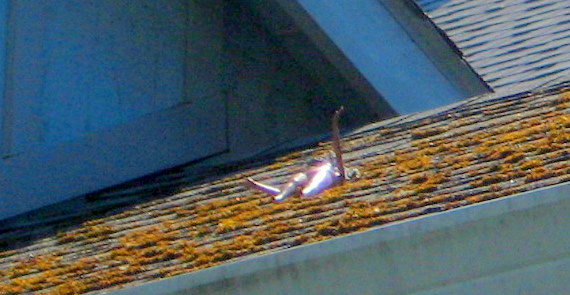
"After the tea party." Dolls on roof, Portland, OR, 5 September 2011.
I’ve officially decided to start a series on abandoned dolls. I just can’t describe the emotion I feel when I find these things — nostalgia? sorrow? grief? curiosity? — but the emotions, like the dolls, fascinate me.
I didn’t realize until I got home and uploaded these to the computer that this roof actually held two dolls — the naked, sunbathing Barbie was hiding until I looked closely at the photos. Here are some close-ups.
I was driving a two-hour commute to teach a college class. I listened to the news on the radio. At one point I had to pull over on the side of the road just to catch my breath. Later, I passed others who had done the same. When I got to school, I spent half an hour trying to figure out how to break the news to my students, because none of them had heard yet. I canceled the day’s lessons. I told them they could leave to call family or friends if they needed to, or they could stay and talk about how they were feeling. I asked them to try and not react with anger, because it was almost certainly anger that caused the attacks in the first place. Ten years later, I am still asking people to remember that.

 So, Portland author and generally cool guy (you should see the reception this dude gets at readings) Riley Michael Parker has released his novel, A Plague of Wolves and Women.
 My friend





 Samuel Snoek-Brown