Photo blog 52

The sky is a soft gray ceiling, the air damp and cold, my skin dimpled like a basketball. When I lived in the desert, I yearned for such a day.
Believe it or not, this is a true story.
Sort of.

I remember studying H. P. Lovecraft in college, though at the time we studied him as literature, not gospel. I was enchanted by his name, Lovecraft, as though it was a commandment: here is the craft of writing fiction, and you shall adore it. But as much as I enjoyed his name, I utterly revered the names he wrote into his stories, none more than that mysteriously unpronounceable Cthulu. I’d read all the stories, studied the mythos in compendiums, listened to the tribute song by Metallica, even played that ridiculous role-playing game.
I had no idea that I was preparing for a life in the priesthood. Very few of us did, really. Even when the news began to break, the strange reports buried in the back pages of newspapers or tucked away in tiny side-links on the Internet, under some heading like “Odd News,” even then we had little clue as to our future.
I saw it a few days after the news first broke. I like to peruse the odd news files, always have. But the headline, “Giant Sea Creature Baffles Chilean Scientists,” was nothing more than a curiosity. Even I, with all my literary training, all my love of Lovecraft, didn’t immediately grasp what it was we had found. Some dead whale, except it was so badly decomposed its internal organs had turned nearly gelatinous. Then it wasn’t a whale, it was a giant squid, but the more scientists studied the degrading corpse, the more tentacles they discovered, far too many for a squid. So it was a mammoth jellyfish, some behemoth heretofore unknown. But the flesh encasing the jellied organs was tough, almost like sodden leather, nothing like any jellyfish anyone had ever encountered.
For three weeks this went on, but for the most part the news remained buried in the oddities. Some of us, though, had begun to read with greater interest.
My friend Vernon, from grad school, was the first of our future priesthood to arrive in Chile and confirm what some of us had begun to suspect: the great gods of old had at last surfaced, exactly as Lovecraft had described. Cthulu had arisen. And Cthulu was dead.
It took another few months for those of us who understood the old gods, however little we can understand these great and terrifying beings, to convince the rest of the world of the truth. And to this day we remain a fringe movement, still gaining devotees, but we are beginning to challenge the upstart faiths that have for so long denied the old religion. But our biggest challenge, both among the other world religions and, more importantly, within our faith itself, was how to explain this terrible paradox: in the same moment that we found God, we found that God is dead.

One of the first writing exercises I really loved was using newspaper clippings to find a story. It’s an old exercise, but I was introduced to it by Robert Flynn (from whom I took a summer workshop at West Texas A&M back in 2000; I got to see Bob read again just a couple of weeks ago in San Antonio, which was delightful). That exercise was also the first that bore real fruit, resulting in my story “The Simple Things,” which later appeared in (the now-defunct) Bias Onus Quarterly.
The exercise is fairly simple: take a headline, just those few words — a subject and a verb, occasionally an object — and devise an entire story based on it. Sometimes, as in the exercise I did in Bob Flynn’s workshop, you can mine the news article itself for details — characters, locations, etc — but you should be careful not to merely rewrite the news story. Instead, look for minor characters from whose perspective you could tell the same story differently, or imagine alternate scenarios that might change how the plot unfolds.
In this case, I dug into my archive of old news clippings (I keep loads of them on hand, just in case) and found an old online story with exactly the headline above: Giant Sea Creature Baffles Chilean Scientists. I remembered when I first saved that file that I had immediately associated it with Lovecraft, so I figured, what might happen if the Cthulu Mythos turned out to be real?
Hence, this beginning to a story.
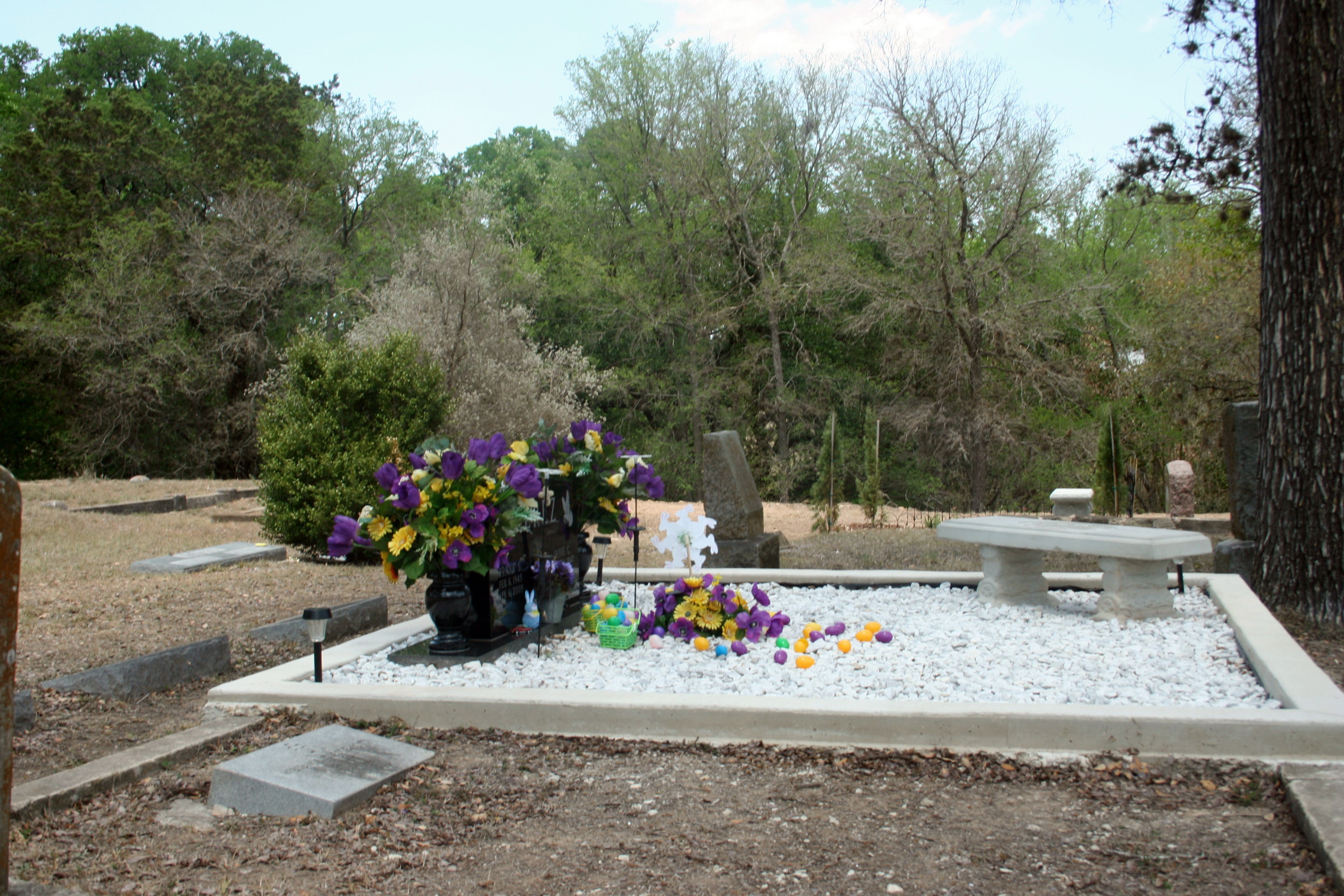

“Arisen/Fallen.” Glen Rose Cemetery, Kerrville, TX, 26 April 2011.
 I used to climb up on my parents’ roof to watch the sun melt like butter over the rose-and-cerulean horizon. Twenty years later, the evening sky from my parents’ place is still that beautiful.

The conference is over. I’m exhausted, mentally and physically, in the best ways. But it’s going to take me a couple of days to get around to writing a fuller account of my conference — the panels I attended, the ideas I heard or offered, the fiction I read, the friends and colleagues and scholars and writers I found. I have a lot in my journal (which I nearly lost, about which more in a whole separate post!), but I need to process and distill it all so I don’t overwhelm everyone with my notes and observations.
A couple of quick notes here: I was thrilled to hear some fantastic fiction and poetry this morning (William Woods, it was a pleasure to see you again! Jerry Bradley, I will always love your ability to make people laugh and contemplate at the same time with your poems. Millard Dunn, your raw, honest emotion and keen observation in poetry is always, always a delight).
I learned a LOT about comics at this conference, including in my final panel (Sean Connors, Amy Nyberg, and Anthony Warnke and Alison Cardinal, I thought I’d be burned out on comics by now, but you all rocked your panel!).
I also learned a LOT about pedagogy over the past few days, including a very cool panel today on Facebook in the classroom (Aimee Robison, way to hold your own as the sole panelist, and I look forward to bouncing ideas off you in the future!).
And San Antonio? You’re a strange, almost mystical city. I don’t always understand you, I don’t even always like you, but damn it if I don’t still love you. This town I grew up in or near is fast becoming one of my favorite places for conferences. Who would have guessed?
(I’ve been a bit remiss about posting during the conference, which I blame mostly on the hotel or the organizers or whoever decided to lock us all out of free wifi in the lobbies. But plenty of other conference attendees have been posting a lot, including the very cool Joe Historian. Go read it.)
I had thought to sneak in a little writing this week during the PCA/ACA conference I’m attending, and believe me, I’ve written PLENTY, but very, very little of it has been creative in the strictest sense. It’s mostly conference notes. So I don’t have a Writer’s Notebook today.
I did, however, read a piece of my own fiction at the conference today, and the reading went tremendously well. The other two panelists I read with, Mark Busby and Grace Epstein, were fantastic, and earlier today I had the great privilege of hearing Robert Flynn read fiction. I took a terrific summer workshop with Bob Flynn back in 2000 at West Texas A&M University, and I’m still using a lot of what he taught me; hearing him read fiction today was a terrific treat.
Next week: back to the writing!

These have been some packed days. And for some reason, everyone is sending me to comics panels (no pun intended)! Not that there’s anything wrong with that — I love comics. But it’s starting to feel weird because today I attended a library panel (on defining the role of librarians through popular representations) and wound up hearing even more about comics, even though it wasn’t officially part of the topic. Graphic novels are everywhere! In fact, though most presentations that involve comics have felt it necessary to begin with a defense of or justification for taking comics seriously (let alone using them in the classroom), the fact that everyone’s arguments are sounding alike now and everyone is backing up their arguments with some heavy hitters (and even daring to refute the heaviest hitter, Harold Bloom, who apparently loathes comics but is WRONG to do so!), I’d say that all those intros have been rendered obsolete. Everyone I’ve been hearing seems to agree that comics are important cultural artifacts, works of literature, and pieces of art all rolled into one. (And one panel added history, journalism, and memoir to the list of comics as teaching texts.)
Anyway, I’ve been taking pages and pages of notes, but I’m doing it the old-fashioned way and hand-writing them in a paper notebook,* so I’ll try to update people on the specifics later.
Tomorrow: I read fiction!
* Funny story: Just before I left Abu Dhabi, I misplaced my paper notebook and figured out I might have left it in a grocery store. I was distraught, as it contained some great little ideas and passages for my writing, so I called the store to ask if anyone had found it. I told them I was looking for a small orange notebook. After ten minutes of talking to colleagues and searching various sections of the store, the clerk came back to the phone and said, “I’m sorry, sir, but we haven’t found any notebooks. Can you tell me what brand it is so I can have our people keep an eye out for it.” I said I didn’t remember; it was just a small, palm-sized orange notebook with an elastic strap and maybe 80 or 100 line-ruled pages. The clerk was silent a moment, and then something clicked, and he said, “Ah, you mean a paper notebook! I thought you meant a small computer….”
Such is the world we live in, and such an old-fashioned writer am I. 🙂


“Tiny bubbles.” Boerne, TX, 18 April 2011.

Today, the 2011 conference of the Popular Culture Association/American Culture Association begins. In just a few hours, I’ll be attending my first panel, and as the conference carries on over the next few days, I’ll be posting updates of the panels I’ve attended and the things I’m learning.
To which end: the poll results (however skimpy they are for now) are in, and I have my assignments for today: I’m attending a panel on sight and sound in the horror genre, and I’ll be at three (count them — three!) comics panels, including a special discussion on Alan Moore. There’s also a fiction panel I hope to attend, but we’ll see if I make it.
It’s still not too late to give me my assignments for the rest of the conference, though. Check out my poll page for PCA/ACA in SA, April 2011 to vote for the panels you’d like me to attend. I’ll be deciding on tomorrow’s panels later this afternoon, and I’ll start choosing the rest tonight or tomorrow, so head over to the poll page and vote now to give me homework!

 Samuel Snoek-Brown