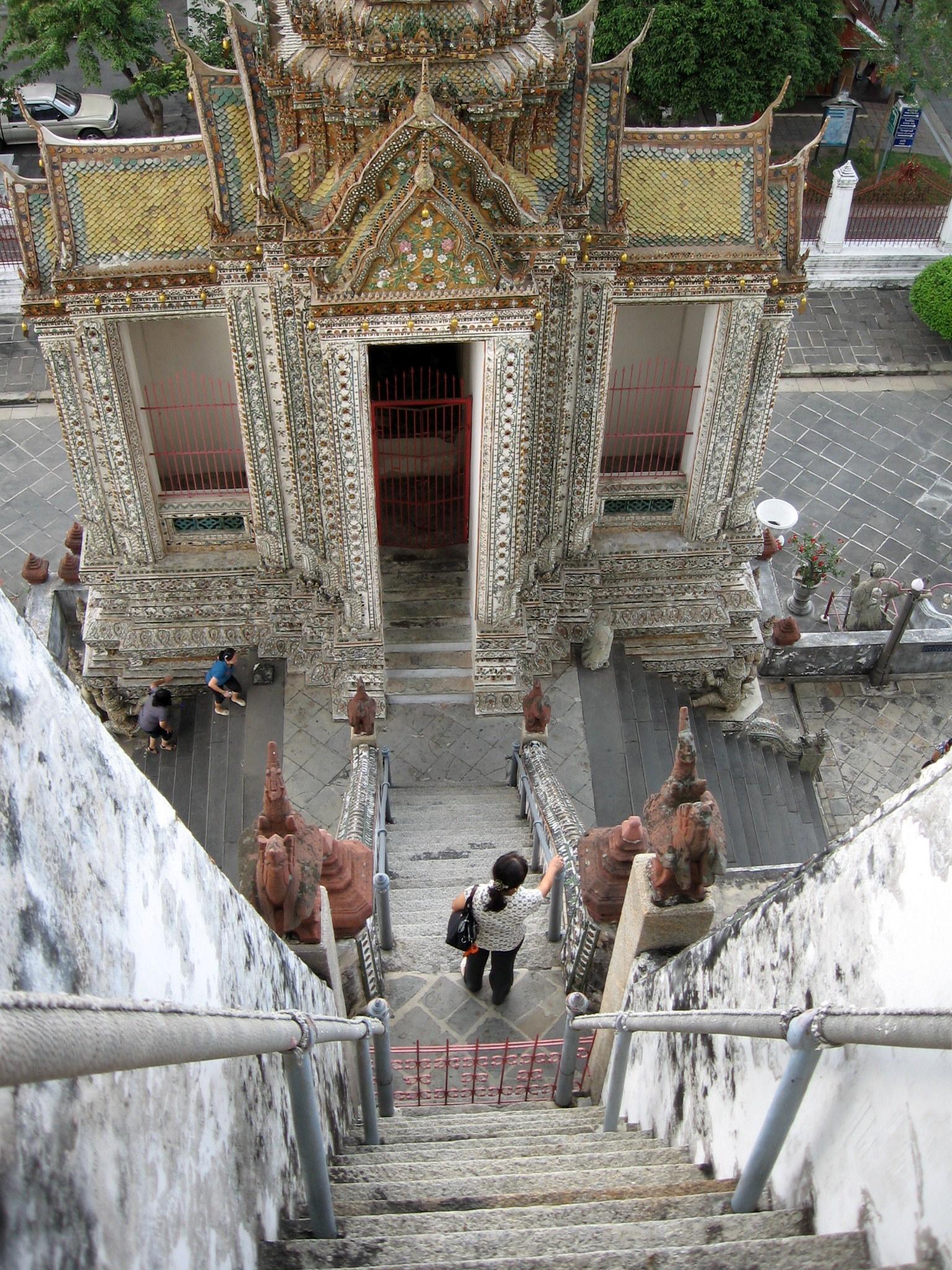

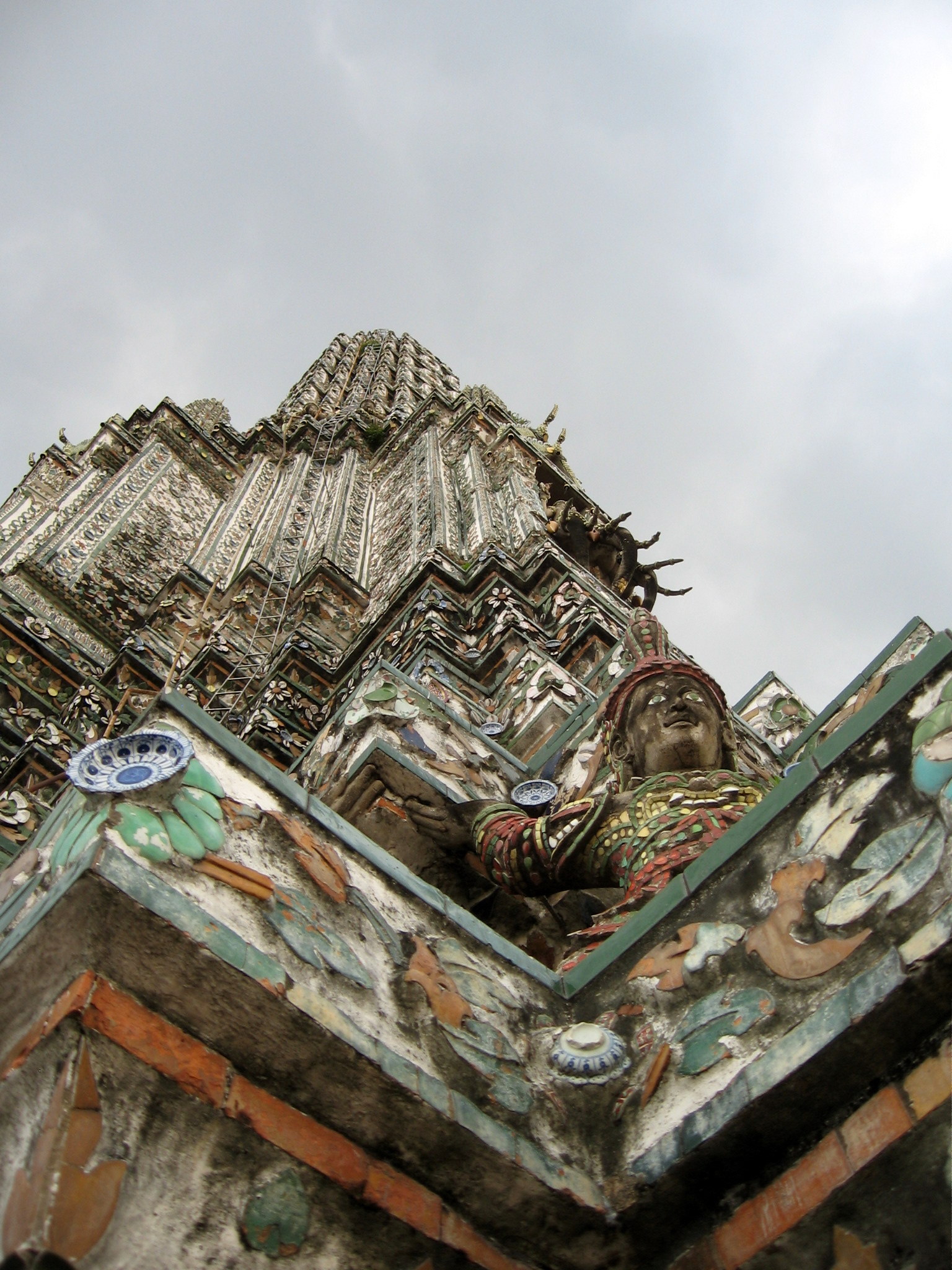
“Path.” Wat Arun, Bangkok, Thailand, 16 November 2010.

“Path.” Wat Arun, Bangkok, Thailand, 16 November 2010.
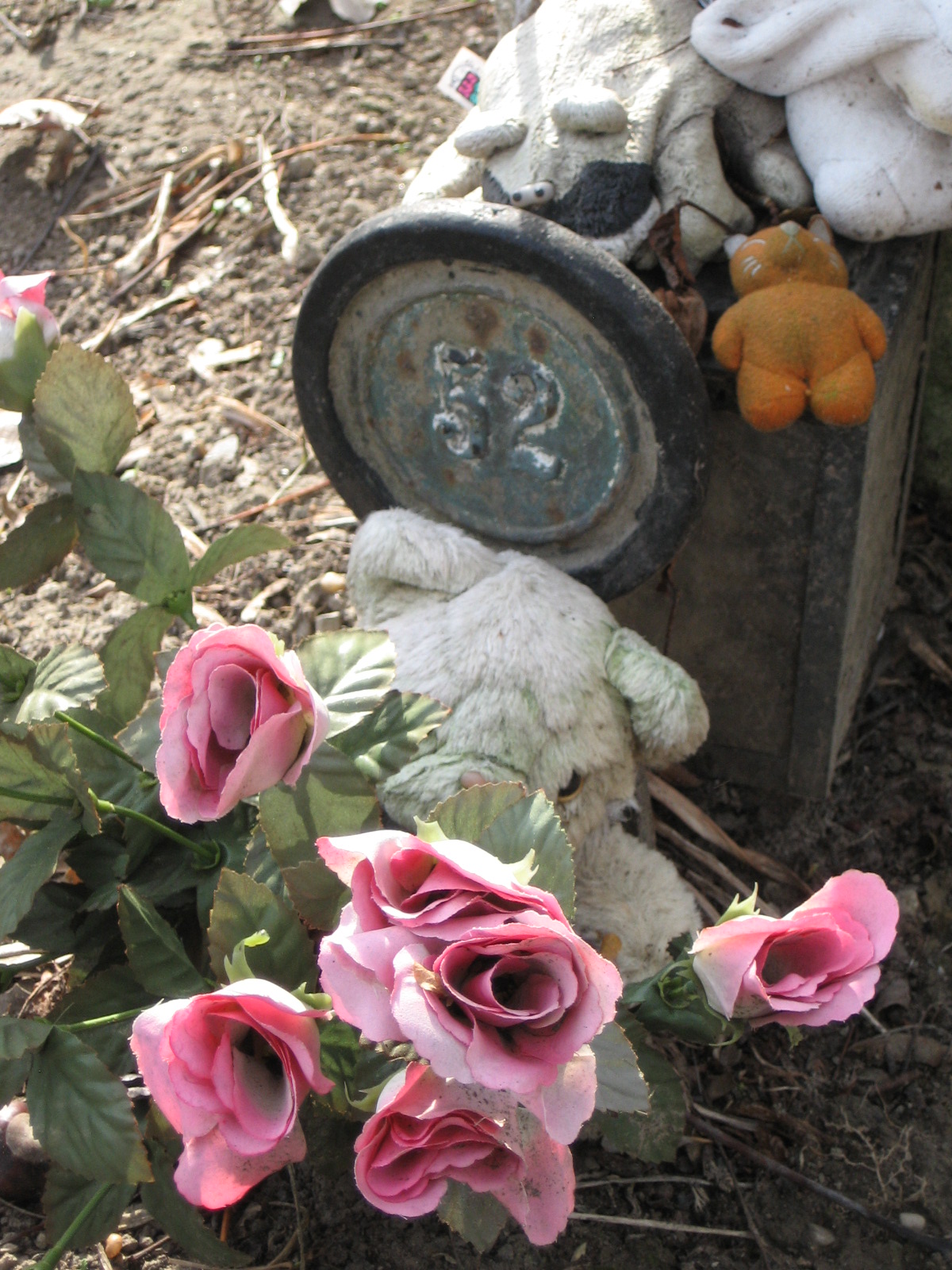 A few minutes ago, I helped a stranger cat to die. Not directly, but it was close enough. He’s a street cat, beefy and tough and full of spit and bravado. He’d been hit by a car. I think his hip is shattered. With the help of some neighbors, I coaxed his broken body into a cage and sat with him until another neighbor could come to take him to the vet, where he will be coaxed back out of the cage, talked softly to, and injected with sedatives until his tiny, tired heart stops beating.
Right now, my own cats are quietly eating their breakfast in the kitchen, and my own heart is broken.

Bill Roorbach has announced on his blog, Bill and Dave’s Cocktail Hour, that his new novel, The High Side, is scheduled to appear in print next spring. I can’t tell you how excited I am by this: I’ve long been a big fan of Bill — his writing but also his nature, because he’s one of the coolest guys I’ve ever had the privilege to meet — and his nonfiction is among my favorite prose in print. (Seriously. Go buy a copy of Temple Stream. Check it out from the library first if you want to, but you’re going to want to own this book, because you’ll be reading it more than once.) But the first Roorbach I read was his short fiction, in his award-winning story collection Big Bend, which appeared around the same time as his first novel, The Smallest Color, and I’ve been hankering after more fiction for a long time now. So I’m thrilled that this time next year I’ll be settling in with a new novel from one of my favorite writers.
Rock on, Bill. (And never cut your hair.)
I think I might accidentally have started a new novel. It doesn’t look like much in this exercise, I admit, but believe me, it’s frighteningly large inside my brain. I don’t have time for this right now, frankly, and I’m going to have to put this on hold for a while (I might save it for this year’s NaNoWriMo), but here it is anyway, taunting me. I blame Orhan Pamuk, really. But more on that below….

I feel I need to make this clear up front: I am not alive. I’m not even very much among you, though of course our existences overlap, the way the sun on the horizon can leave the illusion of wholeness as its half-hidden light spills over the line in the earth. There are parts of my existence that spill over into yours, and I have come to believe that yours spills over into mine. But I am not among the living; I am among the after-living.
One advantage of an existence that transcends life is access to information, to perspectives not my own. Of course, even from this transcendence, my understanding of these perspectives is inexact because, of course, I never truly lived. I have only my present state and my observations to go on.
You might say that I am an angel. That’s fine — few would dispute it. But do not assume that see or hear or know all. I see and hear only those things to which I am assigned, those events which are close to me. I know only what I am given to know.

For several years now, I’ve had an idea for a historical novel set in medieval Anatolia. I even have an outline for the thing floating around somewhere. But I’ve been putting it off for two reasons: One, the book requires a LOT of research, which I’m not averse to but haven’t had the time or money to do properly (I really need to spend a few weeks in Turkey, which I plan to do some day, but who knows when?). And two, I’ve never really been happy with any of the ways I’ve tried to access the narrative voice.
Right now, I’m reading Turkish author (and Nobel laureate) Orhan Pamuk’s My Name is Red, which is set in 16th-century Istanbul and other parts of the Ottoman Empire. The book opens with a dead narrator — or, in the parlance of my own research, a postmortal narrator, meaning a narrator that exists in a state beyond the moment of death, not a ghost haunting the earthly realm but also not really a spirit within a definite or ultimate afterlife. That in itself caught my attention. Then the book switches narrators, over and over again, piecing together its story through multiple and sometimes recurring perspectives, something like Faulkner’s As I lay Dying (the first true postmortal novel). The narratives get so inventive that at some points in the book, the story is told by an drawing of a dog or a painting of a tree.
But it was the opening that most intrigued me, because it reminded me of the possibilities in a narrator that exists outside of life but also not yet in an afterlife: a narrator connected to the living but not (yet) involved in life. given the time period (it’s set in a Christian monastery just before the Turkish Muslim conquest of Anatolia), a first person narrator would be difficult to pull off without a history degree and a decade of research. But a traditional third-person, limited omniscient voice always felt too distant and academic to me. But a first-person observer narrator that transcends the events in the story and transcends even life itself provides a perfect balance of personal perspective and distance, and an excellent excuse to provide some level of omniscience but not total omniscience. Also, because my novel would deal with weighty spiritual issues as well as death specifically, I figured a voice from the afterlife (or at least between life and the afterlife) would be ideal.
The more I read Pamuk’s novel and thought about his process and the narrative choices he makes, the more I thought about how I might adapt some of those choices for my own novel. And these few trial paragraphs were the result.
I call this a “mentor texts” exercise for two reasons: I’ve recently agreed to give a talk to a group of university students here in Abu Dhabi who are learning about fiction writing, and a lot of their work so far has been with studying existing books and learning techniques by imitation. This technique is discussed extensively in Nicholas Delbanco’s writing text, The Sincerest Form, which uses imitation as a foundation for writing exercises. (Francine Prose offers a similar approach in her excellent book Reading Like a Writer.) The idea behind a “mentor text” is to use an existing book as a model, to learn from the techniques at work in other fiction in order to improve your own. It’s not a matter of pastiche, though in the beginning if often works that way; rather, it’s more like forms in poetry: you have a model, and you find a new expression within that framework. Using texts as your “mentor,” you can pick up ideas for characterization, plot development, structure, or, as I’m doing here, narrative perspective.
So give it a shot: find a book you love, figure out why you love it, and then try some of those same techniques. See where it takes you.

My friend Lori Ann Bloomfield, of The Last River Child fame and author of that Elvis story I liked to a while back, is opening up the floodgates to reader questions over at her First Line blog. Got a burning question about writing, reading, or publishing? Go visit her blog and drop her a line — she’s happy to help!
(So am I, by the way: you’re always welcome to ask me questions, too. But Lori is awesomeness itself, and we’ve had some great discussions about writing, so I know you’d learn a lot from her.)

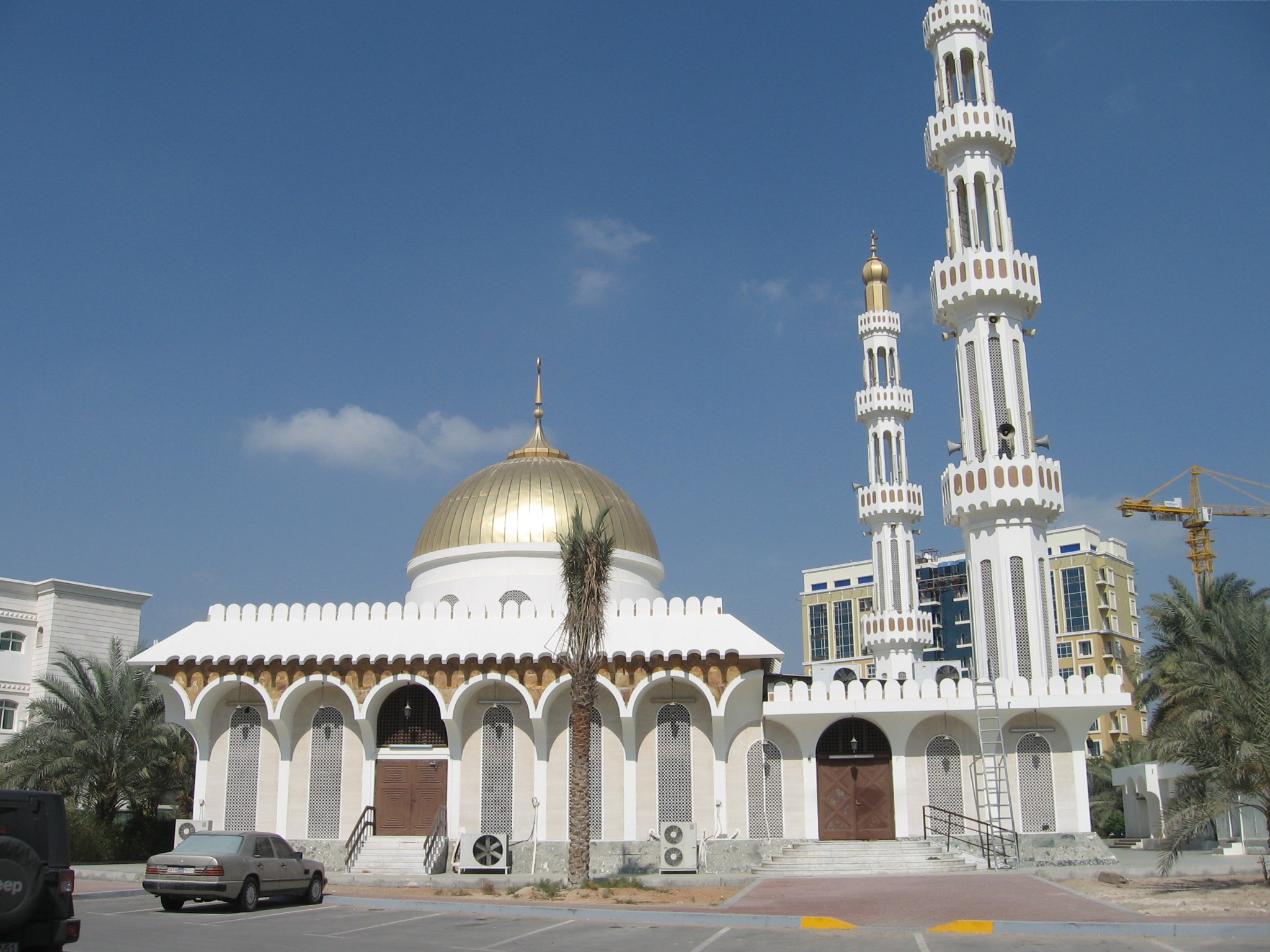 The fading echo of the muezzin’s adhan blurs into the rising songs of birds awakened from their roosts in the minarets.
I can’t explain why, but I woke up with this in my head:
Like everyone else, the caricaturist had good days and bad days. On good days, the people would laugh and clap their hands, touch his shoulder, would point to their hairdos or their cocked grins and say, “Oh, that’s me exactly! That’s me to a tee!” On bad days — and he’d learned to see this coming, even as he sketched them — they would scowl at themselves when he’d finished. Their noses were too big. Their breasts were too prominent. “Who the hell do you think you are?” they’d say. They’d demand their money back, and he’d give it to them; then, in revenge, he’d hang their discarded portraits in his sample gallery for everyone to see.
A lot of my stories have started out as dreams. The opening section of my novella, the opening chapter of my dissertation novel, and a handful of other pieces published and unpublished came to me in dreams, sometimes wholly formed. It’s a weird sensation, and I haven’t had it for a long while, but I’ve learned to keep a notebook handy to record these odd narratives or character sketches or bits of language, just in case they become something later.
I don’t know if this short character sketch will become anything useful (I know even less about where he came from — why on earth was I dreaming this? and in these words almost exactly?), but I have a good feeling about this guy and the directions he might go. I’m definitely going to follow him for a while, and if it develops into something fun, I might post the results here later. (If it develops into something truly good, I might wait and send it out for publication.)
But for now it’s just a beginning, which means you’re free to take the reins and see where this guy leads you as well. If you get somewhere, you’re welcome to share your story with me! I’d love to see the different directions this guy might take.

I’m posting this heart to represent the fragility of my heart as I watch the news this week, and to represent the huge sense of compassion I feel for all sentient beings all over the planet but, this week, especially for the people of Bahrain, Libya, and Japan. Please be safe, please be peaceful, please be well, please be compassionate. And know that you are loved.
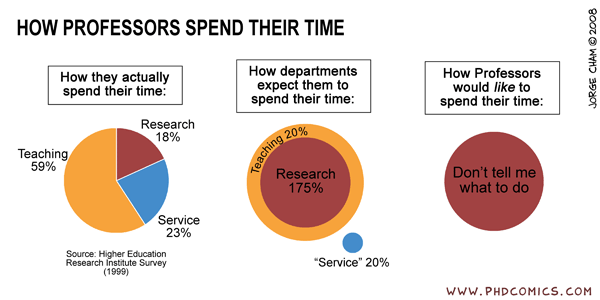
If there was a weak spot in my number-crunching comparison of MDs and PhDs from last week, it was in the accounting of how many hours a typical academic PhD works in a week. I’m confident of the numbers I offered — an average of 60 hours a week — but those numbers were based on the personal accounts of professors, including my own. There isn’t really any good, hard data recording how many hours a week a typical academic works.
The reason there isn’t good, hard data? “Academic labor doesn’t really break down into discreet parts,” writes English professor and blogger Philip Nel. “You think, write, edit, prepare for class, grade papers, where and when you find the time.” In a blog post from a few weeks ago (which I just found today), Nel accounts for his working hours over the course of a typical week and explains just what it is that professors do all day. It’s a fantastic account, and while it’s still rooted in personal experience, he backs it up with detailed records of his activities (toward the bottom of the post, you’ll find day-by-day hourly reports).
How many working hours did he record? 60. Which is the same as the average I arrived at in my own post.
Also, take note of how he accounts for his working time during summers. I knew in my own accounting that I was being lenient when I suggested most PhDs work only 40 weeks in a year; the truth is, we work off and on year round, and Nel’s accounting of his summer work is worth paying attention to, particularly for people who mistakenly assume we teaching PhDs “get summers off.”

 Samuel Snoek-Brown