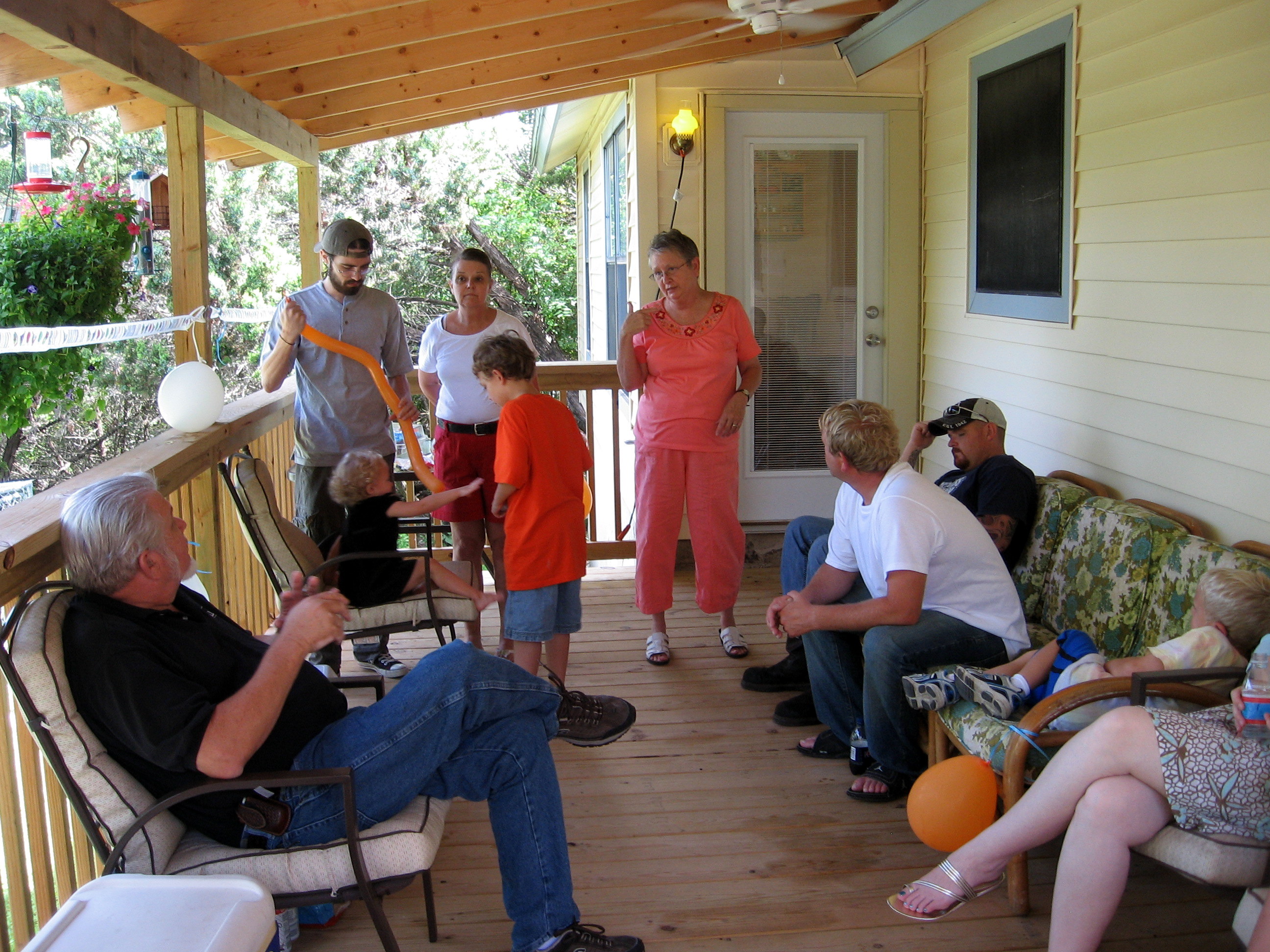
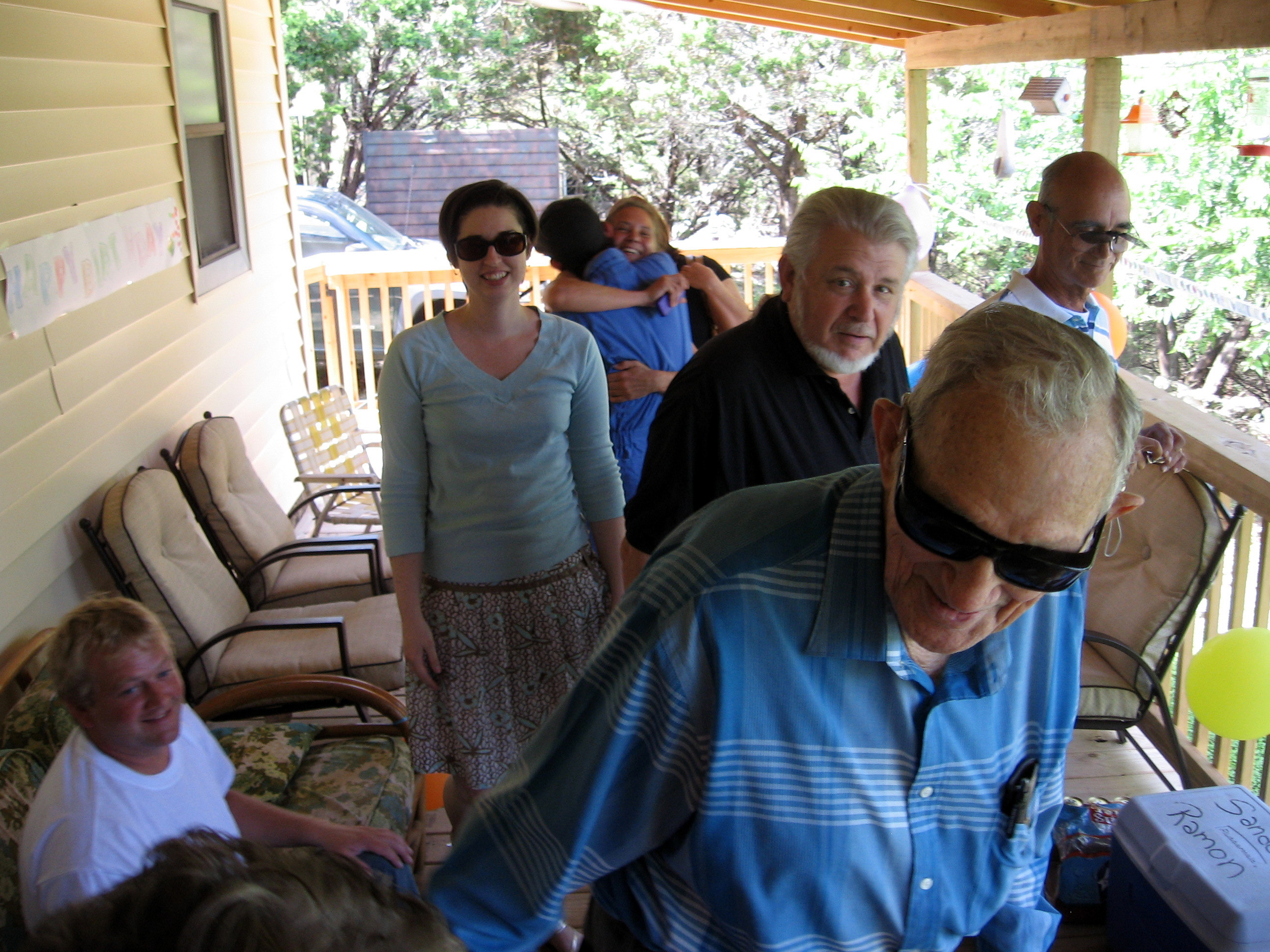

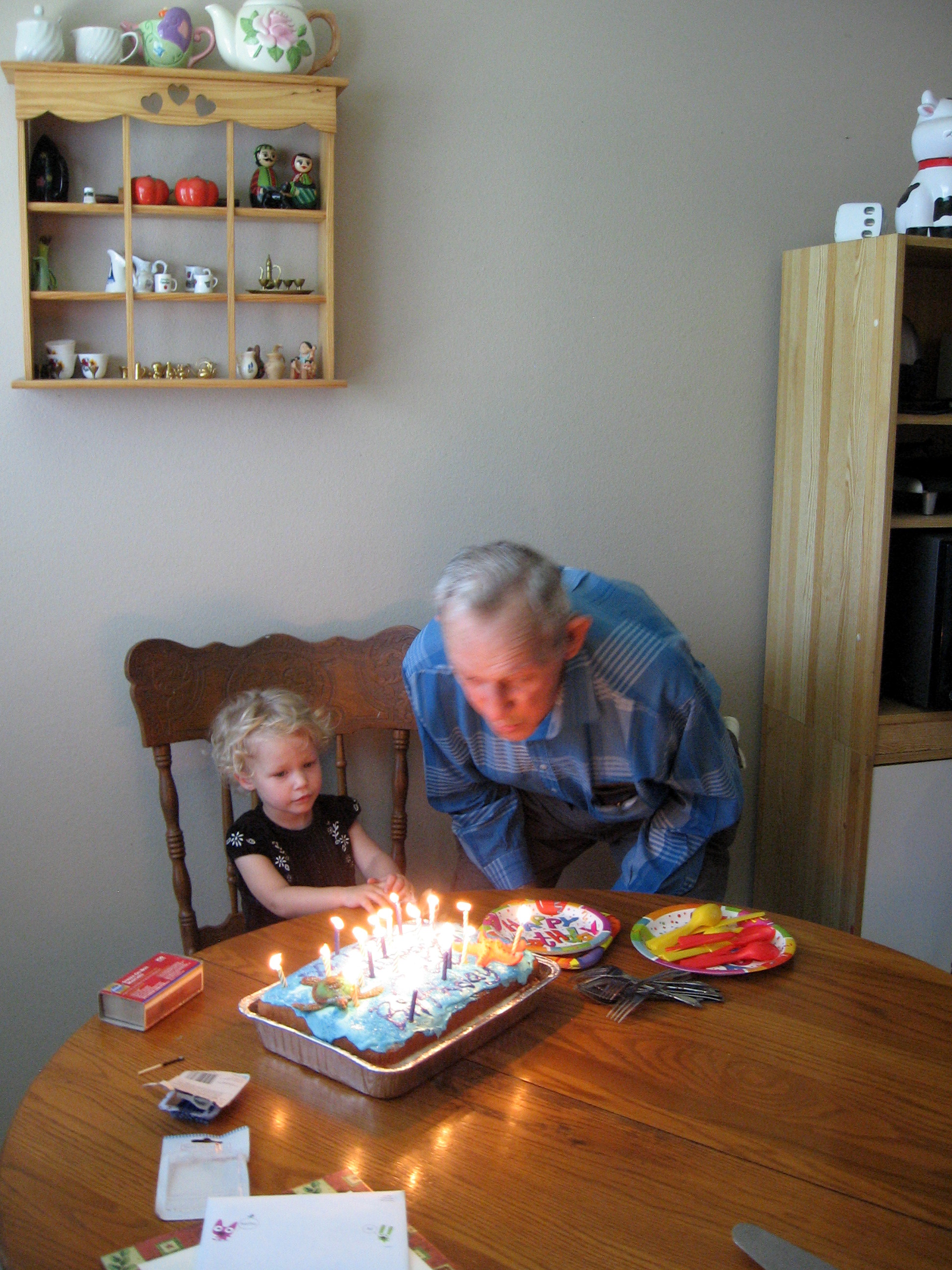
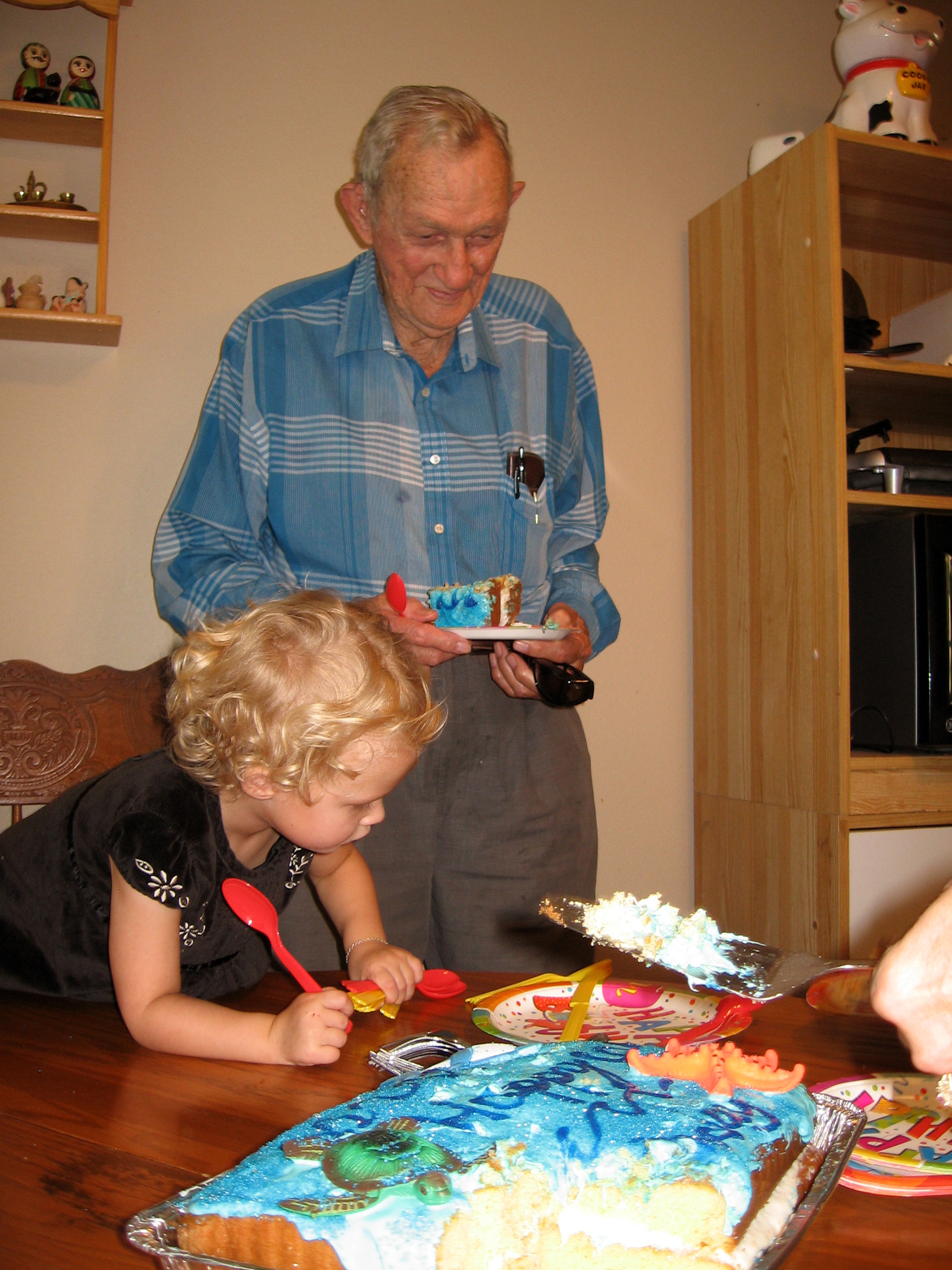
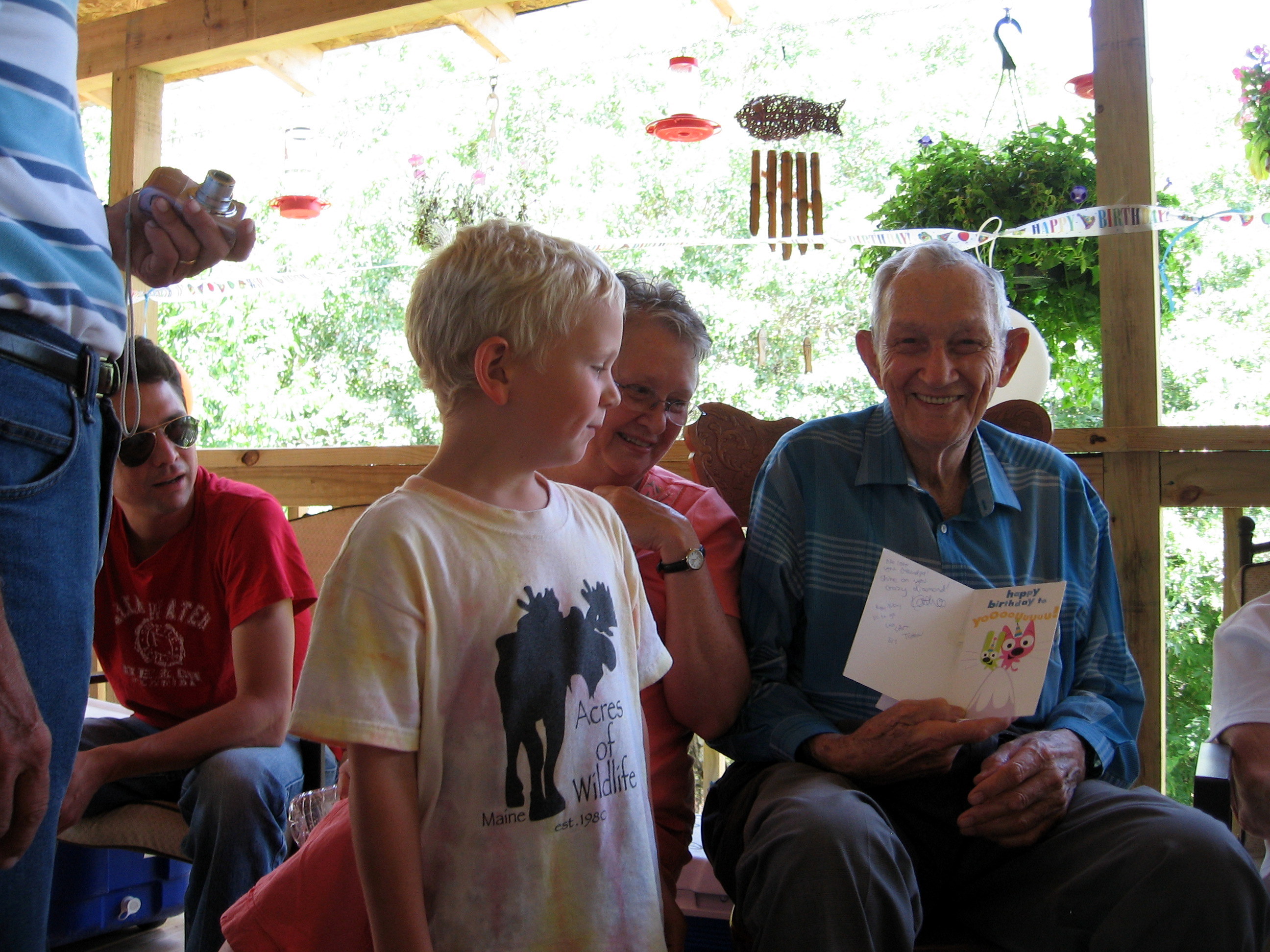
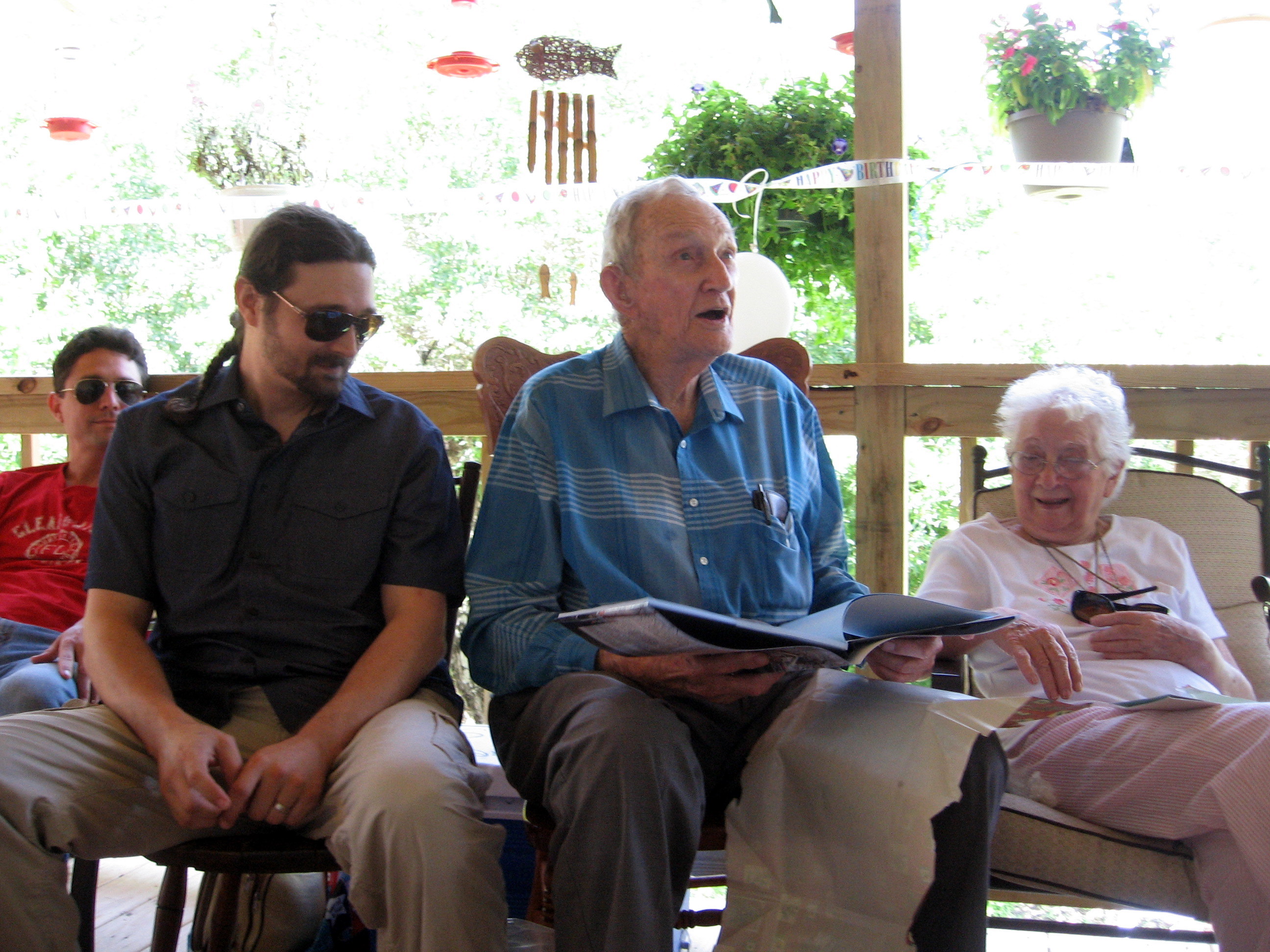
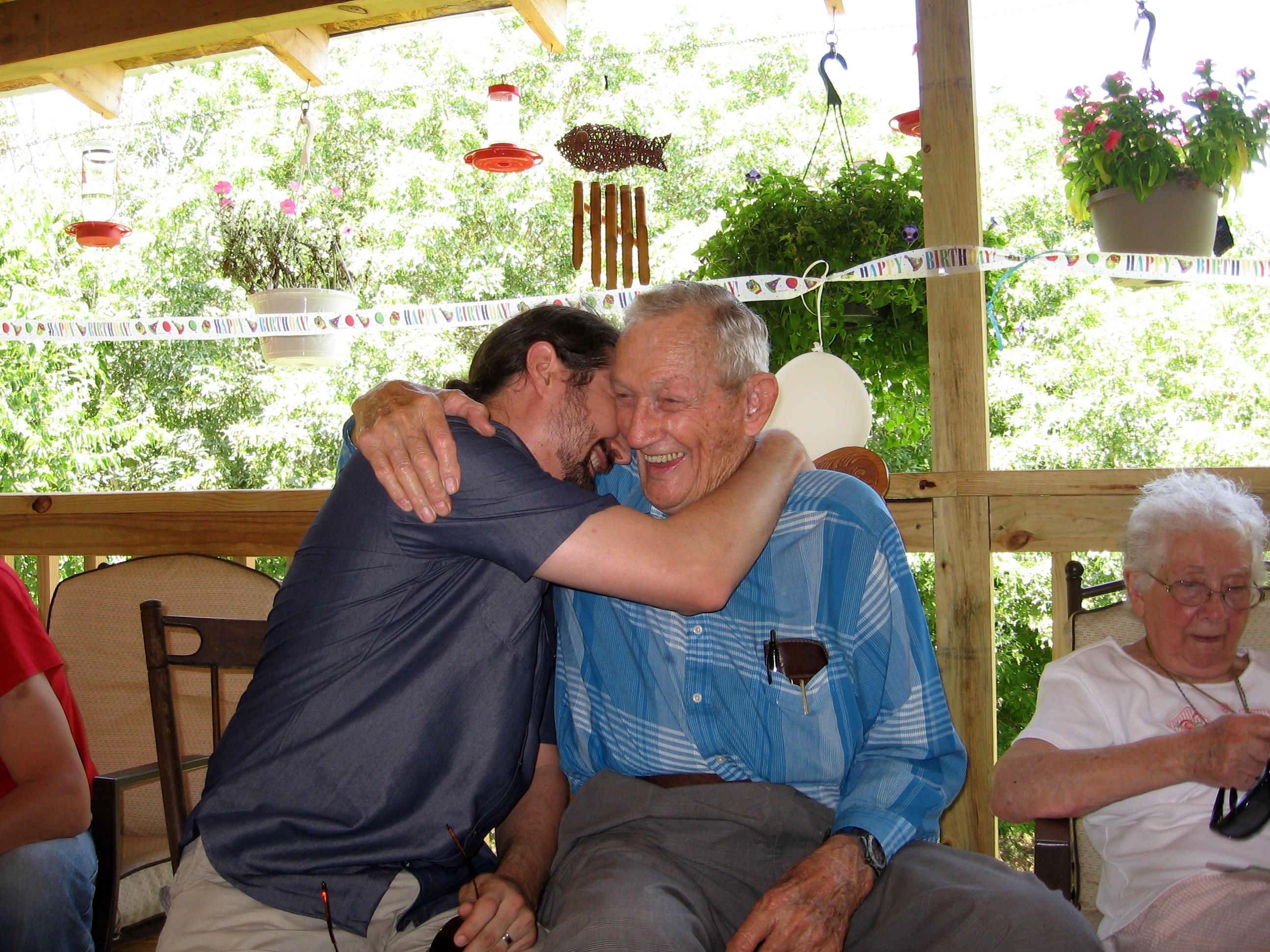

 “90 and 20.” Birthday party and small Snoek-family reunion, Boerne, TX, 17 July 2010.
(photos 7 and 8–bottom left and bottom center of grid–by Jennifer Snoek-Brown)

“90 and 20.” Birthday party and small Snoek-family reunion, Boerne, TX, 17 July 2010.
(photos 7 and 8–bottom left and bottom center of grid–by Jennifer Snoek-Brown)
The following conversation is not one I invented. I made up the characters and the situation, but the dialogue already existed. But I’ll explain below.

Jacob smiled and leaned across the table. “It’s terribly funny,” he said. He winked.
Sebastian shook his head. “You are pulling my leg.” Jacob only grinned. “You exaggerate!” Sebastian said. “Surely not!” Jacob sat back in his chair and put his hands behind his neck; he was still grinning. Sebastian eyed him, screwed up his mouth in a thoughtful pose. “You don’t say,” he said slowly, then he leaned forward himself and slapped the table. “You are joking!”
Jacob shrugged.
Finally, Sebastian pushed himself away from the table and stood.
“Joking apart,” he said. “Agreed. Ok?”
Jacob clapped his hands and stood as well. He walked around the table and slapped Sebastian across the back.
“Likable!” he said. He clapped Sebastian again. “Nice personality! It’s wonderful, splendid.”
Sebastian bowed and Jacob laughed with him. “Encore!” Jacob said.
They left the cafe and walked up the dark street, arms around each other’s shoulders.
“You are crazy,” Sebastian said.
“So much the better,” Jacob said.
Sebastian shook his head as Jacob guided them around a turn and into a small alley.
“My pals,” Sebastian said.
A new voice emerged from the shadows, gravelly but thin, a bit high pitched. “He is a jolly nice fellow,” the voice said.
“It’s rotten luck,” said another, deeper and smoother, almost a hiss.
Jacob and Sebastian stopped, peered into the shadows until they could make out two shapes, one thin and the other thicker.
“To put one’s foot in,” said the first voice.
“To drop a brick,” said the other, and then a small explosion on the alley wall near Sebastian’s head, bits of brick raining across both men.
“To do something stupid,” Jacob said.
When they heard his voice, the owners of both voices emerged into the wedge of light cutting into the alley. A husky woman and a thin, willowy man. They squinted in the light and grinned, both with twisted, yellow teeth. They both rushed to Jacob and hugged him. Sebastian stood aside.
“How are things?” Jacob said.
“Things are going badly,” said the woman with the gravelly voice.
“I am bored,” said the hissing willowy man.
“What a pity!” Jacob said.
“You’ll get used to it,” Sebastian said under his breath. “I don’t care tuppence.”
But the group heard him, and the husky women glared at Sebastian. “What are you driving at?”
Jacob waved one hand, dismissing Sebastian. “He was drunk,” he said, then he looked pointedly at Sebastian and added, “Fool.”
“Be quiet!” Sebastian said. “Shut up!”
“Take it easy!” the willowy man said, both hands pressing against the air as though suppressing something physical.
“Calm yourself!”
“That’s going too far!” Sebastian said.
Jacob said only, “Damn.”

I’ve always been a fan of found art, be it Duchamp’s “Fountain” (a urinal he stole and claimed as his own sculpture) or Donald’s Rumsfeld’s accidental poem “The Unknown.” But here I’m using found dialogue.
Strangely enough, all the spoken words in this scene appear — verbatim and in order — as “popular idioms” in an old copy of the Collins Dutch Phrase Book (1975), which I found on my parents’ bookshelf this week. The choice of phrases struck me as so odd and so amusing that I couldn’t help but hear them as a conversation, which got me wondering who might have such a conversation and where it might take place.
Dialogue itself is a tricky business, really, but because it’s so tricky, we often place more emphasis on how to write dialogue for scenes and pay not enough attention to how scenes might fit around dialogue. And thanks to Hemingway’s “Hills Like White Elephants,” most beginning writers try at least one story written entirely in dialogue but forget the importance of threading action and description into a conversation to control pace and set scenes. So this exercise can be a handy way to practice building a scene around dialogue without having to invent the conversation itself. This can be especially useful if you’re working with nonfiction or writing interviews and have lines of dialogue or the text of a conversation but don’t know how to build a scene for it.
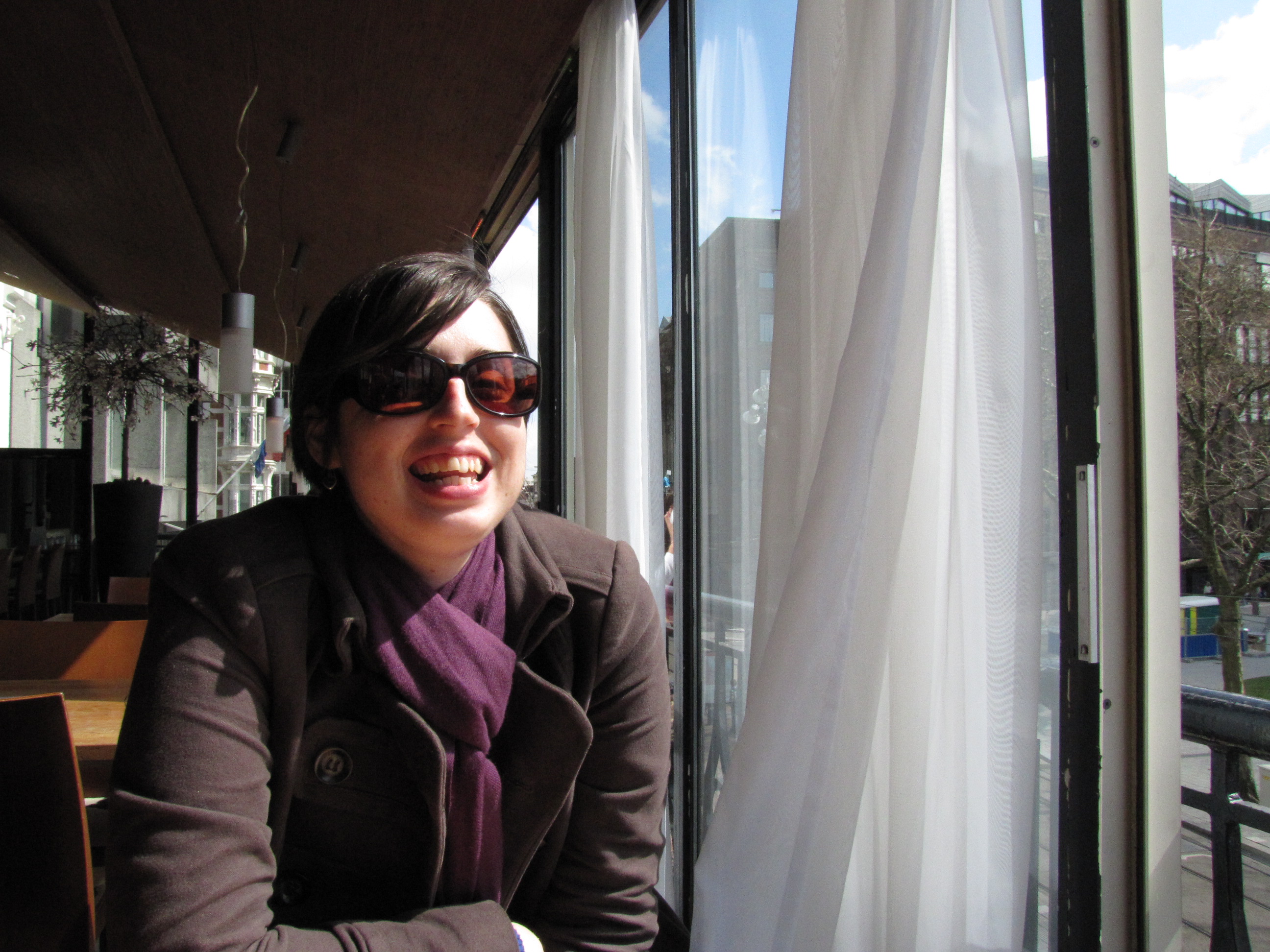


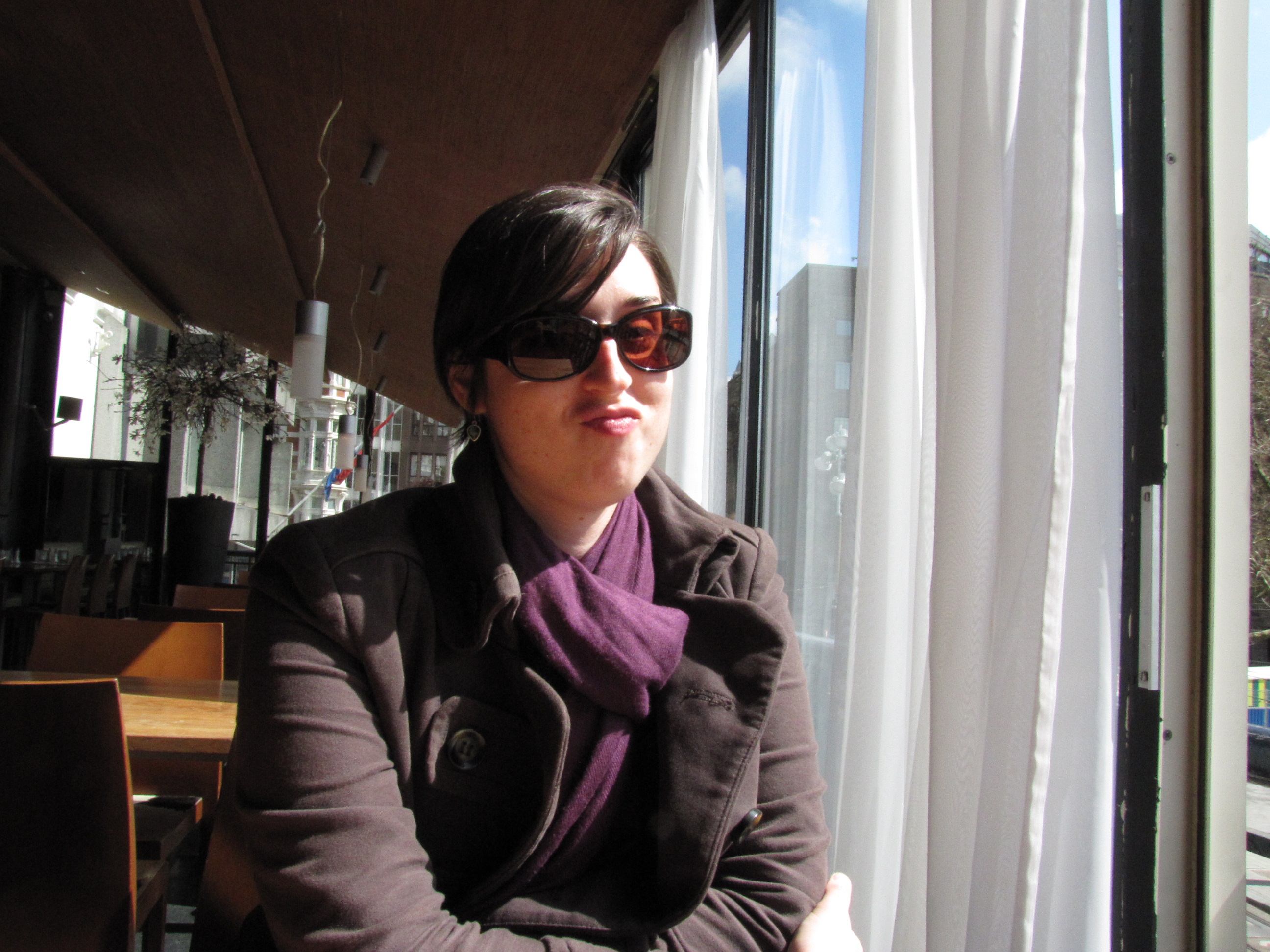

“Caught in the act.” Jennifer Snoek-Brown (catching me taking candids) in De Kroon Café, Amsterdam, the Netherlands, 20 April 2010.
I spent part of this week in the hospital for a bleeding ulcer. Nothing life-threatening, but it did threaten to interfere with our travel plans. The good news is that it didn’t, and today, I am traveling. But those two things combined–the ulcer and the travel–have left me with a blank page for this week’s Writer’s Notebook.
Sorry about that. But it happens.
So this week, write in your own notebook and, if you like, share the results in a comment! And I promise to catch up on my own weekly writing next week.

This is not a spectacular photo, I know, but I wanted to post it in honor of the 75th birthday of His Holiness the 14th Dalai Lama (6 July). While he is not formally my teacher, I have received teachings from him, including teachings on Tara (the female bodhisattva of compassion, whose Chinese name is Kwan Yin), who has become very important to me.
Thank you for your wisdom and compassion, Holiness, and for your willingness to teach so many. May you live a long and healthy life for the continued benefit of all sentient beings, and may you continue to return to us for as long as we need you, until samsara ends.
This story I’m writing about the character named Ford is ballooning, but in the best way–each week I find new ways to build it, expand it, let it breathe.
But more on that below. Right now, five quick questions to help flesh out the character of Ford:
a) What are the character’s physical attributes, from head to toe?
Ford is tall, burly, wide-shouldered and narrow-hipped. He keeps his ashy blond hair in a buzz so short it sometimes looks as though he’s bald, just a heavy five-o’clock shadow on his head. (He cites the Roman military as the inspiration for his cut–“Makes it harder for guys to grab your hair in a fight or out on the field,” though it occurs to me that it also makes it harder for a girl to grab his hair when attacked.) You’d expect a former football star turned ex-con to have a hard face, a solid jaw with pronounced muscles that jump when he’s agitated, but this isn’t the case with Ford. At 28, his face is still boyishly round, outlined in shadowy sideburn stubble that descends to his jaw. He does have piercing eyes, though, narrow eyes under low-hanging brows that pinch in at the center so he always looks like he’s studying you.
He has two visible recent scars, one on his right shoulder and one on his left forearm. The one on his shoulder is a shiv-wound from prison. The one on his arm is a deep bite mark, two jagged crescents facing each other. He claims he got this, too, in prison, but the bite looks small.
He wears denim work shirts or plain t-shirts, and tight jeans. He prefers heavy workboots, especially when mowing lawns or scavenging trash. He mostly stands with one leg cocked and his hips at a tilt, a thumb in one pocket, like he’s posing for a cigarette ad.
b) What relationships are important to your character? Why?
Ford maintains no relationships anymore. His parents moved away from Boerne after his conviction, and he has not spoken to his one younger brother in several years. But Ford was determined to move back to the town he grew up in, where everyone avoids him and he avoids everyone.
c) What does your character do? For a job? For fun?
Ford mows lawns and, in his spare time, scavenges the roadside trash for salvageable discards, old washers or refrigerators, broken furniture he can repair, anything he might be able to fix and/or sell somewhere down the line. For fun, he works in his backyard model of Boerne, arranging the lives and narratives he’s concocted there.
d) What is your character most afraid of?
Women. He worries they make him weak.
e) What does your character want?
To force the entire town to admit they were wrong about him–no matter what it takes.
This past Monday, I linked up via video chat with the teen writing workshop I founded back in Platteville, Wisconsin, now led by Ryan Werner. Some of the writers in that group were there with me from the beginning, and one of them–talented young author Stephanie–invited me to join the group from across the ocean. Alas, the video link-up didn’t cooperate as well as we’d have liked, but because I was still connected on chat, I was able to participate in the writing exercises they did that day.
This was one of those exercises, part of a series the teen writers did in their workshop. And because I’m in the middle of this story about Ford, it seemed a perfect opportunity to work more on his character.
Ryan might have to correct me on this–some of the details got lost in the garbled video feed–but I believe these questions come from the oft-used exercise book What If?: Writing Exercises for Fiction Writers. If it doesn’t you can certainly find similar lists of questions in other writing books (I know there are some good lists in Jesse Lee Kercheval’s Building Fiction, for example). And I had loads more culled from other sources over the year–a whole MS Word file devoted to them, actually, which I might break out for a future Writer’s Notebook. But if you’re playing along and want to delve into a character a bit, these five questions are a great starting place.
Just a quick announcement that the new issue of Forge came out today. It includes my story “A Smooth, Clean Cut.” If you’re interested.
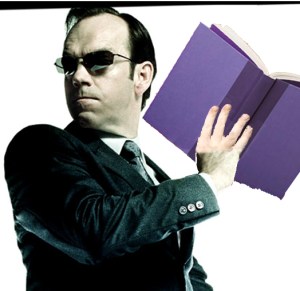 99 literary agents!….
Come on, sing it with me now!
Over the past several months, I’ve become a big fan of the blog Literary Rejections on Display, partly because the rejections all look so familiar (it’s nice to know we’re not alone in the long, good fight to share great literature, isn’t it?) but also partly because the blog’s (anonymous) author has been so open about her/his struggle to wrap up a book, land an agent, find a publisher, become famous (though still anonymous?). If you read the blog long enough, the work starts to feel epic. It’s like my own career as a writer is on the line, and in a way, it is, because the LRoD author is in there fighting for all of us, and if he/she can land a big break, then there’s still hope in the land of literature.
Ladies and gentlemen: There is still hope!
It took 99 agents to get there, but our fearless, anonymous pen-warrior might finally have landed a break! So grab a bottle of whatever you choose from off the wall, pass it around, and three cheers for quality writing.

Recently, I had the idea to write a new short story in a particular style, a genre I have practiced before but a long time ago. I’m out of practice. So I dug up some old examples and some new ones, and I started analyzing them for clues as to how to proceed. And then I struck upon an old technique, one I don’t use nearly often enough, that would not only help me understand the genre better but also help me construct my story.
I’m writing a descriptive outline.
FYI: This isn’t the outline for the story I’m working on — I’m still in the middle of that piece, so this is just an example for the sake of today’s post. And I’ll explain the process more below, but a couple of things to know about this outline: The notation “P1” technically refers to “paragraph 1,” but actually it’s addressing small sections of text, which might contain multiple small paragraphs (this is especially important in sections of dialogue, or I’d wind up with something like 247 paragraphs to describe). When a section does contain multiple paragraphs, I’ve indicated that with notations like “P3-?”. And the notation “< SB >” means “space break.” Finally, I’m cutting this outline short because including the whole story would make this post unreadably long, and besides, I hope you actually read the story itself, so I don’t want to give anything away. The rest, I hope, is self-explanatory.
P1: Set-up (past tense), sense of scope (lots of people) but whittled down to two main characters in first few sentences: the narrator, and the second main character (#2). End on complication/source of initial (past-tense) conflict.
P2: Short background/introduce secondary characters (note the near-absence of the most important secondary character, who I’ll call #3).
P3-?: Lead from background into scene.
P4: Shift from dialoque to action, then go into detailed background of #2. End on strange/quirky detail; use a stand-alone one-liner to shift into second phase of background….
P5: Second phase of background = history of second main character’s relationship to narrator. Keep it brief, but also use it to hint at the nature of the main (not initial) conflict.
P6-?: Return to scene from P3&4. Re-introduce the situation that was initially mentioned at the end of P1.
P7: End section on image symbolizing the central sub-conflict of section one. If possible, also make the same image indicative of main conflict.
<SB>
P8: Shift to present tense. Open on stand-alone that states the second (present) sub-conflict. Then a paragraph opening with a brief setting description and finishing with an illustration of the second sub-conflict (between narrator and the most important secondary character, #3)
P9-?: Move into a scene, with a mix of action and dialogue, that serves as an example of the sub-conflict.
P10: Scene continues, but it’s transitioning into main action. #2 arrives and narrator moves allegiance from #3 to #2. End on metaphor for (dangerous) liberation
P11-?: Travel narrative. Include some specific details of places, sights, things done or picked up along the way. A few lines of dialogue, but focus on the journey and the action.
P12-?: Flashback involving narrator and #2. Preferably a reference to first sub-conflict from section 1.
P13-?: Return to journey, but it’s paused:
P14-?: Return to journey (moving): Change directions — physically go somewhere unexpected (and perhaps take the narrative somewhere unexpected as well)
P15: Abruptly stop journey: Richly describe destination
P16: End on a promise (hopeful or ominous, either way) of things to come….
<SB>
P17: Shift to future tense….
This is partly born from a discussion over on the blog How Not to Write, in which the author Jamie Grove talks about not only the importance of outlining but also the importance of dispelling the myth that outlining is limiting, that it’s rigid, or that it must follow a particular format. All it needs to do, he argues, is work for the writer — it is a tool, like any other we use, to help us move through the writing, and it can also help us organize our writing. (There are some great ideas in the comments about ways to approach outlining, so make sure you check those out. Full disclosure: I left a comment there, too, though I’m not claiming my ideas were “great.”)
Here, I’m working with a kind of combination of the descriptive outline and the prescriptive outline. The prescriptive outline plans and, as closely as possible, tries to “predict” how a text should be written. A lot of people, myself included, don’t like them because we view them as limiting — we feel tied to the outline and can’t enjoy the process of discovering a draft as we write it. But the descriptive outline comes at the problem from the other side: It diagrams a text that already exists.
It’s useful for all sorts of purposes, including both analyzing someone else’s published stories and breaking down your own drafts in preparation for revision. I love the descriptive outline for both these reasons, and I’m surprised at how long it’s been since I’ve done one. In fact, I can’t recall ever having written an outline for a short story — only for novels and, occasionally, essays.
But today, I’m actually using this exercise as both a descriptive and a prescriptive outline. In other words, once I describe an existing text in outline form, I’ll use that outline to guide my own new story.*
Imitation is an old writing technique, and people have a lot of mixed opinions regarding it. Some people view imitation as the best way to learn writing; others view it as cheap, as derivative, even as plagiarism. (Watch the last half of the Sean Connery/Rob Brown movie Finding Forrester for a great example of both these views.) I actually believe both perspectives. I think imitation adhered to too slavishly does produce horribly derivative work, and I can usually spot such work a mile away. But I also believe that if an author knows how to use imitation as an exercise, as a springboard to new ideas, then it can produce some amazing results, and the author gets to learn a few new tricks along the way.
The outline above, in fact, is of a story that comes from that latter camp. It’s of “Triathlon,” by Tom Franklin, from his collection Poachers. I chose it mostly because it’s one of the most perfectly structured stories I’ve ever read, and I love breaking it down into its pieces. But I also chose it because Franklin freely admits it started as an imitation: Franklin began “Triathlon” as a variation on Rick Bass’s brilliant “Redfish” (from his collection The Watch). If you read both stories closely and back to back, you can see some of the influence of “Redfish” on the first couple of pages from “Triathlon,” but the point is that the influence is confined there: It was a springboard only, and through constant reworking and revision, Franklin developed a completely unique and, I think, equally brilliant short story that has nothing at all in common with “Redfish.” He used what he needed, learned what he could, but he made the story his own.
That’s how imitation ought to work, and if you use this exercise, it’s how your story ought to work, too. Use the descriptive outline to learn some things about structure and to get you started with the writing, but don’t feel tied to it. Let yourself and your story develop as you begin to convert — no, rewrite — that outline into your own story. (I cannot emphasize enough how important it is for you to rewrite the story, to make the story your own! If you don’t work hard to break away from the initial outline, you’ll wind up with a pale imitation of the original, at best, and you could find yourself plagiarizing. Learn from the outline, but don’t just steal the story!)
* Note: The trick to making this work is to write your descriptive outline in the broadest terms you can, keeping an eye on specific techniques of craft rather than on plot or character details from this particular story. Though, if you’re writing fanfic, you could do note the plot and character details, too.) [back to exercise]

 Samuel Snoek-Brown