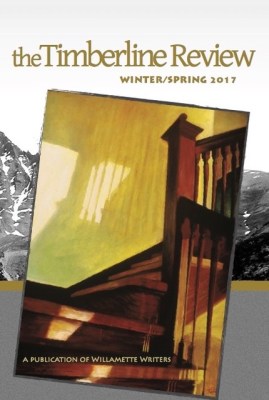
This afternoon, I sojourned once again into Portland. My destination was the Another Read Through bookstore, where I gave a reading with some of my fellow writers in the current issue of The Timberline Review.
But by happy (or, more accurately, bittersweet) accident, this is also the final weekend for Portland’s beloved Reading Frenzy indie bookstore — the owner, Chloe Eudaly, was elected to Portland’s City Council this past November, which is a wonderful thing for the city because she is a fierce advocate for Portland’s renters and homeowners; but as a new City Commissioner, she has to divest from her small business to avoid conflicts of interest, and Reading Frenzy is something of an institution in Portland, so its absence from Portland’s book scene will be widely mourned. So of course I took the opportunity to stop into one of my favorite Portland bookstores one last time, where I browsed the zine shelf and wished ChloeCommissioner Eudaly the best in her new position.
I picked up two little zine-like chapbooks at Reading Frenzy: Bob Schofield’s The Inevitable June, and Melissa J. Price’s Not Enough Cloth to Cover Such Love.
It helped that Another Read Through and Reading Frenzy are both on Mississippi Ave. (yes, Portland is so replete with awesome little bookstores that they often inhabit the same streets); it also helped that Mississippi Ave. is in what used to be my neighborhood when I lived in Portland, so between Reading Frenzy and Another Read Through is Bridge City Comics, the place that used to be my local comic book shop, which I also stopped in at. Just yesterday, my new local comic book shop, Stargazer Comics in Tacoma, hosted a Women in Comics celebration, where I picked up the first trade volume of Pretty Deadly. (The writer, Kelly Sue DeConnick, is a Portlander herself — are you sensing a trend in all this?) Actually, I had originally picked up the first issue of Pretty Deadly, but thumbing through it in the store, I knew this magical-realism violent Western was right up my alley (and would fill a hole I’m currently feeling while awaiting the next trade volume of my other favorite quasi-Western East of West as well as the second trade volume of DeConnick’s other series, Bitch Planet), so I put down the single issue and grabbed the first trade volume instead. I was right about the series; I’m already hooked, so today I popped into my old Portland comic shop to find the second trade volume (which I’m about halfway through now).
Of course, at Another Read Through, I had to snag another book or three, too. It started when I arrived early to the store and spied on the shelf a copy of a book I’d read way back in my undergrad New Testament course, for an essay I was writing on the historical Christ: Marcus Borg’s controversial but seminal Meeting Jesus Again for the First Time. Then poet Devon Balwit, who also read at this afternoon’s event, announced that she had copies of her latest chapbook on hand, so I grabbed How the Blessed Travel. And then, browsing the back issues of Timberline Review, I discovered an essay by my friend Kate Ristau, so I wound up leaving the bookshop with not only my own current issue but also the first issue of Timberline Review.
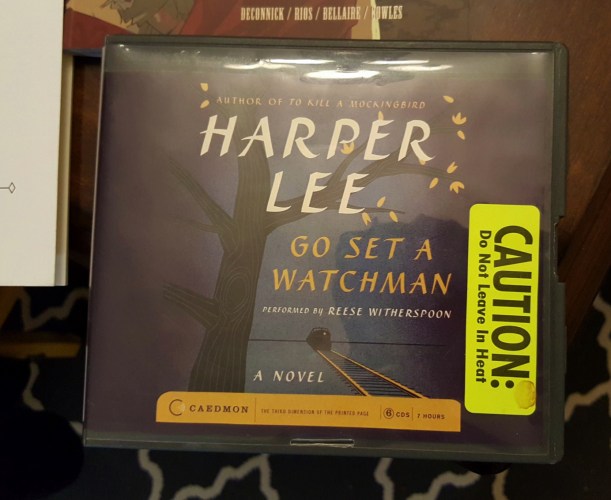
Of course, these weren’t my only literary endeavors today: taking advantage of the long drive down to Portland, I also listened to the audiobook of Harper Lee’s Go Set a Watchman — but that was significant enough that I’m devoting a full post to my review of it, so look for that first thing next week! (Sneak preview: Reese Witherspoon is definitely a Southern gal. She nails the reading.)
I’ve got a few events coming up on the calendar, folks, if you’re in America’s Pacific Northwest and want to come out to say hi.
The first isn’t so much an event of mine as an event I’m attending: my local arts and literature community, Creative Colloquy, is celebrating their third anniversary this coming Monday. I’m not on the official line-up, but I might try to hit the open mic; I might even read my story “An Understanding,” which appeared in Creative Colloquy’s online magazine a few months ago. I’m also contributing a copy of Hagridden to a prize basket — full of books by local writers/Creative Colloquy contributors — for the evening’s raffle, so if you want to grab a bucket o’ books, that would be a great opportunity to do so!
Then a couple of weekends later, on April 1, I’ll be at Another Read Through in Portland, from 1:30-3 pm, for the Timberline Review Poets & Writers Read event. My story “Ashfall” was in their Winter/Spring 2017 issue, and this one is a good, old-fashioned print magazine, gang so if you want a copy, you’ll have to order one online or else come out to Another Read Through and pick one up. They make it worthwhile, of course — in addition to some wonderful poets and writers in the issue, Timberline Review and Another Read Through are also offering wine and appetizers! It’s a lit party. Come celebrate.
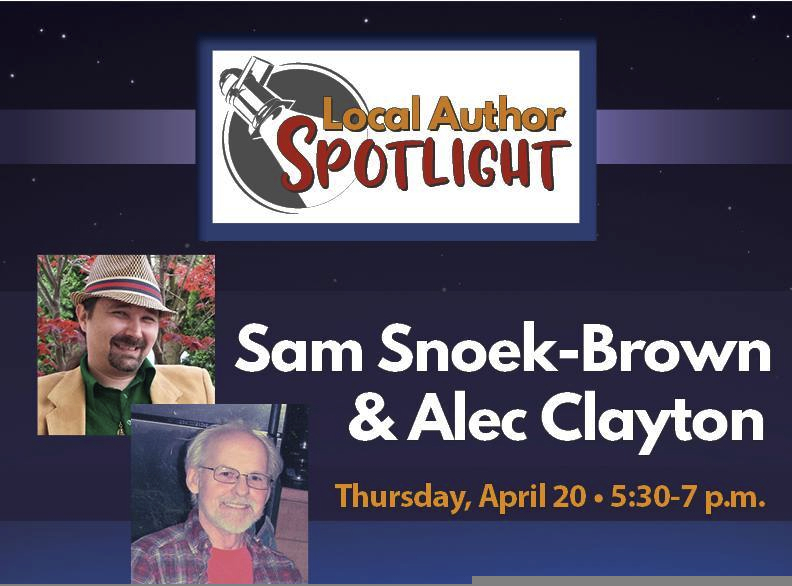
And then, a few weeks after that, I’ll be down in Lacey, WA, to join my friend Alec Clayton for the Local Author Spotlight at the Lacey Timberland Library. Alec is a fellow Southern transplant (he’s from Mississippi; I grew up in Texas), so we’re going to talk Southern fiction: you’ll not only get a chance not only to hear us read, but you can also ask us questions or — because we’re both Southerners and this is what we do — just sit around and shoot the breeze with us. We’re going to hang out from 5:30-7 pm, and I can promise that if you let us, we’ll talk your ears off in that time.
I’m looking forward to all these events, and here’s hoping I run into some of you in the next month or so!
For about a year now, I’ve been struggling to revise a novella of mine. It has an interested publisher, and that publisher sent me some fantastic notes for kinks to work out in the story, but as I began tugging on burls in the knots I’d tangled, I realized how much more story there was to tell. And because I’m not smart, I’ve also written myself into the mess of trying to connect all my fiction to all my other fiction — to try, at least with my realistic fiction, to let every character live in the same literary universe, to connect all my work through references to places or events — and this particular story is smack in the middle of a vast complex of fiction, all set in the Texas Hill Country I grew up in, with dozens of overlapping characters and events. Which meant that anything I revised or added to this book (and it is quickly becoming a small novel more than a novella) would have to jibe with everything else I’ve written about this place and these people, much of it published. So I needed some way to sort and arrange all the stories, all the people and places and events, in a way that I could see and manipulate everything at once.
I’ve written before about plotting my novels and working in timelines, but in the past, I’ve taped pages to long hallways or mounted notecards to magnetic boards or drew in crayon on butcher paper. Each method helped me sort the events and characters, but no one technique ever seemed to work in quite the ways I wanted. Or, rather, I always felt like I wanted to do all of it at once: The notecards never held enough information, so I wanted to arrange the passages and pages I’d already written in among the notecards; but the pages were never as moveable as the notecards, which made rearranging difficult. And I kept wanting to draw lines of connections — character relationships, event echoes, location references, overlapping timelines — but crayon can’t travel between pages and the few times I tried tacking colored yarn to all my notes, I wound up with an indecipherable mess that I could never rearrange. (How do all those detectives investigating serial killers do it on the tv shows?)
Molly Solverson is clearly much smarter than I am. (Seriously. I hope future seasons of Fargo revisit her, because she rocks.)
And then last November I completed NaNoWriMo and, among the prizes and discounts I “won” for finishing a bad draft of a novel, I discovered Aeon Timeline.
No, not this Aeon . . .. . . THIS Aeon.
While the software is actually quite a bit more complex than the way I’m about to explain it, it basically allows you to create and manipulate timelines on an infinite “bulletin board,” stretching as far or as deep as you need it to. And that alone makes it worthwhile for what I’m trying to do now: not only organize the timeline of the book I’m currently working on but also fitting it into the universal timeline I’m trying to adhere to.
In the image above, you’re seeing the beginning of the timeline for my novel(la), with events and dates aligned under the master event of the book’s narrative arc. On the righthand side, a window for the highlighted event, showing details like the narrative arc it belongs to and which characters are involved. In other tabs, I can add notes regarding the event and the times and dates during which it occurs, down to the minute.
And for me, this is where Aeon Timeline becomes so useful. As I’m using it right now, I can actually craft multiple timelines in a single file, attaching events to various “story arcs” (or, as I’m using them, whole stories) and then seeing how the events from one story line up with events from another.
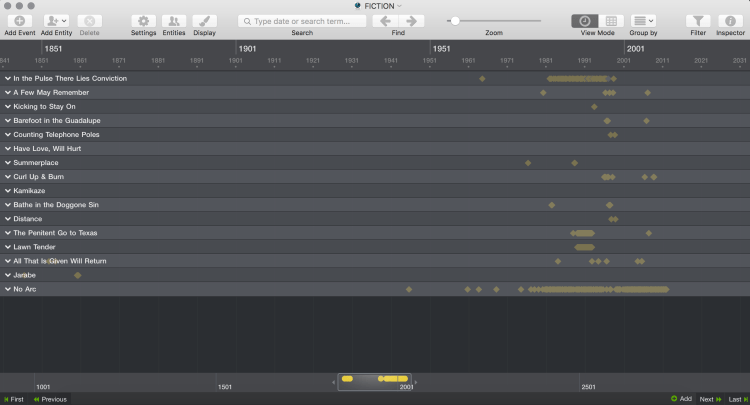
It doesn’t look like much when collapsed, but here are some of the plotted events in fifteen of my stories (more stories, events, and details are forthcoming), plus some general events not tied to any particular story.
This helps me know, for example, that around the same time that my book begins, a character named Ford Randall Kempe (from “Curl Up and Burn“) has just been arrested and convicted of statutory rape, an event my book’s characters would certainly have been aware of and so they comment on it. I’m also aware that their classmates include Mark and Keaton (from “Barefoot in the Guadalupe“), and Keaton also gets a reference. My protagonist, Kid, lives on the same street as a woman named Cecily (from “The Penitent Go to Texas“), though when she lived there, Kid was just a toddler; however, my new book does contain a reference to Jeremy, the street preacher from “Penitent.” And I’ve also discovered in this new revision of my book that one of the nameless background characters here is also the narrator in another story (“All That Is Given Will Return“), which helped me understand much better what that guy was doing in this book.
And so on.
Also, in a separate timeline of researched material, I can keep track of real-life events, like weather anomalies (a freak heatwave in February 1996, a windstorm and heavy rains in May 1997), the weekend of a local German-heritage celebration called Berges Fest, the beginning and end of the school year and the dates of holidays. I can also add notes and import images to event records, and if I tag events, I can filter according to those tags.
Here is a grouping of events filtered for the tag “Weather,” so I know when major events like floods and heat waves occur.
Here, I’ve expanded one of the events to show some of the details and an image I borrowed from a weather history archive (which I’ve also linked to in my notes for easy reference).
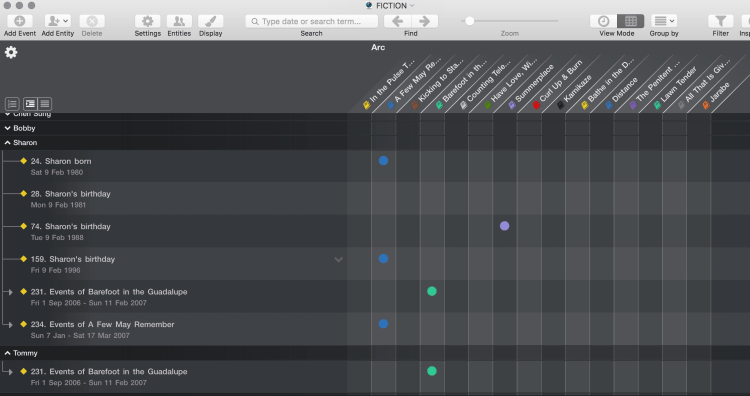
The program also allows me to fill out character profiles, complete with birthdays (so the software can automatically track their ages), and it can assign characters to events on the timeline. In this way, I can arrange my various notes not only according to the linear, multilayered timelines but also according to character or story arc, tracking where different characters or stories overlap in my larger universe.
The overlap of one character making appearances in multiple stories
Aeon isn’t a quick fix — it’s fairly easy to learn but it takes a long time to set up all the details (and I’m still discovering features I haven’t used yet), and at first I thought that, by itself, it wouldn’t accomplish all the things I want it to do. For example, I still want access to all those pages I’ve written — I want to see how the timelines align with the stuff I’ve already committed to the page. And I’d like to be able to arrange these events into some kind of narrative outline, helping me see not only the chronology but also the achronological plot structure. But this is where I discovered the feature that made me go ahead and invest in the program: it synchs with Scrivener!
Granted, I like to tell people that I’m not much for outlines, and I still struggle with feeling too constrained by them. But for longer projects, I find them necessary, and being able to tie my timelines to my outlines — to see both, side by side — proved crucial to this current book project, helping me see my book’s newly revised structure and sort out where — or rather, when — everything was happening.
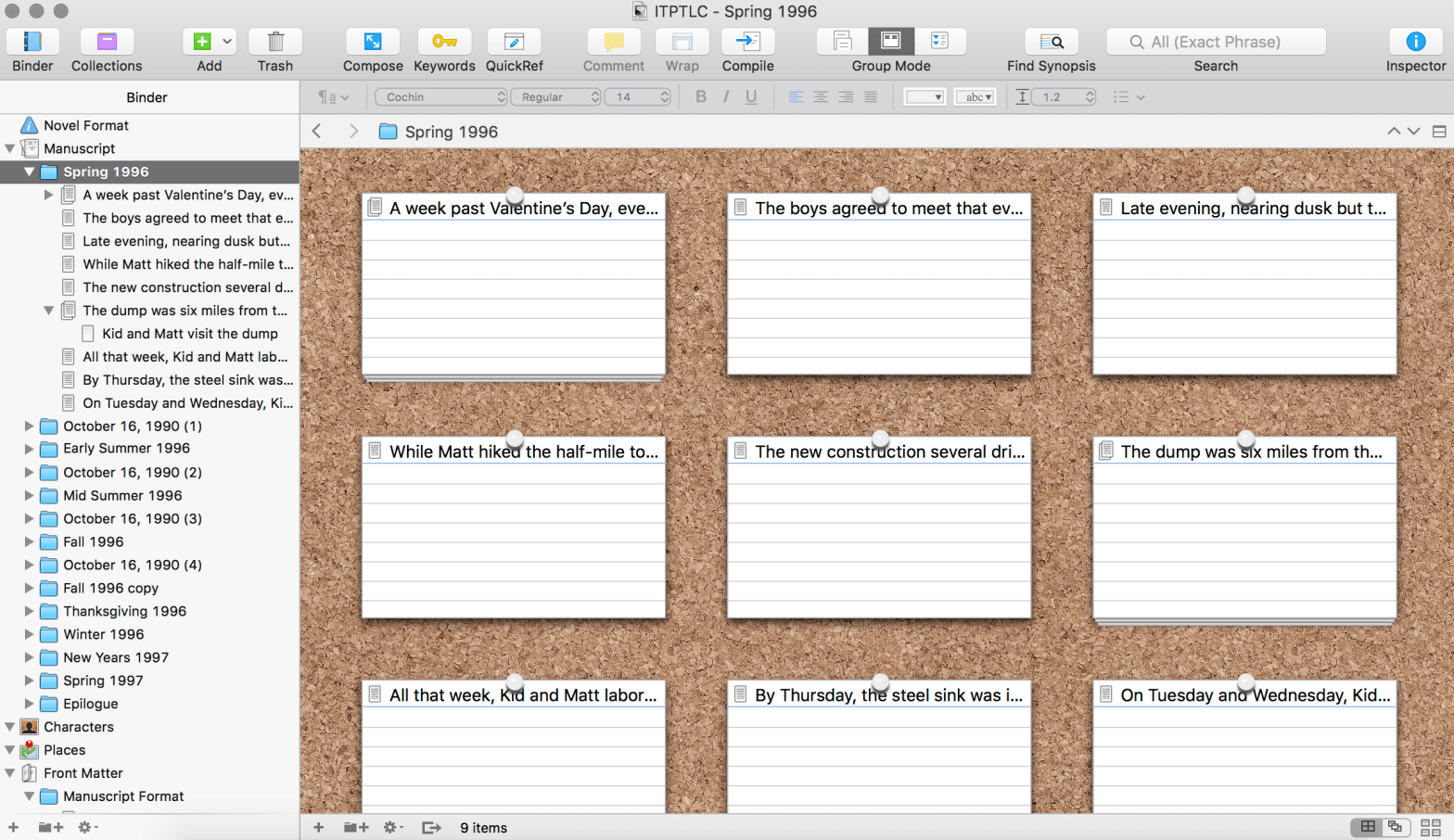
Here’s the outline of my novel as notecards on Scrivener’s “bulletin board”
And here is a page of the story in Scrivener.
And here’s that same outline, synched from Scrivener, open in Aeon.
This way, I get my complicated timeline, my notecards on a bulletin board, my pages of fiction — all of it, in two easily synched programs. And in Aeon, I can attach items from the timeline to the outline, or vice versa, and rearrange the outline as needed.
The main downside to Aeon isn’t even about Aeon — it’s about me and my own weakness for tinkering in the details. A friend’s son once coined the term (or, at least, we’re giving the kid credit for it) “procrasturbation,” and that’s a perfect word for my habit of falling down self-indulgent rabbit-holes of research and plot structure and geography. Aeon makes it far too easy for me to indulge in those habits, especially because it allows me to pretend I’m still writing. As my writer friend Ryan Werner told me the other day on Facebook, “That sounds like a lot of work! Might I suggest just winging it?” He’s right, and I do often “wing it,” especially in my flash fiction but also in scenes as I build these longer narratives.
But sometimes the only way I can wing it is to feel grounded in the reality I’m writing about. It’s like moving to a new town: you can’t just pop out to the store for a case of beer, because you don’t know where the store is or how you can get back. You need to spend some time driving around or sorting out the bus system, becoming familiar with your surroundings, and you should absolutely plan to get yourself lost, to wander down unknown roads and then find your way home again. That’s the best part of being in unfamiliar territory, in fiction as in life. But if what you need right now is a case of beer, and you don’t really have time for getting lost, and you have a smartphone, you use your nav app.
Aeon is the nav app for my fictional world.
I know that no one will ever care enough to work all these details out while they’re reading these stories or books. I am laboring purely for my own amusement. And I remember well — and take seriously — the advice I once heard from Louisiana writer Tim Gautreaux: explaining that he tries to avoid working gimmicks and clever references into his stories and novels, he said (and this is a paraphrase but it’s close enough to quote), “If you’re playing games in your fiction, you aren’t telling stories — you’re just playing games.”
But the truth is, I like the games. Doing this sort of work gives me the same mental pleasure that murder mysteries and detective stories give some people. And I feel reassured, looking at these timelines I work in, this universe I’m creating, that everything fits, everything works. Rather than distract me from the work of my writing, these “games” actually give me the confidence to carry on with my writing, assured that the story is sound and the people are where they are supposed to be, doing the things they’re supposed to be doing.
It’s a confidence we can’t always feel in the real world. So I like building it into my fictional world.
This coming Sunday evening, I’ll be at the Clinton Street Theater in Portland, OR, to close out the second annual Poe Show PDX* by reading Poe’s “The Raven.”
It’s a tremendous honor, closing out the show this way, and I’m humbled by it not only because it’s the finale but also because I love Poe so much.
When the organizers asked me to submit a bio ahead of this weekend’s show, I decided that instead of the standard intro (I write books; I’ve been published here, there, and elsewhere; I live with my wife and cats), I should give a little background about my relationship with Poe’s work. What follows is cribbed a bit from that other, briefer exploration:
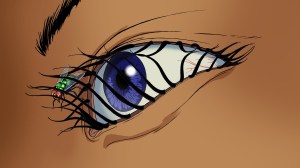
Back in middle school, when all of my adolescent friends were whispering cultishly in the library stacks over the latest Stephen King novel (I think at the time it was The Eyes of the Dragon and then The Dark Half; I was reading my dad’s copy of Misery, by which he’d been too disturbed to finish), I was reveling in the saturated lexicon and macabre lives of Poe stories. I remember being especially taken with “The Tell-Tale Heart”; that grotesque eye, glistening in the wedge of light cutting from the narrator’s lantern to his sleeping housemate’s face, was a constant fascination for me, and I loved to read the ending with my hand on my own chest, feeling the thud of my heart in beat with the final sentences of the story.
I probably wasn’t the only high school English student who read “The Pit and the Pendulum” and “The Cask of Amontillado” twice, but I probably was the only one to hit the library in my downtime and research the Spanish Inquisition and “amontillado” just to understand those stories’ contexts. I loved the richness of Poe’s descriptions, but I loved, too, his reliance on history and culture to flesh out his stories. Call me a research nerd (I do write historical novels, and I am married to a librarian), but filling in the background by learning what Poe had learned to write these stories — that was never a distraction for me. It was an invitation to a larger world, and it grounded Poe’s fantastical narratives in a real history, made the horrors feel more accessible and therefore more terrifying. I loved it.
I also spent a great deal of time in Poe’s biography. I don’t know how many of my fellow students knew much about Poe beyond his salacious death in a ditch. How many of my classmates had read about his troubled youth, his fraught stint in military school, his awkward relationships and his marriage to his cousin? How many had studied his literary theory and his reviews of Hawthorne (another early love of mine)? How many understood that Poe’s drunkenness and drug abuse were likely rumors derived from medical conditions and the newspaper rantings of vindictive rivals? How many were curious about the mysterious visitor to Poe’s grave in Baltimore each year? I suspect that even within my small-town Texas community, I wasn’t Poe’s biggest fan. But I was certainly a devoted student of his work and his life.
In grad school, working on my PhD, one of my proudest moments occurred at an impromptu house party where I drunkenly — but successfully — argued for the merits of “Annabelle Lee” as a serious poem. Later, I discovered Poe’s bizarre but brilliant book-length prose-poem, Eureka, and felt like my whole life of adoration had been justified.
In my adulthood, Poe had begun to feel like some literary fad, a passion everyone of a certain age went through and eventually grew out of. Like JD Salinger, Ayn Rand, Hunter S. Thompson, Raymond Carver, Charles Bukowski. It took me a long time to realize that you never truly grow out of your literary influences. You just learn what to do with them, how they influenced you, what was youthful or amateurish fascination and what was deeper, more profound, lasting.
Poe lasted for me. You can find his influence on my work in the grotesques and the horror elements of my novel, Hagridden. You can see my continuing love of and practice in the short story form — my ongoing pursuit of Poe’s “Unity of Effect” — in my short-fiction chapbooks Box Cutters and Where There Is Ruin. And many people have often pointed to my general fascination with language and rhythm in my prose.
So I owe a debt to master of the macabre, and I am looking forward to celebrating his life and work this coming weekend. If you’re in the Portland area, I hope you’ll head to the Clinton Street Theater and join us! And if not, then live vicariously by breaking out your own volume of Poe, lighting a few candles and pouring a cognac, and settling in for a story or poem.
* The annual Poe Show is usually scheduled to coincide with Poe’s birthday January 19, but this year’s intense winter weather in Portland forced the show to reschedule. Hence this March date.
I’ve been meaning to share all the books I’ve been buying/reading since the year began, but every time I think I’m ready to put together this post, I wind up buying more books to add to it.
I think I’ve hit my limit, though, or at least I’m ready to pause long enough to give these books the shoutout they deserve!
I’ll begin with graphic novels and comics: I recently reread Watchmen (a timely book), which put me in the mood for more comics, so I decided to finally try Brian K. Vaughan and Fiona Staples’s renowned series Saga. I borrowed all the currently available trade volumes (1-6) from my local library, and I fell so immediately in love with the series that, when my local comic book store participated in Image Comics Week, I picked up the whole series at a discount.
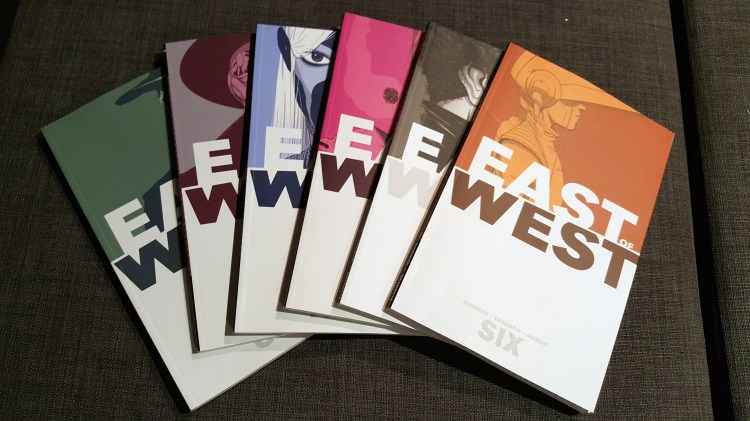
At the same sale, I also grabbed the first trade volume of Jonathan Hickman and Nick Dragotta’s East of West. I’d picked up the debut issue a few years back and liked it, but I never wound up following it in the monthly issues. So when I spotted the first trade on the sale table, I decided to give it another try. It, too, wound up being so compelling that I grabbed the next five volumes, too, and I’m glad I did, because this series is amazing.
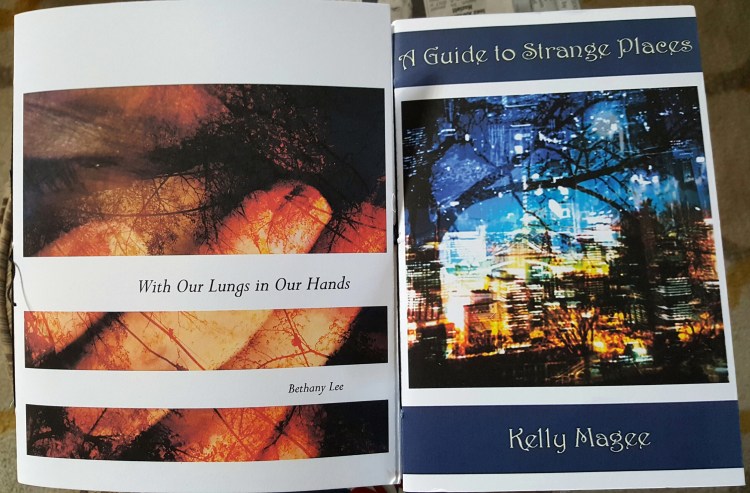
I’ve also been on a bit of a chapbook kick lately. It begin with a couple of Red Bird chapbooks, which I picked up along with new copies of my own Red Bird chapbook, Where There Is Ruin. But both of these new chaps are books I’ve been eager for, because one is a debut poetry collection by my grad school friend Bethany Lee (With Our Lungs in Our Hands); and the other is by author Kelly Magee (A Guide to Strange Places), whose fiction I’ve long admired.
I got #24 of Bethany’s run . . .
. . . and #22 of Kelly’s run.
Then there’s the chapbook I picked up at the Women’s March in Olympia, WA. There, one of the featured speakers was Washington poet (and “Her Majesty”) Lenée Reid, who gave a powerful and impassioned delivery of her poetry. After the march, I found a protest sign containing the text of Reid’s poem “One” (which ends “I am my temple our temple is we / Let us be at home as one”), and then I noticed that Reid herself was standing nearby, preparing to recite yet more poetry. I thanked her for her words and after she hugged me, she offered me a copy of Revolutionary Woo, which I happily accepted!
Lennée Reid reciting poems after the Women’s March in Olympia, WA
Lennée Reid’s chapbook Revolutionary Woo
You can see a video of her official address to the rally here:
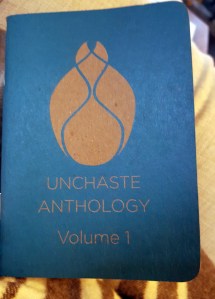
I also recently received my copy of the first-ever Unchaste Anthology, a collection of works by the women and gender-nonconforming writers and poets who have read in Portland’s famed Unchaste Readers series. I had contributed to the anthology’s Kickstarter campaign, because I love that reading series and I believe in the work it promotes, the voices it amplifies, and I was eager to help bring that work out into the world. And now I have this beautiful little collection!
Speaking of amazing, badass women: I also just grabbed a copy of Roxane Gay‘s new collection, Difficult Women. I’ve been a fan of Gay’s for ages, starting back when she was at [PANK] and my friend Ryan W. Bradley was publishing Gay’s debut book, Ayiti. I’ve geeked out over meeting her at AWP, I’ve devoured her commentary in newspapers and magazines, and I’ve been collecting the monthly issues of her run as a comic book writer with Marvel’s Black Panther: World of Wakanda. But about six weeks ago, I caught Gay on NPR discussing her new book, and I knew I had to pick up a copy. So when I spotted it at my local bookstore, King’s Books, I went ahead and bought it.
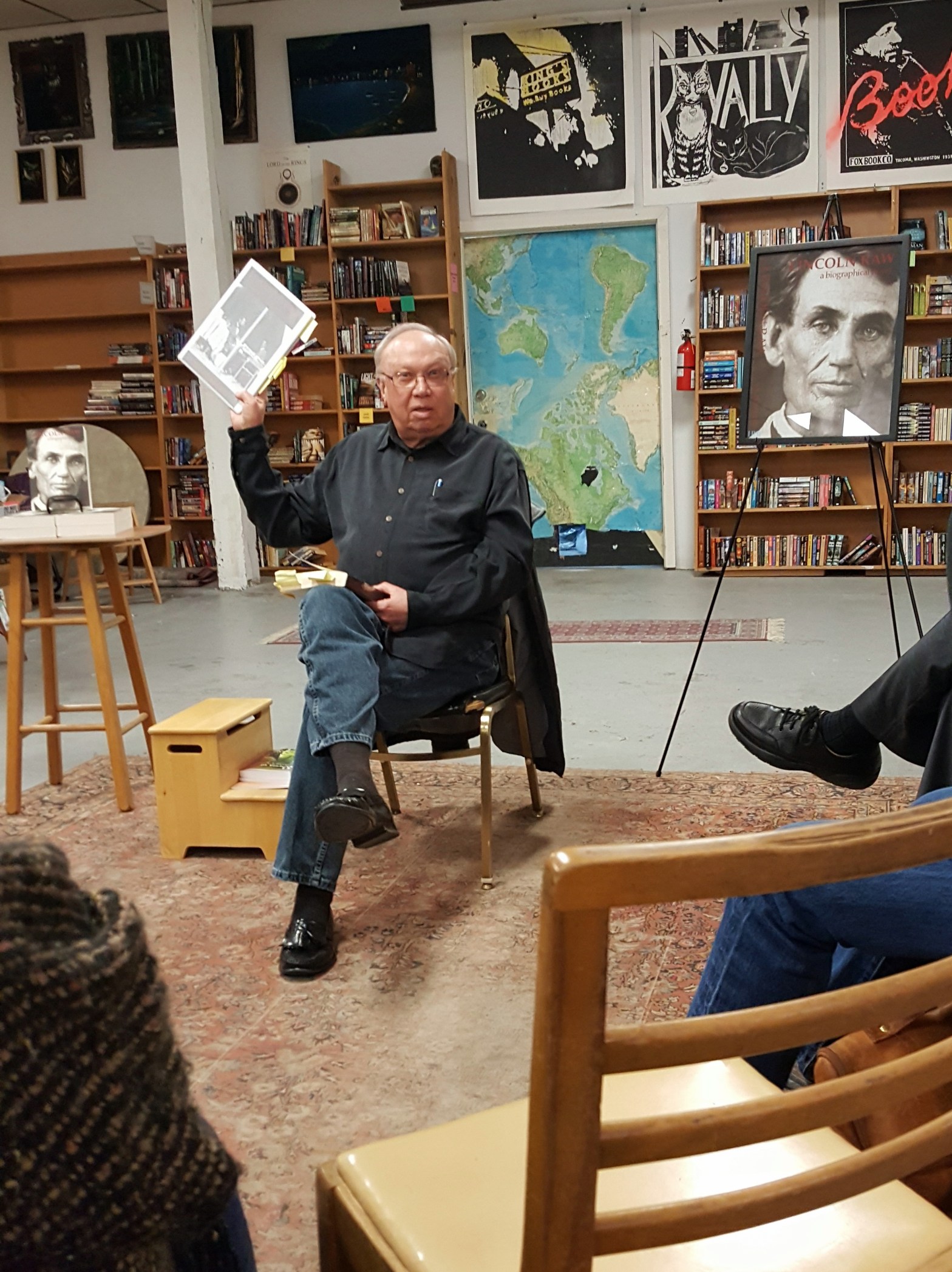
As I wrote the other day, I was at King’s Books for a talk and reading by local author DL Fowler, and while I already own his book Lincoln Raw, that night I picked up his earlier novel, Lincoln’s Diary. So add that to my deepening to-read stack, too.
But wait — there are MORE books by friends of mine!
Late last year, my mother-in-law was looking for ideas for Christmas gifts for me around the same time that my friend Matthew Burnside was announcing his forthcoming book-length fiction collection Postludes. I’ve been a HUGE fan of Matthew’s work for about four and a half years now, ever since his fable-cycle “For Kylie” appeared in an issue of Jersey Devil Press. Since then, I’ve read most of his online work, and I own three of his chapbooks — Book of If & Ever and Escapologies, both from Red Bird Chapbooks, and Infinity’s Jukebox, from Passenger Side Books. Still, I’ve been awaiting a book-length work from quite a while, so when my mother-in-law asked for suggestions, I tossed Postludes on the list even though it wouldn’t be out til after Christmas. Of course, I offered other options, too, and my wonderful mother-in-law obliged me in every case (I now have quite a stack of Texas historical research material to get through, too!), so I figured I’d pick up Matthew’s book later. But then Postludes turn up in my mailbox — my mother-in-law had gotten it for me, too! (Thanks again, Phyllis!)
Around the same time as Matthew’s book arrived in my mailbox, I was having coffee with Pacific Northwest author Kristin Noreen, who brought me a copy of her memoir On Silver Wings. It’s a harrowing tale — “She went for a bike ride, but woke up a week later on life support, her life forever altered” — but I’m here to tell you that it has a happy ending, because we enjoyed a lovely conversation over coffee last month.
And that’s my stack so far! Lots to get through soon, though of course I also have all the research books I have to get through, and the backlog of books from Wordstock last year I’m still getting around to, or all the books I already want to buy next (Jenny Forrester‘s Narrow River, Wide Sky is near the top of my list!).
What are you reading so far? No, wait, don’t tell me — I’m likely to buy those books, too, and I’m not sure I can afford any more! 😉
My late paternal grandfather was a deeply religious and compassionate man, had a tremendous and constant sense of humor, and stood six foot four and a quarter — the same faith, disposition, and height as Abraham Lincoln. Which is the reason I always felt an affinity for Lincoln: he reminded me of my Grandpa.
Lincoln was my gateway to studying the US Civil War, which eventually led me to write my first published novel, Hagridden. But in the meantime, I remained fascinated by the figure of Lincoln. His politics, his faith, his humor, his prose. To this day, I use the five acknowledged drafts of Lincoln’s Gettysburg Address to teach audience analysis, workshopping, and revision skills to my college students.
But I am just a casual dabbler in the mythology of Lincoln compared with author DL Fowler, who has written two novels about Lincoln — Lincoln’s Diary and Lincoln Raw — and is currently working on a third.
Last night, Fowler gave a talk and reading at Tacoma, Washington’s famed King’s Books, and the anecdotes he can rattle off from memory are astounding. For example, I knew that Lincoln had as a child been kicked in the head by a horse, but I never realized (or had forgotten) that this resulted in a drifting eye, making his love of reading (and that fact that he taught himself) all the more impressive. I also knew that Lincoln had had a long-standing adversarial relationship with Stephen Douglas, but I never knew until last night that Lincoln had once broken off his engagement with Mary Todd, after which the future First Lady began dating . . . Stephen Douglas! According to Fowler, this annoyed Lincoln enough that he renewed his relationship with Mary Todd, stealing her back from his political rival!
These are the kinds of stories that Fowler revels in. As he said last night, while a lot of Lincoln scholars tend to focus on Lincoln the President, or Lincoln the politician, or Lincoln the lawyer, or any other noun-label one could apply to Lincoln, Fowler has always been most interested in Lincoln the human being — the man rather than the American myth. (Fowler’s latest interest: Lincoln the poet. And he makes a compelling argument for the lost verse of America’s greatest president!
Fowler’s talk last night was fascinating, though of course, I expected such brilliance from Fowler — after hearing him read at a few of Tacoma’s Creative Colloquy readings and hearing his engaging interview on the Literally Tacoma podcast, I knew the man knows his Lincoln and knows how to write a story. Still, the thing about Fowler is that no matter how many times you hear him speak about Lincoln, you always wind up learning something new. Which is why I’m eagerly awaiting Fowler’s third Lincoln-related novel — as big a Lincoln fan as I am, I still have a lot to learn.
Over the past few years, I was involved with the amazing group of people who put together the annual Terroir Creative Writing Festival, hosted on the Yamhill campus of Chemeketa Community College. I’ve moved away from the area now and so haven’t been involved in this year’s planning, which means this year, I get to experience today’s announcement of their 2017 speaker list the way everyone else does: with excitement and joy!
They’ve put together a heck of a lineup, including novelists, memoirists, and poets as well as playwrights, journalists, literary agents — and, to my delight, a few of my friends:
Sean Davis, author of The Wax Bullet War and Post Commander at what might be the nation’s most exiting — and most literary — American Legion post (and he’s a personal hero of mine: in addition to being a decorated war vet and tremendous writer, he also ran for Mayor of Portland last year, fights forest fires each summer, combats homelessness every day . . .)
Lidia Yuknavitch, divine author of The Book of Joan, The Small Backs of Children, and The Chronology of Water, and the woman who gave that TED Talk about misfits that you probably shared a few dozen times with all your social media pals
Looks like an exciting festival this year, folks! If you’re anywhere near McMinnville, OR, keep an eye out for the registration forms, sign up, and enjoy all the genius and creativity and community!
I’ve been a fan of Forest Avenue Press practically from the beginning (they received an Oregon Literary Fellowship in publishing the year after I received mine for fiction), and one of the things I’ve always loved about the press, publisher Laura Stanfill, and their authors is how mutually supportive they all are of the larger literary community.
But if you’re not at AWP, you can still get involved by signing this pledge. And it’s an easy pledge to sign — you pledge to engage in seven literary-community actions, but I think every conscientious literary citizen is already doing all seven anyway (I certainly am). Here’s what you’re committing to:
To encourage my neighbor writers in the creation of art.
To attend local literary events, because gathering to discuss ideas and encourage creativity is an essential and radical act in these times.
To support my independent bookstore or, if I don’t have one, order direct from the publisher.
To foster a healthy small press and literary magazine climate by reading new work and submitting my own.
To introduce new friends to my core community, allowing us to grow louder and stronger together.
To credit writers and presses publicly for their ideas, photos, and efforts, and to be genuine with praise.
To celebrate every success in my community as a shared success. This is Main Street. Parades welcome.
You’re already doing all those things anyway, right?
But the pledge is just a beginning. The real purpose here is to start building and supporting our literary community in a whole range of ways:
In addition to the AWP launch, we’re circulating the pledge online, spotlighting writers who make a difference, sharing insights from small publishers and industry thought leaders, and offering Main Street Writers Movement classes in select cities. As we grow, we’ll roll out a website and toolkits for small presses to share with their authors. We also plan to establish a list of small presses and agents that support the movement, so writers submitting their work know they should mention their Main Street involvement in their query letters.
So sign up, tune in, and here’s hoping that, someday soon, I run into you at a literary reading (like the Creative Colloquy reading series in my own Tacoma, WA) or a local indie bookstore (like King’s Books in Tacoma)!
A handful of years ago, I was so taken with Hosho McCreesh’s poetry collection, For All These Wretched, Beautiful, & Insignificant Things So Uselessly & Carelessly Destroyed…, that I decided to write a story about one line from each of the poems. I eventually conceived a story cycle, each poem-inspired story set in the same ecological apocalypse, and I worked on that project during my writing retreat in 2013. I’m still working on it, still reworking stories to better fit the larger narrative.
But today, I’m proud to announce that the first finished story from that project has been published in the Timberline Review. My story, “Ashfall,” was inspired by the line “Lonely as a weeping trumpet,” from the first poem in McCreesh’s book.
I’m very grateful to the Timberline Review, especially editors Peter Field and Pam Wells, for this publication. The issue is beautiful (my story is immediately preceded by a powerful poem, “Halab (Aleppo),” by Tala Abu Rahmeh) and I’m honored to be counted among such fine writers.
A handful of days ago, author Meg Tuite put out a call on social media for writers and artists to participate in a video about how we should not just survive the coming year(s) but also fight back against political and artistic oppression under a new regime. The result is “Standing Together,” a video I am proud to have participated in.
Many thanks to Meg Tuite for organizing this video, to Ken Robidoux for editing it, and to Connotation Press for publishing it. Thanks, too, to all the beautiful, creative people who participated, many of them I’m proud to call friends:
Bethany W. Pope
Jordan Blum
Jack Cooper
Joanne Adams
Indigo Moor
Lidia Yuknavitch
Malacki Rodriguez
Meg Tuite
J. Bradley
Ravyn Stanfield
David Snow
Kari Nguyen
Ramon Lovato
Teisha Dawn Twomey
Len Kuntz
Robert Vaughan
Cynthia Lee Ameli
Paul Beckman
Laura Stride
Anne Elizabeth
Leif Miller
Sheldon Lee Compton
Kevin Ridgeway
April Bradley
Josephine Adams
Joani Reese
Vivian Faith Prescott
Matt Tuite
Cass McMain
Here are just a few of my favorite lines from the video:
If you know that you’re an artist and you know you have a chance to influence people, now is the time.
~ Indigo Moor
We need to love each other fiercely into the otherness.
~ Lidia Yuknavitch
Reach out, take a holy risk, and find your voice.
~ Gerri Ravyn Stanfield
This is the year of the rebels.
~ Teisha Dawn Twomey
No action is too small. We have to move on, fight on, and, now more than ever, kick complacency to the curb.


 This afternoon, I sojourned once again into Portland. My destination was the Another Read Through bookstore, where I gave a reading with some of my fellow writers in the current issue of The Timberline Review.
 It helped that Another Read Through and Reading Frenzy are both on Mississippi Ave. (yes, Portland is so replete with awesome little bookstores that they often inhabit the same streets); it also helped that Mississippi Ave. is in what used to be my neighborhood when I lived in Portland, so between Reading Frenzy and Another Read Through is Bridge City Comics, the place that used to be my local comic book shop, which I also stopped in at. Just yesterday, my new local comic book shop, Stargazer Comics in Tacoma, hosted a Women in Comics celebration, where I picked up the first trade volume of Pretty Deadly. (The writer, Kelly Sue DeConnick, is a Portlander herself — are you sensing a trend in all this?) Actually, I had originally picked up the first issue of Pretty Deadly, but thumbing through it in the store, I knew this magical-realism violent Western was right up my alley (and would fill a hole I’m currently feeling while awaiting the next trade volume of my other favorite quasi-Western East of West as well as the second trade volume of DeConnick’s other series, Bitch Planet), so I put down the single issue and grabbed the first trade volume instead. I was right about the series; I’m already hooked, so today I popped into my old Portland comic shop to find the second trade volume (which I’m about halfway through now).
 Of course, at Another Read Through, I had to snag another book or three, too. It started when I arrived early to the store and spied on the shelf a copy of a book I’d read way back in my undergrad New Testament course, for an essay I was writing on the historical Christ: Marcus Borg’s controversial but seminal Meeting Jesus Again for the First Time. Then poet Devon Balwit, who also read at this afternoon’s event, announced that she had copies of her latest chapbook on hand, so I grabbed How the Blessed Travel. And then, browsing the back issues of Timberline Review, I discovered an essay by my friend Kate Ristau, so I wound up leaving the bookshop with not only my own current issue but also the first issue of Timberline Review.















 Last night,




 Samuel Snoek-Brown