Todd McNamee releases “Drifting”

1011697_572367239461397_1674800218_n

“I’m a bastard.”

Could you ask for a better opening line?

But the narrator in Todd McNamee’s debut novel, Drifting, isn’t speaking figuratively or self-depracatingly: he means this literally.

“My name is Patrick Mulligan and I was raised an only child in Portland, Oregon, by a mother who loved me,” the narrator continues. “My father’s name is Ray and I’ve never met him.”

When I was twelve a letter arrived from my half-sister, Mary. I had only met her once before when I was six years old and was in the middle of a cross country trip with my mom. [. . .] By the time I was twelve I had a lot of questions about Mary. I knew that Mary was also raised without our father, and that he had been married to Mary’s mom long before I was born. There were many questions that I wanted to ask my mother and Mary about Ray, but my mom always shifted, paced, and rolled her eyes whenever the subject of Ray came up and I gave up trying to learn anything from her.

But soon, the narrator begins to learn bits and pieces about this mysterious other family out there, until finally he forces his mother to confess:

Mom pulled over to the side of the road, lowered her head and placed her right hand on her brow as if to wipe away sweat. “When I met your father,” she said, “he told me he’d never been married before. After we were married, he told me he’d been married several times before. Tonya is another sister of yours. Like Mary is.” At that she started the car and we drove to the store and never spoke of it again. [. . .] But I continued wondering about it for years, thinking about whether or not I should call Mary up and ask her if she knew anything about our other family members. I never got up the nerve. But the questioning started then. I could imagine a whole brood of family members meeting each other for the first time. But mom had trained me very well. She’d trained me to be just as tough and emotionless as she was. I’d learned early on not to trust my feelings or give in to them.

Many years later, at the age of thirty-three, my half-brother, Dan, whom I had never heard of before, called me on the phone and soon many of the questions I had would be answered.

So begins McNamee’s novel,  a twisted saga of a family dispersed across the world but connected by their relationship to one mysterious man, a father that none of them had ever known. Eventually, all these scattered offspring decide to meet in a huge family reunion, and when they do, according to the novel’s write-up, “they discover they have more in common than just a sense of being abandoned. While aboard a ship heading through the Hawaiian Islands they share stories, drink to excess, and build a connection they never had before.”

There’s something classically Portland about this novel, not quite the same as a Chuck Palahniuk or a Monica Drake but certainly in their emotional wheelhouse, and it promises to be both a fun and a serious ride, one I trust the author to navigate with us expertly. (I know Todd from my local Buddhist sangha; he and I took refuge together a couple of years ago.)

I haven’t read the whole novel yet but I’m eagerly awaiting it, and I hope you’ll grab a copy, too. [UPDATE: Now available on Kindle, too!] If you beat me to it, tell me how it is. Otherwise, look for a review here in the near future. And Todd? Congrats, my friend.

North Texas writers

I tout the books of friends and writers I admire here on the blog from time to time, but as good fortune would have it, lately I’ve been getting a lot of news about books from former classmates!

I did my doctorate in English at the University of North Texas, where I had the tremendous good fortune to work with some profoundly talented people. And even though my specialization was fiction writing, one thing I loved about UNT’s program was its insistence on diversity, so I got to sit in classes with a lot of poets and essayists, some of whom became good friends.

This past month, one of those poets, Natalie Giarratano, published her first book, Leaving Clean. That in itself is a huge deal, but even more impressive is that her book won the 2013 Liam Rector First Book Prize in Poetry. It’s already getting rave reviews, and I’m not surprised at all — one reason I gravitated toward the poets I did was because of their talent (I’m in awe of good poetry), and Natalie was one of the best and most serious of the bunch. There’s something so subversive about her ability to make a deeply moving piece of political poetry look at first like a beautiful painting. And she has an almost surgical ability to pinpoint emotional threads and pluck them. She’s a true artist.

But she’s not alone. This week, one of our fellow classmates, the delightful David Shattuck, opens up the pre-ordering for his first book of poetry, Invisible Cities. David was always one of my favorite guys to hang around in grad school — great for drinking beer and cracking inappropriate jokes with in the bar, but equally great for having quiet, serious conversations about love and God and philosophy outside of class in the warm night air. And his poetry always reflected that combination, surprising people with its intellectual resonance — his was always poetry I wanted to read three times in a row, and still I always felt there was something rich lying just under the surface that I needed to get to. And yet it never felt pretentious: David has this wonderful honesty about him that is an essential part of his poetry, and I can’t wait to read his book.

Of course, I went to school to fiction writers, too. In addition to Darin Bradley (who just announced in an interview last week that his brilliant first novel Noise is expanding into a loose thematic trilogy) and the horror writer Eric Grizzle (who is widely anthologized and needs to come out with a full-blown book in a hurry, because I love his stuff), I also briefly overlapped with the novelist Danny M. Hoey, Jr. I’m sad to say I never sat in a class with the guy, but we shook hands over drinks at readings on campus while I was finishing my dissertation and I’ve gotten to know him a little since then. His first novel, The Butterfly Lady, is making waves already, winning the Winter 2013 ForeWard Firsts award and landing Hoey an interview with Lambda Literary.

And there were scholars, too. Granted, the creative writers rarely crossed paths with the literature scholars outside of classes, but I ran into a few, like Darin Bradley and, briefly, David Gillota. Fortunately, David and I met up again in Wisconsin, where he and his wife Amanda Tucker were both teaching in the same English department I was. (Small world!) At the time, he was working on a scholarly book about ethnic humor, initially in American fiction but, at the time, he was rapidly expanding the study into other areas of popular culture. The result is his first book, Ethnic Humor in Multiethnic America, by all accounts both a witty and a wryly brilliant look at American culture, American humor, and issues of race and identity in pop culture from comedy sketch shows to children’s animation to novels. . . . It’s such an effective first book of scholarship that it’s already got a plug in the Chronicle of Higher Education.

And these were just the people I was lucky enough to meet in my days on campus. Since then I’ve found online Gwendolyn Edward, who is a current grad student at UNT whose work has appeared in Jersey Devil Press and who runs her own magazine, Deimos eZine. And there’s Matthew Burnside, whom I also met online when JDP published him and has since become one of my favorite writers. (Matthew has a new chapbook out, too: Infinity’s Jukebox, out now from Passenger Side Books.)

And there are the people I loved working with from whom I keep waiting to see books: the poets Brianna Pike and Michael Levan; the fiction writers Andrew Mortazavi and Amos Magliocco; the essayist Kristen Keckler; the scholars Laura Thomason and Rima Abunasser. . . .

Seriously, publishers, if you’re looking for great books to put out there in the universe, start with the alumni from UNT’s graduate programs in English. If only to fill my bookshelves.

Unshod Quills One-Hit Wonders and reading in Portland

uqreading posterI am so, so fortunate to be part of so many little circles of writing communities — authors, poets, editors, publishers, public readers, Portlanders…. And when two of those circles overlap in a kind if literary Venn diagram, the fun doesn’t get smaller, it gets more concentrated. So you can imagine the degree of Awesome that got unleashed this past Tuesday, when my Unshod Quills cohorts joined forces with Dog on a Chain Press to celebrate not only the publication of Dena Rash Guzman‘s phenom of a first book but also the arrival in Portland of Ryan Werner and Justin Lawrence Daugherty, who rolled into town on their rock-n-roll chapbook tour for Passenger Side Books AND were joined onstage by Future Tense Books‘s Kevin Sampsell.

Let me just put this into perspective, folks: Dena’s book, which was officially releasing at our reading, had already spent a week in the top-five bestsellers at Powell’s Books, including a sell-out day where she reached #2, and at the reading itself, St. John’s Booksellers had a near-constant line at their table of Dena’s books while Passenger Side Books sold copies of their work out of the trunk of their car like true rock-n-rollers and everyone else swapped copies of zines and chapbooks. Onstage, our not-so-little gathering in the Crush bar accounted for writers and editors from at least a half-dozen magazines and small presses and represented at least five different states from the East Coast to the West Coast. And the readings we gave ranged from the serious to the comic to the salacious, from fairly straightforward prose to wild performance poetry, including, for several epic minutes, a pole dance — Ryan Werner donned American-flag spandex pants and heavy motorcycle boots (and not much else!) and writhed and posed onstage as an interpretive accompaniment to Kevin Sampsell’s poem “Rock Criticism.”

You just don’t get any cooler than that.

Stuffed on bar food and exhausted from the fun, my wife and I headed home around 11, but I heard later from those who stayed, some at late as 2 am, and while I don’t have details, I can tell you that at one point, apparently, chicken feathers were involved.

Here: just so you believe me, I’m going to share a few photos, mostly stolen from Dena’s cell phone (thanks, Dena!). The lighting was crazy and for some reason Dena managed to only take photos in the red filter, though Mark Russell (author of the newly released God Is Disappointed in You) managed to get one shot with different shades of color (I stole his photo, too — thanks, Mark!).

And for the photos of Ryan Werner and Kevin Sampsell: You’re welcome.

This slideshow requires JavaScript.

How to handle rejection from a literary agent

  1. English: ice cream cone in the street

    Sit quietly and sip coffee all morning long. Resist the urge to switch from coffee to hard liquor. At least until after lunch.

  2. Forget breakfast. You’re wallowing, after all. Absentmindedly nibble banana chips just to say you ate something.
  3. Eventually, let your loved ones express outrage on your behalf. Secretly feel both validated and vindicated, but outwardly, just sigh and shrug.
  4. Send a kind note to the agent thanking them for their time, because, after all, they did give it careful consideration, and it was a well crafted rejection note, and if they didn’t love the book, they wouldn’t have been right to represent it anyway.
  5. Nevertheless, wallow some more. Develop a massive headache. Lie down for a few minutes and wind up taking a nap.
  6. Eventually, eat lunch, but only because your loved ones make you and because it might help your headache. Think about drinking, but fill a glass with water instead. It is just 2 pm, after all.
  7. Make some vague comment about the rejection online. Then play video games. The more mindless, the better.
  8. Go outside. Preferably into sunshine. Eat ice cream. Get the waffle cone — you deserve it.
  9. Let your loved ones usher you into a serious conversation about what to do next. Noncommittally begin to develop a plan: revise? resubmit? Maybe the former, eventually the latter.
  10. Because you can’t put them off any longer, start acknowledging the consolation messages your friends send you online. Yes, it’s just one rejection. Yes, there are plenty of other agents out there. Yes, it really is a good story, and it’ll happen sooner or later.
  11. As your head clears (ice cream is great for headaches), start getting determined. Realize that your loved ones and your friends are right. It is a good story. Start looking at new agents. Hell, start looking at every big-name agent you can find. So what if they reject you? You can handle it.
  12. Shoot for the moon.
  13. Feel better about yourself. Feel better about your work. Feel GREAT about your work.
  14. And now you can start drinking.

Even the Jersey Devil worships the Great Old Ones

Lovecraft coverWhen I was in high school, I was a huge horror fan. I plowed through Stephen King, devoured Clive Barker, dabbled in Dean Koontz. When I discovered that Poe — which we were supposed to read for school and was therefore supposed to be boring — was actually a killer horror writer, I plunged into older works. Nathaniel Hawthorne’s Scarlet Letter might have been some ponderous love story with a miserable ending, but wow, was “Young Goodman Brown” a spooky story of Satan worship! Washington Irving’s “The Legend of Sleepy Hollow” is way creepier than Disney lets on. And some Brit who briefly lived in Canada wrote a wickedly terrifying story about a North American legend I’d never even heard of before (seriously, you need to read Algernon Blackwood’s “The Wendigo”).

And then I found H.P. Lovecraft.

The first story I read was “The Outsider,” and for my angsty teenage self, it was a revelation. I hurried through “The Rats in the Walls,” “The Unnameable,” “The Colour Out of Space,” “The Thing on the Doorstep,” “The Dunwich Horror” . . . . And “The Call of Cthulhu.”

On and on. Late into the deepest hours of the night.

I read every story two or three times just in my few years of high school. I talked about him with some of my friends, but I mostly kept him to myself, hoarding him, as though I’d make some rare discovery, unearthed this genius no one else knew about, and had to keep him a secret lest the world at large ruin him with their failure to understand him the way I understood him.

Thank god I’m not a teenager anymore.

Still, I keep coming back to Lovecraft. His dense, filigreed prose; his murky, complex mythos; his brooding perspective on the depravity of human beings — our lusts, our fears. . . . I love that man.

So it was with giddy enthusiasm that I joined the other editors in the idea of running a special Lovecraft-themed issue of Jersey Devil Press. And that issue has finally arisen from the deep.

Of course, when we do Lovecraft, we do it Jersey Devil-style. Drug-infused Gonzo journalism meets satanic cults. The Necronomicon gets turned into home-improvement television. “The Cats of Ulthar” now include Puss-in-Boots. And Cthulhu becomes a chicken.

But fear not: not all is wacky (though very reverent) twists on our beloved author’s genre. We made sure to end with true horror and unnatural births. (If you’re reading late at night, I wouldn’t save “The Watchers in the Dark” for last.) Plus, there is the deliciously eerie cover art by returning artist Justin McElroy (whose work you can find here and here. Behold it and squirm.

So chant on, worshipers! Call forth the latest issue of Jersey Devil Press, and embrace the madness!

How to order The Disordered

Sunnyoutside Press is doing book trailers now. Their first is for the poetry collection The Disordered, by Anhvu Buchanan. The book comes out next week, but you can get on the preorders here: http://sunnyoutside.com/releases/066/o.html

Why share this with you? Two reasons:

  1. Sunnyoutside has a hell of a reputation with poetry, and they put out some of my favorite poetry collections around right now. And
  2. Sunnyoutside is the press that’s publishing my own first chapbook of fiction. (No release date on that yet, but stay tuned).

Besides, I’m kind of a fan of the whole book trailer idea. A lot of them wind up looking silly, I agree, but a lot of them look pretty cool, too, and why shouldn’t we get the same kinds of promos as movies and music? (I wonder when I’ll get to start selling tie-in merchandise for my fiction?)

Anyway, here’s the cool trailer for Anhvu Buchanan’s The Disordered, available soon from Sunnyoutside Press.

More books to read this summer

I might have a lot of books
I might have a lot of books (Photo credit: litlnemo)

Back at the end of May, I posted a list of new books out or soon to come as a kind of summer reading list. But there’s plenty more where that came from. Just today I realized I was entering that delicious part of summer where I am physically stacking up on my nightstand the books I plan to read over the next few months. (Current book: Wildwood, by Decemberists frontman Colin Meloy; beneath that book, Suzanne Collins’s Catching Fire and Alexis Smith’s much-lauded Glaciers.)

Other books in my queue: Charity Seraphina Fields’s Battle Against Infinity, some local history books and nature books about Portland and the surrounding area, and, because I’m crazy, maybe it’s time I begin the Song of Ice and Fire series. (That’s a big maybe, because summer is short.) Also, some manuscripts some writer friends have sent me!


The other day, I spotted an article on Flavorwire about “The 50 Books Everyone Needs to Read, 1963-2013.” One of the most interesting things about the post is that it’s not a “greatest 50 books ever” list — instead, they pick just one book per year for each of the last 50 years. Of course, there’s a lot to argue about in such a list (Margaret Atwood’s 1985 novel The Handmaid’s Tale is a classic, sure, but is it really better than Cormac McCarthy’s Blood Meridian from the same year? No, it is not). But kudos to the compilers for including other notables from each year, so those of us who would pick Cormac McCarthy every year he wrote a book still have options. And there’s plenty to agree with on the list, too, most notably the 2012 selection of Chris Ware’s genius Building Stories (which I’m teaching in the fall at Pacific Northwest College of Art as part of my course of the story cycle). Also a great addition to the list: the inclusion of my fellow Oregonian Cheryl Strayed and her Oregon Book Award Reader’s Choice-winning memoir Wild.


Also this week on Flavorwire, small-press superhero Matt Bell lists his favorite novels with “strange families,” in honor of Bell’s own strange-family novel In the House upon the Dirt between the Lake and the Woods. It’s a great list, full of lesser-known gems — kudos to Bell for not diving down the rabbit hole of literatures great “strange families” and sticking to newer, smaller works. I mean, hell, for a list as short as eight, you couldn’t even include all of Faulkner (the Snopeses? the Bundrens?  the Compsons? And those are just the biggies!).

The two “big names” on Bell’s list are CS Lewis’s Narnia kids and the father-son duo in McCarthy’s The Road, both of which are a smart additions: With the Narnia kids, Bell notes Lewis’s distinctive take on the “kid protagonists have to be orphans” trope (if you didn’t know already, the kids get sent to the countryside and consequently into the wardrobe, where they meet the titular Lion and Witch, as evacuees from London during WWII). “Susan leaves the story by a different method than the other Pevensie children,” Bell notes toward the end, “‘orphaned’ already once by her parents for being too young to stay in London during the war, and then again, by her siblings, for being too grown up to stay in Narnia.” That’s some smart reading!

As for The Road, Bell is highlighting what might be the greatest novel ever written about the father-son relationship, even if it is set in the worst situation imaginable. “Is there anything more heartbreaking than a father who would do anything for his child, in a world where nothing will ever be sufficient?” Bell asks. If there is, I’m pretty sure I don’t want to read it. Yet, for me, the book is profoundly uplifting — at least by McCarthy’s standards — because of that relationship. When I was tutoring a high schooler in this novel last year, the kid flat fell in love with the book (and with Cormac McCarthy in general), and the thing he kept coming back to wasn’t the violence or the grim prophecy or the debauchery or the destitution or the hopelessness. The thing this kid loved the most about the book was how important it was for the father and the son to keep carrying the fire. (For a beautiful account of a father reading this novel while his infant son slept on his chest, see my friend Michael Levan’s blog post from a few years ago.)

This all got me thinking about how I treat family in my own work, whether it’s the saga of a deported immigrant mother and her confused, Anglicized son (seen here, here, and in the forthcoming “Have Love, Will Hurt”), or the widowed young girl and her mother-in-law trying desperately to survive in the Louisiana bayou 150 years ago (seen here and here), or the married couple who struggle with lost children and lost loves (seen here and here), or the mother trying to explain war to her young son in the conspicuous absence of his soldier father (seen here).

I don’t have any critique to offer about my own work. I’ll leave that to the readers. But I realize how often I do write about family. I try in my fiction to wrestle with the idea of home — specifically with that weird conflict of feeling tied to a place and wanting to leave it at the same time — but it makes sense that this focus would lend itself pretty readily to family as a placeholder for home (or vice-versa), and I’m curious now what I might make of all that in retrospect.


Finally, I mentioned in my last “summer reading” post that my friend Dena Rash Guzman would be publishing her first book of poetry soon. Well, it’s out now and available for order. Check out the post at her publisher’s site, where you’ll also see information about a release party and reading in Portland. Bonus news: I’ll be reading there, too, gang, as will Passenger Side Books authors Ryan Werner and Justin Lawrence Daughterty, who are driving over band-in-a-van style on their own book tour. We’ll all be joining a gaggle of other rad authors, poets, and creative weirdos for quick and brilliant little bursts of performance. If you’re in the Portland area July 9, drop me a line and I’ll feed you the details.

This week in reading and writing on the Interwebs

I’ve been reading a ton of little articles and blog posts about writing the past couple of weeks, to the point that my browser was getting sluggish from all the tabs I had open because I wanted to revisit articles. Not all of them are recent, and only a handful were ultimately of any use. But there were some great ideas, and I thought I’d compile them into a little post of links here:


“Want to Learn How to Think? Read Fiction,” Tom Jacobs

Are you uncomfortable with ambiguity? It’s a common condition, but a highly problematic one. The compulsion to quell that unease can inspire snap judgments, rigid thinking, and bad decision-making. Fortunately, new research suggests a simple antidote for this affliction: Read more literary fiction.

I am such a sucker for brain science, especially when it overlaps with studies about reading. Of course, in many cases, what we wind up with is just science discovering or more scientifically explaining what we writers and readers have known all along. But we all know how writers crave validation.

In this case, the “comfort with ambiguity” thing is deeply positive — the idea is that being comfortable with ambiguity is a part of developing better critical thinking and greater compassion. (What these scientists call “comfort with ambiguity,” I’m pretty sure Buddhists like me would call “equanimity.”)

The way it works is this:

“The thinking a person engages in while reading fiction does not necessarily lead him or her to a decision,” [the researchers] note. This, they observe, decreases the reader’s need to come to a definitive conclusion. “Furthermore,” they add, “while reading, the reader can simulate the thinking styles even of people he or she might personally dislike. One can think along and even feel along with Humbert Humbert in Lolita, no matter how offensive one finds this character. This double release — of thinking through events without concerns for urgency and permanence, and thinking in ways that are different than one’s own — may produce effects of opening the mind.”

But you should read the whole article, because it’s fascinating stuff.


“30 Things to Tell a Book Snob,” Matt Haig

You know, the snobbery that says opera and lacrosse and Pinot Noir and jazz fusion and quails’ eggs and literary fiction are for certain types of people and them alone? There is something innately snobby about the world of books.

I wish Matt Haig had gone into more detail about the specifics of the “snobbery” he derides. I agree wholeheartedly that exclusivity in literature — or pretty much anything else — is a dangerous idea. But I have this feeling from his list that he’s being a bit snobbish about the snobs, as though people who like Pinot Noir and jazz fusion are snobs not for their exclusivity but for their taste in the first place. I mean, the very first item on his list is “People should never be made to feel bad about what they are reading,” yet the set-up of this piece seems to ridicule people who prefer “Martin Amis over Stephen King,” as though anyone who dislikes King (or likes Amis) is an idiot. I don’t think that’s what Haig is actually saying, but the brevity of the presentation does leave that door open, I think.

Full disclosure: I have been accused of being a literary snob, and I have sometimes embraced the term. But I don’t eat quail eggs, and I both deride and celebrate Amis and King in equal measure. And while some of the items on Haig’s list are reductive, empty platitudes, there’s a lot on here to like as well, and some items that might get you thinking about your own habits and tastes. And the penultimate note is well worth repeating: “For me, personally, the point of writing is to connect me to this world, to my fellow humans. We are all miles apart. We have no real means of connecting except via language. And the deepest form of language is storytelling.”


“Captions in the Classroom,” Cody Walker

For me, the most interesting part of the essay was Cody’s use of the Caption Contest in his writing courses. Cody’s winning caption is an excellent example of not only a good joke but also a good sentence.

I’m a long-time New Yorker subscriber, and when they first rolled out the caption contest, I was a huge fan. But I thought it was a temporary gimmick, and as the years wore on, I became less enamored of it. (For one thing, a lot of the winning captions wind up being the simplest or the lowest of the options, but then the purpose of a democratic contest is to achieve the widest possible appeal, merit be damned.)

This article, though, renewed my interest in the contest something fierce! I love writing from prompts, and I love bringing those sorts of exercises into the classroom. I also love teaching students that almost all writing can boil down to the joke structure — if they know how to tell a joke, they know how to write an essay or a story or a poem or even a business letter…. So I’d often toyed with using these captionless cartoons in the writing classroom.

Walker beat me to it, and he did so in ways I hadn’t even considered yet! He manages to use a single exercise to teach micronarrative, sentence structure, metaphor, pace and rhythm, and maybe half a dozen other crucial writing skills. All from a cartoon.

I am absolutely adapting this to my classroom next fall. This is just genius.


“Bracketology for Story Plotting?” Ken Hughes

A tournament’s system is about matching opponents together and tracking how that changes.  It’s one of the simplest, purest methods there is for managing the intricacies of a plot, while staying focused on what makes it powerful.

I love playing games in writing. I especially love charts, maps, and lists in the writing process — I love Vonnegut’s “crayon outline” in Slaughterhouse-Five, I love JK Rowling’s hand-drawn spreadsheet of her characters and plot points in the Harry Potter saga, and I love this idea of using tournament brackets as a means of plotting fiction.

Two particularly cool bits: the way Hughes expands or modifies the bracket system to better serve storytelling, and the way he explains working your way backward through the bracket to build a backstory fraught with conflict.
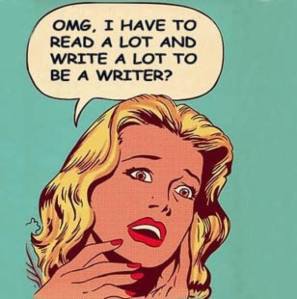

942023_10151640217424573_1362657776_nA Facebook conversation with J. Chris Lawrence you don’t get to see unless we’re friends on Facebook

Stephen King says (I’m paraphrasing) that if you don’t have time to read, you don’t have time to write. What do you guys think? Do you have to be an avid reader to be a successful writer?

This is why you need to engage with your writing community, folks: the conversations we have are fascinating. Okay, maybe “exhausting” is a better term, but I like mental fatigue the way runners like the burn of a long run.

So, the other day, a writer friend named J. Chris Lawrence posted this photo on his Facebook page along with the blockquoted comment above. And what I loved about the resulting conversation was the wide diversity of opinions. I mean, you’d think every writer on earth would be a voracious reader, if only out of solidarity or karma-bargaining. As one commenter put it, “How can you ask others to spend money and time to do what you aren’t willing to do yourself? It seems like the height of hypocrisy and narcissism.” But this was in reply to another person in the conversation who was adamantly anti-reading, and this other person made some passionate arguments against reading (or at least, needing to read): “Overall, I find writing to be a wholly unique and individual process,” this person wrote. “My process is mine and mine alone.” And later: “The first person to ever write anything great must have only had crap to read. Every writer has to find their own voice.”

Of course, this launched us all down a fun sidetrack about what the earliest written art was and what its influences were — what did the Sumerians read other than agricultural accounts or judicial rulings? Are Gilgamesh and Genesis miraculously original stories spawned of pure creativity, or are they imaginative embellishments of the everyday stories people were already telling about real events?

It only got more complicated from there. And I loved every line of it.

Oh, and if you want to know where I weighed in on the “to read or not to read” question, just read my earlier blog post on this subject, which is how I answered the question in the Facebook discussion, too.

Jersey Devil Pressed until the blood squeezed out

the birds 2It’s that time again, folks: Jersey Devil Press‘s new issue is out and in your face. And just in case you were getting comfortable with the level of awesomeness our writers bring to us, we’ve got a few surprises in store for you. In addition to the requisite killer turkeys and absurdist superheroes and drunk Brits discussing bread vans with their heads in a fish tank (seriously, we have a story about that), we also have a poignant view of PTSD, a clever commentary on nuclear war, and our first-ever poem.

That’s right. A poem. (Stay tuned this summer, gang — we’ve got more where that came from!)

And in what is a particularly eerie case of soothsaying, we’ve wound up publishing a story about pervasive government overreach and drone warfare in America even though we had no idea when we accepted it how àpropos a story like that would be this month.

(Or, maybe we did know. We editors are wizards, after all.)

Anyway, enjoy the June issue of Jersey Devil Press! And then wipe your hard drive before Big Brother finds out what you’ve been reading….

Oregon Literary Fellowship recipients in a chapbook

Screen shot 2013-06-04 at 1.36.53 PMLiterary Arts and the excellent Mel Wells have issued a special promotional e-chapbook for the 2013 Oregon Literary Fellowship recipients. I have the honor to be among that amazing group of writers and publishers, and so I’m in this chapbook, where you’ll find a little Q&A with me, an excerpt from the novel (you get to meet the rougarou face-to-face in this one, gang!), and some beautiful, kind words from the fiction judge, Pinckney Benedict, about my work.

(Seriously, those comments: I’m undone by them! It’s fantastic enough to know that people read and enjoy my work, but when someone like Benedict actually gets my work and can explain it –thematically, structurally, psychologically — even better than I can, as though he’d reached in my head and seen my vision first-hand…. I don’t like to get too hung up on validation, gang, but wow! That does an ego good.)

And then there’s the company I get to keep in this little book. The poets and the publishers and dramatists and the YA author and my fellow fiction writer Gina Ochsner! Every time I look at anything related to Literary Arts or these fellowships, I feel such tremendous gratitude for being allowed to play in the same literary playground as these people.

So go check out the whole chapbook. You’ll love it.

Or, if you want to skip straight to my section, you can find me on page 26.

Also, I called this a “promotional” chapbook because it’s also a good reminder that the deadline for next year’s fellowships is coming up. If you’re an Oregonian and you want to become a part of this state’s amazing literary community, head to the website and apply by June 28. No matter what happens with the application, you won’t regret getting to know Literary Arts and the people that hang out together in name of literature.