I’m back from Texas now, but while I was there, I did indeed take more photos of locations related to my fiction. (And thanks to Jennifer and my family for putting up with me as I pulled over on the side of the road every few hundred yards!)
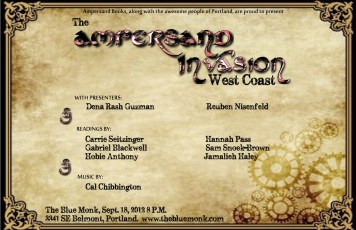
Yesterday, I announced that Ampersand Books is sponsoring a reading here in Portland, at which I’ll be one of the readers. So I thought today I’d share some photos from my story “Horror Vacui,” which appeared in the online supplement to Ampersand Review‘s issue 6. (The story slipped into the cracks of Ampersand’s awesome reboot of their website, but they’ve been reposting old stories a few at a time and mine’s in the cue. In the meantime, you can read it in the Issuu edition of the online supplement, which still lives here.)
These photos are of the house (or, one like it) where main character and professional sword-swallower Samson lives:
It had been a Friday, those five years back. He had been sitting on the toilet in his home, a clean house with white limestone siding and aged-honey trim in a sprawling country suburb with many identical houses.He collected his two dozen swords in their oiled scabbards and their velvet crimson wraps and he took them into the ruined kitchen, kicking aside cups and plates, and he oiled the blades in the sink, prepared them for his act. Then he walked out the back door to the old wooden deck that creaked and chafed against its rusted nails, and he hurled the swords one by one like javelins into the dirt of the cedar hill that rose behind his house.
But wait, there’s more! The always excellent Dena Rash Guzman and Reuben Nisenfeld will be emceeing the evening, and we’ll have live music by Cal Chibbington.
So if you’re anywhere near Portland on Sept. 18, head down to the Blue Monk and drown yourself in sweet, dirty art.
And if you’re not anywhere near Portland? Well, grab an adult beverage, pick up a copy of Ampersand Review, and live vicariously.
(And stay tuned for pics and — if we’re lucky — video. Because we wouldn’t want you to feel left out.)
I know I’ve already mentioned Jersey Devil Press’s forthcoming story collection by Ryan Werner, but it bears repeating, which is why Ryan is blogging about it every day this month leading up to the release of Shake Away These Constant Days. If you aren’t reading those posts — well, maybe that’s okay, because then you’ll come to the collection fresh without all the backstory Ryan is (bravely) sharing over at his blog. But get to those posts eventually, because it’s pretty good reading, even for me, a guy who’s read most of these stories in most of their drafts and revisions over the years. I’m always fascinated by a writer’s process, and knowing the writer — and the process — as well as I know Ryan doesn’t diminish that fascination one bit.
Each story is short and powerful, complete with terse and refined prose that are quick like a boxer’s jab. But, to be fair, these stories are almost too short; and, coupled with the quantity of stories included, it’s easy for them to melt together, especially if you find yourself reading from cover to cover.
That being said: Werner’s collection still manages to maintain a cohesive unity throughout, like that one song you play on repeat and can’t seem to get out of your head.
Or, if you just want to get into the fiction and judge for yourself, go hit Jersey Devil Press, where we have a four-story preview up for your free perusal. And it starts with my favorite story Ryan’s ever written — and one of my favorites ever — “Back and to the Left.” Seriously, go read that thing. And then buy the book.
“Sometimes she brought Mark with her, late in the evening with a beer and four-pack of wine coolers.”
“In the cemetery, the live oaks hung with dried ball moss and the cedars oozed sap, and a fresh rain had come down the hill into the little creek, so the water smelled clean, like stones and ice.”
As I said last week, I’m in Texas. I’m still running around taking photos, but I’m also on vacation so I haven’t bothering uploading and culling them yet. But I do still have some photos from my last trip, which is what these are. They’re related to a scene in my story “A Few May Remember” (the college this references is Schreiner University, where I did my BA degree):
The cemetery where they buried Joseph sat behind the college where Sharon and Mark had met. It looked beautiful in the late winter despite the chill, and the breeze blew this perfect, gentle breath. Back there in the stones and markers and trees, the noise of highway 27 never quite registered. Sharon used to spill down the dirt slope behind her dorm and cross the little creek that separated the cemetery from the school and walk back there, just to get away from campus for a few minutes. Sometimes she brought Mark with her, late in the evening with a beer and four-pack of wine coolers. Mark drank Natural Lite; Sharon liked piña colada. On this day, a couple of days after the funeral, Sharon brought not wine coolers but her letter inside a small archival box she’d bought in an office supply store, and her fireplace shovel.
In the cemetery, the live oaks hung with dried ball moss and the cedars oozed sap, and a fresh rain had come down the hill into the little creek, so the water smelled clean, like stones and ice. Across the creek and through the thick woods, up the dirt slope, some college students in sweats played volleyball behind the old brick dorm where Sharon used to live.
She walked down into the woods toward the thin streak of water, where she poked around until she found a soft spot on a slope of the bank. She set down the box and began digging with the fireplace shovel. It took her forty minutes, but she managed a hole about a foot square and three feet deep. She raised the box to her lips and whispered to it. “Your name was Sharon Reeves,” she said.
Ryan Werner, who is great at titles, has a new book coming out from the press I work for, Jersey Devil Press, who are great at being awesome. Shake Away These Constant Days officially releases one month from today, on September 25, so for the next 30 days, Ryan and JDP are doing some things to plug the book. On Ryan’s blog, he’s writing a post a day about the 30 stories in the book. At JDP, we’re offering a free digital preview of the book. And here on my blog? I’m just cheerleading. (You don’t want to see my pom-poms.)
So hit up both places on the web and brace yourself for the book that Sarah Rose Etter calls “a fist to the ribs” and “a beautiful pummeling.”
This is an old crib from a class assignment. I was in grad school taking a creative nonfiction workshop (which, this fall, I will be teaching myself, so hey, progress!), and I’d missed a day. (I forget why.) To make up for the missed class discussion, I had to write this response to an essay, much as I will have students write responses to essays — even when they don’t miss class — this coming fall.
In reading Tanizaki’s essay, I am reminded of the old Zen meditation device of a square of white paper surrounding a large disc of black. The idea was to sit and stare at this big dot in empty space until you became Enlightened. What that meant, exactly, I’ve never been quite sure of — perhaps you stare until the black and white are no longer distinct, where you make no more such judgments of division — though I’m sure the great Zen masters would point out that if you figure out the purpose of staring at the dot, you’ve missed the point and must begin again.
It’s the parable — central to the essay in location if not in theme — of the origins of Japanese culture and the “shadows” of his title in relief to the pure white that so often creeps up in his essay (in porcelain tiles, in paper, and so on). That’s what makes me think of the Zen dot. But it’s also his mode of writing, his tone and his address: This essay is a meditation in a sense perhaps purer than Montaigne’s, because I get the feeling that Tanizaki is writing not for me, not for a general audience, not even for himself, but for the sake of writing period. It is a reflection not of Tanizaki (though he does show up often in the piece as a commentator) but of Tanizaki’s mind, which, ultimately, is not Tanizaki’s mind but Mind. This, perhaps, is what Lopate is referring to when he comments that Tanizaki’s essay “opens up” to encompass Japanese culture as a whole and even human culture as broader than Japanese alone.
What amazes me is the organicism of his process. In the opening, it is about architecture alone, about the very personal decisions he’s made in constructing his own home according to modern “necessities” as well as traditional aesthetics. This naturally unfolds into broader considerations of Japanese taste in general and the conflict between tradition and modernity, which of course raises the more crucial — for Tanizaki — issue of traditional Japanese in conflict with (or, worse, being supplanted by) modern Western. But because he continually returns to the frame of his home and his private tastes, this transition is gradual to the point of being imperceptible. Yet it does occur with force, like the old Taoist metaphor about the fluid strength of water eroding stone, so that by the end of the essay — which is overtly a plea for remembering Japanese traditions in the face of increasing Westernization — I find myself thinking at first that this is what the essay has always been about. I am drawing no distinction between the bright beginning and this other purpose emerged from the shadows of the essay.
There was a time when I read everything — fiction and poetry, anyway, as well as the images of film — in search of Christ motifs. I was obsessed. Lately, I’ve been doing the same with Buddhism, finding Eastern philosophy behind every thing I read or see. (As an illustration of this transition, I once started a massive and near-uncontrollable paper on the Qumranic dual-messiah theme in The Matrix; after my wife and I had watched the third film, she commented that she didn’t really buy the film’s explanation for why a reincarnated character had changed appearance, and I responded “Oh, it’s a Buddhist thing,” a comment that was unintentionally pretentious and condescending and which got me in a lot of well-deserved trouble at home, but which also signaled my shift in focus when I interpret things.) I am relieved, in a way, that finally such a reading is deserved and not the product of my own perceptions, because I would argue that Tanizaki is profoundly and intentionally Buddhist not only in what he says but in how he says it. At AWP this year, one of the last panels is titled Writing the Buddha, and I hope it will further validate my perspective; I hope, if the opportunity comes up, to mention Tanizaki and perhaps this essay.
What to say about a response essay? I’m a bit of a purist, by which I mean a true response should be a pure response: start with how you feel in the moments during or immediately after reading a work. There are no wrong answers in such a response: you are simply recording what you think and feel.
Sometimes those thoughts and feelings will be, on reflection, misinformed or somehow off the mark. And that’s fine — you have a position from which to learn something. But sometimes, by stripping away the onus of scholarly insight and critical thought and focusing instead on the reading experience and creative thought, you can access the material in a way you might not otherwise have done.
This piece, incidentally, is a bit of both. In that respect, it sort of doesn’t really belong here in the notebook, because this isn’t the first draft — I edited this before I handed it in to my professor. But it is very near the first draft, and the reactions here still feel honest to me. So, in that sense, it still feels pure.
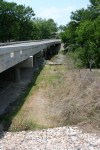
“Then, at Center Point, I veered south toward the bridge and parked nose-down in a gully that led to the Guadalupe.”
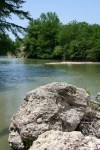
“I slid down a rock-and-dirt embankment, jumped onto a huge rock nested in the riverbank, and sat down.”
I’m in Texas the next two weeks, and while I’m here, I thought I’d drive around some of my old haunts and photograph places that turn up in my Texas fiction. I did a little of that when I was last in Texas, back in April 2012. That’s when I took these photos. They relate to my story “Barefoot in the Guadalupe“:
I took the Datsun out into the backroads, weaving fast through the cedar clutches beyond the highway. I was due at work that afternoon, but I didn’t even bother calling in. I just let the trees wash past, the post-and-wire fences, the goats and small cattle. I hit 27 west and got out past Comfort, the windows down. Driven fast like that, the curves winding around the hills were a constant surprise — I never knew if a deer would run into the road, an armadillo would wander under my tires, a pick-up would barrel into my lane. It didn’t matter. I wanted surprise, not what lay behind the hills but the hills themselves, hulking blanks that told me nothing. Then, at Center Point, I veered south toward the bridge and parked nose-down in a gully that led to the Guadalupe. I slid down a rock-and-dirt embankment, jumped onto a huge rock nested in the riverbank, and sat down. A pick-up rumbled overhead, a bass beat thumping the bridge, and then, everything settled. The Guadalupe was thin here, thinner than usual. I pulled off my shoes and tugged my pants up my calf, past the knee, a warm breeze through my leg hairs. I took my socks off and stuffed them in my shoes. I bounced my feet on the rock a few times, imagining pedals. Then I lay back on the rock, knees bent and eyes to the treetops, and I threw my arms behind my head. I could hear the water whispering over the tiny river stones, the same way I could hear the blood moving through my ears. Without sitting up, I dropped one leg over the lip of the big rock, then my other leg, knees on the edge and my bare feet hanging over what was left of the water, my toes still a good twelve inches above the water but it was close enough.
My story (or is it a prose poem?) “Duel” is up at Visceral Uterus.
Here I am on vacation, with the full intent to take a break from the Internet and relax for a bit. Sure, I’m checking email, just in case something important comes up, but otherwise, I’m unplugging.
And today — my first real day off — I get an email with news of a new publication!
Better still, it’s already online. So here I am, sharing the news with you.
It’s not one of my happier stories, but it is my shortest piece ever, and it’s quite the hybrid — if you wanted to call it a prose poem, I certainly wouldn’t stop you.
Anyway, I hope you enjoy it! And many thanks to Jennifer Patterson and Ms. Taylor Adams over at Visceral Uterus for publishing my story “Duel.”
So, last week, as I was posting here looking for a title for my new chapbook, I was also trawling Facebook for title ideas and a friend of mine asked what a chapbook even was. She even apologized for being “just too lazy to Google it.” Which was totally cool with me — we’ve all been there — but after I started writing my (unnecessarily long for a Facebook comment) answer, I decided to Google it myself. And you know, the answers my friend would have found if she hadn’t been “too lazy” aren’t really very good answers at all.
Title page of a chapbook (Photo credit: Wikipedia)
If you went to Wikipedia, for instance, you’d think the chapbook died in the Victorian era. The section on “History” gives the necessary background in broadsheets and pamphlets and then offers a very brief paragraph — just two lines — on the actual heyday of chapbooks, which begins not with their peak but with their decline:
Chapbooks gradually disappeared from the mid-19th century in the face of competition from cheap newspapers and, especially in Scotland, religious tract societies that regarded them as “ungodly.” Although the form originated in Britain, many were made in the U.S. during the same period.
And that’s it.
After that comes a long paragraph you would expect to be about the resurgence of the form in the mid-20th century and its current — and increasing — popularity. Instead, the longest paragraph in the entry actually goes backward in time, re-addressing the origins of the form and then, somehow, talking about pamphlets that might have sort of resembled chapbooks dating to the 17th century.
About the modern chapbook, Wikipedia offers only this single, short sentence: “Modern collectors, such as Peter Opie, have chiefly a scholarly interest in the form.”
Which is absurd for two reasons: one, there is SO much more to say about the contemporary chapbook! And two, “chiefly scholarly interest” my ass. The chapbook is alive and well as a literary art form and I don’t know a single collector who views them with “chiefly scholarly interest” — we’re readers and writers engaging in a living art, man.
So, back to Google: the second hit that turned up on my search led to what looks like a student project, which isn’t about chapbooks at all but concerns a specific story and its manuscript history; the chapbook background serves as a contextual introduction to this other discussion. And it’s a decent background, but it, too, focuses on earlier texts than I might like, so it’s more confusing than helpful.
The rest of the hits that Google turns up, for the first few pages anyway, are links to chapbook contests (almost all poetry) or chapbook “publishers” (most of whom are actually vanity presses).
So I thought I’d write my own perspective on the chapbook. It’s not comprehensive, and it’s not very scholarly, so kids, don’t plagiarize this for your homework. Rather, these are just some things I’ve picked up about chapbooks in classrooms, from fellow writers and publishers, and from my own experience.
The thing we call a chapbook today really got rolling in the Victorian era. Some of these other histories like to take it back to the 17th century, the 16th century, even the 12th century, but I think it’s a mistake to do so. There are a lot of reasons for this having to do with form and intent, but the simple reason is that the word “chapbook” doesn’t even show up in the language until 1824.
In form, the chapbook was — and still is — a small literary work, smaller than a book but larger than a pamphlet. Most of the time they were — and still are — self-published, too. The idea was that it was a way to share your work when no one would publish it, or as a means of convincing a publisher to publish it, or as a cheap, small form of literature for people who couldn’t afford to buy books. (The word “chapbook” is short for “chapman book”; chapmen were street peddlers whose name might be derived from the word “cheap.”) A lot of histories point out that in the chapbook’s heyday, education was improving and literacy was skyrocketing, but the newly-literate masses couldn’t afford to build a traditional library and thick, leather-bound volumes, so they turned to chapbooks (and their later Victorian successors, the penny-dreadfuls) for their literature. And this has a lot of truth to it, but for the discerning reader and the avid collector, the chapbook did sometimes enjoy a reputation as something more than just cheap street writing.
They died out toward the end of the Victorian era. Some sources blame the rise of newspapaers and magazines for the decline, and there’s a lot of truth in that, but, as I said, people figured out how to print books more cheaply, too, and the penny-dreadfuls became hugely poplar. (One of the first of them was a story called Varney the Vampire, which helped launch the vampire genre and paved the way for Dracula. But that’s another post.)
L.A. Is Evil chapbooks (Photo credit: ‘Lil)
For a long time cheap novels and magazines held sway, and for the most part they still do, but then the ’60s happened. As subversive poetry and essays met up with the advent of the copy machine, we saw a resurgence of self-produced pamphlets, radical treatises and manifestos but also some poetry. And from there, the chapbook reemerged as well. As the hubbub of the counterculture died down, chapbooks slipped into the shadows again, but they haven’t ever quite gone away, and these days, they’re a legitimate literary form in their own right, with contests exclusively for the chapbook. And yeah, there’s also still a strong DIY culture of people who produce their own.
One thing that’s interesting is that chapbooks, as a modern literary form, have almost exclusively consisted of poetry. Initially, you saw a lot of political essays, too, but when things settled down and the chapbook became its own thing, poetry was king. This makes a lot of sense: when you only have a couple dozen pages in a pocket-sized book, you need a form known for its brevity and compactness – something you could stuff in your pocket and read in an afternoon at the park.
Generally speaking, chapbooks still cling to this modern tradition. But in the last few decades, we’ve seen the emergence of flash fiction, first as an experiment and then as a sub-genre and then as a vogue. These days, it’s widely accepted and popular as a prose form, especially now that so many lit journals are web-based and people are reading more fiction on e-readers and iPhones. Also recently, the stand-alone story publishers like One Story magazine, featherproof books, Artistically Declined Press, and Mendicant Bookworks have garnered a ton of respect. Consequently, we’re seeing more fiction chapbooks now. There are even a few publishers who specialize in chapbooks, including fiction.
In my own work, I have produced six chapbooks now. The first two are pathetic photocopied-and-saddle-stapled collections of bad poetry I wrote in college and ran off on the school’s copy machines. I was ambitious and took them seriously enough back then — I even managed to talk the campus bookstore into stocking them and sold all of three copies (I made $6) — but seriously, they’re pretty bad.
Even so, the second one includes a few short fiction pieces, because even back then, I was questioning the weird prejudice against prose in chapbooks and wanted to try to squeeze some fiction in.
The other four are all unpublished. Two of them are sitting at publishers right now; they both are pretty short and consist almost entirely of flash fiction (though one has a relatively long story and a couple of just-over-flash stories). A third one is longer, almost a slim book-length collection, with some longer stories in it; the whole thing is Texas-themed. And the fourth is a trilogy of connected stories that loosely ties into my long story collection; I have this idea of using that chapbook as promotional material for the long story collection.
Cherry: Chapbook (Photo credit: bjanepr)
Why so many? I respect the form. I like it the way I like flash fiction, actually: it manages to say a lot in relatively little space, so you feel like you’re reading a full collection — and you are — but everything is more compact, more meaningful, yet, maybe, less burdensome. A chapbook is a little like the Winnebago of fiction books: it can sometimes be a bit awkward, but it’s portable, it’s fun, and if you get in there and start opening doors, you realize how much space can exist in such a thing, that no nook is wasted, no corner useless, and it is really, really well designed.
Or, that’s the hope, anyway.
I do still like the idea of DIY chapbooks, and I might like to self-publish one here soon. In fact, I have a neighbor who does hand-bound bookmaking, and I have this idea that we could get together — I could print the pages and she could do the binding — and put out a super-limited run of a handmade chapbook. But that’s a project far down the road.

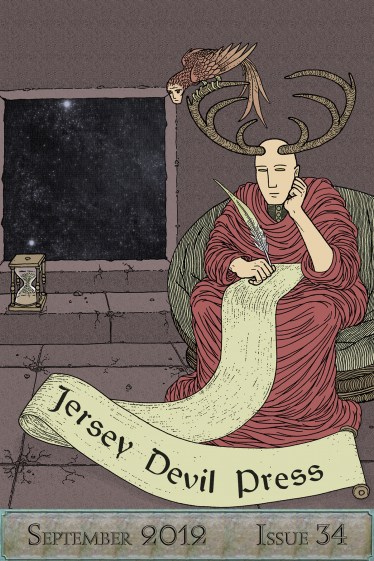 It’s out: the September issue of Jersey Devil Press. Really cool cover art from Justin McElroy, plus gobs and gobs of flash fiction, including a one of my favorite stories in any magazine this whole year, Matthew Burnside’s excellent “For Kylie.”





 Samuel Snoek-Brown