Front-page image from Slate's website promoting their article on the Virginia Quarterly (click the image to go to their story).
Back in August, I wrote a post about the tragic suicide of Kevin Morrissey; in that post, I commented on one aspect of the narrative unfolding at the time, namely, the dangers of workplace bullying and the need for our vigilance in fighting it.
That post has received a lot of traffic since, partly from VQR‘s own blog post on the subject and partly because of continuing coverage in the mass media. But that post is a response to just one aspect of this narrative, the one put forth by the Chronicle of Higher Ed article that started the national attention to Morrissey’s tragic death. This week, Slateoffered a very lengthy follow-up to the story and an alternate perspective on what happened at VQR, and I feel it’s important that I share their version here as well.
In Slate‘s view, my earlier post bought into an anti-bullying narrative; the author, Emily Bazelon, seems to suggest that we all were fools to do so. But I’m glad that I did. I said in that first post that whether or not Ted Genoways acted as a bully wasn’t really the point; the point was that the issue of workplace bullying had been raised, and we cannot ignore charges of bullying if we ever hope to defeat bullying. Despite all the news coverage and editorials and in-depth studies (the Slate article is something like 4,800 words long), I don’t really know what happened in the small and insular community of the VQR staff. I agree that the Chronicle had an agenda, spelled out loudly in the verb they chose for their article’s title, “What Killed Kevin Morrissey?” I believe Slate has the opposite agenda, spelled out neatly in their text but also apparent in their web layout, in which they lead the article with a large, professional photo of Genoways and then show a much smaller candid photo of Morrissey, which shows him alone in a crowded room, small and centered in the frame but isolated from the activity around him. The Chronicle wanted to sell us the idea that someone else was to blame for Morrissey’s death; Slate wants to sell us the idea that Morrissey’s depression and isolation were to blame.
Both those narratives miss the point, I think. What we should be focusing on is not who gets blamed for what, but that when someone feels bullied, or oppressed, or depressed (and Morrissey was certainly the latter and possibly the former), we all should act as much as possible to foster communication, respect, and compassion for everyone involved. And I continue to advocate for that.
For more on how to help each other through such difficult, emotional times, please consider the following links (and feel free to share other resources in the comments):
Today’s exercise is going to be short and relatively uncreative. I’m polishing up a story collection I recently finished, and while most of the stories are published, finished, or well on their way, one is still very much an ugly draft, so I’ve decided to go over that weakest story and do some broad revision. What follows is a checklist of sorts, just a dry accounting of things that won’t really make much sense to anyone but me, but I’m posting it anyway because an exercise is an exercise and I think it helps to see writers at work. I’ll explain the checklist and my notes below.
1. Check your external conflict.
Does the story have an immediate and gripping external conflict?
Yes. But really, no. The story opens on a scene filled with conflict, but it is merely an introductory conflict, and mostly, it’s someone else’s conflict. The main external conflict for the main character doesn’t show up until page 3. It’s a 21-page story (for now–it’s going to get shorter), but still, page 3 is a long time to wait for the main conflict. I think I need the other, introductory conflict involving other people to set up a major complication later in the story, but I need to get into and out of it a LOT faster so I can get to the main conflict somewhere on page 2.
Does the external conflict keep tension alive throughout the story?
Yes. There’s a shift in conflicts, but it’s less a swapping of one conflict for another and more of a transition, an evolution of the main conflict, so I think (for now) it works.
If the first external conflict is resolved and its place taken by successive external conflicts, check each for conflict, crisis, and resolution to ensure that the parts are working.
Checked.
Is there a final crisis action bringing all the outstanding external conflicts together…?
Oh boy, is there ever. I’m not sure yet that it’s the RIGHT crisis action, but it sure is a doozy.
2. Check your internal conflict.
Is the internal conflict well established after page one of the short story…?
No. In the current draft, the external conflict starts on page 3, but the internal doesn’t even get hinted at until the end of page 5. That’s way too late in the game. But I think I know a way to bring it up earlier without wrecking the story–I’ll just have to cut some stuff and move some other things around.
Trace the internal conflict as it heats up and cools down throughout the story to make sure the flame doesn’t burn out.
I like the pieces of this internal conflict, but right now they’re still just pieces. It’s not running in an ebb-and-flow (a “heats up then cools down”) rhythm like I want it to. It’s like it dwindles to embers and I have to blow like hell to get the flames going again. Definitely need to work on that.
When the internal conflict is finally resolved, do you use a dream or an image, or the character’s thoughts and memories to make the moment significant and convincing?
No, it’s all in action. The internal conflict gets externalized, which–right now–is the point (see the next question).
Which type of resolution is it, comes-to-realize or fails-to-realize? Decide now.
This main character is so messed up in the head that I can’t honestly say whether he realizes anything or not. But I think he does. Because the internal conflict becomes externalized–it’s brought out into the open, out loud–it’s hard for this to be anything but comes-to-realize.
There’s a lot more to the checklist, but this is plenty to work on for now, and I don’t want this post getting too long.
This checklist is from the chapter on revision in Jesse Lee Kercheval‘s Building Fiction. To be honest, I’ve always resisted such checklist-style approaches to writing–and revising–fiction, because it’s always felt too rote for me, too formulaic. Kercheval flirts with formula here, too, but if you read her other chapters on conflict and character and endings, you realize how very flexible her approach is. For me, it is the perfect blend of the flexibility I want in my writing process and the discipline I feel my fiction needs.
Take this story, for example: I knew when I finished the draft that the story was a hot mess, but I’ve been rolling along smoothly enough in my fiction lately that I assumed it would be a day’s work to fix it. Going through this checklist–even just the first two sections–I see now how much revision is needed. I’m not talking about fixing a few problems; I’m talking about revision in the classic sense of seeing this thing with new eyes. One of the things I love about Kercheval’s checklists, actually, is that they help you become your own second reader. It’s not a replacement for actually handing a draft to other human beings and getting their feedback, but it’s perhaps the next-best thing.
"A literary spirit." The Old Manse, Concord, MA, 4 April 2007.
Many thanks to my old college friend, Erin Hostetler, who drove me out to Concord in the snow to see Walden, the graves of the Alcotts, Emerson, Hawthorne, and Thoreau, and this, the house in which Hawthorne lived and wrote.
One of my former professors, a great but humble man named Scott Simpkins, died this morning, in his home in Denton. I don’t know any more about his death except that he’d been in poor health for some time, and that he will be dearly, dearly missed.
One of the great joys of academic life is meeting people who excite you intellectually. Scott Simpkins was more than that: He was excited by the intellect of others, which, in academia, can sometimes seem like a rare thing. We get so caught up in our own work, in what we are arguing or who is reading us or how quickly we’re advancing through the ranks, that we forget that the work of others is our work. But Scott Simpkins seemed always aware of that symbiotic truth, and he loved it. I knew him only briefly and mostly through the classroom — he taught my critical theory course and my course in Gothic literature, both with as much humor and enthusiasm as brilliance and insight — but I never saw the man in or out of the classroom, never passed him in the hall or stopped by his open office door just to say hi, without encountering a smile and smiling in return, and I never stopped for a chat without learning something or — more important, perhaps — unlearning something. He was excited by the ideas of others and so he excited new ideas in me. He did that to everyone: He lit us up.
It is through us, I like to think, that Scott is still alight himself. Within minutes of news breaking within the department, Scott’s colleagues and former students began posting memorials in their Facebook statuses and on Scott’s Facebook wall. In everyone’s digital voice, there are notes of both sorrow and gratitude, comments of loss and regret as well as the sincerest thanks for all Scott taught us, his former students, his friends, his colleagues.
Of course, Scott might challenge my reading of that. He might challenge my reading of all this — he made a living out of challenging assumptions. We’re talking about a man who wore t-shirts, cargo shorts and sandals to teach every day partly just because professors aren’t “supposed” to dress like that. In his Facebook photo albums, he included a picture of himself jumping up and down on a black suit and tie he’d just cut from his own body, an act of what he describes as “performance art” to teach composition. He was Descartes’s evil genius if ever there was one, and he just loved upending assumptions.
But there is no upending this: He is loved by all who knew him, and we all are better off because of him.
He was also one of the coolest people I ever knew. The guy was into everything, and while he would never have claimed to know everything about everything, he definitely knew a little bit about everything and a whole hell of a lot about most things. But he never let his intellect get in the way of a good time. While some of his students and his colleagues were hunched over yellow legal pads in the library or typing up essays in their dark rooms, trying so desperately to “get ahead,” Scott was enjoying a beer with students or hiking in Palo Duro Canyon out west or cycling across town or just kicking back with a book. And he still thought circles around most people, still had a hell of an impressive publication record, still enjoyed the respect of his colleagues. And he had fun doing it. His faculty profile photo at UNT shows him wearing a backpack in the hills; his personal website begins with a quote from Sense and Sensibility and Sea Monsters. This is a man who knew how to make academia fun, how to make academia cool.
Sometimes I feel like we only get a few of those in our lives. I value and revere all the teachers I’ve ever had, even the ones I sometimes disagreed with, but I can name maybe one or two professors from each stage of my career — middle school, high school, grad school, my doctoral work — who’ve had a deep and lasting impact on my approach to academia and to my work both as a writer and a teacher. Scott Simpkins easily ranks among them (and it’s no accident, I think, that he was the most-requested “second reader” on creative writing theses and dissertations at UNT — he had this kind of impact on everyone).
So here’s to Scott Simpkins. The world is a lesser place today, but only a little and not for long, because we who love you will always remember you.
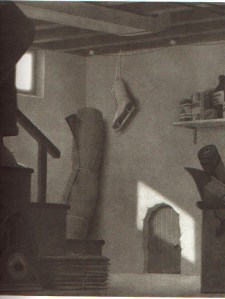
Uninvited Guests. "His heart was pounding. He was sure he had seen the doorknob turn."
Like my early Writer’s Notebook entry “1,000 words,” this exercise requires I post a picture. This picture, though, comes with a title and a caption, which I’ve included with the pic at the right (for the full citation, see the end of the story). Children’s lit fans might recognize the title of this post and/or this image, and so you might have guessed what I’m up to here, but as usual, I’ll save the description of the exercise for the end of the post.
1.
When I’d moved into the cottage, the owner had shown me around — where the cups were in the cupboard, how to prise open the window over the writing desk in the little loft, those sorts of things — but, curiously, she had walked past the tiny door at the foot of the stairs without comment. I’d stopped her and pointed to it. She’d laughed and said, “Oh, that’s our little-person door.”
“You mean, like a midget?”
She stopped laughing, gave me a stern look, but she shook her head and said, “No, it’s just what we call it. It’s a storage area, really.”
“Why’s the door so little?” It was, too — maybe 20 inches high at the peak, less than a foot wide, and it was arched so the doorway was narrower at the top. Even lying on my side and worming on the floor, I couldn’t have fit through it.
She said, “I don’t know. The cottage is very old, of course, they did odd things in the old days. But it will make for good writing, a quiet, clean place for you to finish your book.”
I squatted and reached out a hand to the tiny doorknob, but she put a hand on my shoulder.
“It’s been locked since we’ve owned the place. Best to leave it alone — it doesn’t often do to go poking about these old places.”
“You mean there might be mold?” I said.
She looked at me a moment, then turned and marched toward the little den up front. “Sometimes,” she called over her shoulder, “the light is very pleasant here in the morning, and I think you’ll find an outlet beside the sofa. I have a spare adapter if you need one.”
I looked at the door again but finally just followed her. I was getting this place cheap, a whole month for barely three hundred pounds. That’s something like five hundred dollars. I didn’t want to upset the woman.
But the first week I barely worked. I would eat a quick breakfast in the kitchen, drink a cup of coffee in the den and read a little, and then I’d pour a second cup and head upstairs to write. But on the way I’d stop, stare at the tiny door for a good minute or two — sometimes longer — and when I finally did drag myself up the stairs to the little study, all I could think of was the door. Why its proportions. How to get in. What might be hidden inside, and how old those things might be.
Instead of turning on the laptop and setting to work, I’d dig out my leather notebook and start scribbling lists. I started with the mundane, just to keep myself as grounded and as bored as I could — the more ordinary the room’s contents, the faster I could get to work. Old tools. A rotted straw mattress. Someone’s forgotten tea set and wedding china. But I couldn’t help myself, and soon the ideas became more elaborate. A stash of controversial books banned by the church and secreted away. A spinster’s unused wedding dress. Furniture of a child who died too young. The body of the child.
It was too much. I can’t sit here making lists for the next three weeks. So I’m going in. I’m writing this down now, and dating it, and sealing it and dropping it in the post, so there will be a record. I don’t know what’s in that room, but if it’s something no one wants found, I don’t want people thinking I’m the one who put it there.
And now, here goes nothing.
* * *
2.
For as long as he’d lived in the house, the door had been there. No one could explain to him what it lead to, since on the outside of the house there was only the garden and the big oak tree — that wall was bare, the same mud-plaster walls as the rest of the house and utterly seamless. He’d looked. For all he knew it opened onto the inside of the wall, someone’s idea of a joke. But he’d never been able to find out, because he didn’t like to climb the ladder to reach the doorknob so many feet off the ground, and the few times he’d risked it the knob wouldn’t turn.
It was better, everyone told him, to leave the door alone, and in the end he’d decided they were right. It made a nice conversation piece when he had visitors. Better still, all that wood, as wide as half the wall and rising clear to the high ceiling, made an excellent display wall for his wife’s country paintings. Best not to disturb them.
Still, he liked to stand in the grand hall from time to time, studying the door, the strange width of the planks, the doorknob bigger than his head. He’d heard there were some trees over in America that grew hundreds of feet high, dozens and dozens of feet across, and perhaps the planks of this door had been milled there, cut from these huge trees. But who would take the trouble to import such wood here, and for such a cottage — despite the grand hall with the huge door, his cottage was otherwise small and unremarkable.
He wondered at the craftsmanship necessary to cast a doorknob so large, but he wondered, too, if the engineering had simply proved impractical, if the doorknob in fact didn’t turn at all, the door mere decoration and never meant to open, and that’s why he’d never been able to manage it from the ladder.
But then, as he was standing before the door one summer afternoon, the air warm through the windows on his back, he felt a tremor, two careful thuds, like trees had fallen outside. He flinched and thought to run around the house and check the big oak in the garden, but before he turned he noticed the paintings, all his wife’s little country scenes, were trembling on their hooks. It was only a moment, but he knew he’d seen them shake. Then he heard another thud, this one against the house itself, and he went very still, the sun no longer warm on his back, his hands tense and unsteady. His heart was pounding. He was sure he had seen the doorknob turn.
For those of you who didn’t recognize the title or image, this is from Chris Van Allsburg‘s haunting little book The Mysteries of Harris Burdick. This exercise was my wife’s idea; she came home from the library where she works all happy and grinning slyly, and she told me, “I have a great idea for this week’s writing exercise!” And then she handed me the Van Allsburg. His books have always been favorites for both of us (my wife, who has a graduate specialization in youth literature, introduced me to Van Allsburg), but I suspect this particular exercise was partly inspired by our nephew Aidan, who is this year beginning to read some Van Allsburg, much to his aunt and uncle’s delight.
The Mysteries of Harris Burdick is an unusual children’s book, though, because it doesn’t involve much story. Or rather, it directly involves the reader in the story — it requires you to write your own.
The premise of the book is that Van Allsburg “found” these images in the home of a friend, who tells him a strange and unresolved tale of an artist who made a set of drawings to accompany his stories and then left the art behind without ever submitting the stories. The artist, eerily, is never heard from again, and no one can seem to find out anything about him. The only clues are the titles for the images and the small captions the artist had written on the backs of the pages. Those titles and captions, then, are “reproduced” along with the art in Van Allsburg’s book, and it is up to us readers to supply the stories.
Van Allsburg is of course fully aware that he’s written what is essentially a book of writing exercises for children (and adults), because when you visit his website, you will find a link to the Mysteries of Harris Burdick Story Writing Contest, a site which includes instructions for how to go about writing a story from these images as well as scores of reader-submitted fiction (and at least two short animations, and at least two songs written from the images).
So whether you are a child, a children’s author, or just a child at heart (like me)*, I encourage you to find a copy of The Mysteries . . . at your local library, then head over to Van Allsburg’s site and try your hand at a story. (That means you, too, Aidan!)
Stephen King is also a child at heart. In his story collection Nightmares and Dreamscapes, King himself tried his hand at another of the stories suggested in The Mysteries . . . , the final picture, “The House on Maple Street.”
I’ve written a lot about Texas, both in my fiction and in this blog (most notably in my blog post on Texas regionalism), partly because Texas is so diverse it leaves room for a lot of literary exploration. But many people outside Texas–and probably many people in Texas, as well–might not realize that Texas is not only big enough to contain several states of its own, its state constitution actually has a provision for doing just that: Texas can, should it decide to, divide itself into as many as five separate states.
Today, my father–who was born in Southeast Texas and currently lives in the Texas Hill Country (that’s right: Texas is so big its regions get capitalized)–sent me a link to the first in a series of articles published by the Houston Chronicle about this unique political phenomenon. I’ll definitely be paying attention to it this week. Anyone who’s interested in Texas should do the same.



 Samuel Snoek-Brown