A Writer’s Notebook: “Casting a Wide Net”

This week, another exercise from Scott McCloud’s Making Comics. In this exercise, McCloud asks us to create a cast of characters that share one trait (from a list of traits–see below) but are different in at least four other ways.

These academics are my four characters (in the order I wrote them).

Sandra:

45, a vocal activist who has two young children (she waited until she got tenure before she started her family); she wants to motivate the administration but does not want to take on administrative duties herself (she doesn’t want to become “The Man”).

André:

37, he is opinionated and aloof, single and isolated (he prefers being single–he doesn’t get along well with others); he has high ambitions in his field but he doesn’t like to work toward those ambitions–he’d rather recognition came to him on its own.

Max:

a shy, 23-year-old phenom, he is single but is the object of much attention from his students; he wants to prove himself without stepping on any toes (he often feels embarrassed by his own youth).

Olivia:

62, an even-tempered, natural leader; she is a grandmother as well as a local figurehead and so has very little time to herself, which part of her prefers–she is therefore torn between remaining in her career and her public obligations and retiring to travel and write (she is keepign an eye open for a next-generation leader to take her place).

Scott McCloud’s full list (from chapter 2, exercise #2; the title of the post is McCloud’s name for the exercise) is as follows:

  • height
  • weight
  • facial profile
  • beauty
  • strength
  • race and ethnicity
  • background
  • desires
  • age
  • intelligence
  • style of outfit
  • temperament
  • obligations
  • allegiance
  • gender

The formula should be familiar for fans of comic books: The Fantastic Four, for example, are of different ages and genders, wildly different temperaments and scientific backgrounds (the former is the source of their frequent intra-group conflicts; the latter is one of their greatest strengths, when used in combination), different degrees of (or ideas about) beauty and physical appearance, different super-power strengths, and different desires and levels of commitment to their fight against evil. Yet they were originally bound together by their adventurous, progressive approach to scientific inquiry and, as a result, are now further bound together by their shared super-power-transformation experience. (They all wear the same uniform, too, of course, but this is more a reflection of their unity than a cause of it–and, of course, a necessary early comic book trope).

But look beyond the world of comics and you can see this dynamic playing out in all sorts of literary groupings: The shared goal–matrimony and, if possible, romance–but vastly different temperaments and different paths toward their goal among the Bennett sisters in Pride and Prejudice, for one classic example. Or, for a more blatant example, behold the Fellowship of the Ring in Tolkien’s work.

I even recognize this device in my own real life of academia, in which the members of colleges, academic departments, even committees and individual classrooms have an array of differences but are (ideally) united in their common pursuit of academia and excellence in education.

So, I started there, and created this cast of characters.

I found it strangely difficult to define how my characters were different without first discovering their one similarity, so I had to start there: I chose intelligence.

For the differences, I listed age, temperament, obligations, desires, and gender, but I could just as easily have included race and ethnicity (André comes from a French or Francophone background, for example; I don’t know enough about the others to speculate too much, but Sandra and/or Olivia could be Latina or Italian-American, if I wanted them to be; and Max may or may not be African-American, German, or any number of other backgrounds). I also could have listed style of outfit (study your colleagues or your teachers and tell me you don’t detect significant differences in fashion statements). I might have listed allegiance (to specific academic disciplines, for example), or height and weight (Max strikes me as small and thin; Olivia seems stout and intimidating; Sandra is probably very tall).

In fact, all the attributes above could become differences. Some could also be unifying similarities: They might all have different academic specialties, for instance, but they might also share a passion for teaching or scholarship.

Will these characters make for a good comic book? I don’t know–it might be worth pursuing. Could they make good literature? Absolutely–go read Kingsley Amis‘s Lucky Jim!
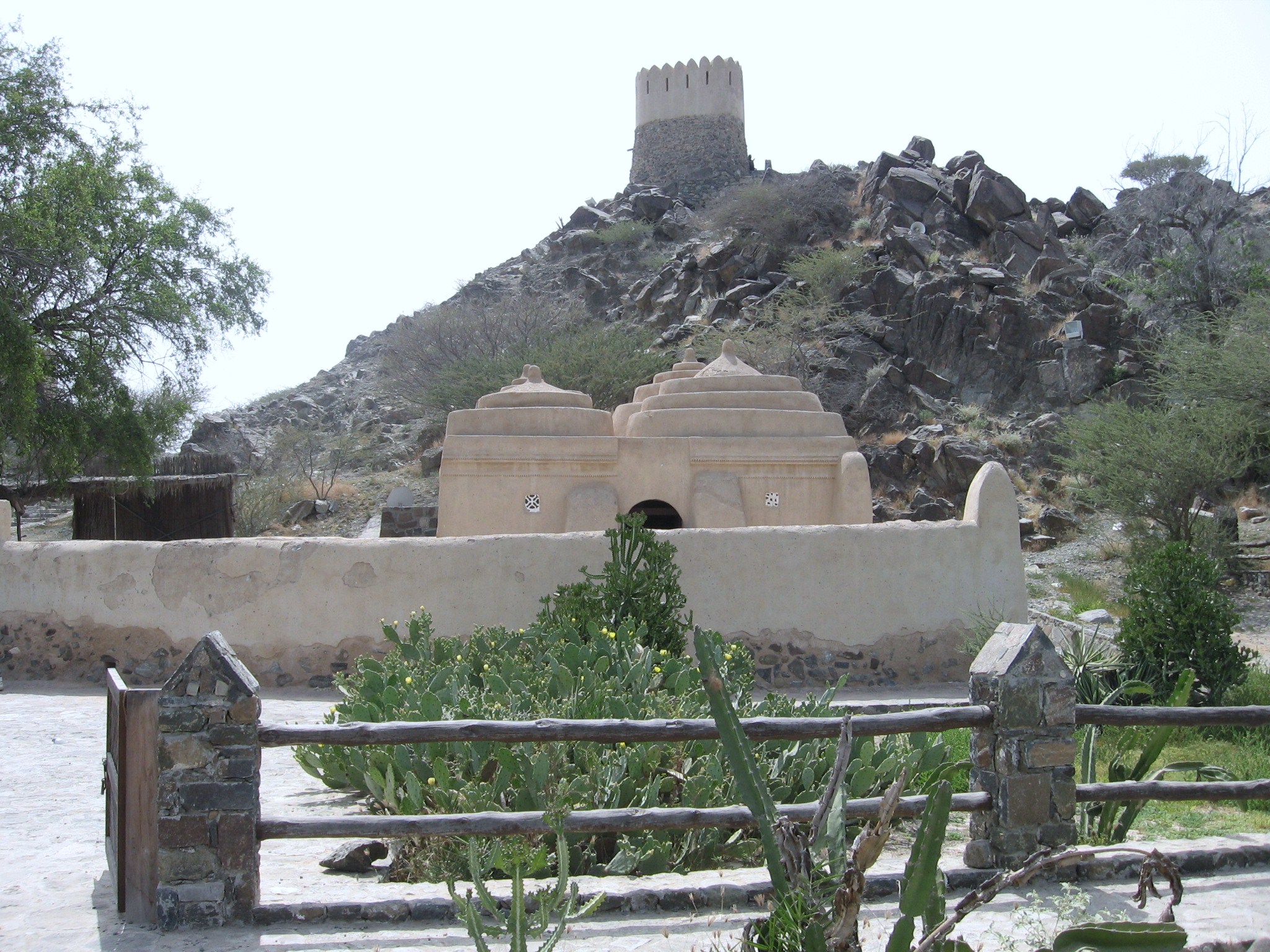
Photo blog 18

"Protected." 15th-century Al-Bidiya Mosque (and hilltop fort), Fujairah emirate, United Arab Emirates, 8 May 2009.

Ramadan mubarak!

A Writer’s Notebook: Comics cut-and-paste

Today:  Some comics.  Slightly later today:  An explanation of the exercise.

Click for a larger image.

In some ways, this exercise is similar to last week’s, in that I’m “borrowing” from other sources and piecing them together into new art.  Of course, this looks wildly different: It’s more than partly visual.

I’ve just finished reading the third of Scott McCloud‘s brilliant books on comics and graphic narrative, Making Comics, and unlike his previous two books, this one is as much textbook as critical theory and historical evaluation of the form, particularly because it includes writing/drawing exercises.  So, I’ve decided to dabble in a few of the exercises just to see what I can manage.

Of course, I have less artistic skill than a wet stick, so I particularly enjoy those exercises in McCloud’s book which let me off the drawing hook.  This one, Exercise #3 from Chapter 3 (“The Power of Words”), goes as follows:

Can you make an entire comic using nothing but pictures and words cut from the latest issue of a popular magazine?  How does the cut-and-paste look of it affect the reading experience?

I’ve modified it, though.  Today, I’ve simply rounded up interesting art photos from the Internet (I did a lazy Google search) and then tossed in whatever captions came to mind as I scanned the images.  And, for the sake of brevity, I haven’t made a whole comic.  But you get the idea.

If you have more artistic skill than I do, I’d love to see what you’re capable of.  Feel free to send me stuff!


And now, a few notes:

To put the page together, I used BookSmart, the book design software from the print-on-demand company Blurb.com.

The photos credits are as follows:

Panel 1: From The Lilli Pad:  http://lillipad.wordpress.com/2008/04/05/it-begins-homage-to-black-and-white-beach-photography/

Panel 2: From Fine Art America:  http://fineartamerica.com/featured/the-beach-in-black-and-white-photo-art.html

Panel 3: From Steve Gosling Photography:  http://www.stevegoslingphotography.co.uk/

Panel 4 & 5: From Digital Photography by Sandro:  http://www.sandrophoto.com/2007/11/24/photo-headers/ (panel 5 also found on TORFEH Group:  http://www.torfehgroup.com/en/photography.php)

Panel 6: From Smashing Magazine:  The Beauty of Street Photography:  http://www.smashingmagazine.com/2008/12/14/the-beauty-of-street-photography/

Panel 7: From Hypebeast: The Photography of Kazuhiko Kawahara:  http://hypebeast.com/2009/01/the-photography-of-kazuhiko-kawahara/

Smile! (the new blog)

My new blog is active.  It’s called Smile!: celebrating happiness one image at a time.  Check it out, and spread the word–I’m hoping to share a little happiness with everyone I can, and you can help share the happiness too.  🙂

Photo blog 17

"Illuminated." Sheikh Zayed Grand Mosque, Abu Dhabi, UAE, 28 January 2009.

Ramadan kareem!

* Because we’re in the midst of the Muslim holy month of Ramadan, I thought I’d spend the next few weeks posting images related to Islam and our country of residence, the United Arab Emirates.  Stay tuned for more.

Pakistan flood relief

Reuters image from CBC article

I’ve mentioned before how hard it is to keep up with relief efforts for the string of major disasters in the past year or so, and because so many of the relief and aid organizations tend to be the same for each disaster–and recent constant experience has made them (presumably) the best prepared to help–I’ve been referring people to the old lists I put together back during the Haiti and Chile earthquakes.

But the current news out of Pakistan is bleak, to say the least.  The aid that we are trusting to arrive in Pakistan is apparently slow in arriving, or not arriving at all, and the situation there is getting terrifying.

Fortunately, a friend of mine posted a request on her Facebook asking for reliable aid organizations, similar to my own request back during the Haiti days, and some of her friends in turn came through with this excellent list on the blog Secular Pakistan.  Please check it out and consider sending help through one of those organizations.

Also, don’t forget about the needs of other people the world over.  Even while we worry about the pace of relief efforts in Pakistan, other news reports are whispering in the media background that efforts to rebuild Haiti have all but stopped, and I’m not even sure anymore what the situation is like in China or Tibet.  One of the problems with so much tragic news covering so many countries is that we tend to move on to the next news cycle and forget about the desperate needs of the people we once sought to help.  Please, if you can–and I know it’s getting hard–continue working for the people in Haiti, Chile, Tibet, China, and other regions that continue to need our help.

Noise, by Darin Bradley

A friend of mine is releasing his first novel in a couple of weeks, an apocalyptic novel called Noise.  I haven’t read it yet, but by all accounts, it’s awesome.  (I have read the teaser text on the publisher’s website–it certainly looks awesome!)

Darin and I are bouncing back and forth on an interview about the book, his writing, and the apocalypse, which I’ll post closer to the novel’s release date–August 31–but in the meantime, here’s a teaser trailer:

Noise, by Darin Bradley–teaser trailer #1 from Darin Bradley on Vimeo.

A new blog

FYI: I’m working on a new blog. It’s going to be all about smiley faces, which I collect with rabid enthusiasm. A lot of the items I’ll post on the blog will come from my personal collection (keychains, bath towels, hackysacks, even a smiley face toothbrush holder), but some of the posts will be smiley art, smiley graffiti, even smiley simulacra (my favorite!).

Stay tuned for the URL–I’ll be launching it later this week.

One tragedy in academia

Among my various pet causes (promoting nonviolence, encouraging the creative writing of kids and teens, supporting increased awareness about breast cancer), one of the most recent for me is bullying.

Usually, we associate bullying with the schoolyard, and when the news reports on bullying (and it has been reporting on it more in recent years, which is good for helping combat it), the stories are nearly always about kids and teenagers. But workplace bullying is just as serious, just as dangerous, just as important to remain vigilant against.

That’s why this recent article* in The Chronicle of Higher Ed is so distressing and so tragic, especially since it hits so close to my own academic and creative heart: the university-supported literary journal and the people who work to share the newest, best literature with the wider world.

The comments following the article tend to descend into petty back-and-forth arguments over the intent or style of the reporting (see the note below), but one careful reader was helpful enough to focus on the allegations of bullying and noted that whether or not those allegations are entirely true in this case, they are indicative of a serious problem in academia that we should not ignore. (If you’re looking for the comment, it’s #22, written by Professor David Yamada.) And then, rather than simply offer that observation and walk away, he actually links to his professional blog post on the issue as well as a web resource on bullying and suicide.

Here’s the link to the blog post, which also includes more links to web resources on bullying in the workplace and in academia specifically.  Please, check out that or, if you prefer, conduct your own research into the subject. And in addition to your office-door stickers of commitment to intellectual freedom, workplace diversity, religious tolerance, and all your other causes, consider committing yourself to combating bullying everywhere you see it, for children and adults alike.


* Among the criticisms some readers level against the Chronicle story, the most prevalent is that this isn’t quite journalism.  Some claim it is merely lax about its editorializing, while others complain it is nothing better than crude gossip, but the broader point is that much of its reporting stems from (informed) speculation and lacks concrete documentation. Most of the more careful readers, though, are quick to move past that point and acknowledge that the real stories here are the dangers of workplace bullying and, more importantly, the tragedy of Kevin Morrissey’s death.

Kevin Morrissey, from VQR’s website.

I join those readers — and the author of Literary Rejections on Display (from which I first found this story) — in offering my condolences to everyone: the VQR staff, the UVa faculty, and especially Morrissey’s friends and family.

A Writer’s Notebook: Magnet poetry

Caveat emptor:  This is not good poetry. Blame the magnets.

My velvet yesterday surrounds
today in translucent smoke, you
in corduroy angling for another
cut of tea, steam a prisoner
behind your glasses, the naked smile
that tugs one side of your lips,
the memory of the porcelain morning
light over the ocean. We never
liked giving up the days, prefer not to wake
but to let each twilight melt into dawn.
Once, we lingered, liquid around
the needle of midnight. Now,
we are bellows, blowing our memories
into our mornings and blushing as
we hope they take hold, flower.
Every color delicious, every flavor
transient, every breath of steam
from the the cup, our miss.

Call me a quasi-Dadaist at heart, but I love magnet poetry. The poetry itself is often terrible (I make no claims for the quality of this poem), but but process of stringing together words is fun, and the relatively random act of pulling words from a box can produce some surprising combinations of images.  I’ll let you judge which of the images in this poem you might like, but for my tastes, I think there are nearly as many cool lines as there are corny ones.

And that’s where the practical side of this exercise comes into play:  If you ever find yourself wanting a unique way to express an idea or describe an emotion, pulling together random words can help break you out of your habitual phrases.  Maybe the magnets don’t really provide anything useful themselves–that’s okay.  The point is, they force you to think differently, and they can help you put ideas together yourself that you might not have combined otherwise.

Don’t have a magnet poetry set?  Don’t worry–you don’t have to rush out and buy one:  The Magnet Poetry website provides a cool online tool for making your own magnet poetry, complete with “metal tray” and side box for sorting all your words.  (For this exercise, I used the “Poet” kit, though I confess I love vocabulary of the “Genius” kit best of all.)  Or, you play it old school and just cut up a newspaper like the Dadaists used to do–but I’ll do that in another exercise, so more on it another day.