Beautiful words at the Academy Awards

Late last night, shortly after the Oscars wrapped up, I posted this on my Facebook page:

I want to believe it is significant that at the whitest, malest Oscars in recent years, the night’s most rousing, most meaningful speeches were by a woman demanding equal pay for women, two African-American men spreading hope and compassion while still keeping our awareness on the continuing struggle for racial justice, a suicide survivor speaking hope and strength to every kid who might feel “weird,” and a Mexican teaching us about equality in true art and calling for more compassionate treatment of the immigrants who built and are still building America.

I don’t want their words to get lost in the reporting of tonight’s Oscars. I want their speeches to mean something.

My writer friend Marie Marshall agreed and wondered if there were transcripts available, to preserve their words. There probably are, but it’s early hours and the best I’ve found are videos accompanied by pull-quotes, so I decided to transcribe the speeches myself (parentheses link to videos of the speeches):

Patricia Arquette (best supporting actress, Boyhood):

To every woman who gave birth, to every taxpayer and citizen of this nation, we have fought for everybody else’s equal rights. It’s our time to have wage equality once and for all and equal rights for women in the United States of America!

Common (best song, “Glory,” from Selma):

Recently, John and I got to go to Selma and perform ‘Glory’ on the same bridge that Dr. King and the people of the civil rights movement marched on fifty years ago. This bridge was once a landmark of a divided nation but now is a symbol for change. The spirit of this bridge transcends race, gender, religion, sexual orientation, and social status. The spirit of this bridge connects the kid from the south side of Chicago, dreaming of a better life, to those in France standing up for their freedom of expression, to the people in Hong Kong protesting for democracy. This bridge was built on hope, welded with compassion and elevated by love for all human beings.

John Legend (best song, “Glory,” from Selma):

Nina Simone said it’s an artist’s duty to reflect the times in which we live. We wrote this song for a film that was based on events that were fifty years ago, but we say that Selma is now, because the struggle for justice is right now. We know that the Voting Rights Act that they fought for fifty years ago is being compromised right now in this country today. We know that right now, the struggle for freedom and justice is real. We live in the most incarcerated country in the world. There are more black men under correctional control today then were under slavery in 1850. When people are marching with our song, we want to tell you we are with you, we see you, we love you and march on.

Graham Moore (best adapted screenplay, The Imitation Game):

When I was sixteen years old, I tried to kill myself, because I felt weird, and I felt different, and I felt like I did not belong. And now I’m standing here. And, so, I would like for this moment to be for that kid out there who feels like she’s weird, or she’s different, or she doesn’t fit in anywhere. Yes you do. I promise you do. Stay weird. Stay different, and then when it’s your turn and you are standing on this stage please pass the same message to the next person who comes along.

Alejandro Iñárritu (best director, Birdman)

Honestly, this is crazy, in a way, talking about that little prick called ego. Ego loves competition, because, for someone to win, someone has to lose. But the paradox is that true art, true individual expression, as all the work of these incredible fellow filmmakers, can’t be compared, cant be labeled, can’t be defeated, because they exist. And our work only will be judged, as always, by time.

Alejandro Iñárritu (best picture, Birdman)

I want to dedicated this award for my fellow Mexicans, the ones who live in Mexico. I pray that we can find and build the government that we deserve. And the ones that live in this country, who are part of the latest generation of immigrants in this country, I just pray that they can be treated with the same dignity and respect of the ones who came before and built this incredible immigrant nation.

Nick Hornby and Cheryl Strayed and one of the coolest nights in my literary life

Other than the publication of my own books and the Oregon Literary Fellowship I won a couple of years ago — in other words, other than events involving my own work — I’ve had a handful of truly exhilarating, giddy, can’t-stop-grinning literary moments in my life:

  • I once heard Kurt Vonnegut lecture (he did his amazing “shapes of stories” bit)
  • I once interviewed Madeleine L’Engle
  • In grad school, I spent a whole evening drinking with and interviewing Tom Franklin in what became the beginning of my masters thesis on him
  • Later in grad school, I brought Tom Franklin to my campus as a visiting author and the resulting reading, Q&A, after party, after-after party, and after-after-after party is to this day a legend in the grad program I graduated from
  • I once shook hands with Frank McCourt and talked with him for a few minutes about teaching
  • And tonight, Nick Hornby signed my cast!

20150209_204452

Back when I was an undergrad, in 1996, my main college writing mentor, the novelist and poet (and now Reverend) David Breeden, gifted me a then-new paperback edition of High Fidelity. I was perhaps dimly aware of some book called Fever Pitch, but Hornby wasn’t really on my radar at the time, and up til then I’d only really read novels in three categories: my dad’s action-adventure novels, lots and lots of horror, and whatever I had recently discovered in my college classes. By this point, I’d already (just) been inducted into the Fraternity of Kurt Vonnegut and was devouring him, but my mentor thought it was time I read some more contemporary literature, so he loaned me Mark Leyner’s bizarre Et Tu, Babe and then, as a gift, he gave me Nick Hornby.

And Nick Hornby changed me.

It seems odd to think so all these years later, and it speaks to my relative naiveté as a reader back then, but I’d never before encountered that kind of intimacy and that confessional style in a male novel before. Most of the books by men and about men that I’d read were all funny, or all horror, or all bravado. But in Hornby’s Rob Fleming, I’d found a character who was a human being I recognized as some kind of dream version of myself — though roughly a decade older than I was then, the character felt somehow like both my coolest and my most pathetic self: hip and deeply musically literate (I am neither of these things but still wish I could be) but also immature and emotionally fragile (I’ve certainly been these, a fact I felt keenly at the time I first read the novel).

A few years later, I wrote my first completed novel under the guidance of Breeden and another of my mentors, William Woods. They kindly allowed me to write a ridiculous straight-up comedy about two clueless morons who are best friends but have a falling out over a misunderstanding in a library and spend the rest of the book trying to figure out their lives alone until they each can — well, fail to mature, really — and finally reconnect.I was no Nick Hornby and I knew it, which is why I gave up trying to be insightful and just went for broad absurdist humor, but I  told my story in short, punchy chapters, full of lists and quips and not-so-hip pop culture references. Stylistically I was sure as hell trying to be Hornby.

Later I discovered other influences (namely, Tom Franklin and Cormac McCarthy) and my long-form style shifted, but I still love the humor and the humanity and the insight and the intimacy that Hornby continues to bring to his work, whether it’s older books like About a Boy or his little-known literary study Contemporary American Fiction (yes, I actually read that book) or his beautiful screenplay adaptations of An Education and Wild or the films made from his novels or his new book, Funny Girl, which I’m eager to read.

So tonight was already a treat enough just getting to hear Hornby in conversation with Cheryl Strayed. But getting to meet the man, watching him sign that same copy of my first Nick Hornby book my former professor gave me nearly 20 years ago, and, ultimately, his agreeing to sign the cast on my still-healing writing hand (he wished me a quick recovery!) is going to be a memory I will always cherish.

20150209_204818-001

The Jersey Devil puts the lotion in the basket

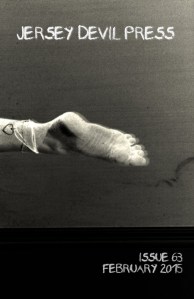
jdp cover feb 15 frontThe February issue of Jersey Devil Press has been out for a few days now, so surely you’ve read it by now. If you haven’t, get over there for the awesome: we ride roller coasters (of love), we do a little native (love) magic, we play with a (love) snake, we erect epic, long-lasting monuments (this is getting a little sexual now), we have heart attacks (get it?), then we run away to a deserted isle and wait for the buxom ladies (and the occasional moron) to turn up.

And then there’s that long, long leg on our cover, courtesy of Czech artist Radka Bartůsková (check out our cover-art page for the full effect of her photograph “I Am a Skin and a Lotion Soaking Up Myself“).

Who needs chocolate and flowers when you have the Jersey Devil in February?

Why I’m watching for the Watchman

First, I want to say that I am thrilled at the news of a second book from Harper Lee.

I say that first because, while I’m not alone in my enthusiasm, there is also a lot of rumor and speculation and skepticism surrounding the recent announcement about Go Set a Watchman, a kind of prequel/sequel (according to the press release, Harper Lee wrote Go Set a Watchman before To Kill a Mockingbird even though the events take place after To Kill a MockingbirdTo Kill a Mockingbird is effectively the back story of Go Set a Watchman).

Some people are suggesting that there is some sort of shady deal or even a conspiracy afoot — that, at best, HarperCollins is taking advantage of an elderly and possibly senile woman for purely financial gain, or that, at worst, her current lawyer is fabricating or abusing this entire situation and releasing this book against Harper Lee’s lifelong wishes. To read those rumors is to dip your toes in the waters of conspiracy theory, and if you read the commentary on some of these articles, the conspiracies get more complicated and more absurd from there.

It is, of course, entirely possible that Harper Lee, who is in fact quite old, is senile and is being taken advantage of. And it does make a kind of sense, in a simplistic, storytelling world, that, in the past 55 years, Harper Lee never published this book because she never wanted to, and the only explanation that it’s being published now is that it’s being done against her wishes.

But that reasoning only makes sense if you assume that people are manufacturing her comments quoted in the New York Times article anouncing the publication, in which she states quite clearly that she’s thrilled that people have discovered this manuscript she herself lost ages ago and that they are interested in publishing it all these years later.

But I don’t actually care about those rumors, that conspiracy speculation. If Lee is being taken advantage of, shame on anyone who would do such a thing. But as a reader, I am exhilarated at the idea of reading a second work from a writer so accomplished that she has gained a place in American letters on the strength of a single book.

Which leads me to the skepticism, because a lot of people are nervous at the idea that this second book, which Lee wrote first but never published, is in fact as bad as most first books tend to be, and that it might ruin her reputation. And they could certainly be right. We have plenty of examples of authors publishing earlier works late in their career just on the strength of their name, or, as some have (to my mind cynically or offensively) made the comparison, works published posthumously after a writer has died, especially when that writer has expressly asked those works not be published. (It seems grossly offensive to me to suggest that Harper Lee’s situation, while she is alive and, at least according to her comments in the New York Times, lucid, is in any way comparable to a dead author, or to presume that we know what her wishes are in this situation, let alone that we know her wishes are the opposite of what she herself is quoted as saying this week. But such is the nature of the Internet, and such has always been the nature of readers: we love to assume that we know what everyone else is thinking and doing, and we love to latch onto the authorial intentional fallacy.)

This latter skepticism, particularly as connected to this question of an author’s right to deny the publication of a work, is interesting to me. I confess (and I’m taking this only in terms of postumously published works and not getting into Harper Lee’s current wishes) that I fall into that camp who believes that an author’s wishes after death can be trumped by readers’ desires for more material. I certainly understand the desire to protect an author’s reputation and legacy, particularly from people who might publish works without concern for the author’s legacy or any attempt to honor the author’s voice or style or stated intent for a piece. But, personally, I feel that when I die, the rights to my work will go to whoever inherits them and I have no more say in the matter because I’ll be dead. I’m not a Viking; my works and my story do not assure my immortality except on the page. Let people do with me what they will.

But this is not the case with Harper Lee, because she is still alive, and since I don’t know her medical condition or her mental state (and I doubt any but her closest friends and family do either), I have to assume that this is something she intended. And even if she didn’t, a lot of cynical people are, however cynical, rightly pointing out that this book, now that it’s been rediscovered, would have appeared in print after her death anyway. Such is the nature of things. So what harm does it do to be published in now, especially if it is done in a way that can benefit Lee financially while she is still alive?

All of which is beside the point. Because all the speculation about the damage this book might do to her reputation is dependent upon the assumption that the book is no good and will definitely damage her. And I make no such assumptions. Firstly, why on earth would we assume that one of our greatest modern writers, whose reputation we are so fiercely protecting based on a single text, would have produced anything less than good, if not a second stellar masterpiece? And secondly, even if the book is mediocre, if her first book is so good that we seek to protect her from a second, then how can that first book possibly be threatened by a lesser work? Each book should be able stand on its own.

Most writers have greater works and lesser works. Jane Austen saw the publication of two of her books posthumously, both of which were not the fully realized texts she might have published had she lived long enough to finish revising them, as well as the publication of her juvenilia and several unfinished works. She is still our beloved Jane, and we still cherish her work. (Austen’s Northanger Abbey was, like Go Set a Watchman, Austen’s first finished novel, but it never saw publication until after Austen’s death, and while a lot of people shrug off that novel as inferior to, say, Sense and Sensibility or Pride and Prejudice, I love Northanger Abbey. Austen’s other posthumous and technically finished though unpolished novel was Persuasion, and that novel routinely vies with P&P for readers’ favorite Austen novel.) Why would it be otherwise with Harper Lee?

So I don’t begrudge anyone their apprehension about this new book, particularly because it is so easy to conflate excitement with nervousness. And I don’t begrudge anyone their conspiracy theories or speculation regarding the deal that led to this publication, because, if not in the comments then at least in the articles I’ve read, most people seem to be expressing their concerns in an interest of protecting Harper Lee and her legacy. And that’s respectable.

But I for one am eager to see the new book, both as a writer and a student of craft and as a fan of Lee’s (now first, not only) novel.

As I told my writing students when the news was first announced, this is a reminder to us that those books we keep in our drawers might still be worth something, if only we can live long enough to work on them enough to make them beautiful.

And it’s a reminder that it’s never too late, and we’re never too old, to tell a good story.

A left-hand turn

Last Tuesday night I watched a blender fall from my kitchen cabinet and reflexively I reached to catch it. I was either too fast or too slow, because the blender hit the granite countertop and shattered just as my hand arrived. In effect, I wound up punching quarter-inch-thick, cut glass, resulting in an inch-long slice along my pinky knuckle that reached deep, to the bone.

It was my left hand. My writing hand.

My writing hand.

My wife and I spent all that night and into the dawn hours in an emergency room as doctors and residents and nurses flushed the blood from my wound, tied off a severed artery in my hand, and took x-rays, warning me that there might be damage to the tendon. Then they stitched me up and sent me to a hand specialist.

The next day, I noticed my pinkie was dangling, limp. It contracted fine, joining the rest of my fingers in a sore fist, but it could not extend. I chalked it up to residual numbness and swelling from the ER, and maybe a side effect of the painkillers. But on Friday, the specialist confirmed what I feared: the tendon was severed and I would need surgery.

So far, I had been taking all of this in stride. I’m not afraid of my own blood, and I’m not unfamiliar with emergency rooms, having suffered bleeding ulcers and crushed vertebrae in the past. In the emergency room last week, I eagerly watched as the doctors stretched open my wound to expose my bones and manipulate the knuckles and the tendon in there. I was fascinated by my own internal anatomy.

But as I spoke with the hand specialist, who was describing the days of surgery and recovery, the splint or cast I would have to wear for at least a month, the nearly twelve months of physical therapy to recover full use of my hand, I began to feel disoriented. Disconnected from myself. Worried.

As the uneasiness swelled over the next few days, I tried to sit with it, to understand it, and I finally realized that this wasn’t just a wound to my hand — this was a threat to my writing.

I typically do most of my writing these days on a keyboard, mostly my laptop, so I don’t have the same connection between my writing and my writing hand as I might have had a decade ago. And I know that my dread here is a bit ridiculous. Plenty of writers have carried on under much more trying circumstances than this. And I trust my doctors and I know this will all heal up in the end, and I’ll be fine.

But every time I feel that twinge in my pinky, when I see the impotence of it as it dangles below the rest of my fingers, every time I bump this lame finger against something because I’m unaccustomed to its uselessness, I feel somehow shaken in my identity as a writer.

Long ago, I had a discussion with my students about the tactility of writing and the difference between writing in pencil or pen and writing on a keyboard. We all agreed that there is some qualitative difference, though I continued to lean in favor of my machines. This past fall, a new student of mine was adamantly anti-typing and preferred to write all of his essays for class in longhand with a fountain pen on nice paper. I admired — and sympathized with — his desire to feel his writing. He even gifted me an inexpensive fountain pen just to remind me of what writing felt like. I took the gift as a challenge to reconnect with handwriting.

Now I cannot use his pen for at least a month, maybe longer. And for the rest of this term, when I grade my students’ essays, I’ll have to do so by computer, instead of my usual habit of scratching notes in pencil on their pages. The same is true of my own writing — it will all have to be by computer now, by necessity rather than by choice.

Technology affords us so many avenues these days, and I’ve been typing comments on Facebook and writing emails to colleagues and friends. I have voice recognition software on my phone, which I’ve blogged about before, and I’m using it now to write this blog post. So I’ll be able to write, and in much the same way as I usually write.

But in truth, this blog post is the most writing, in both seriousness and in length, I’ve done since the accident. I haven’t written any fiction in a week now. I have materials in my study and beside my bed, waiting for me to get to work. I have files still open on my laptop from a week ago, before the blender. But I’ve had this psychological block for days. Because I can’t write long-hand, I suddenly don’t want to write any other way.

My mother’s first comment when she found out about my injury was to worry about the novel I’ve been working on this winter. And she’s right. Even with the technology of typewriting or voice recognition, the work will be so much slower now that I worry about regaining the kind of momentum that drove me through my first published novel.

I wonder how long it will be before I can write the way I used to. I wonder even if I should be writing the way I used to.

One writer friend of mine, when reading the news of my injury on Facebook, told me this injury and long recovery might be a good thing. He related how he had once injured his hand and in rehabilitating his fingers to a pen or pencil, he had to slow down, which in turn slowed down his thought processes and his consideration of the words he used. He said being injured made him a better writer. I don’t doubt this at all. In fact, I anticipate it. I hope this will make me a better writer, or at least a more mindful writer, which as a Buddhist I should be striving for anyway.

So that’s how I’m trying to embrace this injury: it is a chance to rethink how I write, to slow down and improve my writing. This is a chance to rediscover myself as a writer. To consider all over again what it is I do and why I do it.

One thing I know for certain: I will keep writing even through the injury. Especially through the injury. When my hand specialist said that it might take a year to regain full use of my fingers, I almost laughed at him. I was thinking at the time, before I’d had a chance to walk away and overthink things and begin to freak out, that this doctor didn’t understand what it means to a writer to have full use of his hands. He doesn’t realize how hard I will work — how much of the work I already do is hard — and how eager I am to recover. How fast I will work to regain the use of my writing hand.

Being a writer means living with this bizarre, lurking self-doubt, this fragility that makes us all so prone to fearing rejection, bemoaning hiccups, worrying about any imperfection. We make this myth of writer’s block — and it is a myth — our invented reality.

But writers live a contradiction, because being a writer means also being determined in the face of anything, it means feeling like you have so much to say that no amount of self-doubt can stop the words from coming, that you have to write no matter what.

I’ve wrestled with this blog post for days, feeling I needed to write about what I was feeling and thinking, in part to laugh at myself for being so worried about it and in part to understand that worry and work through it. But I’ve come to think of this writing, these past couple of days, as a siphon. I often tell my students that writing is a bit like siphoning gas — you suck on the hose and spit out the fuel until the gas starts flowing on its own, and then you just let gravity do the rest. You write and you write until the words start flowing, and then you let them come.

It’s taken me a couple of days of thinking and overthinking and worrying and speaking into my phone and typing with one hand and massaging my sore wound, but the words are coming. I’m ready to get back to work.

Writing hand or no, I have to keep writing. No matter what.

Going home again

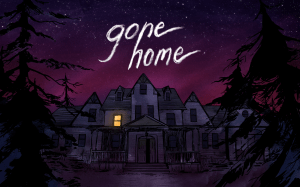
I don’t normally think of video games in narrative, literary terms. Sure, plenty of video games depend on story and follow some kind of linear narrative, but (and I’m not an extensive gamer, so gamers, feel free to add titles in the comments) I don’t often come across a game that is so immersive and so focused on storytelling (as opposed to puzzle-solving or other gameplay elements) that it feels more like interactive literature than anything else. That old game MYST felt a bit like that. Some of the best Nancy Drew games from HerInteractive can sometimes feel a bit like that.

"Gone Home" by The Fullbright Company - http://www.thefullbrightcompany.com - Steve Gaynor, The Fullbright Company. Licensed under CC BY-SA 3.0 via Wikimedia Commons - http://commons.wikimedia.org/wiki/File:Gone_Home.png#mediaviewer/File:Gone_Home.png
Gone Home” by The Fullbright Company.

But I just finished Gone Home, and this game feels like something else altogether. It’s a bit like a novella that you get to literally (well, digitally, anyway) walk around inside of.

The tease for the game is intriguing enough: “You arrive home after a year abroad. You expect your family to greet you, but the house is empty. Something’s not right. Where is everyone? And what’s happened here?” The promo material describes the game as “an interactive exploration simulator,” and promises an exhaustive, immersive environment: “Interrogate every detail of a seemingly normal house to discover the story of the people who live there. Open any drawer and door. Pick up objects and examine them to discover clues.”

I love that level of detail, and in most games like this, I’m often frustrated by the limitations of what you can mess with in the game. For me, the restriction of an interactive environment to just a handful of key “clues” when there’s SO MUCH MORE going on in the background has always just served to reinforce the artificiality of a game, and this problem only gets worse as game visuals get more detailed. Why put all that effort into fleshing out richly complex backgrounds if I can’t actually engage with that detail? But Gone Home promised that I could engage, that I could actually live in this “seemingly normal house” and interact with anything.

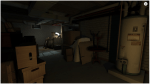
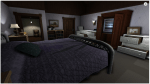
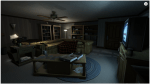
And the screenshots seemed to reinforce this:

And in the trailer the gameplay looked smooth and organic, very much first-person POV but without being too shaky, without too much effort to artificially imitate a “human gait” with that swimming up-and-down head bob I’ve disliked since the old Doom games. It all just looks so beautiful:

If you watch that trailer, you might have caught the final, deciding factor in my buying the game: that “destination” on “Katie’s” luggage tag? Portland.

That’s right gang. This game is set in my own hometown of Portland, OR. Or, just outside it, really — an old mansion in the hills west of the city.

Screen shot 2015-01-12 at 9.54.21 PMIt’s also set in the mid-90s, and while the game is packed with pop culture references to the time period in general — an invitation to see Pulp Fiction in the theater, a comment about Don’t Ask Don’t Tell, a poster for The X-Files — it’s also alive with these wonderful references to cultural moments distinctive to the Pacific Northwest: the waning of grunge, underground punk and demo tapes (the game’s load screen is a cassette tape), riot grrrl music, zines.

Katie’s dad is a writer; her mom is a ranger with the Forestry Service. The whole thing just screams nostalgia for me, not only for my own mid-90s life but also for the dream of the Portland I always wished I could have lived in back then, the culture I was trying to be a part of the best I could from way down in rural Texas.

It’s the kind of Portland a lot of people move here expecting; it’s the kind of Portland a lot of people already here keep fighting to preserve.

And here it is, in a video game, in a quiet, intimate narrative, in the first-person. It is preserved, and for a few hours, you get to live it in. You even get to listen to it: the game features songs (in the form of “bootleg” cassette tapes you find in the game) from actual riot grrrl bands Heavens to Betsy and Bratmobile, as well as the Portland band The Youngins.

But that’s all just icing. The cake — the sweet, rich world of the game — is the story itself, which is eerie and unsettling and heartbreaking and beautiful. It actually brought me to tears not just at the end but throughout the game. And it can do this because, as intense and atmospheric as the environment is — lights left on in the otherwise empty house, the place ransacked, a storm raging outside, dark corners and secret passages and deeply unsettling images — the main force in the game is its characters. Despite being absent at the outset of the game, everyone mentioned — the parents, the sister, the friends, the friends of friends, the colleagues, the relatives — they all have such rich backstories, which develop such complexity in those characters, that they feel present in the house, almost haunting it.

And that’s what makes this feel like fiction, like literature. The whole thing feels like you’re walking around not in someone’s game or even in someone’s house, but in someone’s life. In multiple lives. And the layers in those lives that you uncover as you progress through the game are expertly placed, unfolding and changing as the game goes on, uncovering inner lives and altering your assumptions as you go.

That’s where the real mystery in the game lies. You’re trying to figure out where your family (Katie’s family) has gone, but in the process you discover who your family really is, and how they’ve been changing while you’ve been away, and how that changes you and your perception of yourself.

And the whole thing speaks in echoes, speaks to broader issues of who we, as a society, used to be, and how we’ve changed and are still changing and how we still need to change.

I have to stop there before I give too much away. Before I get any more carried away.

I just really loved this story. In the way that I love a good book, the way I sometimes like to hold a book to my heart when I finish it. I wish I could press the gigabytes of this game into my chest.

It was that kind of experience.

Repairable Men, by John Carr Walker

Folks who follow me on Twitter or Goodreads have likely already seen this review of John Carr Walker’s Repairable Men, but I liked the book so much that I wanted to include the review here, too.


Repairable Men: StoriesRepairable Men: Stories by John Carr Walker

My rating: 5 of 5 stars

Repairable Men starts out simply enough, a terse story of brotherly conflict and maturity and domestic discord and the things men inherit from their fathers. But in the last paragraph the whole world shifts, signaling what the book truly is: a resonant mythology of masculinity.

You wouldn’t think we needed more stories like this. Surely we have had plenty of men telling stories about men — about our efforts at heroism and our pathetic defeats, about how hard men have it even though we live in a world of men.

But, it turns out, we do need John Carr Walker’s stories. Because as hard and sometimes violent as these stories can be, Walker treats the characters with a gentle sympathy and humanity. The book has its share of abusive fathers and bumbling fuck-ups, but it also has fathers who are simultaneously sad in their clinging to old dreams but beautiful and heroic in their love for their sons. It has lost brothers returning to themselves and bringing order to the world. It has tenderness and confusion, and when it reveals that there aren’t any answers in the world — in spite of the title, very few of these characters are repairable — it offers you the comfort of knowing that you aren’t alone in that revelation.

My favorite stories in this book are the ones about fathers and sons. Some of them, like “The Atlas Show” or “Candelario” or “The Rules,” are overt, the father-son relationship central to the story. Others, like “Ain’t It Pretty” or “Brother Rhino,” are more oblique, glancing at the father or the son from the edges of some other story, but that relationship still defines — almost always in negative space — the world the characters inhabit. There’s something about the way Walker writes these stories that speaks to me, as though the author and I share some secret.

In the same way that nostalgia is both sickening and addictive, or that bittersweet combines opposites, Walker creates a terrific combination of unease and comfort in these stories, the two emotions always slipping past each other like two magnets of the same polarity, but doing so with that same invisible pressure. I always like to hold two opposing magnets together, to feel them push against each other with a force I can feel but can’t see or fully understand — and I like to press them together as hard as I can until they meet. That’s the sort of thing Walker accomplishes in all these stories but especially in the father-son stories: that invisible pressure, and the weird delight in pushing past the pressure.

Repairable Men is a powerful little book, and I eagerly await John Carr Walker’s next book.

View all my reviews

The Jersey Devil loves pop tarts

jan15coverWe gorge ourselves on junk food and zoo animals and then we belch the belch of universes. Even the dinosaurs are impressed.

And that, boys and girls, is basically the gist of our entire January issue!

(No, seriously. Just read it. You’ll see.)

Also, we’re extremely proud to start our new year with this fantastic cover art from architect and designer Katerina Kamprani! What better artist to kick off 2015 than one who specializes in making us all feel Uncomfortable?

Because that’s how we do it.

Happy New Year!

#Je suis Charlie

(Premièrement, s’il vous plaît excuser la maladresse de mon français. Mon français est tellement rouillée c’est décrépit, et oui, j’ai complété mes compétences linguistiques pauvres avec Google.)

Comme beaucoup de gens — en particulier de nombreux artistes et écrivains et autres créateurs dans le monde — j’ai fait beaucoup d’introspection aujourd’hui.

Pour les peu de gens en ligne qui n’ont pas encore entendu parler, aujourd’hui, trois fous armés ont fait irruption les bureaux parisiens du journal satirique français Charlie Hebdo et massacrés douze personnes, dont un agent de police, le directeur du journal, et de quatre caricaturistes. Onze autres sont blessés, dont quatre sont dans un état critique.

Les fous (un mot que je suis en utilisant intentionnellement, et je refuse de donner leurs noms) semble avoir ciblé l’éditeur et caricaturistes. Sur la base de leurs cris pendant l’attaque, ils semblent réclamer une motivation religieuse.

(Je dis “réclamer” parce qu’il n’y a pas de motivation religieuse légitime pour assassiner. Je refuse d’accepter qu’il y est. Celui qui professe d’assassiner au nom de la religion est délirant et ne parle pas pour la religion qu’ils prétendent.)

En France, une société profondément laïque qui champions liberté d’expression encore plus ardemment que nous faisons en Amérique, ils appellent cela un attentat à la liberté d’expression, et il est absolument. Charlie Hebdo est une publication controversée radical qui est volontairement provocateur dans sa satire, mais que la provocation est enracinée dans une expression de la liberté stridente. C’est une liberté d’offenser, bien sûr, mais c’est une liberté artistique, et en tant qu’artiste, je suis horrifié par l’atrocité d’attaquer, et encore moins tuer, n’importe qui en raison de leurs expressions artistiques.

Mais je suis aussi une personne profondément religieuse, et je respecte et honore toutes les traditions religieuses du monde. Que figuré ou littéralement, il y a des choses telles que «vaches sacrées», et j’ai longtemps cherché à respecter et le respect sacré dans ma vie quotidienne. Cela ne signifie pas que toute religion est irréprochable — loin de là. Parce que je suis religieux, je détiens toutes les religions à un niveau très élevé et attends le meilleur d’entre eux. Et je suis absolument d’accord que lorsque certains aspects de tout système de croyance donnée sont, sur leur visage, ridicule, alors, par définition, ils méritent ridicule. Cela inclut la foi que j’ai grandi dans, le christianisme, ainsi que la religion que je pratique actuellement, le bouddhisme. Cela inclut l’Islam, une religion pour laquelle j’ai beaucoup de respect profond et durable, et dans lequel je compte des amis proches. Mais si quelque chose dans une religion est absurde, c’est absurde; si c’est le sens d’humour, c’est humoristique. Et j’ai ri de nombreuses blagues inoffensives au détriment de nombreuses religions, y compris le mien.

Mais il y a de l’humour, et puis il y a la décence humaine fondamentale et le respect mutuel.

Je ne cautionne ni n’approuve tout ce que Charlie Hebdo a publié. Je trouve beaucoup d’offensant, certaines d’entre elles répugnant, et une grande partie franchement juvénile. La publication dit qu’ils ne ciblent pas quelque chose de spécifique, que ce qu’ils se moquent de l’extrémisme partout où ils le voient, et je applaudis cette sensibilité. Mais quand quelqu’un dit qu’ils sont des délinquants égalité, qu’il n’y a pas de vaches sacrées, ce qu’ils signifient en général, c’est que quand ils sont connards, c’est correct, parce qu’ils sont connards à tout le monde. Et honnêtement, ce n’est pas correct — c’est juste être un connard.

Pourtant, je crois passionnément le droit de quiconque d’être un connard, et certainement dans le droit de quiconque de ne pas être tué pour être un connard. Le droit à la vie est encore plus sacré pour moi que le droit à la liberté d’expression, et en tout cas, parce que je crois que nous avons tous le droit de nous exprimer librement, même quand il est offensant pour le faire, je ne comprends pas — en fait, je abhorre — ces gens qui sont tellement bête et si ignorant que la réponse habile à l’infraction qu’ils peuvent penser est la violence.

Je suppose une chose qui rend cette première difficile mais finalement facile à prendre position sur c’est que dans la liberté d’expression — si elle prend la forme de l’art ou du texte ou de la chanson ou de l’action — la ligne qui divise c’est offensant de ce qui est drôle, c’est brut et inutile de ce qui est artistique et essentiel, c’est plein d’esprit de ce qui est ridicule et irrespectueux, est vaste, un ligne grise, densément brumeux. Il est presque impossible d’articuler, à définir. Nous pouvons rester dans les chambres et argumenter sur cette distinction sur tout l’art particulier, et encore moins un corps entier de travail ou mouvement artistique, pour toujours. Vous pouvez mettre une centaine de personnes dans une pièce et leur demander c’est offensant et ce qui est hilarant et, si vous leur permettez de nuancer leurs réponses, vous obtiendrez une centaine de réponses différentes. Peut-être un cent cinquante.

Mais dans la violence, la ligne est claire et nette. D’un côté de cette ligne, il y a l’attaque, il y a assassiner, il y a le terrorisme, il y a brutalité. Et de l’autre côté de la ligne il y a la société, en reculant d’horreur de ces mesquins, actes pathétiques.

Donc, aussi difficile que cela peut parfois être de défendre ce que je n’aime pas dans l’art, il est extrêmement facile de condamner ceux qui réagissent à cet art à la violence.

Je pense que notre travail en tant qu’artistes est de provoquer. Je préférerais que nous provoquons la pensée, que nous provoquons le débat, et non que nous provoquer intentionnellement indignation en étant malveillants dans notre ridicule. Mais alors où doit-on tracer la ligne entre ce genre de provocations? Parce que je ne sais pas une réponse unique et définitive à cette question, je dois défendre tous provocations, et alors que je ne suis pas nécessairement un fan de tout ce que Charlie Hebdo publie, je déclare absolument et avec fierté aujourd’hui, je suis Charlie!
charlie

(First, please excuse the awkwardness of my French. My French is so rusty it’s decrepit, and yes, I supplemented my poor language skills with Google.)

Like many people — especially many artists and writers and other creators in the world — I’ve been doing a lot of soul-searching today.

For the handful people online who haven’t heard yet, today three armed madmen stormed the Paris offices of the French satirical newspaper Charlie Hebdo and massacred twelve people, including a police officer, the newspaper’s director, and four cartoonists. Eleven others are injured, four of whom are in critical condition.

The madmen (a word I’m using intentionally, and I refuse to give their names) seemed to have targeted the editor and cartoonists. Based on their shouts during the attack, they seem to be claiming a religious motivation.

(I say “claiming” because there is no legitimate religious motivation for murder. I refuse to accept that there is. Anyone who professes to murder in the name of religion is delusional and does not speak for the religion they claim.)

In France, a deeply secular society that champions free speech even more ardently than we do in America, they’re calling this an attack on freedom of expression, and it absolutely is. Charlie Hebdo is a radical, controversial publication that is intentionally provocative in its satire, but that provocation is rooted in a strident expression of freedom. It’s a freedom to offend, to be sure, but it is an artistic freedom, and as an artist, I am horrified by the atrocity of attacking, much less killing, anyone because of their artistic expressions.

But I also am a deeply religious person, and I respect and honor all the world’s religious traditions. Whether figuratively or literally, there are such things as “sacred cows,” and I’ve long striven to uphold and respect that sacredness in my daily life. That doesn’t mean that any religion is above reproach — far from it. Because I am religious, I hold all religions to a very high standard and expect the best of them. And I absolutely agree that when certain aspects of any given belief system are, on their face, ridiculous, then by definition they deserve ridicule. That includes the faith I was raised in, Christianity, as well as the religion I currently practice, Buddhism. That includes Islam, a religion for which I have deep and abiding respect, and in which I count close friends. But if something in a religion is absurd, it’s absurd; if it’s humorous, it’s humorous. And I have laughed at many harmless jokes at the expense of many religions, including my own.

But there’s humor, and then there’s basic human decency and mutual respect.

I do not condone or endorse everything that Charlie Hebdo has published. I find a lot of it offensive, some of it repugnant, and much of it frankly juvenile. The publication says that they don’t target any specific thing, that what they mock is extremism wherever they see it, and I applaud that sensibility. But when someone says that they offend equally, that there are no sacred cows, what they usually mean is that when they are assholes, it’s okay, because they’re assholes to everybody. And honestly, that’s not okay — that’s just being an asshole.

Yet I believe passionately in anyone’s right to be an asshole, and certainly in anyone’s right not to be killed for being an asshole. The right to life is even more sacred to me than the right to freedom of expression, and in any case, because I believe we all have the right to freely express ourselves, even when it is offensive to do so, I do not understand — actually, I abhor — those people who are so base and so ignorant that the cleverest response to offense they can think of is violence.

I suppose one thing that makes this first difficult but ultimately easy to take a stand on is that in free expression — whether it takes the form of art or text or song or action — the line that divides what is offensive from what is funny, what is crude and unnecessary from what is artistic and essential, what is witty from what is ridiculous and disrespectful, is a vast, gray, densely foggy line. It’s almost impossible to articulate, to define. We can stand in rooms and argue about that distinction on any particular art, let alone an entire body of work or artistic movement, forever. You can put a hundred people in a room and ask them what is offensive and what is hilarious and, if you allow them to nuance their answers, you will get a hundred different answers. Maybe a hundred and fifty.

But in violence, the line is sharp and clear. On one side of that line, there is attack, there is murder, there is terrorism, there is brutality. And on the other side of the line there is society, recoiling in horror from these small-minded, pathetic acts.

So as difficult as it can sometimes be to defend what I dislike in art, it is extremely easy to condemn those who react to that art with violence.

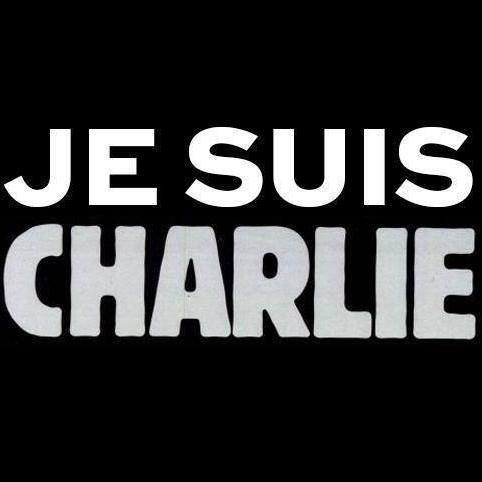
I feel that our job as artists is to provoke. I would prefer that we provoke thought, that we provoke debate, and not that we intentionally provoke outrage by being malicious in our ridicule. But then where does one draw the line between those kinds of provocations? Because I don’t know a single definitive answer to that question, I have to defend all provocations, and while I’m not necessarily a fan of everything Charlie Hebdo publishes, I absolutely and proudly declare today, Je suis Charlie!

Books that surprised David S. Atkinson

David S. Atkinson, whose book Bones Buried in Dirt just plain delighted me this time last year and whose preview of Hagridden this year was beautiful and so greatly appreciated, well, he’s gone and done something awesome again.

Not a great believer in “top books” lists, David has instead listed some books that surprised him this past year. “These ones are from authors who I was already familiar with, but the authors did something so interestingly different from their other work I’ve read that I wanted to make special note.”

And there’s Hagridden on the list. David had previously read Box Cutters, which, for those who haven’t picked it up yet, is indeed quite different from Hagridden. One is a dense and violent historical novel; the other is a compact chapbook of tight flash fiction involving contemporary characters and situations.

I’m thrilled that David liked them both!

Also on David’s list, some books I’ve heard great things about and want to read soon, like David Mitchell’s Black Swan Green, as well as books I read a while back and still love and refer to all the time, like Irvine Welsh’s Marabou Stork Nightmares.

And then there are the bevy of books by writer friends of mine, which you definitely need to pick up copies of ASAP:

  • Ryan W. Bradley, Love and Death in the Moose League
  • Timothy Gager, The Thursday Appointments of Bill Sloan
  • Jon Konrath, The Memory Hunter
  • Edward J. Rathke’s Twilight of the Wolves
  • Michael J. Seidlinger, Metronome
  • Ben Tanzer’s Lost in Space: A Father’s Journey There and Back Again

That’s some amazing company to be in, folks!

And seriously, you need to get all these books. But instead of linking to them, I’ll just send you over to David’s post, where he lists even more great books and links to all of them.