The wishing tree

In my neighborhood here in Northeast Portland, someone has put together a Wishing Tree. The tree is full of small nails, and there are two clipboards, one explaining the concept and the other holding a plastic baggie full of cardstock tags and a permanent marker. The idea is to take a tag, write your wish on it, and hang your wish on one of the nails.

I’ve been stopping by the tree for months, just to check in on the wishes, but I’ve been meaning to take some time and snap photos of the tree. Today, my wife and I were out for a walk, and we had the camera with us so I could snap photos of Jennifer for her style blog, and the sun was out and the day was winter-chill perfect, and I figured now was the time to photograph the tree.

As I walked around the tree reading tags and snapping photos, I realized this was something I wanted to share with you, friendly readers. So here you are. Wishes hung to spin in the breeze.


IMG_2305

IMG_2306

IMG_2307

I wish for an elehant in my dream -- Archer 3yr
I wish for an elehant in my dream — Archer 3yr
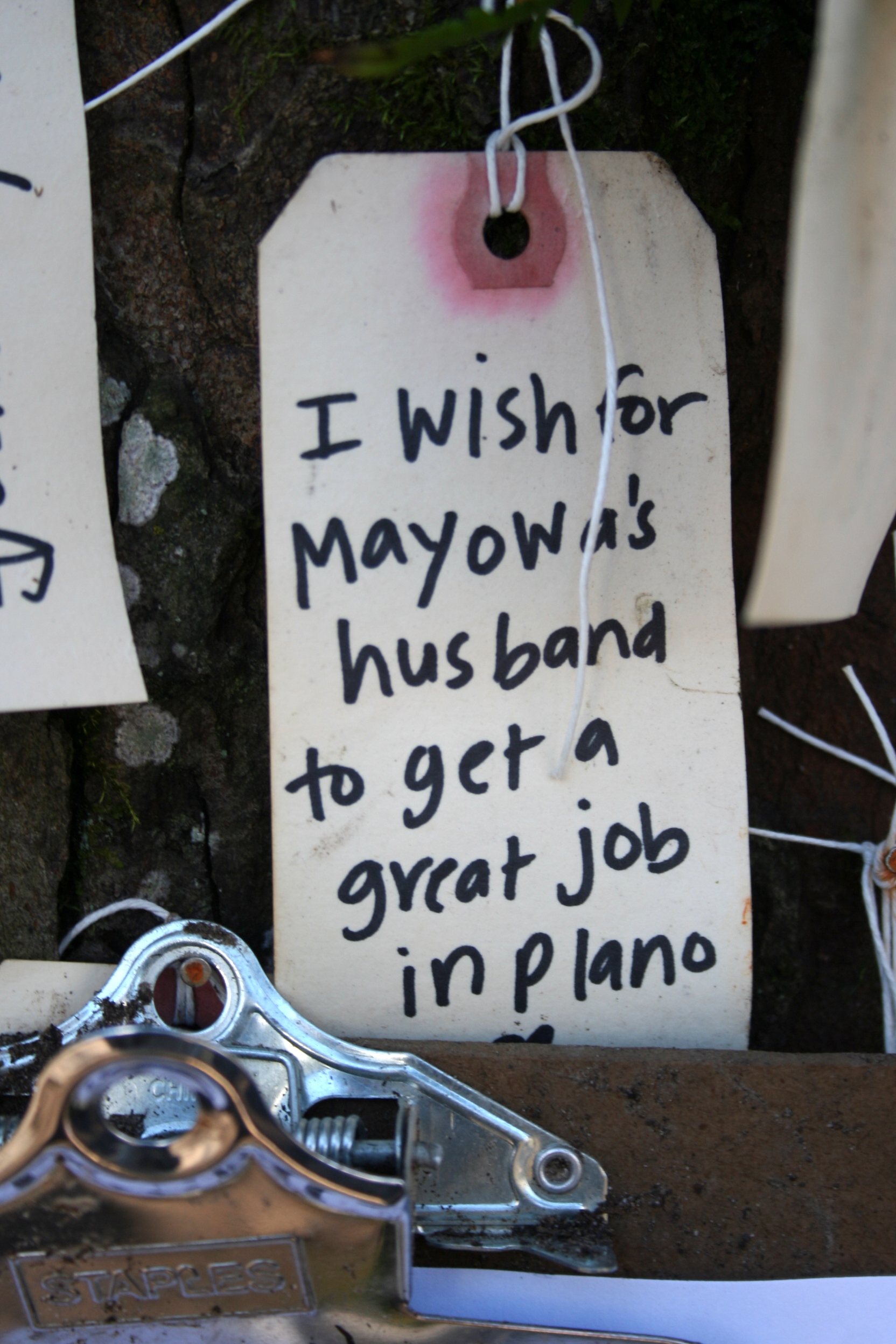
I wish for Mayowa's husband to get a great job in Plano. (TX?)
I wish for Mayowa’s husband to get a great job in Plano. (TX?)
I wish for a great love to enter my life. And love for all to receive.  ||  I am wishing for my family's heath, safety & happiness & sobriety & to move to a great new place w/ W/D & yard  ||  I wish a pony for everyone. :)
I wish for a great love to enter my life. And love for all to receive. // I am wishing for my family’s heath, safety & happiness & sobriety & to move to a great new place w/ W/D & yard // I wish a pony for everyone. 🙂
I wish for Nick to love me forever. ...And a dog.
I wish for Nick to love me forever. …And a dog.
peace <3 || I wish for the courage to do these things I can't seem to do and to feel surrounded by friends as I do it. xoxo  ||  I wish for another baby.
peace ❤ // I wish for the courage to do these things I can’t seem to do and to feel surrounded by friends as I do it. xoxo // I wish for another baby.
I wish I could be Spider-Man.
I wish for grandpa to smile down on us from heaven this holiday season & to know he is dearly missed. <3
I wish for grandpa to smile down on us from heaven this holiday season & to know he is dearly missed. ❤
I wish that no one smoked and everyone had a home.  ||  I wish for everyone to love unconditionally.
I wish that no one smoked and everyone had a home. // I wish for everyone to love unconditionally.
I wish for good health for my whole family.
I wish for a full recovery for Jim (we need him in our lives!)
I wish for no bullying ever again! -- Shyann age 13
I wish for no bullying ever again! — Shyann age 13
I wish all your wishes could true! Love this idea.
I wish all your wishes come true! Love this idea.

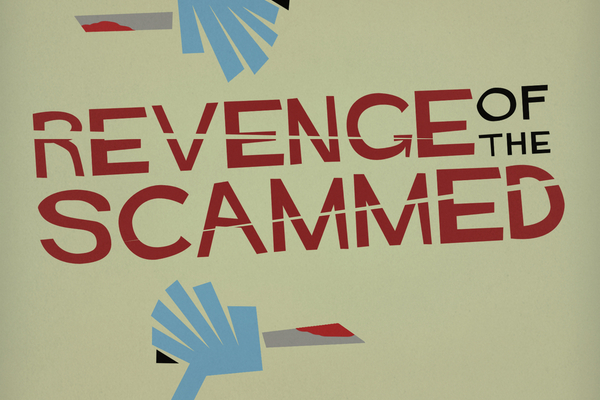
New publication — in the Revenge of the Scammed Anthology!

I’ve been hyping this off an on, but I have new news about it: The Revenge of the Scammed Anthology, a benefit book to help out writer Edward J Rathke, will now include a new story by me, written just for this project!

image

So if you haven’t donated to the campaign yet, head over there now and chip in. Chip in enough and you could even get a copy of the book — digital or print — and read my new story. Chip in a bit more, and you could score a signed copy of my chapbook, Box Cutters.

ATTN: Indie Lit Community

Author Michael J Seidlinger has put together a hell of a list of indie-press awesomeness coming our way in 2014. I’m on this list (Hagridden is coming your way this fall, gang!), but so are dozens of other writers I know and love. What’s particularly cool is that Seidlinger also includes some announced anthologies and contests, like a collection of anthologies from Broken River Books, or the cool-sounding neo-noir anthology coming out from Curbside Splendor; or like the 421 Atlanta Chapbook contest that Mary Miller is judging, or the Rose Metal Press chapbook contest judged by Michael Martone. (Some of these contests are still open for submissions, folks!)

Clear some shelf space, everyone. 2014 is going to be a hell of a year for books.

Unknown's avatar

Author Michael J Seidlinger has put together a hell of a list of indie-press awesomeness coming our way in 2014. I’m on this list (Hagridden is coming your way this fall, gang!), but so are dozens of other writers I know and love. What’s particularly cool is that Seidlinger also includes some announced anthologies andContinue reading "ATTN: Indie Lit Community"

View original post

“In this moment I want to allow myself joy.”*

The biggest lie I ever told myself about writing is that I had to hurry up and do it. Every time I sat down and thought about writing — and I don’t know why I put that in the past tense, because I still do it — I would tell myself the get the words out, to finish the draft and revise the draft and get the work out there. Get it into print, get it in front of readers. I would tell myself that if I didn’t finish this story or publish that book as soon as possible, I was failing as a writer.

In terms of productivity, this lie has been a wonderful lie. I’m not as prolific as some, but I’m more prolific than you’d think, and many friends — writers and nonwriters alike — have marveled at how frequently I seem to publish. “Really?” I’ll always tell them. “To me it’s felt like ages.”

I’m a deeply impatient person, at least when it comes to myself and my work. I need to write down an idea the minute it comes to me, and I’m distracted unto uselessness until I can find a place and a few minutes to get that idea down. I feel like I need to finish a story almost as soon as I’ve started it, often with the ironic result that I’ll throw away and restart the thing several times because it keeps coming out worse than I imagine the final draft will be. If I’m writing a book, I’m working on the pitch in my head before I’ve even finished the manuscript, and I’ll pace my living room and wring my hands for months until someone either turns it down or, the two times this has happened so far, accepts it. When a story or a book gets rejected, I’ll daydream myself into a fury over what might have been, not because the rejection bothers me so much but because I was already imagining the thing in print, and any delay in that is maddening to me.

But this is all predicated on a lie. This is the realization I’ve had recently. I don’t really have to be in any hurry to do anything.

For years (and years and years), I’ve had the idea that there are great works hiding inside me somewhere, and if only I can find the right shadow on the surface of the pond, cast a line with the right flick of the wrist, feel the right tug, I can hook whatever it is down there and reel it to the surface. For years, I’ve always felt my best writing is down there somewhere, yet to emerge.

This is a stupid thing to think. Already some of my best writing has bobbed to the surface, sometimes because I found it but sometimes because it simply floated up and I was there to see it happen. My chapbook came together through years of hard work, but some of the stories in it seemed to have happened all on their own. My novel took me four years to figure out and another three to write, and I’m doing a final round of edits soon, but when I first had the idea to write it, it felt whole and ready for me to discover — distant and indistinct in the haze, but definite, waiting for me to cross the miles of time to reach it. My story “Lightning My Pilot,” a finalist in this year’s Million Writers Award, took me less than twenty-four hours to put on paper, but the pieces of it — the ideas and the potential of it — had been running through my head since my college days, some seventeen or eighteen years back.

The point isn’t that these pieces were easy. They weren’t, not by a long shot. They were grueling, and mind-numbing, and agonizing. I agonize over them still. No, the point is that I always believed they would be good. There was a confidence in them from the outset, and for some reason I can’t fully explain, I didn’t feel any crushing urgency about them. I knew they were good and I knew they would always be good, whether I was good enough yet to write them or not. So I left them until we both were ready, the stories and I, and then we met like old friends. Like an old couple. We came together, the words and I, and we understood each other the way my wife and I understand each other, because we’d always been there. We knew we could count on each other.

About a month ago, I wrote a post about my routine in writing, and I ended it by explaining that I don’t have a routine so much as I have confidence: “So I don’t think it’s really a matter of making time for the work you love,” I wrote. “I think it’s much more peaceful than that. It’s about accepting the time when you have it, and when you don’t have time, it’s about having confidence that the work will be there waiting for you.”

Which is easy to write when I’m writing about routine. But there’s still that nagging issue of the “great” work, the extraordinary writing that is so much more than routine. That’s the work I was still anxious about. That requires a different level of confidence.

This all came back to the surface — this anxiety, this yearning to write great things and to do so in a damned hurry — after my wife and I watched Spike Jonze’s Her this weekend. It’s a stunning film, and I highly, highly recommend it, but that’s not what this is about. This is about me wanting to write something like that, something that good, and wishing I’d done so already. And so while I was wrestling with that, I was reading everything I could find about the film, which is to say, the bits and bobs on the movie’s IMDB page. I reread some of the quotes from the film. And I’m not going to give away the movie, but there’s a line at the end, a conversation between the protagonist and his operating system girlfriend, that is about patience and emotional discovery, about becoming who we are. And I reread those lines several times, and I replayed those scenes in my head, late at night, downstairs at my dining table in the dim overhead light. And I felt this sudden release.

I won’t call it “epiphany,” or “revelation.” Not really. It wasn’t any insight I gained. It was more an idea I was letting go of. It felt more like exhaling. And I realized, all the great things I might ever write, they’re there. Or they’re not there. But I’m not going to conjure them out of nothing, and I’m not going to grab them by the wrist and drag them screaming into the world. This writing I do — the kind of writing I want to do — it isn’t about forging something in a crucible or hammering it out on a hissing anvil. It’s a relationship. Me and the words, old friends that we are. I just need to spend time with them, writing and writing and writing, putting in the time and the effort, and some days will be ordinary and some days will be frankly shitty. But some days will be beautiful. Magic days where everything is going right and everything comes together, and  then the great writing will be there. As long as I’m present for it, it’ll be there.

And there was no more anxiety. There in the dim late night at the dining table, I stopped worrying about the writing. I got a cold glass of water. I went upstairs to bed. It would all be okay. I’ll still feel the urgency, I’ll still want to write as often as I have time for, and I know there will still be times when I’ll be pacing in front of the mailbox or refreshing my email every five minutes, anxious for replies about a submission or thinking ahead three steps in a draft, trying to get to the good stuff. But there’s a difference between urgency and desperation, between excitement and worry. And I know now that the writing and I? We’re going to be just fine.

There’s no need to hurry any of this.


* The title of this post is a line from the movie Her. Don’t worry — it doesn’t give anything away.

The Revenge of the Scammed

20131206102330-ScammeDA while back, a fellow writer, Edward J. Rathke, got ripped off. Long story short: a guy hired him to write a book, wrote a fraudulent check, and wound up scamming Rathke out of his entire savings.

So we in the writing community are banding together to help Rathke out — and get revenge on the guy who ripped him off!

The brainchild of Bartleby Snopes editor Nathaniel Tower, the plan is this: a whole gang of us writers are writing stories about the scam artist, using his (fake) name, and exacting our fictional revenge on him in print. The proceeds of the resulting book, The Revenge of the Scammed Anthology, will then go toward reimbursing Rathke for the money he lost.

And you can contribute to that reimbursement!

Donate to the campaign now, and you can get in on some great incentive packages, including a signed copy of my chapbook, Box Cutters.


The Jersey Devil likes all the best music, even at our age

jpd blind toast cover 1-14This month’s issue of Jersey Devil Press is all kinds of milestone-ish. Not only is it the first issue of 2014, it’s also the 50th issue. Fifty! It’s rare enough that any literary magazine makes it that far, but for a weird little online magazine that loves dick jokes and aliens that live on human poop as much as we love serious speculative fiction, that’s frankly astounding.

This issue also marks my second anniversary as production editor! And I’m still standing! Miraculous, folks.

But wait, there’s more: this month’s issue is so amazeballs that our content editor, Laura Garrison, made a playlist for the issue. And the music that goes with these stories? I mean, sure, it’s got some Springsteen and some Bowie and some Rockwell — yes, that Rockwell — but she had the genius/temerity to include Green Jellÿ’s “Three Little Pigs”!

Let’s all just pause for a moment to reflect on that.

I just had a high school flashback.

But let’s get to the fiction: we have haunting broken-romances about men turning to ashes and men growing gills, a fable about a smartassed fox scaring the bejeezus out of three pigs, a weirdly tender story about a meth-head who talks to dogs, and the existentialism of poor Waldo (can he find himself?).

Where’s Wally World Record (where you there?)
He’s in there somewhere.

And because it’s the New Year, we’re bringing you a toast from cover artist Pedro Abreu. And because we’re JDP, the toast is blind and eerie.

So here’s to the new year and the next 50 issues, gang! Cheers!

Enhanced by Zemanta

2013 in review

The WordPress.com stats helper monkeys prepared a 2013 annual report for this blog.

Here’s an excerpt:

The concert hall at the Sydney Opera House holds 2,700 people. This blog was viewed about 17,000 times in 2013. If it were a concert at Sydney Opera House, it would take about 6 sold-out performances for that many people to see it.

Click here to see the complete report.


17,000 views this year? Fewer than last year, but not too shabby. A little strange that my two most popular posts from the past year aren’t even from the past year — they’re from 2012 — though that doesn’t really surprise me. The #2 post was my Freshly Pressed post, which still gets hits fairly regularly. And my #1 post, on the Hatfields & McCoys miniseries, gets an explosion of hits every time the History Channel reruns the series, and, not counting my home page, it’s my #1 post of all time, by a LONG shot. (As of this writing, that Hatfields & McCoys post almost 9,250 hits. The next-most popular post, that Freshly Pressed post, has less than half that number, and the #3 post of all time has less than 1,500 hits.)

Otherwise, not too much surprising here.

I’ll be curious to see what next year brings to the blog, however, since next year I’m going to AWP in Seattle, doing some readings in support of Box Cutters, and revving up the publicity machine for my first novel, Hagridden, which will come out next Fall.

So stay tuned, gang! We’re just getting started.

And in the meantime, I hope you have a wonderful (and safe) New Year.

People reading — and writing about — Box Cutters

One last post this year of photos from readers. But I’m adding a bonus here: some snippets of reviews people have been posting on Goodreads and Amazon and Powell’s!

Jen
from my very excellent librarian wife, Jennifer Snoek-Brown
(she’s read and reread the book probably a dozen times — it just took me this long to catch her at it with a camera nearby)
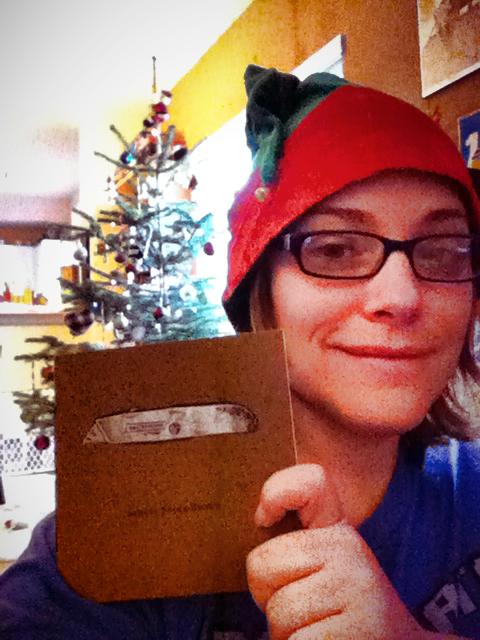
from fellow Pacific-Northwesterner and part-time elf Jaretta Richey
from grad school pal and tech-writing professor Crystal Elerson

Like some other friends/readers, Crystal decided to take my book on a little road trip. “Well-written short fiction that travels well and lends itself to fun photography — what more could you need?” she wrote when she showed me these.


Speaking of people saying nice things about the book: there’s a (very cool!) published review by Alex DeBonis on The Small Press Book Review, and, from what I understand, a few more reviews in the pipe at various publications. But in the meantime, readers like you have been writing some wonderful comments about the book, too!

From Goodreads:

It’s an ultra-short collection of piano-wire-taut very short fiction with moments sharpened down to razor-wire. And be them violent, lonesome, tormented, misguided, haunted, caged, or rejected — we each become voyeurs in these snap-shot lives, and the surprising nature of these moments.

Hosho McCreesh

Sam Snoek-Brown is good. Real good. His writing is simple and it shines.

Leesa Cross-Smith

I commend Sam Snoek-Brown for his marvelous, skilled writing. I love short fiction, and he really delivers a top rate collection in Box Cutters.

Wendy Ellis

This is a stunning collection of short fiction from Sam.

Robert Vaughan

From Amazon:

From within the simple Americana situations of Raymond Carver, Samuel Snoek-Brown is able to combine astute observation, Tom Waits-style lyricism and heartbreak, and a bit of poetry to reveal, in brief, tense bursts, human beings creating and then questioning their own estrangement from each other.

John Sibley Williams

These superb little flashes of people in their places remind me of facets in a gem. There and then gone, yet not.

Nancy Collins

This compact compendium is entertainingly rich in imagery of the finest sort. The stories are all quite short, but despite their compact nature they don’t leave the reader with a sense of incompleteness. Indeed, anything but. This is prose that dances like poetry.

Dan Cooper

From Powell’s:

A fast read, and very well done! I especially like the form he used, it’s blog-like.

Patte Farkas-Braker

Loved the stories. A short read, variety, and nice introduction to his writing if you have not already experience reading his other publications.

Julie Snoek

Okay, full disclosure: that last one was my mom. (Hi, Mom!) 🙂


If you’ve read Box Cutters, I’d love to know what you thought of it! Good or bad — I can take it. I just want to hear from readers.

And if you have a copy, I’m always looking for photos of the book in its new home! Please keep sending them, gang!

Booklist 2013

I’ve been going over my reading list for the past year, and it’s a doozy. Altogether I plowed through 75 books, and while that’s two fewer than last year, it’s still a hell of a year. Here’s the whole list, followed by a sort of break-down:

Stan Allyn, The Day the Sun Didn’t Rise
Janet Allured and Judith F. Gentry, Louisiana Women: Their Lives and Times
Barry Jean Ancelet, Cajun and Creole Folktales
Sherwood Anderson, Winesburg, Ohio
Kenneth Aguillard Atchity, Cajun Household Wisdom: You Know You Still Alive, If It’s Costin’ You Money!
Jane Austen, Persuasion
Arthur W. Bergeron, Jr, Guide to Louisiana Confederate Military Units 1861-1865
Arthur W. Bergeron, Jr, The Civil War in Louisiana: Part B: The Home Front
Ben Boulden, Hidden History of Fort Smith, Arkansas
Christopher Bowen, We Were Giants
G. A. Bradshaw, Elephants on the Edge: What Animals Teach Us about Humanity
Carl A. Brasseaux and Philip Gould, Acadiana: Louisiana’s Historic Cajun Country
Howard C. Brooks, Gold and Silver in Oregon
Jeffrey Brown, Clumsy
Matthew Burnside, Infinity’s Jukebox
Sandra Cisneros, The House on Mango Street
Todd Cobb, Ghosts of Portland, Oregon
Suzanne Collins, Catching Fire
Suzanne Collins, Mockingjay
Susan Cooper, Over Sea, Under Stone
Jerry Craven, The Big Thicket
R. Crumb, The Book of Genesis
Jules O. Daigle, Dictionary of the Cajun Language
HH the 14th Dalai Lama, Lighting the Way
Edwidge Danticat and Robert Atwan (eds), Best American Essays 2011
Justin Lawrence Daugherty, Whatever Don’t Drown Will Always Rise
Ann Downer-Hazell, Elephant Talk: The Surprising Science of Elephant Communication
Monica Drake, The Stud Book
Rachel Dresbeck, Oregon Disasters: True Stories of Tragedy and Survival
Maggie Dunn and Ann Morris, The Composite Novel: The Short Story Cycle in Transition
William Faulkner, Go Down, Moses
Tom Franklin, Poachers
Tom Franklin, Smonk
Gabriel García Marquez, Love in the Time of Cholera
Webb Garrison, Civil War Curiosities: Strange Stories, Oddities, Events, and Coincidences
Nicole J. Georges, Calling Dr. Laura
Natalie Giarratano, Leaving Clean
Louise Y. Gossett, Violence in Recent Southern Fiction
Dena Rash Guzman, Life Cycle
Jeffrey Hecker (ed/ill), Instructions for the Orgy
John Alfred Heitmann, The Modernization of the Louisiana Sugar Industry, 1830-1910
J. Gerald Kennedy (ed), Modern American Short Story Sequences: Composite Fictions and Fictive Communities
Stephen King, The Shining
Rolf Lundén, The United Stories of America
Roger Manley, Mark Moran, and Mark Sceurman, Weird Louisiana: Your Travel Guide to Louisiana’s Local Legends and Best Kept Secrets
Susan Garland Mann, The Short Story Cycle: A Genre Companion and Reference Guide
Cormac McCarthy, No Country For Old Men
Colin Meloy and Carson Ellis, Wildwood
Donald Menard, The Untold Story of Hurricane Audrey
Debra Monroe, The Source of Trouble
Alan Moore, The Watchmen
Barry Moser (ed/ill), Cowboy Stories
Alice Munro, Lives of Girls and Women
James Nagel, The Contemporary American Short Story Cycle: The Ethnic Resonance Of Genre
Chuck Palahniuk, Fugitives and Refugees: A Walk in Portland, Oregon
Cathy C. Post, Hurricane Audrey: The Deadly Storm of 1957
Morris Raphael and George Rodrigue, The Loup-Garou of Côte Gelée
Ethel Rohan, Hard to Say
Bill Roorbach, Writing Life Stories
Floyd Hiatt Ross, Shinto, the Way of Japan
Nola Mae Ross, The Devastation of Hurricane Rita: A Pictorial Log of Hurricane Rita’s Path of Destruction Through Cameron and Calcasieu Parishes
Nola Mae Wittler Ross, Hurricane Audrey
Nola Mae Wittler Ross, Louisiana’s Acadian Homes and Their History
Traylor Russell and Robert T. Russell, Some Die Twice
Lyle Saxon, Edward Dreyer, and Robert Tallant, Gumbo Ya-Ya: A Collection of Louisiana Folk Tales
David Small, Stitches
Alexis M. Smith, Glaciers
William L. Sullivan, Oregon’s Greatest Natural Disasters
Joe Gray Taylor, Louisiana, a History
Ron Thibodeaux, Hell or High Water: How Cajun Fortitude Withstood Hurricanes Rita and Ike
Philip Varney, Ghost Towns of the Pacific Northwest
Kurt Vonnegut, Cat’s Cradle
Chris Ware, Building Stories
Bill Watterson, The Authoritative Calvin And Hobbes
Ryan Werner, Murmuration
John Sibley Williams, Controlled Hallucinations

Dizzy yet? Of these 75 books, 31 were things I read for research or inspiration while working on books — cleaning up my novel Hagridden (forthcoming from Columbus Press!) during my research trip to Louisiana, working on my apocalyptic story cycle on a writing retreat, or pounding out a rough (and incomplete) draft of a new novel during NaNoWriMo.

Twenty-five of these books were fiction, including novels (13), story collections (3), story cycles (4), and chapbooks (5). Another five were poetry collections, and five more were graphic novels.

An interesting note I’ve never counted before: 16 of these books were books I read or reread for classes I was teaching, including a literature course on the story cycle and a creative writing course, and a few novels I tutored a high school guy in and decided to reread for fun. In fact, between my classes and my research, I reread 20 books this year.

And that doesn’t count the fact that I’ve read and reread my own chapbook, Box Cutters, at least a dozen times this year between edits and proofs and just enjoying seeing the thing in print at all. And I’ve reread my novel Hagridden twice (and will be rereading it again in edits and again in proofs over the coming year). And I’ve reread portions of my story cycle I worked on during retreat. And I reread (I can’t count how many times) the 11 stories I published this year as well as the one I just finished. (Yep — ending the year writing, gang!)

And, of course, there are the roughly two dozen books I’ve picked up in purchase, gifts, or exchange over the holiday season and hope to read in the next month or so, before my school load starts piling up again.

Speaking of which: I’ve also read hundred and hundreds of pages of student writing, almost all of it essays and most of it exhilarating, some of it downright breathtaking.

2013: the year of all the awesome I could ever want

I’ve been looking over 2013 and thinking about my writing work, and folks, this has been one hell of a year.

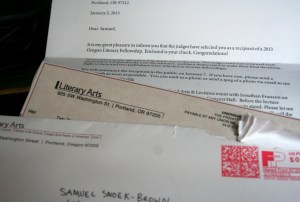
"It is my great pleasure to inform you that the judges have selected you as a recipient of a 2013 Oregon Literary Fellowship."

It started in the very first weeks of January, when I received — almost back-to-back — an offer from sunnyoutside press to publish my first book, Box Cutters, and an Oregon Literary Fellowship.

Both those events were huge. They were life-changing, in fact, but I’ll get there in a minute.

In February, I published one of my favorite stories in one of my favorite online magazines, and then March became the Month of Fiction, when I published five pieces, including an excerpt from my fellowship-winning novel, Hagridden.

Me (I read the first story from my chapbook Box Cutters, out this fall from Sunnyoutside Press)

March was also an interesting month because I used my Fellowship money to take a research trip to Louisiana, where I finished the last work needed on Hagridden. I felt like things were moving for me, the literary stars aligning in my favor, and I didn’t even know what was yet to come.

A few more stories spread from April through October brought my total publications for the year to eleven. I also gave a summer reading with Unshod Quills and my friends Dena Rash Guzman, Justin Lawrence Daugherty, Ryan Werner, Mark Russell, and a whole lot of other awesome writers. And in August, I went on a writing retreat to work on a story cycle I started a couple of years ago.

Also in August, I found out my short story “Lightning My Pilot” had been nominated for the storySouth Million Writers Award, which was a huge deal. And then in September I discovered I’d been shortlisted to the Notable Stories list for that award, and in November, I found out I’m a finalist! (By the way, there’s still time to vote for my story before the end of the year, if you’d like to see “Lightning My Pilot” win that award.)

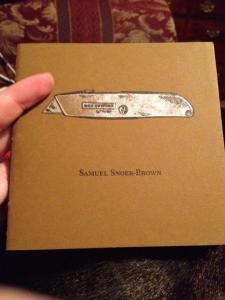
Samuel Snoek-Brown, Box Cutters

Also in November, on the same day I was giving a reading at my community college, sunnyoutside press released Box Cutters. My first book. I cannot express how important this has been to me. I’ve been reeling from the attention it’s gotten, with some kind reviews and photos from readers and an interview on the radio . . . .

But the year wasn’t done with me yet: just a few weeks later, in first week of December, I signed a contract with Columbus Press to publish Hagridden.

My first novel. The book that got me the Oregon Literary Fellowship. The book that started my year off so wonderfully was ending my year great, too.

I couldn’t have hoped for a better year — the things that have happened so far have been more than I could have wished for in a single twelve-month stretch.

And next year is already set up to be pretty great, as I set up readings in support of Box Cutters and work through final edits with my publisher and prepare for a Fall release of Hagridden.

2013 has been a red-letter year, gang. Here’s to a 2014 that’s just as great.