Meanwhile, the Jersey Devil got drunk with General Grant

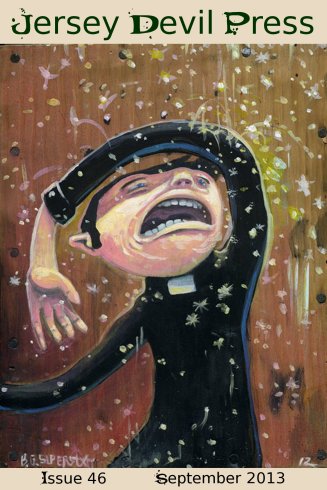
JDP sept cover2 2013That’s an odd title for a post, but let me explain:

The first story in the September issue of Jersey Devil Press is about a woman from the set of a vanity zombie flick having a love affair with General Robert E. Lee.

And I know you’re not surprised by that sentence, because it’s Jersey Devil Press. We do things like that. But, you know, the Jersey Devil is from New Jersey, so while our story’s narrator is sneaking a rendezvous with Lee, we’d surely be knocking back a few with Lee’s Yankee counterpart.

Meanwhile, teenagers are kidnapping Jesus, hitchhikers are learning to rob gas stations, couples are having sex at Disneyland, and — of course — the universe is unraveling. Because that’s how we roll.

Plus, we have this gorgeous cover art from painter Brett Superstar! (If you like this one, you should see his giant robots and smug rabbits.)

Also, heads-up, loyal readers: our gallant content editor, Mike Sweeney, is moving on from the magazine, and this is his next-to-last issue (Mike prefers the word “penultimate,” because it’s sexier). I’d be sad about that, because he’s been an amazing guy to work with, but A, he deserves some free time; and B, the editor stepping into his really big shoes (ahem — ladies….) is going to be just as awesome. Still, we’re going to miss Mike, so as you read this issue, Join us (and General Grant) in hoisting a glass to our compadre.

And then tune in next month for Mike’s last issue, and the month after that for our new editor’s first month, and keep tuning in after that, because the Jersey Devil has a lot more Jesuses to steal and universes to destroy!

Manscaping the website

And, we’re live again. Thanks, gang, for bearing with my disappearing site while I worked on it.

The whole site was getting a little, shall we say, hairy, at least in terms of all those little drop-down menus and subcategories…. I am notorious for over-organizing things, with menus under menus and folders inside folders. (My laptop is an absolute labyrinth of folders and files — it’s a wonder I can ever find anything!)

Good-bye, old, cluttered home page! You were fun while you lasted.

This cluttered sense of “organization” was probably best illustrated by the interactive “bulletin board” image I used to have on my home page. I was actually quite fond of that thing when I made it, and I still think the interactive image thing is pretty cool. But the more I looked at it, the more I realized it was just a jumbled collage of craziness. And I began to feel the whole website was a bit like that, really. Just a big, messy desk.

Then there was the “Polaroid” collage that was my banner. Again, it was fun to put together, but it was also starting to look awfully messy.

To be honest, the website itself (like my desk) is still pretty messy. I still have loads of pages and subpages scattered all over, some of which are actually harder to find now (did anyone actually like my “Photos” page? Because that’s practically buried now). But those are the pages almost no one visits, and that I mostly did for fun — there are more important pages on the site that tell you something about me or my work.

So that’s the bulk of what I did with the redesign: I stripped out the menus. Now the most important information is all up top, and for your convenience it all gets repeated down at the bottom, too, in a footer menu. Only two menu items function as drop-downs now, and there are no more submenus (so no more chasing drop-downs underneath pop-outs inside of drop-downs…).

I made this for the site. Keep checking the home page here for the official cover from Sunnyoutside.
I made this for the site — it’s not the cover of my book. But keep checking my home page; I’ll update with the official cover from Sunnyoutside when it becomes available.

I also replaced the cover image with a little graphic I made for my forthcoming chapbook, Box Cutters. When the official cover comes out from Sunnyoutside Press, I’ll replace my graphic with their (much cooler) cover.

And I swapped out that cluttered banner for just a nice, clean image of my name (written by my wife especially for the site — thanks, Jennifer!).

The category cloud in the sidebar was another good example of how jumbled the blog was starting to feel to me, so I pulled it and replaced it with a new side-list of the most popular categories or features here on the site.

Also, because my lists of links to authors and presses and cool blogs was getting unbearably long, I moved them all out of the sidebar and made a new Links page. Please do visit it — I would still love all my friends and acquaintances and colleagues to keep getting traffic.

So, that’s it, folks. What do you think? Anything you used to visit all the time and miss now? Anything new you’d like to see on the site?

A quick note about a quick hiatus

"TUESDAY" production sign
“TUESDAY” production sign (Photo credit: Vaguely Artistic)

For people who follow the blog or just like popping in from time to time to browse the website, I thought I’d let you know I’m going dark tomorrow. I’ve been planning a fairly significant redesign of the website, so I’ll be pulling it down Tuesday afternoon to work on it. I hope to have it back up for you to check out by Tuesday night, but if you don’t see it, keep coming back — it’ll definitely be ready by Wednesday.

And then I’d love to know what you think of the redesign!

See you soon, gang.

A writing retreat

When I won an Oregon Literary Fellowship this year, the award itself was more than I could ever have hoped for. But the fellowship also helped fund a research trip to Louisiana to finish my novel. That was an outstanding experience that I could only have dreamed of.

And that was all I ever expected.

But Literary Arts continues to offer its fellows amazing opportunities, including, this past week, a week’s retreat at a nearby writing cabin courtesy of a generous arrangement with the folks at Far Lookout.

I’ve finished the novel that earned me the fellowship this year, so I’m on to other projects now. At the moment I’m working on a story cycle set in Oregon during a natural apocalypse in the near future. (A comet or an asteroid, who knows what, slams into the moon and breaks of two huge chunks of the moon’s surface, which then plummet to earth and cause a catastrophic chain reaction of polar ice melt, planet-wide tectonic shifts, volcanic eruptions, biblical flooding, uncontrolled wildfires, and so on, and so on. Not that the destruction itself is really the point — I’m more interested in the people trying to survive it all.) You might remember it from my NaNoWriMo project a couple of years ago. It was a bit of a mess when I stopped work on it back then, and I’ve thrown out most of the work I did on it a couple of years ago, but the idea has stayed with me and I’m excited to return to it, so I figured I could use this week to start whipping it into shape.

It worked.

What follows are a few blog post-like entries I typed out at the ends of a few days, plus some photos my wife and I snapped with our smartphones.


August 18, 2013

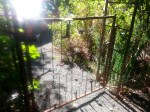
It’s odd how well the trees and brambles can shelter one from sound. We are at the end of a narrow lane, barely room for two cars to pass each other, the bend in the road just a few hundred yards from the Willamette. But we’re also only a few blocks from a dense residential area, half a dozen blocks from a state highway. Trains rumble over a narrow bridge almost within eyesight but you’d hardly know it. Here in the cabin, past the whining iron gate and hidden in the tomato plants and grapevines, we are in another world.

It seems odd to be so at peace here in this cabin, so secure in this quiet residential neighborhood, when I’m here to write about the end of the world. Or the end of this world, anyway.

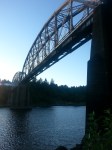
Today, we ventured down to the river and clambered over rocks to stand beneath the railway bridge. The thick stone pylons rose like obelisks from the river. Across the water, yachts floated at the docks of many-gabled mansions, and shirtless twenty-somethings cruised the river blaring classic rock or country songs. Their wakes lapping the boulders at the riverbank. A man picked his way out onto weathered knees of wood under the bridge to fish, and a young couple threw balls and sticks into the water for their playful pitbull to chase. I gazed up at the trestle and thought, When my world ends, even this will be gone, rocked loose in the earthquakes and washed away in the floods. But then a warm breeze blew and in the setting sun Jennifer skipped stones out into the water, and I wondered how I could ever write what I came here to write.

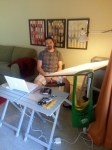
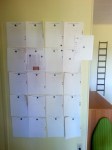
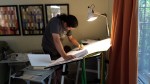
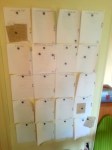
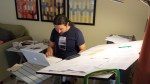
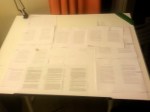
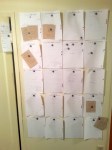
Now it is fifteen minutes to midnight, and I’ve been taking notes and reworking sentences for almost two hours while Jennifer sleeps. I have my pages of notes arranged on the wall, held up by magnets on a steel sheet, and I’m using the huge drafting paper on the cabin’s architect’s table to scribble titles and character names. I’ve been reading off and on all afternoon — books on natural disasters and extinction and horror, but also books on survival and human compassion — and I’m finding that just being here is enough to begin the work, that just knowing that I came here to write is more important than what I came here to write, and sure enough, the words are coming.

So it begins.


August 19, 2013

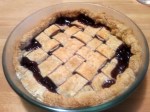
Today is my birthday, so I’ve been taking it easy. Lazed around on the couch, took a walk to the river, baked a blueberry pie. Still, I put in the writing time and managed to finish one story — or, at least, get it to a full-draft, ready-for-revision state — and make solid headway in another. I also spent some time reading, some time organizing, and some time sitting in the garden just thinking about things as I nibbled the wild grapes.

So it’s been a productive day but mostly I’ve been relaxing.

The last thing I did, though – besides writing this – was to prepare a formal writing schedule for the rest of my retreat days, which is as follows:

9 – 9:30 am
Sit in meditation

9:30 – 10 am
Breakfast

10 am– 12 pm
Write

12 – 1 pm
Lunch

1 – 2:30 pm
Time with Jennifer (sometimes we’ll go for walks, sometimes we’ll watch old episodes of Friends, sometimes we’ll just lie around and read)

2:30 – 5:30 pm
Read/write

5:30 – 7 pm
Dinner (includes prep time and dessert)

7 – 9 pm
More time with Jennifer

9 – 11 pm
Write (I’m a night owl, so I have coffee with dessert and I’m often up till midnight)

This is a tentative schedule: I’ll probably get earlier or later starts on everything, or switch things around from time to time. But it gives me some guidelines to work with, at least.


August 21, 2013

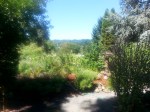
I’m sitting outside in a plastic lawn chair listening to the crickets and the distant highway traffic and, sometimes, a night bird I can’t identify as it calls into the late night. I almost typed “calls into the darkness,” but it’s not truly dark, even at 11:30 at night. There’s a sheer of cloud up high in the atmosphere, above the planes but sufficient to reflect the city lights of nearby Portland, and the stars are few enough I can count them: I can see ten at the moment; if I put away the laptop and unfocus my eyes, I might count two dozen. It’s light enough I can see the gravel and the wood steps to the cabin, and a near-full moon shows me the branches of a nearby tree.

I’ve been watching a Japanese movie from the late `50s, an Ozu film called Floating Weeds. I take a lot of inspiration from mid-century Japanese cinema and tonight is no different. Even though the film is set in a quiet Japanese fishing village a dozen years after WWII and my book is set in Oregon in the middle of a near-future natural apocalypse, I see an emotional connection between that film and my book. It’s quiet, and pensive, and contained; it deals with the ordinary lives of ordinary people and their fraught but ordinary emotions, and that is the thing I want most to focus on in my book: for all the destruction and chaos my apocalypse creates, I want more than anything to show my characters struggling with simple, mundane conflicts. How to love and what to eat for dinner and how to know who your friends are. But, sure enough, though I’ve made terrific headway on a few of the stories over the last couple of days, I’ve spent most of my time destroying the earth.

Destroying my beloved Oregon.

And sitting out here now among the crickets, looking into the lamplit evergreens with the Willamette drifting past just yards from my chair and the city of Portland audible in the distance, I find myself wonder what I’m doing. I love my city; I love my state. I feel defensive when people mock it, proud when it gets good press, protective and embracing. Especially Portland and its surrounding areas. I tell Portland good morning when I drive over bridges; I tell it goodnight when I gaze over it from hilltop parks. I joke with my wife that Portland is the only affair I’ll ever have.

So now, sitting out here among the cricketsong, I feel guilty at the fictional devastation I’m bringing it.

I think ultimately it has to do with fear. I grew up in Texas and while there are a great many things to celebrate about that state and my hometown, I have always written about Texas with trepidation. All my characters are always in conflict with it; frequently I use some version of the line that Texas is too big to get out of in a day, and I think I do that because I spent my whole life in Texas trying to escape it. I appreciate it now, but I know that a lot of that appreciation is only possible from a distance.

In Oregon, I have found my home. My people are here, my culture. Here I have sunk my roots. This is where I belong. So in the same way that I write fiction about people trapped in a Texas they long to escape, I suppose I’m now writing fiction about an Oregon I would be terrified to lose.

I’m still at a stage where I need to finish drafts, just get the stories down, and I’m not deluding myself that I’ll finish even that project during this writing retreat. But I think tonight I’ve set myself the rules by which I need to revise this whole book. And I’m reminding myself to approach the whole project not with a mind toward plot and world-building but with a care for the characters and a sense of this place I love so much.


August 22, 2013

I’m out on the back porch of the cabin and a light rain is falling over the corrugated plastic roof and tinging on the metal waterhose reel. The air smells fresh and mulchy from the dampened compost heap nearby. Earlier this afternoon, Jennifer and I sat out here and played a game a backgammon while out on the river a trio of rowdy jet skiers raced over each other’s wakes, the revved engines and the slap of the water obnoxious up here on the hill. But now the rain is muffling even the distant traffic and I feel even more pleasantly isolated than I did at the start of the week.

It’s funny the things that drive my work, the references that spark the mind. Earlier this morning, I checked in on Jennifer, who was in the cabin’s bedroom watching the first half of the last Harry Potter movie on her laptop. She started humming the Nick Cave song that plays in the tent scene between Harry and Hermione, and it got stuck in my head too, so I used my smartphone to find “O Children” on YouTube. Whoever uploaded the song patched together a montage of stills from the whole Harry Potter series, showing the three young actors growing up, but when the song came to the bit used in the film, the video switched to that sequence.

In it, Ron has just abandoned Harry and Hermione in a horcrux-fueled jealousy, and Hermione is listening to a tinny radio while sulking in a corner of the tent. When the Nick Cave song comes on, Harry decides to rouse her spirits by pulling her up to dance. It takes some cajoling, Harry swinging Hermione’s arms back and forth to dance her like a puppet, but after a few measures she breaks a smile and soon the two are laughing and dancing together in the tent.

And then the song ends, and Hermione’s face falls. She’s wearier than she ever was, and as Harry tries desperately to hang onto whatever good cheer he managed to conjure up, Hermione just shakes her head in resignation and turns away from him. Because they are still alone, lost and vulnerable, in a miserable situation. And dancing to a song hasn’t done anything to change that.

I couldn’t have asked for a more succinct reminder of the emotions felt by these characters I’m writing. And music has always been an inspiration for me while I work, so this was exactly what I needed this morning. I listened to the song on a loop four or five more times and I finished another story and started in on two more.

Then the day turned bright and beautiful and it was hard to concentrate on work, which is when Jennifer and I sat out back for some games and some afternoon drinks.

But now it’s dark and wet, the sound gone from the world except the sound of rain on the roof and somewhere blocks away a miserable dog begging to be let indoors. And I’m making my way deep into a fourth story today, probably the second I’ll actually finish before I go in for the night.

Or maybe I’ll just close the laptop and sit out here. And listen.


I was at the cabin for almost seven days — or, five full days and two half days. I worked a little the first day and a little second (my birthday). After that I stuck more or less to my schedule, getting the most writing done in the mornings and late at night. The last morning, I didn’t do any writing but I did scribble a few last-minute notes for the work I have left to do.

And I still have a lot of work to do. The project I’ve been working on is a story cycle consisting of twenty separate but related pieces. Even with the first drafts I knocked out (and mostly discarded) during the NaNoWriMo binge a couple of years ago, there’s no way I would have finished the whole book in less than a week. But as of this morning, I have finished six stories, five of them written from scratch and two of them very nearly ready to start sending out at individual pieces. I’ve also gotten more than halfway through three other stories and have several paragraphs and most of the ideas for two or three other stories. Altogether, that’s roughly half the book more or less finished. And on the Wall of Fiction I’ve compiled for this book, I have strong notes and the gist of the story for all but three of the other stories.

So, all in all, this was a hugely productive week, and I couldn’t have gotten all this work done without the generosity of the owners of Far Lookout Writer’s Cabin, Literary Arts, and of course my wife, who kept me motivated, gave me feedback on ideas, and documented a lot of the work I was doing.

Unshod and pregnant. With bees.

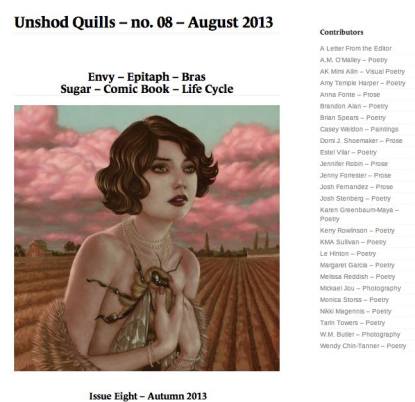
1186285_510450712381115_934937446_nOh, you guys. This issue. The photography, the poetry, the prose. The cover art. The beauty of it all!

The long-awaited Issue 8 of Unshod Quills is live and online now, and it’s a wonderful, sweet, buzzing literary creature.

Since we’ve switched to a focus on poetry, our ranks of gorgeous poets have swelled beyond my capacity to list them all here. But do keep an eye out for our featured poets Karen Greenbaum-Maya and AK Mimi Allin, as well as my friends Amy Temple Harper, James H. DuncanMolly Gaudry, and Monica Storss.

But don’t worry — we still know some damn fine prose writers, including our featured writers Josh Fernandez and Anna Fonte, as well as my powerhouse prose pals Domi J. ShoemakerJenny Forrester, and Justin Lawrence Daugherty.

And then there’s the artwork. We love artwork, especially photography and video, and we’ve got some beauties in this issue, including featured work by W.M. Butler and Mickael Jou.

honeyAnd our cover art.

Oh Casey Weldon, is there anything you can’t do?

I’ve loved Casey Weldon since before I ran his work on a Jersey Devil Press cover last year, and he’s been eating up the internet this past month with his unnerving but beautiful Meow Brow exhibit. But the first painting of his I ever saw was our cover image, “If You’re Out There Getting Honey, Then Don’t Go Killing All The Bees,” when UQ editor Dena Rash Guzman found it a while ago and started preaching the glory that is Casey Weldon. I’ve been a disciple ever since. So I feel extraordinarily fortunate that we’ve got him as our cover artist this issue. And if you like the bee painting, check out our feature page on Weldon for an interview and more of his work.

But not before you finish reading Issue 8 of Unshod Quills. There’s art to be consumed, freely given, us to you. Dive in and coat yourselves with it.

After Everything Has Changed Forever: Justin Lawrence Daugherty

My friend Justin Lawrence Daugherty, talking about his hard-driving, visceral little chapbook from Passenger Side Books (a small press that is, balls to bone, entirely my friend Ryan Werner).

Read some. Buy some. Tell them all I said hi.

booktalkmagazine's avatarBookTalk

bw JD

Justin Lawrence Daugherty lives in Atlanta, GA, and runs Sundog Lit. His chapbook, Whatever Don’t Drown Will Always Rise, is out at Passenger Side Books.

***

BookTalk: You recently released a collection of ten stories called Whatever Don’t Drown Will Always Rise, from Passenger Side Books. What holds the collection together? Are there any ideas you continually jab at, or explore?

Justin Lawrence Daugherty: I think one of the things that drives the stories in this collection is an interest in catastrophe. Each of the stories involve someone on the verge of collapse. I talked in another interview with Eddy Rathke that I’m interested in the falling apart of peoples’ lives, the moments after everything has changed forever, when people are just on the edge of disintegration. I talked with an essayist friend recently and said that I’d been writing down desolation for a while. I think…

View original post 1,114 more words

Interview with Todd McNamee, author of Drifting

1011697_572367239461397_1674800218_n

My friend Todd McNamee will be holding a reading this Saturday at Old World Merchants in Vancouver, WA, “surrounded by all my wonderful friends and family,” he writes on the event’s Facebook page. “I am very excited to be doing this at my dear friend’s import store” — which is such a cool venue for a reading, yes? I’m psyched.

To prepare for the reading, the other day I joined Todd at a café in northeast Portland for coffee and a chat about his first published novel, Drifting. Of course, we ourselves drifted into other topics (see what I did there?), like religion and relationships and rehabilitation. But all those things play an important role in his novel, too, so in what wound up being a serendipitously cohesive conversation, we always managed to bring it back to the writing.


You said you started writing the book eight years ago?

Yeah. It was around 2004, 2005. It was kind of the beginning and the end of one phase of my life and the next. I’d gone through a period where I’d written a fantasy novel and gotten an agent and sent it out, and that got rejected. And shortly after that, I started my own business where I was tuning pianos full time and teaching [music], so I didn’t do any writing at all for a few years. And after a couple of years of that, I realized I really wanted to write another novel, but I didn’t know how I was going to do that. I couldn’t figure out the time thing.

So it was just a sense. You knew you wanted to write something, and it had to be a novel.

Yeah, well, this was the fourth novel I’d done. I’d written a novel every couple of years for several years before then. I think I finished my first one when I was 21. So I’ve been doing this for a while and it’s just been a part of my life. But the thought of finishing a book, the size was just intimating at that time, and I couldn’t figure out how I was going to fit that in with my schedule. So I tricked myself. Because the thought of doing another novel was too big, but the thought of doing short stories was something I could wrap my mind around. So the idea was to have several different characters, each with their own story, told through a central narrator.

Almost like a Winesburg, Ohio sort of thing?

Yeah. And it went through a lot of drafts, because I threw out everything I’d learned up to that point. The fantasy novel was very plot-driven, and it had everything in it I knew about writing. Drifting has almost none of that. It was like starting over from scratch. And it was really personal. A lot of the stuff that’s in it is based on real things that happened to me or people around me.

I was going to ask how autobiographical it is.

Just with the central idea. My biological father, he likes to marry people. He doesn’t necessarily get divorced, but he’s one of those people, he’ll come into a town, find a woman, knock her up, and vanish. I was talking to my sister about this a little while ago, and her best guess is that there are nine of us. I don’t actually know any of these people. My sister is the only one I’ve actually met in person, and my brother John, who has the same mother as me. And I thought that was interesting, so I thought, okay, I’m going to have a cast of characters, who have a central figure connecting them. This father. I thought that would be a good basis for fiction, because fiction is what you don’t know.

Do you feel like this book was partly a way for you to . . . not to get to know the people you’ve never met, but to invent them?

Absolutely. And also, when you write a novel, you’ve got to stay interested in it for a couple of years. And I thought this would give me something that I could work on for a couple of years.

Do you consider it a “Portland” book, or is it more personal than that?

I think of all of my books as Portland books. I don’t think you can distinguish me from the city. I grew up here. I keep trying to leave, but I keep staying.

So, the novel starts out in Portland, but these characters, this fictional family, they all wind up on a cruise together in Hawaii? What made you send them down there?

Because I’d been on a cruise to Hawaii. I went with my in-laws. And I liked that idea as a way to keep the book within a certain time frame. You know, having everything happen, from beginning to end, within the space of a week, I like that system. One of the books I’m working on now is kind of like that, too. I mean, things are defined by the limits you put on them.

And you said your mother has started reading the book.

She has. She’s about halfway through.

What is she thinking about all this?

I’m kind of afraid to ask, really. But, you know, other than the basic idea, everything else is completely fictional. But it’s hard to explain that to people. If you tell somebody you know, “This character is partially based on you,” what they’re going to read is all the stuff that’s completely made-up and then say, “You really think about me that way?” And I have to say, “No! I mean, when you do this particular affectation, I think that’s really cute so I used that for this character, but it’s not you.” So I’m not really sure what my mom’s going to think about this. I’m blown away that she’s actually reading it.

You know, when you write a book, you always have to think about an audience, and for this one I really just wrote it for one person. I was thinking about my friend Effie, whom three of the characters are based on, different aspects of her personality, from her tattoos or the way she talks. So that was whom the book was directed toward, as an audience.

Was it hard to keep track of such a wide cast of characters, even if they’re based on a limited number of people?

Yes and no. They were all pretty distinct in my mind, and only a couple of the characters get most of the attention. It’s really the story of Patrick and Tonya, and the rest of them just also happen to be there in that group. But it’s their story, those two characters, and other stories go on around them.


[At this point, my iPod got fried in the hot sun and I lost several minutes of our conversation before I realized it had overheated. I switched to a different recorder, so, no problem, but here’s the gist of what I lost:

Todd was explaining how this novel, Drifting, “was written right before I had to quit drinking.” Todd is very active in the recovery community and very open about his own recovery efforts. This novel, it turns out, bridged a peak in his drinking and the beginning of his recovery. In the beginning, he was doing the Hemingway thing (we actually talked about this) where he refused to write while drinking, so he wrote in order to give himself permission to go drinking. But with work and his marriage and his drinking, it was hard going, so he had to write it practically a page a day. And all the while he was drinking more and more.

Then there’s a great moment, the makings of literary legend, in which Todd had finished this novel and gotten it through a few revisions when, frustrated with both Todd and his attention to the writing, his then-wife took the novel and put the whole thing through the shredder.

“My god!” I said. “It’s like that scene with Annie Wilkes in Misery!”

Todd laughed. “It was, a little bit.”

Fortunately, Todd had earlier drafts to fall back on, but at the time, he quit writing the book. And that’s where the recorded interview picks back up. . . .]


So I never planned to work on this book ever again. Then I got sober. But I didn’t write anything for the first year and a half or so that I was sober. I just couldn’t think straight enough to do so. But I did a lot of journaling — I figured it could be material someday when I could think again. After that time period had passed, I wrote a different book, really about what it felt like to get sober, but it was done in the context of a contemporary science fiction book.

I had met Heather, who would go on to become my publisher, I met her online through a friend of a friend, and I knew she was a publisher. We were chatting online, just as friends, and one day we started talking on the phone, and I knew that she had a book. She’s like, “Well, I’m editing this manuscript,” and I’m like, “Oh, well, I’m editing a manuscript myself right now. Why don’t we swap?” That’s all I was thinking about. It had been a long time since I’d shared my work with anybody — it had been five or six years at this point. Anyway, this book was about this guy who has psionic abilities, but they didn’t work when he drank, and he drank a lot, for that reason. It was very plot-driven, you know, back to what I was doing before. And Heather was like, “Wow, we really want to do this, but we’ve never done a science fiction book.” And I said, “Well, if you’re interested in more literary fiction, it just so happens that I have a novel, already written and ready to go, if you’d like to take a look at it.” And that was Drifting.

And here we are.

It was the book that just wouldn’t die.

Do you find that Buddhism comes into your work a lot? [Todd and I took refuge together at the Kagyu Changchub Chuling dharma center in Portland, which is where we met.]

I’m writing a book write now that’s kind of a love story, about this emotional affair. It’s a writing exercise I found somewhere, which was, take something that didn’t work out the way you want it to and see what would happen it did, but it went horribly wrong. So I got an entire book out of that one exercise. Plus, it has the best title of anything I’ve ever written. It’s called Sex, Death, and Buddha: a Love Story.

I love it!

Isn’t that a good title? You would totally buy that book!

I would buy that book!

But both the main characters in that book are meditators, so that’s kind of the feel. It’s sort of in book form what happens in your mind during an emotional affair. That’s the most overtly Buddhist book. But when I finish these three other projects I’m working on, I want to write a nonfiction book on Buddhism, which I’ve been taking notes on for four or five years now.

What’s the gist of that nonfiction book? What’s your angle?

Well, that’s the thing, it keeps changing. I want it to be a very hands-on, practical book. That’s one half of me. But the other half of me wants to do the exact opposite of that. I’ve done five drafts where you write a hundred pages and then you scrap it all and six months later you start from page one again. And then an idea for a novel comes up, and the novel has been the Muse that’s been really kind to me lately.

You mentioned other projects before the Buddhism book?

Yeah, the book I’m editing right now is a good old-fashioned road trip book. It’s about a music writer and her hero is this gal who’s a punk rock gal who dies from suicide. She lives over in New York and my character lives here on the West Coast, and she decides to drive out to the memorial, because her daughter also lives in New York and she hasn’t seen her daughter in a number of years, and her husband’s been dead for ten years. And her life is at a crossroads. It was my NaNoWriMo book last year.

Do you do NaNoWriMo every year?

Yeah, but I normally never get anything useful out of it. Usually I get 25,000 words of a really bad idea that goes nowhere, but usually it’s a good warm-up for the next book, which then goes really well. But this time, the idea was there, fully formed, bam, from day one until the end.

Are you pretty rigid with your writing schedule? I mean, you said earlier that with Drifting, it was like a page a day, squeezing it in.

I try to be pretty rigid about it, yeah. These last couple of years I’ve been really blessed in that my work schedule is that I work in the afternoons, and it’s pretty set.

So are you one of those morning writers?

I am. That comes down to, I think it’s in The Seven Habits of Highly Effective People, that whatever’s the most important to you, you do first thing. So I get up, I make my coffee, I meditate, I write for a bit, and depending on what my work or school day is, I’ll alternate: I’ll sit for a bit, I’ll write a couple of pages, I’ll sit again, then I’ll write a couple of pages.

How hard is it to keep those separate? For me, if I were to sit between writing, I would still be writing in my head, and it would be so hard for me to actually sit in meditation.

I don’t know. I’ve done a few retreats now, so it’s not as hard. And before I sit each time, I also do a little reading in the dharma, so that will cleanse my palate a little bit. I can definitely go through periods where all I do is write, and I definitely go through periods where all I do is sit, but neither one of those is very useful to me. When I’m doing one, I feel guilty that I’m not doing the other. So I do one, but I always tell the other one, Don’t worry, I’ll get to you in a second.

Do you work and sit in the same space?

Yeah. I live in a tiny, tiny room now, so it’s my bed, and this much space, and then it’s my bookshelves. And that’s fine. I mean, I learned to meditate in jail, and I was at Inverness jail, which is sixty guys in a dorm, so where I am now, that’s not so tough.

I had done some meditating before jail, but in this case it was like, I have time, I have motivation, and it’s not like I have someplace I’m going. All the environments are conducive to really making some progress. And there was also the awareness going in that this could be an experience that really benefits my life, or it could be one that marks my life going the other direction. It was very black and white, a very clear choice, which was good, because that was all I could comprehend at that time.

I basically used Jack Kornfield’s book, A Path With Heart, which was the only book on dharma in the jail library. And that was alright. And there was this guy who sat across from me who had only one leg and was in for heroin issues, but he was a Sufi. They regard the Buddha as a prophet and give him lots of respect, so we had lots of talks. He was the only person I spoke to the whole three weeks I was in. You don’t want to try making a lot of friends in jail!

And you know, I had read somewhere about different Tibetans who had done ten, twelve years in prison in China, and a lot of them had said those were the best years of their lives because they were in the dharma all the time. Whereas now, I have my teaching schedule, I have all these appointments, I’m moving around a lot, and I’m doing everything except for practice.

Distractions, distractions, distractions.

Exactly. So I really liked that idea. Plus, I was a mess. I was a real mess. But I knew that something was working, I could feel it. So there’s been no looking back.

So how many other books to you have, altogether, besides Drifting?

I’ve written seven.

And how many are you hoping to get out there? Because, you know, we all have at least one we keep in the drawer.

Oh, even that one I sent out. I send out all of them, I’m shameless! But my first three books I’m not worried about ever seeing the light of day. This one I’m glad is going out. I really do think it’s some of my best stuff. The kind of writing I do really well, this book highlights that. I’m a dialogue person, so there’s a lot of that in there. And like I said, it’s a personal book. This is the book you write when you’ve run out of ideas. Like, I don’t really know what I’m doing anymore, so I’m going to do this.

Tell me what you’re going to do for your reading on Saturday.

I was going to talk about a lot of the stuff we’re talking about now, how the book got written. I might talk about character, about how I edited the book, about the process. Also, I’m really excited with how the cover turned out. Talking about distractions while meditating! The retreat before last, back in March of 2012, that’s when I got the idea for how the cover was going to look. It was a ten-day retreat and I got that on the third day, and I knew exactly who I was going to ask to model, I knew exactly which photographer I wanted to use.

So you’re on retreat, meditating, and you’re thinking about some woman’s leg?

Yeah! Only the leg — no other parts! But yeah, that’s all I thought about. I mean, on my first retreat, it was good by the end of it, but the first seven days were a living hell, so I just kept wanting to go back home. I would look at the parking lot nostalgically. But what happened on this second retreat after I got this idea, I wanted to go back home then, too, but it was because my life was so great, and I was so happy. It was a really good marker of where I was and how far I’d come. Other than the distractions, but they were distractions based on joy.

So that was really fun, doing that cover shoot and being a part of that. And also, you know, when you’re a writer and you’re working on something by yourself. . . You know, it was just me. I mean, I’d played in bands before, and it’s all the fun of babysitting without all the money. You’re feeding everybody’s egos — “You really are the best bass player in the greater southeast area,” that sort of stuff — egos egos egos. That’s one of the reasons I always went back to writing. It’s just me doing it.

But that’s one of the things I’ve realized working on this book. I mean, wow, there’ve been a lot of people working really hard to help me realize this book. I can count ten people off the top of my head who have put in hours helping me make this happen. And that was humbling.

Although, now that I think about it, that’s not humbling at all — that’s ego gratified!

So it feels good to realize this dream, then.

Well, that’s another thing. Nothing in my life has prepared me for this moment. I’ve got thousands of rejections slips. I was submitting a lot in the `90s, I was writing a lot of short stories.

What do you miss about story submissions?

I miss the mail. I mean, I used to write on a typewriter. I like that.

Is it just the pace of it? Or the nostalgia factor?

A lot of it’s nostalgia. When an editor mails you back something, even if it’s a rejection, but they’ve got a little handwritten note on there saying hey, we really liked this particular one, if you’d clean this up and resubmit. Or there was nothing in this particular batch but keep sending stuff to us. Those things are really nice, but they were really rare. You didn’t get those all the time.

But it’s the pace, too. That was the great thing about the mail: it forced you to move on and start working on the next thing. Now all you do is check email. I mean, why work? Checking email is a full-time job!

A lot of those early stories you had published, they were under a pseudonym. What made you switch to your non-pseudonym — your nym — for the novel?

Well, I was publishing poetry under Todd McNamee, which is my name. My middle name is Steen, which is simple. My last name, no one can pronounce it. So originally I was thinking I would do poetry under one name and fiction under a different name, just to keep those separate. And the main thing that happened the last few years is that I just stopped giving a shit.

This is who I am.


46479_470029306361858_195831489_nTodd McNamee is a writer, musician, piano repair man, mountain climber, world traveler and student of life. He is actively involved in the recovery and Buddhist communities. McNamee has published dozens of poems in various literary zines and many works of short fiction under the name T.M. Steen. He is currently working on a novel about punk rock.

I’ve been nominated for the storySouth Million Writers Award!

Screen shot 2013-08-09 at 8.13.35 AMFolks, this is just too amazing not to share:

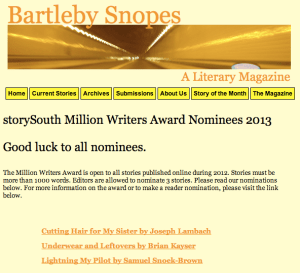
The editors at Bartleby Snopes have nominated my story “Lightning My Pilot” for the 2013 storySouth Million Writers Award!

It’s a hell of an honor, and I’m inexpressibly proud to be listed alongside Joseph Lambach’s “Cutting Hair for My Sister” and Brian Kayser’s “Underwear and Leftovers.”

Thanks, SO MUCH, to the editors at Bartleby Snopes (easily one of my top-five favorite lit mags online), and many happy congrats to Lambach and Kayser. Also, you should go to the announcement on Bartleby Snopes‘s website and scroll down — there are a few other stories that readers nominated as well.

Good luck to everyone!

(Oh, and if you’re interested in the story’s background, I did a three-part interview with EJ Runyon about “Lightning My Pilot” over at her blog.)

Ryan Werner on small presses, road trips, and rock-n-roll

About a month ago, I posted about the big Unshod Quills One-Hit Wonders reading here in Portland, with a lot of attention to literary rock star (literally) Ryan Werner.

But there’s a hell of a lot more to his side of that story, and today, in Passages North, he tells it:

We do all of these things in different ways. It took me a lot of years and a lot of conscious effort to make myself realize that, aside from there being a vast-but-finite number of journals and publishers and multiple-but-limited opportunities within each realm, someone gaining something is not the same as someone taking something away from me.

via Writers on Writing #52: Ryan Werner.

The Jersey Devil never rhymes . . .

JDP_poetry_cover2. . . But this month, for the first time in a full issue, we have poetry.

That’s right, folks: your friendly neighborhood Jersey Devil Press, home to all your favorite short fiction — sci-fi, horror, comedy, sci-hor-medy, deep literary musings, and not-so-deep literary musings — has gone all bard-y and started breaking lines and making stanzas.

And the results are unearthly!

You want retellings of Egyptian myth? You bet your eye of Horus we’ve got it. You want witchcraft? Don’t worry — you’ll survive getting turned into a newt. You want carnivorous trees? Mind the branches. You want the apocalypse? Pack your bug-out bag. You want scifaiku and Cthulhaiku and honest-to-Odin Vikings? Well, buckle in, folks, because we got all that and more, and every bit of it is in glorious, blood-dripping verse.

So join Hamlet, Prince of Uranus (see what we did there?) and settle in for an evening of electrifying poetry.