Lulu for literature

Screen shot 2013-01-23 at 8.00.26 PMWhenever I see the POD service Lulu, I think of LuLu hypermarkets, where my wife and I sometimes shopped in Abu Dhabi.

But then I also think about friends of mine who’ve put out work through Lulu.com, and I think about the online literary magazines who have turned to Lulu to produce their fine print editions and special anthologies.

This month, I’m proud to be in two such print editions!

product_thumbnailThe first was a couple of weeks ago, when I re-blogged editor Meg Tuite’s post announcing the release of the Exquisite Quartet Anthology 2012. If you haven’t checked out that anthology yet, do — it’s a fantastic (and fantastically fun) collaborative exercise in which, for each story, Meg joins three other writers in crafting a single tale, with awesome results. If you’re still not sure you want to shell out for the book, check out the Exquisite Quartet column at Used Furniture. And then buy the book, because you’ll want one.

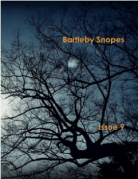
Screen shot 2013-01-23 at 7.57.26 PMThe second project I’m in, just released today, is the ninth print issue of Bartleby Snopes. Culled from the online archives, the print issue contains Bartleby Snopes‘s Dialogue Contest finalists, their Story of the Month winners from the last six months, and an amazing collection of stories handpicked by their staff. I’m particularly excited to be in this issue because my friend Matthew Burnside is in there with me, and folks, if you haven’t been following his “Eliot” fables series, you are seriously missing out!

The Next Big Thing

Yes, this is another one of those chain-post things. But this one’s for writers, and I got tagged by Ryan W. Bradley and Eirik Gumeny, so what the hell.


What is the [working] title of your book/work in progress?

I have a lot of projects in my brain and/or on paper to some extent or another, but right now I’m focusing mostly on the final polish to my Civil War novel, Hagridden.

What is a one-sentence synopsis of your book?

To survive the Civil War, two women kill stray soliders in the Louisiana marsh until their neighbor returns from the war and brings his deranged former commander into the marsh hunting them all.

Who or what inspired you to write this book?

Long story. The short version is that I got the idea several years ago while watching old samurai movies at the same time I was reading a lot of bleak Southern fiction.

What else might pique the reader’s interest in your book?

Killer women, lunatics who skin dogs and dress up like the legendary swamp-werewolf called the rougarou, sex, hurricanes, the violent desperation of ruined townsfolk, a flood . . . . What’s not to like? But the main reason I enjoyed writing this book was that it addresses both an aspect (the desperation of people left behind by war) and a region (the Louisiana marshland, where some of my family comes from) of Civil War history not often enough explored in fiction.

Where did the idea for the book/work come from?

Didn’t I already answer this? I’ll add this, though: there is a devastating hurricane in the novel, an addition I made to my outline when Katrina and Rita hammered the Louisiana saltmarsh and wiped out my uncle’s home both times.

What genre does the book fall under?

Historical Southern fiction.

What other books would you compare this story to within your genre?

Probably Charles Frazier’s Cold Mountain and Tom Franklin’s Smonk or Hell at the Breech, and maybe (dare I say it?) something by Cormac McCarthy . . . . Not Outer Dark, not Blood Meridian — nothing near as brilliant as those books — but maybe some small cold moon orbiting one of those novels.

Which actors would you choose to play the characters from your book?

I don’t really have anyone in mind for the two women — to me, they feel like these mythic entities, female spirits haunting the marsh, which is why neither of the women has a name — they’re just “the woman” and “the girl.”

But I asked my wife (who lives and breathes movies). At first Jennifer thought unknowns would probably be the best choices, especially given the nameless nature of the women. But she did half-heartedly wonder if someone like Dakota Johnson might be an interesting choice for the girl. I wasn’t so sure. “Could she be hard?” I asked. “Could she kill a man?” Jennifer said, “It’s about what war does to people, not about who’s hard. It’s about how an ordinary person could be driven to kill a man.” My wife — as usual — is right. Still. I keep thinking of someone with an attitude like Jennifer Lawrence, but after The Hunger Games, she’s too obvious a choice. So maybe Johnson could work after all.

My wife also floated Cherry Jones as an option for the older woman, and I really like that idea. The perfect choice, of course, would have been Sally Field 15 years ago or so, but since that’s not an option, I think Jones is an excellent choice.

For Buford, the wiry neighbor who deserts the war and tries (for a long time unsuccessfully) to seduce the girl, I told Jennifer I needed someone who could become desirable but doesn’t start out that way. It took her all evening, but she finally stumbled by accident across Stephen Arnell. “That’s Buford,” she said in an outburst. Then she turned her computer around to show me the photo of Arnell at some awards show or premier or something. “I could see him dirty,” she added, “and he’s good-looking but not too good-looking.” I’m thinking, okay. He’d have to lose about 30 pounds and stop showering for a few weeks, but I think he could work.

Of course, now I’m on a roll and thinking about everyone, so I have to take a shot at the insane former commander who dresses up like a werewolf. And while I don’t know that this is a perfect choice, I did run through IMDB for a while and think Julian McMahon — after two or three sleepless nights — might be interesting.

How long did it take you to write the first-draft of your manuscript?

Two weeks. It was my first foray into NaNoWriMo, and I finished early. It sounds fast, but I’d been ruminating on the idea for years before that, with a few paragraphs and some research and a short, rough outline; after the two-week draft, I spent a long time revisiting the research, and then I labored over a few intensive revisions, with one last hard polish coming after a research trip to Louisiana I’ll be making soon.

Will your book be self-published or represented by an agent?

I’m on the lookout for an agent or a publisher, but right now it’s a passive search because one agent and one small press have asked to look at it soon. We’ll see what they have to say.


And now I’m supposed to tag other writers I admire and want others to discover. Strictly speaking, I’d tell you to just consider anyone with a link in my Authors/Poets/Editors list over on the right as tagged, but it’s a big list. Also, I don’t want anyone to feel any obligation to do this thing. But I’ll go ahead and tag Hobie Anthony, Jax Garren, and Anna March. Check them out next week. 🙂

Taking off my shoes; putting on another hat

UQI have a new job, gang. I’m now serving as production editor at Unshod Quills, where I join the excellent Dena Rash Guzman, Wendy Ellis, Donald Rilea, Holly Hinkle, and Brian Tibbetts.

I’m proud as hell to be part of a magazine that has already published work by Patrick Bahls, Rusty Barnes, Matthew Burnside, Matty Byloos, Chloe Caldwell, Evan B. Harris, Joseph Taylor Golding, Eirik Gumeny, Reuben Nisenfeld, Riley Michael Parker, Sugahtank John Roubanis, Carrie Seitzinger, Eva Steil, Meg Tuite, Ryan Werner, and John Sibley Williams, just to name a handful of the fantastic visual and literary artists who have graced the last six issues.

Look for what little contribution I can hope to bring to this already awesome publication starting in March!

A while back, Meg Tuite invited me to join her in co-authoring a story for her excellent “Exquisite Quartet” series at Used Furniture. I dig Meg’s work and I love Used Furniture, so of course I dived right in! That story, “Scenes from an Open Marriage,” gave me the chance to write with Meg as well as Jordan Blum and Julie Innis, and it was terrific fun and (I think) turned into a damn fine story.


But gang, that’s just the beginning! Meg has wrangled an amazing group of other writers to join her in this series, including my friends Ben Tanzer, Dena Rash Guzman, and Misti Rainwater-Lites. And now you can read them all, in one place, the old-fashioned way: curled up on your couch with the scent of wood pulp and binding glue. So go buy the book and settle in. You’re in for some great stories.

megtuite's avatarMeg Tuite's Blog

http://www.lulu.com/shop/meg-tuite/exquisite-quartet-anthology-2012/paperback/product-20627117.html

Exquisite Quartet Anthology 2012 is available for purchase. An outstanding group of writers: Mary Stone Dockery, Alex Pruteanu, Kristine Ong Muslim, Ben Tanzer, Len Kuntz, James Claffey, Timothy Gager, Kevin Ridgeway, Linda Hedrick, Angelle Scott, Joseph A.W. Quintela, Andrea Carlisle, Leah Rogin-Roper, Ken McPherson, Nate Jordon, Julie Innis, Samuel Snoek-Brown, Dena Rash Guzman, Jordan Blum, Deborah Henry, Erin Zulkoski, Clifford Garstang, Neil Serven, Aleathia Drehmer, Misti Rainwater-Lites, Gay Degani, Stephen V. Ramey, Court Merrigan, Kari Nguyen, Linda Simoni-Wastila, Faye Rapoport DesPres, Robin Stratton, Larry O. Dean and Meg Tuite.

View original post

A Writer’s Notebook: first lines for essays

My creative nonfiction class is working on an exercise this weekend. I’ve got them doing the map-making exercise from Bill Roorbach’s Writing Life Stories, but I’ve done that one here on the blog before. It’s worth doing again (and again, and again), but I promised them I’d share my writing from the exercise we did in class, which is what appears below.

It was so embarrassing, me prancing up and down the rubber court whooping and waving my arms over my head. The pleats of someone else’s kilt flying behind me. A group of students and staff had been talking about changing the campus mascot from the cartoonish fur-capped mountaineer to a rugged and fearsome Highland warrior. I’d been enthusiastic, and so somehow I’d been cajoled into donning borrowed Scottish attire and showing the school what such a symbol could look like.

In public.

I was faking it as a mascot, and the real mascot was angry, but what really embarrassed me were all the faces. The crowd — my classmates, my teachers — was full of people chewing on lips or scratching heads. They were embarrassed for me, making this kilted display of myself, and they were taking away the air in the gymnasium, raising the temperature. There should be a mutant villain in the comic books with the power to create and feed on embarrassment.

The face of the basketball coach, too, was mortifying. His head pink under the hot gym lights, his stony face fixed on me through the swarm of his players, his jaw twitching. It was the opening of March Madness, a special basketball exhibition at midnight meant to improve player morale and student interest in the tiny team at my tiny college. The coach had been brought in specifically for this purpose. I was a distraction.

And then the mascot — the real mascot — lifted up my kilt to show the whole school what I wore (or didn’t wear) underneath it.

The exercise is the fifth from Roorbach’s first chapter. It’s all about first lines, which I’ve done a lot with here in the Notebook, but I don’t usually use first lines for essays, so this felt a bit different. Some of that might have to do with the source. Roorbach’s exercise calls for examining other people’s first lines and talking about what makes those first lines work. So my class and I had spent part of a class period talking about what made the first line of Chloe Caldwell‘s recent Salon essay “My Year of Heroin and Acne” so interesting and effective. In that discussion, we also talked about the first two paragraphs of Chloe’s essay, and how she gets from her first line to the meat of the essay so quickly and effectively.

But I wanted to get then writing, too, so I combined this discussion and Bill’s exercise with another first line exercise: using existing lines as a starting place for original work. And for those first lines, I turned to one of my favorite sources, Lori Ann Bloomfield‘s now-closed First Line blog (lines meant for fiction, but as I’ve said in class, a story is a story, and a good first line in fiction could be the impetus for a good personal narrative). I offered them several options, and the few students brave enough to read in the first week wrote impressive beginnings to essays about car wrecks and door-to-door evangelists, but I was the only one to go with the embarrassment line.

Of course, what I wrote is terrible, and I don’t yet know what would get it past the point of mere anecdote to become a legitimate personal essay. But that’s a conversation for another class….

New publication

Crack the Spine coverI’ve got a new story online today, called “Period,” over at Crack the Spine. I’d tell you I hope you enjoy it, but it’s not exactly pleasant — it makes some people a bit uncomfortable. But it is what it is. Maybe you’ll be more mature than the characters in the story. Or me.

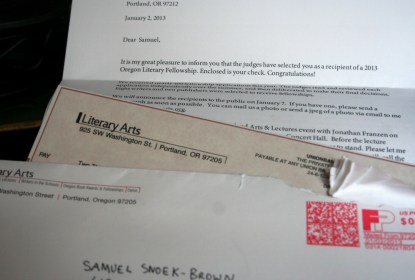
I’ve just received an Oregon Literary Fellowship

"It is my great pleasure to inform you that the judges have selected you as a recipient of a 2013 Oregon Literary Fellowship."
“It is my great pleasure to inform you that the judges have selected you as a recipient of a 2013 Oregon Literary Fellowship.”

I can hardly believe I’m typing this. Every time I look at the letter, which I received in the mail last Thursday, I have to read the first paragraph two or three times just to make sure it’s real. But it’s true:

I’ve been awarded an Oregon Literary Fellowship.

This is huge news. This is momentous: this is the beginning of things.

Literary Arts, who conduct the fellowships, received 400 applications. They selected eight writers and two publishers. I am one of the eight writers — one of only two fiction writers. My fellowship is the Walt Morey Fellowship, named for the author of Gentle Ben.

I am beside myself.

The award is based on the merit of my Civil War novel, Hagridden, and I’ll be using the fellowship funds to travel to the region the novel is set in. I want to walk the land, to reconnect with the kinds of people I remember from my childhood who colored my regional characters, to visit the sites of the few major battles that took place in the region during the war, to meet with area historians and librarians. I feel I need to get out there and live inside this book before I can truly call the novel finished.

Now, thanks to the generosity of Literary Arts, I have the opportunity to do that.

Many, many thanks to Literary Arts and all the people who help make that organization, its mission, and its fellowships possible, and to the judges for this year’s fellowships. I am humbled. I am overwhelmed.

I am ready to get to work!


sententiaWant to read some pieces from the novel that got me the fellowship? An excerpt appeared in Sententia #3, which you can buy online through Sententia Books. And another excerpt will appear in SOL: English Writing in Mexico in March, so stay tuned!

Really good blog post on how to help writers (and how writers can help themselves). Seems an appropriate post to share as Bill Roorbach heads to Portland. Oh, you’re going to be in PDX on Thursday, Jan. 10? Great! Head to Powell’s at 7:30 pm, hear Bill read from Life Among Giants, and then buy his book — he’ll totally sign it for you. Heck, buy all his books (I’m teaching from his Writing Life Stories in my nonfiction workshop starting on Monday).

A Writer’s Notebook: some kind of revision

The time-travel entry! (The date says Friday, but we all know it’s Saturday and I’m late in posting this. But I did write it yesterday, while sitting in my chiropractor’s waiting room.)

Original:

“The people made such a fuss because they are worried,” Bobby continued for her. “Nothing like this has ever happened, Nessie. Nobody has ever died on this side.”

“This side of what?” I shouted. “Where the hell are we?”

“Not Hell,” Sarah said.

“Only After,” Bobby said.

“After what!” I demanded.

“Life,” they both said in unison.

“After life? What are you…” And then it struck me. Somewhere deep, I realized it, and slowly the truth spread up through my brain like a tumor. “I’m dead?”

“Yes,” they both said.


Dissertation version:

“Where the hell are we?” I say.

“Not hell,” Tarah says. She’s stepped closer and now she takes my hand. Hadi takes the other and looks up at me, his deep brown eyes huge like a cartoon. He says, “Only After.”

“After what?” I say. I’m exhausted, but I don’t feel like sleeping. It’s like it was across the highway, in the warehouse with Aléjandro — I’m getting close to something.

“Life,” they say in unison.

“After — life?” I say. “That’s the best you got?”

“Yes,” they both say.

“So I’m dead.”

“Yes,” they both say.

“I’m dead, and this is it, this stupid fucking inn is heaven? You’ve got to be kidding.”

“Not heaven,” Tarah says. “Not hell. Not anything. Just after. The After. It’s all we know to call it.”


Latest version:

“Where is this place?”

“It’s nowhere.”

“No, I mean in relation to things. To the world. Up? Down? Out in space? Where am I?”

“You’re nowhere. This is just an expression of you, of your transition. This is you changing.”

“So I’m inside my mind.”

“No. You aren’t inside anything. If you need a relationship, you are after.”

“After life? Like, the afterlife?”

“After nothing. Life is still there. You are still here. You are after the you you were, becoming the you you’re going to be. You are the most you you have ever been, but it won’t last. This isn’t someplace you come to or leave, it isn’t a place you get to stay. It is just after. After whatever you want to think of as having come before. It is after the moment you died, but it still you in the process of dying.”

Back in the summer of 1999, I had a dream and when I woke I wrote the whole thing down as a short story. It wasn’t very good, but it had a lot of potential. I kept going back to it, and after a couple of years, I realized it was the beginning of a novel, though I didn’t then know how to go about writing it. Another several years passed, and I was nearing the end of my doctoral work and knew I wanted to write a novel, and I knew if I was ever going to tackle this novel I had better do it in an environment where I’d have guidance and support. So I made that novel my dissertation.

It got me my PhD, but sometimes I don’t know when to leave well enough alone, and I keep going back to the manuscript, changing words or sentences or scenes. Sometimes, I re-imagine the whole thing. I’ve rewritten the beginning I don’t know how many times. I’ve switched narrative POV at least three or four times since I finished the novel, and just last week I changed the narrator entirely.

This scene was in the original short story that started this whole thing. It was the moment the main character, a woman named Nessie, is told she’s dead and is now in some kind of post-death experience. In its original version, it fairly sucks.

I like the version that’s in the dissertation version (where I switched the child-characters names from Sarah and Bobby to Tarah and Hadi, though I’m thinking now about switching them back). But it’s pretty lengthy, cumbersome, and heavy-handed, and I’ve always wanted to revisit it.

Then, in the waiting room at my chiropractor’s office, I was reading a Buddhist text by HH the 14th Dalai Lama and started thinking about this conversation again. So I scribbled a new version, from scratch. I have no idea whom Nessie is talking to in this scene — it’s not the kids anymore — and if anything, this conversation is more philosophical and heavy-handed than any other revision. A classic example of doing too much, of going too far with a rewrite, and I am almost certainly going to go back to the dissertation version and revise again from that.

But it was a fun exercise nonetheless. Sometimes, I think, you have to take a piece too far just so you know where too far is, so you can get comfortable with the work you’ve done as the better approach.

My Jersey Devil Press anniversay

January13 coverExactly one year ago, I put together my first issue of Jersey Devil Press as their new production editor.

I’ve loved JDP for a long time because it’s always been awesome, but I feel like it’s better than ever. A lot of that is down to the expertise of our content editor, Mike Sweeney, and to the vision Eirik Gumeny gave us, and to the quality of the submissions we get (seriously, we have the privilege of working with some damned fine writers!). I haven’t changed a whole lot in how JDP actually looks and feels. But one thing I did bring to the table as production editor is the move to outside cover art, and I’d like to think I’ve brought some pretty kick-ass artists to our covers. I look back over the last twelve issues (I did the cover of 2012’s thirteenth, the special International Human Rights Day issue, myself), and I am amazed by the artists I’ve had the pleasure of working with.

So, for my own anniversary issue, and the first of 2013, I knew it had to be something special if it was going to measure up against this past year.

Thank god for Dasha Shleyeva, because she nails it.

And by the way, folks, I hope if you’re enjoying our cover art as much as I am, you’re taking a moment to click through the links and find the artists’ websites and storefronts. Check out their other work and spread the word. If you can swing it, buy some prints — support these awesome artists!

But before you jump over to Dasha’s website and start shopping, check out the JDP issue. We have psychic bubble babies, killer geese, erections, haunted K-marts, KISS cds…. If it’s cool, it’s in there.