
When I was a child, I knew where the wild things were. I was one of them.
When I read Maurice Sendak’s classic book — again and again — as a child, that was one of the most important things I took away from the text. I was a wild terror of a boy, after all. I never got sent to bed without supper, but I certainly got sent to bed, often and deservedly, for being so . . . “rambunctious” was the word my mother used when she was feeling generous. She could just as easily have yelled that I was a “WILD THING!” as Max’s mother does. And I was one.
And I didn’t care that I was annoying my mother, either. Someone might look at my childhood and adolescence and suspect that this was a subtler lesson I learned, whether I knew it or not: that parents are an unfair constraint on freedom and crazy abandon and the natural wildness of youth. That we need to run away from our parents, declare ourselves kings, make our own damn rules. I couldn’t necessarily say those people would be wrong; certainly much has been made of the not-so-coincidental timing of Where the Wild Things Are, given that the children of the early `60s grew into the rebellious teens of the late `60s, freedom loving Wild Things who disregarded everything that anyone of authority told them. We celebrate that generation, those hippies; I celebrate them, at least, and I did my level best to follow their example.
 But the other thing I learned for sure was that a good imagination can tame the scariest nightmares. And I dived into my imagination. It became my escape from whatever pain and hardship, real or imagined, I encountered as a kid. I, too, could conjure up forests and oceans and strange, distant lands. I, too, could disappear “through night and day and in and out of weeks and almost over a year.” In fact, I was so wild that when I drifted off into my private, silent world, my mother would often come looking for me, worried that I wasn’t making any noise.
These were the things I took from the book as a child. As a boy. As a Wild Thing.
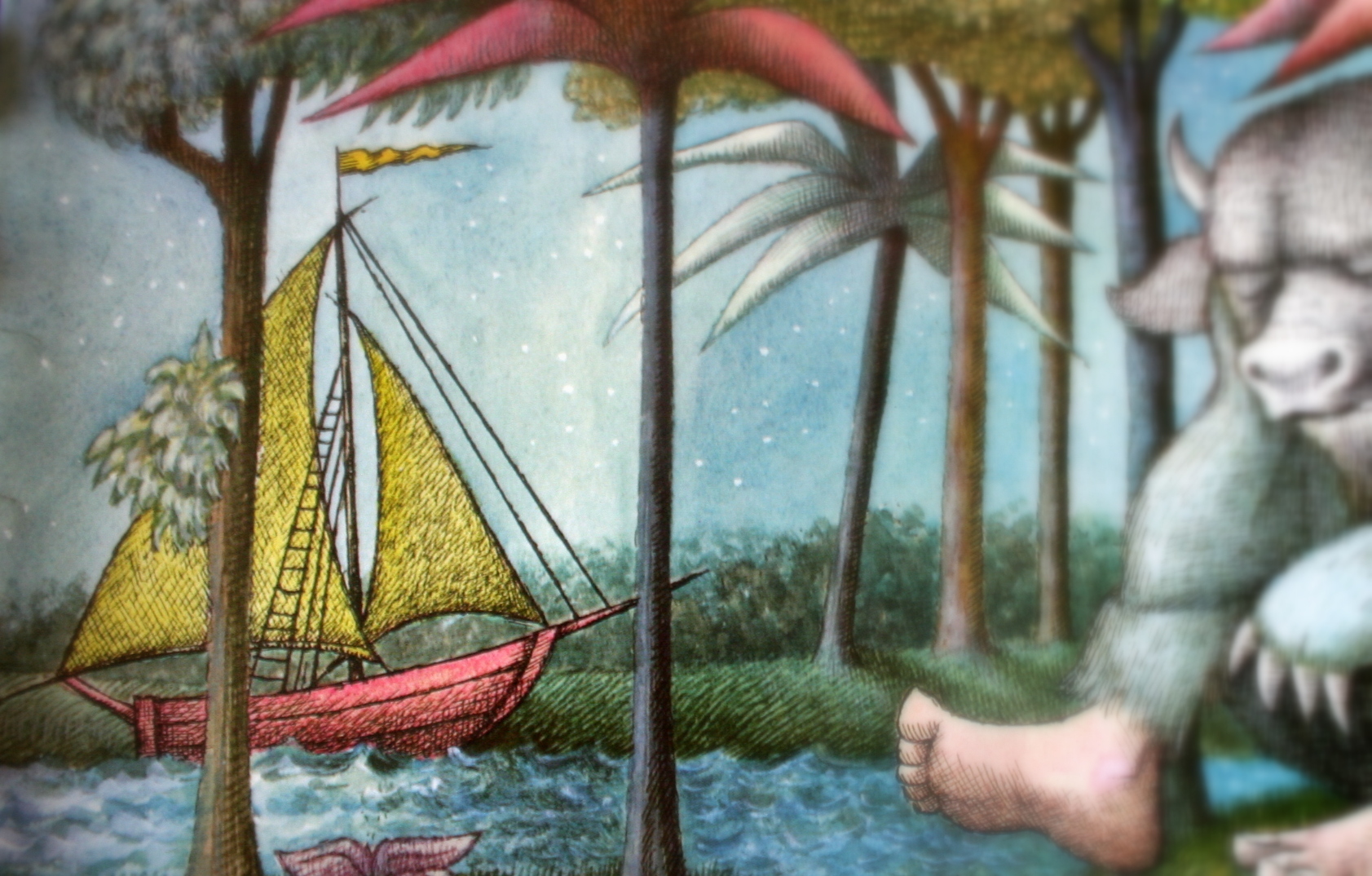
Today, Maurice Sendak has died. And I confess I felt adrift for much of this morning, because Sendak was neither our Max nor our wild things — he was our boat, carrying us across those dark waters to the distant shores of our own imaginations. How will I get to the wild rumpus now?
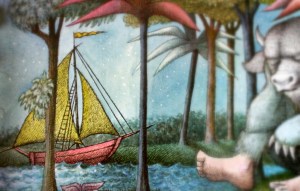
So I pulled out our copy of Where the Wild Things Are — yes, we still own a copy — and reread the book. I laughed; I cried. I’m not just writing that. It happened. But then I read it again. And today, my adult self discovered a fascinating new lesson:
This book is all about love.
Let’s not sentimentalize Sendak any more than we already have. Those who followed his work — or at least those who caught his gloriously witty and cantankerous two-part appearance on The Colbert Report recently — know him for the no-holds-barred bitchy realist he was, always willing to tell the truth no matter how much it might pain us.
So when I say this book is about love, I don’t mean the hugs-and-teddy-bears love of Hallmark cards on Mother’s Day. I mean real love, strange and combative and consuming. Love that devours us.
“I’LL EAT YOU UP!” Max shouts at his mother, and so he’s sent to bed hungry. It comes across as an angry declaration of war, Max against his mom, and in the heat of battle she takes it that way. I took it that way as a kid.
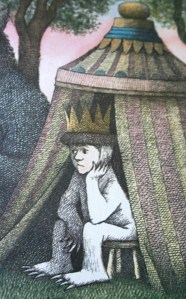 But later, surrounded by giant creatures who revere Max and cater to his every wild whim, Max suddenly feels lonely. Sitting slumped inside his lordly tent, he realizes that he wants “to be where someone loved him best of all.” Frankly, he’s already in such a place, because when he decides to leave his new friends, they gather yowling on the shore, pleading with him to stay, and in doing so they echo Max’s declaration: “Oh please don’t go — we’ll eat you up — we love you so!”
We’ll eat you up.
I can’t explain the psychology behind this — someone who can, feel free to chime in — but what parent hasn’t pretended to devour their children? Stuffing babies’ feet and fists into our mouths, we grin maniacally and coo, “Oh I could just eat you up!” It’s an expression of deep, consuming love, and as babies, we understood it that way — we LOVED when our mothers threatened to eat us up.
When Max first usurps the phrase — early adolescent role-reversal? — and shouts that he’ll eat up his mother, he might well mean it as a threat. But deep down, he understands its earlier, truer meaning: angry as he is, he loves his mother desperately. This is why, surrounded by devoted followers, he yearns for her alone, and it is the smell of her cooking that draws him back home.
Where his mother — who, annoyed though she may have been with Max, loves her son just as desperately and cannot send him to bed hungry — has set out his dinner for him after all. She, like my mother, missed his wildness and worried at his silence. And so they find each other’s love. “And it was still hot,” the book tells us.
True, this is no happy ending in the conventional children’s-story sense. There is no rushing into arms and reconciliation (as there is in the film version of the book). Max’s mother never appears in the book, and in the end, he gets away with his wildness.
But this is the reality of love. It’s not always out there in the open for us to see. It’s not always easy to sort out. Sometimes we can get everything we want and still feel lonely; sometimes we can feel guilt over our behavior and still get away with doing awful things. In that way, Where the Wild Things Are is not so much a children’s book as a human story for all ages.
Which is why we keep coming back to it, and will always come back to it. We might grow up and move past its early lessons; we might find out it means something we didn’t hear the first time. But we can always come back to it, and there it is waiting for us.
This morning, when I needed a little comforting, I came back to Where the Wild Things Are.




 Samuel Snoek-Brown