The April 2012 issue of Jersey Devil Pressis online, and this month, we’re getting all cultured. And stuff. Many of the stories deal with writers, literary references, rejection — the grist of the everyday writing mill. And a couple of the stories deal with Art. Capital A. But don’t worry, we’re not looking down our noses at anyone: in this issue, Sylvia Plath tries to kill herself and none of the other writers minds very much; European artists screw, lament their lives, and jump into rivers; nerds and scholars fret over the loss of great literature; and even God gets a rejection notice.
So read with deep and abiding irreverence, Cultured Readers. 🙂
A lot of my colleagues don’t bother with final exams in a writing class. The essays are the important thing, they argue, and the idea of a “test” seems out of place — there isn’t any knowledge a student can gain in a writing class that they haven’t already demonstrated in their essays, so there isn’t anything to “test” them on in the traditional sense. And I agree. But I still give a final exam, for three reasons:
I feel the experience of writing a complete essay (or any piece of writing), from draft through revision, in a timed, stressed environment is a valuable lesson — in fact, I tell my students that I view the final exam as a final lesson, not a final “test.”
In practice, it does become a kind of test of students’ skills, since they do have to go through the whole writing process in just two or three hours (depending on the college): the exam becomes a final chance to demonstrate just how comfortable they have become with their own process over the course of the term.
Except for an initial “ice-breaker” assignment in the first week, all their out-of-class essays go through intensive workshopping, which is great and benefits the students tremendously, but this final exam is independent writing, with no other input, so it’s a good chance see what they’re capable off on their own (especially when compared with that first assignment).
What usually happens is that students wind up writing some of their best work. Sometimes that’s because a student works better under pressure and doesn’t have a couple of weeks to second-guess himself or herself. Other times it’s because they really have learned so much and gotten so comfortable with their own writing that they feel more confident. And sometimes, I suspect, it’s the nature of the final exam itself.
Every term, I ask my students to write a reflective essay. It’s a chance for them to look back over a period of time or a particular project or a series of essays and examine how things have changed. Plus, it neatly combines several forms of writing we practice in a term and a few forms we don’t, including comparison essays, illustration essays, personal essays, persuasion essays, and process essays.
The nature of that reflection is different every term, so I’m not giving anything away for future students here, but this term I asked my students to look back over the past ten weeks of my writing class and reflect on their education — and to project a little, too: “What did you learn from this class that you expect to carry forward into the rest of your education or your career?” I asked. “How will that carry forward, or how do you expect to employ it?”
And, just because I’m fair and I want my students to be honest in their writing, I also turn it around: “Or, if you learned absolutely nothing this term, what had you expected to learn, and how did you or this class fail to meet that expectation? What will be the impact of that vacancy in your experience?”
What follows — in lieu of a Writer’s Notebook this week, because these are, in fact, responses to a prompt — are a few anonymous excerpts from my students’ exam essays this term. Yes, I’m cherry-picking; not all of my students wrote brilliant essays, and not all of my students were so glowing in their reflections. But I’m a positive guy, and I like to promote the possibilities in writing, so I wanted to share some of the comments that plucked my intellectual and emotional strings.
I have not, however, chosen any comments that might give away a students’ identity. These are totally anonymous; my students are perfectly safe. And except for truncating one sentence to conceal some identifying info, and a bracketed correction of my own name, I have not edited these or altered them in any way. These are exactly as they appear on the final.
“People don’t realize when they take classes, they aren’t just learning facts from a book, they are learning skills to better themselves in every aspect of their lives.”
“I have learned a lot about different persuasion techniques, including what not to use as an argument when writing a persuasion essay. I feel this will be helpful when I write future persuasion type papers, or if I have to persuade one of my teachers to change my grade in the future.”
“I didn’t just learn from things we did in class but from things I did not do. Not being here, not focusing and not detailing my work, taught me what I needed to do to improve myself and my writing.”
“I feel much more like a writer than I did my first day of class. Dr. [Sam] has taught me that it is ok to be who I am; and that just because my life story may be different from everyone else; it’s still ok to tell it.”
“I learned that revision is more than just correcting misspelled words and misplaced commas. It is sentence structure. It can mean finding words within your sentence that will make your writing more enjoyable for the reader. I found myself at one point thinking that I needed to take an English class so that I could expand my vocabulary. That really isn’t the problem at all, I think that truly I just need to spend more time during the revision process, and look at each sentence one by one asking myself, ‘How can I make that sentence better?'”
“Taking this class has helped me actually care about writing and creating ideas, which I think is the most important thing because if you only care about a grade, then you won’t fully grasp the concepts of writing and the freedom you have to create whatever you want.”
“When I think of the word ‘fun’, writing a thousand word essay does not find its way into my thoughts, but I know that it’s necessary and must be done. When I am interested, however, I put my all into the assignment. I need to find different ways of connecting any topic back to an interest of mine. I think this will help me immensely in future writing classes.”
“I found that I need to expand and try to work on this and get used to different writing styles, not just my own. I can’t always have a little me in everything that I write.”
“Just like the popular phrase “you have to love yourself before you can love someone else.” It is the very same for writing, you have to love your writing before someone else can.”
Fiction is flying all over the place today! This morning, I had a long story accepted for publication — more news on that this summer — and then this evening I get word that the new issue of Unshod Quills is live, which is great for me because I have not one story — not two stories — not three or four stories — but FIVE new stories in that issue! Five, people!
And because UQ works from assigned themes, writing those pieces was challenging enough that I produced some really interesting, really strange stories. They’re as much a surprise to me as they might seem to you. And I love that.
All five stories are on the same page, so if you want to check out the new work, just head to Unshod Quills and look for my name. And while you’re there, check out all the other excellent work there, including from my old pal Ryan Werner and my brand new pal and UQ featured writer Meg Tuite!
And giant thanks to my pal and UQ editor Dena Rash Guzman for making the magic.
This is the animal shelter in Boerne, Texas, where "Kicking to Stay On" is set. (The image is from Google's Street View in Google Maps.) But this is NOT the shelter in the story -- that shelter is a fictional place! The real Boerne shelter is excellent, and my family got some good pets from here. So if you live in the Texas Hill Country and find yourself crying while reading my story, click on the photo above to go to the Boerne shelter's adoption page and contact info and maybe rescue a dog or a cat today.
Spring is busy for me, gang! Publications abound, and I’m feeling pretty damned lucky.
Today, my story “Kicking to Stay On” is live at Fried Chicken and Coffee — at least, it’s live until the main character kills it. He’s a dark dude, and he likes to kill things. Starting with animals. So if you love animals as much as I do, take care reading this story! Leave the lights on, keep a loved one close, and maybe hide the story from your pets.
In just so you know, this story was harder to write than it is to read — I wept while working on this — but I’m damned proud of it and I’m thrilled that this story is finally in print. Cooler still: shortly after I got word that it had been accepted, I saw a tweet from editor Rusty Barnes in which he noted that “there’s nothing like reading two stories in a row that kick you square in the doodads — and in a good way.”
I’m pretty sure one of those stories was this one, gang! I kicked Rusty Barnes square in the doodads! 🙂
More stories still in the cue, everyone. Go check out the Publications page for the list, and keep an eye on the blog for more announcements.
PS: Seriously, I love animals, gang. Please track down your local humane society or animal shelter, or contact the ASPCA, and consider donating time, money, even old bedding and other items a local shelter might need.
This year, I have a new favorite Irish writer, and she’s going to get the post all to herself: the fabulous Ethel Rohan.
So far, I’ve only read her slim collection Cut Through the Bone, but believe me, that one book is enough make anyone want to grab everything she’s written and devour it. Already I’m salivating for her follow-up collection, Hard to Say.
I also love that she’s not only focusing on the density of flash fiction but that she dares to write such closely linked collections. Cut Through the Bone isn’t quite a story cycle, but the thematic and tonal connections between the stories unify that book beautifully. (You can read my review of it here.) Hard to Say, on the other hand, is a definite story cycle, a form I love and continue to play with.
You can always tell it’s March Madness time when everyone starts breaking out tournament brackets for everything imaginable. And we hopelessly nonathletic nerds will not be left out of the fun! So Half-Price Books is running an online “Tournament of Villains,” a bracket of evil that includes baddies from film, literature, and comic books, mostly in the sci-fi, horror, fantasy, and super-hero genres but also with a healthy smattering of old-fashioned literary evildoers…. Basically, if a nerd loves it, it’s on the list.
As of today, the bracket looks like this:
SPOILER ALERT: So far, it looks like Freddy Kruger is edging out Frankenstein’s Monster, which I find disappointing. But Narnia’s White Witch is neck-and-neck with Professor Moriarty, which is fascinating! And Snow White’s Evil Queen is tied with Captain Hook, which is also interesting — obviously, people are thinking of the classic Hook more than the Disney Hook, though it’s also equally possible that people are thinking of Julia Roberts‘s Evil Queen rather than the chilling Charlize Theron (or the downright satanic Sigourney Weaver, for that matter).
(Seriously, you think Dustin Hoffman could do anything but wet himself when faced with this Evil Queen?)
Join in the fun while you can: click here to vote! This round ends on Monday, and then it’s onward and onward until the epic final! (I’m predicting Vader vs. Sauron in the semis; who Voldemort will have to face in his semi, I’m not sure — the top half of that draw is a bit more up for grabs.)
A vintage postcard of Mercado Zaragoza in Piedras Negras.
This is technically a day early — the issue officially goes live tomorrow — but according to my Google alerts emails, the page is active and already getting traffic, so screw it: I have a new story online!
In that post a few days ago, I explained a bit about the plot — Mexican-American woman gets sent back to Mexico after a divorce and has to find her own way again — but what makes this story so interesting for me, personally, is that it started out as a dream. That happens to me now and then, but only twice have I dreamed a story in which “I” (not me as myself, but the perspective of the dream) was a woman. The first time it happened, I turned the dream into the basis for my dissertation novel. The second time it happened, I was the woman in this story.
And the bones of this story were all in the dream — the divorce, the loneliness in Mexico, the awkward but ambitious young politician that everyone calls “El Chino,” the young boy with a fist of nails…. Even the burned coffee and dusty concrete floor in the convenience store at the very beginning were part of the dream. The story itself needed a lot of fleshing out to make it all work, but those basic elements were all in the dream, more or less in order. And in the dream, “I” was Guadalupe.
Incidentally, I have been to Piedras Negras, where (and when) this story is set. There’s a moment in the story when El Chino points to a church in town and tells Guadalupe that he built it with the help of a Presbyterian congregation that drove down from Texas. I was part of that church group, back in the `80s, that built that church. I helped shingle the roof.
In advertising and business, they call it “cross-marketing.” In literary studies, they called “intertextuality,” and when it occurs all in one place, by the same author, on purpose, they call it a “story cycle” or a “composite narrative” or a handful of other terms.
But that’s just for old or dead writers. When we new writers do it, they call it self-indulgence.
I’m self-indulgent. I connect all my stories.
In my head, all my fiction looks like this.
In theory, my long-term goal is to connect every piece of fiction I write to at least one other piece of fiction, but I know that’s probably not going to happen with the longer stuff, like my novels (how do I connect my historical novel set in the Louisiana bayou during the Civil War with my apocalyptic story cycle set in a future Pacific Northwest?). But with my shorter works, I have a lot more room to play, and I love drawing connections between stories, pulling minor characters from one story and turning them loose in another, re-examining themes in new ways, collecting multiple perspectives on a single place or event….
When people deride these sorts of literary games as self-indulgent, they do so because they feel the playfulness is for the author alone and will detract from good storytelling, which is mostly about the reader. And they have a point. But the best writing is often writing that the author enjoys. We are our own first readers, and if we’re not getting any richness or depth or entertainment out of our own work, how can we expect anyone else to?
And sure, maybe there are better ways to add richness and depth and fun to a work. But this is my way. I love how layering in overlapping references to other works that otherwise stand alone give each work an almost 3-D effect, a fuller conception of the world in which these stories take place.
I bring all this up because this month I’m publishing a handful of stories that all have something to do with each other:
In mid-March, SOL: English Writing in Mexico is publishing my story “It Was the Only Way,” about a Mexican-American woman who has been divorced by her white husband, robbed of her children and her dowry, and sent packing back home to Mexico. That’s just the set-up, of course — what happens when she crosses the border is the story, which I hope you’ll read — but note that line about her children. They stay in Texas with their white father. In this story, they’re still quite young, one just a toddler, but that toddler, Miguel, turns up in another story I’m publishing soon.
In “No Other Milk Would Come,” which will appear in Scintilla Magazine later this month or early next month, Miguel is a teenager working in a restaurant in the Texas Hill Country. As a rebellious boy, he is trying to rediscover his Mexican heritage, which causes tension with his white father and step-mother, but he finds solace and tries to establish his masculine independence when he falls in love with an older — and pregnant — waitress at work. The restaurant is rife with secrecy and shady dealings, though, so the romance, like Miguel’s relationship with his parents, gets complicated in a hurry.
These two stories are actually part of a trilogy of stories about Miguel and his family, the third of which is “Have Love, Will Hurt,” this time showing Miguel as a young adult. A few people are familiar with this story because I read it at the Pop Culture Conference in San Antonio last year, but it’s so far unpublished, so I won’t go into detail about it. I bring it up, though, because there’s another character in that story, a creepy, possibly dangerous man named Robert, who turns up in a third story you’ll see online soon.
On March 23, Fried Chicken and Coffee will publish that story, “Kicking to Stay On,” which focuses on Robert — called Bobby by his co-workers — as he settles into his new job at an animal shelter. He’s sought work at the shelter on purpose, because he wants to learn how to kill animals. Bobby has a dark past, but his future is even darker.
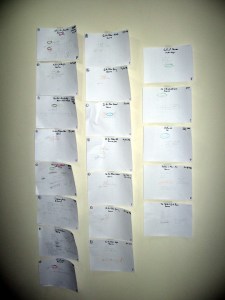
This is the actual "storyboard" I did for all the stories and novella chapters (plus a few connected but excluded stories) for Strangers Die Every Day. Those aren't notecards -- those are sheets of printer paper, and that's an entire wall. When that thing gets picked up for publication, I'll do a whole post detailing this big wall of craziness.
Incidentally, you might be interested to know that “Kicking to Stay On” and “Have Love, Will Hurt” are both stories in my book-length collection Strangers Die Every Day. That book is itself a story cycle, all the stories and the novella interconnecting through shared characters, overlapping settings, some common themes, and the same inspiration. It’s under consideration right now, too, so I won’t say any more just yet, but if you’re curious, check out my publications page and look for “Barefoot in the Guadalupe,” “A Few May Remember,” “Kamikaze,” and “Counting Telephone Poles,” all of which are also in Strangers Die Every Day. (If you figure out the connections, keep them to yourself for now — I wouldn’t want to ruin anyone else’s fun!)
Also out this spring: a few new stories at Unshod Quills, which aren’t connected to anything (yet) but which are connected to other stories in UQ by the issue’s designated themes: my stories are on the themes of David Lynch, Razor Dance, and Secret Life. That last story in particular is worth noting in this post: keep an eye out for “The Edge of Seventeen,” which I wrote as a kind of mini-cycle of multiple perspectives on a single event.
And while you’re waiting for all these stories to come out in the next month or so, check out the rest of my publications and see if you can find any other connections between them. Because believe me, I put them in there. I really am that self-indulgent.
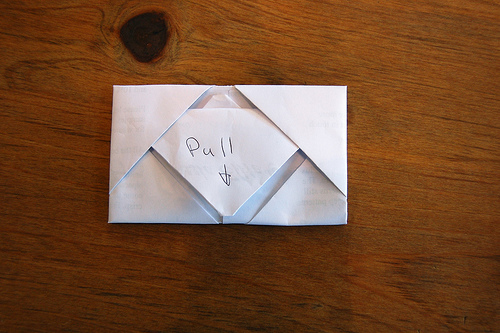
I never could figure out how to open these things, let alone fold them to begin with.
Maybe you’re young enough that every note you’ve ever passed in class was in the form of a text message. But not me. I remember when all passed notes were on intricately folded sheets of notebook paper, often torn out of spirals, and handed cupped palm to cupped palm below desk-level or handed off in hallways like spies swapping secret microfilm.
Not that anyone ever passed me notes. I wasn’t cool enough to ever be the recipient — I was just the courier. But that doesn’t mean I didn’t peek now and then.
That’s not true — I did receive a note in second grade. A first-grade girl passed it to me on the bus. It was one of those Q&A notes, like a survey. It contained a single question: “Do you want to be my boyfriend?” Underneath were two large, hand-drawn checkboxes next to the words YES and NO. I checked YES, and just like that, I had my first girlfriend. Her name was Natasha. I never saw her except on the bus, and we were both too shy to ever talk to one another, let alone sit next to one another. I don’t know that we ever officially broke up. (Natasha, if you’re reading this, you should know that I’m happily married now. Sorry to break it to you like this.)
I thought about those old passed notes when I submitted my story “The Voice You Throw, the Blow You Catch” to Fiction Circus a week ago. Fiction Circus is a bit of an anomaly in the lit magazine world, because they don’t simply collect your fiction, laugh about it in some back room, and then file it away for two or three months before they get around to rejecting you. Instead, they make their entire submissions and considerations process open and public: Not only does the whole world know what you’ve submitted to them and when, but the whole world also has a chance to read your submission and comment on it, vote on it, and laugh about it in the cold, hard light of day.
The editors claim that all this public judgment has no official bearing on their decision-making — “Stories that attract lots of votes will not necessarily be published,” they write in their guidelines, “and stories that seem to be ignored by the majority might achieve instant transcendence. Your ever-watchful Fiction Circus editors have strange tastes and precarious whims.” But let’s face it: those votes do mean something, because any traffic — up or down, good or bad — is still traffic, which means a shitty story that gets lots of buzz is surely more likely to attract the editors’ attention than a good story that everyone’s ignoring.
You want to vote yes. I know you do.
I think I’ve written a good story, and I’d like it to not get ignored. So this week, instead of my usual Writer’s Notebook entry (which, I know, I’ve been lax on lately), I’m going to simply pass you a note. Do you like me? Please check YES or NO!
To read the story, head to this page at Fiction Circus and click on the title. (You might want to right-click and open it in a new window; alternatively, you can just click here to read it at Ryan Werner’s Our Band Could Be Your Lit, where it originally appeared). Then, back at that Fiction Circus voting page, click on the up arrow to show how awesome you think the story is. Or the down arrow, if you think it sucks, but really, admit it, it’s pretty damned good.
Feel free to leave a comment at the Fiction Circus page, too.






 Samuel Snoek-Brown