“Writers are the lunatic fringe of publishing.”
~ Judith Rossner
During the next month or so, I’ll have five new stories in print online. Two of these stories — “No Milk Would Come,” appearing in Scintilla Magazine, and “It Was the Only Way,” appearing in SOL: English Writing in Mexico — are part of a trilogy of connected stories. (The third story is still making its way around the market.) Keep an eye out for the announcements that these stories are online, and kudos to people who read both and pick up on the connection!
The other three are unconnected, but they’ll all appear in the upcoming issue of Unshod Quills, which calls for submissions according to theme. These are tricky but exciting, because the themes are essentially writing prompts (I’ve posted about them before in the Writer’s Notebook), and I always love seeing where other writers take themes I also chose to write on. My three stories will present my takes on the “David Lynch,” “Razor Dance,” and “Secret Life” themes. Keep an eye out for news that they’re online, too, and then have fun comparing my interpretations to the work of other writers, artists, poets, and so on!
You can also check out links to my other stories on my Publications page.
I have my students writing personal essays this week, but I’m a bit too busy right now to write an essay alongside them.
I can, however, toss a prose poem your way.
New Orleans, 1996
When I wandered the shoreline near Jackson Square the saxophonist called me, lured me to him like a rat to a piper, only I was the pied one and the musician a denizen of the river. I could see the notes in the air, that ribbon of clef waving like a flag. I thought the instrument a clarinet, no idea what a treble sax was but no idea a clarinet could sound like that.
After I’d dropped a silent five in his porkpie hat, I found myself on Decatur Street. Not brave enough to look uncool in the Café du Monde, I slipped into Jimmy Buffet’s chain bar, sat alone along a wall to eat shrimp salad and drink Texas beer. A glassless window opened into the dive bar next door, the semicircular frame a glimpse onto the small stage there. A man in a flowery camp shirt and a straw hat, his skin dark as black beans, hung his heavy head over the worn, warm face of his steel guitar and picked the strings with his teeth. When I applauded, no one turned. I got my check. I was always just this side of the wall.
I don’t know why, but for some reason, there is still some question as to what a prose poem is. Plenty of people understand the form, and if you think about it even a little bit, the definition should be self-evident. I think some people get hung up on division and classification — they want prose to be prose and poetry to be poetry — but these are probably the same people who think prose is boring and poetry should always rhyme.
How to actually write a prose poem, on the other hand, is a very good question indeed.
This is not a good example of one. In fact, I’m a notoriously awful poet, and I’m not the greatest essayist either. But for some reason, that’s precisely how I think about some prose poems: as tiny little personal essays that rely on heavy mood or scene or language but not so much on character or story. The content is essentially essay-like, but the style and the brevity is poetic.
This prose poem, however, emerged for the worst possible reason: I wanted to dabble in a personal essay alongside my students but didn’t have much time to dig deep for content, so I was stuck thinking only of short scenes. (The scenes here, by the way, are true scenes, from a road trip I took to New Orleans during college.) They should be meaningful scenes, I told myself, but still, I wasn’t going to spend much time developing a story. So, go for brevity and style, compress whatever meaning I was after into as tight a space as possible. Write an essay that feels like a poem.
Except compressing content into poetic prose takes at least as much time as developing ideas, and if I didn’t have time to develop ideas, I certainly wouldn’t have time for refining the language. Which is why this isn’t great.
But hey. It’s a Notebook entry. It’s supposed to be rough.
Want to learn more about prose poems? There’s a pretty good discussion of the form at Dragoncave. Ironically, it’s not a very concise discussion, but it is pretty cool, and it’ll get the ball rolling.
Thanks, Zephyr! You are, without a doubt, the bee’s knees.
Sure, I know the “award” is sometimes considered a kind of meme or chain letter (or worse, just a way to pad the stats with pingbacks). And I think if you want to view it that way, that’s fine by me. But I think the people who treat it kindly, like Zephyr, are seeing it for its potential as a kind of higher-level social networking. I mean, how different is it from “liking” or “sharing” each other’s work online? Except in this case, we are liking and sharing not just posts but whole blogs!
The VBA is like the Nobel Prize of the “Like” button!
And that’s just keen. 🙂
So if all this accomplishes is to give me an excuse to share some of my favorite blogs with you and show a little love to the people I love to read, well, then, I think we all win. So, peaches. Let’s rock this award!
First, the rules of acceptance: I must thank the person who named me (check); then I must write a list of seven things about me. Why, exactly, I don’t know — it’s the most “meme-ish” thing about this whole process. But, what the heck.
I’m a (sometimes poorly) practicing Buddhist. My refuge name is Karma Chö Ying.
I have cats named after Henrik Ibsen and the Bronte sisters. This was an accident — they had those names when we adopted them — but now I want to continue the trend, so I’m determined to name our next cats Cormac and Austen (though my wife insists she’ll veto at least the former).
Want to buy me a gift? I drink single malts. I’m partial to Highlands, but Speysides are awesome, too. (And I’m always down for a dram of Laphroaig.)
I cry at movies all. the. time. Happy movies, sad movies, romantic movies — it doesn’t seem to matter. I cry at tv shows, too; I even cry at commercials. Today I cried just because it was a beautiful day outside and I was listening to a beautiful song. That sounds ridiculous, but I swear it’s true.
I once fractured my spine falling out of a tree. Seriously. It was a compression fracture, something that doesn’t usually happen unless you have osteoporosis. When the physical therapist fitted me for my cruciform brace so I could heal, it took her ages to track one down. “We’re having trouble finding one big enough for you,” she said. “We usually only have to stock these for 80-year-old ladies.”
And finally, I need to spread the love by naming 15 other blogs I read and admire. Which is hard, because if you glance over at my lists of links on the left, you can tell that I read and love a lot of folks. How on earth do I narrow that down?
I suppose the name of the award implies a preference for blogs that cover a wide array of topics, and a lot of the honorees do post a wonderful mix. But in the absence of any original guidelines, I’ll go ahead and just throw a shout-out to a bunch of blogs I love the hell out of, some of which are remarkably focused.
One rule I set for myself: No nepotism. Which means I won’t nominate my own Smile! blog, and — despite my genuine love for both her blogs — I won’t nominate my wife’s work, either. (But you should — go check out her Reel Librarians website and get obsessed, and then nominate her like crazy!)
So, here’s the list, which is really just the list today. I could probably make a different one tomorrow. But seriously, check out all these blogs. You’ll love `em. And backtrack to Presents of Mind, too, and check out Zephyr’s blog plus all the other ones she nominated (she has great taste — I’m already following some of the ones on her list, too).
"Love." On the campus of Schreiner University, Kerrville, TX, April 2011.
This is a true story about two dates, February 1, 1997, and February 1, 2012:
This is on the campus of Schreiner University, in Kerrville, TX. Fifteen years ago, that tree wasn’t there, and the room behind it was a small rec room. Fifteen years ago, I was on my way to that rec room to set up a party the student newspaper was hosting. There was a beautiful girl with amazing legs standing exactly where that tree is now. I talked to her; she talked to me. Later we swapped addresses and phone numbers. Fifteen years later, there’s a tree in that very spot, as though to commemorate the meeting, and I’m married to that beautiful girl with the amazing legs.
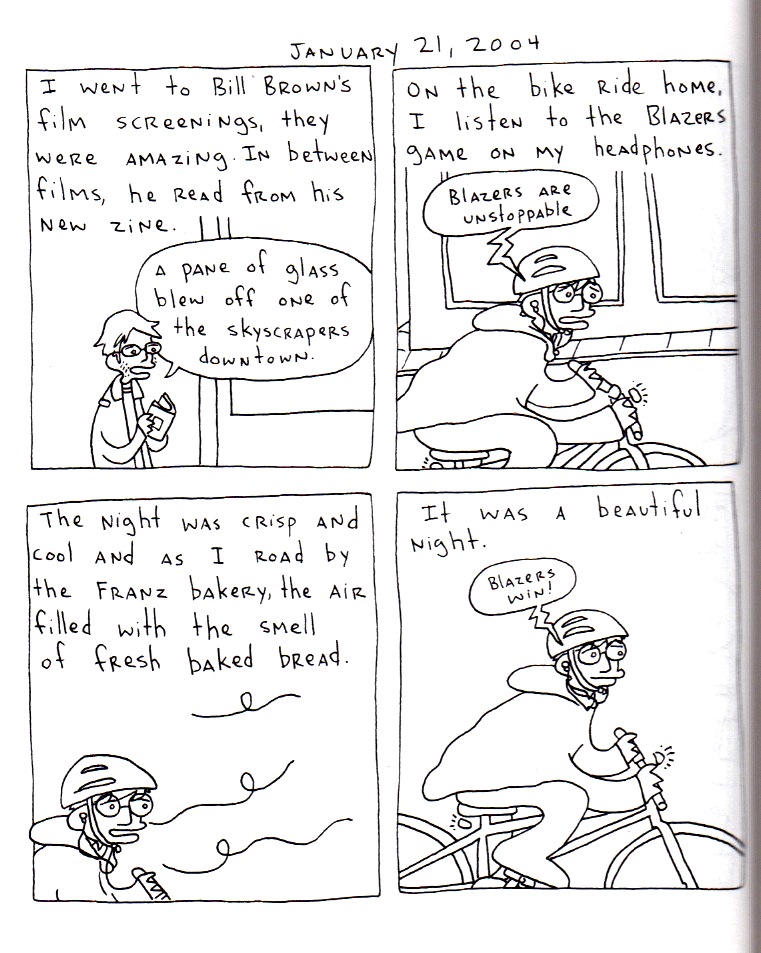
Last night I dreamed in comics. I’ve been reading a lot of Portland artist and zinester Clutch McBastard‘s collected works lately, and for weeks now it’s usually what I flip through just before I go to sleep. So I suppose it was only a matter of time before I started working the comics into my dreams. But this was the first time I’ve ever dreamed in cartoons, at least as an adult (Stratos and Man-at-Arms, from the He-Man cartoons, invaded my dreams through my bedroom window when I was in grade school, and the Care Bears and Superman once had a party in my house).
But last night I dreamed in 2-D line drawings very much in Clutch’s style, and the drawings were of me and characters from Clutch’s comics. We were riding bikes. I seemed to be enjoying myself, though there was an underlying sense of angst or ennui (probably both) ready to float up to the surface at any moment — much like in the Clutch comics. Which is why I love the Clutch series — the honesty and simplicity of these “diary” entries are engrossing, a kind of “reality comic” that, unlike the televised reality shows, actually is about real life, in all its mundanity and small glories and minute complexities. It’s simply lovely stuff.
from Clutch: The Lost Years
When I woke this morning, I lay in bed a few minutes thinking about the dream, and I decided to try my hand at drawing this blog post. I didn’t get past the first panel, because I suck at drawing. I mean, I am REALLY bad.
See what I mean?
Which got me wondering, why can’t I just sketch a few lines? Or rather, why don’t I have the patience and equanimity with myself to learn how to sketch a few lines? I know this is as much a learned and practiced skill as it is a talent — probably more a craft than an art — and as a writer, I fully believe in the importance of practice and the role of craft in the work I do. But for some reason I sketch a few lines of visual art and just plain give up.
It’s kind of sad, really, because I love what other people do with quick, simple lines. My wife, for example, can draw a killer caricature of me, and Eirik Gumeny, my cohort at Jersey Devil Press, did a really cool sketch of me for our staff bio page.
Drawing by Jennifer Snoek-BrownDrawing by Eirik Gumeny
But I can’t draw myself or anyone else for the life of me.
It’s been busy this week, what with the website relaunch and all. So I’m back to old notebooks (ridiculous misspellings and all).
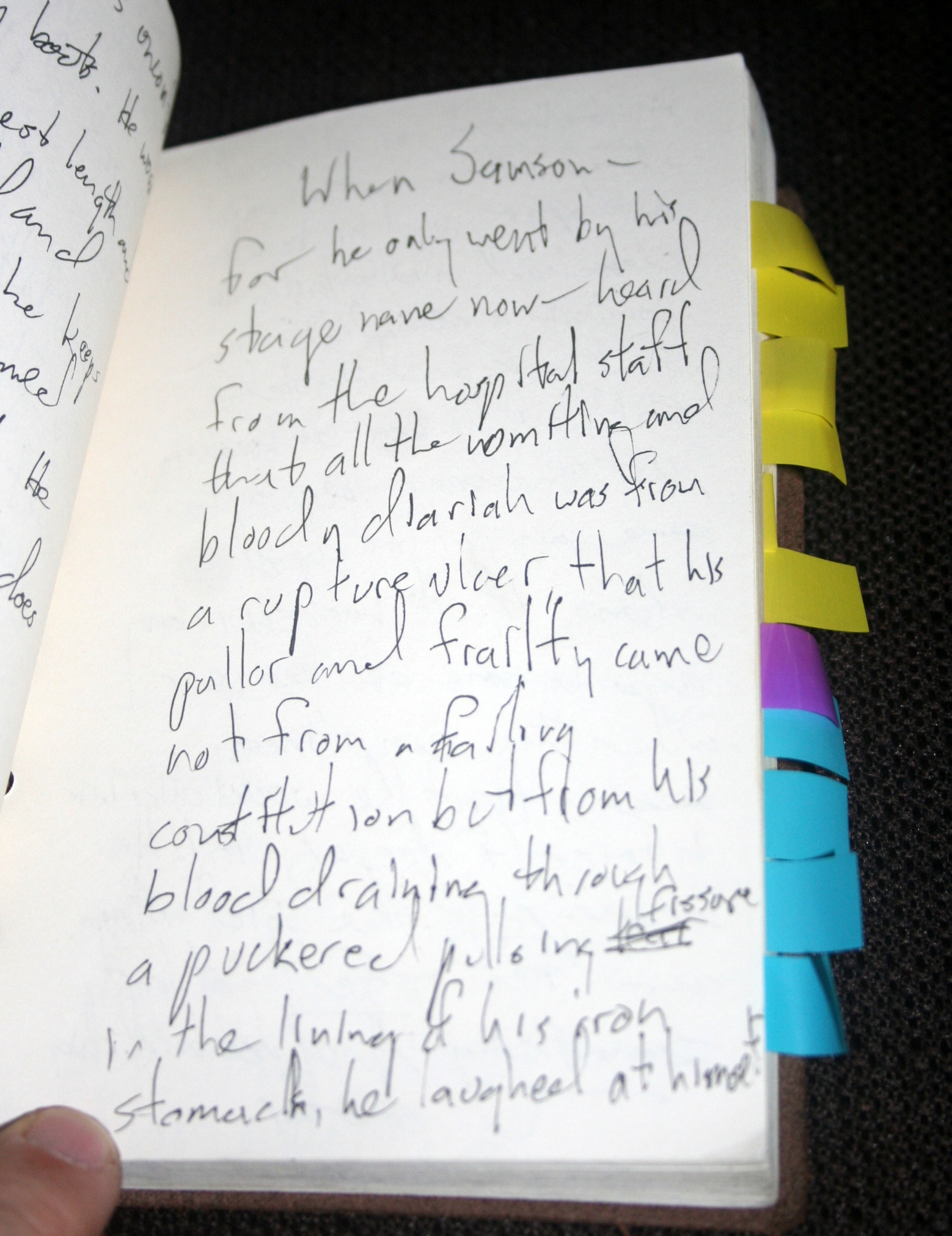
When Samson — for he only went by his stage name now — heard from the hospital staff that all the vomiting and bloody diariah was from a rupture ulcer, that his pallor and frailty came not from a failing constitution but from his blood draining through a puckered, pulsing tear fissure in the lining of his iron stomach, he laughed at himself. His forehead was cold and damp with sweat he could not spare, and his bowels clenched involuntarily to contain a new delivery of black and liquid shit, but he went on laughing just the same, because in some way, at last, he’d done it. He had sworn long ago in some darker year when the emptiness began that he would dig into himself, deeper, until he broke past the void within and felt — felt — at last something. And now he’d dug too far.
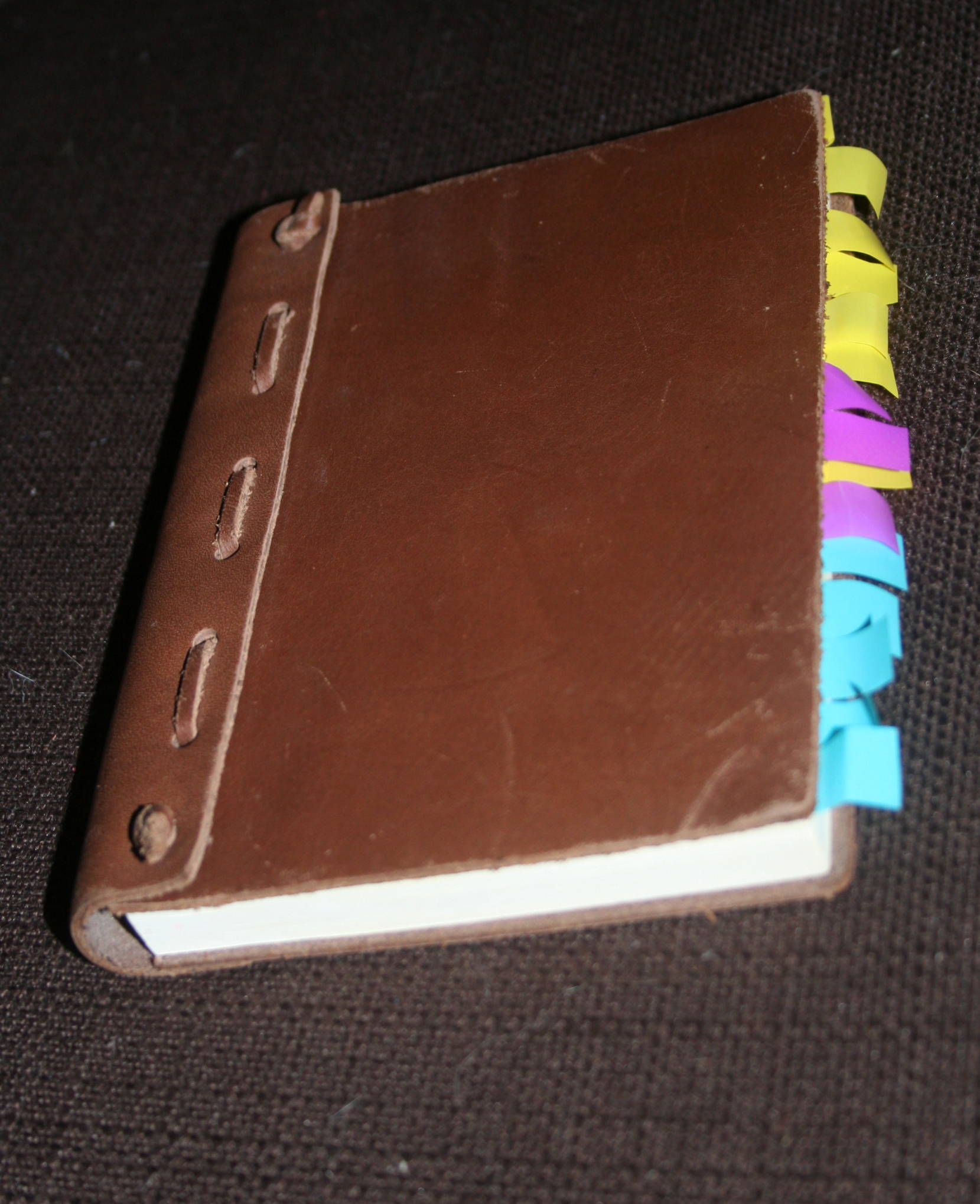
This notebook was one I used a lot in grad school at University of North Texas. I don’t recall exactly when I picked it up or when I filled the last page, but I know it took me a long time to fill the book. The first page contains an early sketch for the story that eventually became “Distance,” which appeared in print in 2003 but which I’d been working on for at least a year before I published it. And the last pages contain notes from Debra Monroe‘s Q&A and reading when she visited UNT. That was, I think, some time in 2004 or 2005. So I was working in this book for at least a couple of years in the early 2000s.
The text is actually the first draft — written cold, in my car, on the side of the highway — of the story that wold become “Horror Vacui,” which appeared in the online edition of Ampersand Review last year. I’d been listening to the stereo and a song caught my ear, got my brain spinning, and soon I was conjuring the character of Samson. This opening appeared more or less as is in my head, and I turned it over a few times until I had no choice but to pull over and scribble it down in the notebook. (It pays to carry a notebook, people. It looks pretentious and “writerly,” but damn it, those things come in handy!)
I’m a bit surprised, actually, that this first draft bears so much in common with the version that wound up in print. It felt rougher at the time. But it’s worth pointing out that I crafted this several times — not once or twice, but over and over — in my head, even a couple of times out loud, just me speaking into the empty car like an idiot, before I bothered putting words on paper. Which isn’t always the way I work, but it’s worth trying once in a while. I like refining the words mentally, actually — it feels like stretching, like yoga, a wonderful combination of exercise and meditation.
All those flags taped into the notebook? When I was working on my story cycle, Strangers Die Every Day, I needed to keep all the stories and all the overlapping characters and situations straight, so I went through all my notebooks and color-coded the notes I’d scribbled for all the pieces of that big collection. This notebook happens to contain more of those notes than usual. 🙂
The song that inspired this beginning of a story, by the way? Not a song — it was a whole album, Tool’sAenima.
There are still a few bits and bobs I plan to add in the coming weeks, like a couple more photo galleries, but say hello to the new and (I hope) improved website. Check out the new interactive photo menu on the main page, the new photos page, the new publications page, and anything else you might be interested in clicking, reading, browsing, or sharing with your friends and neighbors.
And feel free to share your thoughts in a comment!
It has been simply ages since I last wrote about the spiritual and temporal guides to my career, my “Patrons of writing and teaching” series. It’s not for lack of content (in addition to this post, I have several others in my pocket for later), but I got quite sidetracked by the writing itself, which I suppose means my mentors and muses have done their job well.
Anyway, I was scouring my photo files this week for a project I’m working on, and I remembered I’d taken a handful of photos of my college professors (or, more accurately, photos of photos) while in Texas last spring, with a mind to putting them in a post just like this one.
So here we are.
I love tracing academic and creative lineages (I wrote one of my doctoral exam answers on tracing influences from author to author in American short fiction), and I make no bones about the admiration I feel for my own teachers and influences. Today, in particular, I want to focus on one of the handful of professors who most impacted my writing as an undergraduate student at Schreiner University (then, College) in Kerrville, Texas.
Dr. David Breeden, back when he taught at Schreiner University.
When I was in Texas last spring, I knew it would likely be my last visit for a while, so when I had some free time, I made a kind of pilgrimage up to the old alma mater to nose around a bit. While there, I discovered that a few of my professors had won the university’s award for teaching excellence, which is the series of photos I snapped that prompted this post.
Among these was David Breeden, one of my English professors, who was hugely supportive of my writing and who served as my undergraduate thesis director (I wrote a novel, a comedy about two morons, which my father loved so much he still insists I clean it up and publish it somewhere).
David Breeden was my first and longest college writing mentor — in fact, he was my first college teacher, serving both as my advisor during registration and as the professor of my first college course — and he remains a good friend. He taught me a lot of what I first learned about creative writing:
compression of form: he was brutal to both my prose and my poetry, and I needed that brutality desperately;
editing: he invited me to edit two of his novels, Another Number and Stack to the Moon, from which I learned a LOT about revising my own work;
the publishing industry: he was always game to experiment with publishing innovations, working up one of the first attempts at a hypertext novel I’d ever heard of — an idea that quickly though inexplicably died away among the general public — and publishing his novel Artistas as one of the first print-on-demand books (that wasn’t from a vanity press) that I’d ever heard of, back when the technology was still tragically prone to printing errors;
how to read poetry aloud: the breath is so important it does almost as much to define the line breaks as the line breaks do to define the breath;
the trick of switching forms as a way to change your perspective during revision: he was in the habit of changing his novels into screenplays and then back into novels just to tighten up the prose; he also changed his screenplays into novels and then rewrote them as screenplays to better develop characters and plot . . .
And a myriad of other things.
Breeden also encouraged me as I produced a couple of (really amateur) chapbooks in college, stepped up as an advisor for our student newspaper (I was an editor), supported our chapter of Sigma Tau Delta (the English honor society), and got me involved in the Texas Association of Creative Writing Teachers and the Gulf Coast Association of Creative Writing Teachers — when one of my short stories won an undergraduate fiction award from GCACWT, it was Breeden who collected the award for me at the conference and presented it to me during one of my classes!
But perhaps his biggest influence on my career wasn’t what he taught me about writing, but what he taught me about academia. I once asked him why, with all the writing he did, he had chosen to teach college rather than write full time. He quipped that teaching was the best way he could figure out to stay in school and “not have to get a real job.” It was the former part of that joke that appealed to me, because at the time I was just discovering how well suited I was to higher education and academic life, and while I’d entered college with the idea that I would teach high school, I decided then and there to pursue my education through my PhD and teach college, because while even then I knew how much of a “real job” teaching actually is, I was absolutely besotted with the idea that I could stay in college for the rest of my life.
Rev. David Breeden at a Minnesota Faith Rally in February 2011. Photo from Flikr, by "StandingontheSideofLove."
More directly, Breeden and his cohort (and my next Lineage post) William Woods, were instrumental in helping me find my place in the masters program at West Texas A&M University, where I worked with (future Lineage post) Jerry Bradley, who introduced me to author (and subject of my masters thesis) Tom Franklin. . . . You see what I mean about the importance of tracing a lineage?
Breeden, I should point out, has since left academia to pursue another passion of his — religious philosophy — and after attending seminary, he currently serves as a Unitarian minister and writes religio-philosophical poetry and essays while also fighting for social justice and equality. We remain good friends, and I continue to learn from him.
Just a reminder, gang, that I’m going dark tomorrow for a few hours while I revamp and update the site. I should only be down for a few hours, but bear with me — this process has a way of presenting surprise problems along the way.
Remember, too, that when the fire drill is over, we’ll all be meeting at snoekbrown.com!




 Zephyr at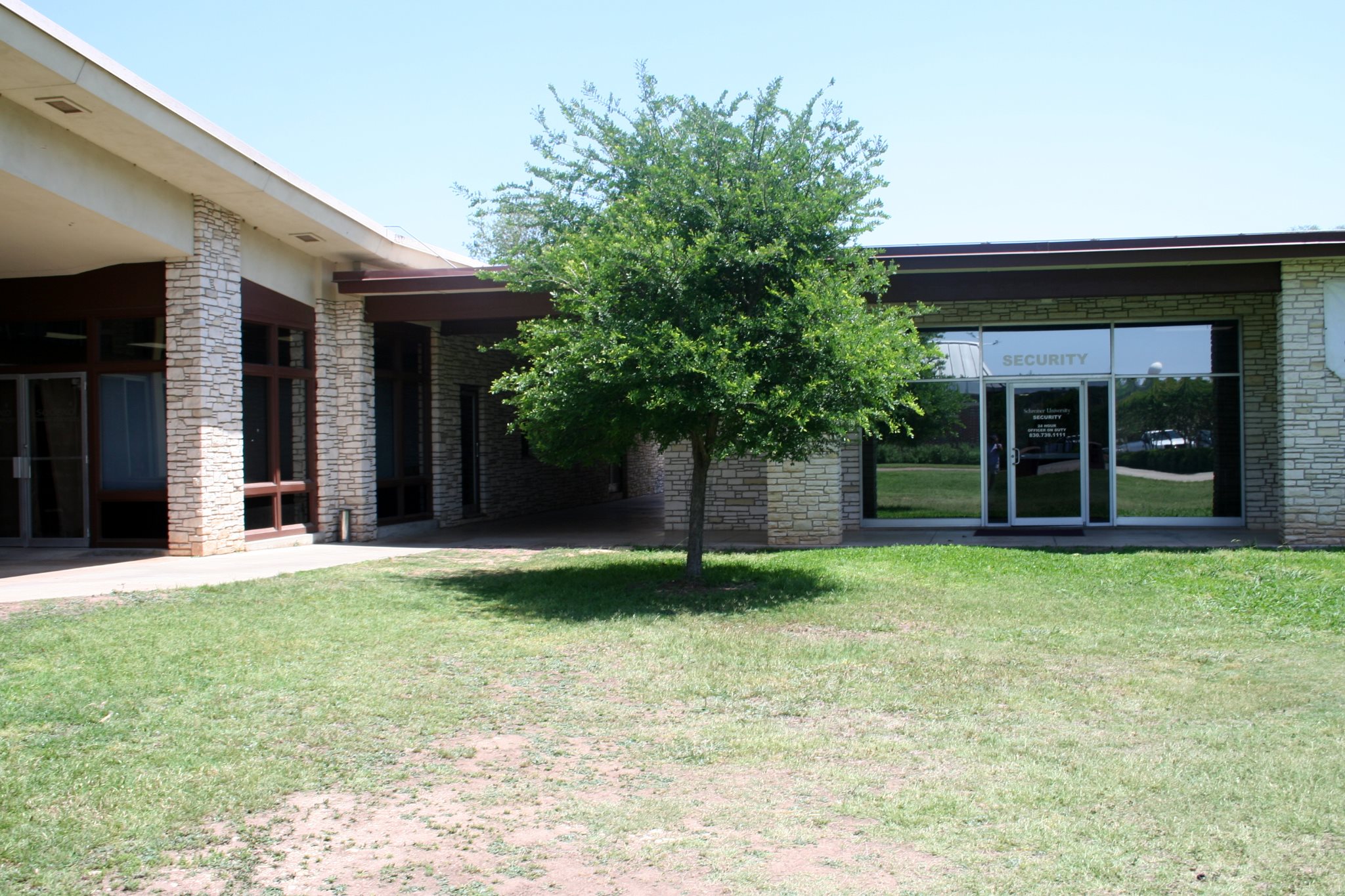




 Samuel Snoek-Brown