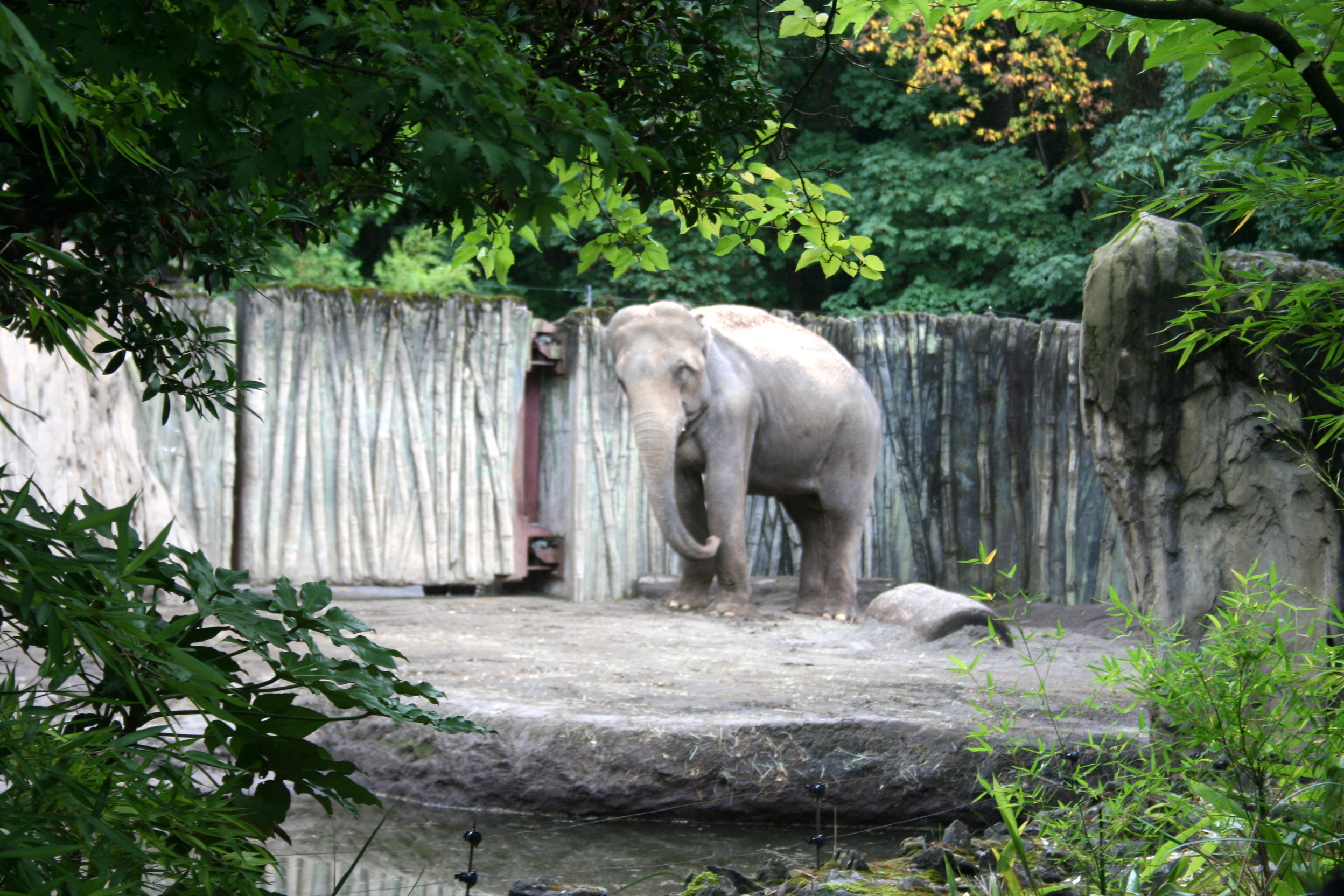
This is one more photo for the NaNoWriMo project. It’s not particularly “apocalyptic,” but one of the stories involves the elephants at the Oregon Zoo, so I figured I’d share this particular pachyderm.

This is one more photo for the NaNoWriMo project. It’s not particularly “apocalyptic,” but one of the stories involves the elephants at the Oregon Zoo, so I figured I’d share this particular pachyderm.
I’ve said before that I want this whole apocalyptic novel-in-stories to focus on the characters and their personal struggles more than on the trappings of the whole apocalyptic genre thing. Which is to say, I don’t want to eat up much page space with descriptions of the apocalyptic environment or background on how the world got into the mess it’s in or explanations of how people are rebuilding society (or societies).
And yet that’s precisely what I’ve been doing. Part of this makes sense, because I can’t do much to write in the mindset of the survivors without understanding what it is they’re surviving. And I think it’s actually quite interesting to explore how our internal, emotional world reflects our external environment.
But I’m also aware of what a distraction all this background work is. And I’m aware of how much of this is purely background work, meaning however much it’s contributing to my NaNoWriMo word count (and I’ve almost doubled it from last week), I’ll ultimately have to delete a lot of what I’m writing.
Which isn’t a bad thing, really. It just makes for strange excerpts in the weekly Notebook.

from “Either They Want All This or They Can Do Nothing to Stop Us”
I looked around at the trees, the regal mountains that the trees called home. Birds switched branches somewhere in the distance, the wind gusted like laughter. A cluster of brave young flowers on the edge of the camp’s clearing bent to touch the ground. The breeze slowed until it stopped, the warmth of the new sun flushed my skin. I closed my eyes.
I listened for him. They said he never went far. I sat on the log and studied the grains of the earth while I waited. An ant, lost and confused, scurried around the boulders of shattered pebbles that surrounded her. The ant stopped next to a dried-up bit of leaf, contemplating it. I knew she was nowhere near home and would probably never find her way back. Alone in world much too large for her, the ant wouldn’t live to see her hill again. I believe that the ant understood this. With no queen to feed, all the ant could do was eat the leaf herself and move on. There was no reason to pick up the morsel and take it along her hopeless excursion.
The ant reached out, picked up the leaf in her mandibles and, throwing it on her back, went along her destinationless journey.
from “Like Churchbells On a Hangover Sunday”
Someone had a plan: we would bag and tag our children like they were bodies already, tiny corpses just waiting to happen. It was like that game you play at the airport, everyone saying goodbye at the car so no one had to say goodbye at the gate. We buried our children in clothes and luggage and sent them with their own coffins — this is true — by the truckload to all these safe havens out in the countryside, up on the hilltops, anywhere we could think of.
We’ve done this before. The Brits did in it World War Two, loading millions of kids onto trains and shipping them out of the cities. They brought a lot of them back too soon, of course, and so many died in the Blitz anyway. But something about that stuck with us, especially over here in the States, where our children were never in any danger from anything but ourselves. We fell in with the romanticism of the idea. I blame CS Lewis, really, for the idea that if you ship kids off they’ll all wind up in wonderfully romantic places, huge abandoned mansions with crabby old folks but with wondrous hiding places, musty forbidden rooms, and, if you were lucky, secret magical kingdoms. That was Britain, this is not. But we took the idea and ran with it. When I grew up, it wasn’t the kids getting sent to the countryside for romping adventure and days of eternal sunshine. It was our family pets. Dogs by the millions were galavanting across someone’s open field, cats by the hundreds of thousands catching mice in someone’s barn. Goldfish finding their way through the pipes to the wide open sea that glistened gold and blue in the setting sun.
We’ve told our children these stories for generations, so even though we don’t have the history of the British, we had precedent enough to make the plan work, and away the children went.
from “Life, Thus Far”
Food stores were thin and the days were long and cold when Henrietta and Roberto went to Larch Mountain looking for food. They each carried a large bell, one stolen from a cattle barn where it had once hung from the neck of a cow and the other dismantled from an abandoned firehouse where it had hung ceremonially. They had agreed that whichever of them found any kind of food — berries, mushrooms, nuts, even the squirrels that hoarded the nuts — that person would ring the bell and wait for the other to arrive so they could share the food. If they had extra to bring back, that would be good, but the first order was to eat their fill, but of even greater importance was to do so equally. This was the way of new and desperate societies: individualism had died with the old world, and now survival depended on collective effort, for without Henrietta, Roberto would have to learn sock darning and wood working and other necessary crafts; and without Roberto, Henrietta would have to learn medicine and cooking; and without each other, they would loose what little warmth they got from each other’s bodies in the night, for their small cabin had no heat. They were the smallest possible community, but each depended on the other, which was how things worked now.
When they reached the summit, they split up, assured of their mutual agreement. Roberto wandered south but found nothing edible. Henrietta, however, searched north, where she found a large chestnut, nearly as big as a small apple. It was grotesque how massive the nut had become. It looked less like the offspring of a tree than like its tumor. It was decadent in its size and Henrietta felt so overcome with her desire to eat it that she dropped her bell as she bent to scoop it up in both hands. She pressed the nut between her breasts and drew a breath to call out for Roberto but her voice caught. She pressed it into her stomach, which now churned at the proximity of food, and inhaled again, but her throat was too dry. She pressed it between her thighs, as she had when she was a girl and needed to pee but couldn’t, and she calmed herself and took a long, careful breath. But she could not call for Roberto, and she had entirely forgotten her bell. All she could think about was the chestnut.
from “A Meaningful Conversation with a Stranger”
I lit some candles, tried to sex up the storm a bit. Rubbed Jess’s shoulders, kissed her on the neck. She shrugged me off, just kept staring out the window. Fewer scavengers, more rain. I walked around a while, bumping into doorways in the dark. Then I said, “You know what we could do, Jess. It’s all dark — no lights, you know? Like you like it?” She wasn’t interested. And so there was nothing left; I pulled up a chair. It was all we could do: sit and watch. Neither of us liked it, I can tell you. Not a damned bit.
Hours. Lots of them. Who knows how many — we couldn’t see any of the analog clocks in the dark, and the one digital with a working back-up battery had never properly reset itself. According to it, the time was 12:00 12:00 12:00.
But it was late, I think, when we both jumped in our chairs, when we both heard the noise out on the front porch.
I said, “I didn’t see anything.” I looked at Jess. “It’s so damned dark out there — did you see anything?”
She shook her head.
And right then, no word from either of us, the door came open and the rain pushed in a man. The door slapped against the wall and left a little dent where the lock poked out from the knob. The man said, “Well, shit, sorry about that,” then he jerked the door into its jamb.
He stood on the mottled little welcome mat on our tile entryway, dripping. His long coat hung sloppy with rain off his skinny shoulders, and his hair did about the same from his long head. Everything about him dripped, as though he was hung up from the doorway and was not standing on our welcome mat but spilling onto it.
He wore a tie with the knot half undone and draped down mid-chest. And he carried an umbrella, rolled up and point down like a cane. Looked like he’d never bothered to open it out there in the storm.
Jess and I still sat on our window seat, me with one leg over the edge in the middle of standing up. I couldn’t see Jess’s face from behind, but I’m pretty sure her mouth hung as open as mine.
The man looked at us square on, shook his head once, and screwed up his brow.
“Why are you two just sitting there? Fine night like this! Shit, the power out, everything all freaky-like, we could have some hilarious fun, you know.”

Total word count as of this post: 33,300 words.
For more about my NaNoWriMo project, check out my NaNoWriMo page here or my profile on the NaNoWriMo website.
 It’s been a good week for publications. On Monday, my story “Barefoot in the Guadalupe” appeared in Red Dirt Review, and the same day I got word that I’ll have a story in Scintilla sometime in the future. Then today, Jersey Devil Press‘s special Holiday Half-Issue my colleagues and I have been working on turned up online. And it is (in)glorious. Seriously: besides my story ripping apart Santa Claus and stitching him back together again (literally), the issue contains a delightful New Year’s story about obnoxious family and a magic genie hiding in a bottle of root beer, and two — count them! two! — stories about vengeful turkeys.
It is awesome.
Check out the issue online now. Because we need some new holiday bedtime stories.
Oh, where to begin?
It seems like the publishing market — or, at least, the small press and indie lit markets — like to work in tandem, with everyone publishing stuff all at once. It’s like our literary periods are in synch or something. I say this because a lot of my friends and acquaintances have been announcing new publications recently. And since I like to plug the writers I know, I figured I’d try to issue a bunch of plugs all in one place.
So, here goes. And I’ll just tackle this alphabetically, because trying to sort it all chronologically would take up NaNoWriMo time.
Looking for a writer you know? Use these handy — UPDATED with a new writer! — links to skip through the list! Because I have news about and publications by loads of writers, including
Portland writer Hobie Anthony has loads of work all over the web and in print, but his most recent piece is the flash fiction “The Theater of Normal People” over at Housefire.
He also has a piece forthcoming in Palimpsest sometime this month, and another story will eventually turn up in Ampersand Review, where I published a while back (I love that Hobie and I are going to be literary neighbors now!).
You can find links to more of Hobie’s work at his website.
Christopher Cook, who lives in Prague but hails from Port Neches, Texas, where I also spent part of my childhood, has a whole slew of things going on right now. He has three pieces available through Amazon — two novellas and a collection of three stories — that operate together as a kind of long narrative cycle, with shared settings and so on. So if you plan to read Cloven Tongues of Fire, for example, you might as well go ahead and download Storm and Tiger Ridge, too, because you’d be cheating yourself otherwise. (Christopher’s artist wife, Katerina Pinosova, did two of the covers. Which is very cool.)
You can also read a free excerpt from Christopher Cook’s novel Robbers in the newest issue of SOL: English Writing in Mexico, which just went online today. I should warn you, though: if you start reading that excerpt, you’ll want to go ahead and just buy the whole novel, because Robbers is gripping, hellaciously fun stuff. I read it a month or so ago and was spellbound. Really damn fine fiction.
You can find out more about Christopher Cook and his fiction at his website.
Molly Gaudry, writer, bookseller, and friend to small presses and indie publishers across the country — and founder and director of The Lit Pub, the coolest online bookstore/literary social community you’re going to find out there — had HUGE news this fall: her book We Take Me Apart was a finalist for the Asian American Literary Awards for Poetry. Which is just epic. But then it gets even cooler — because We Take Me Apart defies easy categorization, this book that was a finalist in a major poetry prize also has been nominated for the McLaughlin-Esstman-Stearns First Novel Prize. Go figure.
But that’s how cool Molly is.
Oklahoma native and a former classmate of mine, Wayne Lee Gay, is kicking literary ass lately, too. His memoir “Bird of Paradise” is appearing in cream city review, a publication I admired a lot when I lived and worked in Wisconsin (it’s published out of the U of Wisconsin-Milwaukee). And, even more impressively, Wayne’s story “Ondine” is in Best Gay Stories 2011. Seriously, gang: a Best anthology! That’s awesome. And well deserved, too — Wayne was one of the finest prose stylists I had the privilege of studying with down at the University of North Texas, and I still think fondly on some of the excellent stories and essays he wrote for our workshops. I don’t recognize the titles of either of these pieces, though, so I’m really looking forward to reading new work from him! (You can read the first page of “Ondine” in Amazon’s “Look Inside!” feature.)
And then there’s Dena Rash Guzman. Dena, Dena, Dena. Another Portland writer, she has been basically tearing up the literary world.
Her essay “Not For All The Tea In China,” a guest post at The Faster Times, has one of the most killer first paragraphs I’ve seen in an essay, and I dare you not to get sucked into it.
She also has a terrific new poem, “Mexican Coke,” at Ink Node, and she has a short new piece, “I Dream In Italics, Eat In Mandarin and Order In English At the Noodle Shop” at Sqwawk Back.
As if all the pubs weren’t enough, Dena’s also heading to Shanghai — actually, is being flown to Shanghai! — for a book release with HAL, a publisher for whom Dena is the North American director.
And Dena has two stories included in HAL’s next book, Middle Kingdom Underground, which should turn up on our shelves here in the US sometime in January; AND she also was featured in the first Viva Las Vegas Poets Anthology. (I really need to get into the anthology business.)
And because all of that isn’t enough, she has two more pieces forthcoming online, at www.asiancha.com and on the www.haliterature.com website.
Oh, and in a couple of months, she’ll be at Lolita Bar in NYC to feature at the Earshot series, so if you’re in the area on Jan. 19, stop by and tell her hello.
Hosho McCreesh, whose poetry collection inspired my NaNoWriMo novel, has recently published a short story ebook with mendicant bookworks. The story, “Something That’s True,” is generating a bit of buzz online, both at Poet Hound and at Orange Alert Press, and if it’s anything as good as the novel excerpt he ran in Sententia‘s special “pitch” issue this September, the buzz is well deserved!
Yet another Portland writer, Riley Michael Parker, has a new story out today in — wait for it — PANK. As in, that literary magazine we all wish we could get published in. He just got published in. Seriously. Which is awesome, so go check out “Silver Dagger.” You can thank me later.
My cohorts over at Jersey Devil Press have also been busy! Stephen Schwegler and Eirik Gumeny‘s book, Screw the Universe, has been out as an ebook for a while now, but just a couple of weeks ago, it became available on Amazon as a full-grown paperback (“Just like grandma used to make,” Stephen says). I confess I have’t read it yet, but it’s supposed to be hilarious, and I love the stuff Stephen and Eirik write, so join me in rushing over to check it out.
And, last and possibly least (just kidding, Ryan), we have Ryan Werner. Ever the prolific — and talented — bastard, Ryan has been on such a publishing run lately that he’s had to make his own damned list, which you can check out at his lit magazine/blog Our Band Could Be Your Lit. The short version: he has something like half a dozen stories currently online or coming soon to a lit journal near you, and I can tell you, they’re all worth reading. All joking aside, Ryan is a hell of a talented writer, and I’m proud to know the guy.
Ryan will also have two pieces in the upcoming December issue of Unshod Quills, which is edited by Dena Rash Guzman. Remember Dena? Yeah, she edits Unshod Quills, too. And Ryan’s gonna be in that in December.
Wow. Am I done yet?
Only for now, gang.
Do I know you and I left you out? Feel free to leave a reference to your work — or even a link, if it’s online — in the comments!
(Oh, PS: the title of this post? It’s a line from Abe Lincoln: “The things I want to know are in books; my best friend is the man who’ll get me a book I ain’t read.”)

Just a quick note about a new story of mine, though “new” is a bit misleading — I actually wrote the first draft of this one something like a decade ago and have been revising and retooling it ever since. A while back I finally got it where I wanted it, and it’s been making the rounds, and this past week Red Dirt Review picked it up (and praised the hell out of it, which feels great).
Seriously, I’m pretty damned proud of this one, folks.
The story is “Barefoot in the Guadalupe.”
And bonus points to anyone who figures out where I got the idea. (Friends who already know: no fair cheating and letting the secret out. Let the other kids play for a change.)
Also, a couple of previews: a lot of my literary friends have been really, really busy lately, and tomorrow I want to plug some of the awesomeness they’ve been up to. So, more publication news to come. And, while I’m on the subject, I’ve had another story picked up just this morning, but I’ll wait and announce it once it’s actually in print.
This has been a strange week. If you’re following my daily word counts, you’ll see a lot of spikes and dips: on days I teach, my word count plummets, sometimes into the mere hundreds; then, on days I don’t teach, it leaps up as I try to make up for lost time. So far I’m running slightly behind par, but maybe this weekend I’ll catch up again.
Another thing that’s strange about my writing: I’m rewriting a lot. That’s technically against the rules, and really, I’m not deleting much of what I’ve written even as I change course in the story I’m working on. But I’m changing course a lot.
This is turning out to be a good thing, though, because I’m cutting a bit looser and tackling some strange ideas I hadn’t expected and might not have tried otherwise. Like telling a story in the form of artist’s notes on the gallery he’s inventing in his head, or telling a story from the perspective of elephants.
from “The Bones of the Long Forgotten”
We are elephants. This is a human. This human is dead. This human was tall but frail. This skin is drying, this skin feels like my skin. These bones — some are underneath this skin and some are poking free — were old. This human did not die of disease. This human died in pain. I remember this human. My sister remembers this human. My uncle remembers this human. We remember this human. This human was a woman. This human woman was called a name, other humans called this woman a human name. We will remember it. Together, we will remember it.
This human’s name was Martha. She was with us many days, but we have agreed she was not someone who belonged to our zoo. She was a visitor, but not like the visitors who come to point and talk about us and click boxes aimed at us. She wore different coverings on most days but always one piece the same. It smelled the same. We cannot make out the shape or the color very well, but it smelled the same and felt the same. She is wearing it now. It is dirty, it is covered in burned earth and rock dust and there are small holes in it that smell charred, it is thinner somehow and we think something has been eating its fibers, small insects or maybe a mouse. But beneath all that it is the same covering. It is something she wore because she was here, on the days when she was here.
[…]
But here is Martha. She has come to us. All the other humans left. Our friends and feeders and washers and carers. We remember the days when they gave up, two or three at a time. They cried. We cried. They shouted at us but not in a mean way. They were distraught. We could tell. We felt the same way. But you get a sense of these things, and after the first several humans left, we discussed it and realized that they were leaving to be with their families. We are with our families. So we understood. We wished the humans well. I think they understood.
We aren’t sure how much family Martha had. She spent so much time with us. She was not in here, in our home, the way the feeders and carers were. But sometimes she came inside. We let her. We liked her.
We are sad that Martha has died.
from “Like a Cold, Heartless Whore”
We said they’d kill each other in the end. Now we argue about how true that was. It’s up for debate. It’s hard to say.
We all started out in the Seaview, a whole bunch of us up on the top floors. There were six rooms. Well, four. Three of the rooms lost the walls between them and everyone wound up living together. None of us is sure how many rooms there were to start with, before the waves came in. That’s just not one of those things you remember.
There was the older couple on the outer wall, who we all expected to die of exposure right away but who’ve turned out to be heartier than any of us. Ruth and Friedrich. That was his name, insisted we all pronounce it correctly. Not Frederick, but Friedrich, with a lilt on the first syllable, drawing it out. We were not allowed to call him Fred, nor Ruth Ruthie.
There was the larger room next to us, the peak of a separate building, where the family was. They’d rented a whole two-story building, three bedrooms and a kitchen and a large living room. When the waves started, they headed upstairs, and then the water climbed higher and they broke through to what would have been the attic space if there’d been an attic, and they clung to the rafters and the roof supports. The outer walls facing us sheered away, same as all the buildings, and the ceiling dropped out from under them and they were all left straddling wood beams like playground equipment, frozen in some bizarre family snapshot. Two dads and two kids, a boy and a girl, the boy ten and the girl eight. We asked. Took them a while to get chatty, focused as they were on hanging on, but soon we learned all about them.
from “Everything Created Will Be Joyously Destroyed”
I walked my neighborhood today. No stockpile runs or scavenging. I just needed to get out. The winds are quieter and the ashfall is less, and the air is wetter which keeps the worst of it on the ground instead of in the air. I think the forest fires must be dying down, or the volcanoes are settling, or both. I remember old weather reports, the problem of warm fronts meeting cold fronts and all the unstable wind that could produce. Down south it made tornados. Made a few up here, these last several months, but I bet the south really got hammered. I remember a few years back, when it was just our own shitty weather that made all the storms and the wildfires and the flooding, and there was this one summer that had just hundreds of tornados all through the south and the midwest. I think there were two or three whole towns and half a big city that got just flattened in those storms. That one in Missouri wiped clean off the map. I remember the photos on the news, the only sign of the city the grid the streets made. Nothing but shattered lumber like pick up sticks, plastic bags caught in the stripped limbs of the two or three trees left standing. Man, that was a horror to look at. And we had no idea.
I bet the whole south, the whole midwest must look like that now. It must be like Mad Max down there.
Here the tornados stayed mostly east of the Cascades. Which I figured. I figured on a lot of things: I knew people would panic, I knew they’d run. I knew once they’d gone I’d have the place mostly to myself. I knew they’d raid a lot of the stuff I needed but I knew they’d leave plenty behind. I’m like that Oklahoma landrush in reverse. Used to be the first man into a place gets to claim as much as he wants, as far as he can see. Now it’s the last man standing. And I do love my neighborhood.
It’s nice to get outside like this. I think in the coming weeks I’ll start a formal inventory. No sense letting all this space go to waste.
from “When I Sketch a Clean, Measured Line”
Day 112: Self-portrait (reflection).
Soap scum and dried suds on a broken mirror.
This piece is unlikely to last long. Even in the best museums, with their humidity controls and their giant vacuum-seals on all the gallery rooms, sooner or later someone would breath on this wrong and the moisture will melt the soap away. That forelock I still insist on styling in my bathroom each day, it will come undone, will slide over my forehead until I look less like Christopher Reeve in Superman and more like Javier Bardem in No Country for Old Men. Until I look like Peppermint Patty in Peanuts. And my face will begin to dissolve, too. My cheekbone will droop, my iris will slip from my eye, or my eye from its socket, and will spill down the surface of the mirror, down my drooping cheek. My arm, which I’m holding crooked around my neck to grasp the back of my head in an imitation (I won’t say how good) of Schiele, it will relax and unfurl across the glass, a slow wave as from a parade float. Perhaps my hand will remain in place and I’ll be waving with only a stump. My pectorals will descend, my stomach will sag, my penis — yes, that’s my penis — will soften. With enough time, or enough people there to gaze upon it, this piece you see now will simply dissolve to become just a streaky cloud on an old mirror.
[…]
Day 154: A dead beetle (found art).
Mixed media in ash-plaster.
On the trail that runs past my studio in Forest Park, among the fallen twigs leaves and now-ancient tracks of mountain bikes half-buried in wet ash, I found this beetle, dead but whole, collapsed head-first into the ash. No deep-treaded hiking boot had crushed his black shell; no surviving forest bird had snatched him from the leaves. He was exactly as you see him here: pristine, glistening like a gem, like the onyx oval in my class ring. (I can’t believe that I still think of things like class rings. But there it is, an association with a forgotten world.) He is the first insect I’ve seen since this all started, though of course I hear them in the undergrowth at night, sense them crawling the old stone walls of my studio. And the more I studied him there in the ash, the more sure I become that this was probably the first insect I’d ever seen who had died of old age. I bent down to see him, thought how wonderful it must have been for him to lay there in the dirt, sucking last oxygen through his shell, and think, This is it — I’ve made it unmolested, I have reached the end. Through all the world has witnessed, not just in the months since the impacts but before then, the wars, the weather, the human swarm marching over the earth. And here he has made it, like the rest of us, grateful to die quietly.
Total word count as of this post: 17,827 words.
For more about my NaNoWriMo project, check out my NaNoWriMo page here or my profile on the NaNoWriMo website.
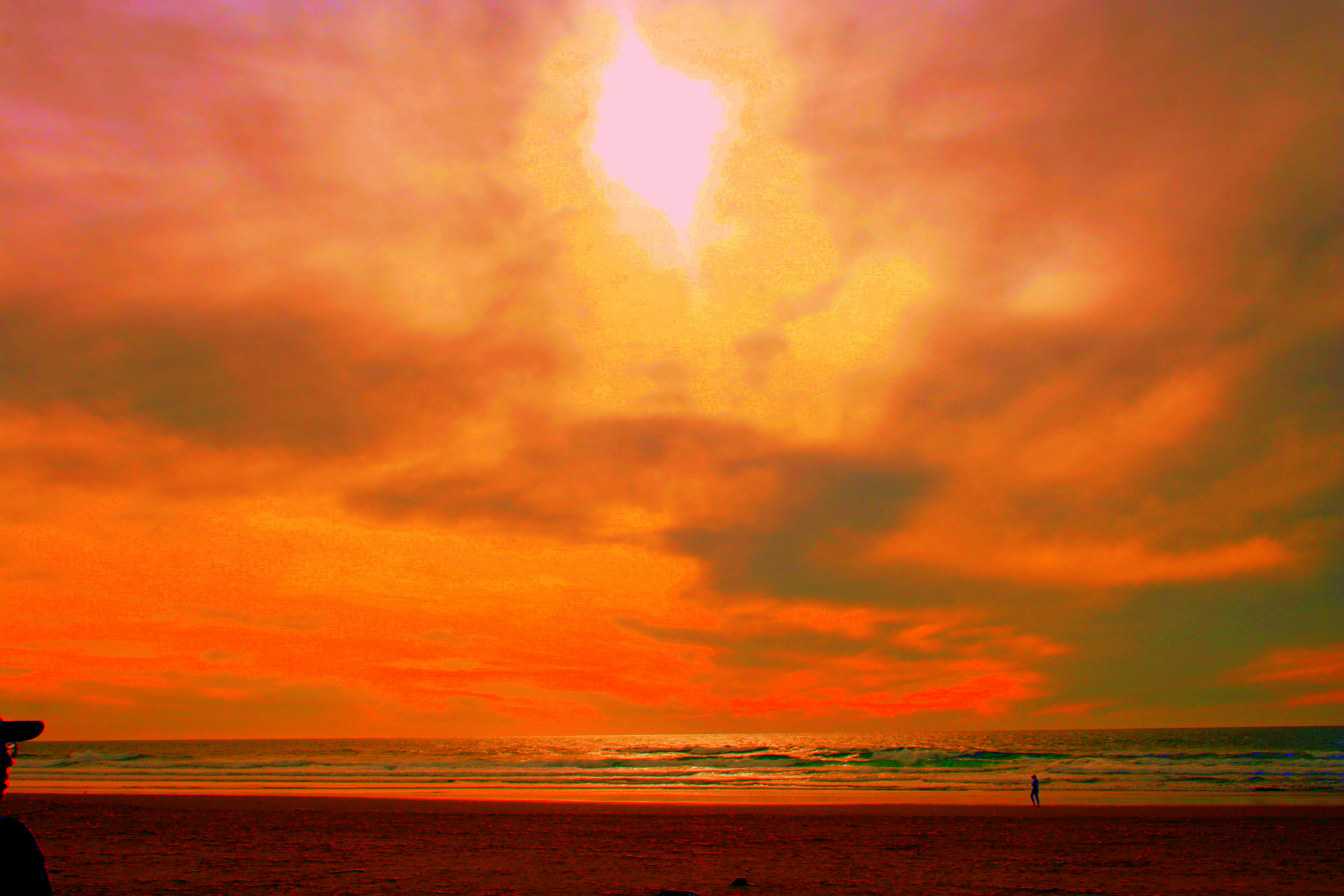

So, more doctored, fake-apocalyptic photos of Oregon, this time of “blood-red” sunsets along the Oregon coast, after William Ashcroft‘s famous oil pastels depicting the eerie sunsets following the eruption of Krakatoa in 1883.
Long-time readers know I love having music while I write. Sometimes it’s just background noise, but often it’s a specific set of songs, and in the case of whole books (like my story collection or two of my novel projects), it’s full-blown soundtracks, with each song selected and organized to reflect what’s going on in a particular part of the book. That was certainly the case with last year’s NaNoWriMo.
This year is a bit tricky, though. I still like having something to listen to while writing, but because I’m writing about a wrecked, apocalyptic planet with very little (or perhaps no) functioning electricity and most of humanity focused on just making through the day, I feel like it would be cheating to have music in my head while I’m writing, because the people in this novel don’t have music to listen to. They’ll have songs running through their heads, of course, and in long periods of silence I often find myself playing whole albums in my head — the sound is shockingly vivid, and I sometimes forget I’m not actually listening to the music — but since they can’t actually put on a cd or hit the playlist on their mp3 player, I don’t want to, either.
Besides, I use music mostly to set mood, and the mood I want to set while working on this book is isolation, contemplation, devastating silence . . . . Not to bum everyone out, but seriously, that’s the world these people live in. So that’s the background noise I want.
Because some of that noise is very internal and emotional, the eerie white noise of our brains listening to themselves, I decided to look into so-called “noise music.” There’s plenty of it out there, and most of it is ridiculous, but I knew if I asked the right people, I could find the kind of head-fuzz I was looking for. I turned to my music guru Ryan Werner, who in turn looked to some music-minded friends of his, and eventually Ryan turned me onto a group called Eleh, whom I’ve started listening to:
It’s not natural noise, of course, but it’s the sort of thing I imagine going on inside people’s brains in an apocalyptic environment. If we hear music in our heads in the long absence of music, it makes sense to me that we’ll also hear machinery in our heads after the long silence of the technological world. It’s the pervasive background noise we never knew was in there, and when it stops, I think, we’ll start manufacturing it in our heads.
So I’m listening to some of this while I write.
But there’s more going on in this world than just our brainwaves. The planet is broken, whole continents ablaze or underwater — or both. Meteor impacts have triggered earthquakes so massive they’ve triggered other earthquakes, a chain reaction that has awakened long-dormant volcanoes, which have set forests ablaze and choked the skies all over the world. It’s ugly out there. So for all this silence in a post-industrial world, there’s still plenty of noise to deal with.
So I went looking for eerie sounds, things allegedly of nature but utterly alien, inexplicable. Things like this:
Or this:
And it’s not just sounds of nature in nature that I’m interested in. I want sounds of nature invading our interior spaces, the weird quiet of abandoned buildings or wind racing through empty hallways:
And what about the human beings living in this world? What about the voices of people trying to escape the devastation?
But the more I think about all this, the more I listen to these haunting, morbid sounds, the more I start to think I’m wrong about the music. For some people, it’ll take some time to adjust, to get used to the idea that we can’t just pop in our headphones and blast our Robbie and the Robots or our Legal Fingers, or brood over our Burials, or relax to the jazzy intellectualism of Chica y los Gatos, or bounce around to the silly punk fun of Dum Dum and the Smarties. (There you go, friends of mine: a few shout-outs to some bands I know.) Because all this music we love to listen to? Somebody made that, usually on instruments, sometimes on instruments that don’t require electricity. In fact, most of us have made music of our own at one point or another, whether it was lame attempts at strumming a buddy’s guitar or your sad conviction that you rocked the bongos or that shoebox-and-rubberband guitar you made as a kid. Even the pot lids you banged like cymbals in your mother’s kitchen when you were a toddler. (And yes, gang, I’m guilty of that entire list. Even the bongos.) We all make music. We’ve been doing it for millennia. We might have been making music before we even made language.
And we will make music again, even in the middle of the apocalypse, using whatever we can get our hands on.
So I’ve added some music to my YouTube playlist after all:
I’m on day four of National Novel Writing Month. And it’s been a good but strange few days, because while I have a table of contents already and a relatively solid idea of what I’m writing about — the apocalypse, and, now that I’ve done some quick-and-dirty background research and settled some things in my head, I know what kind of apocalypse (cataclysmic double-meteor strike that in turn triggers mass earthquakes, tsunamis, and volcanic explosions), where it began (one in the Mediterranean and one on the Arabian Peninsula), and what region(s) I’m mostly writing about (mostly the Pacific Northwest, though I might set a story or two in Texas just out of habit).
What I don’t have is an outline, a definite chronology, or a specific set of characters. I’m just sort of making those up as I go. Which in some ways is wonderfully liberating, and in other ways is unsettlingly random. For example, I haven’t really finished the first story in the novel — and in fact that story is currently just a jumble of disjointed scenes — but I’ve already started writing scenes and snippets for some of the other stories.
So this year, I think I’ll post my weekly excerpts not according to the days I wrote but to the stories I’ve worked on during the week. Which is what you’ll see below: bits and pieces from some of the story/chapters I’ve been working on.
from “Lonely As a Weeping Trumpet”
By the time anyone thought to ask why the world was ending, it had already happened. So I can’t tell you exactly what caused it, which impact was first. And as far as anyone knows, it’s still going on, all this loss and confusion and undoing of things and reforming of things, all this dissipation and coming together, so I also can’t tell you when it ended because it hasn’t yet. Or maybe it would be more accurate to say it’s still ending, it’s always ending. An end without end.
This morning I stepped outside without a heavy coat for the first time in months, which felt glorious despite the ashfall and the grayness of things. My footsteps made no sound, the ground like a months-old snow to look at but like a featherbed to walk upon. The air was cold on my face but wet and refreshing, as if I could just lean back and inhale the morning. But I’m not stupid. I’ve seen people die that way, bent over with one elbow on their knee, a hand on a porch post or a tree, blood in the ash.
Each morning when I walk the road to the base of the hill, I think about mail. How I ought to be checking, a rusty mailbox lid creaking on its hinge, the flag half up and half down, no telling what I might have. It’s not something I ever bothered with before, living in the city, my mailbox one of a row of boxes at the base of my apartment stairs. My email felt more important than all that printed junk. Tree killers, I called those things, wholly unaware of what was coming for the trees. This mail-at-the-end-of-the-lane thing, it’s something I picked up from movies as a kid, those quiet homes in the Midwest, out in the country somewhere between the farms and the suburbs, the dirt road, the split-rail fence, the mailbox on the post. Some kid maybe ten years old, maybe thirteen, strolling down the drive with an old stick in his hand, swiping at rocks and thwacking the fencepost as he rounded the turn to the mailbox.
It’s strange how the things we miss are the things we never had to begin with.
from “This Last March of the Human Animal”
When the world was nearing its end, we got all sorts of advice on the morning shows and in the radio broadcasts. Even when the Internet was up and running, you could find lists. Water, food, batteries, first aid. Which made sense. Moist towelettes and cell phone chargers. Which didn’t make any sense at all. Later, the lists became more practical, contained things like bivvy bags and waterproof matches, hatchets and lantern fuel. Alcohol and a handgun. But no one thought to tell us about the coffee.
I lived in a shitty little three-bedroom house I shared with two other guys, out in Banks, which I thought was remote enough. We were only 10 minutes out of Forest Grove, a half hour from Portland. This was when we were still driving cars, but even by bike we could be in Hillsboro in an hour. And on the other side of us, about the same distance, was the Tillamook State Forest, with all the wood and wildlife we could ever need. So when everything went to shit I figured we had it okay. But then the cities became unsafe. They always do.
[…]
We knew we were headed into the forest, where it’d be both easier to hide and easier to survive, even with the horror stories we were hearing about the weirdos holing up in the hills. But we weren’t sure where exactly until Greg started yammering on about the Tillamook Burn. He was a history major in college and he’d written some paper on how the state forest got started, all those forest fires back in the `40s. And I have a thing about ghost towns, so when he got started in on the forest and the fires and the logging, I remembered about Idiot Creek and the old abandoned logging camp up there. So we headed for Idiotville.
from “So Much Simply Lost”
We had bread. It was light, puffed up, full of tiny air pockets. Sometimes it contained seeds, sometimes raisins and spices, and sometimes it was a pale golden color we called “white bread.” It never contained soot or fine grains of pumice. We could bake it at home if we wanted to but not many of us did. When I had bread, I bought it from the store, where it came already sliced, stacked inside a plastic sleeve. I used it to make peanut butter sandwiches and ham and cheese sandwiches and grilled cheese sandwiches and patty melts and clubs and BLTs. That’s an acronym. It was delicious. I knew people who would cut a hole from the center and fry an egg inside the bread. I knew people who soaked it in syrup and coated it with sugar and made a thing called French toast. I never made it that way; instead, I made just plain toast, which I smeared with butter and jam. Jam was crushed up fruit that seemed to last forever. We could bake it dry and cut it into cubes to serve over salad, or we could half-burn it and crush it into crumbs to dust the top of our macaroni and cheese. There was once a time so decadent that we would take old bread we hadn’t bothered to eat in time and head down to the riverside where the ducks gathered in the shallows, and we would pinch off bits of bread and toss them, a piece at a time, into the water for the ducks to feed on. The ducks weren’t hungry — they didn’t need the bread. But we liked to watch them eat. And we had all the bread in the world.
Total word count as of this post: 6,928 words.
For more about my NaNoWriMo project, check out my NaNoWriMo page here or my profile on the NaNoWriMo website.

I just read this fantastic blog post — no, I’ll go ahead an call it what it is: an essay — from “Siobhan Curious” at Classroom as Microcosm. Titled “Why Do I Have to Learn This?,” it is an excellent response to a recent New Yorker piece by Louis Menand (whose New Yorker pieces I often admire). Between Menand and Siobhan Curious’s reading of Menand, we get a beautifully articulated account of the fundamental errors in — and fundamental beauties of — our ideas about higher education.
In fact, this post is so excellent, both as a commentary in its own right and as an example of response writing, that I’m going to require my students to read it and respond on our online discussion forums. But I hope like hell that they respond at the Classroom as Microcosm site, too, because I’m teaching community college students, many of whom are headed to colleges or universities in a year or two but many of whom have different aspirations, and since this conversation of the importance of college is mostly about the four-year institution, I’m really curious what my students might want to add to this discussion.
If they let me, I’ll report a bit about what they had to say in a future post. But in the meantime, go read this thing now, because it’s awesome.
via Why Do I Have to Learn This?.

 Samuel Snoek-Brown