I asked my Grandma about this photo back in 2000, shortly before she died. She said she was pregnant with one of my uncles, and she was “hiding” behind my Papa to disguise her belly. 🙂
And, just for good measure, here’s what they looked like roughly 20 years later, in the `70s:
Beth and J.C. Locke. And yeah, that’s me in Grandma’s lap.
This is more of my grandmother’s story. The year is 1945. My grandmother, Beth Locke, has just turned 20, and she works at the nearby Navy base, where troops are returning from the war. (I think you see where this is headed….)
Along about this time, my social life was at a complete standstill. I had no dates, went no place except to work, all the boys were only in our area temporarily and all our local boys were gone. I guess I was happy enough, but sort of lonesome. I went to work, Mom and I would go to town on Saturday if we had enough gas coupons. She would well eggs, maybe we would go to a movie, still went to Sunday School and Church and our youth activities, visited with neighbors, but I had no personal life.
One of the few outings that I had was with my best friend Lydia. We would ride the bus from work and go to town and eat and go to a movie. Our favorite thing to eat was a lettuce, bacon and tomato sandwich, a glass of milk, and a piece of cherry pie à la mode. My, we felt sophisticated ordering that. Well, one evening in the fall of 1945, we were meeting another good friend of ours and were walking up and down Main Street, waiting. As we walked to the corner in front of the bank, there stood the cutest sailor I had ever seen. Now, of course you have to understand, ALL sailors — ALL boys — were cute to me. But this one was exceptional. Beautiful brown eyes and the cutest smile. I looked at him, and he winked…. Well, I almost swooned. We said nothing, we turned and walked back up the street. We met out friend and I told her about him, so of course she said, Oh, I know who he is, that’s J.C. Locke.” But we never spoke or anything like that, just went on about our business.
Well, a couple of days later, I was spending the night with this same girl, and my new sister-in-law Norma was with us. Both my friend’s husband and Norma’s husband Doc were in the Navy and at the time were gone overseas. This friend, Dorothy, had a little Ford coupe we called “Salty,” and we were always singing “Bell bottom trousers, coat of navy blue, I love a sailor and he loves me too!” Well, that night we decided to go to roller skating in town. It was a rainy night, and I had borrowed the rain coat from Dorothy. We were walking down the street and all at once, out of a parked car along the street, popped this handsome guy, J.C. Locke. He spoke to Dorothy and said, “I know that you’re married, what about you other two?” Well, I was taking no chances of getting lost in the shuffle, so I said, very loud and clear, “Me! Me! I’m not married!” So J.C. said, “Well, you get int this back seat then. We’ll go get a coke.” I needed no second invitation, I crawled in the back. As it turned out, J.C.’s Uncle Silas, a guy just a few years older than J.C., was driving his car. Norma and Dorothy got in the from seat with him. I don’t know about J.C., but I fell in love on the spot.
We did go and get a coke and talked and talked and Silas complained for years about being stuck with two old married women.
J.C. and I made a date for the next week. He was home on leave from the Navy, and I knew that had to go back soon. I was so thrilled, I bragged to everyone I knew about my big date. But when the night came he never showed up. I was sick, humiliated, and MAD! I knew I’d never see him again and I had really fallen for him, but I had my pride. I never could stand to be disappointed.
On the next Saturday, my mama and I had made plans to ride the bus to Lake Charles and go shopping. I would save my paydays until I had several dollars and then go on a big shopping spree. As we were waiting for the bus, again walking up and down the street, all at once up stepped J.C. Well, I was not expecting to see him, I thought that he was long gone, but I wasn’t about to act happy to see him. After all, he had stood me up and embarrassed me! But he was very sweet and apologized, said he had trouble with his transportation. He tried to explain, but I was rather cool to him and told him that I had to catch the bus with my mother. He was very nice, and as far as I knew, that was that. Needless to say, I was very sad all day. I thought he was leaving that day to return to the Navy, and he hadn’t asked to see me again, asked for my address or anything. I figured that was the story of my life. I had always figured I was destined to be an old maid, and now I knew I was and had let the man of my dreams get away.
[A few interceding events occur, mostly regarding work and the humdrummery of everyday life. J.C. did write, but they were only polite notes.]
One night in January, 1946, Mama and I went to a movie in town. Mama still loved movies, and so did I. When we came out of the movie house — suddenly, out of the shadows stepped J.C. I was in shock. I had thought of him often but hadn’t expected to see him ever again. He spoke to me and asked if he could take me home. I told him no, that I had come with my mama and would go home with her. He said OK, and he didn’t say a word about seeing me again. Of course, I figured I had blown my last chance with him.
As usual, on Saturday, when Lydia and I weren’t working, we were together. We had both rolled our hair — on Saturdays we always washed our hair and set it in those endless little pin curls. We always wore our oldest clothes and in general looked very tacky. Suddenly, someone knocked on her front door. We went and peeked out the window, and it was J.C. and Silas. Well, we ran around trying to find head scarves to tie over our pin curls, and of course we wore no make-up. I went to the door and invited J.C. in. Silas stayed in the car. I asked him how he knew where I was — you have to remember, in those days we didn’t have such conveniences as telephones — and he said, “I drove up at your house and your dad was out mowing. He didn’t give me a chance to ask where you were, he just pointed over toward this house and said ‘She’s over there.'” Well, that sounded like my daddy, he never got too excited over my boyfriends. Anyway, J.C. asked me to go out that night and asked me about getting someone for Silas, since he had the car. I said, “Well, I don’t know,” not knowing whether Lydia wanted to go or not. Suddenly, J.C. turned to Lydia himself and said, “What about you?” Lydia said, “Who, me?” And that started a six month’s romance and courtship.
This isn’t to do with any of my tutoring exercises. I’m still working on my Civil War novel, and I’m adding some details about the sort-of romance between two of the main characters, but, unlike last week (when I was farming this material for the novel), this isn’t about the book, either. This is just something I read as I was perusing my grandmother’s work, and I’ve always thought the story of my mother’s parents was one of the best damn love stories I’ve ever heard. In fact, I try to model my own marriage on the marriages of both sets of grandparents. I certainly feel just as lucky to have found my wife as my grandmother felt to have found her husband.
By the way, my Grandma’s best friend Lydia and my Papa’s uncle Silas married each other on the same day — and in the same ceremony — as my grandparents: it was a double wedding. 🙂
Oh, and that song my grandmother and her friends were singing? It’s “Bell Bottom Trousers,” an old sea shanty that was wildly popular in 1945.
PS: The other great love story in my family — the marriage of my paternal grandparents — is just as wonderful, by the way. And I wanted to make sure I said so, because both my paternal grandparents are still with us and still very much in love. And also, today is my grandpa Ted Snoek’s birthday. He turns 92. 🙂
The main page of Nouvella’s website for the month of June.
It’s both funny and somehow appropriate that it’s taking many of us until the middle of June to realize that June now celebrates the middle child of fiction: the novella. National Novella Month is something Dan Wickett (oh he of the grand and holy Dzanc Books) got started a couple of years ago, and I love that it now exists. To be honest, I didn’t realize until last month that May had been deemed National Short Story Month, but I was thrilled when I found out, because poetry—holy and beautiful and worthy of praise though it is—has been hogging the spotlight in April for years now. Okay, sure, we set aside April for poetry because that poor form goes so under-appreciated the rest of the year, but, excepting my writer friends (and maybe even including some of them), when’s the last time you picked up a story collection? They sell about as well as poetry collections these days, which is a damn shame, because I love short stories.
But the novella? Forget about it. We can’t even agree on what the novella is for crying out loud! Nouvella (whose excellent graphic I stole for this post) calls for submissions of novellas between 10,000 and 40,000 words; Caketrain, whose chapbook contest allows for novellas, asks for 12,000 to 26,000 words; Main Street Press, who published Ben Tanzer’s novella My Father’s House—which I read not long ago—calls for manuscripts of 30,000 – 50,000 words (“This is a FIRM number,” they say); the Malahat Review‘s novella contest asks for a scant 10,000- to 20,000-word range, which the magazine The Long Story would not consider a novella but simply a . . . well, long story (their range is nearly identical to the Malahat contest’s range).
Tom Franklin’s award-winning novella “Poachers,” which led to him landing an agent and eventually a book contract that included his story collection of the same name, takes up only 60 pages in the book version of Poachers. My Penguin edition of Saul Bellow’s Sieze the Day runs 118 pages. My own novella, which I’m currently shopping on the market, clocks in at a whopping 135 pages.
And notice the ways in which I handle the titles. Many novellas wind up in italics as stand-alone works, like novels, but I put the 60-page “Poachers” (as opposed to the whole collection) in quotes, like a short story. In my case, I do this as a matter of form—the novellas that appear as stand-alone books I treat with italics, but Franklin’s novella—as part of a collection—I put in quotes. But peruse other writers’ and publishers’ and critics’ usage, and you’ll see it’s pretty widely variable. And what on earth would I do with a novella that had appeared as a stand-alone and then got anthologized, or vice-versa?
So let’s set aside length and discuss what else distinguishes the form from the long story (on the one hand) and the novel (on the other). Should the novella satisfy Poe’s “unity of effect” or his idea that “all works of literary art” ought to be readable within “the limit of a single sitting”? And if the novella does satisfy these terms, does that just make is a really long short story? Or, if it doesn’t, are we simply looking at a really short novel? (Or, is this just another way of talking about length?)
I think the answer is neither, because to compare the novella to either form is counterproductive. No one thinks of short stories in terms of their relationship to the novel. Well, we do—one of the most common things you hear in (sometimes lazy) fiction workshops is, “I think this story could be expanded into a novel,” and certainly most of Joseph Conrad’s novels developed that way; and I’ve often remarked on what I felt were overindulgent and under-edited novels that they probably ought to have been short stories (Chuck Palahniuk’s Lullaby, I’m talking about you!). And don’t get me started on the story cycle, which tries to be—and sometimes calls itself—a “novel in stories”!
But in general, we don’t really think of the story as being just a shorter version of the novel, or vice versa. They accomplish different things. The story is about limited scale, single events or single characters or single settings—Poe’s “unity of effect”—and in focusing that way, they most often speak to us as individuals, as though we were having a conversation with ourselves or, at most, the small gathering of human beings we surround ourselves with. Novels, on the other hand, are more expansive, not just in length but in scope—they are a conversation with the whole world—and they have room for more grandiose commentary on philosophy, society, and the human condition. There’s overlap, sure, but the intent is what’s important. Jane Austen’s Pride and Prejudice is a love story about Lizzie and Darcy, sure—and Austen’s a marvel at the minutia of human character—but it’s more largely about Regency society and marital tropes. Hemingway’s “Hills for White Elephants” is about abortion, sure, but it’s more specifically about what these individual people do in this particular kind of (un)romantic situation and, by extension, what we ourselves might do.
It’s easy to distinguish the story from the novel because they’re so far apart in their intent. Our difficulty in talking about the novella, I think, lies in our insistance on drawing a line between the story and the novel and then trying to drop the novella somewhere along the spectrum. And to my mind, that’s a bit like drawing a line between warthogs and elephants and trying to figure out where the rhino falls between them. The novella is simply a different creature altogether.
When I set out to write my novella, I knew going in that I was writing a novella—not a novel, and not a short story. I knew I wanted to deal with large social issues and cultural themes, but also that I wanted to focus those issues through lens of two distinct characters in a smaller-than-novel scale. (See, I’m still not immune to the spectrum/comparison approach.) I knew that I wanted the story to span a full year—actually, five seasons, plus a prologue that sets up a backstory—but also that the story would remain focused on these two characters and this one location. The scope of a novel but the scale of a story, maybe.
So, okay, maybe I can’t get away from comparing the novella to a short story or the novel, but I still don’t see it as just a waypoint on some kind of evolutionary scale. It’s more like the offspring of the short story and the novel, and which traits get passed along from which parent form depends a bit on breeding and a bit of the mysteries of genetics. The novella isn’t a stop on some line, it’s the third point in a fiction triangle.
Or something. Look, we’re all still trying to figure this creature out, really. Maybe calling the novella the rhino on a warthog-elephant scale isn’t the best analogy. Maybe it’s the Bigfoot of fiction, some mythical creature that everyone sort of knows the general description of but that no one can agree on regarding specifics (and that some people still don’t believe in), and none of us is quite sure if it’s some kind of missing link or another species altogether. But that doesn’t stop us from celebrating it.
Which is why it’s so terrific that June is National Novella Month. Maybe in the process of celebrating the form, we can start to observe it more closely and learn a little more about it. Or at least sell really big plaster casts of its footprint.
I’ve been a fan of Scott McCloud’s books on writing comics — books on writing in general, really, because his insights into narrative purpose and narrative structure are fascinating — but for some reason it wasn’t until a few months ago that I finally picked up McCloud’s own graphic fiction, Zot! When I did, it was in the form of the complete collection, published as a single (massive) book four years ago.
As much as I knew about the formalist background of the work and some of the ideas McCloud was playing with — elemental archetypes in the characters, superhero/manga hybrids before anyone in America even knew Japan had comics — I wasn’t really sure what I was going to think of the work. In its inception, it’s basically about a teenage boy with superpowers and high-tech gadgets, zipping back and forth between our dimension and his. There are some cool moments examining the disparity between dreams and reality, between the ideal and the mundane, and the occasional shot of genuine teenage romance. But as I read the background and even as I got into the first few installments, the story sounded almost juvenile to me. Fun, but not groundbreaking or even necessarily great.
For the first third of the book, this held pretty well true. And even in the second third (or so), when the art and some of the concepts get quite stylistically inventive — McCloud does some fascinating things in this series — it still felt, well, textbook. And it was, but that wasn’t McCloud’s fault, really. After all, he’d actually written the textbooks I was comparing Zot! to, and it was just my dumb luck that I read those books first.
But then the series shifts, roughly two-thirds into the collected book, and becomes a different kind of comic altogether. Not to give too much away (but SPOILER ALERT anyway): Zot, who has been popping back and forth between his world and ours, where his maybe-sometimes-girlfriend lives, gets trapped on our side, and the whole series turns into a kind of meditation on teenage life in America.
And it is utterly transforming. And so, so beautiful.
But no story in this whole work as as powerful as Zot! #33, which is (again, SPOILER ALERT) the issue when gal pal Terry comes out of the closet.
Remember, this is 1991, and these are teenagers. This issue would have been controversial, perhaps even bold, just a few years ago. Twenty years ago, it was one of the most daring things in comics. But McCloud didn’t view it as a dare, or as some kind of social responsibility — an onus — or as a gimmick to generate buzz. It is just a story, about a girl. It is mature, and subtle, and honest, and tender, and wonderful.
I say all this as a straight man, of course. I can’t know in my heart how a gay woman would respond to this story. (If you do, please comment! Especially my friends!) But for me, the ways in which McCloud approaches this story are wonderful. Consider the page above, for example: it’s one of several dream pages where Terry is confronting her sexuality unconsciously, struggling to bring it forward enough in her consciousness that she can address it in her waking life. All the dream pages are the same: black backgrounds with an even grid of panels, every image given equal weight, while the dominant figure — Terry — sleeps at the bottom of the page. The set-up of what’s going on in some of these pages — the “you always wanted a boy” juxtaposed with Terry’s longing look at the girl in the ocean — can feel a bit obvious, maybe, but they never quite feel force-fed. Never in this dream page, for example, does Terry express her desire out loud. We are given only images. We see what she sees. And through her gaze, we understand her emotions.
Elsewhere in the story, a high school boy is bullied so severely he’s left permanently handicapped. He isn’t gay, but the bullies who beat him up think he is, and in any case, no one does anything about it. (Well, almost no one — there is a wonderful heroic moment when a school newspaper student publishes a scathing criticism of the bullies and becomes a target himself.) This violent homophobia casts Terry’s emotions in a dangerous light, and she becomes not only terrified but also severely depressed. And this is when McCloud brings his manga influence to bear, using richly detailed ink drawings of landscape and weather to signify Terry’s confusion, depression, and loneliness (notice the rain in the page below), her insecurity in a militantly anti-gay world (notice the large fence surrounding the high school), her feeling of insignificance (notice how small she is on the hillside) and her self-loathing (the extreme close-up as she condemns herself).
And, fortunately, into this scene comes Zot, not as a superhero but simply as a friend — and he is possibly at his most heroic because of it.
A couple of pages later, in the same location but the rain now ended (gotta love symbolism), Zot and Terry discuss what has happened in all the gay-bashing, and Terry opens up about her fears and her feelings. Zot comes from an apparently perfect social utopia where, if this kind of bigotry exists, only lurks in the shadows — where it belongs. Which is why he is such an interesting foil for the characters in this particular story, because while he is capable of comforting Terry, he is utterly incapable of understanding where this hateful homophobia comes from and why anyone in our world would tolerate it. But, kind soul that he is, he doesn’t get angry about this; he doesn’t try to fight homophobia or judge the bigots or solve Terry’s problems. Instead, he recognizes what Terry needs most in the moment, and he simply consoles her.
And it is that last panel that so undoes me, makes me weep every time I read it. “Look what they’ve done to you.” Those simple words — that simple gesture of holding a friend — framed once again by all that empty space and backed by that looming fence. How small Terry feels. How insignificant even a superhero like Zot is in the face of her anguish. And yet how necessary, as she crumples into him, and the most heroic thing he can do is acknowledge her pain, and hug her.
It is a masterclass in narrative perspective and in drawing (literally) characters not as characters but as human beings.
We are lucky, these 20+ years later, to live in a world at least somewhat more accepting of gays and lesbians. Even in comics, which are usually at the forefront of confronting social issues but which usually do so quietly and inoffensively, we are seeing now — finally — gay characters in major, big-name comics. From military veteran Kevin Keller, who married his partner in the Archie Comics issue Life With Archie #16 (it was the first gay wedding in comics), to gay X-Man Northstar’s wedding in Marvel Comics’ Astonishing X-Men #51, and DC’s recent retcon of the original Green Lantern as gay (a previous retcon had announced that the Green Lantern’s son was gay), mainstream comics have tackled this issue fairly fantastically in the last few years.
But so far, I haven’t seen any presentation that can compete with the emotional intensity and honesty of McCloud’s story in the Zot! series.
This is another exercise drawn from my tutoring, this time from a high school junior who’s been studying The Grapes of Wrath. I’ll explain more below, but before you start reading, a little context: What appears in the Notebook is not my own work but an edit of something my maternal grandmother, Beth Locke (née Luallen), wrote in 1986. In this piece, she’s continuing, in brief, her life story, which began in a short bit she called “An Oklahoma Girl”; here, she’s describing her family’s move south where she became “A Louisiana Girl.” I’m skipping some of the intro, but the set-up is that, like practically everyone else in the Dust Bowl, the family has had to abandon the farm in Oklahoma. They tried selling Fuller brushes in Kansas for a while before giving that up and moving on down to Louisiana, which is where I’m picking up the story.
We left Kansas in November, 1937, and drove to DeRidder, Louisiana in a 1930 Chevy. We hauled our furniture in a four-wheel trailer. We left Grandma and Mike with Uncle Doyle. Doc and I were very excited, but when I think of my Daddy, what he must have felt. He was thirty years old, had two kids ages ten and twelve, and a wife and two hundred dollars in his pocket to build a house and live until he could do something else. I remember coming into Louisiana and seeing the beautiful tall pines and since we had never had hardly any trees in Oklahoma, this looked like paradise. We went to the land agent’s house and stayed several days. He had a beautiful home and we enjoyed staying there. His name was Mr. Scalfi and he proved to be a good friend to us all.
We looked for a place to live in while we were building our house. Finally found an old two-room shack that someone had been using for hay and sheep. We shoveled it out and moved in. Daddy bought an old wood stove and we used it for heat and cooking. This was a new experience for us, although Grandma had used to cook on a big wood cook stove. I can still remember the smell of the roasted peanuts that we tried out and found we liked them very much. We had a lot to learn about in this new country we had moved to. We felt almost like pioneers. It was a hard few months for Mama and Daddy. This was the winter and the coldest the weather ever gets in the South; of course, since we were used to the cold Oklahoma winters, it seemed like we were in the tropics. We were in the little cabin for Christmas and it was the first time we could have a little tree, since there were so few in Oklahoma. Mama and Daddy managed a little Santa Claus — how I’ll never know — and we were happy.
Doc and I got started to school. Our school was at Rosepine, a small town of about two hundred. Doc was in the sixth grade and I was in the seventh. Doc had decided he would no longer be called by his nickname and would register in school as Clarence. Well, this only lasted a few days, as he would fail to answer roll call when they called him Clarence, so it was back to Doc, and has remained so to this day. My teacher was a Mr. Scoggins and for the first few months I never understood one word he said. Didn’t take me long to pick up on them “youalls” though.
[…]
I liked school but had a pretty hard time at first. I was a new girl in school and also was a yankee — to these Southern children anyone that came from north of the county line was a yankee. But suddenly I discovered that all the boys thought I was cute! Well, let’s say I was someone different, and so they flirted with me; therefore, none of the girls liked me. Of course, my charm soon won them over, and at least I made a few friends, because as soon as the new wore off, all the boys lost interest.
I graduated seventh grade in the spring. We girls all wore pretty organdy long dresses. I wore pink and felt very pretty. Mama has raised a lot of pretty flowers in our yard and she had the prettiest white shasta daisies, and she fixed some in my hair. She always did her best to try to make her little ugly duckling daughter look as pretty as possible. I was chosen to be on the program. I recited the poem “I would like to live by the side of the road, and be a friend of man.”
There is so, so much more to the story, so maybe later I’ll include in the Notebook the story of my grandmother’s incredible bravery when she packed up and went to college despite how shy and inferior she sometimes felt, or the story of how my Papa — one of the coolest, manliest men I’ve ever known — courted and married her. But I wanted to include this section today for two reasons: 1) it’s a wonderful beginning to this part of her story, full of some richly specific details, and 2) it’s the part of her story most related to the Great Depression and the Dust Bowl, those themes my tutee is studying in relation to The Grapes of Wrath. Also, for his class, he had to write a narrative of his own family’s westward migration, so he wrote about his great-grandmother, who lived in roughly the same period and same general region as my grandmother.
To be honest, though, I wasn’t reading my grandmother’s stories because of the tutoring — that was just a happy accident. I picked them up because I knew she’d also written an account of her husband, my Papa, J.C. Locke, and his upbringing in southern Louisiana. My plan was to borrow regional and cultural details from his childhood to add some richness to my Civil War novel set in the same region. But my grandmother is such a natural storyteller that I simply got caught up in reading everything she’d written — seriously, I changed maybe two words in this whole narrative, and I might have moved a comma once or twice. Other than that, this is all Beth Locke, in her natural narrative voice.
Thanks, Grandma! And thanks, too, to my mom for passing these stories on to me when my grandmother died eleven years ago. (Rumor is, my grandmother also kept extensive diaries, which I haven’t seen yet — I’m looking forward to diving into those the next time I visit my parents!)
Oh, and for any poetry nerds who are curious, the poem my grandmother recited at her seventh-grade graduation? It’s “House by the Side of the Road,” by Sam Walter Foss.
I’ve written so many times now on how music affects my writing that everyone must be getting sick of it. And I’m not the only one doing this — practically every writer with a blog has commented on his or her writing playlist at some point. I think it’s because we all wish we could be rock stars (or at least that writers got treated like rock stars).
But whatever. I hope you aren’t completely sick of the subject yet, because here I go again.
Except that this time I’m writing — revising, really — a novel set in the American Civil War, which is pretty hard to make a soundtrack for. Sure, we have plenty of music from that era: practically all our popular folk music comes from the Civil War. “Dixie,” “When Johnny Comes Marching Home Again,” “Battle Hymn of the Republic”…. You know, all those songs you were forced to sing in fourth-grade music class.
But I’m not listening to any of those while revising my novel. They were largely propagandistic, rousing attempts to inspire men to fight and women to bake bread and sew uniforms or, toward the end of the war, at least not die of utter despair. And my novel — set in the eighteen months or so just before and just after the end of the war — is full of despair. And desperation, and violence, and grit, and bitterness…. I don’t need rousing. I need honesty.
And I need earthy. Southern helps, but earthy is more important. The characters in this book are literally killing and dying in the dirt, scratching out their desperate, meager lives from the Louisiana bayou, sandy saltmarsh to their south and dirty Texas grassland to their west and full-blown swamp everywhere else. I need music that makes me feel grimy, sweat-stained, exhausted. I need banjos and drums and some weeds and gravel in a sorrowful, twangy voice.
Which is why I turned to William Elliot Whitmore.
But I couldn’t just listen to him through the days — weeks, months — of revision, because it would wear me out. I needed to mix it up, but I’m so focused on the writing that I don’t want to bother tracking down people to add to the playlist. Which is why I turned to Pandora.
Pandora is not a perfect DJ — it keeps throwing Tom Waits at me, who is awesome but too modern in his sensibility for what I’m working on — but for the most part, the mix is turning out pretty well. In addition to William Elliot Whitmore, I’m getting a lot of Johnny Cash and Guy Davis, and a bunch of music from O Brother Where Art Thou? (the Ralph Stanley, Alison Krauss, and Dan Tyminski versions are better than the movie versions). And there is still a smattering of Tom Waits that works quite well, and (not nearly often enough) a few Muddy Waters tunes. Best of all, though, is the healthy dose of Delta blues that comes through the playlist. And it cycles back to Whitmore pretty frequently, so I’m more or less happy.
None of this is period- or region-accurate, of course — most of it is modern, and even the oldest of the “old-time music” dates from the 1930s; and the regional flavors come from all over. But it feels right, which, when I’m writing, is the only thing that matters.
And I do sometimes abandon the list to put on our Civil Wars album, which also works fairly well for the more contemplative moments in the book.
And when I get tired of either, I can always switch over to Spotify and listen to the soundtrack for the Hatfields & McCoys miniseries (which I totally plan on buying, but maybe later, as a birthday present to myself).
Got any other suggestions that might fit the mood of these things? Leave me a comment! Just remember, the darker and grittier the better, though (as the Civil Wars and the Hatfields & McCoys soundtrack prove) I’m open to somber or sorrowful as well.
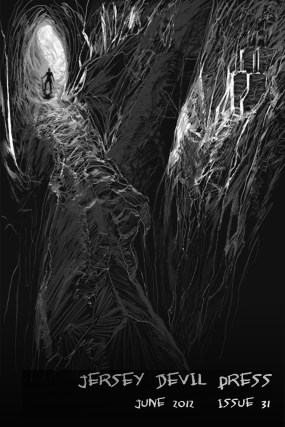
But you’ll be lucky if it’s just rabbits you find down there. Seriously, this is a fairly dark issue, in some beautifully haunting ways. There are stories here that give me the chills, stories here that make me want to cry, and — lest you think we’ve lost our sense of humor — stories that make me laugh. It’s a fantastic issue; I think it’s one of our best ever. Which I think I say every month, but seriously, the writers are kicking ass more and more each month!
So for stories about monsters and gods, stories about love and sex and heartache and shit-eating, for stories about pain and delusion and the fiery end of the world, all hiding behind the deep dark cover art of Andy Dudak: go check out issue 31 of Jersey Devil Press.
Jennifer Snoek-Brown (yes, the name looks familiar — I’m lucky enough to be married to her) has written such a beautiful tribute to Ray Bradbury today that I can’t think of anything to add. So I’ll just share her post with you:
“Homeless.” Doll on the sidewalk, Portland, OR, 1 June 2012.
A new entry in my “abandoned dolls” series, though this doll wasn’t technically abandoned or “homeless” — her “mama” was playing nearby. For the other photos in the series, see below:



 Samuel Snoek-Brown