How fantastic is this! A long while ago, I posted my whimsical little children’s story “The Escutcheon Plates Between Us” at StoryStar.com, and today, over on their Facebook, they’ve named me their Story Star of the Day! Just because it’s my birthday! (And, okay, maybe because the story is good, too.)
I’m just thrilled to bits over this — how fun! Hope you enjoy the read, gang. 🙂
You Know Which One I’m Talking About (Photo credit: Sharon Drummond)
Remember pencils? Not mechanical ones — wooden yellow #2 pencils. School pencils.
Remember sometimes in school you would start feeling restless, and you’d just want to get up and move around a little? It’s not that the lessons were boring (sometimes they were) or that your brain had shut off (a lot of times it had); it’s just that you were a kid, and your legs were getting jittery, and you needed to be out of your seat. Any reason that would work, any reason that would get you out of your desk without getting you into detention.
The bathroom was out — teachers were onto that game. The library was out — someone already had the hall pass. So what did we do? What did we ALL do?
“Miss? I need to sharpen my pencil.”
We didn’t need to sharpen our pencil. We just needed to blow off some steam, to procrastinate a little.
You might have noticed I’ve been a bit absent this week. Not much posting, and no Writer’s Notebook entry. Over at my Smile! blog, things have been just as silent.
I was sharpening my pencils.
Okay, what I was really doing was prepping a new literature course I might get to teach (dead narrators, y’all — my specialty), and polishing a chapbook to send to a publisher, and tutoring, and editing my Buddhist sangha‘s monthly newsletter…. All while getting ready for vacation, which is just another way of saying I’ll be absent from the blog for a bit longer.
I’m going to try to cue up a few posts for the next couple of weeks, though, things people have been asking me about. Someone I know on Facebook wondered what a chapbook is, and the answer has gotten interesting enough I think it might be worth sharing. I’ve been explaining my interest in dead narrators to colleagues all week, too, so maybe I’ll write up a little background on that topic. Another friend has a book coming out soon, from the press I work for, so I thought I’d write something about that.
I don’t know that I’ll actually get to all these things. Maybe I won’t. Maybe you’ll stop by here sometime next week and realize THIS is still the most recent post.
What can I say? I was feeling restless. I needed to leave my seat for a while.
But I’ll be back soon, and all the pencils will be sharp!
So, I’m wrapping up a new chapbook this week. The collection of ten stories, about half of them flash fiction or very short stories, deal with characters isolated from lovers or from themselves; some of them seek companionship in violence or in dead bodies, others lock themselves away until forced out into the light of day. There are stories about characters who can fly, characters who want to eat people, characters who manifest human beings from thin air, and characters who want to bring Santa Claus back to life even if it means killing a man. Some of the stories are fairly uplifting; most of them choose to explore our more desperate selves.
Nine of the ten stories are as polished as they can get, and the last needs only a bit of tweaking. I have the order down, I have the document compiled, and I already know where I want to send it.
All I need now is a title.
And titles, for me, are the hardest part.
I put the call out on Facebook a few days ago, but the titles I suggested then got more or less nixed, including by my friend and writing partner Ryan Werner and by author Debra Monroe. Still, at least one of my initial suggestions had a few supporters, and in the comments, some friends suggested a few new ideas. Also, Debra Monroe told me to go back to a classic technique and dig up strong strand-alone lines from the stories that could become titles.
So, below is a long, long list of possible titles. It includes my original ideas, some of the new suggestions, a few titles from the stories in the collection, and a slew of lines from the text as per Debra Monroe’s advice.
Please vote for the title you like best! Can’t decide on just one? No worries — you can vote as many times as you want. Not seeing a title you like? Suggest a better one, either in the blank on the poll or in the comments!
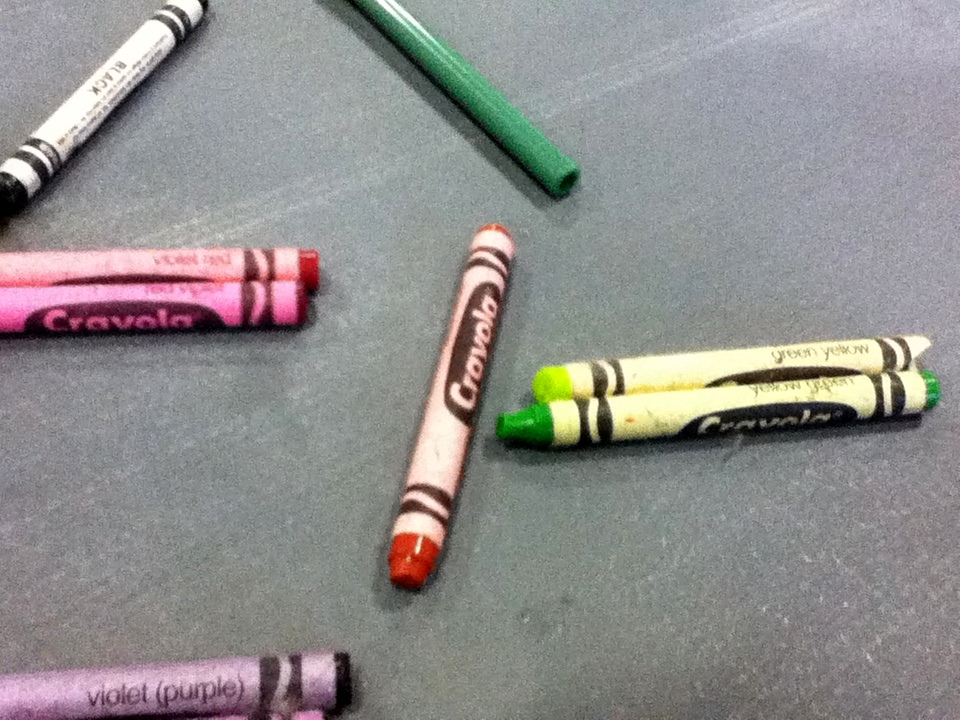
A couple of weeks ago, I was at the campus of the Pacific Northwest College of Art, where, in the lobby, I found a pile of crayons on a table. I don’t know why. It’s a college of art — why wouldn’t there be crayons just lying around?
Anyway, I sorted through them — weird color pairings, red-blue with blue-red, yellow-green with green-yellow, everything an opposite, everything hyphenated — until I found the odd color out: “bittersweet.” I used it to write its name in my notebook:
I made a few other notes, and then, when I got home, I wrote this:
The box of crayons was in disarray. Again. I dumped them all on the floor and began sorting them by shade: the greens, the blues, the metallics. But it didn’t make sense to me the way it did when I was a kid. The organization all wrong. So I devised a new system: the primaries, of course, red and brown and black. Then the unimaginative combinations: red-violet, green-blue, orange-yellow. The stupid names: laser lemon, mauvelous, piggy pink. This was easy. Next, the foods: almond, asparagus, cotton candy, macaroni and cheese. Then the plants: forest green, cornflower, dandelion. Was plum a food or a plant? New category: fruits. The exotic earthy shades: raw umber, sepia, chestnut. No, that’s a plant. The emotions: bittersweet, blush. The metals, which still made sense. The skin tones. There was only one. “Flesh.” A pale peachy beige. White folks who’d gotten just a bit of sun, not beach-tan but flushed from an afternoon tossing a frisbee in the park. As though God had fashioned His people not from clay or mud from from putty and plaster. Jesus was indeed a carpenter, it seemed, the people He saved all the color of pine lumber. I unwrapped it. I smelled it. I put the flesh in my mouth, the way a toddler would. It tasted like tallow and a bit of salt. When I pushed my teeth into it the flesh parted in flakes, a shaving at a time, until it broke in my lips. The nib opn my tongue. I sucked at the flesh until it went soft, then I swallowed it. I looked at the shattered end of the crayon, naked in my fingers. I looked at the rest of the crayons, the last unsorted shades, and saw that I had been wrong. Tan, too, was a flesh color. If not of skin, surely of hide. It would taste leathery, like sucking on the fingers of a glove. I unwrapped it, pushed it into my mouth, too. I would need a new category: edible and inedible. But I didn’t bother starting, because I had sorted the colors already and there wasn’t any flesh left.
At the time, my super-secret writing group was playing with a super-secret theme, the details of which I won’t reveal but which involved the word “flesh.” So as I was playing around with the crayons, I was thinking about that — I even wrote the words “‘flesh’ color?” in my notebook — and also about the oddity of naming colors after emotions. So I put those two ideas together.
I actually kind of like this piece, at least in concept, and I might play around with it some more and see if it could develop into something short, a flash piece or (dare I attempt one?) a prose poem, which I’ve been intrigued by lately but haven’t yet been brave enough to tackle.
I think I just dared myself….
Oh, and I wasn’t kidding about the crayons on the table. I snapped a photo of them with my iPod:
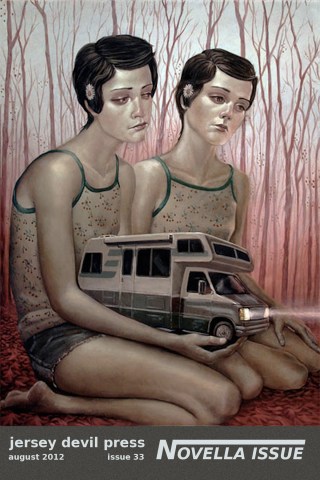
I’ve been really psyched for Jersey Devil Press‘s special novella issue since we editors first agreed to tackle a novella contest. Then we got a look at the top stories and, blown away, I’ve been even MORE psyched to get this issue into print. How Jody Giardina manages to make such a gross-out story about the disgusting dietary habits of invading aliens so endearing and deeply emotional, I really can’t get my head around. Read the novella — if you can figure out how he pulled off this balance of sick and heart-warming, fill us in. All I know is that I love it. And then, because the story was so good we just couldn’t help but run it, too, Nick Kimbro’s harrowing horror story about divers desperate to survive in homicidal water appears as a follow-up that will haunt you.
So yeah. The issue was shaping up to be one of our best ever. And then we got word that artist Casey Weldon would let us use his brilliant painting “Lazy Daze” as our cover art. I’ve been a fan of Weldon’s for several months now, and if you love the cover as much as I do, you should definitely check out his website, where you can buy prints of his work — including the painting on our cover — for amazing prices. Seriously. Do your Christmas shopping early.
And then read the issue. It’ll take you a little time to get through, but I dare you to put down the issue before you finish the first novella. It’s just not going to happen — the thing is gripping. Then, okay, you can grab a sandwich, browse some of Casey Weldon’s art, and then settle in again for the second novella — which, again, you will absolutely finish in a single sitting. Because folks, this is just about as good as good gets.
(As with so many of my reviews, this is available on Goodreads as well, but I wanted to share it here, too, because it’s a book worth sharing.)
Bill Roorbach is an artist of the human heart, but as a writer, he is pure craftsman. You can see the workmanship in his prose the way you can see it in good handcrafted furniture. Sure, there are moments in this novel where I caught myself thinking, “Oh, I see what you did there,” but I don’t think this is a bad thing: indeed, reading this novel is an education is crafting a story.
There are problems, I think. There are times when I felt like the novel was three or four different kinds of story all pieced together like inlay. Or, to abandon the carpentry metaphor for the cooking one Roorbach employs in the novel, there is a fascinating medley of literary flavors here — mystery, family drama, sports narrative, love story, Gatsby-esque literary fiction (the promotional material sells this last line a little harder than it might deserve, but it’s still an apt comparison given the fabulously wealthy and decadent setting at “the High Side,” Roobach’s version of Gatsby’s mansion) — but the flavors sometimes exist independently of each other, not quite blending into the perfect bite. “Oh, there’s the mystery,” you might catch yourself thinking in one chunk of text. “Oh, now I can taste the love story.”
Still, as a meal, the novel is immensely satisfying, and the characters at play here — from hyper-literate football hero Lizard (our narrator) to his obsessive bipolar sister to the mysterious and alluring dancer (Sylphide, what a name!) to the delightful if a bit caricatured butler Desmond to the con-man father…. The characters stay with you no matter what you might think of them, so alive they become.
The setting, too, is exquisite: whether you’re in the extravagant High Side or dense New York or sweaty, spicy Miami, the world this novel lives in is rich and alive, teeming with history and atmosphere.
Overall, Life Among Giants is a wonderful read, a perfect bridge between easy commercial fiction and quick, smart literature, and I will gladly recommend it to everyone I know.
I mentioned last week that I’ve been writing an essay on Superman. I gave it up for a recollection of the ’96 Olympic Games, but the essay has still been on my mind. Then, the other day, a friend of mine posted an outraged link to Newsarama’s list of the 10 Worst Comic Book-Based Movie Performances of All Time, number 9 of which was — if you can believe this — Christopher Reeve as Superman.
And I thought, oh, screw Newsarama! They messed with the WRONG FAN!
But it made me want to finish the essay I was writing, so here, it is. Word of warning, though: it’s messy and disorganized and flamboyant and overly reverential and silly and ROUGH. Just like a first draft should be. 🙂
When I went to watch The Dark Knight Risesearlier this week [last week], I was as excited to see the first teaser trailer for Man of Steel as I was to see the movie itself. Not that I was really all that fired up about this particular film — prior to the trailer, I had all sorts of misgivings about the choice of actor, the redesigned costume, the ridiculous still of Superman bursting through a bank vault. But I am a disciple, and I will always look forward to any reboot of the Superman franchise.
The trailer itself is a spare minute and a half, just a few vague shots of a kid in a red towel cavorting in a backyard, a lonely Clark Kent roughing it on a sea trawler and hitchhiking in some cold blue backwater (echoes of a powerless Kent trekking across Canada in Superman II), all with an authoritative male voiceover. In one trailer, it’s Jonathan Kent; in the other — the one I saw — it’s Jor-El. And then Superman flies.
And I wept.
I couldn’t control myself. Intellectually, I wasn’t sure exactly what I thought of the trailer. A bit indistinct, all tone and no plot, the finale shot of Superman rocketing into the sky at a distance, our hero tiny against all that blue. In my brain, it was intriguing but a bit underwhelming.
But emotionally, I was undone. My chin quavered, fingers over my lips; my chest caved in. I couldn’t see the giant screen for all my tears.
I felt absurd, but only for a moment, because then I realized what was happening.
I read an article in Wired several years ago, in the run-up to the first Michael Bay Transformers movie, about the importance of Optimus Prime to guys my age. Prime, the article argued, was our proto-hero, my generation’s John Wayne, the cowboy and the pickup truck and the shotgun all rolled into one awesome being. But he was gentle, too, and honorable, and caring. In the afternoon cartoon, he spoke to young Spike with love. He was, according to Wired, every young boy’s surrogate father figure.
And I agree with this whole-heartedly. I adore and revere Prime, I feel protective of him, I want to evoke him in challenge to schoolyard bullies: my Prime can beat up your Prime! I have all the important Prime toys, too: the G1 Prime with trailer, the giant 1986 animated movie Prime, the giant 2008 movie Prime, even the big plastic helmet that lets you speak with Peter Cullen’s awesome voice. I have taken each of these out of the box, transformed the toys into trucks and back into robots, worn the helmet. But I do not play with them — I treat them like statues.
So yes, I think Optimus Prime is our surrogate father figure, or mine anyway.
But my generation also grew up with Superman. Not just the animated version kids know today, not Lois & Clark or Smallville, not even the fun but silly Richard Pryor movie or the absurd fourth film where even the costume looked tired. No, we grew up with the first two movies, the iconic Richard Donner and Christopher Reeve two-part epic.
And if Optimus Prime was our fictional icon of manly fatherhood, then Superman was our God.
The Donner films — and Bryan Singer’s reverential Superman Returns — play this angle heavily. The early Superman origin stories sold him as an American Everyman who happened to have super powers, the ultimate good Samaritan; or a national symbol, everything that is good and pure in America made manifest in super-dense, indestructible form. One nation, indivisible indeed. And over the years he has come to represent many other things: the story of the American immigrant, the waxing and waning role America plays in the world, the new manifest destiny of American space exploration, Reagan-era Cold War politics and nuclear deterrence, the authoritarian police state . . . . But the Superman I grew up on was unequivocally a Christian messiah figure, the human-looking only begotten Son of a white haired Being in the Sky who had sacrificed His Child in order to save mankind. My Superman wasn’t quite omnipresent (though he was damned fast), wasn’t exactly omniscient (though he was plenty smart, and man did those crystals in the Fortress of Solitude contain a lot of information), and was almost omnipotent. He wasn’t exactly the God I learned about in Sunday School, but he had enough of the right qualifications, as far as my young mind could comprehend, and so he was close enough to God the other six days of the week that when someone shouted “Look, up in the sky!” I wasn’t expecting the Second Coming any more than I was looking for a bird or a plane. I was praying for Superman.
This sounds facetious, I know. But I’m not kidding here. I still remember vividly a dream I had in third grade in which I was lying in bed — in the dream, I mean — looking up at my ceiling, distraught about something (a bully at school, my parents arguing, something along those lines) and praying, actually saying out loud in the dream, Please, help me. And then Superman flew through my bedroom window and hovered over my bed, looking with such love and protectiveness down at me, saying, “Tell me what you need.” I woke in that moment, sitting upright in bed, and I felt such security, such comfort. My little heart ached that it had been a dream, but I believed — I truly had faith — that if I ever needed help, Superman would be there for me.
And, as most people experience with faith at some point, I had my moments of doubt and disillusionment, too. My first movie-going memory is of hiding behind the seats in the dark theater, terrified of the scene in the second film where Superman gives up his powers, his skull showing red in the crystal chamber that, I thought at the time, was killing my hero and protector. I cannot describe the flood of relief I felt when he later regained his powers (resurrection story, anyone?), but still, it was troubling to see Superman so weak, so human.
(As an adult, I find this sequence of Clark Kent’s powerlessness the most compelling part of the first two Superman movies, for many of the same reasons that I find studies about Christ’s humanity far more interesting than stories about his divinity. And Man of Steel, despite any other misgivings I might still have, seems to be doing a brilliant thing by actually beginning its story in the human emotional weakness of Clark Kent. But more on that later.)
As I entered my teens, I began to find the Superman comics of the ’80s tiring, overly simplified or overly didactic or overly expositional. There was no beating Superman, and everyone knew it, so why even bother? And so I entered my period of disillusionment. This peaked with the death of Superman — he could be beaten after all — which, no kidding, happened around the same time I first encountered Nietzsche: God is dead, indeed. Somehow, this felt to me simultaneously a relief and a nightmare, but ultimately, I was glad it had happened. I was too intelligent and too mature for dressed-up fairy tales.
None of this is to denigrate Christianity or any other particular belief system. I had a strong upbringing in the Presbyterian church — my family was active in whatever congregation we belonged to, and I went to a private college affiliated with the church. As I grew older, I made no real direct connection between my family’s religious worship and my childhood idolizing — idolatry? — of Superman. Even amidst the heavy-handed messiah-figure treatment in Singer’s Superman Returns, in which no one can ignore the comparisons between Christ and Kent (watch carefully toward the end: Superman-as-Christ is actually stabbed in the side by a spear-sized chunk of kryptonite before falling to earth, only to rise again and, glory hallelujah, when Mary-and-Martha the hospital nurse rolls back his recovery room door, the tomb is empty!), I still wasn’t thinking, “Wow — Superman is my god!” It was all just an intellectual exercise, a game the filmmakers and I were playing together.
But my connection to Superman is much more than merely intellectual. I have always teared up at anything connected with Superman. I have a visceral emotional reaction to films, tv shows, comics, even toys. I mostly have chalked this up to nostalgia — Zach Snyder is a genius for setting up his trailer’s flight shot with faceless close-ups of the boy in the red towel, the playful stand-in for every young boy in America — well, every young white boy, but we’ll save discussions of Hancock for another essay. For me, that image of the boy primed my heart to leap when I saw Superman fly, and the distance of that final shot, Superman just a speck in the sky, makes us feel that we are in a real world, standing in our own backyard, seeing a man fly the way we’d see a bird or an airplane fly. The whole set-up is supposed to play off our nostalgia.
When I watched that trailer for the first time in the theater this week, I was aware of all this. I knew why I was seeing the boy in the towel, knew I was being manipulated. I was happy to be manipulated, but I was aware of it. So that nostalgia is not the reason my heart leapt into my throat and I burst into tears when I saw Superman flying. The emotional reaction in that moment was much deeper than that — not boyish but soulful.
Today I am a Buddhist. When I sit with my teachers, I feel such reverence for them; when I met monks during a trip to Thailand a couple of years ago, I truly felt I was in the presence of spiritual heroes. And the few times I have had the great privilege to attend public teachings from His Holiness the 14th Dalai Lama, I have felt something rather close to what I feel watching Superman: both a sense of boyish glee (a joy that radiates from the humorous Dalai Lama himself — the man is infectious) and a sense of utter awe, total love, perfect comfort and protection.
Of course, one of the things I love most about the Dalai Lama is that, unlike Superman, he has his feet firmly on the ground. The Dalai Lama is very much a part of this world, a fellow human being.
And this is what makes Superman so godlike, I think. As Clark Kent, he too is grounded, but as Superman, he soars. He is otherworldly, superhuman. He is not just Jesus Christ sent by God the Father; he is also Krishna, divine avatar walking among the people; he is Thor, son of Odin. Even Singer, overtly messianic though his version is, makes a kind of medley of Greek gods in Superman, giving us not only Heracles and Hermes — all strength and speed — but also a reference to Prometheus from Lex Luther, and a visual reference to Atlas when Superman catches the falling Daily Planet from his newspaper’s building. (Unless you’d rather read that image, too, as Christian, because Superman does indeed have the whole world in his hands — a reference reinforced when he descends into the underworld and lifts the entire hellish Kryptonian continent into the sky. Seriously, I could do this all day.)
It’s tempting to chalk all this up to hype, or to hypersensitivity. I wouldn’t argue with that charge. In fact, I couldn’t argue with it, because this isn’t an essay about logic. This is an essay about faith. I believe in Superman.
I don’t know if I’ll like this new cinematic vision of my boyhood god, but I can’t help but wonder if now, after the Gospel according to Donner and Singer, we might finally have in Man of Steel our long-awaited Second Coming.
What I do know is this: watching it next summer, I will weep. In that dark, hushed, hallowed sanctuary of the theater, I will hold my heart in my hands. And I will whisper at the end of the film my childish version of an amen: “Thank you, Superman.”
So, if you want an “exercise,” call this a response, first to the trailer and then to those articles I linked above.
In the meantime, here are both trailers. And if you cry, just consider it a baptism, and I’ll call you my Brother or Sister in the true faith of childhood. 😉
Today marks the launch of Lidia Yuknavitch‘s new novel, Dora: a Headcase, the follow-up to her much-lauded memoir The Chronology of Water. To celebrate the launch, Lidia has decided to promote body image awareness and women’s rights issues through a viral photo campaign on her Facebook page. Here’s the explanation in her own words:
the game is based on my character Dora, who is a punk rebel bad ass. so i asked myself, what would Dora do?
if you agree to play with me, DO THIS: on August 1, by midnight, say, post a facehooker picture of yourself in your bra with a sign in front of your face that reads: “MY BODY IS NOT YOUR BATTLEGROUND. Love Dora and the Daughters of Eve.” preferably with your bra showing pretty good and your face obscured.
i’m going to come up with about 5 “games” like this to do on facehooker and elsewhere leading up to september”
In lieu of a photo blog today, I’ll simply direct you to Lidia’s Facebook page and let you browse the beautiful variety of women’s freedom of expression.
But! This is not just a women’s issue. This is a human issue, and men are joining the movement, too. Including me. So (bravery moment), here’s my contribution to today’s campaign:
Sorry, ladies, I’m already taken — in fact, today is the 11th anniversary of the day I married my wife. You can look, but Jennifer says you can’t touch! 🙂







 Samuel Snoek-Brown