Bob Marley in the dress shop makes the track lighting feel like sunshine, and all these bohemian prints and bell-sleeves tunics make me yearn for sandalwood incense and a Red Stripe, the sizzle of kebobs on the barbecue, and the green grass cool and dewy between my toes.
I’m participating in the River of Stones project in January. Look for a new post each day. Click the badge at left for more details.
A few years ago, when all this technology was still emerging, I wrote a short piece advocating a major revolution in the textbook industry: I called for the educational publishing industry to replace print texts with e-textbooks. That piece became part of a chapter in a book on compassionate teaching that I’m writing, but it seems now I’m going to have to revise that chapter, because e-textbooks are, at long last, here.
This is the piece I wrote those few years back, unrevised:
As I understand it, the two primary causes of high textbook costs are the limited audience (and therefore greater per-copy cost of printing the books) and the rapid rate at which new editions emerge. I think many textbook authors abuse the latter part of this system in order to profit from it, releasing minor changes to chapter reviews or slightly modified examples and illustrations and calling these “new” editions, which students must in turn pay for (I know of at least one author who confessed her only changes between editions were cosmetic, including cover design). However, in general I believe the system of updating textbooks should work in favor of our students, because it allows us to provide students with the most recent information and theories available in a textbook format, so I continue to support responsibly updating the editions of our books.
The revolution I propose is to adopt new technology like Amazon’s Kindle electronic reader or the Sony reader, or downloadable electronic texts from an e-library, and then cease print publication altogether.
I do not advocate abandoning the printed page. I am one of those stolid traditionalists who insists that part of the experience of reading necessarily involves the tactile and olfactory sensations connected with the paper and printers ink. But in the case of a textbook industry built on continuous updating, I think e-texts and portable readers are the best solution for our students. Digital readers in particular appeal to me as a medium for textbooks because they provide students with the portability of traditional textbooks but the compactness of the digital technology; a student could hold all their semester’s textbooks in a single reader and have access to their entire collection all the time. Better still, they could cease the tragic but currently necessary habit of selling back textbooks, and could therefore keep all their college texts throughout their educational career and beyond, giving students a personal and portable library of reference texts as well as a literal continuum of the knowledge their acquire in college. Moreover, students can interact with these digital texts with a greater freedom than traditional books, using the note-taking and highlighting features available on many readers without fear of damaging a book (or its resale value).
In this way, students can have a more direct interaction with their texts, and because their notes and their texts can be available on the same reading device, we teachers can reinforce the interdisciplinary reality that all coursework relates to all other coursework. And, most importantly, because these books will be “printed” and distributed digitally, the cost of producing the texts will be drastically reduced and the textbooks will in turn be cheaper for students to purchase.
According to James Proctor, whose blog post “The Future of Textbooks in a Digitized World” tipped me off to the emerging e-textbook technology, all these things are coming true, and it’s about time. Go check out Proctor’s blog post for more details, including some excellent points about the problems facing e-readers and blind students as well as some fascinating discussion in the comments over the legal ramifications of these changes.
The glass crunching underfoot is something of a mystery, as though city workers had broken all the globes in the street lights just to change the bulbs.
I’m participating in the River of Stones project in January. Look for a new post each day. Click the badge at left for more details.
A video is a strange thing to include in a Writer’s Notebook, at least in the sense that I couldn’t have written this in my little brown notebook with the unlined paper. But the purpose of the online Notebook is simply to create, and I’ll use whatever medium works. So bear with me, and I’ll explain the process below.
“How Long My Bruises Will Last,” originally published in Tonopah Review (Jan 2009).
This isn’t so much an exercise in creating or even revising fiction as it is an exercise in hearing fiction.
However far removed many of us might be from our spoken-word literary past, language retains an orality we cannot ignore. We can work and sweat and weep and scratch out and rewrite our sentences and paragraphs all we want, but unless they sound right, the work will always feel off. Poets still know this, cultures which have retained their esteem for the spoken word still know this, hip-hop artists and singers know this. Watch the movie Love Jones. Attend a poetry reading. Listen to a street rapper. Look up videos online of poetry slam performances. And when people speak, close your eyes. Listen. Experience the words.
None of this has anything to do with the mechanical voice of this digital puppet, of course. His voice is flat and electronic and utterly devoid of genuine emotion. But there’s something about that quality which seems to work for this story. The narrator here isn’t emotionless at all, but he is perhaps a bit cathartic, and the world he occupies isn’t as black-and-white as he might once have thought (I chose the monotonal, almost 2D figure and background for exactly this reason), so maybe there’s something beneficial about having him “read” this story.
(I do lament the reading of the last line, which, when I read this story aloud, never rises in tone. It doesn’t drop in tone, because the ending isn’t a downer, but I like to end on a voice that connotes fact rather than emotion or opinion. The rising tone this computer guy gives that line comes off too editorially optimistic, I think.)
Anyway, I’ve been tinkering with this Xtranormal video software for a few months now, after watching (and posting) a video about education and the Humanities, because I kept thinking about what a computer voice might bring to–or take away from–a reading of literature. I’ve been thinking about this, really, since I first discovered the voice feature on an old Mac, and I was briefly obsessed with it after I first heard “Fitter Happier” on Radiohead’s OK Computer. But this video software adds a visual element that makes the “reading” feel more like a reading, as though you’re in a room with this guy. So, here we are.
I tried another video reading poetry, which I think sounds better, but my own focus is on fiction, so for this post I wanted to do one of my own short stories. But I really do prefer the poetry, and if you decide to try this out for yourself, send me the link–I’d love to hear it!
Outside the Sears Tower (now “Willis Tower”), playing sax.
In a subway station at Lake and State, playing guitar, fiddle, harmonica, and tap-shoe percussion, often simultaneously.
“Word on the street.” Musicians in Chicago, IL, 12 July 2009.
Soapbox moment: I strongly support public artists like muralists, sidewalk chalk artists, street musicians, and street poets. So yes, in exchange for the privilege of taking these photos and listening to some great music, I did tip both these musicians. I also thanked them. You should, too.
I used to manage this website on one of these. (Seriously, don't you want one of these in your living room?) (Image by Ethan Hein via Flickr)
Are we re-alive? Re-animated? A zombie?
Whatever the case, here we are, exactly one year after I migrated over to WordPress and expanded my blog to become a website, and now I’ve relaunched as–well, really, the same thing. Only cleaner, with better organization. My website has matured. And taken a shower and combed its hair.
So, browse the new drop-down menu tabs up at the top; check out the new menu pages for my bio and for Writing and Teaching; enjoy the new sidebar with category cloud, support for education, and so on; and so on…. And then just keep enjoying the site, because really, not much has changed.
Let me know what you think, and if there’s still something missing, something you’d like me to add or remove or tweak about this site and my blog, bring on the suggestions!
* (By “again,” I mean, “again, again”: Thanks to a bug in the transition, the prescripted post announcing the relaunch of the site went out a day early, so some of you may have received a link to a page that didn’t exist. But it’s real this time–the site up and operational!)
Just a quick post just for those who subscribe to the blog (since you soon won’t be able to see this post online): I’m shutting down the site for the big upgrade. I should go live again in a few hours, but I want to let people know what happened to the site.
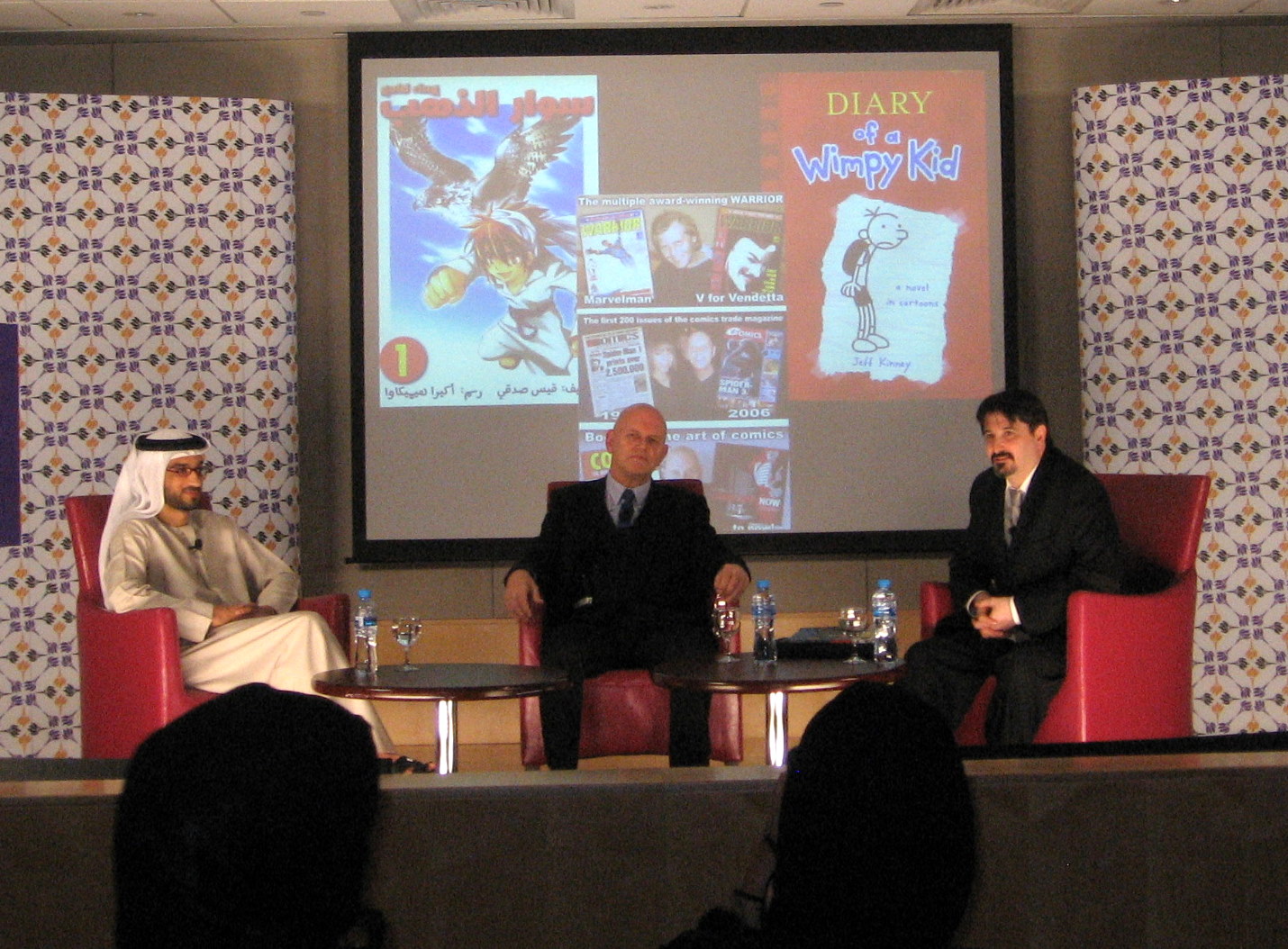
Left to right: Qais Sedki, Dez Skinn, and Charles Kochman, at the NYU Abu Dhabi Institute’s symposium, “Middle Eastern Comics and their Place in the 21st Century,” 25 January 2011.
This evening, I sat in a small auditorium with a crowd of artists and intellectuals. On the stage sat three men: Dez Skinn, the British comics editor who founded Warriormagazine and helped launch the careers of Dave Gibbons, David Lloyd, Alan Moore, and Grant Morrison. Charles Kochman, an American graphic novel editor who championed Diary of a Wimpy Kidinto print. And Qais Sedki, Emirati founder of Pageflip Publishing and author of the Arabic-language, manga-style comic Gold Ring, winner of the 2010 Sheikh Zayed Book Award for Children’s Literature. We were at a symposium on Middle Eastern comics. I had out my notebook, ready to scribble ideas if any occurred. Instead, I wrote pages and pages of notes, desperately scratching out quotes in shorthand and trying not to miss a word, making comparisons and side comments in the margins. The audience carried the symposium overtime with questions, including a fascinating back-and-forth about comics and libraries between the panelists and my own wife that had the panelists themselves leaning forward in their seats, nodding and asking questions of their own and celebrating librarians and comics and the engaging discourse of the whole evening. Afterward, we mingled in the lobby and chatted over fruit and cakes with a pair of Belgians, discussing the differences between American and European comics and sharing titles we should read.
Oh, how I love academia.
I’m participating in the River of Stones project in January. Look for a new post each day. Click the badge at left for more details.

 I’m participating in the River of Stones project in January. Look for a new post each day. Click the badge at left for more details.




 Samuel Snoek-Brown