Quantity vs. Quality: the purpose of NaNoWriMo

Me, typing fast to reach my 50,000 words for NaNoWriMo. (Yes, that's actually my novel open on the screen, though you can't read the text because the screen showed up too bright.)

Recently, I got an e-mail from my dad in which he asked a question about the NaNoWriMo word counts.

“Didn’t want to ‘disrespect’ your writing thing,” he wrote, “but do want to know….. what’s the point of how many words? In my way of thinking the objective is to get across the point or story and how many words that takes should be immaterial.”

My dad has a way of sometimes asking very sincere questions that force me to examine myself and what I do. This is one of those questions, and my dad is right. This is a fairly rare occurrence between any father and son, but honestly, I completely agree with him.

But it is precisely this concern with good storytelling and with quality writing that most often locks up my writing process. The myth of the writers block affects me, too.

This is why I love the month of November. It’s not at all the way I normally write, but it reminds me of the importance of writing first and revising later, the importance of producing what Anne Lamott calls the “shitty first draft.” In her chapter on the shitty first draft in Bird By Bird (which I’ve quoted elsewhere), she explains that “the first draft is the child’s draft, where you let it all pour out and then let it romp all over the place, knowing that no one is going to see it and that you can shape it later. You just let this childlike part of you channel whatever voices and visions come through and onto the page. [. . .] Just get it all down on paper, because there may be something great in those six crazy pages that you would never have gotten to by more rational, grown-up means.”

This sounds pretty simple, liberating even, but really, it’s a hard lesson to learn and an even harder lesson to put into practice. I second guess everything I write, every word that ever enters my head. Just this morning — and this is a true story — I spent 10 whole minutes mentally trying to rephrase a sentence, trying different punctuation and different word arrangements, working in my head to avoid misplaced modifiers and to most clearly and effectively convey my meaning. Ten whole minutes, and I never put anything on paper — it was all in my head. And the sentence wasn’t about my NaNoWriMo novel or about any of the short stories I’m not working on this month or the comments I was making on a friend’s short story draft or even an e-mail to a friend or a Facebook status update. It was a comment I thought about making regarding a news article I’d read online this morning. I never actually leave comments on news sites, and I realized halfway through my mental editing that the sentence I was trying to rearrange was never going to see the light of day, and still I kept trying to get the sentence right, just because it was there and I needed it to be great.

This is the kind of foolishness I engage in, and I know I’m not the only one. It is the worst kind of writers block, really, because it allows us the pretense of writing even while it prevents us from ever putting words on paper.

The purpose of NaNoWriMo is to push beyond that particularly nasty block, to write no matter what, to write so fast and so freely that we stop caring if it’s any good. Because, as Lamott says, “you can shape it later.”

On their site, the folks at NaNoWriMo express it like this:

Valuing enthusiasm and perseverance over painstaking craft, NaNoWriMo is a novel-writing program for everyone who has thought fleetingly about writing a novel but has been scared away by the time and effort involved.

Because of the limited writing window, the ONLY thing that matters in NaNoWriMo is output. It’s all about quantity, not quality. The kamikaze approach forces you to lower your expectations, take risks, and write on the fly.

Make no mistake: You will be writing a lot of crap. And that’s a good thing. By forcing yourself to write so intensely, you are giving yourself permission to make mistakes. To forgo the endless tweaking and editing and just create. To build without tearing down.

Participating in this project last year taught me the very real value of this kind of experience, and in fact it has changed my approach to fiction. I write much more deliberately now, no longer always waiting for the “right” words to come and freeing myself to possibilities in my fiction that I wouldn’t have explored otherwise. Not long ago, in fact, I was pushing my way through a short story I’d been working on for ages and could never find the “right” story for; I decided to take the NaNoWriMo approach and simply commit to writing the thing, no matter where it went or what wound up happening. As I wrote, I actually surprised myself — I was writing so fast and so freely that even I didn’t know what was going to happen next in the story.  More than once, I said out loud, “Where did that come from?” Not all those surprises stayed in the story, but a lot of them did, and it was a more exciting and unpredictable story because of that.

My dad says that “the objective is to get across the point or story,” and he’s absolutely right. He says that the quantity of words it takes to tell that story or make that point is irrelevant. In the sense that the length should serve the story and not the other way around, he’s absolutely right. But every story has to start somewhere. Every story has to start with a shitty first draft. And if you can’t come up with a good story, writing a lot of words until you discover a good story is a great way to begin. That’s what NaNoWriMo is about. We write 50,000 words because somewhere in there, we hope, a good story hides. And if not, at least we had fun doing it.

A Writer’s Notebook: NaNoWriMo update #1

Today, I am five days into NaNoWriMo.  My current official word count (not counting the writing I’ve already done today) is 13,666 words, with an average of 3,416.5 words per day.  This is a pretty frenetic pace, really, and I don’t expect to keep it up throughout the month (yesterday, for example, I actually wrote only 1,919 words), but I am trying to stay ahead of the 1,667 daily average necessary to finish the book during November because I’m going on vacation in 10 days and will be taking some time off from the writing.  Last year, I broke the 50,000-word barrier on November 15, which is the date we’re leaving for vacation this year, so if I can keep to that pace, I should be in good shape.

The strange thing is that while I have just as complex and impassioned a vision for this novel as I did for last year’s, I don’t have anything like the same detailed plan or outline for this novel.  Consequently, my writing so far has been all over the place.  I started out pounding through the first several pages, but I soon found myself skipping ahead to a much later scene, then back to fill in some gaps, and, just last night, I jump so far forward I wound up in a completely different chapter.  The energy is still high, but stitching this novel together at the end is going to prove a bit of a chore if I don’t start writing within more defined plans.

Fortunately, this is NaNoWriMo, and the only things that matter here are speed and energy.  Plans and sense are very distant seconds, so I remain free to write whatever, whenever, and I don’t have to worry about any of it making any sense until December, at the earliest.

So, behold the madness: a series of random excerpts from this week’s writing.

Julian walked in the penumbra of an eclipse, himself a light in a darkened world.  So he felt.  Everything, everyone, moved around him without ever touching him.  There was repulsion, the aura around him a warning to others so that no flesh ever touched his on purpose.  Julian walking through the city was a scene in a movie meant to represent something—isolation, loneliness—though for Julian it represented nothing.  It was only truth.  He isolated himself.  Better to walk alone than live the horrors of his thirst.

***

In the kitchen, the narrow cabinet on the end open, a glass of tomato juice in his hand.  A bottle on the counter: iron supplements.  The maximum milligram dosage.  He took two, downed them with the tomato juice.

Julian kept his pills in here for two reasons.  One, he’d always liked tomato juice, and milk, and other thick drinks, so much so that he even drank them with his vitamins and drugs.  And two, in the kitchen, he didn’t have a mirror.

The iron supplements.  He’d always been anemic, his parents said, and so he’d always had the supplements.  More as he grew older, even though his doctors always told him to ease up, that too much iron could kill him.  And that he wasn’t anemic at all.  Doctors—plural because his parents couldn’t see any other reason for his weakness and switched whenever they got the wrong answer from a doctor.  “Julian is just a feeble child, is all, not a trace of anemia that I can tell.”  Or, “Can I run some tests for drug abuse?”  One doctor had smiled, at Julian like he knew something, and then at Julian’s mother; he said, “He’ll either grow out of it” —then back to Julian— “or he’ll grow into it.  Nothing to worry about, though.”

But his parents always insisted it was something in the blood.  And they’d never been far from the truth.

***

They looked at each other.  The interviewer set aside his clipboard.

“Hypothetical.  Someone busts in here at three in the morning looking for drugs.  We keep all kinds of tranquilizers in back, for the dogs and the cats.  How would you handle that situation?”

“I’d call the police, sir.  And try to detain the break-in.”

“Try?”

“I’d detain him.”

“How?”

Julian’s world was going black from the edges, like some dark wall behind him was leaning over and around him, a gaping maw set on swallowing him whole.  When he spoke, he spoke through this other mouth, his own voice an echo in his head.

“I guess it would depend on the situation, on the person.”

The man leaned into Julian’s dark aperture, his mustache huge on his face and moving with the man’s lips as though alive itself, as though the man’s hushed and conspiratorial voice issued not from his throat or his fat mouth but from that thick, bristly strip of hair.

“What I’m asking is, could you hurt a man?”

“Yes sir.”

“If you had to, I mean.”

“Yes sir.”

“If you had to.…”  He rubbed his cheek but stared into Julian’s draped vision, his eyes bulbous….  “is there anything you wouldn’t be willing to do to protect this store?”

Julian closed his eyes.  From outside, he was sure it looked as though he were squeezing them, little wrinkled folds like a chromosome in a high school textbook.  He was squeezing them.  He was desperate to have them shut, whether to keep in his thirst or to close out the smell of this big man’s ruddy skin, his medicinal shampoo, the starch in his polo shirt, his breath, his blood.  Julian pinched his lids against it all.  But when he opened his eyes to answer, the man just sat waiting, and only an instant had passed, and Julian had only blinked.

He said, “Anything.”

“Really,” the man said.  His voice flat.  Disbelieving.  He sat back slightly, thought, then leaned in again.  “You could kill a man if you had to?”

Julian was sick.  He couldn’t think.  He gripped the arms of his chair.  He dreamed of the doorway, the sidewalks, the open night.  Somewhere out there, he was already rushing home.

“If I had to, I’d drink his fucking blood.”

***

That Sunday, his workweek suspended for a holy day, he walked down to the strips of nightclubs on Bowery, on Houston, on the various numbered streets.  He spoke to no one.  He drank as much as he could afford, but mostly he gorged on the energy drifting into the streets, swimming, terrified, lost, rapt.  Passion in the Greek sense:  to be affected by something, by all things; to feel, to sense.  To be well—or—to suffer horribly, to endure all the violent infections of every sick person who wandered these streets, this city, the earth.  Both—Julian was in the passion of both, a lover dying of orgasm and Christ blissfully flayed on a cross.

And it got worse.  The people around him no longer needed touch to infect him.  They were vectors all, their presence alone enough to thrill him as though with the thousand stingers on a savage swarm of bees.   He left the district dizzy, staggering, unbothered for change.  A market loomed, open late; he entered; he bought a package of ground chuck, five pounds of it, which he tucked covetously under one arm like a child and cradled it home.  There, he stabbed the yellow styrene with a fillet knife two, three times and held it over his open lips to suck the thin fatty blood through.  And when he’d dumped the meat in the freezer and washed the knife, he cut himself as well.

There is no writing exercise to any of this except to write.  Write fast and hard and don’t look back.  I’d call it freewriting, but actually, I’ve been employing a whole slew of exercises this week, from freewriting, to writing to music, to writing to pictures.  Check out my NaNoWriMo page here on the site for more about some of the things I’ve been up to this week.

My son is gay (via Nerdy Apple Bottom)

This is the first time I’ve ever “re-blogged” a post here in WordPress, but I had to share it. This is a wonderful story.

My son is gay Or he's not. I don't care. He is still my son. And he is 5. And I am his mother. And if you have a problem with anything mentioned above, I don't want to know you. I have gone back and forth on whether I wanted to post something more in-depth about my sweet boy and his choice of Halloween costume. Or more specifically, the reactions to it. I figure if I'm still irked by it a few days later, I may as well go ahead and post my thoughts. Here are th … Read More

via Nerdy Apple Bottom

Songs for NaNoWriMo

Cover of "The Bees Made Honey in the Lion...
Cover of The Bees Made Honey in the Lion's Skull

As I’ve written elsewhere, I often use music to write.  Sometimes it’s about setting the mood, sometimes it’s just about filling the silence, but sometimes, especially on long works like a novel, it’s also about structuring my thoughts.  For both my dissertation novel and the novel I’m writing now for NaNoWriMo, I use a full-blown and carefully organized playlist not only to set various moods as I write but also to give myself aural cues for the plot of the novel, a kind of outline in song.

Usually, such a playlist is an ever-expanding thing, with songs turning up or dropping off as I come across them or the order shuffling as I re-organize the outline of the book.  This playlist is no different–it is by no means a final draft.  But to give people some idea of what I’m listening to as I write, I’m going to post my current playlist here.

Later, as the structure of the novel takes a clearer shape, I might re-post a revision of this playlist, with the songs broken into their respective chapters.  These already are arranged in roughly the order of the events in the novel (at least, as I’m imagining them right now), but the exact breaking points for the chapters is still unclear to me.  Stay tuned for that later.  But for now, this is what I’m working with:

  • Muse.  “Exogenesis: Symphony Part 1 [Overture].”  The Resistance.
  • Tool.  “Forty-six and 2.”  Aenima.
  • Tool.  “Parabol/Parabola.”  Lateralus.
  • Opeth.  “Weakness.”  Damnation.
  • A Perfect Circle.  “Orestes.”  Mers de Noms.
  • Nine Inch Nails.  “Closer.”  the downward spiral.
  • Rob Zombie.  “The Ballad of Resurrection Joe and Rosa Whore.”  Hellbilly Deluxe: 13 Tales Of Cadaverous Cavorting Inside The Spookshow International.
  • Metallica.  “Cyanide.  Death Magnetic.
  • Muse.  “Hysteria”  Absolution.
  • Sarah McLachlin.  “As the End Draws Near (Extended Remix).”  Rarities, B-Sides & Other Stuff.
  • My Life with the Thrill Kill Cult.  “After the Flesh.”  The Crow soundtrack.
  • Sarah McLachlin.  “Possession (Rabbit in the Moon Remix).”  Rarities, B-Sides & Other Stuff.
  • Opeth.  “In My Time of Need.”  Damnation.
  • Chris Isaac.  “Kings of the Highway.”  Heart Shaped World.
  • The Doors.  “Riders on the Storm.”  The Best of…
  • Metallica.  “The Small Hours” (cover).  Garage Days Re-revisited.
  • Pink Floyd.  “Brain Damage.”  Dark Side of the Moon.
  • Muse.  “Exogenesis: Symphony Part 2 [Cross-pollination].”  The Resistance.
  • Danzig.  “Invocation.”  Danzig 4.
  • Angels of Light.  “Promise of Water.”  We Are Him.
  • Ministry.  “Scarecrow.”  Psalm 69: The Way to Succeed and the Way to Suck Eggs.
  • Om.  “Unitive Knowledge of the Godhead.”  Pilgrimage.
  • White Zombie.  “Blood, Milk and Sky.”  Astrocreep 2000: Songs of Love, Destruction and other Synthetic Delusions of the Electric Head.
  • Metallica.  “Harvester of Sorrow.”  …And Justice for All.
  • Danzig.  “Sadistikal.”  Danzig 4.
  • Earth.  “Left in the Desert.”  Hex (or Printing in the Infernal Method).
  • Tool.  “Reflection.”  Lateralus.
  • Metallica.  “Outlaw Torn.”  Load.
  • Opeth.  “Death Whispered a Lullaby.”  Damnation.
  • Tool.  “Sober.” Undertow.
  • Pink Floyd.  “Time.”  Dark Side of the Moon.
  • Earth.  “Omens and Portents I: The Driver.”  The Bees Made Honey in the Lion’s Skull.
  • Earth.  “The Dire and Evercircling Wolves.”  Hex (or Printing in the Infernal Method).
  • Om.  “Flight of the Eagle.”  Conference of the Birds.
  • White Zombie.  “El Phantasmo and the Chicken-Run Blast-O-Rama.”  Astrocreep 2000: Songs of Love, Destruction and other Synthetic Delusions of the Electric Head.
  • White Zombie.  “I Am Legend.”  La Sexorcisto: Devil Music Volume One.
  • Blue Oyster Cult.  “Astronomy.”  Secret Treaties.
  • Muse.  “Exogenesis: Symphony Part 3 [Redemption].”  The Resistance.
  • Opeth.  “Ending Credits.”  Damnation.
  • Earth.  “Ouroboros is Broken.”  Hibernaculum.

Photo blog 28

“Balloon face.”  Mask on red balloon in decorative reeds.  Abu Dhabi, UAE, 31 October 2010.

I’m a few days into NaNoWriMo by now, and I’m working on characters.  So far, my favorite is probably the seductive but cold (and ultimately evil) Portia Lynn, whose stone-white face and emotional distance this mask makes me think of.  In fact, I’ve now so associated this mask with Portia Lynn that, seeing it surrounded by the red balloon, I’ve decided to give my character red hair.  (I’m a sucker for redheads and they usually turn up as love interests and fantasies in my fiction, but this time my redhead is going to be dangerous and sickening and corrosive.  And still desirable.  Sort of like a wild, evil Tilda Swinton, the way she looked in the 1995 Paolo Roversi photo or the second of the Inez van Lamsweerde & Vinoodh Matadin photos in V Magazine.)

So, look for excerpts introducing Portia Lynn later this week, in the special NaNoWriMo Writer’s Notebook entry.


Actually, I took a slew of photos of this balloon, because it’s just so creepy, and I had a hard time deciding which image to post here.  In the end, I let my wife pick the image (and, to quote the knight in The Last Crusade, she choose wisely), but just for fun, I thought I’d include a second page to this post on which you can view the whole gallery, including the images I digitally manipulated.  To get there, click Page 2 below, or simply click here.


Some tips for new WriMos

nanowrimo - day 7 goal
Image by Paloetic via Flickr

I was browsing my Middle East Regional forum over at the NaNoWriMo website today and found a post thread that I imagine is showing up on everyone’s discussion forums: tips for first-time WriMos (a “WriMo” is someone participating in NaNoWriMo, though to be honest, I’m not a fan of the term).

The first question, unsurprisingly, was how to even make it to 50,000 by the end of the month. Most of the responses amounted to the easy (and good) advice to aim high: The daily average word count works out to 1,667 words, so if we all aim for 2,000 words a day, we’ll be well ahead of the game in no time.

But my regional moderator, “Brian C,” offered a few more detailed tips, and then I added my own thoughts on the end of it. What follows is Brian’s advice, and then my own:


Brian C’s advice:

  1. Don’t limit yourself to writing linearly. In other words you don’t have to write Chapter 1 first and Chapter 21 last. I usually make a list of scenes and then write whatever floats my boat on a particular day. If I feel dry on something I stop writing and look for a different scene that I feel more in tune with that day. Unless it’s clear in my head, I usually write my first chapter last. You can always rearrange everything into the correct order later (as long as you have named your files well). Of course tracking wordcount can be tricky this way, but I usually use a separate file for every day and every scene and or subscene that I write.
  2. If you miss a day or fall below your wordcount goal don’t get down on yourself and think, “Ahhh — how am I ever going to finish this now?” Just pick yourself up and start typing. A little bit of wordcount is better than no wordcount. (Closely related advice never, never, NEVER erase anything. Who cares if it is the most boring, stilted, stupid prose in the history of writing. Keep it and move on. Erase it December 1st!
  3. Related to #2. My first year I got sick and had some big issues at work and didn’t write for almost an entire week. I still came back and finished with over 54,000 words! Nothing is impossible!

And now, my comments:

As Brian C wrote elsewhere, the two things that helped me most last year were forcing myself to write constantly, regardless of quality, and coming up with a kind of outline or checklist — a model to go back to if I ever felt stuck.

These ideas seem antithetical — on the one hand, you’re writing freeform, wildly pounding out whatever pops into your head; yet on the other hand you’re planning and plotting and organizing and doing anything BUT write. But I found that the two opposites fed each other. If I woke up in the morning and couldn’t seem to pick up where I left off, I’d work on the outline for a while. You tinker with words and images and scenes long enough, sooner or later something’s going to grab your attention enough that you write a sentence, or a paragraph, or a whole scene, and once that happens you’re off and running. (Another great tip from Brian: Don’t feel trapped in linear writing. Feel free to skip ahead and write something at the end of the outline and fill in the rest later.)

Alternatively, if I wake up with the words already pouring, I can easily knock out several hundred words right out of bed, but then things might dwindle and I’m stuck with less than half my daily word count. Here, too, I return to the outline and tinker with the more basic elements of the story.

Another tip: Don’t be afraid of character sketches or scene descriptions. Not everything you write each day has to be a direct part of your novel. You might spend the first few days just writing out character descriptions and backgrounds, and because these will eventually make it into your novel in one way or another, I say they should count toward your daily word count. Likewise, you might spend some downtime trying out scenes, little bits of story that might not be related to what you started out writing but can come into the novel later. If they find their way into the story down the road, then those, too, will count toward the daily word count.

The beauty and joy of NaNoWriMo is that it allows us — or forces us — to write without rules, which means that as long as you’re writing and staying at least vaguely within the realm of your novel idea, you should be able to pound out 50,000 words by the end of the month.


Good luck to everyone participating this year! And if I come across any other good tips, I’ll post them here in the blog.

For more on my NaNoWriMo experience this year, visit my NaNoWriMo page here on my website, or check out my NaNoWriMo profile.

A Writer’s Notebook: Found poem (from Nizar Qabbani)

I’m in Dubai this weekend, visiting friends.  Yesterday, I spent part of my day on the Dubai campus of Zayed University, where, in a hallway leading to the campus library, I found a row of large, framed prints, each bearing–in Arabic and in English–lines of poetry.

The lines all come from existing poetry, but they are quoted from at least three different poems and appear out of order.  Arranged on the wall this way, they create a kind of Dadaist found poem, which I present here.  I’m typing it in two different orders because, though I read the English on the wall from left to right, the Emirati students here would read the Arabic from right to left.  So, on the left, I present it as I read it; and on the right, I present it in reverse, as an Arabic speaker would read it.

And then, below, I’ll explain how this works, for those of you looking for an exercise.

Imagine, even perfume knows Banishment and Exile. 

Every time you traveled

Don’t you know how to draw a bird?

Like a child

Asking about the return of its mother

Love has no notebooks

But this is a prison, father.

Swim and fly by yourself

And I tell him, son forgive me… I’ve forgotten the shapes of birds.

And I tell him, son forgive me… I’ve forgotten the shapes of birds. 

Swim and fly by yourself

But this is a prison, father.

Love has no notebooks

Like a child

Asking about the return of its mother

Don’t you know how to draw a bird?

Every time you traveled

Imagine, even perfume knows Banishment and Exile.

So far, I’ve identified two source poems for these lines, “I am not a teacher” and “A Lesson in Drawing,” both by Syrian poet Nizar Qabbani.  I suspect the rest of these lines also come from Qabbani poems, but I haven’t yet found translations to match the lines I saw on the wall.  If anyone recognizes the rest of these lines, please leave the titles of the poems in a comment (and link me to translations if there are any online)!  I’m new to Qabbani, but the poems I read while looking for these lines are astounding–I am definitely a new fan.

As for the found poem exercise, there are a few ways to go about this.  The purest way is to read an existing text as a poem, altering the way we interact with it.  My first (lame) attempt was when I read line breaks into the way the warning on a school bus was arranged:

school bus
STOP
children loading
and unloading

Such a deep message about the dangers of losing our kids to education, eh?  But you get the idea.

In Dada poetry, the poet takes a slightly more active role, “finding” words in existing texts and then cutting them apart and rearranging them to create new art.  It’s the source of our now-beloved distraction, Magnet Poetry.

Here at Zayed University, the framed prints on the wall combine these techniques, preserving whole lines but arranging them on the wall in a new art form.  I’m calling it a “found poem” because to an Arab reader familiar with Qabbani’s work, these are simply quotes, references meant to evoke the poems they come from, much like my friends sometimes use song lyrics as status updates in Facebook.  But to my eyes, unfamiliar with Qabbani’s work, they formed something new.

Photo blog 27

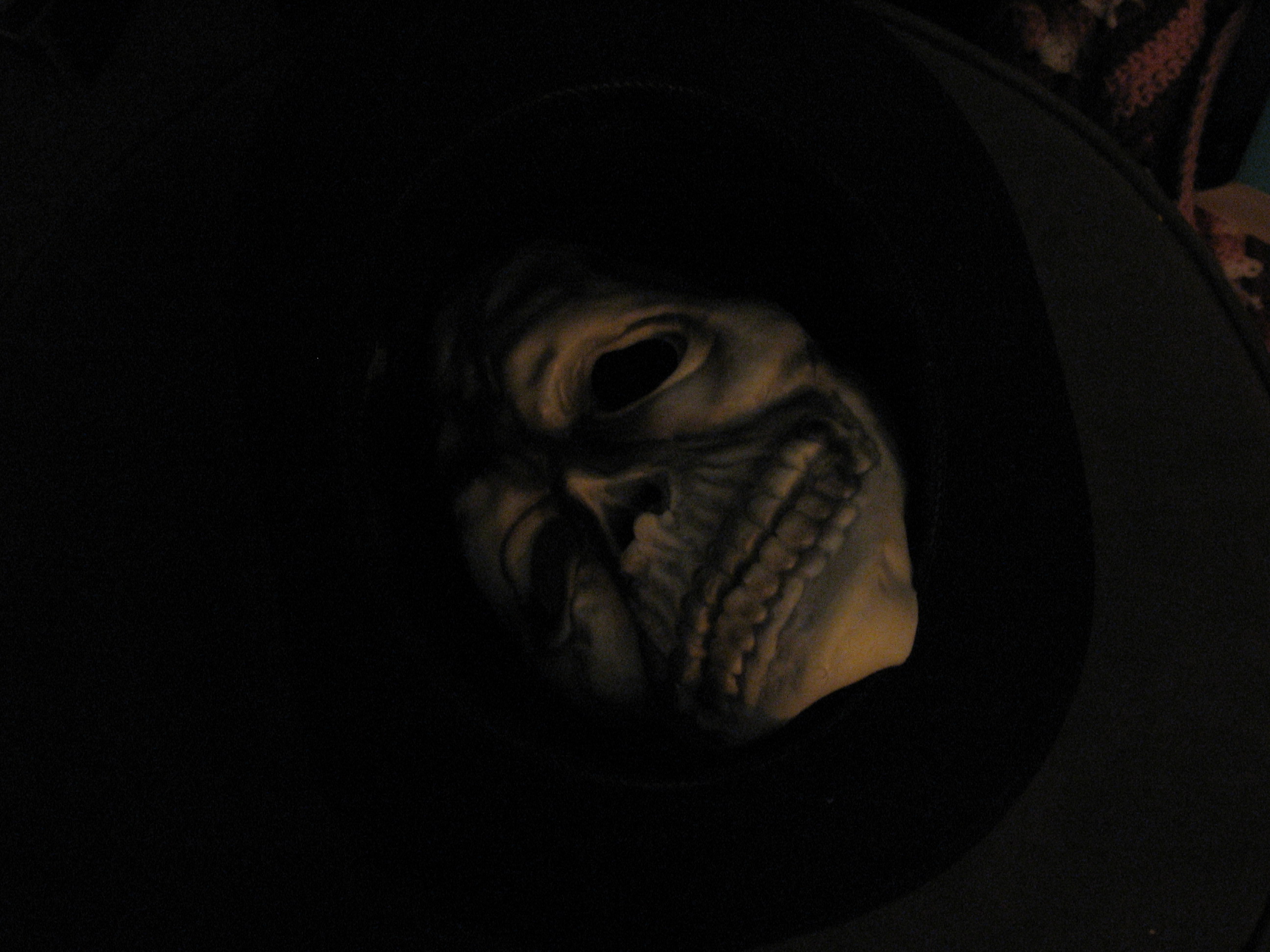
"My holiday is just caprice, a mad joke that I play on life." Skull inside a top hat. Platteville, WI, 31 October 2006.

*(The title of this photo comes from a line in the 1934 film Death Takes a Holiday.)

“Humanities in higher education is under attack.”

Pursuant to last Thursday’s post about Peter Thiel’s plan to destroy higher education, I offer this:  simultaneously the funniest and the most depressing commentary on academia I’ve seen in ages.

Xtranormal | Text-to-Movie

Vodpod videos no longer available.

This video might, in fact, look familiar, because it’s gone viral on Facebook and on several of the blogs I follow.  (Quick plug:  Though I’d seen it on the statuses of many of my grad-school friends and former professors, I decided to post this after reading the comments on my friend Lindsy’s blog, To Be an Electric Telegraph.)

To be perfectly honest, though, despite all the serious/tragicomic dialogue about higher ed, I think my favorite exchange was this one:

Professor: “Harold Bloom is a misogynistic narcissist.”

Student: “Harold Bloom informs much of my own scholarship.”

Professor: “You cannot seriously be this stupid.”


Hee hee!  (Sorry, Harold Bloom!)

A Writer’s Notebook: My nephew’s assignment

Yesterday, my sister sent me an e-mail which contained a story my nephew Aidan had written.  His story was about a string, and it reminded me of my own string story, which I began to write for my nephew.  And then–because Aidan’s story was a school writing assignment–I realized this would make an excellent Writer’s Notebook.  So I am telling that story here.

Below:  the assignment itself.

Once, when I lived in Denton, I found a string in the parking lot of the UNT campus. This is a true story. The string stretched from the art building clear across the parking lot to the street–and then it crossed the street. It had broken where traffic had run it over so often it wore thin, but there on the other side of the street was the string, and it continued on down the road. I went inside the art building and found some students and asked them about the string. They told me it was an art project, and that anyone who noticed the string was supposed to follow it. So I did.

The string carried on down Mulberry St., zigzagging across the street and twice dropping into the deep runoff culvert.  It was broken in a few places where the traffic had run over it, but it was definitely one continuous string.  The final break I found was in the culvert behind a funeral home on the corner of Mulberry and Carroll Blvd, and because I was wearing nice clothes, I couldn’t stoop and crawl through the pipe under the wide, busy street, but I knew the string was in there, so I decided to cross Carroll.  On the other side of the street, where a large government building provided some shade, I dropped back down into the drainage ditch and sure enough, there was the string.

I followed it along the ditch until it rose up the concrete wall and draped out across the parking lot.  In the middle of the parking lot, however, the string simply stopped.  I stood in the middle of the lot and looked around.  This couldn’t be the end!  The sun was high and hot in the early afternoon, and I wiped sweat from my brow as I squinted in the sunlight and looked for the string.  Finally, I found it, white string coiled around the trunk of a small tree at the edge of the parking lot.  From there, the string continued across a small grassy lot and into the drive-through of a bank.

As I made my way across town, I had to stop several times and turn circles with my hand shading my eyes as I looked for the string.  In the busy traffic of downtown Denton, the string was broken in many places, the ends blackened from the tires rolling over it in the streets.  Occasionally, I noticed that someone had come along and coiled the broken ends, sometimes around sign posts or fire hydrants, once around the wheel on a dumpster.  In the worst places, I had to hunt for the ends of the string across 30- and 40-foot gaps.

For most of its cross-town journey, the string trailed down Mulberry, ducking through parking lots and drainage ditches here and there.  Along the way I discovered side streets and shops I’d never known had existed.  I’d driven these roads many times, but from the window of my car, the buildings had drifted past unnoticed.  On this day, walking through the streets and looking carefully at everything around me so I wouldn’t lose the string, I saw the town in a way I’d never seen it before.

I passed at least two small art galleries, a coin collector’s shop, a furniture importer, a travel agent.  I saw graffiti on the walls and stickers advertising bands stuck to stop signs and dumpsters.  I saw trash on the sidewalks and picked some of it up as I walked, dropping it in the trash cans I passed.

Finally, just past downtown, the string turned diagonally across an empty lot and ended at an abandoned auto shop so old it was shaped like a barn.  And there, tied to the end of it, was a tin can with a bell inside.  I lifted the can from its nail-hook and held it to my ear, like the “telephones” I made as a kid from cans and a string.  The bell jingled.  I held the can by the string and shook it, ringing the tiny bell several times.  I looked around but no one was watching.  I was completely alone, but suddenly, I felt surrounded by everything and everyone–I felt connected to the world.

It was simple and silly, but I got the biggest kick out of that string.  I grinned the whole way back to my car, and even today, I think about the string and smile.  I’d been on a  small adventure, and I was proud of myself for finding the end of the string even over the broad gaps where it’d broken.  All I’d found was a can and a bell.  But I felt like I’d found the world.

Aidan’s homework was to write a story using words from his weekly spelling list.  My sister wrote me that “he was having a hard time getting motivated so I told him I’d email you the story when he finished.  That got him going!”  I’m not sure which of the words in his story were on his spelling list (Aidan is 9), but his story involved finding a string on the street, which is what reminded me of my own experience.  (If I get his permission to share his story, I’ll post it in a future post.)

For exercises using lists of words, check out the several versions Lori Ann Bloomfield posts on her blog First Line (by synchronicity or coincidence, today’s post is one such exercise).  Or check out the exercises in the excellent Writer’s Toolbox, which is ideal for writers of all ages (I used it several times when I was leading teen writing workshops a few years ago).